Local soy bean fields are (all?) harvested. Field corn harvest is underway. Autumn colors have emerged on just about all of the oak leaves in the neighborhood. Samhain / Halloween arrives in a week, although temperatures the past few days have been reaching the low to mid 70s, 15 to 20℉ above average for this time of year. I'm not used to breaking into a sweat while cleaning up leaf fall.
Not that I've paid close attention, but political ads seem way too abundant and more full of tricks than treats. Wouldn't it be nice to live somewhere, some time, in which politicians told us lots more about why they deserve our votes rather than why their opponent(s) don't? Are politics really supposed to be a zero sum game? Why not focus on how to attain what's best for the country and its people? How can we get more politicians trained in multi-solving instead of mudslinging?
The Better Half [BH] and I spent a some time Saturday afternoon at a Halloween party hosted at the stables where Daughter Person boards her horse and BH, Daughter, and Granddaughter go riding. There were noticeably more young ’uns than us oldsters, as it should be around Halloween and some other holidays. Everyone seemed to have a good time and the horses enjoyed the extra company, but 73℉ just didn’t feel right for a Minnesota Halloween party. Today we're back to cloudy skies and seasonable temperatures. We may not see another 70℉ until next Spring.
Much of next week will be devoted to managing fallen leaves and trying to get organized for Winter and whatever the election results may bring. Heather Cox Richardson's Letters from an American today reminds US that, about 100 years ago, we went through a similar con job of "let's run the country like a business." It's unfortunate to tragic that our social and cultural memories don't serve US better. Maybe this time when I put my hand on a hot stove it won't badly burn me? Don't forget to VOTE!
October is the month that seems All woven with midsummer dreams; She brings for us the golden days That fill the air with smoky haze, She brings for us the lisping breeze And wakes the gossips in the trees, Who whisper near the vacant nest Forsaken by its feathered guest. Now half the birds forget to sing, And half of them have taken wing, Before their pathway shall be lost Beneath the gossamer of frost. Zigzag across the yellow sky, They rustle here and flutter there, Until the boughs hang chill and bare, What joy for us—what happiness Shall cheer the day the night shall bless? ’Tis hallowe’en, the very last Shall keep for us remembrance fast, When every child shall duck the head To find the precious pippin red.
********************************************
Thanks for visiting. Come again when you can.
Please be kind
to each other while you can.
In our northern hemisphere, this coming Saturday, August 1, Lughnasadh is celebrated among the Celts and Irish Gaelic. Locally, row crop harvest will start in a couple of months and fruit and vegetable harvest has been underway for a couple of months. Somewhere close to or on August 7 we'll reach the midpoint between between Summer Solstice and Autumn Equinox. This sure seems like peak Summer and the weather concurs. Right now the temperature is in the mid 90's (℉) and the humidity makes it feel like 113℉. At least the wildfire smoke has eased away for now.
The limited cool down forecast for the next ten days may be enough for those Minnesotans who vote in person on August 11 to get over being hot under the collar. Early voters, not so much. Those who pay close attention to the state of the world, the country, the state, and/or the 99% are unlikely to cool down regardless of the weather. I'm reminded of the key theme from Dr. Seuss' The Lorax: "Unless someone like you cares a whole awful lot, Nothing is going to get better. It's not." I'm here to say it's well past time we all stop voting for Once-lers while we still have a habitable planet to protect! I wonder if we could send all of the 1% to colonize the "Red Planet." (Am I the only one who sees real irony in that?)
At some point we seem to have allowed those who are supposed to represent US to act as though the words accommodate, tolerate, cooperate, and compromise are each spelled with only four letters and aren't to be used in polite political company. winner take all is the antithesis of a democracy, just as is the short-sightedness of not thinking beyond this quarter's profits. How can we be sure to vote only for those who realize we, and our descendants, are all in this for the long term? Your thoughts?
Much of the local field corn has tasseled. Late yesterday we noticed a whitetail buck in velvet. This year's fawns seem to be everywhere. Wild turkey poults? Not so much. Heat, humidity, and fine particulates from northern wild fires in Minnesota and Canada have dominated the weather recently and look like they'll come and go for the rest of the season. Does anyone know of a place where it's October-like year round?
At least July is more than half gone and "normal" maximum temperatures would begin to decline late this coming week, on Friday the 24th. I'm not sure what that may portend in reality, since so little is normal these days. I am sure that we'll find a way to celebrate Lughnasadh in about two weeks, on August 1. If nothing else, it will start a countdown to the Autumn Equinox which will then bring US closer to National Election Day on November 3. Some of US are hoping there's meaningful symbolism with the Day of the Dead immediately preceding Election Day. No doubt the other side is wishing for the same thing, but in their favor. Can't we find a way to make politics win-win instead of zero sum?
The Guardian recently published an article about the increase in political violence worldwide. It attributes much of the cause to political rhetoric increasingly demonizing the opposition spouted by the same politicians who deplore actual violence against politicians. Does anyone else see a classic case of "Do as I say, not as I do"? Political types claiming to be Christian might want to recall the dictum "Let he who is without sin cast the first stone." Perhaps, since we're approaching the harvest season, recalling Galatians 6:7-9 would be better: ".... for whatsoever a man soweth, that shall he also reap."
It rained (again) this morning. Thunderstorms are in tomorrow afternoon’s forecast. Lots of hay fields around here have their first cutting of hay lying in rows to dry or sitting in round bales. All of the above makes me glad I’m not a farmer trying to make hay, cause the sun isn’t shining much these days.
Cornfields look happy, though it’s dicey if corn will be knee high by the Fourth of July. According to recent reports from the mosquito control district, this is becoming (has become?) a banner year for mosquitos. If the “hot sports” are several counties south of us, I don’t want to know how thick the flocks of the “state bird” are down there.
Since weather is, tragically😉, limiting today’s outdoor chore possibilities, I mixed up a batch of sourdough that’s now rising. Early tomorrow, before the day heats up, we’ll bake a loaf of artisan sourdough using a recipe we’ve neglected for a couple of years now. Slices of that’ll serve as breakfast for several days and help keep me away from too many cookies.
Early this morning we enjoyed some mild thunder and lightning as thundershowers rolled through. Later, we watched a wild tom turkey displaying for a sole hen in the backyard. She didn’t seem interested, but maybe she just thought the field was too open to engage in intimacies. In any case, after ten minutes or so, the hen wandered into the woods, followed by a somewhat distraught tom. I’m guessing that at this time of year, most of the hens are incubating eggs and the mating season is winding down.
Once the back yard performance ended, we headed off to the farm to pick up this week’s community supported agriculture [CSA] share. It includes:
ARUGULA
MESCLUN
SPRING "SPACE” SPINACH
SIMPSON OR PIRAT LETTUCE, and
CHIVES
One of the high points of my week is the drive to the CSA farm through the countryside of the St. Croix River valley, noting changes in the season’s displays. This year some farmer’s are either planting very late or leaving what looks like an unusual number of fields fallow. Other fields, that got corn planted early(?), are showing emergent corn plants already.
Now it’s time for me to go and refresh the planting trays and try again to successfully germinate some bergamot seeds. Cross your fingers for us, please.
Not the bottle Not the burn on the lips lit throat glow Not even wild really but a small-town bird whose burgundy throat shimmers like nothing ever A huge bird impressive who lurches and stalks me window to window in this desert retreat What does he want? Clearly he is lonely pecks his reflection and speaks to it in a low gubble (not gobble) gubbles so tenderly Soon as I think of him his eye hits on me We have watched each other for days His shifting colors fascinate me his territorial strut But it is his bald and blue-red head his old man habits and gait that move me If I even think of him I taste whiskey Drunk on solitude I’d talk to anybody I try his language on my lips His keen response burns like shame
********************************************
Thanks for visiting. Come again when you can.
Please be kind
to each other while you can.
Before we get into today’s themes, let me be among those greeting you with the salutation:
May the Fourth Be with You! Happy Star Wars Day!
Yesterday farmers were working fields that had standing water in the low spots and, sometimes, elsewhere. I suppose there’s only so many days in a growing season no matter how much it rains in springtime and that means fields need to be readied for planting. I wonder if having cover crops has any effect on working fields that otherwise might be too muddy to work.
Intermittent rain and sun have brought full leaf out to about three quarters of the trees in the area. Wild plum bushes / trees have developed ivory blooms to beautify rural roadsides almost everywhere we drive. Meanwhile, our efforts to germinate wild bergamot seeds has proven to be mostly a failure, compounded by one seeding tray getting blown off the deck railing yesterday. I think we’ll try replanting at least one of the trays. There’s plenty of seeds left in the bag but we’re not sure what went (or we did) wrong, although even in the house the temperature has been at or less than ideal for germination.
This morning we picked up week #2 of our Spring Greens community supported agriculture [CSA] shares. Week two’s box contains:
There are sayings that “There is no waste in nature” and “Nature wastes nothing.” You may have seen writings about a “circular economy.” Based on a recent article in MinnPost, and related materials, the sayings are true, the writings are coming true, and the Green New Deal is turning blue. Here’s a reprint of the MinnPost piece to save you the trouble of following a link. Combining pollution control with economic development is what nonpoint source pollution has been waiting for. I’m on my way to sign up for more information. Enjoy!!
How innovation in technology used to manage and treat water could spur economic development
by Ava Kian, MinnPost March 7, 2024
The University of Minnesota is partnering with a consortium of science and engineering researchers across the Great Lakes region to develop technological innovations around water management and resource conservation.
The consortium, Great Lakes ReNEW, will receive up to $160 million over the next decade from the U.S. National Science Foundation to focus on how it could create new technologies and use them to boost the economies of Illinois, Indiana, Michigan, Minnesota, Ohio and Wisconsin.
“The basic concept is to make research investments at a regional scale that involves university researchers, but also partners in the corporate sector and in the community, and invest in a way that creates innovation that would lead to economic development in the region,” said Jeffrey Peterson, director of the university’s Water Resources Center and one of the school’s co-leads on the project.
The university put together a proposal to join the consortium last year. It was linked with a proposal from another group, Current, a Chicago-based organization that focuses on water innovation across the Great Lakes region.
Developing technologies
The work of the consortium includes technologies to manage and treat water that seek to minimize negative impacts on the climate. They can sometimes have added benefits like recovering waste from water and turning it into something economically valuable.
“There's many things that are connected to (water management) that might not be so obvious,” Peterson said.
Those include sensors or advancements in data science and analytics that can monitor large data streams that come from those sensors, he said.
The ultimate goal of the project is to get the ideas out of a lab and into the field. The researchers will look at how to improve productivity for Minnesota’s farmers by recovering nitrates from water and re-using them to fertilize land.
The University of Minnesota is working on a project torecover nutrients from water. It also has a project that focuses on sensors that can detect nutrients like nitrates, phosphates and heavy metals in water, which Tianhong Cui, the co-lead of the University of Minnesota project and professor of mechanical engineering, will be working on.
Jeffrey Strock, a professor and soil scientist at the University of Minnesota’s Southwest Research & Outreach Center in Lamberton, is involved with this effort. He works on different innovations to help crop and livestock farmers have good productivity, profitability and environmental quality.
He’s excited about the project because there’s so much collaboration from people in different disciplines.
Recycling water and nutrients
Some of the solutions Strock is looking at involve storing water on landscapes in ditches or farm ponds. By doing that, water could be “recycled” and irrigated back onto the landscape, allowing the resources like nitrogen and phosphorus — which were either applied as fertilizer or were already in the water — to not go to waste.
“If you think about the last three years … we've had moderate to severe droughts in different parts of the state. Some places like Southern Minnesota, we don't have wells for irrigating like you do in sandier soils in central Minnesota,” Strock said. “But what we do have are these farm ponds and these drainage ditches where we can take drainage water that's been temporarily stored, pump it back out of those reservoirs back onto the landscape and irrigate some of the land that might be under drought conditions. It ends up bringing that water full circle.”
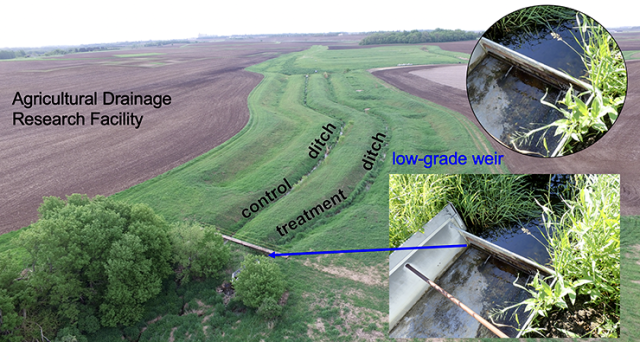
He said most agricultural areas don’t have bodies of water that can be used for storage, so some innovations have involved adjustments to drainage ditches to slow the flow of water, similar to how urban drainage systems manage stormwater runoff.
Some of the solutions Jeffrey Strock, a professor and soil scientist, is looking at involve storing water on landscapes in ditches or farm ponds.
“(That) can potentially help with, you know, downstream flooding. It can potentially help with things like reducing nutrients, like nitrogen and phosphorus, that might be in the water,” Strock said.
Cui is developing sensors that can monitor nitrogen, phosphorus and heavy metals in drainage water in real time. Strock said having that data from the sensors will allow certain water management processes to happen in preparation for weather events, creating more productivity for farmers and keeping the water quality up to standards.
“Say they know there’s a storm coming — those sensors will allow water in water bodies to drain and create storage capacity. Before that storm event we can drain more rapidly some of the water … that's currently there,” Strock said. “Then that storm event happens, conceptually what our idea here is, you can actually then slow that water back down and create some storage capacity in that system, to then hold back the new flush of water and nutrients that might be coming out of our (agricultural) lands.”
Strock is working with the Cottonwood Soil and Water Conservation District, which has an 11,0000-acre watershed. He applied for a grant through the state’s Environment and Natural Resources Trust Fund, which he thinks could complement the larger U.S. National Science Foundation grant and help to manage and clean the water in the drainage ditches that lead to Cottonwood Lake.
The technology developed through the NSF research, he said, could really help the Cottonwood district. “There's an absolute application of the technology that we're developing in a watershed like that,” he said.
A ‘decarbonized’ economy
The “Great Lakes Water Innovation Engine,” which the University of Minnesota is part of, is one of ten such engines that seek to improve innovation across the nation and foster regional economic competitiveness through a near $1.6 billion investment from the NSF.
A central focus of the grant is creating a “decarbonized circular blue economy,” which Peterson described as a system of water managementthat can also generate economic value for the region.
Cui, for example, is in communication with companies in the water management sector who would be interested in implementing these technologies. Those private companies are who municipalities would then work with in implementing the technologies in water treatment plants.
“You're taking resources out and reusing them for other things and creating value along the way. That circular blue economy that's being referenced, there's the circularity of resources associated with water and, hopefully, finding technologies that generate new kinds of economic value,” Peterson said.
This article first appeared on MinnPost and is republished here under a Creative Commons license.
********************************************
Thanks for visiting. Come again when you can.
Please be kind
to each other while you can.
As long as I'm at it, what about the idea of taxing Artificial Intelligence that does anything except making current software bug-free, interoperable and unhackable. I’m tired of the amount of time I have to spend dealing with workarounds and/or responses to some programmers screwup.
All of which means we need to stop electing Republicans, who have clearly demonstrated that, even when they win by cheating, they’re incapable of governing or even carrying their own weight.
In October of the year,
he counts potatoes dug from the brown field,
counting the seed, counting
the cellar's portion out,
and bags the rest on the cart's floor.

He packs wool sheared in April, honey
in combs, linen, leather
tanned from deerhide,
and vinegar in a barrel
hoped by hand at the forge's fire.

He walks by his ox's head, ten days
to Portsmouth Market, and sells potatoes,
and the bag that carried potatoes,
flaxseed, birch brooms, maple sugar, goose
feathers, yarn.

When the cart is empty he sells the cart.
When the cart is sold he sells the ox,
harness and yoke, and walks
home, his pockets heavy
with the year's coin for salt and taxes,

and at home by fire's light in November cold
stitches new harness
for next year's ox in the barn,
and carves the yoke, and saws planks
building the cart again.
********************************************
Thanks for visiting. Come again when you can.
Please be kind
to each other while you can.
In a few hours we’ll pick up our final community supported agriculture [CSA] share of the year. That fits with our progression into the dark half of the year. In just more than two weeks, it starts getting dark really early when Daylight Savings Time ends. But, for now, here’s what sunshine and rain and soil and seeds and farmers have produced:
BUTTERNUT SQUASH
BABY PIE PUMPKIN
APPLES
DAIKON RADISH
BROCCOLI
BRIGHT LIGHTS CHARD
LETTUCE
GREEN ONIONS, and
CILANTRO
It’ll be a fun drive over mostly rural roads enhanced by autumn’s peak leaf colors. Even the oaks, usually conservative in their autumn dress, are looking exuberant this year. [Note to self: remember to bring good camera.]
After some poking around on line, the Better Half [BH] and I have found, and concurred on, a source of new and different (to us) soup recipes to get us through another North Country winter. If you're interested. take a look here. The search was triggered by a mention on one of the social media platforms of a newly published UK book of Seasonal Soups. I couldn’t find anything really comparable for our North Country, so the on line search began.
Beth Dooley has several seasonal cook books based in Minnesota, but they’re focused on more than soups. It may, however, be worthwhile to take a look at some of her works in preparation for next year’s CSA seasons. Or, as usual, I could mind my own business and rely on BH’s creative solutions about what to do with the fresh vegetables I insist we buy and then complain about eating. She came up with a potato / cheese / cabbage combination the other day that I actually enjoyed eating. Perhaps the age of miracles hasn’t passed.
We are fortunate, so far, that for many of US winter is still a time for enjoying food and getting the proverbial “fat, dumb, and happy.” However, Congress has yet to pass a farm bill, nor has it authorized funding for the federal government for the current fiscal year. If folks keep electing too many Republicans, we may find ourselves wishing we were all farmers, with greenhouses, and rebuilding (re-digging?) root cellars. Let’s hope it doesn’t come to that.
Another sign of the changing of the seasons? Today we pick up our penultimate autumn share from the community supported agriculture farm. Here’s what we’ll be collecting:
BUTTERCUP SQUASH
FAMOSA CABBAGE
APPLES
CARROTS WITH GREENS
BROCCOLI
HOT PEPPERS, and
KALE
The chilly weather today, plus the hot peppers in the CSA box, reminds me we’re entering chili season. [Note to self: speak to Better Half about upcoming menus.] After next week, we’ll be back to relying on local grocers for any fresh vegetables during the winter. There was an interesting article in The Guardian the other day about the need to rely on “mass agriculture.” It both irritated me in its support for large scale agriculture and helped me realize that, once again, the real world answers to many issues isn’t “either / or,” it’s “both /and.” Unfortunately, much of the corporate, capitalistic, global economy persists in creating mega-markets that will only deal with mega-producers, thereby eliminating smaller, local food webs and making all of US vulnerable to price gouging because of oligarchically controlled markets, much like our problems with pharmaceutical giants.
There’s also a significant and growing issue associated with mega-farms and confined animal feeding operations (CAFOs): surface and groundwater pollution that’s imposed additional treatment costs on local water supply systems, both public and private. Instances can be found in Iowa, WIsconsin and Minnesota. I’m unsure of other locations, but The Limits to Growth, 30 Year Update, notes the problem is global in scale:
Resources can be renewable, like agricultural soils, or nonrenew- able, like the world’s oil resources. Both have their limits. The most obvious limit on food production is land. Millions of acres of cultivated land are being degraded by processes such as soil erosion and salinization, while the cultivated area remains roughly constant. Higher yields have compensated somewhat for this loss, but yields cannot be expected to increase indefinitely. Per capita grain production peaked in 1985 and has been trending down slowly ever since. Exponential growth has moved the world from land abundance to land scarcity. Within the last 35 years, the limits, especially of areas with the best soils, have been approached.
Another limit to food production is water. In many countries, both developing and developed, current water use is often not sustain- able. In an increasing number of the world’s watersheds, limits have already been reached. In the U.S. the Midwestern Ogalallah aquifer in Kansas is overdrawn by 12 cubic kilometers each year. Its depletion has so far caused 2.46 million acres of farmland to be taken out of cultivation. In an increasing number of the world’s watersheds, limits have already, indisputably, been exceeded. In some of the poorest and richest economies, per capita water withdrawals are going down because of environmental problems, rising costs, or scarcity.
At the rate we’re going, and have already gone, it probably won’t be long until “big ag” gets sued by as many offended folks with the resources to make it a lasting fight as is currently underway with “big oil.” By the time we’re through, subsistence agriculture may be the only option for the remaining population. That’s also a chilling thought.
When I was young, my father taught us how dirt made way for food, how to turn over soil so it would hold a seed, an infant bud, how the dark could nurse it until it broke its green arms out to touch the sun. In every backyard we’ve ever had, he made a little garden plot with room for heirloom tomatoes, corn, carrots, peppers: jalapeno, bell, and poblano— okra, eggplant, lemons, collards, broccoli, pole beans, watermelon, squash, trees filled with fruit and nuts, brussels sprouts, herbs: basil, mint, parsley, rosemary— onions, sweet potatoes, cucumber, cantaloupe, cabbage, oranges, swiss chard and peaches, sunflowers tall and straightbacked as soldiers, lantana, amaryllis, echinacea, pansies and roses and bushes bubbling with hydrangeas. Every plant with its purpose. Flowers to bring worms and wasps. How their work matters here.
This is the work we have always known, pulling food and flowers from a pile of earth. The difference, now: my father is not a slave, not a sharecropper. This land is his and so is this garden, so is this work. The difference is that he owns this labor. The work of his own hands for his own belly, for his own children’s bellies. We eat because he works.
This is the legacy of his grandmother, my great-granny. Ollie Mae Harris and her untouchable flower garden. Just like her hats, her flowerbeds sprouted something special, plants and colors the neighbors could only dream of. He was young when he learned that this beauty is built on work, the cows and the factories in their stomachs, the fertilizer they spewed out— the stink that brought such fragrance. What you call waste, I call power. What you call work I make beautiful again.
In his garden, even problems become energy, beauty— my father has ended many work days in the backyard, worries of the firehouse dropping like grain, my father wrist-deep in soil. I am convinced the earth speaks back to him as he feeds it—it is a conversational labor, gardening. The seeds tell him what they will be, the soil tells seeds how to grow, my father speaks sun and water into the earth, we hear him, each harvest, his heartbeat sweet, like fruit.
********************************************
Thanks for visiting. Come again when you can.
Please be kind
to each other while you can.
Early this morning, but after the dogs’ walk, we had thunder and lightning that, over an hour or two, delivered about a quarter inch of much needed rain. Many trees are showing early color with greens turning into yellows. Lower leaves on a maple sapling in the back yard are turning red, but there’s no red on the throats of the hummingbirds we’ve seen the past few days. Only gray throats around the feeders is a sign the male ruby-throated birds have headed south. Females and youngsters will follow in a few weeks.
Much of our engagement with our place is either entertainment like watching birds at the feeders or wildlife crossing the yard, or chores like mowing the grass or trapping pocket gophers so their mounds don’t wreck the mower. When we first moved here, we tried planting a vegetable garden. Horseflies, deer flies, sandy soil and similar detractions deterred us from continuing that “hobby.” Our dependence on ecosystem services is indirect, tenuous, or both. Yes we need fresh air to breathe and clean water to drink. We have little, if any, control over significant destruction of forests in the Amazon or the North Woods. We have actively helped oppose hard rock mining in Minnesota, but that’s as much on principle as based on a direct relationship with the resources that would be affected. We don’t eat much wild rice nor vacation “up North” all that often.
On the other hand, we support local and regional food systems as much as we can. That also contributes to the local economy and helps protect local water quality. But, all in all, our dependence on “nature” while as pervasive as it was for those who lived here prior to colonization is nowhere near as obvious. I’m rambling about this because I can’t figure out how we get substantially more people to understand and appreciate that we can’t afford to destroy our water supplies so that we can eat, harvest timber or mine metals. I’d happily rely on cast iron fry pans and griddles if we could get rid of PFAS. What I haven’t yet found is a rigorous and reliable way to organize my day to day life so that I can tread lightly. The building industry organized itself into the Green Building Council which brought about standardized criteria in the form of LEED ratings. Can someone work up a comparable set of LIFE ratings? Would enough folks bother to apply such criteria if they existed? Do we need an update to our Original Instructions? And how do we consumers get honest ESG ratings on the producers of our products? There’s lots of advice available, almost all too general or abstract to be applied by ordinary folks who have overly complicated lives to live.
Tchaikovsky’s Eugene Onegin is 3,592 measures. A voice kept far from feeling is heard as measured. What’s wanted in desperate times are desperate measures. Pushkin’s unfinished Onegin: 5,446 lines.
No visible tears measure the pilot’s grief as she Lidars the height of an island: five feet. Fifty, its highest leaf. She logs the years, the weathers, the tree has left.
A million fired-clay bones—animal, human— set down in a field as protest measure 400 yards long, 60 yards wide, weigh 112 tons. The length and weight and silence of the bereft.
Bees do not question the sweetness of what sways beneath them. One measure of distance is meters. Another is li. Ten thousand li can be translated: “far.” For the exiled, home can be translated “then,” translated “scar.”
One liter of Polish vodka holds twelve pounds of potatoes. What we care about most, we call beyond measure. What matters most, we say counts. Height now is treasure.
On this scale of one to ten, where is eleven? Ask all you wish, no twenty-fifth hour will be given. Measuring mounts—like some Western bar’s mounted elk head— our cataloged vanishing unfinished heaven.
********************************************
Thanks for visiting. Come again when you can.
Please be kind
to each other while you can.
Remember that phrase from the tv series Hawaii 5-0? I wonder if a Jack Lord recording will be played in Fulton County, GA as an ex-president re-elect wannabe surrenders to be arrested on conspiracy and racketeering charges. I haven’t yet decided whether I care enough to watch. I’m sick of hearing and reading about MAGAts, including the chief one.
Sans segue, our community supported agriculture [CSA] farm is behind schedule again this week so we don’t yet know what will be in our share box tomorrow. But, we haven’t yet let you know what was in last week’s box because that message arrived late. So, now we’ll fill you in on what was, and wasn’t, in last week’s share.
GARLIC
CARROT (missing)
YELLOW ONION
EGGPLANT
TOMATO, and
Add ons WATERMELON, Broccoli or carrots (ours was watermelon)
Tomorrow, as we’ve mentioned already, is the last CSA share of the summer. The Better Half made a delicious moussaka with the egg plant and bacon, lettuce and tomato sandwiches with the tomato(es). We’ll report on tomorrow’s surprise in a posting soon. It’s well understood that part of the package of participating in a CSA is that the members share risk with the farmer(s). That’s why you won’t see me ranting about being short-changed no matter what’s in the weekly box, or even if there is one. Farming is a tough business and we’re interested in helping to build a local food system so we’re not dependent on big boxes, industrial ag, and CAFOs (concentrated animal feeding operation). There’s a new farm bill being negotiated. You might want to track what Minnesota’s Land Stewardship Project has to say about it, especially if you enjoy eating regularly.
With some luck, tomorrow we will celebrate Lammas / Lughnasadh. The sourdough loaf I baked a week or so ago is almost gone. Tomorrow I’ll freshen the starter again and bake around midweek. I just read a paragraph that highlights for me how this feast fits these times.
The essence of Lughnasadh is the joy of life under the knowledge that darker times are moving in. We take in the warming rays of the Sun and store their power for the times coming. At the time we celebrate the next festival, Alban Elfed, it will be fall and the warm summer days will already be a memory.
If you’re concerned about our own darker times, you should consider taking a look at a book to be published next month, Democracy Awakening NOTES ON THE STATE OF AMERICA, By Heather Cox Richardson. I’ve been reading her Letters from an American for some time and find it heartening and reassuring. We’ve been through dark times before and, no doubt, will again. In large part it’s up to US how things get resolved.
In Democracy Awakening, Richardson crafts a compelling and original narrative, explaining how, over the decades, a small group of wealthy people have made war on American ideals. By weaponizing language and promoting false history they have led us into authoritarianism — creating a disaffected population and then promising to recreate an imagined past where those people could feel important again. She argues that taking our country back starts by remembering the elements of the nation’s true history that marginalized Americans have always upheld. Their dedication to the principles on which this nation was founded has enabled us to renew and expand our commitment to democracy in the past. Richardson sees this history as a roadmap for the nation’s future.
Another level headed source of hope that I think I’ve mentioned before is Tristan Roberts. Today he asks, and answers quite satisfactorily, the question: do you have hope for our kids? He concludes his answer this way:
I don't need to summon hope for the kids. They were born for this world. They've got everything they need.
That includes us, showing up every day, expressing ourselves.
Tomorrow is a first attempt at a Tweetless Tuesday. I’m going to do my best to avoid that platform tomorrow and may even see if I can forego my daily dose of doom and gloom by not reading the news media. If the world does end tomorrow, would one of you ber so kind as to mention it in the comments here? Thanks!
Today’s hope is a flickering candle that dwells in a snow-dusted window, circulating the prayers of Christmas mornings. Today’s hope is the crisp daffodil in colorless photos, containing the soul of a small child, who only wishes and knows of peace and love. Today’s hope is the sparkling eyes that truly believe in achieving anything to reach unity. Today’s hope is the palm to palm connection bracing each other for the climb neither expected, but couldn’t abandon. Today’s hope is peering beyond the lingering barrier, but still recognizing the diversity in ourselves. Today’s hope has been dimmed and tossed recklessly, but still generously stays with us, for we cannot help but come back like wide eyed children to candy. We are said to be weak to rely on such strength, but we are only believers. That spark That gives science a baffled case And oceans an infinite plane, is the eagle that dips and soars and fights, which stands for the hope of today.
********************************************
Thanks for visiting. Come again when you can.
Please be kind
to each other while you can.