Leaf buds are burst. Leaf out has begun. The creeping Charlie in front of the house has pretty little blue flowers. The lily of the valley patch along the driveway is about half a foot tall. Spring is sprunging everywhere. Today's temperature is in the upper 70's approaching 80. Next Sunday is Mother's Day. The humming bird / oriole feeder has been filled and hung.
I'm trying, and sometimes failing, to not let the craziness emanating out of the state and national capitols sour me on the world and many of its inhabitants. When I stop doom scrolling and look around I can find beauty and goodness. Let's see if I feel optimistic enough this week to go buy a fishing license. 🤞
I bet you know that Minnesota's constitution has provisions governing spending lottery funds on environmental projects but doesn't have a "Green Amendment" establishing our right to clean air, clean water and a healthy environment. That strikes me as being a cart before the horse kind of deal. There's an organization / movement, Green Amendments For the Generations, with the mission:
to ensure every person and community across the United States is able to experience the health, quality of life, education, joy and economic prosperity provided by a clean, safe and healthy environment; to end environmental racism; and to help ensure that nature itself is able to thrive, by constitutionally empowering all people to secure and enforce their inalienable human right to pure water, clean air, a stable climate, healthy ecosystems and environments.
Minnesota is not listed as one of the states active in the Green Amendment movement. I'm curious to see if I can get a handle on why and how we might be able to change that. Please feel free to share thoughts in the comments
The Green Amendments movement is similar to but not the same as the Rights of Nature movement. The former focuses on anthropocentric values and the latter on nature's intrinsic values. I think we should look toward a "both and" approach rather than an either / or situation, but it may well turn out to be a one step at a time movement. Now that Minnesota is the headwaters of America's Most Threatened River, the Mississippi, perhaps the powers that be may become more amenable to the proverbial "clean up our act" effort. Stay tuned.
Today's poem is one of my own that I was fortunate enough to find a home for in a book by a friend of ours, Krista Detor's Flat Earth Diary. Most of those who will benefit from Green Amendments aren't yet born or grown up.
A Way
Earth's children grow leave home go away where dragons roam
dragons fly aweigh to lands on maps filled with children grown away from home
Hubble captures dragons a way from home away from children aweigh in space
children young and old pass away as dragons fly where earth aweigh finds a way to roam home
J Harrington
********************************************
Thanks for visiting. Come again when you can.
Please be kind
to each other while you can.
Wotzka owns about 10 acres in Weaver in Wabasha County, a mile or so from the Mississippi River. He and his wife grow crops on about a half-acre and keep a fruit orchard on another 7 acres. After eliminating the use of commercial fertilizer, Wotzka said, their water nitrate levels fell from 6 or 7 milligrams per liter when they bought the property in 1997 to about 1 milligram per liter today.
He said Minnesota is too quick to blame nitrate issues on old wells built before federal pollution regulations were enacted. Instead, Wotzka said, the state must focus more on addressing water sources.
"If we start cleaning up the aquifers through changing the land-use practices, the first water that's going to be impacted is the shallowest water and that's where the old wells are," he said. "We don't have an old well problem; we have a contaminated aquifer problem."
And then there’s the issue of Congress’ repeated failure to unequivocally define “waters of the United States”:
On September 8, 2023, the Environmental Protection Agency (EPA) and U.S. Army Corps of Engineers (Army Corps) published a revised definition of “waters of the United States” or WOTUS. 88 FR 61964. To conform with the U.S. Supreme Court’s recent Sackett v. EPA, 143 S. Ct. 1322 (2023) ruling, the agencies made various changes including the removal of the “significant nexus” standard and amending the definition of “adjacent.” The new rule went into effect September 8, 2023. Because the revision was required to make the Rule comply with the Sackett decision, no notice and opportunity for public comment was necessary.
If we persist in relying on laws to govern increasing amounts of the behavior of real and legal persons, we need to increase the rate at which full legal coverage of all systems' components is rapidly attained or significantly slow socio-economic and technical change.
Or, we could start electing more competent, less obnoxious legislators and judges, but that would require a more competent, less obnoxious electorate, but that would require significant improvements in our education system and less book burning and home schooling and parents who want kids to grow up “just like them.”
Meanwhile, greenhouse gases keep increasing. Weather becomes more volatile. The 6th extinction continues. The 1% and their corporations keep most of us at each other’s throats while we blame each other and the “gummint” for our problems. Is this really the best we can do?
We got a bunch of water in celebration of today. Unfortunately, it came as flakes, not drops, and we were the recipients of more than twice the amount that fell in most of the area. Measured on our deck and the railing, there were 9 inches of fresh snow this morning. Last night’s forecast was for 1 to 3 inches. Almost everywhere around us topped out at 4 inches. Sunday’s forecast is for an additional 10 inches. Sigh! Spring in the North Country brings blizzards before wildflowers.
the Kinnickinnic River, a relatively clean trout stream
World Water Day this year is about Water for Peace, consistent with the UN’s Sustainable Development Goals, particularly Number 6. In Minnesota, and much of the rest of the country and the world, water quality is being deteriorated, largely through human activities, much like the climate is being disrupted through human greenhouse gas pollution. Do you see a larger pattern here? At the rate we’re going, we won’t be able to colonize Planet B or it’s successors in time to save what’s left of the human race. And if the pattern continues to be consume, dispose, destroy, we’ve no business infecting the rest of the solar system or galaxy. Time to make ecocide a capital offense for countries, corporations,, and their executives?
On a brighter note, at least for now, as the snow melts and rain falls and spring springs, water willl seep into the ground and flow overland to our rivers and streams. Some of us will grab a rod and head out to see what, if anything, we can catch. I’ve been pondering how many of us would be interested in protecting access to and the quality of local waters if we didn’t fish, canoe, kayak, swim, etc. It’s been more than 50 years since the Clean Water Act Amendments of 1972 were enacted, with the goals of:
"to make all U.S. waters fishable and swimmable by 1983;"
"to have zero water pollution discharge by 1985;"
"to prohibit discharge of toxic amounts of toxic pollutants".[120]: 1
We are failing miserably and seem headed backwards from attaining those goals. Unless we make more progress, faster, we’re unlikely to attain peace in our time with those who recognize “Water Is Life.”
There are sayings that “There is no waste in nature” and “Nature wastes nothing.” You may have seen writings about a “circular economy.” Based on a recent article in MinnPost, and related materials, the sayings are true, the writings are coming true, and the Green New Deal is turning blue. Here’s a reprint of the MinnPost piece to save you the trouble of following a link. Combining pollution control with economic development is what nonpoint source pollution has been waiting for. I’m on my way to sign up for more information. Enjoy!!
How innovation in technology used to manage and treat water could spur economic development
by Ava Kian, MinnPost March 7, 2024
The University of Minnesota is partnering with a consortium of science and engineering researchers across the Great Lakes region to develop technological innovations around water management and resource conservation.
The consortium, Great Lakes ReNEW, will receive up to $160 million over the next decade from the U.S. National Science Foundation to focus on how it could create new technologies and use them to boost the economies of Illinois, Indiana, Michigan, Minnesota, Ohio and Wisconsin.
“The basic concept is to make research investments at a regional scale that involves university researchers, but also partners in the corporate sector and in the community, and invest in a way that creates innovation that would lead to economic development in the region,” said Jeffrey Peterson, director of the university’s Water Resources Center and one of the school’s co-leads on the project.
The university put together a proposal to join the consortium last year. It was linked with a proposal from another group, Current, a Chicago-based organization that focuses on water innovation across the Great Lakes region.
Developing technologies
The work of the consortium includes technologies to manage and treat water that seek to minimize negative impacts on the climate. They can sometimes have added benefits like recovering waste from water and turning it into something economically valuable.
“There's many things that are connected to (water management) that might not be so obvious,” Peterson said.
Those include sensors or advancements in data science and analytics that can monitor large data streams that come from those sensors, he said.
The ultimate goal of the project is to get the ideas out of a lab and into the field. The researchers will look at how to improve productivity for Minnesota’s farmers by recovering nitrates from water and re-using them to fertilize land.
The University of Minnesota is working on a project torecover nutrients from water. It also has a project that focuses on sensors that can detect nutrients like nitrates, phosphates and heavy metals in water, which Tianhong Cui, the co-lead of the University of Minnesota project and professor of mechanical engineering, will be working on.
Jeffrey Strock, a professor and soil scientist at the University of Minnesota’s Southwest Research & Outreach Center in Lamberton, is involved with this effort. He works on different innovations to help crop and livestock farmers have good productivity, profitability and environmental quality.
He’s excited about the project because there’s so much collaboration from people in different disciplines.
Recycling water and nutrients
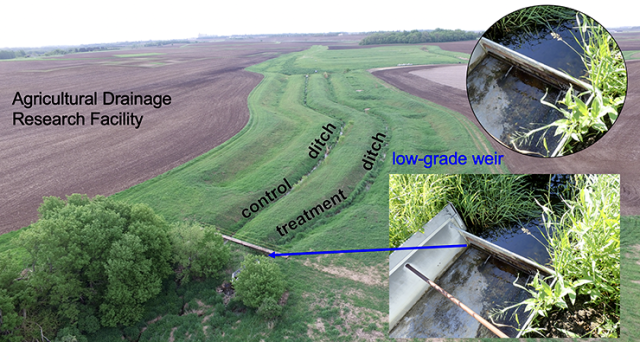
Some of the solutions Strock is looking at involve storing water on landscapes in ditches or farm ponds. By doing that, water could be “recycled” and irrigated back onto the landscape, allowing the resources like nitrogen and phosphorus — which were either applied as fertilizer or were already in the water — to not go to waste.
“If you think about the last three years … we've had moderate to severe droughts in different parts of the state. Some places like Southern Minnesota, we don't have wells for irrigating like you do in sandier soils in central Minnesota,” Strock said. “But what we do have are these farm ponds and these drainage ditches where we can take drainage water that's been temporarily stored, pump it back out of those reservoirs back onto the landscape and irrigate some of the land that might be under drought conditions. It ends up bringing that water full circle.”
He said most agricultural areas don’t have bodies of water that can be used for storage, so some innovations have involved adjustments to drainage ditches to slow the flow of water, similar to how urban drainage systems manage stormwater runoff.
Some of the solutions Jeffrey Strock, a professor and soil scientist, is looking at involve storing water on landscapes in ditches or farm ponds.
“(That) can potentially help with, you know, downstream flooding. It can potentially help with things like reducing nutrients, like nitrogen and phosphorus, that might be in the water,” Strock said.
Cui is developing sensors that can monitor nitrogen, phosphorus and heavy metals in drainage water in real time. Strock said having that data from the sensors will allow certain water management processes to happen in preparation for weather events, creating more productivity for farmers and keeping the water quality up to standards.
“Say they know there’s a storm coming — those sensors will allow water in water bodies to drain and create storage capacity. Before that storm event we can drain more rapidly some of the water … that's currently there,” Strock said. “Then that storm event happens, conceptually what our idea here is, you can actually then slow that water back down and create some storage capacity in that system, to then hold back the new flush of water and nutrients that might be coming out of our (agricultural) lands.”
Strock is working with the Cottonwood Soil and Water Conservation District, which has an 11,0000-acre watershed. He applied for a grant through the state’s Environment and Natural Resources Trust Fund, which he thinks could complement the larger U.S. National Science Foundation grant and help to manage and clean the water in the drainage ditches that lead to Cottonwood Lake.
The technology developed through the NSF research, he said, could really help the Cottonwood district. “There's an absolute application of the technology that we're developing in a watershed like that,” he said.
A ‘decarbonized’ economy
The “Great Lakes Water Innovation Engine,” which the University of Minnesota is part of, is one of ten such engines that seek to improve innovation across the nation and foster regional economic competitiveness through a near $1.6 billion investment from the NSF.
A central focus of the grant is creating a “decarbonized circular blue economy,” which Peterson described as a system of water managementthat can also generate economic value for the region.
Cui, for example, is in communication with companies in the water management sector who would be interested in implementing these technologies. Those private companies are who municipalities would then work with in implementing the technologies in water treatment plants.
“You're taking resources out and reusing them for other things and creating value along the way. That circular blue economy that's being referenced, there's the circularity of resources associated with water and, hopefully, finding technologies that generate new kinds of economic value,” Peterson said.
This article first appeared on MinnPost and is republished here under a Creative Commons license.
********************************************
Thanks for visiting. Come again when you can.
Please be kind
to each other while you can.
Early this morning, or very late last night, the clouds and the bare, clustered tree branches provided a faint, ghostly portrait of the moon approaching full. According to this year’s Minnesota WeatherGuide Calendar, come Saturday the 24th, the full moon we’ll experience is an Ojibwe Sucker Fish Moon. also known as the Popping Trees Moon by the Lakota.
On our way to deliver our "tax organizer, “ plus attachments, to our tax preparer, we glimpsed a pair of swans close to County Road 36 on the Sunrise River pools of Carlos Avery Wildlife Management Area. The fact that there were no other waterfowl to be seen makes me think the ones we saw are overwintering somewhere nearby but also heightened my anticipation of spring migration.
Also this morning, we received a notice from the good folks at Water Legacy that comments are being solicited on Minnesota Pollution Control Agency PFAS Rulemaking. An extract from the notice notes:
Why Comment on PFAS Rulemaking?
Last year, the Minnesota Legislature passed a statute (Minn. Stat. § 116.943) that would prohibit PFAS in many types of products unless their use in those products was “currently unavoidable.” This was an important positive step to keep PFAS out of surface water and groundwater.
Now the MPCA is developing rules that will determine how the PFAS statute will be interpreted. The details will determine if Minnesota waters and human health are protected.
PFAS “forever chemicals” have a wide range of serious health consequences including cancers, liver damage, increased cholesterol and obesity, reduced immune response to fight infection, dangerous high blood pressure in pregnancy, reduced infant birth weight, and developmental delays in children
The MPCA will receive many comments from industries seeking less transparency and more exclusions to allow continued use of PFAS. Your comments will push back on the pressure from special interests.
You might want to read the whole thing and consider commenting. Something I’ve not seen mentioned yet, but is in an article in The Guardian today, is that
Among the main sources of food contamination are tainted water, greaseproof food wrappers, some plastics, pesticides, or farms where PFAS-tainted sewage sludge is spread as fertilizer.
I haven’t yet had my fill of watermelon or ripe peaches. I have reached my limit on humidity, temperatures of more than 89℉, drought, and cloudy days. Sounds like we’re in a late August phase and matching mood. Tired of summer, not quite ready for autumn. The good news is we hadn’t retired to Maui or southern California or British Columbia. Meanwhile, the foot-dragging and minimal response to reducing greenhouse gas emissions continues. There are too many folks engage in magical thinking and that’s dangerous for the rest of us. There is an alternative to magical thinking.
Earlier today I was pondering which might be a better approach: advocating for the adoption of a green amendment to Minnesota’s constitution, along the lines being followed by members of the NCEL, or advocating for the legal establishment of nature’s rights and personhood. It didn’t take too long for me to realize that the question isn’t an either / or choice, it’s a both / and effort. States, including nation states, that wish to demonstrate environmental leadership need to incorporate into their Bill of Rights language that guarantees a healthy environment. They also need to establish legal personhood for their ecosystems. There are no markets on a dead planet. Our entire gross domestic product can’t be “health care.” We’re better off making our environment healthy than repairing all the damage an unhealthy environment does to our bodies, minds and souls.
At a local level, and a more immediate time frame, you might want to consider adding your voice in favor of the removal of both dams on the Kinnickinnic River in River Falls. The Kiap-Tu-Wish chapter of Trout Unlimited has on their web site a nice summary of the recent open house held by the Corps of Engineers and the city of River Falls. Take a look and share your thoughts. If you have questions, feel free to drop them in the comments and I’ll do my best to post an answer.
Remember, all of this is done--
For the Children
The rising hills, the slopes, of statistics lie before us. the steep climb of everything, going up, up, as we all go down.
In the next century or the one beyond that, they say, are valleys, pastures, we can meet there in peace if we make it.
To climb these coming crests one word to you, to you and your children:
We dodged several bullets yesterday, almost literally. There were thunderstorms all around us and we were caught, briefly, in a torrential downpour, but we avoided, through pure luck or something, the hail that shattered windshields and dented sheet metal elsewhere in the Twin Cities area. Strangely enough, we also had a brief dry spell while we picked up our CSA share box and again later while we were unloading bags and boxes of items for a yard sale. It looks as though I’m going to have to forego my “poor me” complaints for at least a week or two.
Upon arrival home, the mail contained a package of pamphlets from the Order of Bards, Ovates & Druids, including several on the role of water in Celtic and Druid spirituality. Those nicely complement the Kimberly Blaeser paper I’m currently reading, A Cosmology of Nibi. I’m more and more delighted by the correspondence I find between Celtic and Native American cultures. The likelihood that what passes for culture in colonial America will ever give earth and water and air the respect they deserve is not great, but I keep hoping to find ways to move the needle in the right direction. I think that’s something elders are supposed to do, isn’t it?
As long as we’re on the theme of moving needles, I want to share a recently distributed notice from the Twin Cities chapter of Trout Unlimited, of which I’m a long time member, that may be of interest.
Regular newsletter readers are aware that we have a once-in-a-lifetime opportunity to remove two dams on the Kinnickinnic River, an iconic trout stream that is the home water for much of our membership. This year, the US Army Corps of Engineers is conducting a feasibility study on the removal of the dams and restoration of the river corridor. This feasibility study is the first big step in developing a firm plan for the restoration of the river, and can bring up to $10 million in federal funding to the project. TCTU members have provided critical seed money to get this project going. The Corps will be hosting an open house on Tuesday August 15th from 6 pm to 8 pm at the River Falls Public Library. Corps officials will provide a detailed overview of the feasibility study, and welcome the public to join and provide comment. River Falls City Officials will also be present. The Corps' press release announcing the Open House is here. This is a great opportunity for us to show our support for the restoration, provide comments, and get our questions answered. I plan to attend, and I hope that you can join, too! A strong contingent of TU members at this meeting will demonstrate to the Corps and the City just how important this project is to us. If you would like to read more about the Kinni Restoration project, please check out this page on our website.
It is a very pleasant surprise to find the Corps actively engaged in river restoration as well as their normal efforts at river industrialization. We look forward to a positive outcome of the feasibility study and, ultimately, the removal of two dams in River Falls. We’ll check for press coverage late next week and will post here anything we find.
Nervous-system tracings of rivers before dams— to map watercourses is to diagram human hands running in fingers to deltas. Neosho, Kaw, Cimarron, Verdigris, Arkansas, Chickaskia. Flood flow in spring, summer languid. Call their names—conjure those whose language they carry. Memory exists in nerves, lives in rivers like silver-scaled great-horned serpent, basilisk who admonishes our failures. Metaphor reminds us that humans subsisted along rivers immemorial. Recall, then, those dead metaphors, breathe them back to life—river of time, river of memory, river of life, river of blood, river of song, river of death. River of contempt. Not the same river, not the same woman—Heraclitus’ axiom along cattail-encumbered bank. Honor rivers’ meanders, their currents our late-night reveries that roar, crawl along, rush downstream, and overflow, leaving mica scales behind. How rivers sometimes get lost. How we all get lost.
********************************************
Thanks for visiting. Come again when you can.
Please be kind
to each other while you can.
I’ve been playing in and around, and working on and for, rivers, streams and oceans for more than half a century. I keep finding that my knowledge of water quality, hydrology, land use and pollution abatement could always stand more breadth and depth. I probably would benefit from a better understanding of human psychology, too.
Somehow, I’ve not yet read any of Luna Leopold’s books, nor have I read any of the tomes on riparian zones. One of my earliest reads was The Ecology of Running Water plus several photo essays on rivers. Then there’s the classic A River Runs Through It and multitudes of volumes on trout, trout streams, aquatic invertebrates, hatch matching, fly casting, and the ever critical “reading the water.”
All the preceding is a lead in to a recent discovery of the only book like it I’ve come across: Field Guide to Wisconsin Streams: Plants, Fishes, Invertebrates, Amphibians, and Reptiles. The book originally sold for $30.00. Most copies I can find these days are being offered for anywhere from $1,000 to $3,000. (Most stocks wish they appreciated like that.) The original publisher notes they don’t know when it will be available again.
This leads me to (leaves me and you with) several questions:
What would it take for the University of Wisconsin to republish / reprint the volume at a reasonablle price? There seems to be a market.
Why aren’t comparable volumes available for the other states?
Should Trout Unlimited and its chapters be encouraged to create comparable volumes to accompany the Trout in the Classroom program and stream restoration projects such as DARE?
Until recently, I was unaware that May is American Wetlands Month. As a waterfowler, wetlands are one of my favorite places. Ducks, geese, swans, shorebirds, and others depend on wetlands. So do the rest of us who live on planet Earth. Someone whom I have been helping restore a nearby river shared an email a few days ago on videos of Wisconsin Tribes: Leading the way in protecting and restoring wetlands and watersheds. Today, as part of wetlands month, I want to pay forward that sharing. I hope you enjoy these videos as much as I have, even more, maybe. The summaries below the photo come from an Outreach Toolkit for the videos.
a neighborhood wetland->Sunrise River->St. Croix River
The Red Cliff Band of Lake Superior Chippewa, located on the southern shore of Lake Superior in the northernmost tip of Wisconsin, retains a strong cultural connection to the waters and lands of the region. Tribal members use a wealth of natural products from wetlands including fish (gigoonh), blueberries (miinan), cranberries (aniibinim, mashkiigimin), wild rice (manoomin), and many traditional medicines and plants used in ceremonies. Protection of tribal wetlands and the associated cultural resources and natural benefits like clean water and flood protection is critical for the health and welfare of tribal members. Learn how the Tribe recently increased its investment in these critical resources by establishing a wetland program to protect, monitor, and manage wetlands for future generations.
Keywords: wetlands, water, Bayfield, Superior, Red Cliff, tribes, watershed, Bayfield County, culture, tradition, Chippewa, Anishinaabe, flooding, water quality, protection
For the Bad River Band of Lake Superior Tribe of Chippewa Indians in Northern Wisconsin, water is life. Protecting water means protecting the watersheds that provide water for their Reservation and people from top to bottom, including uplands, floodplains, and globally important coastal wetlands along Lake Superior. It also means carefully monitoring their land and water resources and developing programs and policies to protect these resources for future generations. As a result of these efforts, the Tribe is protecting water quality, alleviating flooding, protecting habitat for fish and wildlife, and providing natural resources for their people’s sustenance and cultural practices.
Keywords: wetlands, protection, restoration, Bad River, tribes, manoomin, wild rice, flooding, water quality, habitat, Superior, Ashland, Chequamegon, Ashland County, Mashkiiziibii, Chippewa, Anishinaabe
The ancestors of today’s Bad River Band of Lake Superior Tribe of Chippewa Indians in Northern Wisconsin followed a prophecy telling their people to travel westward to seek a new home “where the food grows on water.” The vast beds of manoomin (wild rice) growing in what we now call the Kakagon-Bad River Sloughs on Lake Superior signaled to the travelers that they’d found this new home. Today, the Sloughs, which have received global recognition for their ecological and cultural importance, continue to provide the natural resources to meet the tribe’s physical and cultural needs.
Keywords: wetlands, protection, restoration, Bad River, tribes, manoomin, wild rice, migration, Superior, Ashland, Chequamegon, Ashland County, Mashkiiziibii, Chippewa, Anishinaabe
Our climate is changing. Along the shores of Lake Superior in Northern Wisconsin, one signal of these changes is the intense storm events that in recent years have dropped many inches of water in just a few hours. The Bad River Band of Lake Superior Tribe of Chippewa Indians is working with nature to help manage these changes. By protecting wetlands within the watersheds on their Reservation, Bad River is helping manage water from these big storms. Wetlands help slow the flow of water, disperse its energy, and allow the water to soak into the ground, which replenishes groundwater. These areas also provide habitat for wildlife and a more resilient tomorrow for future generations.
Keywords: wetlands, restoration, climate change, Bad River, tribes, watershed, flooding, erosion, water quality, Superior, Ashland, Chequamegon, Ashland County, Mashkiiziibii, Chippewa, Anishinaabe
It’s truly unfortunate that in Minnesota, one of our congressional representatives [“mine" he typed in disgust] is putting at risk the wetlands and watersheds of the Boundary Waters and other watersheds in northern Minnesota in his efforts to toady to the mining interests up north. I wonder if there’s a way to make him watch the videos and follow the examples of Minnesota’s Ojibwe.
Praise the rain; the seagull dive The curl of plant, the raven talk— Praise the hurt, the house slack The stand of trees, the dignity— Praise the dark, the moon cradle The sky fall, the bear sleep— Praise the mist, the warrior name The earth eclipse, the fired leap— Praise the backwards, upward sky The baby cry, the spirit food— Praise canoe, the fish rush The hole for frog, the upside-down— Praise the day, the cloud cup The mind flat, forget it all—
Praise crazy. Praise sad. Praise the path on which we're led. Praise the roads on earth and water. Praise the eater and the eaten. Praise beginnings; praise the end. Praise the song and praise the singer.
Praise the rain; it brings more rain. Praise the rain; it brings more rain.
********************************************
Thanks for visiting. Come again when you can.
Please be kind
to each other while you can.
An excerpt from an email sent by our Republican congressman this morning:
During the hearing we heard about the challenges we have in accessing our mineral resources and the harm done to our local economy by project delays. The simple truth is that the Iron Range thrives when we’re mining to our full potential, and we desperately need to get shovels in the ground.
However, if we’re going to unlock the full potential of our resources and secure our domestic mineral supply chains, we need the political will to implement permitting reform. This hearing provided a platform for my constituents to further inform my colleagues about the challenges we face to getting shovels in the ground and securing our mineral supply chains.
And now that my colleagues have seen up close the important role northern Minnesota can play in securing our nation’s mineral supply chains, I know they will help me advocate for the Iron Range in Washington.
Apparently the good congressman is not an avid student of either history or real progress. One long time resident of the Iron Range, Aaron Brown, recently wrote that
If Minnesota is to maintain the so-called “world’s best” environmental policies regarding mining, and also fair wages and collective bargaining for its workers, it has to embrace its most important assets: expertise and quality of life. Right now, some of the best minds in mining work in Minnesota. Our education and health care systems are some of the best in the nation. These factors, taken together, could make northern Minnesota a hub for development of green steel, iron-air batteries, and innovation in sulfide mitigation.
Decades before new options for green steel making or related innovations became possibilities, another Iron Ranger captured the very real problems of an economy based on extraction of natural resources. Eventually non-renewable resources will all be extracted. What then? In the meantime, life is like a roller coaster for families dependent on extraction. Shouldn’t we want better for our neighbors to the North? Shouldn’t they?
Come gather ’round friends And I’ll tell you a tale Of when the red iron pits ran plenty But the cardboard filled windows And old men on the benches Tell you now that the whole town is empty
In the north end of town My own children are grown But I was raised on the other In the wee hours of youth My mother took sick And I was brought up by my brother
The iron ore poured As the years passed the door The drag lines an’ the shovels they was a-humming ’Til one day my brother Failed to come home The same as my father before him
Well a long winter’s wait From the window I watched My friends they couldn’t have been kinder And my schooling was cut As I quit in the spring To marry John Thomas, a miner
Oh the years passed again And the givin’ was good With the lunch bucket filled every season What with three babies born The work was cut down To a half a day’s shift with no reason
Then the shaft was soon shut And more work was cut And the fire in the air, it felt frozen ’Til a man come to speak And he said in one week That number eleven was closin’
They complained in the East They are paying too high They say that your ore ain’t worth digging That it’s much cheaper down In the South American towns Where the miners work almost for nothing
So the mining gates locked And the red iron rotted And the room smelled heavy from drinking Where the sad, silent song Made the hour twice as long As I waited for the sun to go sinking
I lived by the window As he talked to himself This silence of tongues it was building Then one morning’s wake The bed it was bare And I’s left alone with three children
The summer is gone The ground’s turning cold The stores one by one they’re a-foldin’ My children will go As soon as they grow Well, there ain’t nothing here now to hold them
********************************************
Thanks for visiting. Come again when you can.
Please be kind
to each other while you can.
A lazy Sunday in March is good for reading, napping, munching, and watching the birds come and go at the feeders. Once again we are faced with a mostly cloudy week upcoming and the prospect of more than an additional half a foot of snow before next weekend. I hope someone soon reminds Mother Nature that we’ve reached the time of year when the snow pack is supposed to experience a next loss, not gain more than melts. I’m sure we’ve not lost seven inches of snow cover during the past week.
There’s no sign of open water, nor even the icky gray color that rotting ice shows, at the Sunrise river pools in Carlos Avery Wildlife Management Area. We’ll check more regularly from now on since we believe that, in general, waterfowl migrating north generally seek open water. That’s likely to be slow coming since the near term temperature is below normal and even normal isn’t all that warm around here.
Even though Minnesota offers fly fishing opportunities during the winter, the traditional stream fishing opener (inland trout) is more than a month away. In anticipation, I’m going to ask you to read a couple of recently published articles that we all need to think about and act on.
There’s also an article in today’s Star Tribune in which Minnesota Pollution Control Agency officials claim they can’t limit nitrate pollution to our rivers and streams. There’s legislation [HF2076/SF1937] pending in the Minnesota Legislature that would reinstate the Citizen Board that used to oversee the MPCA. If you’re concerned about clean air, clean water, healthy babies and having the “fishable/swimmable” water we were supposed to have back in 1983, you might want to demand your Minnesota legislators support that legislation. Alternatively, if there are no fishable waters, we anglers won’t be faced with the question of whether we, ourselves, are a conservation challenge. Problem solved.
Although I can see him still,
The freckled man who goes
To a grey place on a hill
In grey Connemara clothes
At dawn to cast his flies,
It's long since I began
To call up to the eyes
This wise and simple man.
All day I'd looked in the face
What I had hoped 'twould be
To write for my own race
And the reality;
The living men that I hate,
The dead man that I loved,
The craven man in his seat,
The insolent unreproved,
And no knave brought to book
Who has won a drunken cheer,
The witty man and his joke
Aimed at the commonest ear,
The clever man who cries
The catch-cries of the clown,
The beating down of the wise
And great Art beaten down.

Maybe a twelvemonth since
Suddenly I began,
In scorn of this audience,
Imagining a man,
And his sun-freckled face,
And grey Connemara cloth,
Climbing up to a place
Where stone is dark under froth,
And the down-turn of his wrist
When the flies drop in the stream;
A man who does not exist,
A man who is but a dream;
And cried, 'Before I am old
I shall have written him one
Poem maybe as cold
And passionate as the dawn.'
********************************************
Thanks for visiting. Come again when you can.
Please be kind
to each other while you can.
The year now ending included elections. Many politicians, or the political party to which they belong, like to ask US “Are you better off now than you were four, or two, years, or even one year, ago? What’s usually missing from that question are such considerations as:
Is your water supply polluted?
Is the air you breathe clean?
Is the rain that falls on you full of PFAS?
Does your government listen to you?
Are the officials you elect telling you the truth?
Are there more species endangered now than a year or two ago?
Has more money brought an improved quality of life?
Are you and your family more or less stressed than you were a year or two ago?
Do you have a future you can look forward to leaving for your children?
Many years ago, a politician I admired, Robert F. Kennedy, raised such issues in a 1968 speech. From what I can see, we’ve continued for more than fifty years to elect those who would prefer to ignore such questions. Maybe next year we can prepare oursellves to do better in 2024? That’s only a short portion of seven generations.
Even if we act to erase material poverty, there is another greater task, it is to confront the poverty of satisfaction - purpose and dignity - that afflicts us all.
Too much and for too long, we seemed to have surrendered personal excellence and community values in the mere accumulation of material things. Our Gross National Product, now, is over $800 billion dollars a year, but that Gross National Product - if we judge the United States of America by that - that Gross National Product counts air pollution and cigarette advertising, and ambulances to clear our highways of carnage.
It counts special locks for our doors and the jails for the people who break them. It counts the destruction of the redwood and the loss of our natural wonder in chaotic sprawl.
It counts napalm and counts nuclear warheads and armored cars for the police to fight the riots in our cities. It counts Whitman's rifle and Speck's knife, and the television programs which glorify violence in order to sell toys to our children.
Yet the gross national product does not allow for the health of our children, the quality of their education or the joy of their play. It does not include the beauty of our poetry or the strength of our marriages, the intelligence of our public debate or the integrity of our public officials.
It measures neither our wit nor our courage, neither our wisdom nor our learning, neither our compassion nor our devotion to our country, it measures everything in short, except that which makes life worthwhile.
And it can tell us everything about America except why we are proud that we are Americans.
If this is true here at home, so it is true elsewhere in world.