Showing posts with label bees. Show all posts

Wednesday, June 26, 2024

June showers bring summer flowers

I was distressed that the city’s ditch mower had knocked out every milkweed plant growing between our driveway and the field entrance on our property, until this morning when I noticed how many milkweed plants are growing in the field behind the house. Rarely have we seen many milkweed plants growing in those fields, but this year’s rains have been far more than normal. Will that bring pollinators back to our property? We’ll see. Once again our pear tree, which was covered with blooms earlier this spring, has no fruit that I can see. I believe it’s due to a lack of pollinators but it could also be that there’s nothing to cross pollinate with, or both. Anyhow, our fields are full of rarely seen wildflowers and that pleases me more than the rainy, cloudy days have annoyed me.

photo of back yard pear tree in bloom
back yard pear tree in bloom
Photo by J. Harrington

The blossoms on the elderberry bush are looking much more abundant than usual. If any pollinators arrive in time, we could have a bumper crop of elderberries. Again, we’ll see. As we move into a less rainy pattern, I have to keep reminding myself that living here and managing the property is a life style, not a series of chores to get done. I “decided” toward the end of winter that I was going to take a more relaxed, less middle-class suburbanite approach to yard work. We can add one more to the list of easier said than done. Can you say OCD-type symptoms?

The tray of bergamot seedlings continues to look happy. Some day soon the Better Half and I will sketch out where we want to plant them but that’s a challenge for another day especially since the guides I’ve seen suggest planting them 18 inches apart and we have almost three dozen “cubes" of seedlings in the tray. This is beginning to remind me of the story of The Man Who Planted Trees.


Come slowly – Eden! (205)


Come slowly – Eden!
Lips unused to Thee –
Bashful – sip thy Jessamines –
As the fainting Bee –

Reaching late his flower,
Round her chamber hums –
Counts his nectars –
Enters – and is lost in Balms.


********************************************
Thanks for visiting. Come again when you can.
Please be kind to each other while you can.

Friday, March 29, 2024

Good Friday thoughts.

Snow is melting. Cloudy skies have some thin spots and patches of blue even. It’s almost Easter weekend. There are enough good things happening that we shouldn’t be dismayed that too many humans turn April Fool’ into a daily event. This morning I saw an add for a helpful solution to much of the aggravation and agitation triggered by living in contemporary society. There’s a helpful new drug that wasn’t developed by big pharma. Take 500 mg of fukitol, followed by a nap.

photo of bumblebee on purple lupine
bumblebee on purple lupine
Photo by J. Harrington

The Better Half sent me a link this morning to a story in the Washington Post that cheered me in at least two ways:

  1. the subject matter offers hope for protecting pollinators, especially bees, (and so, much of our food) and;
  2. it was one of the better written news articles I’ve read in a long time.

I don’t know if this link will work, but you’re welcome to try it: https://wapo.st/4cMGQYa

By this time next week, I expect most, maybe all, of the snow to be gone and the dogs and I will again enjoy our walks down the driveway and along the road instead of treating them as a necessary chore. I bet we’ll even return to walking to the pond north of us to see if Canada geese or wood ducks have stopped to rest. I wont’t be wearing Yak-Trax or a down parka and the dogs won’t be wondering why I filled their ditch full of snow. Shortly after that, we can start watching for spring ephemerals while listening for more bird song. Spring will have arrived in more than name only.

Do you suppose local news would be more successful if they/it published and practiced more solutions journalism stories? I’m more than a little tired of reading the abundance of bad news that mentions not a bit of what to do about it. In fact, for a couple of local newspapers I check regularly for projectsI’m trying to follow, they frequently lack any in depth coverage that didn’t come from a news release. At the time we originally were heavily dependent on a free press, we barely had a functioning postal system. Now we’re back to a barely functioning postal system and have a multitude of information sources full of mis and disinformation. Whatever happened to fact checkers and copy editors?


Not Ideas About the Thing But the Thing Itself


At the earliest ending of winter, 
In March, a scrawny cry from outside 
Seemed like a sound in his mind. 

He knew that he heard it, 
A bird's cry at daylight or before,
In the early March wind.

The sun was rising at six, 
No longer a battered panache above snow . . . 
It would have been outside. 

It was not from the vast ventriloquism 
Of sleep's faded papier mâché . . .
The sun was coming from outside. 

That scrawny cry—it was 
A chorister whose c preceded the choir. 
It was part of the colossal sun, 

Surrounded by its choral rings, 
Still far away. It was like 
A new knowledge of reality.


********************************************
Thanks for visiting. Come again when you can.
Please be kind to each other while you can.

Tuesday, September 19, 2023

Two bee, two bee, doo

It is the season of drowning bees, when many wasps and hornets and bees gather at the sugar water feeders. Some get greedy and force their way through the feeding port guards into the reservoir of sugar water. They can’t fly nor swim so eventually, they drown from too much of a good thing. Most people only notice the critters that sneak into their cans of sugar water through the pop tops. Those often get shaken out.

I spent some time yesterday watching several kinds of wasps or hornets or bees trying to feed at the red hummingbird feeder on a front window. Hummers, with their long bills and tongues, get some sort of nourishment. I have no idea if the buzzers could reach any of the sugar water or not. The feeding ports in the red feeder are just large enough to accommodate a hummingbird’s bill and too narrow to allow even small bees entrance. What also fascinates me is the feeders are rarely visited by insects at other times of the year. This year, in fact, the ants never discovered the feeder hanging from the deck railing.

bee on Blue Giant Hyssop
Photo by J. Harrington

Bees are also availing themselves of what’s left of the season’s flowers. I much prefer seeing them in a more natural setting like the one above, rather than on or at a hummingbird feeder. (The bee is about dead center in the picture.) Both honeybees and wild bee populations are declining at unacceptable rates, even in a state like Minnesota, home to more than 500 species of bees.

Last year we left many of the fallen leaves in place to provide overwintering habitat for at least some pollinators. Then came spring with “No mow May.” The yard has taken on a much more natural look. That’s been compounded by the past summer’s drought. We have our fingers crossed that some reseeding the Better Half did the other day will help create a bee friendly lawn. She had some really encouraging reports on the thyme that’s replacing “bluegrass” and rye in the yard. I think that got planted / seeded last year.

[If you haven’t by now recognized today’s title, go listen to Frank Sinatra’s Strangers in the Night.]


Bees, so many bees.


After twenty years of marriage, we walked out
of the bush and on to a rough dirt road
we followed till we saw a pond
we might be able to get to.
The ground was boggy and buzzing.
The pond was thick with weed
and slime. It was not
the sort of pond anyone would
swim in, but we did — picking and sliding
into the water over the bog and bees,
bees we suddenly noticed were
everywhere, were settling on our hair
as we swam, ducks turning surprised eyes
our way. After twenty years of marriage
what is surprising isn’t really so much
the person you are with but to find
yourselves so out of place in this scene, cold
but not able to get out without
stepping over bees, so many bees.


********************************************
Thanks for visiting. Come again when you can.
Please be kind to each other while you can.

Thursday, October 6, 2022

Wait! What? Leaf me alone!

Today’s posting will be short, I’ve been busy with other things, and maybe not entirely sweet, I’m annoyed at members of the environmental community for making life more complicated than need be. It’s not the way to get folks to do what you’d like them to do. Okay, what am I fussing about this time?

mow, rake, leaf alone?
Photo by J. Harrington

Last autumn I started to follow the Xerces Society program for “Leave the Leaves: Winter Habitat Protection.” It ran contrary to some of what I’d been told much  of my  life but it made sense, including:
Leaving the leaves and other plant debris doesn’t have to mean sacrificing your yard to the wilderness. The leaves don’t need to be left exactly where they fall. You can rake them into garden beds, around tree bases, or into other designated areas. Too many leaves can kill grass, but in soil they can suppress weeds, retain moisture, and boost nutrition.  

We even deferred spring cleanup through No Mow May:

Mowing your lawn less creates habitat and can increase the abundance and diversity of wildlife including bees and other pollinators. One way to reduce mowing is by participating in No Mow May. No Mow May is a conservation initiative first popularized by Plantlife, an organization based in the United Kingdom, but which is gaining traction across North America. The goal of No Mow May is to allow grass to grow unmown for the month of May, creating habitat and forage for early season pollinators. This is particularly important in urban areas where floral resources are often limited. 

Then, this morning, we came across some watershed folks telling us pretty much the opposite of the preferred approach of those who would protect pollinators:

Leaves are a potent source of nutrients. If you mulch them into smaller bits with your lawnmower, it has roughly the same effect as adding a round of store-bought fertilizer. That’s a good thing — as long as it all stays in your yard.
If your lawn looks like it’s more than 50 percent covered in leaves, consider bagging or composting rather than mulching them. Otherwise, your mower might not be able to chop them up enough so that they fall between the grass blades.
Remember that when leaves in any condition are blown or washed into stormdrains, all those nutrients go directly into the nearest waterbody. It’s like dumping fertilizer in the river.

The good folks in the permaculkture field aren't much help either. Their lawn guidance doesn't say much of anything about leaf management.

Since we live somewhere lacking storm drains, we’ll continue with a protecting pollinators program, but it would probably be beneficial if a working group, green ribbon?, were convened to produce a coherent set of guidance so those of us trying to do right by Mother Nature don’t develop migraines trying to sort out exactly what that involves.


Leaves Fell

By Juhan Liiv

Translated from the Estonian by H.L. Hix & Jüri Talvet


A gust roused the waves,
leaves blew into the water,
the waves were ash-gray,
the sky tin-gray,
ash-gray the autumn.

It was good for my heart:
there my feelings were ash-gray,
the sky tin-gray,
ash-gray the autumn.

The breath of wind brought cooler air,
the waves of mourning brought separation:
autumn and autumn
befriend each other.


********************************************
Thanks for visiting. Come again when you can.
Please be kind to each other while you can.

Tuesday, September 27, 2022

Frost, freeze, frozen...

This is Minnesota, North Country. Although we’re a few days away from the end of September, I’ve seen a couple of reports of snow in the vicinity of the Boundary Waters. Tonight there’s a freeze warning that reaches into the Twin Cities metropolitan area (the Census version). A frost advisory looks like it extends to and beyond the state’s southern border. Last night we covered many of our vulnerable plants to protect them from frost. We’ll repeat the drill tonight and throw in some crossed fingers.

woolly bear September 26, 2022
Photo by J. Harrington

To speculate again, or more, about what kind of winter we can expect, yesterday I finally spotted a woolly bear caterpillar crossing the road. The brown bands predominate which portends a milder winter. But, the folks at NOAA have a high confidence that we’ll experience a La Nina autumn and early winter, which could mean a colder, snowier winter than whatever we consider “normal” these days. Perhaps the most reasonable approach is to take it a day at a time and look out the window to see what the weather is doing.

Yesterday when I looked out the window, I noticed we still have flowers in bloom. In fact, when I actually went outside and got closer, I noticed a bee on each of two blossoms on one of our plants. Again today as I walked by, I noticed there was a bee on each of two blossoms. Were they the same two bees? We'll probably never know. Two bees or not two bees, that is the question.

busy bees belaboring blossoms
Photo by J. Harrington

So, we now have enhanced volatility and uncertainty in the stock market, the climate, maybe the global economy and also in international and national politics. If we get a Halloween Blizzard this year, it may just remind us of the “good old days.”


When the Frost is on the Punkin

 - 1849-1916


When the frost is on the punkin and the fodder’s in the shock,
And you hear the kyouck and gobble of the struttin’ turkey-cock,
And the clackin’ of the guineys, and the cluckin’ of the hens,
And the rooster’s hallylooyer as he tiptoes on the fence;
O, it’s then’s the times a feller is a-feelin’ at his best,
With the risin’ sun to greet him from a night of peaceful rest,
As he leaves the house, bareheaded, and goes out to feed the stock,
When the frost is on the punkin and the fodder’s in the shock.

They’s something kindo’ harty-like about the atmusfere
When the heat of summer’s over and the coolin’ fall is here—
Of course we miss the flowers, and the blossums on the trees,
And the mumble of the hummin’-birds and buzzin’ of the bees;
But the air’s so appetizin’; and the landscape through the haze
Of a crisp and sunny morning of the airly autumn days
Is a pictur’ that no painter has the colorin’ to mock—
When the frost is on the punkin and the fodder’s in the shock.

The husky, rusty russel of the tossels of the corn,
And the raspin’ of the tangled leaves, as golden as the morn;
The stubble in the furries—kindo’ lonesome-like, but still
A-preachin’ sermuns to us of the barns they growed to fill;
The strawstack in the medder, and the reaper in the shed;
The hosses in theyr stalls below—the clover over-head!—
O, it sets my hart a-clickin’ like the tickin’ of a clock,
When the frost is on the punkin and the fodder’s in the shock!

Then your apples all is gethered, and the ones a feller keeps
Is poured around the celler-floor in red and yeller heaps;
And your cider-makin’ ’s over, and your wimmern-folks is through
With their mince and apple-butter, and theyr souse and saussage, too!...
I don’t know how to tell it—but ef sich a thing could be
As the Angels wantin’ boardin’, and they’d call around on me—
I’d want to ’commodate ’em—all the whole-indurin’ flock—
When the frost is on the punkin and the fodder’s in the shock!


********************************************
Thanks for visiting. Come again when you can.
Please be kind to each other while you can.

Saturday, August 20, 2022

Today, especially, I want to Beelieve

Pardon me for playing with part of a basic manifesto for the tv series The X-Files, but it seems to fit really well with today’s celebration of National Honeybee Day. Although honeybees play a significant role in agricultural production, they aren’t native to North America. I lean much more toward supporting most pollinators through the activities of the Xerces Society.

X Files: I want to believe

From the reading I’ve done, much of the honeybees’ decline can be attributed to agricultural pesticides. So some-to-many farmers seem to be cutting off their noses to spite their faces so to speak. If we focus on creating a world that’s healthier for native pollinators and let bee keepers and farmers sort out their priorities, we’ll probably all benefit.


Bee Whisperer


For weeks we’ve seen some wild winds.
Today, I find my hives knocked over.
A season’s honey smeared in rivers
on the ground. I stand their domes again.

The bees are swarming in the trees and fighting
against the gale. I watch one entire colony
trapped by a whirlwind, carried out and up
across the Green. I run to follow and see them
swept over the river and caught in a maple grove.

                  Can anyone call bees?

Alone before the water’s edge,
in desperate worry for my colony,
not knowing what to do, I hold
my arms high, as if to block the wind,
and cry like swarming bees. I speak
about our apple blooms, promise
them acres of blossoms and honey mounds.

                  Your domes are upright, your babies waiting.

Suddenly, in one black cloud, they return
across the water, above my raised
head and waving arms, over the Green.

When I return, almost
horizontal against the raging winds,
I climb to my orchard, and find
the hives filling back
with colonies of bees.

Notes:

This poem is from my historical verse narrative, An Art, a Craft, a Mystery (Livingston Press, 2022), the story of two women who immigrated to the colonies as indentured servants in the seventeenth century and lived along the Connecticut River. They were both healers and victims of the early witch-hunt delusion in colonial Connecticut. In this poem, Kate Harrison speaks about the harassment she suffered after her husband’s death, and her response to the harassment.


********************************************
Thanks for visiting. Come again when you can.
Please be kind to each other while you can.

Wednesday, May 18, 2022

Halfway through No Mow May

Yesterday we mentioned trilliums and lilacs. This morning we were pleasantly surprised to discover trilliums we hadn’t previously noticed growing along a road we frequently travel. A more obvious  hedge of lilacs has developed flower clusters and will be in full bloom soon. It makes us feel as if we’re coming to know an area when we’re familiar with a variety of locations where domestic and wildflowers grow. Now we’re reminded that it’s time to check on our local patch of prairie smoke. Maybe tomorrow.

Prairie Smoke (Geum triflorum)
Photo by J. Harrington

We’re more than halfway through May and so far we haven’t mounted the mower deck on the tractor nor have we fired up the mulching / bagging push mower. Looks like we may successfully celebrate all of No Mow May. On the other hand, we’re vacillating on brush piles versus burning the dead branches that keep falling from our oak trees. There’s only so much area I want to devote to brush piles and the branches decompose at a rate much slower than they fall from trees. We’ve yet to find an approach we’re comfortable with for managing dead branches in an ecologically sound fashion that isn’t more work than it seems to be worth. We’ve learned that throwing lots of branches onto a pile and then lighting the pile when weather conditions and our burn permit permit is less work than breaking up lots of branches so they fit in the burn pit and we don’t need a permit. We’ll keep working at this issue.

The Better Half claims she’s seen a handful or two of various kinds of bumblebees while she’s been gardening. I’ve not seen any except one on the violets earlier this month. It seems as though, this year, our bees have disappeared. We hope it's not permanent and will cross our fingers and keep our eyes open.


Pea Brush 

 - 1874-1963


I walked down alone Sunday after church
   To the place where John has been cutting trees
To see for myself about the birch
   He said I could have to bush my peas.

The sun in the new-cut narrow gap
   Was hot enough for the first of May,
And stifling hot with the odor of sap
   From stumps still bleeding their life away.

The frogs that were peeping a thousand shrill
   Wherever the ground was low and wet,
The minute they heard my step went still
   To watch me and see what I came to get.

Birch boughs enough piled everywhere!—
   All fresh and sound from the recent axe.
Time someone came with cart and pair
   And got them off the wild flower’s backs.

They might be good for garden things
   To curl a little finger round,
The same as you seize cat’s-cradle strings,
   And lift themselves up off the ground.

Small good to anything growing wild,
   They were crooking many a trillium
That had budded before the boughs were piled
   And since it was coming up had to come.


********************************************
Thanks for visiting. Come again when you can.
Please be kind to each other while you can.

Thursday, May 5, 2022

This week: Spring; next week: Summer!

Yesterday, around sunset, a tom turkey honored us with a mating display in the field behind the house. Only one hen has been seen from time to time in the neighborhood. It’s far from clear if the turkeys have found other locations more to their taste or if the entire population has been reduced. It’ll be interesting to see the hunting success rates after the spring we’ve (not) had.

tom turkey mating display
Photo by J. Harrington

I’m pleased to announce that the front yard is now mostly ready for seeding with a bee friendly mix. We’ll try to get that done before next  week’s rain. Now that the temperatures are reaching into the 60’s, we’ll begin cleaning up some of the winter’s leaf piles but not try to get the yard and drive all done over a day or two. As Lao Tzu tells us, “Nature does not hurry, yet everything is accomplished."

Last week our usual Thursday CSA share pickup wan’t ready until Friday, so this week we’ll just wait and go tomorrow morning. Then, in the afternoon, we’ll take the Better Half off to St. Croix Chocolates for a Mother’s Day treat. One of these days very soon we’ll get to picking up this year’s fishing licenses. Meanwhile, we’re learning to enjoy, as much as we can, whatever we’re working on. Today’s lesson is that I’d be less stiff and sore if I hadn’t abandoned daily exercises during our miserable spring.

Now that we appear to have moved into almost summer, 80’s and thunderstorms in next week’s forecast, spring reminds us of the old joke about the guy who beat his head on a brick wall because it felt so good when he stopped. Time to get back to some yard work.


Bees Were Better


In college, people were always breaking up.
We broke up in parking lots,
beside fountains.
Two people broke up
across a table from me
at the library.
I could not sit at that table again
though I did not know them.
I studied bees, who were able
to convey messages through dancing
and could find their ways
home to their hives
even if someone put up a blockade of sheets
and boards and wire.
Bees had radar in their wings and brains
that humans could barely understand.
I wrote a paper proclaiming
their brilliance and superiority
and revised it at a small café
featuring wooden hive-shaped honey-dippers
in silver honeypots
at every table.


********************************************
Thanks for visiting. Come again when you can.
Please be kind to each other while you can.

Monday, April 11, 2022

Happy National Day, pets!

If you have a pet, go hug him or her or both. If you don’t have a pet, see if you can borrow one.

Today is National Pet Day, so we start with a recent picture of SiSi [in front] and Harry. They think every day is their day so let’s not tell them about today’s special observation. The Better Half has an aquarium of goldfish. I’m not sure if they count as actual pets. Daughter Person et. al. brought home their new puppy yesterday, on Sibling’s Day, to play with their other dog. Timing couldn’t have been better.

SiSI [blond] and Harry [beagle]
Photo by J. Harrington

There’s still no signs of color and life returning to the nearby woods and wetlands. Spring this year appears to be running well behind schedule and now the NWS is scaring us with the possibilities of tornadoes sometime during the next several days. Since it’s likely the storm(s) will drop more dead branches from the trees, I’m glad I’ve not yet begun winter’s cleanup of that mess. Total amount of work is the same, but going back over the same territory several times is annoying, at least to me.

I’ve reached a point at which I can no longer take for granted events or actions I find consonant with how I would like the world to be. Recently Trout Unlimited has been getting a fair amount of acknowledgements  along those lines and I’ve just discovered they’ve done it again. The current issue of TROUT magazine has an article by Shauna Stephenson, Is your food killing your fishing? It focuses on the effects of pesticides, particularly neonicotinoids, on aquatic insects. It also acknowledges the work of the Xerces Society’s Sarah Hoyle, a pesticide program specialist at the Society. As a consequence of the article, I’ll probably make a donation to TU and take out a membership in the Xerces Society. One of my bigger frustrations these days is it’s difficult to find successful ways to break down our industrial agricultural system. So, instead of sitting back and doing no more than complaining, I keep looking for new ways that I haven’t yet tried to make a positive difference. It’s why I still vote Democratic, but that’s another source of frustration, as you may well surmise.

The other aspect I’m working more at is having fun, one way or another, instead of wallowing wading in constant gloom and doom. The Better Half and I are looking forward to seeing what, if anything, blooms this summer on our side hill. We scattered lots of seeds last autumn. We’re also going to plant a pollinator yard in fron of the house, if it ever stops snowing and a tornado doesn’t get us. A long, long time ago I wrote a poem that includes the idea that “’Tis better to light a candle than curse the darkness.” That’s still true.


He's Just My Dog

By Gene Hill


He is my other eyes that can see above the clouds;

my other ears that hear above the winds.

He is the part of me that can reach out into the sea.

He has told me a thousand times over that

I am his reason for being;

by the way he rests against my leg;

by the way he thumps his tail at my smallest smile;

by the way he shows his hurt when I leave

without taking him. (I think it makes him sick with worry

when he is not along to care for me)

When I am wrong, he is delighted to forgive.

When I am angry, he clowns to make me smile.

When I am happy, he is joy unbounded. When I am a fool,

he ignores it. When I succeed, he brags. Without him,

I am only another man. With him, I am all-powerful.

He is loyalty itself. He has taught me the meaning of devotion.

With him, I know a secret comfort and a private peace.

He has brought me understanding where before was ignorance.

His head on my knee can heal my human hurts.

His presence by my side is protection against my fears

of dark and unknown things.

He has promised to wait for me......whenever

......wherever -- in case I need him.

And I expect I will -- as I always have.

He is just my dog.


********************************************
Thanks for visiting. Come again when you can.
Please be kind to each other while you can.

Thursday, November 11, 2021

Leaf me alone!

On this Veterans’ Day, let US proudly remember all the soldiers’ sacrifices. Let US bow our heads to honor them and thank them for everything.

Before the storm, the back, side and front yards were in “fair to middlin’” shape having been cleared of leaves two or three times already. They are now covered again in leaves, wet leaves. What is even more astounding is the amount of leaves still attached to branches. Many of those leaves won’t come down until next spring, when the buds of new leaves swell and loosen the old year’s stems.

If we get some sunshine and drying, I’ll mulch the latest batch of fallen leaves. I’ve not the heart nor motivation to rake, and have run out of edges to which the leaves can be blown. The weather patterns are making it tough to plan what to do next for outside chores. We still have wildflower and clover seeds to be scattered on bare patches of dirt. It would be helpful, I think, to get the seeds spread just before snow cover comes and stays but it’s a real challenge guessing when that may be.

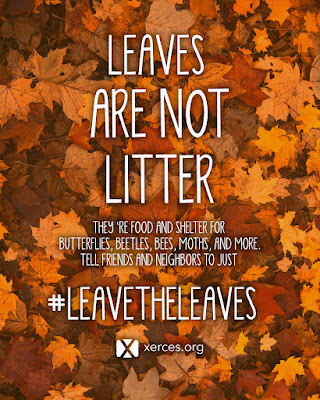
The Xerces Society, among other folks, have some guidance about leaf cover helping pollinators and others overwinter. Creeping charlie and violets have taken over much of what  used to be the front lawn. The north side is almost entirely shaded. The south is wooded and the west (backyard) is abandoned farm field and failed orchard full of pocket gopher mounds. Naturalizing seems like the wisest course and I’m grateful for the excuse of helping polllinators. With a little more study and resolve, I may finally learn to go with the flow instead of constantly trying to swim upstream. [Yes, I know I mixed my metaphors. Consider it misdirected poetic license.]


Leaves are not litter
#leavetheleaves


Leaves Fell


By Juhan Liiv


Translated from the Estonian by H.L. Hix & Jüri Talvet

A gust roused the waves,
leaves blew into the water,
the waves were ash-gray,
the sky tin-gray,
ash-gray the autumn.

It was good for my heart:
there my feelings were ash-gray,
the sky tin-gray,
ash-gray the autumn.

The breath of wind brought cooler air,
the waves of mourning brought separation:
autumn and autumn
befriend each other.


c ********************************************
Thanks for visiting. Come again when you can.
Please be kind to each other while you can.
Sunday, November 7, 2021

Harry the hound says “Hi!"

Yesterday I saw a couple of bees checking out the few blossoms left. This coming Friday, for the  first time locally this season, there’s snowflakes in the weather forecast. I’ve decided that, if the  leaves get mulched, the  grass will be in better shape come spring. If the leaves don’t get mulched, there’ll be that many more places for queen bumblebees and other critters to overwinter. I need to take a similar approach to many other  aspects of life. There’s one good or another. It’s not all win / lose. That kind of perspective could actually result in some sense of tranquility, a rare and fleeting sensation these days.

Meanwhile, I’ve at a loss trying to understand what triggers prompt queen bees to “hibernate” and what causes drone bees to die instead of overwinter. Presumably they starve but I’ve not yet found a satisfactory description of the whole sequence of events.

SiSi says after the stress of meeting a new friend, nap time
SiSi says, after the stress of meeting a new friend, nap time
Photo by J. Harrington

We’re pleased to announce the arrival of a new member of the household. Harry the beagle has joined us as the Better Half’s personal rescuer dog. [photos soon] Franco, her border collie rescue dog, walked over  the rainbow bridge some weeks ago and, after a grieving period, the empty spaces in the house and our hearts are ready to be filled again. Harry is taking his time and carefully considering the implications of the new arrangements in his life, including sharing space with SiSi, my lab crossbreed rescue, who’s about twice Harry’s size and weight. So far, so good as they say. 


Man Dog


I envied the dog lying in the yard
so I did it. But there was a pebble
under my flank so I got up and looked
for the pebble, brushed it away
and lay back down. My dog thus far
overlooked the pebble. I guess it's her thick
Lab fur. With my head downhill the blood gorged
me with ideas. Not good. Got up. Turned around. Now I
see hundreds of infinitesimal ants. I'm on an
ant home. I get up and move five feet.
The dog hasn't moved from her serene place.
Now I'm rather too near a thicket where
I saw a big black snake last week that might decide
to join me. I moved near the actual dog this time
but she got up and went under the porch. She doesn't like
it when I'm acting weird. I'm failing as a dog
when my own kind rejects me, but doing better
than when I envied birds, the creature the least
like us, therefore utterly enviable. To be sure
I cheeped a lot but didn't try to fly.
We humans can take off but are no good at landing.


********************************************
Thanks for visiting. Come again when you can.
Please be kind to each other while you can.

Tuesday, July 20, 2021

Planning now for autumn planting

Several days ago we noted the appearance of what we hoped were spotted horsemint blossoms. Today we're happy to report that our hopes have been fulfilled. There are a number of Monarda punctata flowers showing on the far slope behind the house. It may turn out that our drought is suppressing their numbers. Some wetter years have brought an abundance much greater than we're seeing so far this year.


spotted horsemint (Monarda punctata)
Photo by J. Harrington

We've now planted a clump or cluster of bee balm (Monarda fistulosa), which has us hauling a sprinkler can  of water up the slope every day. That may help save the apple tree on the top of the slope, since it somehow caught hell last winter. Now it's getting watered every time the bee balm gets some.


Bee balm (Monarda fistulosa)
Photo by J. Harrington


Admittedly, our track record at getting seeds or plants to grow where we've planted them is abysmal, in large part due to pocket gophers eating roots and creating mounds that make mowing hazardous to the cutting blades. On the other hand, letting nature take its course has made our front "lawn" much more pollinator friendly as creeping Charlie and violets and wild strawberries have invaded the grass and begun to replace it. The Better Half tells me there's also some smooth Solomon's seal in the woods behind the lawn as well as mixed with  the day lilies behind the garage.

If I can ever manage to let go of or otherwise overcome my middle class compulsion toward neatness and order and control, without yielding to the chuck and chance it approach we've been using in improving our landscapes, we might make more and or better progress. Current projects being contemplated and planned include shade tolerant ground cover on the North side of the house and pollinator wildflowers or "bee friendly lawn" where the gophers have reduced grasses to sand patches. Hot and humid weather is better for planning than planting so late summer or early autumn is when we expect to break ground, literally.


Letter to Someone Living Fifty Years from Now


Most likely, you think we hated the elephant,
the golden toad, the thylacine and all variations
of whale harpooned or hacked into extinction.

It must seem like we sought to leave you nothing
but benzene, mercury, the stomachs
of seagulls rippled with jet fuel and plastic. 

You probably doubt that we were capable of joy,
but I assure you we were.

We still had the night sky back then,
and like our ancestors, we admired
its illuminated doodles
of scorpion outlines and upside-down ladles.

Absolutely, there were some forests left!
Absolutely, we still had some lakes!

I’m saying, it wasn’t all lead paint and sulfur dioxide.
There were bees back then, and they pollinated
a euphoria of flowers so we might
contemplate the great mysteries and finally ask,
“Hey guys, what’s transcendence?”   

And then all the bees were dead.


********************************************
Thanks for visiting. Come again when you can.
Please be kind to each other while you can.

Tuesday, June 22, 2021

It's #PollinatorWeek

Do you remember the beginning of Rachel Carson's Silent Spring, the Fable for Tomorrow?

There was a strange stillness. The birds, for example where had they gone? Many people spoke of them, puzzled and disturbed. The feeding stations in the backyards were deserted. The few birds seen anywhere were moribund; they trembled violently and could not fly. It was a spring without voices. On the mornings that had once throbbed with the dawn chorus of robins, catbirds, doves, jays, wrens, and scores of other bird voices there was now no sound; only silence lay over the fields and woods and marsh.

a friendly, local pollinator
Photo by J. Harrington

As the old saying goes, "today is tomorrow's yesterday."  We've mostly banned DDT in the US, but there's a plethora of other pesticides, herbicides and insecticides that have been approved for widespread use since 1972. The number of pollinators has diminished precipitously. Now we are faced with a prospect of a colorless Spring, lacking blossoms and blooms because we lack pollinators. Faced with that prospect, and the potential loss of many food crops, a few years ago, National Pollinator Week was established.


National Pollinator Week logo

I'm not sure if it was the weather, or a lack of pollinators, or both, but the pear tree is looking quite barren of fruit despite an abundance of flowers this spring. The "abnormally dry" conditions, not quite a real drought, seems to have suppressed many of the prairie flowers we often see in our patch of the Anoka Sand Plain. Today we downloaded a copy of Selecting Plants for Pollinators, A Regional Guide for Farmers, Land Managers and Gardners in the Eastern Broadleaf Forest Continental Province. We'll see if that offers strategies for keeping pollinator-friendly plants alive for more than one season around here. It seems as if the deer don't eat the plant, pocket gophers eat the roots! Then again, I'd really like to establish a field of bergamot so we'll see what the guide suggests.


To the Field of Scotch Broom That Will Be Buried by the New Wing of the Mall


Half costume jewel, half parasite, you stood
swaying to the music of cash registers in the distance
while a helicopter chewed the linings
of the clouds above the clear-cuts.
And I forgave the pollen count
while cabbage moths teased up my hair
before your flowers fell apart when they
turned into seeds. How resigned you were
to your oblivion, unlistening to the cumuli
as they swept past. And soon those gusts
will mill you, when the backhoe comes
to dredge your roots, but that is not
what most impends, as the chopper descends
to the hospital roof so that somebody's heart
can be massaged back into its old habits.

Mine went a little haywire
at the crest of the road, on whose other side
you lay in blossom.
As if your purpose were to defibrillate me
with a thousand electrodes,
one volt each.


********************************************
Thanks for visiting. Come again when you can.
Please be kind to each other while you can.

Saturday, May 29, 2021

Have you tried No Mow May?

Memorial Day is the day after tomorrow. Tuesday is the official start of meteorological Summer. Mid-day on this Memorial weekend Saturday, the temperature has barely broken 60℉. Normal high for today is 73℉. We won't come anywhere near close. I'm feeling less guilty by the day about not getting out there and getting the branches picked up and the  grass cut. [Have you heard of No Mow May?] Maybe, after tomorrow's rain, we'll get closer to normal, comfortable, warm temperatures on Monday. That could make the day a good one for collecting branches and checking for dog droppings before we fire up the tractor and cut grass on the first day of [meteorological] summer.

No Mow May

One of the nice things about living in the country, with no homeowner's association, is there's no requirement to keep the place looking like a suburban yard. Now, if I can get my OCD under control and admit it's unrealistic to keep everything  perfect, all the  time, I may actually enjoy the weekend, next week, the balance of the summer and even the rest of the year. It was definitely more pleasant to watch a tom turkey displaying in the field behind the house, while a hen at the foot of the field's low hill completely ignored him, than doing yard chores would have been.


To make a prairie (1755)


 - 1830-1886


To make a prairie it takes a clover and one bee,
One clover, and a bee.
And revery.
The revery alone will do,
If bees are few.


********************************************
Thanks for visiting. Come again when you can.
Please be kind to each other while you can.

Thursday, May 20, 2021

It's #WorldBeeDay

Most of the blossoms on our pear tree are gone. More and more of the dandelions have turned to fluff and seeds. We're several weeks from day lily blooms but it's peak time for lilacs and some local fruit trees. Since honeybees aren't native to America, I have a hard time getting terribly concerned about them. Then again, I do enjoy cranberry honey in my morning coffee and have read that bee populations are in decline.

late May lilacs in bloom
Photo by J. Harrington

Minnesota, several years ago, began a wild bee survey which now lists more than 400 species. I'm sure you know that Minnesota has an official state bee, the rusty patched bumblebee, as of 2019. Minnesota's chapter of the Xerces Society has lots of information about how to improve life for our pollinators and other critters such as fireflies. We're already most of the way through May, so it won't be too difficult to defer mowing for another week and a half and claim a No Mow May to help create habitat for pollinators and other wildlife. (If only we had more gopher snakes to thin out the pocket gopher population.)

apple (?) blossoms awaiting pollinators
apple(?) blossoms awaiting pollinators
Photo by J. Harrington


Bees Were Better


In college, people were always breaking up.
We broke up in parking lots,
beside fountains.
Two people broke up
across a table from me
at the library.
I could not sit at that table again
though I did not know them.
I studied bees, who were able
to convey messages through dancing
and could find their ways
home to their hives
even if someone put up a blockade of sheets
and boards and wire.
Bees had radar in their wings and brains
that humans could barely understand.
I wrote a paper proclaiming
their brilliance and superiority
and revised it at a small café
featuring wooden hive-shaped honey-dippers
in silver honeypots
at every table.


********************************************
Thanks for visiting. Come again when you can.
Please be kind to each other while you can.

Wednesday, May 20, 2020

How sweet it is!

Today bees, pollinators, and many other insects are declining in abundance. This day provides an opportunity for all of us – whether we work for governments, organizations or civil society or are concerned citizens – to promote actions that will protect and enhance pollinators and their habitats, improve their abundance and diversity, and support the sustainable development of beekeeping. 

Bee engaged!

To bee, or not to bee: that is the question. Paraphrasing Hamlet, the slings and arrows of pesticides, insecticides, mites and land use changes have caused honeybee and other pollinator populations to suffer and encounter a thousand shocks. Minnesota is claimed to be home to at least 455 species of bees. That's many more than the 146 listed in the Minnesota Bee Atlas. Just last year, the rusty patched bumblebee beecame Minnesota's state bee. The University of Minnesota's Bee Lab has a growing abundance of information about our native bees. Bee sure to  check the Learn More page.

bee on yellow flower, not dandelion
Photo by J. Harrington

We saw a few bees, or what we think were bees, on the dandelions today. Still no sign of bees on the  pear tree flowers. There's lots of bushes in bloom, but, except for the dandelions, few flowers have bloomed to provide nectar or pollen. This  afternoon I'll take a look at the bee house we hung last Summer and see if any of the tubes appear to be occupied. Haven't yet seen any monarch butterflies either. None have been reported much North of Milwaukee.

Bees Were Better


In college, people were always breaking up.
We broke up in parking lots,
beside fountains.
Two people broke up
across a table from me
at the library.
I could not sit at that table again
though I did not know them.
I studied bees, who were able
to convey messages through dancing
and could find their ways
home to their hives
even if someone put up a blockade of sheets
and boards and wire.
Bees had radar in their wings and brains
that humans could barely understand.
I wrote a paper proclaiming
their brilliance and superiority
and revised it at a small café
featuring wooden hive-shaped honey-dippers
in silver honeypots
at every table.


********************************************
Thanks for visiting. Come again when you can.
Please be kind to each other while you can.

Monday, May 18, 2020

A pear to draw too?

After spending some time dragging a harrow around to start to knock down some pocket gopher mounds, I sat for several minutes watching our bartlett pear tree. There were no signs of bees visiting the flowers. Since we only have one pear tree, and there are lots of dandelions currently in bloom, our expectations for fruit production are significantly tempered. But, we haven't seen any bees visiting the dandelions either. If we hadn't become curious about a lack of bees, we probably would never have read the paragraph below from Garden Guides:


our bartlett pear tree in bloom
Photo by J. Harrington
The location of the pear tree in relation to other sources of nectar can play a dramatic role in whether or not the tree gets pollinated. The 15-percent sugar content of the nectar must compete with the 40-percent content of competing plants, including apples and dandelions. If there are not enough bees in the area, the bees will choose the higher-sugar-content plants before pollinating the pear trees. Pears will have a higher pollination success rate if it does not have to compete with these plants for the bees’ attention. For small orchards, consider adding one or two beehives for every acre of pear trees.
There's a very small apple tree near the pear, but  it hasn't produced any blossoms this year. We're pleased the pocket gophers haven't managed to kill it yet by eating the roots. Maybe we should take another chance and plant a combination pear tree and put wire mesh around the root ball.

Driving the tractor over grass instead of snow was a very pleasant change, even without much sunshine. If, tomorrow, the drive on mower deck cooperates, we'll get the back yard grass cut to start this year's season. There's still sticks to pick up and leaves to collect on the North side and the  front yard. We're slowly, very  slowly, beginning to learn the advantages of pacing ourselves. Maybe we are actually learning something by reading the Tao Te  Ching. For example:

“Nature does not hurry, yet everything is accomplished.”

― Lao Tzu

It will be interesting to watch and see what, if anything, grows this Summer. We've had decent crops op pears in previous years, but I'm not sure why or how we ended up with a

Green Pear Tree in September


By Freya Manfred


On a hill overlooking the Rock River
my father’s pear tree shimmers,
in perfect peace,
covered with hundreds of ripe pears
with pert tops, plump bottoms,
and long curved leaves.
Until the green-haloed tree
rose up and sang hello,
I had forgotten. . .
He planted it twelve years ago,
when he was seventy-three,
so that in September
he could stroll down
with the sound of the crickets
rising and falling around him,
and stand, naked to the waist,
slightly bent, sucking juice
from a ripe pear.


********************************************
Thanks for visiting. Come again when you can.
Please be kind to each other while you can.

Saturday, August 10, 2019

Time for sowing lavender bee balm

About this time in August, several years ago we took the photo below at the entrance to Wild River State Park. The lavender blooms are, we believe, wild bergamot [bee balm], a native wildflower that should be right at home in our little patch near the Eastern edge of the Anoka Sand Plain. It's attractive to pollinators so, with luck, the seed balls, a present from the Better Half, we placed this morning will germinate and add some late Summer color to the fields behind the house. (If you're wondering, we have no idea what created the streak of yellow flowers in the picture.)

We'll place additional seed balls after we've semi-leveled the pocket gopher mounds that have popped up during the past several weeks. Since the package the balls came in notes that it takes two years (or more?) for the plants to bloom, we'll have to try {Yoda: Do or do not! There is no try.} to take better care of ourselves if we hope to see the results of our labors.

Monarda at entrance to Wild River State Park
Photo by J. Harrington

We're discovering that figuring out what should get planted where, and how, is more of a challenge than extracting invasive plants such as buckthorn or noxious plants like sandburs. None of the wild flowers we've planted previously on the sand slope behind the house has lasted, bluestem grasses  excepted. (Feral oregano, that's taking over the yard, comes close to qualifying as an invasive species.) Perhaps we'll have better results with Monarda. It was happily growing near an old barn on a farm in nearby Amador one of the last times we visited.

Monarda growing near old barn in Amador
Photo by J. Harrington


I Don't Know What Will Kill Us First: The Race War or What We've Done to the Earth


so I count my hopes: the bumblebees
are making a comeback, one snug tight
in a purple flower I passed to get to you;

your favorite color is purple but Prince’s
was orange & we both find this hard to believe;
today the park is green, we take grass for granted

the leaves chuckle around us; behind
your head a butterfly rests on a tree; it’s been
there our whole conversation; by my old apartment

was a butterfly sanctuary where I would read
& two little girls would sit next to me; you caught
a butterfly once but didn’t know what to feed it

so you trapped it in a jar & gave it to a girl
you liked. I asked if it died. you say you like
to think it lived a long life. yes, it lived a long life.


********************************************
Thanks for visiting. Come again when you can.
Please be kind to each other while you can.