Showing posts with label bioregionalism. Show all posts

Sunday, August 17, 2025

the best is yet to come

Lots of purple loosestrife in bloom along roadside ditches, in highway medians, and local waterways. During a drive today we noticed several hawks perched on highway light poles. Migration time nearing? Meteorological autumn starts two weeks from tomorrow. With any kind of luck, the change of seasons will be accompanied by a major improvement in local weather, although most of the recent batches of thunderstorms passed to our south or farther to our north. Update: we've recently been put under a flash flood watch from 10 pm tonight through tomorrow morning.

maple leaves in color on a railing
Photo by J. Harrington

Isolated patches of leaf color, except for sumacs that have largely turned red(ish), are showing up in other trees in the area. Autumn Equinox occurs locally on Monday, September 22, 2025 at 1:19 pm CDT. As the effects of climate change grow stronger, I become more enthused about enjoying my favorite season, Autumn. Cooler temperatures, lower humidity, fishing, hunting, color change, harvest feasts are far more to my taste than sultry, humid, lightning-flashed days and nights. When I was younger and still living on the Massachusetts coast, the approaching time of year left me feeing like a kid in a candy store as striped bass and bluefish schooled up and headed south in coastal waters while inland and up country ruffed grouse season opened and preceded duck season.

Meanwhile, thanks to the weather (storms, smoke, heat, humidity) I'm still working on last Spring's yard cleanup. It's looking more and more like this year's leaves will be falling before I've finished cleaning up last year's. And furthermore, I don't really care. I'm back to finishing reading Jenny Odell's How to Do Nothing, Resisting the Attention Economy. Much to my pleasant surprise, she has incorporated bioregionalism as part of her strategy. [Here's an essay of hers on the topic.] I've been running hot and tepid about bioregionalism for some years now, I suspect because I've been approaching it more mechanically than organically. Time to practice the old zen approach: "fall down seven times, get up eight." 


Testimonial


Back when the earth was new
and heaven just a whisper,
back when the names of things
hadn't had time to stick;

back when the smallest breezes
melted summer into autumn,
when all the poplars quivered
sweetly in rank and file . . .

the world called, and I answered.
Each glance ignited to a gaze.
I caught my breath and called that life,
swooned between spoonfuls of lemon sorbet.

I was pirouette and flourish,
I was filigree and flame.
How could I count my blessings
when I didn't know their names?

Back when everything was still to come,
luck leaked out everywhere.
I gave my promise to the world,
and the world followed me here.


********************************************
Thanks for visiting. Come again when you can.
Please be kind to each other while you can.

Wednesday, July 3, 2024

Happy Interdependence Day

As we approach yet another Independence Day, it may be wise to recall a wonderful quotation that Bill McKibben offered about 25 years ago:

The laws of Congress and the laws of physics have grown increasingly divergent, and the laws of physics are not likely to yield.

I offer his quotation because this morning I read an assessment that purports to explain why so much of the world is turning toward the right. A link is offered below in hopes you’ll consider following it and reading the article, not because I believe it’s entirely explanatory, but because so far it’s the only attempt I’ve seen that even tries to provide an explanation of what’s going on in our world. (I’m not including my theory of Martians hiding behind the moon with a ray that makes people even more stupid.) Here’s the link, courtesy of the good folks at Centre for the Advancement of a Steady State Economy: Democracy Trumped at the Limits to Growth. Our society is, and has been for a long time, based on the premise of perpetual growth to make things better. That’s inconsistent with living on a finite planet, as we’ve been experiencing the past few decades. Not only is there No Planet B, there is no “away” to which we can throw things. Perhaps it’s time for independence to be realized as interdependence day?


I am the People, the Mob

I am the people—the mob—the crowd—the mass.
Do you know that all the great work of the world is done through me?
I am the workingman, the inventor, the maker of the world's food and clothes.
I am the audience that witnesses history. The Napoleons come from me and the Lincolns. They die. And then I send forth more Napoleons and Lincolns.
I am the seed ground. I am a prairie that will stand for much plowing. Terrible storms pass over me. I forget. The best of me is sucked out and wasted. I forget. Everything but Death comes to me and makes me work and give up what I have. And I forget.
Sometimes I growl, shake myself and spatter a few red drops for history to remember. Then—I forget.
When I, the People, learn to remember, when I, the People, use the lessons of yesterday and no longer forget who robbed me last year, who played me for a fool—then there will be no speaker in all the world say the name: "The People," with any fleck of a sneer in his voice or any far-off smile of derision.
The mob—the crowd—the mass—will arrive then.

Tuesday, May 14, 2024

S'up planting?

Now that yesterday’s invasion of British Columbia smoke has passed through, the Better Half is planting annuals in the planters next to the front stoop. The question is: will we or won’t we have to cover them one or more nights during the next few weeks to protect them from frost? Only time and temperatures will tell.

photo of our patchy back yard
our patchy back yard
Photo by J. Harrington

Yours truly has adopted a modified No Mow May regime. The back yard needed to get pocket gopher mounds harrowed level. Leaf cover was sparse compared to the nearby woods. We mowed after we harrowed and the place looks better and we can try over seeding bare spots and watch for fresh mounds so we’ll know where to set traps. Meanwhile, in the front yard, No Mow May continues because we don’t want to mow the violets among the ground ivy. I wonder if any native species of ground cover adapted to shade coud outcompete it.

The planting plan we were beginning to develop yesterday has hit a major setback. We can find neither plants nor seeds for either species of Draba we hoped to plant: Draba reptans (Carolina Whitlow-grass) and/or Draba nemorosa (Yellow Whitlow-grass). We’ll keep looking but it is discouraging. On the other hand, trying to sort out better alternatives to non-native turf grasses is kind of fun. I just wish I’d started 20 or 30 years ago instead of relying on benign neglect.

Now it’s time to replant bergamot seeds and see if there's success this round.


Planting the Meadow


I leave the formal garden of schedules 
where hours hedge me, clip the errant sprigs 
of thought, and day after day, a boxwood 
topiary hunt chases a green fox 
never caught. No voice calls me to order 
as I enter a dream of meadow, kneel 
to earth and, moving east to west, second 
the motion only of the sun. I plant 
frail seedlings in the unplowed field, trusting 
the wildness hidden in their hearts. Spring light 
sprawls across false indigo and hyssop, 
daisies, flax. Clouds form, dissolve, withhold 
or promise rain. In time, outside of time, 
the unkempt afternoons fill up with flowers.


********************************************
Thanks for visiting. Come again when you can.
Please be kind to each other while you can.

Monday, May 13, 2024

Hatching a plan

Technically, we, together with much of Minnesota, are no longer in or under drought conditions. Our cumulative year-to-date precipitation is a little above normal as we approach what has historically been our wettest month, June. Within the past week, local insects have been hatching or emerging in disgusting numbers. I know, birds and dragonflies and bats need to eat too.

photo of male bluebird perched on mullein stalk
male bluebird perched on mullein stalk
Photo by J. Harrington

We’ve been talking with a staff person at the county’s Soil and Water Conservation District about improving the ground cover on our little corner of the Anoka Sand Plain. The fields behind the house are sunny with sandy, well-drained soils. As rhe SWCD staff person noted: “It’s a tough site.” Maybe we need more details of what Aldo Leopold and his family planted, or discovered, on their Sand County property in Wisconsin. The wonderful Almanac makes reference to Draba, “a humble, easily overlooked plant,” “Altogether…of no importance.” A quick check at Minnesota wildflowers web site reveals that there are six species of Draba native to Minnesota, including some counties contiguous to ours. So, why not try some on our sand plain? We’ll do some more exploring before we decide, but it looks very interesting, to borrow a phrase from Arte Johnson.

Another interesting prospect is/are bristle-berry plants. Maybe some could help the elderberries defeat (shade out?) the reed canary grass growing around the wet spot in our back yard.

Our property was part of a farm field. Its natural state was probably like the oak savannah/ mixed coniferous woodlands on the east, north and west side of the property. The south is dominated by a pine plantation that looks like it was planted years ago. If we treat all of these rehabilitation efforts like a hobby and not a project, this may even turn out to be fun. Have you ever read A Naturalist Buys an Old Farm?


The Grass


Bouteloua black
grama grass red
chino side-
oats blue grama grass
hairy buffalo-
grass toboso three-awn
land’s dawn 旦 sun
over sand, tumble
wind-
mill witch- cup- saltgrass
plains love- indiangrass, prairie
cordgrass, pink pappusgrass, sprangle-
top green knotroot
bristle, bluestem, tangle-
head, sacaton
panicles
open, golden drop-
seed blooms desert winter-
grass, awns twist, un-
twist, such
syllables flicker
out of grass
: Nanissáanah
thirst, ghost dance
native
spirits, active
roots, footstalks
to soil as to site, stems
bend, range-
lands wave, seiche
fields sway, clouds
pass over-
grazed grass
staked, fenced
dries, weakens, dies,
fallen
crowns, the grasslands
what
comes to pass, ranch-
hand lands, live-
stock livelihood
wildlife gone, displaced, migrations
impeded, scales im-
balanced
the years
spread, each itself
hitched to everything else
in the universe
nodes
hollowed, drought-
land years, drops
on the hardpan
nature
is endless
regeneration
trichloris, muhly, switch-
grass, wind misses
沙 沙 shasha through the pass-
es, whispering seeds
will pass, will pass
within leaves
listening
grasses, not only
the revelation
but the nature behind
to sustain it, over-
land grasses seeds
spread and grow, rhizome,
stolon to sod, curly
mesquite cotton-
top, draft
to draft 草
ten thousand
grasses, 草 dancing
culms 草 of grass
florescence, sheaths
and blades whorl
flower to
flower, wild
grass, knowing
wind strips, slips
of time, the leaves
words weave, un-
weave the
grass


********************************************
Thanks for visiting. Come again when you can.
Please be kind to each other while you can.

Saturday, March 2, 2024

Is an anti-rescue curmudgeon all wet?

There’s lots of open water showing on local lakes and ponds. The Minnesota legislature is considering a bill to reimburse counties for “ice rescues.” Apparently counties are already reimbursed for surface water rescues. The article troubles me the same way that seeing boaters act stupidly on the Atlantic Ocean used to trouble my friends and I. Since it was, and probably still is, possible to take a small craft handling and seamanship course, we argued that completion of that course should be required to enable anyone to purchase a marine radio that could be used to summon the Coast Guard if one got in trouble on the water.

An outdoor writer I read years ago, possibly John Gierach, proposed in a story that “wilderness” trailheads should have signs posted to the effect that visitors were informed “You’re on your own if you get in trouble! Don’t expect rescues beyond this point.” Not doing so seems to violate the very concept of wilderness, and could do wonders for reducing competition for permits for the BWCA.

photo of northern Minnesota lake
should lakes like this be declared “wilderness?"
Photo by J. Harrington

Contemporary societies are doing a horrendously bad job of managing our commons of air, water, land and culture. In part because we allow distortions such as obscuring the distinctions between human beings and legal persons. Otherwise, corporations, which could in theory be eternal, should be faced with the prospect of a death penalty if convicted of ecocide or equally horrendous, but all too common, behavior.

In order to instill more respect for informed and appropriate behavior, why not declare all the water bodies in central and northern Minnesota as wilderness areas. No rescues permitted. If resorts want to support untrained and uninformed folks venturing forth, let those resorts provide the rescue teams and reflect the costs in their rates, providing a discount for a stay that doesn’t trigger a rescue effort.


Come wilderness into our homes

By Daniela Danz
Translated by Monika Cassel


break the windows come
with your roots and your worms
spread yourself over our wishes
our waste-sorting systems our protheses
and outstanding payments
cover us with your rustling greenery
and your spores cover us that we may
become green: green and reverent
green and manifestly green and replaceable
come weather with your storms
and sweep the slates off the roofs come
with snow and hail smash
through the collective sleep
we are all enjoying in our beds
our worn rationalizations come ice
and form glaciers over the shadow banks
and our drive for liquidity
come through the cracks under the doors
you desert with your sands fill
our desolation up until it forms into a solid mass
rise up over the search-and-rescue teams
and our growth compulsion trickle into
the control panels of the missiles
and the missile defense systems into
the think tanks and the hearts of internet trolls
just leave the hedgehogs with their
snuffling so that it may calm us
come rising sea levels
up over our shorelines both the developed
and the undeveloped the homey
lowland areas wash
jellyfish into our soup bowls
and ramshorn snails into our hair
as we swim in each other’s direction panicked
with our yearning for one another
because almost nothing is left because it’s all gone
and thoroughly soaked through with regrets
finger-pointing and tranquilizers
come earthquakes shatter the apartments
which we built on the foundations
of how we always did everything
come tremors fill the mine shafts
the end of work and
the literature of redemption bury anger
and affection and all manner of added values
swallow up the memories come tremors
hurry so that the bedrock covers us
so we are covered with water desert weather
and over everything that which covers all the wilderness
Translated from the German

Notes:

Read the German-language original, “Komm Wildnis in unsere Häuser,” and the translator’s note by Monika Cassel.


********************************************
Thanks for visiting. Come again when you can.
Please be kind to each other while you can.

Sunday, August 13, 2023

Home territory?

As I’ve pondered my experiences in New England and Minnesota, trying to get a handle on why my affections for the former are so much stronger than those for the latter, it occurs to me that in Massachusetts, there was much more that I could do, close to where I lived, that I really enjoyed doing. In Minnesota, I can do many, but not all, of the same things but it involves much more travel.

One example that promptly comes to mind is that I could, with a half an hour’s drive, be wading a pond and fly-fishing for bluegills and small bass. Although I’ve spent a fair amount of time searching for a comparable location in Minnesota, there are few places (none I’ve found) to wade and fish a pond or lake. Things look much better if one has a boat or canoe, but that adds to the complexity of a quiet evening in the water.

Here’s one that I admit is unfair, but I could readily go clamming, fishing and duck hunting in several locations near my abode in Marshfield, Massachusetts. Minnesota doesn’t offer clamming, the goose hunting is better here but I have to drive most of the way across the state to enjoy that. Trout fishing back East was about as long a drive from home as it is in Minnesota. Turkey hunting when I lived back East was almost unheard of and only became viable in Minnesota several years after I arrived. These days I can hunt turkeys and deer in my back yard, but neither of those is a preferred outdoor activity. I’d rather be slightly more active than sitting in a blind or on a stand. Grouse hunting in both locations I’ve found to be pretty much comparable and about equally distant from home both places. 

some Minnesota trees
Photo by J. Harrington

The Better Half and I have enjoyed a number of vacations that involved some travel and trout fishing. The fishing part has been singularly unproductive. Maybe we should have hired a local guide. (Yes, I want it all: attractive surroundings and good sport.) At one point we lived somewhere that was about half an hour’s drive closer to a wonderful trout stream in Wisconsin. That was almost as good as the pond in Massachusetts, but I’m not sure about including Wisconsin in my assessment of Minnesota.

The purpose of the preceding is to compare, not criticize. I’m convinced that Minnesota, at least around the Twin Cities, has a much more active literary community than I ever found around Boston. I’m truly grateful for that. But overall, I find it much more challenging discovering a sense of place in Minnesota than I did back East. Could it be because I grew up with clam and corn chowder (chow dah) rather than tater tots? You may have noticed that I’ve not mentioned the people in either location. I have every reason to believe that New Englanders are no more or less insular than Minnesotans, but I was born there, not here, so I can’t really do that comparison. I was native to parts of New England and accepted as such. Others, not so much.

If you have any thoughts you want to share about becoming native to aa place, we’d love to see them in the comments.


Native Trees


Neither my father nor my mother knew
the names of the trees
where I was born
what is that
I asked and my
father and mother did not
hear they did not look where I pointed
surfaces of furniture held
the attention of their fingers
and across the room they could watch
walls they had forgotten
where there were no questions
no voices and no shade

Were there trees
where they were children
where I had not been
I asked
were there trees in those places
where my father and my mother were born
and in that time did
my father and my mother see them
and when they said yes it meant
they did not remember
What were they I asked what were they
but both my father and my mother
said they never knew


********************************************
Thanks for visiting. Come again when you can.
Please be kind to each other while you can.

Tuesday, August 8, 2023

Gee! Oh! Poetics?

Canada is once again smoke-bombing the Midwest. We’re under an air quality alert until noon tomorrow. I’m once again deferring burning fallen, dead branches so I don’t contribute to the problem of fine particulates. By the time winter approaches, I have no doubt our neighbors to the north and west will be only to ready to share a different kind of particulate with US. Obviously, we can’t all live upwind or upstream, right?

summer turkey flock
summer turkey flock
Photo by J. Harrington

This morning a flock of more than eight wild turkeys, all or mostly hens, some poults(?), pecked their way through the back yard. I’m not sure what they were feeding on, but they’re welcome to the ticks and beetles we’ve been dealing with all season. Goldenrod blooms are appearing in more and more places. Remember, it’s more ragweed than goldenrod that triggers hay fever outbreaks.

Several weeks or so ago I was unaware of the existence of the field of geopoetics, at least by that name. I’ve been interested in bioregionalism for some time. More recently I’ve become enamored of a growing genre know as literary field guides. I had read that the first of that genre is The Sonoran Desert, co-edited by Eric Magrane. Magrane is also a co-editor of Geopoetics in Practice. If you visit us from time to time, you may well be interested in the projects Magrane has been involved in. Here’s a link to the projects page of his web site.

One of Magrane’s co-editors of Geopoetics is Linda Russo, who also has some fascinating work on her web site. I hope you’ll visit each of these sites and poke around. It’s encouraging, I find, to discover folks who are working on alternative ways in which we can relate to and cocreate the world around us. It’s pretty obvious that the way we’ve been doing it through colonial capitalism isn’t working out all that well.


Various Instructions for the Practice of Poetic Field Research

By Eric Magrane


These instructions were created by poet, naturalist, and Spiral Orb editor Eric Magrane in celebration of National Poetry Month 2012, and in conjunction with Spiral Orb Five: A Poetic Inventory of Saguaro National Park and a reading by the same name that took place at the Poetry Center on April 16, 2012 (listen to the event on Voca).

They are designed to get you out into any given environment and enhance your awareness of that given environment in unexpected ways.


1. Note your elevation above sea level. What poems occur here?

2. Map the ¼ mile radius around your home in a poem.

3. Draw a line. On one side of the line, note observations. On the other side, write responses to those observations. Which is which?

4. Choose an object in your field. Make the object the title. Make it the title three times. Write three pieces with this title.

5. List everything that is alive around you. List everything that is not alive around you.

6. Go to a different elevation. What poems occur here?

7. Choose a species you know little about but that lives in your ecosystem. Learn everything you can about that species. Then, go find the species. Write what happens.

8. The first object-poem (see #4) will be your control. Analyze the second and third against the control. What are your conclusions?

9. Find an urban ecotone. Stand there. Write a poem from the dual space.

10. Imagine a rise in sea level. How will that affect your elevation poem?

11. List everything that is natural around you. List everything that is not natural around you.

12. Observe lists #5 and #11. Why did you organize them as you did? Is there such a thing?

13. Stand up and put your arms out. The length of your arms is the circle of the poem.

14. Choose a field you know little about. Find someone in that field to interview. Research the person’s work beforehand, so that you can ask relevant questions. Conduct the interview, then write a poem.

15. Write a poem that takes place over 4.5 billion years.

16. Write a poem that is 3 degrees Celsius warmer than it is now.


********************************************
Thanks for visiting. Come again when you can.
Please be kind to each other while you can.

Wednesday, August 2, 2023

“Need to know” basis

I did succeed in making yesterday a #TweetlessTuesday. It actually felt good. Except for the agitation surrounding additional indictments of The Former Guy [TFG], I would have probably felt better still if I had stayed away from online news outlets. The ratio of depressing and/or frightening news stories to happy or good news must be st least 9 or 10 to 1. One of our local tv stations has provided a clue to responding to the relentless deluge of conspiracy, theories and actions. They have a segment each morning about 4 Things You Need to Know. After watching carefully for several mornings, I decided they were wrong. I didn’t need to know most of what they were pitching. I think I’ll take a similar approach to other online news reporting.

When I first began to contemplate the idea of “need to know” it brought me face to face with the question of how it applies to this blog. My answer is that rarely am I posting about what you need to know, but I hope we often (sometimes?) bring items you may want to know.

lower St. Croix River
Photo by J. Harrington

Today I’m back to looking at bioregions and their potential roles in creating a sustainable, regenerative future. We live in the St. Croix River watershed, a tributary to the Mississippi River watershed and close to the edge of the Great Lakes watershed. Water, watersheds and related factors will become more and more significant as world temperatures increase and geohydrologic cycles become disrupted. (Colorado River ring a bell?)

At the moment, the water quality in several Minnesota water bodies is threatened by nonferrous mining. The state Supreme Court just “suspended a key permit for the NorthMet copper-nickel mine in northern Minnesota on Wednesday, ruling that state regulators failed to fully consider the threat to water quality posed by the mine.” I would argue that in an increasingly water-stressed world, protecting the quality of the water we have is a top priority, followed by restoring the quality of water that fails to meer designated use standards. If our existing governmental structures were as committed to addressing climate breakdown as they claim, there should never have been a permit that "failed to fully consider the threat to water quality posed by the mine.”

All told, these days I’m returning more and more to many of my first loves: English, poetry, environment, nature, ethics, pllace. Ian McHarg, in Design with Nature, offers the right concepts. He just doesn’t take them far enough, but then he didn’t write it in our times.


Wanting Sumptuous Heavens


No one grumbles among the oyster clans,
And lobsters play their bone guitars all summer.
Only we, with our opposable thumbs, want
Heaven to be, and God to come, again.
There is no end to our grumbling; we want
Comfortable earth and sumptuous Heaven.
But the heron standing on one leg in the bog
Drinks his dark rum all day, and is content.


********************************************
Thanks for visiting. Come again when you can.
Please be kind to each other while you can.

Thursday, April 13, 2023

Make STEM STEAM

There are still a few widely scattered patches of snow remaining after a couple of days in the 80s.We are now into RED FLAG brushfire season plus flood warnings along some rivers. The rain and snow showers expected this weekend will help the former but not the latter. Meanwhile, after a record-setting winter’s snowfall, we’ve set several new daily high temperature records for the Twin Cities area this week. This is what happens when you don’t have an ocean nearby to temper wild weather swings.

haven’t yet seen a local red-winged blackbird
Photo by J. Harrington

I’m pondering why there seems to have been limited effort so far exploring the concept of bioregionalism in the upper Midwest. At least there’s little I can find on line about bioregionalism for Minnesota, Wisconsin, the St. Croix river and watershed, etc. I’m becoming more and more interested in learning about any potential relationship(s) between bioregional and traditional ecological knowledge. I’m also back to exploring questions around the concept of cultural appropriation. All of the preceding is because I am delighted by A Literary Field Guide to Southern Appalachia and look forward to reading Cascadia Field Guide: Art, Ecology, Poetry. 

All of the preceding is due to recent discoveries of online literary field guide type resources and a desire to find a useful model for organizing them. I’m convinced we must include the Arts as part of Science, Technology, Engineering and Math or we are likely to find ourselves in a position similar to the person whose only tool was a hammer. Consequently, every problem or opportunity looked like a nail. Plus, we’ve taken reductionist thinking beyond reasonable limits and need to put time and effort and resources into synthesizing new and improved world views. Perhaps it’s literally time to go “back to the future.”


national poetry month

Digging


Between my finger and my thumb   
The squat pen rests; snug as a gun.

Under my window, a clean rasping sound   
When the spade sinks into gravelly ground:   
My father, digging. I look down

Till his straining rump among the flowerbeds   
Bends low, comes up twenty years away   
Stooping in rhythm through potato drills   
Where he was digging.

The coarse boot nestled on the lug, the shaft   
Against the inside knee was levered firmly.
He rooted out tall tops, buried the bright edge deep
To scatter new potatoes that we picked,
Loving their cool hardness in our hands.

By God, the old man could handle a spade.   
Just like his old man.

My grandfather cut more turf in a day
Than any other man on Toner’s bog.
Once I carried him milk in a bottle
Corked sloppily with paper. He straightened up
To drink it, then fell to right away
Nicking and slicing neatly, heaving sods
Over his shoulder, going down and down
For the good turf. Digging.

The cold smell of potato mould, the squelch and slap
Of soggy peat, the curt cuts of an edge
Through living roots awaken in my head.
But I’ve no spade to follow men like them.

Between my finger and my thumb
The squat pen rests.
I’ll dig with it.


********************************************
Thanks for visiting. Come again when you can.
Please be kind to each other while you can.

Tuesday, February 21, 2023

Damn dams, don’t damn fisheries!

 I think I’ve mentioned that I’m a Trout Unlimited member involved in fundraising and related efforts in support of removing two dams on the Kinnickinnic River in River Falls, WI. Much background on that effort can be found at the Kinni Corridor Collaborative web site.

part of Kinnickinnic River restoration
Photo by J. Harrington

Although restoration of a free-flowing Kinni is important, I don’t believe there are threatened or endangered species involved, unlike a situation involving Atlantic salmon in Maine, back in my native New England. In a message I recently received, Trout Unlimited asked:
Did you know that wild Atlantic salmon are on the brink of extinction in U.S. waters? Salmon once returned to rivers from Connecticut through Maine by the hundreds of thousands. Today, fewer than 1,000 salmon return to just a few rivers in Maine.
Our best chance to save this majestic species is to remove four aging dams on the Kennebec River. Right now, federal agencies are weighing that very question, providing what is likely our last opportunity to restore a self-sustaining run of Atlantic salmon (and other important migratory species) to the Kennebec watershed.
Please join TU in urging federal fisheries officials to save our salmon by decommissioning those dams and allowing the lower Kennebec River to flow free to the sea once again.
Learn more

More and more research is supporting the physical and mental health benefits of fishing. To attain those benefits, folks need someplace to go fishing. The Kinni offers the prospect of adding miles of Class 1 trout water in a city in a large metropolitan area, the Twin Cities. Among most fly fishers, Atlantic salmon are a prized quarry. Let’s not find ourselves bemoaning the truth of Joni Mitchell’s lyrics:

Don't it always seem to go 
That you don't know what you've got 
Till it's gone 


Elegy ["I think by now the river must be thick"]

For my father


I think by now the river must be thick
        with salmon. Late August, I imagine it

as it was that morning: drizzle needling
        the surface, mist at the banks like a net

settling around us — everything damp
        and shining. That morning, awkward

and heavy in our hip waders, we stalked
        into the current and found our places —

you upstream a few yards and out
        far deeper. You must remember how

the river seeped in over your boots
        and you grew heavier with that defeat.

All day I kept turning to watch you, how
        first you mimed our guide's casting

then cast your invisible line, slicing the sky
        between us; and later, rod in hand, how

you tried — again and again — to find
        that perfect arc, flight of an insect

skimming the river's surface. Perhaps
        you recall I cast my line and reeled in

two small trout we could not keep.
        Because I had to release them, I confess,

I thought about the past — working
        the hooks loose, the fish writhing

in my hands, each one slipping away
        before I could let go. I can tell you now

that I tried to take it all in, record it
        for an elegy I'd write — one day —

when the time came. Your daughter,
        I was that ruthless. What does it matter

if I tell you I learned to be? You kept casting
        your line, and when it did not come back

empty, it was tangled with mine. Some nights,
        dreaming, I step again into the small boat

that carried us out and watch the bank receding —
        my back to where I know we are headed. 


********************************************
Thanks for visiting. Come again when you can.
Please be kind to each other while you can.

Friday, July 8, 2022

It’s “both, and” time again

I know it won’t be easy, but I’m determined to put more energy every day into accomplishing something good than I do into bitching about what’s wrong with people. (Complaints about weather, bugs, etc. come under a different category.) With that in mind, today I call your attention to a recent article published in the Daily Yonder: The Power of Place: Educator Helps Literature Teachers Connect Students to Their Rural Roots. 

Parton, Ph.D., spoke to the students about her project, Literacy In Place, which promotes expanding literature curriculums to include works that speak directly to young rural students in middle school and high school classrooms.

Rural
Rural
Photo by J. Harrington

We are losing more and more of our rural population and I don't believe that's good for the country. In part, my New England upbringing accounts for my concern. Town meetings are a fundamental form of democracy. In part, I am vehemently opposed to industrial agriculture and Confined Animal Feeding Operations. Providing sustainably raised and grown food requires more people in farm country. If kids are ashamed of where they come from, they’re less likely to want to live there when they grow up.

We need urban and rural. We need country and city. That doesn’t have to mean that rural is dumber or that urban is slicker. I find that, while I concur with much of Parton’s thinking, I can’t agree with this:

“I realized that rural culture is a culture and that it’s different,” Parton said.

Place
Place
Photo by J. Harrington

Based on my experience, education and reading, there is more than one rural culture. I’m more and more interested in exploring the concept of bioregionalism, which incorporates urban, rural, working lands and sometimes wilderness or oceans, and various cultures and subcultures in a bioregion.

With the exception about cultural pluralism stated above, I heartily agree with Parton’s principles:

Parton said that she based Literacy in Place on three principles: 

  1. Rural stories are worth telling.
  2. Rural stories are worth reading and worthy of study.
  3. And rural cultures (imperfect as they may be) are worth sustaining.

 I was surprised to see her listings didn’t appear to include any of Wendell Berry’s fiction. He’s fundamental to contemporary rural culture as far as I’m concerned.


Do not be ashamed

by Wendell Berry


You will be walking some night
in the comfortable dark of your yard
and suddenly a great light will shine
round about you, and behind you
will be a wall you never saw before.
It will be clear to you suddenly
that you were about to escape,
and that you are guilty: you misread
the complex instructions, you are not
a member, you lost your card
or never had one. And you will know
that they have been there all along,
their eyes on your letters and books,
their hands in your pockets,
their ears wired to your bed.
Though you have done nothing shameful,
they will want you to be ashamed.
They will want you to kneel and weep
and say you should have been like them.
And once you say you are ashamed,
reading the page they hold out to you,
then such light as you have made
in your history will leave you.
They will no longer need to pursue you.
You will pursue them, begging forgiveness.
They will not forgive you.
There is no power against them.
It is only candor that is aloof from them,
only an inward clarity, unashamed,
that they cannot reach. Be ready.
When their light has picked you out
and their questions are asked, say to them:
"I am not ashamed." A sure horizon
will come around you. The heron will begin
his evening flight from the hilltop.


********************************************
Thanks for visiting. Come again when you can.
Please be kind to each other while you can.

Sunday, May 22, 2022

Just park it here?

 We’re starting the last full week of May. The outside temperature is 15℉ to 20℉ bellow what’s been traditionally normal for this time of year. Meanwhile, there’s a heat wave on the east coast; the Minnesota legislature is expected to run out of time to pass necessary legislation and the governor has said several times he won’t call a special session. A different COVID variant, or variants, is resulting in increases in cases of infection and community transmission rates. There’s a continuing nationwide shortage of infant formula. Northern and northeastern Minnesota, among other places, are experiencing high water and flooding. The Minnesota DFL convention is almost done endorsing candidates, including, apparently, a state senate candidate for our district about whom I can find no information. We’ve just about reached the point at which I say “To hell with it all" and go fishing or, if it’s too windy or the water’s too high, work on the yard.

Driftless Area restoration
Driftless Area restoration effort
Photo by J. Harrington

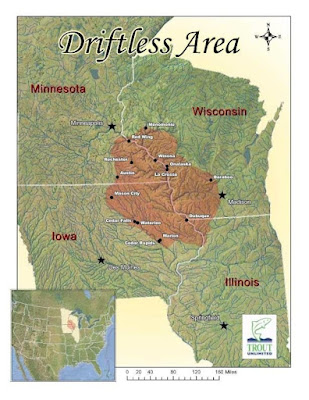
I’ve spent a silly amount of time over the past few days trying to figure out if the Kinnickinnic (Kinnie) River watershed in western Wisconsin [there’s also a Kinnickinnic River around Milwaukee] is or is not part of the Driftless (unglaciated) Area. As near as I can tell, the jury is still considering the evidence. In the process of poking about the nooks and crannies of the internet, I discovered that there’s a proposal to create a Driftless Area National Park which may, or may not, include part of southeastern Minnesota.

Trout Unlimited, which is working with the City of River Falls and several local conservation organizations to facilitate the removal of two dams from the Kinnie and restore the river and its floodplain, where the impoundments were, plus affected areas downstream, has done a lot of work on Driftless Area restoration. I wonder if the Biden administration’s efforts to protect 30 percent of America’s land and ocean areas by 2030 could help facilitate a multi-state conservation area that may, or may not, include a national park. Something to ponder in the weeks and months ahead. Stay tuned.


Exit Glacier


When we got close enough
we could hear
 
rivers inside the ice
heaving splits
 
the groaning of a ledge
about to
 
calve. Strewn in the moraine
fresh moose sign—
 
tawny oblong pellets
breaking up
 
sharp black shale. In one breath
ice and air—
 
history, the record
of breaking—
 
prophecy, the warning
of what's yet to break
 
out from under
four stories
 
of bone-crushing turquoise
retreating.


********************************************
Thanks for visiting. Come again when you can.
Please be kind to each other while you can.

Saturday, March 5, 2022

Going with the flow

The trees are coated with barely melting ice, The air is full of fog, some of which is trying to accumulate on the trees as ice. Temperatures are drifting around 32 to 33℉. Welcome to “spring” in the North Country. The woods surrounding the house look like they’re full of ghost trees, all whiteish and shrouded. Tonight, after an afternoon’s worth of rain, the forecast includes slushy snow. Welcome to “spring?” in the North Country. Hard to believe three or four months from now we may be complaining about heat.

Over the next several weeks, the snow and ice on the ground will melt and become groundwater or flow overland into brooks, creeks, streams and rivers. As I continue to try to get a handle of the place in which I live, I’m gaining some insight into how much political boundaries can distort the bioregional reality in which we live. Here’s an example.

Driftless Area map
Driftless Area map

Our property is part of the Sunrise River watershed, which is part of the Lower St. Croix River watershed, which  is part of the Upper Mississippi River watershed. Across the St. Croix is the state of Wisconsin. On that side of the river, also part of the lower St. Croix River watershed, is the Kinnickinnic River watershed which, as near as I can tell, is one of the most northern watersheds of the Driftless Area, which encompasses parts of Minnesota (southeastern), Wisconsin (southwestern), Iowa (northeastern) and Illinois (northwestern).

Almost all of the time I’ve lived in Minnesota, I’ve leaned toward the wilderness of the northern part of the state and the City of Duluth, which I find a little reminiscent of my native Boston. It was only a few years ago that I learned an area such as the Driftless existed, although I have from time to time fished some of the trout streams in southeast Minnesota. Now I find myself drawn toward the Driftless, mostly due to trout fishing, food, music, and roots. Brook trout char are native to the Driftless and to New England. I’ve been a fan of Greg Brown’s for some years now. He lives in the Iowa section of the Driftless and his music is captured in Going Driftless. Spring, when it finally gets here, and summer, are looking more promising by the day.

In lieu of a standard poem today, let’s enjoy a “prose poem” by the author of Anatomy of a Fisherman.


“I fish because I love to; because I love the environs where trout are found, which are invariably beautiful, and hate the environs where crowds of people are found, which are invariably ugly; because of all the television commercials, cocktail parties, and assorted social posturing I thus escape; because, in a world where most men seem to spend their lives doing things they hate, my fishing is at once an endless source of delight and an act of small rebellion; because trout do not lie or cheat and cannot be bought or bribed or impressed by power, but respond only to quietude and humility and endless patience; because I suspect that men are going along this way for the last time, and I for one don't want to waste the trip; because mercifully there are no telephones on trout waters; because only in the woods can I find solitude without loneliness; because bourbon out of an old tin cup always tastes better out there; because maybe one day I will catch a mermaid; and, finally, not because I regard fishing as being so terribly important but because I suspect that so many of the other concerns of men are equally unimportant - and not nearly so much fun.” - Robert Traver
(John Voelker)


********************************************
Thanks for visiting. Come again when you can.
Please be kind to each other while you can.

Sunday, January 16, 2022

Does MN need Bioregional Learning Centers


As it becomes more and more obvious that our political systems aren’t adequate to help US respond to the crises we face, I keep thinking about the possibility of a bioregional alternative. This morning, after some poking and prodding, the interwebs coughed up some prospects I’d not come across before, Bioregional Learning Centers. The linked source relates the concept to Donella Meadows work as she was co-founding the Balaton Group.

Of more immediate interest, there’s a current version of a BLC functioning in South Devon, England. As described on the group’s home page:

Today we are a seedbed of innovation in soil restoration, organic farming, community-supported fishing, rewilding, the circular economy, social enterprise, re-localising procurement, community action and leveraging systems change with small-scale interventions. We are, together, growing a learning region for a climate resilient future.

As I skimmed my way through several of the pages on the web site, I couldn’t help but wonder if areas in Minnesota might benefit from the creation of BLCs. In particular, the St. Croix River watershed and the northern Minnesota Iron Range/ Boundary Waters complex.

can the St. Croix be protected from CAFOs?
Photo by J. Harrington

Minnesota has already enjoyed an effort somewhat comparable to the Devon’s river charter. In 2016, the Institute for the Environment sponsored a lecture series, one of which was “River Journey: Exploring the Value of the Mississippi River.”

I raise these prospects because, it seems to me, Minnesota has a number of groups that focus well on fragments of our socioecological systems, but lacks the type of umbrella organization that cuts across functions and issues and builds needed networks to get new concepts and best practices implemented in a timely fashion. Instead, we have come to rely on on increasingly dysfunction and combative legislature where too many of us are represented by those more interested in holding power than solving problems. Having several Bioregional Learning Centers (similar to, but distinct from, the University’s Regional Sustainable Development Partnerships?) could help provide the resources, frameworks and interdependence we need for effective regional solutions.


In Response to a Question

The earth says have a place, be what that place
requires; hear the sound the birds imply
and see as deep as ridges go behind
each other. (Some people call their scenery flat,
their only picture framed by what they know:
I think around them rise a riches and a loss
too equal for their chart – but absolutely tall.)

The earth says every summer have a ranch
that’s minimum: one tree, one well, a landscape
that proclaims a universe – sermon
of the hills, hallelujah mountain,
highway guided by the way the world is tilted,
reduplication of mirage, flat evening:
a kind of ritual for the wavering.

The earth says where you live wear the kind
of color that your life is (gray shirt for me)
and by listening with the same bowed head that sings
draw all into one song, joining
the sparrow on the lawn, and row that easy
way, the rage without met by the wings
within that guide you anywhere the wind blows.

Listening, I think that’s what the earth says.

– William Stafford

(from Stories That Could Be True, for educational purposes only)


********************************************
Thanks for visiting. Come again when you can.
Please be kind to each other while you can.