Showing posts with label historic preservation. Show all posts

Sunday, November 2, 2025

Listening for the land to speak

The November section of our Minnesota Weatherguide Calendar and Almanac has a timely epigram from Linda Hogan:

There is a way that nature
speaks, that land speaks.
Most of the time we are 
simply not patient enough,
quiet enough, to pay
attention to the story.

November is Native American Heritage month but, with the federal government shut down since the beginning of October, most .gov websites haven't been updated. November is also the month when the North Country begins to accelerate its slide from autumn into winter. As I was poking about the corners of the internet yesterday, looking for some North Country phenology material, I came across the University of Minnesota's Center for Community-Engaged Learning's Sites of Resistance and Resilience in the Twin Cities on the UMN's Season Watch Resources page. The fortuitous discoveries above remind me of the old dictum: "No amount of planning will ever replace dumb luck."

early November North Country snow [2013]
Photo by J. Harrington

Winter, among those who live close to nature and her seasons, is often a time for quiet hunkering down and storytelling. We're headed in that direction. Summer's ants are disappearing and winter's mice are looking for warm places to nest. If this year is near typical, our "permanent" snow cover will begin about a week before Thanksgiving. If you haven't yet come across a copy of National Geographic's 1621 A New Look at Thanksgiving, I suggest you try to order a copy from Birchbark Books. I'm going to start this year's (re)reading later today.

Harvested cornfields are being gleaned by growing flocks of swans and Canada geese. A few of those waterfowl may winter over on the St. Croix river near Hudson WI. Most will migrate south as open water grows ice cover and harvested fields are covered by more and more snow. Since we lack a snow bird's cottage in the warm south, we'll practice a lethargic, hibernation-approximating existence, as much as we can get away with, until the seasons change again and spring returns.


Map

Linda Hogan

This is the world
so vast and lonely
without end, with mountains
named for men
who brought hunger
from other lands,
and fear
of the thick, dark forest of trees
that held each other up,
knowing fire dreamed of swallowing them
and spoke an older tongue,
and the tongue of the nation of wolves
was the wind around them.
Even ice was not silent.
It cried its broken self
back to warmth.
But they called it
ice, wolf, forest of sticks,
as if words would make it something
they could hold in gloved hands,
open, plot a way
and follow.

This is the map of the forsaken world.
This is the world without end
where forests have been cut away from their trees.
These are the lines wolf could not pass over.
This is what I know from science:
that a grain of dust dwells at the center
of every flake of snow,
that ice can have its way with land,
that wolves live inside a circle
of their own beginning.
This is what I know from blood:
the first language is not our own.

There are names each thing has for itself,
and beneath us the other order already moves.
It is burning.
It is dreaming.
It is waking up.


********************************************
Thanks for visiting. Come again when you can.
Please be kind to each other while you can.

Thursday, July 4, 2024

Return to first principles

Today is one of those days when I get especially homesick for my home state of Massachusetts and my home town of Boston, site of the Cradle of Liberty. Boston is also the location of the Old North Church, from which colonists were warned by lantern, and Paul Revere’s ride, that the British army was on its way to confiscate arms and supplies.

photo of Boston Common and Statehouse
Boston Common and Statehouse
Photo by J. Harrington

We have fallen quite a distance from the time and values of the original Declaration of Independence. The depths to which we continue to fall are revealed in the declaration of servitude offered by one of the presumed candidates for POTUS this year, someone already a convicted felon and adjudicated rapist. Compare the character of this year's presumed Republican candidate with those of any of our founding fathers to further understand the crassness of our times. Then read the Project 2025 playbook and compare those ideas with the original Declaration of Independence. And remember, without the Declaration, there would have been no Constitution and where would that leave US today, recovering from Brexit?


The Landlord's Tale. Paul Revere's Ride


Listen, my children, and you shall hear 
Of the midnight ride of Paul Revere, 
On the eighteenth of April, in Seventy-five; 
Hardly a man is now alive 
Who remembers that famous day and year. 

He said to his friend, "If the British march 
By land or sea from the town to-night, 
Hang a lantern aloft in the belfry arch 
Of the North Church tower as a signal light,— 
One, if by land, and two, if by sea; 
And I on the opposite shore will be, 
Ready to ride and spread the alarm 
Through every Middlesex village and farm, 
For the country folk to be up and to arm." 
Then he said, "Good night!" and with muffled oar 
Silently rowed to the Charlestown shore, 
Just as the moon rose over the bay, 
Where swinging wide at her moorings lay 
The Somerset, British man-of-war; 
A phantom ship, with each mast and spar 
Across the moon like a prison bar, 
And a huge black hulk, that was magnified 
By its own reflection in the tide. 

Meanwhile, his friend, through alley and street, 
Wanders and watches with eager ears, 
Till in the silence around him he hears 
The muster of men at the barrack door, 
The sound of arms, and the tramp of feet, 
And the measured tread of the grenadiers, 
Marching down to their boats on the shore. 

Then he climbed the tower of the Old North Church, 
By the wooden stairs, with stealthy tread, 
To the belfry-chamber overhead, 
And startled the pigeons from their perch 
On the sombre rafters, that round him made 
Masses and moving shapes of shade, — 
By the trembling ladder, steep and tall, 
To the highest window in the wall, 
Where he paused to listen and look down 
A moment on the roofs of the town, 
And the moonlight flowing over all. 
Beneath, in the churchyard, lay the dead, 
In their night-encampment on the hill, 
Wrapped in silence so deep and still 
That he could hear, like a sentinel's tread, 
The watchful night-wind, as it went 
Creeping along from tent to tent, 
And seeming to whisper, "All is well!" 
A moment only he feels the spell 
Of the place and the hour, and the secret dread 
Of the lonely belfry and the dead; 
For suddenly all his thoughts are bent 
On a shadowy something far away, 
Where the river widens to meet the bay, — 
A line of black that bends and floats 
On the rising tide, like a bridge of boats. 

Meanwhile, impatient to mount and ride, 
Booted and spurred, with a heavy stride 
On the opposite shore walked Paul Revere. 
Now he patted his horse's side, 
Now gazed at the landscape far and near, 
Then, impetuous, stamped the earth, 
And turned and tightened his saddle girth; 
But mostly he watched with eager search 
The belfry-tower of the Old North Church, 
As it rose above the graves on the hill, 
Lonely and spectral and sombre and still. 
And lo! as he looks, on the belfry's height 
A glimmer, and then a gleam of light! 
He springs to the saddle, the bridle he turns, 
But lingers and gazes, till full on his sight 
A second lamp in the belfry burns! 
A hurry of hoofs in a village street, 
A shape in the moonlight, a bulk in the dark, 
And beneath, from the pebbles, in passing, a spark 
Struck out by a steed flying fearless and fleet: 
That was all! And yet, through the gloom and the light, 
The fate of a nation was riding that night; 
And the spark struck out by that steed, in his flight, 
Kindled the land into flame with its heat. 
He has left the village and mounted the steep, 
And beneath him, tranquil and broad and deep, 
Is the Mystic, meeting the ocean tides; 
And under the alders, that skirt its edge, 
Now soft on the sand, now loud on the ledge, 
Is heard the tramp of his steed as he rides. 

It was twelve by the village clock, 
When he crossed the bridge into Medford town. 
He heard the crowing of the cock, 
And the barking of the farmer's dog, 
And felt the damp of the river fog, 
That rises after the sun goes down. 

It was one by the village clock, 
When he galloped into Lexington. 
He saw the gilded weathercock 
Swim in the moonlight as he passed, 
And the meeting-house windows, blank and bare, 
Gaze at him with a spectral glare, 
As if they already stood aghast 
At the bloody work they would look upon. 

It was two by the village clock, 
When he came to the bridge in Concord town. 
He heard the bleating of the flock, 
And the twitter of birds among the trees, 
And felt the breath of the morning breeze 
Blowing over the meadows brown. 
And one was safe and asleep in his bed 
Who at the bridge would be first to fall, 
Who that day would be lying dead, 
Pierced by a British musket-ball. 

You know the rest. In the books you have read, 
How the British Regulars fired and fled, — 
How the farmers gave them ball for ball, 
From behind each fence and farm-yard wall, 
Chasing the red-coats down the lane, 
Then crossing the fields to emerge again 
Under the trees at the turn of the road, 
And only pausing to fire and load. 

So through the night rode Paul Revere; 
And so through the night went his cry of alarm 
To every Middlesex village and farm, — 
A cry of defiance and not of fear, 
A voice in the darkness, a knock at the door, 
And a word that shall echo forevermore! 
For, borne on the night-wind of the Past, 
Through all our history, to the last, 
In the hour of darkness and peril and need, 
The people will waken and listen to hear 
The hurrying hoof-beats of that steed, 
And the midnight message of Paul Revere. 


********************************************
Thanks for visiting. Come again when you can.
Please be kind to each other while you can.

Wednesday, November 1, 2023

Welcome, Native American Heritage Month

Today marks the start of Native American Heritage Month. Minnesota’s Governor, Tim Walz, has issued an official proclamation. In a similar vein, President Biden has issued a national proclamation. There are a number of Minnesota events honoring Native American Heritage listed here. A recent US Poet Laureate, Joy Harjo, as her signature project, compiled Living Nations, Living Words, “a sampling of work by 47 Native Nations poets through an interactive ArcGIS Story Map and a newly developed Library of Congress audio collection.” During the rest of the month, from time to time, we’ll add additional resources and expand on the theme.

Although I’m sure it wasn’t a conscious decision on my part, Harjo’s approach to her project, recognizing the connections among the poets, has influenced how I’ve been choosing which poets I want to read next during the past few years. I look for poets who are connected to poets I’ve already enjoyed reading and, although it doesn’t always pan out, it has helped me find several volumes, poets, and publishers that are very much to my taste. Homebound Publications is one example.

Jack O’Lantern greeting our one Trick or Treater

Photo by J. Harrington

Our Halloween record is intact. The only Trick or Treater to arrive at our front door was our granddaughter, leading her mother and father. They left with chocolate bars for the youngest and cheese for the adults, at least that’s how it was supposed to work. If we get lucky, our treat today and tomorrow will be watching the white stuff melt. Today’s poem is one of the few items I can find that reflect Halloween ghouls, snow, and Native Americans.


Windigo

For Angela

The Windigo is a flesh-eating, wintry demon with a man buried deep inside of it. In some Chippewa stories, a young girl vanquishes this monster by forcing boiling lard down its throat, thereby releasing the human at the core of ice.

You knew I was coming for you, little one,
when the kettle jumped into the fire.
Towels flapped on the hooks,
and the dog crept off, groaning,
to the deepest part of the woods.

In the hackles of dry brush a thin laughter started up.
Mother scolded the food warm and smooth in the pot
and called you to eat.
But I spoke in the cold trees:
New one, I have come for you, child hide and lie still. 

The sumac pushed sour red cones through the air.
Copper burned in the raw wood.
You saw me drag toward you.
Oh touch me, I murmured, and licked the soles of your feet.
You dug your hands into my pale, melting fur.

I stole you off, a huge thing in my bristling armor.
Steam rolled from my wintry arms, each leaf shivered
from the bushes we passed
until they stood, naked, spread like the cleaned spines of fish.

Then your warm hands hummed over and shoveled themselves full
of the ice and the snow. I would darken and spill
all night running, until at last morning broke the cold earth
and I carried you home,
a river shaking in the sun.


********************************************
Thanks for visiting. Come again when you can.
Please be kind to each other while you can.

Sunday, October 8, 2023

Becoming native to a place

Tomorrow is Indigenous Peoples’ Day. If I’ve read my history correctly, settlement of the “New World” by European colonists was largely justified by the Doctrine of Discovery. Earlier this year, that doctrine was repudiated by the Vatican. A case of too little, too late, but better late than never.

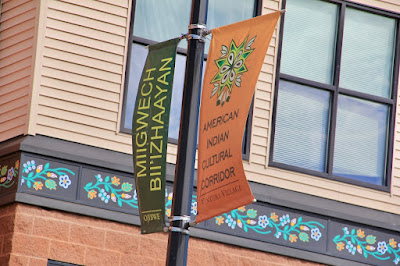
American Indian Cultural Corridor, Minneapolis
Photo by J. Harrington

As the Democrats and Republicans battle for the soul of the US, it is a good time to realize or remember that many of the concepts in the US Constitution are indebted to and derived from the Iroquois Confederacy. In fact, these are times when we should refresh our knowledge of how the country came into existence. One way to do that is to read Heather Cox Richardson’s Democracy Awakening: Notes on the State of America.

Along with that, if you haven’t yet, you probably will want to read Robin Wall Kimmerer’s Braiding Sweetgrass, in which she points out that

“For all of us, becoming indigenous to a place means living as if your children's future mattered, to take care of the land as if our lives, both material and spiritual, depended on it.”

― Robin Wall Kimmerer, Braiding Sweetgrass 

Another way to honor and celebrate Indigenous Peoples’ Day is to


Remember

by Joy Harjo


Remember the sky that you were born under,
know each of the star’s stories.
Remember the moon, know who she is.
Remember the sun’s birth at dawn, that is the
strongest point of time. Remember sundown
and the giving away to night.
Remember your birth, how your mother struggled
to give you form and breath. You are evidence of
her life, and her mother’s, and hers.
Remember your father. He is your life, also.
Remember the earth whose skin you are:
red earth, black earth, yellow earth, white earth
brown earth, we are earth.
Remember the plants, trees, animal life who all have their
tribes, their families, their histories, too. Talk to them,
listen to them. They are alive poems.
Remember the wind. Remember her voice. She knows the
origin of this universe.
Remember you are all people and all people
are you.
Remember you are this universe and this
universe is you.
Remember all is in motion, is growing, is you.
Remember language comes from this.
Remember the dance language is, that life is.
Remember.


********************************************
Thanks for visiting. Come again when you can.
Please be kind to each other while you can.

Tuesday, August 15, 2023

National Code Talkers Day

 Today’s posting speaks for itself in gratitude and apology.


A Blessing

For the graduates of the University of Arizona.

This morning we gather in gratitude for all aspects of sacredness:
the air, the warmth of fire, bodies of water, plants, the land,
and all animals and humankind.
We gather to honor our students who have achieved the extraordinary
accomplishment of earning doctoral or master's degrees.
We gather to honor their parents, grandparents, children,
family members, and friends who have traveled with them
on their path to success. They have traveled far distances to be here
this morning: we honor their devotion.
 
May we remember that holiness exists in the ordinary elements of our lives.
 
We are grateful for a homeland that has always thrived
on a glorious array of people and their diverse cultures, histories,
and beliefs. We acknowledge the generosity of the Tohono O'odham
in granting this land on which we learn, teach, celebrate
accomplishments, and sometimes mourn losses.
 
May we always cherish our ancestors as we prepare for the days ahead.
May we remember that we exist because of their prayers and their faith.
 
We are blessed with distinct and melodious tongues.
Our languages are treasures of stories, songs, ceremonies, and memories.
May each of us remember to share our stories with one another,
because it is only through stories that we live full lives.
 
May the words we speak go forth as bright beads
of comfort, joy, humor, and inspiration.
We have faith that the graduates will inspire others
to explore and follow their interests.
 
Today we reflect a rainbow of creation:
Some of us came from the east, where bright crystals of creativity reside.
They are the white streaks of early morning light when all is born again.
We understand that, in Tucson, the Rincon Mountains are our inspiration
for beginning each day. The Rincons are everlasting and always present.
 
Those who came from the south embody the strength of the blue
mountains that encircle us. The Santa Ritas instill in us
the vigorous spirit of youthful learning.
 
Others came from the west; they are imbued with the quiet, yellow glow of dusk.
They help us achieve our goals. Here in the middle of the valley, the ts'aa',
the basket of life, the Tucson Mountains teach us to value our families.
 
The ones from the north bring the deep, restorative powers of night's darkness;
their presence renews us. The Santa Catalina Mountains teach us that,
though the past may be fraught with sorrow, it was strengthened
by the prayers of our forebearers.
We witnessed the recent fires the mountains suffered,
and in their recovery we see ourselves on our own journeys.
We understand that we are surrounded by mountains, dziił,
and thus that we are made of strength, dziił, nihí níhídziił.
We are strong ourselves. We are surrounded by mountains
that help us negotiate our daily lives.
 
May we always recognize the multitude of gifts that surround us.
May our homes, schools, and communities be filled with the wisdom
and optimism that reflect a generous spirit.
 
We are grateful for all blessings, seen and unseen.
 
May we fulfill the lives envisioned for us at our birth. May we realize
that our actions affect all people and the earth. May we live in the way
of beauty and help others in need. May we always remember that
we were created as people who believe in one another. We are grateful,
Holy Ones, for the graduates, as they will strengthen our future.
 
All is beautiful again.
HózhÇ«́ nááhasdłíí’.

Tuesday, February 21, 2023

Damn dams, don’t damn fisheries!

 I think I’ve mentioned that I’m a Trout Unlimited member involved in fundraising and related efforts in support of removing two dams on the Kinnickinnic River in River Falls, WI. Much background on that effort can be found at the Kinni Corridor Collaborative web site.

part of Kinnickinnic River restoration
Photo by J. Harrington

Although restoration of a free-flowing Kinni is important, I don’t believe there are threatened or endangered species involved, unlike a situation involving Atlantic salmon in Maine, back in my native New England. In a message I recently received, Trout Unlimited asked:
Did you know that wild Atlantic salmon are on the brink of extinction in U.S. waters? Salmon once returned to rivers from Connecticut through Maine by the hundreds of thousands. Today, fewer than 1,000 salmon return to just a few rivers in Maine.
Our best chance to save this majestic species is to remove four aging dams on the Kennebec River. Right now, federal agencies are weighing that very question, providing what is likely our last opportunity to restore a self-sustaining run of Atlantic salmon (and other important migratory species) to the Kennebec watershed.
Please join TU in urging federal fisheries officials to save our salmon by decommissioning those dams and allowing the lower Kennebec River to flow free to the sea once again.
Learn more

More and more research is supporting the physical and mental health benefits of fishing. To attain those benefits, folks need someplace to go fishing. The Kinni offers the prospect of adding miles of Class 1 trout water in a city in a large metropolitan area, the Twin Cities. Among most fly fishers, Atlantic salmon are a prized quarry. Let’s not find ourselves bemoaning the truth of Joni Mitchell’s lyrics:

Don't it always seem to go 
That you don't know what you've got 
Till it's gone 


Elegy ["I think by now the river must be thick"]

For my father


I think by now the river must be thick
        with salmon. Late August, I imagine it

as it was that morning: drizzle needling
        the surface, mist at the banks like a net

settling around us — everything damp
        and shining. That morning, awkward

and heavy in our hip waders, we stalked
        into the current and found our places —

you upstream a few yards and out
        far deeper. You must remember how

the river seeped in over your boots
        and you grew heavier with that defeat.

All day I kept turning to watch you, how
        first you mimed our guide's casting

then cast your invisible line, slicing the sky
        between us; and later, rod in hand, how

you tried — again and again — to find
        that perfect arc, flight of an insect

skimming the river's surface. Perhaps
        you recall I cast my line and reeled in

two small trout we could not keep.
        Because I had to release them, I confess,

I thought about the past — working
        the hooks loose, the fish writhing

in my hands, each one slipping away
        before I could let go. I can tell you now

that I tried to take it all in, record it
        for an elegy I'd write — one day —

when the time came. Your daughter,
        I was that ruthless. What does it matter

if I tell you I learned to be? You kept casting
        your line, and when it did not come back

empty, it was tangled with mine. Some nights,
        dreaming, I step again into the small boat

that carried us out and watch the bank receding —
        my back to where I know we are headed. 


********************************************
Thanks for visiting. Come again when you can.
Please be kind to each other while you can.

Tuesday, November 1, 2022

Honoring Native American Heritage


 November is National American Indian Heritage Month

Celebrate Native American Heritage Month with Twin Cities PBS

Native American Heritage Month - Meet Minneapolis

Bdote Memory Map

Why Treaties Matter

Honor the Earth

The Honorable Harvest
(Braiding Sweetgrass)


American Indian Cultural Corridor
Photo by J. Harrington

Once The World Was Perfect

by Joy Harjo


Once the world was perfect, and we were happy in that world.
Then we took it for granted.
Discontent began a small rumble in the earthly mind.
Then Doubt pushed through with its spiked head.
And once Doubt ruptured the web,
All manner of demon thoughts
Jumped through—
We destroyed the world we had been given
For inspiration, for life—
Each stone of jealousy, each stone
Of fear, greed, envy, and hatred, put out the light.
No one was without a stone in his or her hand.
There we were,
Right back where we had started.
We were bumping into each other
In the dark.
And now we had no place to live, since we didn’t know
How to live with each other.
Then one of the stumbling ones took pity on another
And shared a blanket.
A spark of kindness made a light.
The light made an opening in the darkness.
Everyone worked together to make a ladder.
A Wind Clan person climbed out first into the next world,
And then the other clans, the children of those clans, their children,
And their children, all the way through time—
To now, into this morning light to you.


********************************************
Thanks for visiting. Come again when you can.
Please be kind to each other while you can.
Friday, November 26, 2021

In honor of Native American Heritage Day

After too many broken treaties, it took yet another Act of Congress, in the 21st century, to begin to really recognize treaties. Then came oil and gas pipelines. When will we ever learn?


American Indian Cultural Corridor, Minneapolis
Photo by J. Harrington

Native American Heritage Day: 2009 Congressional Act
SEC. 3. HONORING NATIVE AMERICAN HERITAGE IN THE UNITED STATES.

    Congress encourages the people of the United States, as well as 
Federal, State, and local governments, and interested groups and 
organizations to honor Native Americans, with activities relating to--
            (1) appropriate programs, ceremonies, and activities to 
        observe Native American Heritage Day;
            (2) the historical status of Native American tribal 
        governments as well as the present day status of Native 
        Americans;
            (3) the cultures, traditions, and languages of Native 
        Americans; and
            (4) the rich Native American cultural legacy that all 
        Americans enjoy today.

    Approved June 26, 2009.


from the Editors at the Poetry Foundation

Native American Poetry and Culture

A selection of poets, poems, and articles exploring the Native American experience.


discover who's territory you're living on:

Native Land map


A Quest for Universal Suffrage

I.

Suffrage:

In late middle English

intercessory prayers,

a series of petitions.

Not the right—but the hope.


Universal:

applicable to all cases

except those marginalized

and unnamed.

A belief, but not a fact.


II.

In the trombone slide of history

I hear the suffer in suffragette

the uni uni uni in universal

each excluded ikwe: women

from five hundred tribal nations

mindimooyenh or matriarchs

of ancient flourishing cultures

still disenfranchised by race,

still holding our world together

in the dusky and lawless violence

manifest in colonial america.


Twenty-six million american women

at last granted the right to vote.

Oh, marginal notes in the sweet anthem

of equality, Indigenous non-citizens

turn to the older congress of the sun

seek in the assembled stories of sky

a steady enlightenment—natural laws

(the mathematics of bending trees,

sistering of nutrients—maizebeanssquash,

or wintering wisdom of animal relatives)

each seasonal chorus colored with resilience—

earth voices rising in sacred dream songs.


Even now listen, put on the moon-scored

shell of turtle, wear this ancient armour

of belonging. In the spiral of survivance

again harvest the amber sap of trees

follow the scattered path of manoomin

the wild and good seed that grows on water.

Oh water, oh rice, oh women of birch dreams

and baskets, gather. Here reap and reseed

raise brown hands trembling holy with endurance.

Now bead land knowledge into muklaks

sign with the treaty X of exclusion.

Kiss with fingers and lips the inherited

woodland flutes and breathy cedar songs. 

Say yea, eya, and yes. Here and here cast

your tended nets—oh suffered and sweetly mended

nets of abundance. This year and each to follow

choose, not by paper but by pathway, a legacy:

woman’s work—our ageless ballad of continuance.


********************************************
Thanks for visiting. Come again when you can.
Please be kind to each other while you can.

Sunday, July 4, 2021

Independence Day: stopped by a filibuster?

Because it's a holiday weekend and hot and humid as Hades outside, today's posting will be short and  sweet, or not, depending on your political perspective.

According to the history.com website:

From 1774 to 1789, the Continental Congress served as the government of the 13 American colonies and later the United States. The First Continental Congress, which was comprised of delegates from the colonies, met in 1774 in reaction to the Coercive Acts, a series of measures imposed by the British government on the colonies in response to their resistance to new taxes. In 1775, the Second Continental Congress convened after the American Revolutionary War (1775-83) had already begun. In 1776, it took the momentous step of declaring America’s independence from Britain. Five years later, the Congress ratified the first national constitution, the Articles of Confederation, under which the country would be governed until 1789, when it was replaced by the current U.S. Constitution. ...

... The Congress was structured with emphasis on the equality of participants, and to promote free debate. After much discussion, the Congress issued a Declaration of Rights, affirming its loyalty to the British Crown but disputing the British Parliament’s right to tax it....

Betsy Ross flag

Now, I ask you to consider a hypothetical. If the Congress had adopted rules that included or allowed for the filibuster, would we now be a United States of America? I suspect not, if those in the Continental Congress had put political party and ambition ahead of country. My suspicions are, at least in part, confirmed by The Brennan Center for Justice, which  found, more than a decade ago:

 Founding Fathers Would Like Reconciliation, Not the Filibuster

There is little question that routine use of the filibuster, a de facto 60-vote requirement that inevitably leads to stalemate, defies the intent of those men in powdered wigs who carefully crafted our Constitution. This is not what the Framers had in mind. 


Fourth of July


Freedom is a rocket,
isn’t it, bursting
orgasmically over
parkloads of hot
dog devouring
human beings
or into the cities
of our enemies
without whom we
would surely
kill ourselves
though they are
ourselves and
America I see now
is the soldier
who said I saw
something
burning on my
chest and tried
to brush it off with
my right hand
but my arm
wasn’t there—
America is no
other than this
moment, the
burning ribcage,
the hand gone
that might have
put it out, the skies
afire with our history. 


********************************************
Thanks for visiting. Come again when you can.
Please be kind to each other while you can.

Friday, July 2, 2021

A history lesson?

It's the start of Independence Day weekend. Much of the fight for independence took place in my home state of Massachusetts. Much later, one of our greatest (and my favorite) presidents came from that state. In recognition of these facts, and because I believe we need his kind of leadership more than ever, today I want to share the

ADDRESS OF PRESIDENT-ELECT JOHN F. KENNEDY DELIVERED TO A JOINT CONVENTION OF THE GENERAL COURT OF THE COMMONWEALTH OF MASSACHUSETTS, JANUARY 9, 1961

I have welcomed this opportunity to address this historic body, and, through you, the people of Massachusetts to whom I am so deeply indebted for a lifetime of friendship and trust.

For fourteen years I have placed my confidence in the citizens of Massachusetts--and they have generously responded by placing their confidence in me.

Now, on the Friday after next, I am to assume new and broader responsibilities. But I am not here to bid farewell to Massachusetts.

For forty-three years--whether I was in London, Washington, the South Pacific, or elsewhere--this has been my home; and, God willing, wherever I serve this shall remain my home.

It was here my grandparents were born--it is here I hope my grandchildren will be born.

I speak neither from false provincial pride nor artful political flattery. For no man about to enter high office in this country can ever be unmindful of the contribution this state has made to our national greatness.

Its leaders have shaped our destiny long before the great republic was born. Its principles have guided our footsteps in times of crisis as well as in times of calm. Its democratic institutions--including this historic body--have served as beacon lights for other nations as well as our sister states.

For what Pericles said to the Athenians has long been true of this commonwealth: "We do not imitate--for we are a model to others."

And so it is that I carry with me from this state to that high and lonely office to which I now succeed more than fond memories of firm friendships. The enduring qualities of Massachusetts--the common threads woven by the Pilgrim and the Puritan, the fisherman and the farmer, the Yankee and the immigrant--will not be and could not be forgotten in this nation's executive mansion.

They are an indelible part of my life, my convictions, my view of the past, and my hopes for the future.

Allow me to illustrate: During the last sixty days, I have been at the task of constructing an administration. It has been a long and deliberate process. Some have counseled greater speed. Others have counseled more expedient tests.

But I have been guided by the standard John Winthrop set before his shipmates on the flagship Arbella three hundred and thirty-one years ago, as they, too, faced the task of building a new government on a perilous frontier.

"We must always consider," he said, "that we shall be as a city upon a hill--the eyes of all people are upon us."

Today the eyes of all people are truly upon us--and our governments, in every branch, at every level, national, state and local, must be as a city upon a hill--constructed and inhabited by men aware of their great trust and their great responsibilities.

For we are setting out upon a voyage in 1961 no less hazardous than that undertaken by the Arabella in 1630. We are committing ourselves to tasks of statecraft no less awesome than that of governing the Massachusetts Bay Colony, beset as it was then by terror without and disorder within.

History will not judge our endeavors--and a government cannot be selected--merely on the basis of color or creed or even party affiliation. Neither will competence and loyalty and stature, while essential to the utmost, suffice in times such as these.

For of those to whom much is given, much is required. And when at some future date the high court of history sits in judgment on each one of us--recording whether in our brief span of service we fulfilled our responsibilities to the state--our success or failure, in whatever office we may hold, will be measured by the answers to four questions:

First, were we truly men of courage--with the courage to stand up to one's enemies--and the courage to stand up, when necessary, to one's associates--the courage to resist public pressure, as well as private greed?

Secondly, were we truly men of judgment--with perceptive judgment of the future as well as the past--of our own mistakes as well as the mistakes of others--with enough wisdom to know that we did not know, and enough candor to admit it?

Third, were we truly men of integrity--men who never ran out on either the principles in which they believed or the people who believed in them--men who believed in us--men whom neither financial gain nor political ambition could ever divert from the fulfillment of our sacred trust?

Finally, were we truly men of dedication--with an honor mortgaged to no single individual or group, and compromised by no private obligation or aim, but devoted solely to serving the public good and the national interest.

Courage--judgment--integrity--dedication--these are the historic qualities of the Bay Colony and the Bay State--the qualities which this state has consistently sent to this chamber on Beacon Hill here in Boston and to Capitol Hill back in Washington.

And these are the qualities which, with God's help, this son of Massachusetts hopes will characterize our government's conduct in the four stormy years that lie ahead.

Humbly I ask His help in that undertaking--but aware that on earth His will is worked by men. I ask for your help and your prayers, as I embark on this new and solemn journey.


two eagles: a house divided?
Photo by J. Harrington

COURAGE--JUDGEMENT--INTEGRITY--DEDICATION we would be much better served these days if both major political parties, and all voters, put these qualities at the top of the list of candidates they're willing to nominate and support in free and open elections. Unfortunately, I fear we have a long road to travel before we reach such a destination. 


Of History and Hope


We have memorized America,
how it was born and who we have been and where.
In ceremonies and silence we say the words,
telling the stories, singing the old songs.
We like the places they take us. Mostly we do.
The great and all the anonymous dead are there.
We know the sound of all the sounds we brought.
The rich taste of it is on our tongues.
But where are we going to be, and why, and who?
The disenfranchised dead want to know.
We mean to be the people we meant to be,
to keep on going where we meant to go.

But how do we fashion the future? Who can say how
except in the minds of those who will call it Now?
The children. The children. And how does our garden grow?
With waving hands—oh, rarely in a row—
and flowering faces. And brambles, that we can no longer allow.

Who were many people coming together
cannot become one people falling apart.
Who dreamed for every child an even chance
cannot let luck alone turn doorknobs or not.
Whose law was never so much of the hand as the head
cannot let chaos make its way to the heart.
Who have seen learning struggle from teacher to child
cannot let ignorance spread itself like rot.
We know what we have done and what we have said,
and how we have grown, degree by slow degree,
believing ourselves toward all we have tried to become—
just and compassionate, equal, able, and free.

All this in the hands of children, eyes already set
on a land we never can visit—it isn’t there yet—
but looking through their eyes, we can see
what our long gift to them may come to be.
If we can truly remember, they will not forget.


********************************************
Thanks for visiting. Come again when you can.
Please be kind to each other while you can.

Monday, December 14, 2020

Taking Winter Count

Well, our strategy of test-starting the snowblower a week ago mostly worked. We got a little more than a dusting yesterday afternoon, definitely not enough to actually cause us to blow snow. The cold temperatures led to a drop in the tire pressure in all four tires in the Jeep. We're thinking we should wait until it's warmer than today's low to mid teens before we head off to add air. Maybe tomorrow.


amaryllis, a week before Christmas 2017
Photo by J. Harrington

This year's amaryllis appear to be developing well behind schedule, they're less than a foot tall, while the Christmas cactus bloomed ahead of schedule. We'll just pretend the season started earlier and will run later than usual this year. Last year's beach plums didn't make it through the Winter. We haven't yet killed off this year's holly bushes, although we've noticed we have a tendency to overwater them. As we move toward year's end, we're beginning to take stock of what we did and didn't undertake this year. The three sisters garden didn't get planted. We're blaming a contrary tiller for that. Next year we'll see if it starts earlier in the planting season.


artisan sourdough kernza bread
Photo by J. Harrington

Baking our artisan sourdough bread made some progress and we successfully played with a new ingredient, kernza flour. Thanks to COVID-19 we never did get to the bakery in NE Minneapolis we wanted to check out. Maybe next Summer, after we're all vaccinated. The fishing season was almost a total flop since every time we were ready to go, the wind seemed to be howling enough to make fly-casting hazardous. As Minnesota sports fans know only too well, "there's always next season."

All in all the year has had enough good points that it goes in the "W" column, especially since a new granddaughter has been added to the team. We hope your year has brought you more joy and satisfaction than trials and tribulations, and that you are and remain safe and warm and fed and healthy during this season and all next year. If you're not sure what a "Winter Count" is, you can learn about it here.


Wearing Indian Jewelery


I was wondering why that guy
wore the blanket coat, bone choker, rock
watch, woven buckle, quilled Stetson—
I was wondering why he wore
that beaded vest, like a ledger drawing
or a Winter Count, its skinny figure
forever sneaking after two bison
around belly to back,
around back to belly—
I was wondering why, when he said,
I wear these getups every day—
Every day, because these things
are sacred, these things are prayer.

Then I knew I could live this life
If I had blue horses
painted around and around me,
shells and beads like rain in my ear
praying Prairie open in me
at stoplight, hard city, last call, bank line,
coffee break, shopping cart, keycode,
Prarie open in me
Prarie open in me
every day every day every day.


********************************************
Thanks for visiting. Come again when you can.
Please be kind to each other while you can.

Wednesday, January 23, 2019

Native American place names in the St. Croix river valley #OneMinnesota

We post about dancing with systems and Donella Meadows and Peter Senge and related matters from time to time. In an effort to practice what we preach, walk the talk, or whatever comparable paradigm you like, we're going to try a systems approach as we explore Native American place names in the St. Croix watershed. We decided this after some preliminary research yesterday made it clear we'll make better progress if we start by defining the boundaries of the system we want to describe. But, before we go to far, did you know that before Minnesota became a state, there was a proposal to make the St. Croix River Valley a state? [Time and the River, page 152]

https://upload.wikimedia.org/wikipedia/commons/0/06/Stcroixmnwirivermap.png
St. Croix River (Wisconsin-Minnesota) facts for kids

Geographically, we're focused on one watershed, the Namekagon/St. Croix. that encompasses parts of two states, Minnesota and Wisconsin, and all or parts of ten counties in Minnesota and nine counties in Wisconsin. The Wisconsin Department of Natural Resources [DNR] identifies more than 20 tributaries to the St. Croix. The Minnesota DNR identifies Upper and Lower St. Croix watersheds, separated by the Snake and Kettle River tributaries from the Minnesota side. The St. Croix River Association (we're members) provides access to a geographic information system depiction of the St. Croix basin, sub watersheds and counties. We'll use that as what appears to be the best available integrated and comprehensive geographic identification of the system we're working to describe.

fire, controlled or not, has a long history in the St. Croix valley
Photo by J. Harrington

Our preliminary research yesterday identified a number of resources of Native American place names. In case you're interested, we'll list some of them here.
In days to come, we'll be checking our copies of Mni Sota Makoce: The Land of the Dakota, and Ojibwe Waasa Inaabidaa: We Look In All Directions, among other resources. For now, we want to point out that the name of the very county in which we've lived for many years, Chisago, is derived "from two Ojibwe language words meaning "large" and "beautiful"," referencing originally Chisago Lake. (Upham, Warren (1920). Minnesota Geographic Names: Their Origin and Historic Significance. Minnesota Historical Society. p. 107.)

So we now have a list of two states and about twenty counties against which we can screen indigenous place names from the Dakota or Ojibe languages and, perhaps the Ho-Chunk and Menominee tribes if the folks from National Geographic are to be believed.

The Theft Outright


after Frost

We were the land's before we were.

Or the land was ours before you were a land.
Or this land was our land, it was not your land.

We were the land before we were people,
loamy roamers rising, so the stories go,
or formed of clay, spit into with breath reeking soul—

What's America, but the legend of Rock 'n' Roll?

Red rocks, blood clots bearing boys, blood sands
swimming being from women's hands, we originate,
originally, spontaneous as hemorrhage.

Un-possessing of what we still are possessed by,
possessed by what we now no more possess.

We were the land before we were people,
dreamy sunbeams where sun don't shine, so the stories go,
or pulled up a hole, clawing past ants and roots—

Dineh in documentaries scoff DNA evidence off.
They landed late, but canyons spoke them home.
Nomadic Turkish horse tribes they don't know.

What's America, but the legend of Stop 'n' Go?

Could be cousins, left on the land bridge,
contrary to popular belief, that was a two-way toll.
In any case we'd claim them, give them some place to stay.

Such as we were we gave most things outright
(the deed of the theft was many deeds and leases and claim stakes
and tenure disputes and moved plat markers stolen still today . . .)

We were the land before we were a people,
earthdivers, her darling mudpuppies, so the stories go,
or emerging, fully forming from flesh of earth—

The land, not the least vaguely, realizing in all four directions,
still storied, art-filled, fully enhanced.
Such as she is, such as she wills us to become.


********************************************
Thanks for visiting. Come again when you can.
Please be kind to each other while you can.