Showing posts with label sustainable development. Show all posts

Wednesday, October 18, 2023

Bridging divides

We’ve reached the time when even the oak leaves are changing color. For the first time this season, snow showers have appeared in the extended forecast for late next week. I’ve not yet got around to starting up the snow blower but my motivation just increased. This afternoon or tomorrow we’ll get fresh gas and go from there.

There’s an article in today’s Daily Yonder that made me feel a smidgen of hope for our future. It’s republished below and followed by today’s poem.


Progressives Hope ‘Rural New Deal’ Will Address Economic Issues and Appeal to Voters

Progressive Democrats of America and Rural Urban Bridge Initiative have co-authored a policy paper laying out a set of strategies to revitalize the economy in rural areas through “federal investment in bottom-up solutions.” 

With input from rural leaders and advocates, the Rural New Deal brings together economic policies that are popular with progressives and tailors them to suit the needs of rural communities. 

Democrats have a chance at winning in 2024 if they work to rebuild trust with rural voters, Anthony Flaccavento, director of Rural Urban Bridge Initiative (RUBI), told the Daily Yonder. 

“The federal government is proposing this policy template, but every element needs to be organized such that it's sensitive to the specifics of the regions, that the programs are being applied and that there is local input into how they actually operate at the local level,” Flaccavento said.

The Rural New Deal is made up of 10 overarching economic policy goals, or pillars. These include items such as breaking up corporate monopolies and ensuring livable wages, among others. Each pillar comes with a set of actions that either the federal government or other rural community leaders can take. These range from providing subsidies to small businesses to expanding road and rail infrastructure. 

Additionally, the Rural New Deal focuses on other policy areas like sustainable food production, broadband expansion, affordable housing, public education, and healthcare. It calls for measures such as Medicaid and Medicare expansion, investments in vocational training, and free community college.

The release of the policy document comes at a time when the Democratic Party is becoming less competitive in national races, according to Jeff Bloodworth, a professor of political history at Gannon University in Pennsylvania who studies rural elections. 

He said the Democrats have increasingly focused their electoral strategy on urban areas since the 1960s, while gradually devoting less attention to rural voters. They performed especially poorly in the 2016 and 2020 presidential elections, losing the rural vote to Republicans by more than 20 percentage points in both. 

Progressive candidates like Pennsylvania U.S. Senator John Fetterman and former Maine State Senator Chloe Maxmin won their seats after years of organizing in their states’ rural communities. But Democrats as a whole often don’t run candidates in rural areas, especially at the state and local level, Bloodworth said. 

“Half the state legislative seats in Mississippi, the Democrats don't even run a candidate,” Bloodworth said. “And Mississippi's not an outlier. Democrats were competitive and controlled the state legislature in Mississippi well into the ’90s they just quit trying. They don't show up anymore.”

Alan Minsky, the director of Progressive Democrats of America, and Flaccavento view the Rural New Deal as an important step in building a relationship between progressive candidates and rural communities, both during and beyond elections. But they both see potential issues with its implementation. They anticipate Republican opposition to the Rural New Deal’s calls for increased government investment or decreased privatization, as well as lingering biases against rural voters from Democratic politicians and pundits. 

Urban progressives have assumptions about how rural Americans vote: that they all vote Republican, that they vote against their own interests, or that they simply don’t care about the same things urban progressives care about. Flaccavento said these assumptions can lead Democrats to dismiss the issues that rural Americans face. Republicans, by contrast, are more likely to try to appeal to rural voters, Minsky said.

“The Republican Party has consistently presented itself as the ally of business and therefore it fits in with this notion of being the party that advocates for pulling yourself up by the bootstraps, do hard work, etc,” he said.

Though Republicans have consistently outperformed Democrats among rural voters in recent elections, rural voters themselves – especially young rural voters – have expressed dissatisfaction with how both parties handle economic issues. Minsky, who remembers Ronald Reagan’s elections in 1980 and 1984, saw how unpopular his administration’s economic policies were among rural workers, policies that are still part of the Republican Party’s platform. 

“He really initiated an era of economic policy of not securing and supporting independent businesses and family farmers and allowing the process of corporate monopolization to begin. And then sadly, when you get the Democratic administration coming in ’92, they in no way reverse that,” he said. “In fact, they again acquiesced to the policies for the most part.”

Republicans’ use of “culture war” strategies has also produced mixed results in capturing rural support. In Ohio, a 2013 state constitutional amendment that would have restricted abortion rights failed to attract as much support in rural areas as candidate Donald Trump did in 2020. Similarly, rural Wisconsin voters shifted 5 points to the left in the 2023 election of pro-choice progressive, Janet Protasiewicz, to the state Supreme Court this past April, compared to senatorial and presidential elections. 

Flaccavento said that voters’ responses to these strategies are complex and often informed by their material conditions. 

“Culture war issues are way more effective in dividing us in large part because people feel abandoned economically,” Flaccavento said. “As Democrats begin to really prioritize the needs of everyday people across geography, but especially in rural, … then it's much more likely that those other issues will be like, ‘Well, we don't agree, but that's OK.’”

Bloodworth added that urban progressives need to understand the nuances of rural political attitudes if they want to get support for policies like the Rural New Deal.

“We should not assume that people in rural America are naturally more conservative…Their liberalism, where they are liberals, has a different sensibility,” Bloodworth said. 

This article first appeared on The Daily Yonder and is republished here under a Creative Commons license.


bridge building in process
Photo by J. Harrington

The Bridge Builder


An old man going a lone highway,
Came, at the evening cold and gray,
To a chasm vast and deep and wide.
Through which was flowing a sullen tide
The old man crossed in the twilight dim,
The sullen stream had no fear for him;
But he turned when safe on the other side
And built a bridge to span the tide.

“Old man,” said a fellow pilgrim near,
“You are wasting your strength with building here;
Your journey will end with the ending day,
You never again will pass this way;
You’ve crossed the chasm, deep and wide,
Why build this bridge at evening tide?”

The builder lifted his old gray head;
“Good friend, in the path I have come,” he said,
“There followed after me to-day
A youth whose feet must pass this way.
This chasm that has been as naught to me
To that fair-haired youth may a pitfall be;
He, too, must cross in the twilight dim;
Good friend, I am building this bridge for him!”


********************************************
Thanks for visiting. Come again when you can.
Please be kind to each other while you can.

Thursday, July 28, 2022

Too little, too late? Let’s hope not!

Another week, another month is winding down. Monday will be August 1, Lughnasadh. Local farmers already have small grain harvests underway. Several fields of alfalfa looked like they had already had a second cutting. One day soon, I need to use the bagging mower and get after the sand burs along the road, before the dogs start picking them up in their paws.

Earlier, a Minnesota DFL Senator Tweeted a slightly unsenatorial message: 

“Holy shit. Stunned, but in a good way. $370B for climate and energy and 40% emissions reduction by 2030.


BFD.” 

Much as I usually admire the Senator’s position(s) on most issues, I’m tempted to send her a link to The Who - Won't Get Fooled Again. Senator Manchin always reminds me of the story of the scorpion and the turtle

One lazy afternoon day a turtle was swimming happily along a lake. As the turtle was nearing land he heard a scorpion hail it from the muddy shore. A scorpion, being a very poor swimmer, asked the turtle if he would carry him on his back across the lake. The turtle thought it was the craziest thing he ever heard, “Why would I carry you on my back?” he boomed, ‘You’ll sting me while I’m swimming and I’ll drown.” 

“My dear turtle friend,” laughed the scorpion, “if I were to sting you, you would drown and I would go down with you and drown as well. Now where is the logic in that?”

The turtle pondered this for a moment, and eventually saw the logic in the scorpion’s statement. “You’re right!” said the turtle with a smile. “Hop on!” So the scorpion climbed aboard and the turtle paddled his big fins in the water. Halfway across the lake the scorpion gave the turtle a big sting, and he started to drown. As they both sank into the water the turtle turned to the scorpion with a tear in his eye. “My dear scorpion friend, why did you sting me? Now we are both going to drown…” the turtle was gasping for air. “Where is the… logic in that?” 

“It has nothing to do with logic” the scorpion sadly replied, “it’s just my nature.”

turtle sunning om a St. Croix river rock
turtle sunning on a St. Croix river rock
Photo by J. Harrington

I’m not in the least suggesting our Senator Smith is a turtle, but I did send a reply she should withhold tweets on the legislation until the votes are actually counted. Senator Manchin has made his nature obvious, time and time again.

It would be nice to see legislation enacted that actually does something about climate change. I am frustrated enough by the Democratic failures to take initiative on some of the critical issues that I continue to follow the tactic of funding candidates, not the party. If the party can legitimately claim several significant accomplishments over the next month or so, I may revise my approach.


Winter Morning


When I can no longer say thank you
for this new day and the waking into it,
for the cold scrape of the kitchen chair
and the ticking of the space heater glowing
orange as it warms the floor near my feet,
I know it’s because I’ve been fooled again
by the selfish, unruly man who lives in me
and believes he deserves only safety
and comfort. But if I pause as I do now,
and watch the streetlights outside flashing
off one by one like old men blinking their
cloudy eyes, if I listen to my tired neighbors
slamming car doors hard against the morning
and see the steaming coffee in their mugs
kissing chapped lips as they sip and
exhale each of their worries white into
the icy air around their faces—then I can
remember this one life is a gift each of us
was handed and told to open: Untie the bow
and tear off the paper, look inside
and be grateful for whatever you find
even if it is only the scent of a tangerine
that lingers on the fingers long after
you’ve finished peeling it.

Monday, March 21, 2022

Lent Township’s Spring surprise!

In the midst of the first full day of spring in the northern hemisphere in 2022, local skies are overcast. We may, or may not, reach or exceed 60℉ today. [Update: we didn’t.] Snow is in the forecast for Wednesday. Pretty typical for North Country springtime.

Last night the air rang with the call of a sandhill crane as s/he flew over the house at dusk. More and more Canada geese are arriving in anticipation of open water. Muskrat mounds for nesting are being claimed. A few swans are also somewhere in the neighborhood. Snow cover is about 80%%-90% gone from open areas, less so in the shaded woods.

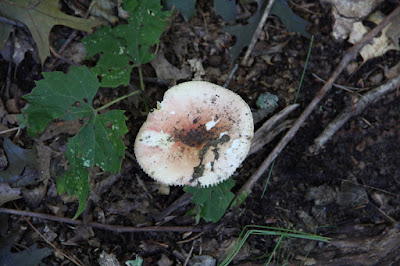
mushrooms: like voters, kept in the dark and covered in manure
Photo by J. Harrington

This evening we’re planning to attend a meeting of Township residents asking questions about the merger with the City of Stacy proposed by the township board at the annual meeting earlier this month. Since much of what  we’ve read leads us to believe that many township residents don’t know what such a merger may mean, or even that it’s been proposed, it should be interesting.

Much of the eastern portions of the township are separated from the City of Stacy by an expanse of Carlos Avery Wildlife Management Area. How could it every be cost effective for the city to provide municipal services such as water and sewer to those residing on the eastern edge of the WMA? The township already has a joint fire department with  the city. The entire concept doesn’t seem to be well thought out. There’s a related series of questions regarding whether the county’s southern portion will actually be a growth area if gas reaches $6 or $7 a gallon before electric vehicles have largely replaced the current vehicle fleet.

Stay tuned for further developments, but, if you ever want to feel like you’re not living in a democracy, where your vote is not worth much, buy property in a township that’s considering the board knows best what’s good for the residents and will tell them when it’s ready.


What Things Want

 - 1926-2021

You have to let things
Occupy their own space.
This room is small,
But the green settee

Likes to be here.
The big marsh reeds,
Crowding out the slough,
Find the world good.

You have to let things
Be as they are.
Who knows which of us
Deserves the world more?


********************************************
Thanks for visiting. Come again when you can.
Please be kind to each other while you can.
Thursday, October 14, 2021

Repeat after me: It’s time for US to learn our A-B-C-D

My email inbox and social media feeds and snail mail contents are full of funding pleas supported by descriptions of impending disasters and past injustices. The climate crisis and the sixth extinction / loss of biodiversity lead the way.  This article from today’s Guardian is a classic example of the problems humanity is facing, before we even begin to talk about the failure of our political and educational systems leaving US with too great a proportion of an ignorant populous that has, at best, poor or nonexistent critical thinking skills. Frankly, I yearn for the days when I felt comfortable deciding for whom to vote and then letting elected representatives do their job instead of being asked, or told, to sign petition after petition to convince representatives to do what’s right.

does healthy water look like this?
Photo by J. Harrington

As evidence I note the extent to which the COVID virus has decimated, and continues to decimate, the earth’s population of humans; corporate greed exhibiting in response; and, neither last nor least, grwoing numbers of citizens showing they’re tired of being played for suckers.

Meanwhile, the Republicans continue to do their best to undermine democracy, aided and abetted by corporate Democrats and little hindered by “jawboning” from the president.

I believe we have become too embroiled in debates about what we’re against (a never-ending list) and not engaged enough in discussions about what we want and how to get it. Back in the days when I was a practicing planner and active in community development, a strong case was made that asset-based community development [ABCD]produced better results than focusing on reducing or eliminating deficits. I see evidence that many organizations are working toward enhancing what’s left of our assets such as land and water, but remain concerned that too many global and national corporations remain in extractive mindsets. Looking at the state of the earth and its inhabitants these days, I believe we’re well past a point from which we can dig our way out of the hole we’re in and it’s probably time to stop pushing the strings our politicians dangle in front of us.

Fortunately for US, Joy Harjo has provided useful, even profound, guidance on how to proceed.


Conflict Resolution for Holy Beings


I am the holy being of my mother's prayer and my father's song

                                                      —Norman Patrick Brown, Dineh Poet and Speaker

1. SET CONFLICT RESOLUTION GROUND RULES:

Recognize whose lands these are on which we stand.
Ask the deer, turtle, and the crane.
Make sure the spirits of these lands are respected and treated with goodwill.
The land is a being who remembers everything.
You will have to answer to your children, and their children, and theirs—
The red shimmer of remembering will compel you up the night to walk the perimeter of truth for understanding.
As I brushed my hair over the hotel sink to get ready I heard:
By listening we will understand who we are in this holy realm of words.
Do not parade, pleased with yourself.
You must speak in the language of justice.


2. USE EFFECTIVE COMMUNICATION SKILLS THAT DISPLAY AND ENHANCE MUTUAL TRUST AND RESPECT:

If you sign this paper we will become brothers. We will no longer fight. We will give you this land and these waters "as long as the grass shall grow and the rivers run."

The lands and waters they gave us did not belong to them to give. Under false pretenses we signed. After drugging by drink, we signed. With a mass of gunpower pointed at us, we signed. With a flotilla of war ships at our shores, we signed. We are still signing. We have found no peace in this act of signing.

A casino was raised up over the gravesite of our ancestors. Our own distant cousins pulled up the bones of grandparents, parents, and grandchildren from their last sleeping place. They had forgotten how to be human beings. Restless winds emerged from the earth when the graves were open and the winds went looking for justice.

If you raise this white flag of peace, we will honor it.

At Sand Creek several hundred women, children, and men were slaughtered in an unspeakable massacre, after a white flag was raised. The American soldiers trampled the white flag in the blood of the peacemakers.

There is a suicide epidemic among native children. It is triple the rate of the rest of America. "It feels like wartime," said a child welfare worker in South Dakota.

If you send your children to our schools we will train them to get along in this changing world. We will educate them.

We had no choice. They took our children. Some ran away and froze to death. If they were found they were dragged back to the school and punished. They cut their hair, took away their language, until they became as strangers to themselves even as they became strangers to us.

If you sign this paper we will become brothers. We will no longer fight. We will give you this land and these waters in exchange "as long as the grass shall grow and the rivers run."

Put your hand on this bible, this blade, this pen, this oil derrick, this gun and you will gain trust and respect with us. Now we can speak together as one.

We say, put down your papers, your tools of coercion, your false promises, your posture of superiority and sit with us before the fire. We will share food, songs, and stories. We will gather beneath starlight and dance, and rise together at sunrise.

The sun rose over the Potomac this morning, over the city surrounding the white house.
It blazed scarlet, a fire opening truth.
White House, or Chogo Hvtke, means the house of the peacekeeper, the keepers of justice.
We have crossed this river to speak to the white leader for peace many times
Since these settlers first arrived in our territory and made this their place of governance.
These streets are our old trails, curved to fit around trees.
 

3. GIVE CONSTRUCTIVE FEEDBACK:

We speak together with this trade language of English. This trade language enables us to speak across many language boundaries. These languages have given us the poets:

Ortiz, Silko, Momaday, Alexie, Diaz, Bird, Woody, Kane, Bitsui, Long Soldier, White, Erdrich, Tapahonso, Howe, Louis, Brings Plenty, okpik, Hill, Wood, Maracle, Cisneros, Trask, Hogan, Dunn, Welch, Gould...

The 1957 Chevy is unbeatable in style. My broken-down one-eyed Ford will have to do. It holds everyone: Grandma and grandpa, aunties and uncles, the children and the babies, and all my boyfriends. That's what she said, anyway, as she drove off for the Forty-Nine with all of us in that shimmying wreck.

This would be no place to be without blues, jazz—Thank you/mvto to the Africans, the Europeans sitting in, especially Adolphe Sax with his saxophones... Don't forget that at the center is the Mvskoke ceremonial circles. We know how to swing. We keep the heartbeat of the earth in our stomp dance feet.

You might try dancing theory with a bustle, or a jingle dress, or with turtles strapped around your legs. You might try wearing colonization like a heavy gold chain around a pimp's neck.


4. REDUCE DEFENSIVENESS AND BREAK THE DEFENSIVENESS CHAIN:

I could hear the light beings as they entered every cell. Every cell is a house of the god of light, they said. I could hear the spirits who love us stomp dancing. They were dancing as if they were here, and then another level of here, and then another, until the whole earth and sky was dancing.

We are here dancing, they said. There was no there.

There was no  "I"  or "you."

There was us; there was "we."

There we were as if we were the music.

You cannot legislate music to lockstep nor can you legislate the spirit of the music to stop at political boundaries—

—Or poetry, or art, or anything that is of value or matters in this world, and the next worlds.

This is about getting to know each other.

We will wind up back at the blues standing on the edge of the flatted fifth about to jump into a fierce understanding together.


5. ELIMINATE NEGATIVE ATTITUDES DURING CONFLICT:

A panther poised in the cypress tree about to jump is a panther poised in a cypress tree about to jump.

The panther is a poem of fire green eyes and a heart charged by four winds of four directions.

The panther hears everything in the dark: the unspoken tears of a few hundred human years, storms that will break what has broken his world, a bluebird swaying on a branch a few miles away.

He hears the death song of his approaching prey:

I will always love you, sunrise.
I belong to the black cat with fire green eyes.
There, in the cypress tree near the morning star.


6. AND, USE WHAT YOU LEARN TO RESOLVE YOUR OWN CONFLICTS AND TO MEDIATE OTHERS' CONFLICTS:

When we made it back home, back over those curved roads
that wind through the city of peace, we stopped at the
doorway of dusk as it opened to our homelands.
We gave thanks for the story, for all parts of the story
because it was by the light of those challenges we knew
ourselves—
We asked for forgiveness.
We laid down our burdens next to each other.


********************************************
Thanks for visiting. Come again when you can.
Please be kind to each other while you can.

Tuesday, April 21, 2020

Earth Week: Day 3

The "wet spot" pond in the back yard is shrinking. Maples and poplars and some bushes are showing softer silhouettes as bud burst begins, Oaks are still hanging tough and waiting for warmer days. The  extended weather forecast finally has foregone below freezing temperatures for the next week or so. It's time to put the beach plum plants back outside and see what happens. A couple of them are showing some small signs of life.

skunk cabbage emerging in April
Photo by J. Harrington

Every year, about this time, give or take several weeks, I have to remind myself that the ground needs to thaw and dry before I can start Spring cleanup. As I look at the tiny tunnel entrances that are scattered below the bird feeders, I'm disheartened by the apparent population of moles, voles, shrews and what all keeping our soils aerated and eating the seeds discarded or dropped by the birds. The local bird population is including more goldfinches and purple finches these days, plus a red-bellied woodpecker is appearing with an increased degree of regularity.

Each day this week, including today, despite occasional sunny moments of warmth, the breeze, regardless of the direction from which it comes, has had a cold bite. Or, maybe I'm just noticing it more as I get older. I've yet to make it back to the wetlands to check on the skunk cabbage or the marsh marigolds. Tomorrow or Thursday look promising. A longish walk through the woods on Earth Day has more appeal than joining fellow tree huggers on line for a 50th anniversary. Maybe I can work in both.

marsh marigolds emerging in April
Photo by J. Harrington

It's not been a horrid Winter, but a longish one and, just as it was fading, COVID-19 struck and stuck us at home. I've had about as much of living in interesting times as is good for me, I'm afraid. May you and those close to you be happy, healthy and able to celebrate Earth Day with love and enthusiasm.

Trout Lilies


by Mary Oliver


It happened I couldn't find in all my books
more than a picture and a few words concerning
the trout lily,

so I shut my eyes,
And let the darkness come in
and roll me back.
The old creek

began to sing in my ears
as it rolled along, like the hair of spring,
and the young girl I used to be
heard it also,

as she came swinging into the woods,
truant from everything as usual
except the clear globe of the day, and its
beautiful details.

Then she stopped,
where the first trout lilies of the year
had sprung from the ground
with their spotted bodies
and their six-antlered bright faces,
and their many red tongues.

If she spoke to them, I don't remember what she said,
and if they kindly answered, it's a gift that can't be broken
by giving it away.
All I know is, there was a light that lingered, for hours,
under her eyelids - that made a difference
when she went back to a difficult house, at the end of the day.


********************************************
Thanks for visiting. Come again when you can.
Please be kind to each other while you can.

Tuesday, January 7, 2020

How flawed is our Environmental Policy Act?

Let's make a couple of points clear from the beginning. First, this blog posting should, in no way, be read or (mis)interpreted as support for any particular mine, or mining, as currently regulated in Minnesota. Second, we're pleased to see that state Senator Bakk has finally lifted a lid off the can of worms about whether Minnesota has sufficiently rigorous environmental requirements regarding mining. We may return some day soon to the question of regulatory capture and political chicanery and their effects, or lack thereof, on several extractive sectors on Minnesota's economy, including mining, agriculture and forestry.

Here's a "money quote" from a Timberjay editorial as republished in MinnPost:
As Sen. Bakk noted, the environmental review, which is the initial part of the permitting process, is designed to better understand the risks and attempt to mitigate those risks to the extent that’s financially feasible. That process is not designed to answer the more fundamental questions of whether a proposed project makes sense or poses too great a risk to allow to move forward.

“So, once they start down that road of applying for those permits it’s pretty hard to stop,” said Bakk.
 If it's been some time since you've read Minnesota's Environmental Policy Act, we suggest you follow the preceding link. The really germane sections are a relatively quick read. In fact, the most relevant section is one that seems to be missing from Minnesota's rules and regulations.

Subd. 2.State responsibilities.


In order to carry out the policy set forth in Laws 1973, chapter 412, it is the continuing responsibility of the state government to use all practicable means, consistent with other essential considerations of state policy, to improve and coordinate state plans, functions, programs and resources to the end that the state may:
...
(3) discourage ecologically unsound aspects of population, economic and technological growth, and develop and implement a policy such that growth occurs only in an environmentally acceptable manner; 
...
(6) develop and implement land use and environmental policies, plans, and standards for the state as a whole and for major regions thereof through a coordinated program of planning and land use control;
(7) define, designate, and protect environmentally sensitive areas; 
None other than a former Commissioner of Minnesota's Department of Natural Resources claims that:
... Minnesota’s regulatory standards are inadequate to protect a unique natural resource such as the Boundary Waters. 
Perhaps you'll be more successful than I was doing an internet search for Minnesota's definition and designation of environmentally sensitive areas. I could find no such references.

Twin Metals offices in Ely, MN
Photo by J. Harrington

Taken by itself, the preceding represents, in my opinion, an egregious example of governmental failure to implement legislation. What seems to represent an even more significant example of malfeasance is the state's willful(?) ignorance of international mining standards that have evolved over the past decade. The Initiative for Responsible Mining Assurance [IRMA] has standards that state, among other requirements:
4.6.5.3.  IRMA will not certify new mines that are developed in or that adversely affect the following protected areas: 
•World Heritage Sites, and areas on a State Party’s official Tentative List for World Heritage Site Inscription; 
•IUCN protected area management categoriesI-III; 
•Core areas of UNESCO biosphere reserves. 

a "reclaimed" iron mine site near Ely, MN
Photo by J. Harrington

A preliminary reading indicates that the Boundary Waters Canoe Area could well qualify as one of the IUCN protected area categories, if Minnesota were working with the IUCN World Commission on Protected Areas. Would such efforts solve the mining issues near the Boundary Waters or those potentially affecting Lake Superior? Not by themselves, but they would help Minnesota frame the issues of whether, and under what conditions, activities that can significantly affect environmentally sensitive areas could or should be allowed to apply for operating permits.

The Well Rising


The well rising without sound,
the spring on a hillside,
the plowshare brimming through deep ground
everywhere in the field—

The sharp swallows in their swerve
flaring and hesitating
hunting for the final curve
coming closer and closer—

The swallow heart from wingbeat to wingbeat
counseling decision, decision:
thunderous examples. I place my feet
with care in such a world.


********************************************
Thanks for visiting. Come again when you can.
Please be kind to each other while you can.

Friday, October 4, 2019

Whatever happened to our hinterland?

Before we answer the question, we have to update this week's leaf color report. We still estimate local color to be less than 25%. That's consistent with the state's report for this area (Southwest corner of Chisago county). Maples are showing more yellows, oranges and reds. Oaks haven't been doing much besides dropping acorns. Black cherry trees seem to have not read the memo that its Autumn. Last night the Better Half covered the flowers in case we had our first frost of the season. False alarm but understandable since, for the first time locally this season, snow has appeared in the forecast for a week from tomorrow. Meanwhile, to be candid and grumpy, Yr. Obt. Svt. has begun to feel what, this year we've had the typical crappy Spring, hardly any real Summer, and now Autumn is becoming a washout. Maybe we'll ask Santa for new and improved rain gear for Christmas.

Then, have you heard the rumors that, sometime near mid-afternoon around here, a huge, strange, bright, yellow light will appear in the Western sky? I, said the doubting Thomas, will believe it when, and if, I see it. Now, finally, let's look at how the corruption of language, e.g., hinterland, can contribute mightily to social issues.

once, urban grain silos make the linkage to farms obvious
once, urban grain silos made the linkage to farms obvious
Photo by J. Harrington

The aforementioned rain and clouds have given us more time than is advisable to sit and read and think. We've been rediscovering Wendell Berry and catching up with his more recent writings and writings about him. For example, there's a really interesting interview with Berry in the July 14, 2019 issue of The New Yorker. That and a number of other things have us once again thinking about cities, hinterland (does anyone else remember that term?) and urban-rural mutual dependencies (that are too often portrayed only as two sides of a divide). Wendell Berry is one of those who seem to be able to write faster and better than we can read. We recently, and belatedly, finished reading The Unsettling of America. We find we're in agreement with about 80% or more of what Berry writes but still struggle to understand how an agrarian culture fits with a global economy. Are they mutually exclusive? Berry farms with horses but drives a pickup truck. If, as we hope and suspect, fossil fuels have been a bridge to a renewable society, where and how does technological innovation arise in an agrarian economy? Or should we depend on serendipity such as the discovery of penicillin?

I've long loved cities, country and wilderness. I've developed an extreme aversion to suburbs. Christopher Alexander, in A Pattern Language, writes about interlocking fingers of farmland and urban land. It's been some time since I've seen consideration of regional land use patterns as an consideration in an urban-rural divide. Of course, it's been some time since Minnesota has had a state planning agency, too.

without rural-grown grain, what uses would mills and railroads serve?
Photo by J. Harrington

Something I believe I learned when I was active in the green building field is that all the elements, design, construction, materials, siting, operations and maintenance need to work together for the built environment to be truly sustainable. I also gained lots of insight into how challenging it is to get that kind of alignment and how rarely building owners and/or developers think that holistically. More to think about unless it stops raining, or snowing, for more than 20 minutes.

The Real Work


by Wendell Berry


It may be that when we no longer know what to do
we have come our real work,

and that when we no longer know which way to go
we have come to our real journey.

The mind that is not baffled is not employed.

The impeded stream is the one that sings.


********************************************
Thanks for visiting. Come again when you can.
Please be kind to each other while you can.

Thursday, September 5, 2019

About that Democratic climate change forum

It's not often we find ourselves bouncing back and forth as much as recent stock market shifts. We're currently changing opinions daily or more frequently about which of two leading Democratic candidates for POTUS we prefer. One's a man, the other's a woman. That's all we're saying for now. Over the past several decades we've displayed an unfortunate ability to put a jinx on many people, places and things we admire. We hope to avoid doing anything like that in the upcoming election. In fact, our track record is such that we are actively considering endorsing one or more candidates that we'd have a hard time voting for.

Where were we? Oh yes, as we checked out the reports on last night's climate change forum, we once again came across a reference to the United Nations' Sustainable Development Goals. We approve of and support the way the 17 SDGs are related to our current "climate emergency."

UN Sustainable Development Global Goals

The urgency of responding to the rapid breakdown our climate is experiencing shouldn't push us to think it's an issue we can tackle in isolation. That's an example of the kind of thinking that got us in the current messes in the first place. Please repeat after us this John Muir quotation from My First Summer in the Sierra:
When we try to pick out anything by itself, we find it hitched to everything else in the Universe.
We believe that this is a more important concept than how much money a candidate proposes to throw at the climate breakdown problem. It isn't a technical climate green house gases issue, it's a systems issue. Our support will go to the candidate that we think has the best systematic approach to tackling climate breakdown, adaptation and drawdown. It's important to leave fossil fuels in the ground. It's also important to make sure their replacements are phased in at the same rate that fossil fuels are phased out. We haven't heard enough discussion yet about that aspect. Have you?

We gained some personal insight into this issue as we thought about how we're going to manage the dead branches that keep falling onto the drive and the back yard. If we just throw them into the woods, eventually fungi and bacteria will cause them to decay and the carbon contained therein will be available to help grow other plants or those that feed on them. It's the rate of carbon release that makes a difference between natural decay and intentionally burning the brush and branches, just as burning fossil fuels is releasing carbon that was contained in plants millions of years ago. We've been releasing most of it in the past couple of hundred years. The rate of change makes a difference. That's part of the systemic change that needs to be managed better than we've even talked about so far.

bald eagle, symbol of the US
Photo by J. Harrington


Eagle Poem


- 1951-


To pray you open your whole self
To sky, to earth, to sun, to moon
To one whole voice that is you.
And know there is more
That you can't see, can't hear,
Can't know except in moments
Steadily growing, and in languages
That aren't always sound but other
Circles of motion.
Like eagle that Sunday morning
Over Salt River. Circled in blue sky
In wind, swept our hearts clean
With sacred wings.
We see you, see ourselves and know
That we must take the utmost care
And kindness in all things.
Breathe in, knowing we are made of
All this, and breathe, knowing
We are truly blessed because we
Were born, and die soon within a
True circle of motion, 
Like eagle rounding out the morning
Inside us. 
We pray that it will be done
In beauty.
In beauty.


********************************************
Thanks for visiting. Come again when you can.
Please be kind to each other while you can.

Tuesday, August 20, 2019

The Green New Deal: construction jobs in Northern MN?

A house divided against itself, cannot stand. ~ A. Lincoln

Remember the old saying about how "when you find yourself in a hole, the first thing to do is stop digging!"? There's some fussing and fuming coming from the general area of the Iron Range now that presidential candidate, Sen. Elizabeth Warren, supports better alternatives than #Line3 and the Twin Metals project. Warren is a Senate cosponsor of S.Res.59, A resolution recognizing the duty of the Federal Government to create a Green New Deal.

Salon magazine (online) has picked up an insightful piece from TomDispatch that explores

Jobs, the environment, and a planet in crisis: How the Green New Deal is changing America

Unions vs. environmentalists or unions and environmentalists?

Fleshing out the concepts in the Green New Deal resolution, and funding the projects that emerge and get approved, including repairing much of the US' infrastructure, should provide lots of local, living wage or better construction jobs on or near the Range.

Minnesota has too many divides
Photo by J. Harrington

According to several reports we've read, unions and Native Americans each have concerns about how the Green New Deal may get implemented. We would respectfully suggest that clearly identifying what changes are needed may be a more beneficial course of action than simply complaining about what's in the resolution or the extent to which some interests were or were not consulted in the drafting process.

One area that the Salon/TomDispatch article flagged is the interest of some unions in carbon capture and storage (CCS) construction jobs. The Drawdown project lists Direct Air Capture as a "Coming Attraction," not a readily implementable element of current climate breakdown solutions. Approaches like "clean coal" aren't mentioned at all.

Building pipelines for energy sources that worsen the climate breakdown problem when there's an electric grid that needs rebuilding and all the deferred maintenance projects on roads, bridges, airports, wastewater treatment plants, etc. seems highly counterproductive. These efforts, plus the necessary shift to a low carbon economy will increase demand for copper, The copper industry is aware of that and making international efforts to make the mining and processing of copper more sustainable. It would be interesting and informative to compare the best practices in Minnesota with the environmental solutions undertaken in Europe.

If we are to function as #OneMinnesota, we need to learn to have conversations instead of throwing brickbats. Has anyone really looked at how much of Minnesota's mining best practices meet or exceed international best practices for copper mining? Is there a report or has there been a symposium? And,by any chance, does Minnesota actually have any sort of minerals policy?

The Planet Krypton


Outside the window the McGill smelter
sent a red dust down on the smoking yards of copper,
on the railroad tracks’ frayed ends disappeared
into the congestion of the afternoon. Ely lay dull

and scuffed: a miner’s boot toe worn away and dim,
while my mother knelt before the Philco to coax
the detonation from the static. From the Las Vegas
Tonapah Artillery and Gunnery Range the sound

of the atom bomb came biting like a swarm
of bees. We sat in the hot Nevada dark, delighted,
when the switch was tripped and the bomb hoisted
up its silky, hooded, glittering, uncoiling length;

it hissed and spit, it sizzled like a poker in a toddy.
The bomb was no mind and all body; it sent a fire
of static down the spine. In the dark it glowed like the coils
of an electric stove. It stripped every leaf from every

branch until a willow by a creek was a bouquet
of switches resinous, naked, flexible, and fine.
Bathed in the light of KDWN, Las Vegas,
my crouched mother looked radioactive, swampy,

glaucous, like something from the Planet Krypton.
In the suave, brilliant wattage of the bomb, we were
not poor. In the atom’s fizz and pop we heard possibility
uncorked. Taffeta wraps whispered on davenports.

A new planet bloomed above us; in its light
the stumps of cut pine gleamed like dinner plates.
The world was beginning all over again, fresh and hot;
we could have anything we wanted.


********************************************
Thanks for visiting. Come again when you can.
Please be kind to each other while you can.

Sunday, June 30, 2019

Should mining be governed by international or regional standards?

Mining is clearly an international business that has contributed jobs to the economies and pollution to  the environment of Minnesota and several other Great Lakes States. Historical results frame the issue as one of jobs or the environment. This continues to be the situation in many countries less economically developed than the U.S. or Canada. North America's environmental regulations, however, are fragmented and have had limited success in moving the metals and mining sector toward responsible mining and sustainable development. Over the past few decades, however, as we've noted elsewhere in this series, international efforts to make development sustainable and to include the mining sector in that effort have occurred. One of the more holistic approaches has been followed by the United Nations, a major international player.

UN Sustainable Development Goals

The United Nations has adopted 17 Sustainable Development Goals. With a specific focus on the mining sector, it has fostered the preparation of the report: Mapping Mining to the Sustainable Development Goals: An Atlas.
The Atlas maps the relationship between mining and the SDGs by using examples of good practice in the industry and existing knowledge and resources in sustainable development that if replicated or scaled up could make useful contributions to the SDGs. Mining companies, their staff, management and boards are the primary audience for the Atlas. The Atlas is also intended to advance the conversation about how mining companies, can work collaboratively with governments, communities, civil society and other partners to contribute to achieve the SDGs.
In some ways even more relevant to Minnesota and the Great Lakes region, the United Nations has crafted a multi-year strategy, the UN Global Compact, to drive business awareness and action in support of achieving the Sustainable Development Goals by 2030 . One aspect of the compact is The CEO Water Mandate, which has, as of this writing, almost 150 business signatories, including a handful from the metals and mining sector. Unfortunately, neither Glencore/PolyMet nor Antofagasta/Twin Metals are listed as having signed that Mandate.
The Mandate is a commitment platform for business leaders and learners to advance water stewardship. Endorsing companies commit to action across six key elements and report annually on progress. In implementing water stewardship, endorsing companies also  identify and reduce critical water risks to their businesses, seize water-related opportunities, and contribute to water security and the Sustainable Development Goals.
Either or both Glencore/Polymet or Antofagasta/Twin Metals could add credibility to their claims of responsible mining and development if they actually walked their talk. Instead, what we see are behaviors based on compliance with watered-down environmental and financial requirements imposed by the state's permitting agencies. Compliance is not a valid substitute for ethical corporate behavior. Conversely, while it's possible we've missed something significant, we've seen no indication Minnesota has given thought to or been engaged in any of the activities that could offer substantial contributions to help protect both the state's economy and its environment. Inaction or inept action won't get us there. Sitting on laurels for too long may result in an uncomfortable rash.

These are the last two stanzas of the poem we've picked to complement this series. It's a long poem but, we believe, fits really well with the theme we've developed. If we truly want a future with both good jobs and a healthy, sustainable environment, conflict resolution offers a more productive strategy than does continuing conflict. we hope you concur.

Conflict Resolution for Holy Beings

By Joy Harjo


5. ELIMINATE NEGATIVE ATTITUDES DURING CONFLICT:

A panther poised in the cypress tree about to jump is a panther poised in a cypress tree about to jump.

The panther is a poem of fire green eyes and a heart charged by four winds of four directions.

The panther hears everything in the dark: the unspoken tears of a few hundred human years, storms that will break what has broken his world, a bluebird swaying on a branch a few miles away.

He hears the death song of his approaching prey:

I will always love you, sunrise.
I belong to the black cat with fire green eyes.
There, in the cypress tree near the morning star.


6. AND, USE WHAT YOU LEARN TO RESOLVE YOUR OWN CONFLICTS AND TO MEDIATE OTHERS' CONFLICTS:

When we made it back home, back over those curved roads
that wind through the city of peace, we stopped at the
doorway of dusk as it opened to our homelands.
We gave thanks for the story, for all parts of the story
because it was by the light of those challenges we knew
ourselves—
We asked for forgiveness.
We laid down our burdens next to each other.


********************************************
Thanks for visiting. Come again when you can.
Please be kind to each other while you can.

Saturday, June 29, 2019

Could PolyMet/Northmet be third-party certified as a Responsible Mine?

Back in the days before we became a recovering planner, we met a number of residents and officials of various units of local government, particularly townships and counties, who had been sure that they didn't need zoning, or their ordinance didn't need to cover certain uses, until it did. Sometimes, then, it was too late. They were faced with the proverbial need to lock a barn door after the horse was inside.

What started us thinking about these situations was a paragraph we reread in The Meaning of Wilderness: essential articles and speeches / Sigurd F. Olson. On page 56 we find the following:
The only hope of preserving a few remnants of the old wilderness ... is to work out a comprehensive zoning plan in which the entire country will be classified as to the type of recreational land use it is best suited for.
Olson was advocating to prevent overflights and/or, especially, aviation access to the Boundary Waters and similar areas. His concept, it seems to us, is sound but has, to our knowledge, lain dormant, to the detriment of those who would protect the wilderness from extractive industries.

does anything protect Minnesota's Sawtooths from mountaintop removal mining?
Photo by J. Harrington

Here's a challenge! See if you can find out what zoning, if any, applies to the site(s) of the PolyMet / NorthMet project or the Twin Metals location. Are there setback requirements from wetlands, streams, rivers or contiguous properties? To provide a sense of what you're looking for, follow the link to an online version of a Minnesota Model Mining Ordinance prepared under the auspices of the Saint Croix River Association. We believe it was developed in anticipation of a proposed sand and gravel operation near the Wild and Scenic River.

The significance of national, state and local designations of recreational areas, and the land use controls that govern them and surrounding areas (buffers) becomes particularly relevant in the case of responsible and sustainable mining operations. One of the standards we haven't yet mentioned in this series of posts is from the Initiative for Responsible Mining Assurance [IRMA]. It explicitly states that:
3.7.5.3. IRMA will not certify new mines that are developed in or that adversely affect the following protected areas if those areas were designated to protect cultural values (see also Chapter 4.6):193
• World Heritage Sites, and areas on a State Party’s official Tentative List for World Heritage Site Inscription;
• International Union for Conservation of Nature (IUCN) protected area management categories I-III; and
• Core areas of UNESCO biosphere reserves.
3.7.5.4. An existing mine located entirely or partially in a protected area listed in 3.7.5.3 shall demonstrate that:
a. The mine was developed prior to the area’s official designation;
b. Management plans have been developed and are being implemented to ensure that activities during the remaining mine life cycle will not permanently and materially damage the integrity of the cultural values for which the area was designated or recognized; and
c. The operating company collaborates with relevant management authorities to integrate the mine’s management strategies into the protected area’s management plan.
3.7.5.5. To safeguard irreplaceable cultural heritage and respect indigenous peoples’ right to self- determination, the operating company shall not carry out new exploration or develop new mines in areas where indigenous peoples are known to live in voluntary isolation.
For our purposes, the IUCN provision is particularly relevant, since we believe the Boundary Waters falls into one of the categories, or at least qualifies for inclusion. Our major point today, however, is that there are a number of established protective strategies and techniques that could be used to both improve the environmental performance of mining operations in Minnesota, and make them more acceptable neighbors. This would, or at least should, enhance their ability to obtain the "social license" needed to get mining and environmental permits. Why are not more of the actors in Minnesota's economic development and environmental protection sectors doing more about this. Wouldn't it be a more productive way to protect both jobs and the environment than to engage in a never-ending series of public relations, legislative and court battles over each and every mine proposal? PolyMet NorthMet claims they are "Committed to Responsible Mining." If they are serious about that, they can apply for certification.

We're going to share the usual poem we put here one stanza at a time. It's a long poem but, we believe, fits really well with the theme we're developing.

Conflict Resolution for Holy Beings

By Joy Harjo


4. REDUCE DEFENSIVENESS AND BREAK THE DEFENSIVENESS CHAIN:

I could hear the light beings as they entered every cell. Every cell is a house of the god of light, they said. I could hear the spirits who love us stomp dancing. They were dancing as if they were here, and then another level of here, and then another, until the whole earth and sky was dancing.

We are here dancing, they said. There was no there.

There was no  "I"  or "you."

There was us; there was "we."

There we were as if we were the music.

You cannot legislate music to lockstep nor can you legislate the spirit of the music to stop at political boundaries—

—Or poetry, or art, or anything that is of value or matters in this world, and the next worlds.

This is about getting to know each other.

We will wind up back at the blues standing on the edge of the flatted fifth about to jump into a fierce understanding together.


********************************************
Thanks for visiting. Come again when you can.
Please be kind to each other while you can.

Friday, June 28, 2019

Recommendations for "Responsible Mining in the Lake Superior Basin"

Less than a decade ago, there was an organization called the Lake Superior Binational Forum (Lake Superior Binational Forum Funding Has Been Eliminated by US EPA). In 2013 it drafted a statement on Responsible Mining in the Lake Superior Basin which contains
... recommendations for future mining operations, briefly summarized as follows:

1. Develop a common set of criteria for use by governments, NGOs and industry to guide the permitting process. Currently public agencies use different criteria in each state.

2. Avoid mining in places with high environmental or social/cultural value.

3. Improve public participation by stakeholders in the environmental assessment process through the collection of adequate baseline data; consideration of potential worst-case scenarios; and independent third-party review processes.

4. Water quality objectives that are consistent with the LAMP should be developed.

5. Overburden and tailings should be discharged into water bodies or wetlands; acid-generating materials should be segregated; and hazardous materials plans should be made public.

6. Companies should make atmospheric emission reports. Environmental assessments should consider greenhouse gas emissions from mining operations.

7. Companies should set aside financial resources for the exploration phase to cover clean-ups, reclamation and long-term monitoring. The public should have the right to comment on the adequacy of these resources and reclamation activities.

8. The public should have the right to access monitoring and periodic technical reports during the life of the mining operation; and to do independent third-party review of the process.

9. Companies should have a reclamation plan with resources set aside for each operation. Mined areas should be re-contoured and stabilized.

10. Citizen participation and oversight are important elements listed under “social impacts and decision making,” including the engagement of Tribal Nations, First Nations and Metis.

11. Research is needed on the cumulative and indirect effects of mining; climate change and mining impacts; and human health research, including impacts on people, fish and wild rice.
overlooking the St. Louis River entering Duluth Harbor and Lake Superior
Photo by J. Harrington

The Lake Superior LAMP 2015-2019 notes this about mining's impacts [p. 48 & 49]:
The Lake Superior basin has a long history of mining operations and related impacts. While mining operations can offer economic benefits, they also present threats to the environment. For example, two Great Lakes Areas of Concern, Deer Lake and Torch Lake, were so designated in the Lake Superior basin due to impacts from past mining operations. Fourteen mines currently operate in the Lake Superior basin, with many explorations and expansions underway. Current and/or past mines in the basin have extracted gold, silver, copper, platinum, palladium, nickel, zinc, diamond, lead, iron-ore and taconite, as well as quarried brownstone. Mining impacts cannot be easily reversed –some can cause far reaching and lasting environmental damage. Mining activity has the potential to impairwater quality(e.g., mining is currently the largest source of mercury emissions from within the Lake Superior basin) and degrade habitat (e.g., through increased sediments). Mining sediments in the nearshore, embayments,and river mouths may cover or degrade fish spawning habitats, Wild Rice and other natural resources. After a mine closes, it can remain a source of contamination from chemicals and waste rock piles; tailing ponds must be monitored and maintained for centuries to avoid environmental impacts. 
Recent developments regarding the water discharge permit issued by the Minnesota Pollution Control  Agency make it, at best, questions whether Minnesota is honoring recommendations 3, 8 and 10. The lack of Water Quality Based Effluent Limits in the issued permit would seem to make it impossible to determine consistency with any water quality objective found in or derived from the LAMP.

In order to assess whether mining is responsible and sustainable, both process and substantive criteria should be agreed upon and compliance with those criteria should be regularly assessed in a transparent process. In Minnesota, we don't seem to be there yet.

We're going to share the usual poem we put here one stanza at a time. It's a long poem but, we believe, fits really well with the theme we're developing.

Conflict Resolution for Holy Beings

By Joy Harjo


3. GIVE CONSTRUCTIVE FEEDBACK:

We speak together with this trade language of English. This trade language enables us to speak across many language boundaries. These languages have given us the poets:

Ortiz, Silko, Momaday, Alexie, Diaz, Bird, Woody, Kane, Bitsui, Long Soldier, White, Erdrich, Tapahonso, Howe, Louis, Brings Plenty, okpik, Hill, Wood, Maracle, Cisneros, Trask, Hogan, Dunn, Welch, Gould...

The 1957 Chevy is unbeatable in style. My broken-down one-eyed Ford will have to do. It holds everyone: Grandma and grandpa, aunties and uncles, the children and the babies, and all my boyfriends. That's what she said, anyway, as she drove off for the Forty-Nine with all of us in that shimmying wreck.

This would be no place to be without blues, jazz—Thank you/mvtoto the Africans, the Europeans sitting in, especially Adolphe Sax with his saxophones... Don't forget that at the center is the Mvskoke ceremonial circles. We know how to swing. We keep the heartbeat of the earth in our stomp dance feet.

You might try dancing theory with a bustle, or a jingle dress, or with turtles strapped around your legs. You might try wearing colonization like a heavy gold chain around a pimp's neck.


********************************************
Thanks for visiting. Come again when you can.
Please be kind to each other while you can.