Today I’m (re)posting the story below because, as much as I dislike MAGAts, I keep wondering who is benefitting from our being at each others' throats and in each others' faces. I really hate being played for a sucker.
Using Art to Bridge the Rural-Urban Divide
by Anya Petrone Slepyan, The Daily Yonder March 21, 2025
As the 2024 election approached, news channels and commentators once again revived a familiar narrative: the urban-rural divide.
But Laura Zabel, executive director of Minnesota-based arts non-profit Springboard for the Arts, was more interested in urban-rural solidarity.
“Going into an election year, we knew that there was going to be a lot of narrative that focused on ways we might be different, or ways that people assume we’re different,” Zabel said. “And we wanted to do something to not only counter that narrative, but to help people build real relationships and real solidarity across urban and rural places.”
Stoking resentment between urban and rural communities serves to divide largely working-class constituencies that could gain more political power if they work together, Zabel said. Emphasizing what these communities have in common, across different geographies and demographics, can help counter that divide. But it’s not easy to overcome a narrative that is so deeply ingrained that many Americans take it for granted.
So Springboard for the Arts launched a new initiative, consisting of over 35 artists working on projects across Minnesota, Michigan, Kentucky, and Colorado that connect urban and rural communities. The installations include phone booths that connect communities in rural Northfield, Minnesota and Minneapolis, a culinary project that celebrates the fusion of a chef’s Southeast Asian roots and rural midwestern upbringing, and a Kentucky poetry slam honoring the renowned theorist and professor bell hooks.
Artists Drew Arrieta and Maddy Barsch created cozy phone booths that connected the communities of Minneapolis and Northfield, Minnesota. (Photo by Drew Arrieta)
The results, Zabel said, demonstrate “all of the different ways that we’re connected, and all of the different creative ways that we might reach out to one another and build that kind of understanding.”
Using art projects to foster connection and understanding is effective, according to Zabel, because they leave room for nuance and complexity that is often flattened by media narratives. Creative projects can also help people approach new ideas with a more open mind, she said.
“Art has a tremendous ability to build shared experience in ways that takes people outside of their comfort zone, or makes people more open to thinking of things in a different way,” Zabel said.
A project installed in two Minnesota elementary schools demonstrates the principles behind the projects. Artist David Hamlow worked with 2nd and 3rd graders in rural St. James and urban Minneapolis to design wall sculptures made of recycled materials. Each student was also given a yearbook photo of a participating student from the other school, and asked to incorporate that picture into the sculpture. The resulting walls of faces serve a purpose similar to pen pals, according to Zabel.
Each student was given a class portrait of their counterpart at a different school, and asked to decorate the picture with recycled materials. (Photo by David Hamlow)
“The goal of this whole project in a nutshell is to just get people thinking about one another as individuals and as people who are living full lives and having similar experiences and to help people be more curious about what those lives might be like,” Zabel said.
The youth-focused project also hopes to reach urban and rural children before they’ve internalized the harmful stereotypes these communities can apply to one another.
Project installations by the initial class of 35 artists are ongoing, but Zabel hopes to expand the initiative further in coming years.
“I think that if we are able to build greater understanding and connection, and help people see a more complete picture of what it looks like to live in different contexts, we end up finding out that there is a lot of shared interest and shared hope for our future and our children,” Zabel said.
This article first appeared on The Daily Yonder and is republished here under a Creative Commons license.
********************************************
Thanks for visiting. Come again when you can.
Please be kind
to each other while you can.
"They do not talk about national Democratic Party decisions in 2000 and 2004 to move resources away from the rural battleground and to metropolitan strongholds, opting for base strategies over outreach."
"Nor do they mention that Texas which is 83% metropolitan, and Florida, which is 91% metropolitan, both rejected Obamacare."
"Two would-be terrorists living in major metropolitan urban areas with over a million residents each, yet the rage narrative is about rural insurrection."
"Those relatively few Capitol insurrectionists were disproportionately metropolitan, not rural, but who’s from what Zip code is not what’s alarming."
It is unfortunate, to put it mildly, that the Federal Government has something in the neighborhood of three dozen different definitions of rural. However, the distinction between urban, rural, and metropolitan becomes clear if one scans the maps of Minnesota displaying Three rural definitions based on Census Urban Areas and compares it to the map of Rural definition based on Office of Management and Budget (OMB) metro counties. It looks to me as though there’s quite a bit of nonurban area in metro counties.
If, as I hope we do, we truly want to manage to bridge and heal the urban rural divide and/or split, I strongly suspect it would be helpful if all of US were talking the same places. I’m disappointed Dee Davis doesn’t appear to share that perspective.
Full disclosure: I live in what, not long ago, was a township in an OMB "metro county" that’s not part of the official 7 county Twin Cities Metro Council area. The township in which I used to live has been annexed [in]to a city because, in Minnesota, townships are considered little more than holding areas awaiting urban development. If it’s not clear, that’s not my view of what should be the role of rural area townships. My perspectives are more in alignment with those of Washington, Adams, Jefferson, and Madison in The Founding Gardeners.
Many, many years ago I encountered the quote: “Demography is destiny,” probably in a college sociology course. This morning, and in other recent readings, I’ve seen the truth of the observation in question.
Today, her county of Fremont, a New-Hampshire-sized area home to 40,000 people, has gone from two birthing hospitals and many obstetricians, to one delivery facility and a single pregnancy doctor for the general population. The trend prompts women in increasing numbers to travel out of the county to give birth—an expensive and logistically challenging option. “I just think it’s insane,” Wachter said. “It puts women at risk.”
The statistics bear out her observation. Women who live farther from delivery hospitals are more likely to experience adverse medical outcomes, such as requiring neonatal intensive care.
Conclusions and Relevance In this cross-sectional study of births in US rural and urban counties, risk of SMM [severe maternal morbidity] was elevated for low-risk and higher-risk obstetric patients who gave birth in lower-volume hospitals in rural counties, compared with similar patients who gave birth at rural hospitals with greater than 460 annual births. These findings imply a need for tailored quality improvement strategies for lower volume hospitals in rural communities.
Urban and rural fertility rates appear similar enough that one distinguishing major variable is likely to be total population and density differences between urban and rural areas. For example, Fremont County, Wyoming’s popullation of 40,000 compares to New Hampshire’s 2024 population of about 1.5 million. The former has shown a significant decline in births by mother’s county of residence between 2008 and 2022. This, of course doesn’t address the chicken and egg question of which came first, loss of birthing centers or decline in number of births. It does suggest that Earl Butz took an extremely short term, short sighted, view years ago when he suggested farmers and ranchers should “Get big or get out.” Perhaps rural areas would have been better served over the long term if he had said “Use it or lose it.”
The sky is bright blue and cloudless from where I sit. Warm sunshine contributes to above seasonal temperatures. Almost all of the snow from earlier this week has melted. The Better Half and the two dogs are napping. I’m sitting here trying to figure out what happened to the bat house. I noticed this morning that the front is missing. Also, the box is now hanging by only one screw and I think part of the roof is missing.
Earlier this year one of the bluebird houses got destroyed by what I believe was a bear. Unless the unseasonable weather prompted one out of hibernation, I don’t think it was a bear that dismantled the bat house, but there haven’t been any recent lightning strikes in the neighborhood either. I suspect we get to just chalk it up as another mystery of country living.
Actually, thanks to a recent annexation, technically we now live in a city, but in the rural portion. At the county level, according to the American Communities Project, we live in a “Rural Middle American” county: "Largely rural and white communities. Middle income and average educational attainment." [That doesn’t help explain the Trump signs we see driving around, unless educational attainment averages have plummeted recently.] Anyhow, the ACP uses fifteen different categories of community types. That certainly seems to complicate any urban-rural divide. I’ve become more and more interested in the emphasis being placed in the media on what divides US rather than what unites US. For next year, I’m thinking seriously of exploring such questions. As an example, when one thinks of rural areas, the role of the arts doesn’t often come to the fore, and yet, there’sResounds: Arts and Culture on the High Plains.
Perhaps as a holiday present to ourselves, and a New Year’s Resolution, we could check our stereotypes at the door and learn more about the actual people who live in various parts of our country. Waaay back when I was in college, I learned in a sociology course that there are three kinds of lies. See today’s title.
We’ve reached the time when even the oak leaves are changing color. For the first time this season, snow showers have appeared in the extended forecast for late next week. I’ve not yet got around to starting up the snow blower but my motivation just increased. This afternoon or tomorrow we’ll get fresh gas and go from there.
There’s an article in today’s Daily Yonder that made me feel a smidgen of hope for our future. It’s republished below and followed by today’s poem.
Progressives Hope ‘Rural New Deal’ Will Address Economic Issues and Appeal to Voters
by Janie Ekere, The Daily Yonder October 18, 2023
Progressive Democrats of America and Rural Urban Bridge Initiative have co-authored a policy paper laying out a set of strategies to revitalize the economy in rural areas through “federal investment in bottom-up solutions.”
With input from rural leaders and advocates, the Rural New Deal brings together economic policies that are popular with progressives and tailors them to suit the needs of rural communities.
Democrats have a chance at winning in 2024 if they work to rebuild trust with rural voters, Anthony Flaccavento, director of Rural Urban Bridge Initiative (RUBI), told the Daily Yonder.
“The federal government is proposing this policy template, but every element needs to be organized such that it's sensitive to the specifics of the regions, that the programs are being applied and that there is local input into how they actually operate at the local level,” Flaccavento said.
The Rural New Deal is made up of 10 overarching economic policy goals, or pillars. These include items such as breaking up corporate monopolies and ensuring livable wages, among others. Each pillar comes with a set of actions that either the federal government or other rural community leaders can take. These range from providing subsidies to small businesses to expanding road and rail infrastructure.
Additionally, the Rural New Deal focuses on other policy areas like sustainable food production, broadband expansion, affordable housing, public education, and healthcare. It calls for measures such as Medicaid and Medicare expansion, investments in vocational training, and free community college.
The release of the policy document comes at a time when the Democratic Party is becoming less competitive in national races, according to Jeff Bloodworth, a professor of political history at Gannon University in Pennsylvania who studies rural elections.
He said the Democrats have increasingly focused their electoral strategy on urban areas since the 1960s, while gradually devoting less attention to rural voters. They performed especially poorly in the 2016 and 2020 presidential elections, losing the rural vote to Republicans by more than 20 percentage points in both.
Progressive candidates like Pennsylvania U.S. Senator John Fetterman and former Maine State Senator Chloe Maxmin won their seats after years of organizing in their states’ rural communities. But Democrats as a whole often don’t run candidates in rural areas, especially at the state and local level, Bloodworth said.
“Half the state legislative seats in Mississippi, the Democrats don't even run a candidate,” Bloodworth said. “And Mississippi's not an outlier. Democrats were competitive and controlled the state legislature in Mississippi well into the ’90s they just quit trying. They don't show up anymore.”
Alan Minsky, the director of Progressive Democrats of America, and Flaccavento view the Rural New Deal as an important step in building a relationship between progressive candidates and rural communities, both during and beyond elections. But they both see potential issues with its implementation. They anticipate Republican opposition to the Rural New Deal’s calls for increased government investment or decreased privatization, as well as lingering biases against rural voters from Democratic politicians and pundits.
Urban progressives have assumptions about how rural Americans vote: that they all vote Republican, that they vote against their own interests, or that they simply don’t care about the same things urban progressives care about. Flaccavento said these assumptions can lead Democrats to dismiss the issues that rural Americans face. Republicans, by contrast, are more likely to try to appeal to rural voters, Minsky said.
“The Republican Party has consistently presented itself as the ally of business and therefore it fits in with this notion of being the party that advocates for pulling yourself up by the bootstraps, do hard work, etc,” he said.
Though Republicans have consistently outperformed Democrats among rural voters in recent elections, rural voters themselves – especially young rural voters – have expressed dissatisfaction with how both parties handle economic issues. Minsky, who remembers Ronald Reagan’s elections in 1980 and 1984, saw how unpopular his administration’s economic policies were among rural workers, policies that are still part of the Republican Party’s platform.
“He really initiated an era of economic policy of not securing and supporting independent businesses and family farmers and allowing the process of corporate monopolization to begin. And then sadly, when you get the Democratic administration coming in ’92, they in no way reverse that,” he said. “In fact, they again acquiesced to the policies for the most part.”
Republicans’ use of “culture war” strategies has also produced mixed results in capturing rural support. In Ohio, a 2013 state constitutional amendment that would have restricted abortion rights failed to attract as much support in rural areas as candidate Donald Trump did in 2020. Similarly, rural Wisconsin voters shifted 5 points to the left in the 2023 election of pro-choice progressive, Janet Protasiewicz, to the state Supreme Court this past April, compared to senatorial and presidential elections.
Flaccavento said that voters’ responses to these strategies are complex and often informed by their material conditions.
“Culture war issues are way more effective in dividing us in large part because people feel abandoned economically,” Flaccavento said. “As Democrats begin to really prioritize the needs of everyday people across geography, but especially in rural, … then it's much more likely that those other issues will be like, ‘Well, we don't agree, but that's OK.’”
Bloodworth added that urban progressives need to understand the nuances of rural political attitudes if they want to get support for policies like the Rural New Deal.
“We should not assume that people in rural America are naturally more conservative…Their liberalism, where they are liberals, has a different sensibility,” Bloodworth said.
This article first appeared on The Daily Yonder and is republished here under a Creative Commons license.
I know it won’t be easy, but I’m determined to put more energy every day into accomplishing something good than I do into bitching about what’s wrong with people. (Complaints about weather, bugs, etc. come under a different category.) With that in mind, today I call your attention to a recent article published in the Daily Yonder: The Power of Place: Educator Helps Literature Teachers Connect Students to Their Rural Roots.
Parton, Ph.D., spoke to the students about her project, Literacy In Place, which promotes expanding literature curriculums to include works that speak directly to young rural students in middle school and high school classrooms.
We are losing more and more of our rural population and I don't believe that's good for the country. In part, my New England upbringing accounts for my concern. Town meetings are a fundamental form of democracy. In part, I am vehemently opposed to industrial agriculture and Confined Animal Feeding Operations. Providing sustainably raised and grown food requires more people in farm country. If kids are ashamed of where they come from, they’re less likely to want to live there when they grow up.
We need urban and rural. We need country and city. That doesn’t have to mean that rural is dumber or that urban is slicker. I find that, while I concur with much of Parton’s thinking, I can’t agree with this:
“I realized that rural culture is a culture and that it’s different,” Parton said.
Based on my experience, education and reading, there is more than one rural culture. I’m more and more interested in exploring the concept of bioregionalism, which incorporates urban, rural, working lands and sometimes wilderness or oceans, and various cultures and subcultures in a bioregion.
With the exception about cultural pluralism stated above, I heartily agree with Parton’s principles:
Parton said that she based Literacy in Place on three principles:
Rural stories are worth telling.
Rural stories are worth reading and worthy of study.
And rural cultures (imperfect as they may be) are worth sustaining.
I was surprised to see her listings didn’t appear to include any of Wendell Berry’s fiction. He’s fundamental to contemporary rural culture as far as I’m concerned.
You will be walking some night in the comfortable dark of your yard and suddenly a great light will shine round about you, and behind you will be a wall you never saw before. It will be clear to you suddenly that you were about to escape, and that you are guilty: you misread the complex instructions, you are not a member, you lost your card or never had one. And you will know that they have been there all along, their eyes on your letters and books, their hands in your pockets, their ears wired to your bed. Though you have done nothing shameful, they will want you to be ashamed. They will want you to kneel and weep and say you should have been like them. And once you say you are ashamed, reading the page they hold out to you, then such light as you have made in your history will leave you. They will no longer need to pursue you. You will pursue them, begging forgiveness. They will not forgive you. There is no power against them. It is only candor that is aloof from them, only an inward clarity, unashamed, that they cannot reach. Be ready. When their light has picked you out and their questions are asked, say to them: "I am not ashamed." A sure horizon will come around you. The heron will begin his evening flight from the hilltop.
********************************************
Thanks for visiting. Come again when you can.
Please be kind
to each other while you can.
In the midst of the first full day of spring in the northern hemisphere in 2022, local skies are overcast. We may, or may not, reach or exceed 60℉ today. [Update: we didn’t.] Snow is in the forecast for Wednesday. Pretty typical for North Country springtime.
Last night the air rang with the call of a sandhill crane as s/he flew over the house at dusk. More and more Canada geese are arriving in anticipation of open water. Muskrat mounds for nesting are being claimed. A few swans are also somewhere in the neighborhood. Snow cover is about 80%%-90% gone from open areas, less so in the shaded woods.
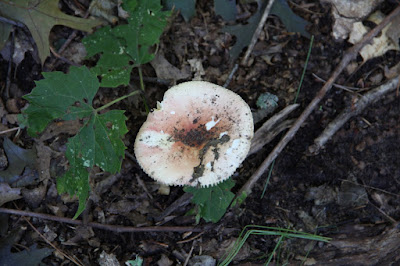
mushrooms: like voters, kept in the dark and covered in manure
This evening we’re planning to attend a meeting of Township residents asking questions about the merger with the City of Stacy proposed by the township board at the annual meeting earlier this month. Since much of what we’ve read leads us to believe that many township residents don’t know what such a merger may mean, or even that it’s been proposed, it should be interesting.
Much of the eastern portions of the township are separated from the City of Stacy by an expanse of Carlos Avery Wildlife Management Area. How could it every be cost effective for the city to provide municipal services such as water and sewer to those residing on the eastern edge of the WMA? The township already has a joint fire department with the city. The entire concept doesn’t seem to be well thought out. There’s a related series of questions regarding whether the county’s southern portion will actually be a growth area if gas reaches $6 or $7 a gallon before electric vehicles have largely replaced the current vehicle fleet.
Stay tuned for further developments, but, if you ever want to feel like you’re not living in a democracy, where your vote is not worth much, buy property in a township that’s considering the board knows best what’s good for the residents and will tell them when it’s ready.
You have to let things
Occupy their own space.
This room is small,
But the green settee

Likes to be here.
The big marsh reeds,
Crowding out the slough,
Find the world good.

You have to let things
Be as they are.
Who knows which of us
Deserves the world more?
********************************************
Thanks for visiting. Come again when you can.
Please be kind
to each other while you can.
Spend too much (any?) time on social media or scanning the home pages of newspapers these days and you may well end up looking like poor Mr. Jack below:
And yet, doom scrolling has become somewhat akin to watching an impending train wreck or rubbernecking past a serious automobile accident. Fortunately, there’s also bits and pieces of, if not absolutely good news, at least better news, but we have to look hard for it. Good news doesn’t draw clicks?
Part of the issues seems to be the expectations we have to begin with and whether they’re derived from a shifting baseline. We suspect, and hope, that during the past five or six years you heard the phrase “don’t normalize it” more than once. Despite my perfectionist tendencies and the problems they cause, I’m sticking with my belief that our society / culture has lowered our expectations much more than we should have. Here’s one example:
No doubt you’ve heard about the tragic shooting and death on the set of the “Rust” movie. There’s been lots of finger pointing around an assistant director informing those on the set about a “cold gun.” According to the gun safety rules I learned when I first started hunting many years ago, that call should have been irrelevant. Recently I was given a handgun as a birthday / father’s day present. The Safety and Instruction manual that came with it documents that the safe gun handling rules I learned long ago still prevail. To quote:
Always keep your firearm pointed in a safe direction.
Always treat every firearm as if it is loaded and will fire.
Never place your finger inside the trigger guard or on the trigger unless you intend to fire.
Always be sure of your target and what is beyond it.
Safe gun handling is your personal responsibility at all times.
You are responsible for the firearm at all times.
Never allow a firearm to be used by individuals who do not understand its safe operation or have not read these firearm safety rules.
Each of the rules above, plus others not cited, is printed in the manual in ALL CAPS RED LETTERS. I haven’t seen reference to any of these rules in any of the articles about the tragedy. From what I have read, compliance with these basic safety precautions was conspicuous by its absence.
At the risk of overreaching a point, a similar criticism can be made these days about our politics, our economics, compliance with most of our basic legal and civic rules and the erosion of our public health and safety. We may not need more laws as much as we need to follow and enforce the ones we have. At the moment, we are suffering too much from the ignorance and tyranny of a minority. Some of the thinking in today’s posting results from an article I read this morning, one with which I don’t entirely agree by believe is worth thinking about. If you’re interested, follow the link to Review: ‘Gunfight, My Battle Against the Industry that Radicalized America’
Thirty years ago, in 1991, the Blandin Foundation turned fifty years old. In anticipation, the Foundation published a book, text by Paul Gruchow, photographs by Jim Brandenburg, title: Images of Home. This morning I skimmed through my copy of that book, which I haven't read for some time, and was startled by the language in the Preface. It certainly didn't evoke the memory of the "good old days" that I recalled. Let me share an excerpt:
In 1991, the Blandin Foundation will celebrate 50 years of service to the people of Minnesota. As we mark this milestone, our state faces a special challenge: the struggle to hold a common purpose in the face of economic realities that threaten to divide and polarize us.
In the countryside, farmers and miners have been battered by more than a decade of bad news.The prospect of a sharp turn away from the farm price support systems of the past 50 years promises continued uncertainty and instability inour rural communities in the near future, whatever effects it might have in the long run.
In the city, corporations are also contending with the difficulties of major restructureing so that they can compete successfully in global markets. And this happens at a time when members of the families that founded our mainstay corporations are stepping aside in favor of professional managers, who may have no particukar commitment to preserving or advancing the Minnesota commonwealth.
So both urban and rural Minnesota are caught up in the tensions of enormous change. At the same time, a growing economic gap threatens to divide rural Minnesotans from their urban cousins, and the wealthiest urbanites from their neighbors, who have not shared in recent income gains....
Doesn't that seem all too familiar? Even without mention of climate change, COVID-19 and variants, vaccines, political parties and lost elections and misinformation and disinformation? It sure looks to me as if we have continued down a misguided path and ended up with even more significantly dysfunctional systems and symptoms thereof.
I moved to Minnesota in the late 1970's, back when it had a reputation as a "state that works." If the Minnesota of today had existed 50 years ago, the state wouldn't even be on the list of places I'd consider as a possible home. Minnesota today does not evoke any images of a place I would want to call home. The economic gap has been publicly joined by a racial gap, a deteriorating environment, a malfunctioning state government with regulatory agencies doing, at best, a poor job of protecting our commons and our most vulnerable and a political system either gridlocked or worse.
The Blandin Preface noted that "...if Minnesota is to work well, it can claim only one interdependent future." We appear to have failed miserably at exercising that claim over the past 30 years, but then so have 49 other states, many greater failures than our own. What do we need to do differently to create the kind of home our children deserve? The current baseline is too deteriorated from what it was a generation ago. We need to find common grounds and restore them.
When we are driving in the dark, on the long road [home], when we are weary, when the buildings and the pines lose their familiar look, I imagine us rising from the speeding car. I imagine us seeing everything from another place– the top of one of the pale dunes, or the deep and nameless fields of the sea. And what we see is a world that cannot cherish us, but which we cherish. And what we see is our life moving like that along the dark edges of everything, headlights sweeping the blackness, believing in a thousand fragile and unprovable things. Looking out for sorrow, slowing down for happiness, making all the right turns right down to the thumping barriers to the sea, the swirling waves, the narrow streets, the houses, the past, the future, the doorway that belongs to you and me.
********************************************
Thanks for visiting. Come again when you can.
Please be kind
to each other while you can.
While skimming through some photos, I noticed that, near the end of September a couple of years ago, the bird bath was covered by a skim coat of ice. The normal high temperature for today, August 28, is 76℉. The normal low: 60. A month later, which is when the photo in question was taken back in 2018, the normal high and low are 66 and 47, respectively. So, the bird bath icing was premature and out of the norm. In light of what passes for normal weather in Minnesota, residents of this state have developed a high degree of tolerance and coping mechanisms. I know I have. What I haven't been able to figure out is if weather exhausts our ability to tolerate and cope with wide differences among people and behavior (Minnesota Nice, anyone?) rather than provide us with the fortitude and serenity to simply accept a number of attitudes and actions we might not adopt or engage in ourselves.
If you've looked around our state, you may have noticed that we include portions of a number of different ecoregions, depending on who's providing the framework. Each of those regions is inhabited by a wide variety of flora and fauna and has significant weather and climate variations. As I was taught after I moved here, that variety is part of the state's strength. If one sector of our economy is down, a different sector in a different part of the state helps hold things together. There's the logging economy and the mining economy and the farming economy and the urban economy and.... Like a healthy ecosystem, we depend on a variety of actors and activities to help meet our needs for clean air, clean water, shelter and healthy food.
And yet, as I've noticed over the past decade or so, Minnesotans seem to be getting less and less tolerant of each other, to the significant detriment of all us who live, work and play here. In fact, it seems to me we've become about as intolerant of each other as our neighboring Wisconsinites are reported to be. I spent a fair portion of the morning looking at summaries and reviews of Katherine Cramer's The Politics of Resentment: Rural Consciousness in Wisconsin and the Rise of Scott Walker. I suppose I'll now have to actually read the book because there's a lot to unpack in it and referring to the source is always advisable. One of my major take-aways though is that the growing fracture between urban and rural perspectives isn't helping any of us. In fact, I was prompted to dig out a book I haven't read for decades, The Intellectual Versus the City. I wondered if the rural folks described by Cramer as resenting the "urban elites" realized that the city has a number of urban detractors also. But, we now live in a world where, for the first time in the history of humans, the majority of us live in an urban area. Much of the world we've created depends on the availability of either a labor force (urban) or natural resources (rural).
Healthy ecosystems derive from interdependence. So do healthy economies and cultures. Much as I dislike cliches, I'm going to close today with one from Minnesota's former Senator, Paul Wellstone. I believe this is true as much as I believe anything: "We all do better when we all do better." I wish more of our politicians believed that. We have an opportunity to do something about it in about 60 days. Do we favor division or distribution? The choice is ours.
John Ashbery wrote a poem that may, or may not, belong on a list like Tony Hoagland's Twenty Poems That Could Save America. We haven't yet decided about that, but we do think that Ashbery's The One Thing That Can Save America belongs with Hoagland's list or any like it.
why are developments named after what they've replaced?
We haven't read much of Ashbery's work. It's only through a book we recently finished that we've come to reconsider Ashbery's poetry. We knew his reputation, but had found his poems excessively cryptic. Matthew Zapruder's Why Poetry nudged us to reconsider by introducing us to and walking us through:
Somehow, the poems on Hoagland's list didn't trigger such questions. They lay dormant. Ashbery not only awakened those questions, his poem also evoked the ghosts of Yeats' The Second Coming. Perhaps we're reading too closely, but we believe the last several lines of Ashbery's "The One Thing..." imply, or at least we infer, that the steps depend on us communicating with our neighbors, honestly, openly, to reach agreement on what we have in common and how we will better manage our differences. The challenges and opportunities facing us are to important to be left to politicians. They belong to us and Shelly's "unacknowledged legislators of the world."
********************************************
Thanks for visiting. Come again when you can.
Please be kind
to each other while you can.
Am Trak wifi internet connections are about non-existent between Boston, MA and Erie, PA and slow and sporadic West of Erie. That's why today's posting will be brief. Plus, it's hard to report on much when you've been in a sleeping compartment for more than 24 hours. And typing is a pain as the car lurches side to side.
We aren't at the "Seen one farm field (or tree, or scrap yard), you've seen them all, but we can better understand how some folks might come to those kinds of assessments. The small towns and cities are different, except where they've been infested by national (global) chains. We're wondering if they reproduce through seeds, or spores, or rhizomes or...?
Is this charmer on "The Range" or in "The Cities?"
Traveling by train, or auto, does give one a better sense of having travelled and of just how large this country is. No wonder we find it hard to get along. We may often agree on the same goals, healthy family, satisfying work, good friends, but have very different ways of attaining those goals. And we don't often understand how those different ways complement or contradict each other.
We have a suggestion for TPT. How about devoting 15 minutes of Almanac each Friday to having on location folks in Greater Minnesota talk about ("Show and Tell") what's important to them and why. Maybe then, the following week, more urban types could respond with how "The Cities" approach the same topic or theme. Maybe that would help more of us get out of our own bubbles. What say you @mlahammer or @CathyWurzer , care to help bridge an urban-rural divide? How do we get more Minnesotans talking about what we have in common?
Upon a lonely mountain, there lived two hermits who worshipped God
and loved one another.
Now these two hermits had one earthen bowl, and this was their only
possession.
One day an evil spirit entered into the heart of the older hermit
and he came to the younger and said, “It is long that we have
lived together. The time has come for us to part. Let us divide
our possessions.”
Then the younger hermit was saddened and he said, “It grieves
me, Brother, that thou shouldst leave me. But if thou must needs
go, so be it,” and he brought the earthen bowl and gave it to him
saying, “We cannot divide it, Brother, let it be thine.”
Then the older hermit said, “Charity I will not accept. I will
take nothing but mine own. It must be divided.”
And the younger one said, “If the bowl be broken, of what use would
it be to thee or to me? If it be thy pleasure let us rather cast
a lot.”
But the older hermit said again, “I will have but justice and mine
own, and I will not trust justice and mine own to vain chance. The
bowl must be divided.”
Then the younger hermit could reason no further and he said, “If
it be indeed thy will, and if even so thou wouldst have it let us
now break the bowl.”
But the face of the older hermit grew exceedingly dark, and he
cried, “O thou cursed coward, thou wouldst not fight.”
********************************************
Thanks for visiting. Come again when you can.
Please be kind
to each other while you can.
Silver bells, silver bells
It's Christmas time in the city
Ring-a-ling, (ring-a-ling) hear them ring (ting-a-ling)
Soon it will be Christmas day
City sidewalks, busy sidewalks
Dressed in holiday style
In the air there's a feeling of Christmas
Children laughing, people passing
Meeting smile after smile
And on every street corner you hear
Silver bells, (silver bells) silver bells (silver bells)
It's Christmas time in the city
Ring-a-ling, (ring-a-ling)
Hear them ring, (hear them ring)
Soon it will be Christmas day
Strings of street lights, even stoplights
Blinkin' bright red and green
As the shoppers rush home with their treasures
Hear the snow crunch, see the kids bunch
This is Santa's big day
And above all this bustle you hear
Silver bells (The corner Santa Claus)
Silver bells (Is busy now because)
It's Christmas time in the city
Ring-a-ling, it fills the winter air
Hear them ring, you hear it everywhere
Soon it will be Christmas day
City sidewalks, busy sidewalks (Silver bells)
Dressed in holiday style (Silver bells)
In the air there's a feeling of Christmas (It's Christmas time in the city)
Children laughing, people passing (Ring-a-ling)
Meeting smile after smile (Hear them ring)
Very soon it will be Christmas day
The Better Half and I headed to St. Paul today. We were past due for a visit to Nina's Cafe, plus, Sixth Chamber books was holding for me a Joy Harjo book of poetry and another one comprised of many of her interviews. We (this is the editorial version) don't get to many of our old hangouts as much as we used to, so it was a pleasant trip with pleasant company to a place that used to be close to a home away from home.
Heading back North after our cappuccinos, we spotted a peregrine falcon land on one of the street lights near the Jackson Street train yards. Not that we're snobs or anything, but a peregrine is a step up from our usual fare of red-tailed hawks. If you quickly check the range map at the Cornell site, you no doubt would question our identification. Instead, go to the ebird sighting and notice that peregrines, though rare, are found in Minnesota. Unfortunately, there's no photo, we were busy driving in traffic.
We need to make it a short and sweet posting this afternoon. We're in the midst of reverting back to baking 5 minute artisan bread, at the request of the Daughter Person. We made the dough before we left this morning and no have the shaped ball rising in our cloche, almost ready to go into the oven. We're hoping this is sort of like riding a bicycle, once you've learned....? Apparently some folks in the family have been "sourdoughed" out. We're grateful that we can accommodate them, especially since we've been thinking that our sourdough bread needs to be a little more sour. If we ever thought we really knew what we were doing, we'd tend to get bored. It's amazing how much variation we can create with different combinations of water, flour, salt, sugar, yeast, sometimes starter, and varying amounts of time and heat. Playing with these ingredients, and a few more, is high on our list for next year. Have you started your 2018 list yet? We're pretty sure ours will include bread baking, poetry, photography, politics, fly-fishing and some local travel, leavened with a dash of flexibility.
Don’t bother the earth spirit
who lives here. She is working on a story. It is the oldest story in
the world and it is delicate, changing. If she sees you watching she
will invite you in for coffee, give you warm bread, and you will be
obligated to stay and listen. But this is no ordinary story. You will
have to endure earthquakes, lightning, the deaths of all those you love,
the most blinding beauty. It’s a story so compelling you may never want
to leave; this is how she traps you. See that stone finger over there?
That is the only one who ever escaped.
********************************************
Thanks for visiting. Come again when you can.
Please be kind
to each other while you can.