Showing posts with label normal. Show all posts

Monday, July 29, 2024

The reign of rain

Well, we now know what it’s like to be the recipient of almost 3.5 inches of rain in less than 24 hours. Just to our west, and again to our south, reported amounts were less than a half inch and a little more than an inch, respectively. One might almost begin to believe the weather has become hyper-volatile, almost as if we were experiencing anthropogenic climate change, but Americans would have to be hyper-gullible enough to vote for a known con man as POTUS, believing that someone inept enough to bankrupt a casino is actually a successful business man, for that to happen, right?

photo of a puddled driveway
this driveway was dry a few hours ago
Photo by J. Harrington

Anyhow, after our overnight deluge, we were visited this morning by a couple of whitetail bucks with antlers in velvet, a doe, a fawn who has lost its spots, and a flock of half a dozen or so turkey hens, but no poults that we could see. Yet another example of feast or famine? Each day there are hours and hours with no signs of wildlife in the fields behind the house other than the birds coming to the feeders. Some seasons, like late autumn through deep winter, there are weeks and months with little, if any, views of critters other than at the feeders.

By this point in the summer last year, we had had almost a couple of dozen days in the 90’s. This year there’s been two. There’s only one more in the ten day forecast. Which year should we consider “normal,”  or dow we average the two as normal? I think I’m trying to raise the issue of times of tempestuous change make it difficult to establish a new baseline that we can at least consider “normal.” Even if meteorologists use something like a 30 year rolling average for some factors, if we continue to experience the “hottest day on record,” year after year, that’s not going to tell us what humans used to consider normal before we created the Anthropocene. We all need to do more to keep context in mind. For more, check shifting baseline.


to the orange still green

Your desire for metamorphosis heard and filed away:
frustration noted, conveyed to proper authorities,
soil and rain. Issues of identity never so labored as today.
I have heard, however, if you hail from Valencia,

it’s quite normal, and as far as dye—why would you
tamper with natural beauty in search of convention, 
in this state where the prophetic sun anoints every
being? Merely for the sake of reinvention?

O Orange, unmatchable trochee except by slant,
by dint of the imagined word, yet to be created,
word of a new world, green world, seamless sphere
content, unbruised by fear of being belated,

join the trend—shed your insecurity, take pride
in the mother country, Brazil, in the year yours arrived
here, 1873, planted by the future scions of Riverside.
Rumor has one of three founding trees still alive,

and that could be your branch, your seed—while my kin
found themselves in Jersey City, trying their damndest 
                                             to speak American.


********************************************
Thanks for visiting. Come again when you can.
Please be kind to each other while you can.

Tuesday, July 23, 2024

What is this “normal” you talk about?

If one considers just some of the events of the past week or two: an attempted assassination of a former present who's campaigning to return to the office; the withdrawal of a current president from campaigning for a second term weeks before the party's nominating convention; a software glitch that created continuing havoc world wide; a state senator threatening civil war if the candidate he supports doesn't win the upcoming presidential election, then apologizing (without retraction?), one might wonder if this IS a new normal and, if not, would one know a new normal if one saw it. The preceding list in far from inclusive and intentionally leaves out environmental issues that are global in scope and grossly under-addressed. The preceding sentences would not have been written if there appeared to be a comparable number of positive events offsetting the negative list.

It appears to me that too many of US are permitting those with a "my way or the highway" perspective to have entirely too much influence and power. How we achieve an appropriate reset remains an open question. I had some concerns about how effective Kamala Harris might be as a candidate until I was reminded of how she questioned Brett Kavanaugh at his confirmation hearing. She might not have made him cry, but she did make him quite uncomfortable. I just hope the Democrats don’t do anything stupid or untoward to mess up the likelihood of the American electorate having an opportunity to display some good taste and common sense. I’d like to avoid a repeat of 1968 in Chicago and 2016 nation-wide.


Little Summer Poem Touching The Subject Of Faith

by Mary Oliver


Every summer
I listen and look
under the sun's brass and even
into the moonlight, but I can't hear

anything, I can't see anything --
not the pale roots digging down, nor the green
stalks muscling up,
nor the leaves
deepening their damp pleats,

nor the tassels making,
nor the shucks, nor the cobs.
And still,
every day,

the leafy fields
grow taller and thicker --
green gowns lofting up in the night,
showered with silk. 

And so, every summer,
I fail as a witness, seeing nothing --
I am deaf too
to the tick of the leaves, 

the tapping of downwardness from the banyan feet --
all of it
happening
beyond any seeable proof, or hearable hum. 

And, therefore, let the immeasurable come.
Let the unknowable touch the buckle of my spine.
Let the wind turn in the trees,
and the mystery hidden in the dirt

swing through the air.
How could I look at anything in this world
and tremble, and grip my hands over my heart?
What should I fear? 

One morning
in the leafy green ocean
the honeycomb of the corn's beautiful body
is sure to be there.


********************************************
Thanks for visiting. Come again when you can.
Please be kind to each other while you can.

Monday, July 8, 2024

What if “highly irregular” becomes the new regular?

The good news is I wasn’t in the midst of yard chores, or standing in a river waving a stick, when the down pour let loose. A few rumbles of thunder, but no lightning that we saw, accompanied the rain. If I had been wading, I probably would have to have fallen into the river to get any more wet than the  “showers” would have left me. Then, it was all over in ten minutes or so. Will there be more today? Who knows? Certainly not the meteorologists who cover themselves in glory with a forecast that includes “isolated thundershowers” or “scattered thunderstorms.” 

photo of a wildflower pasture with yellow, white and purple flowers
our wildflower meadow, late June 2024
Photo by J. Harrington

At the moment, there are no rain events in the 10-day forecast, except for today. The (abnormally) wet weather we’ve had so far this summer created some beautiful patches in the fields behind the house. [see above.] To paraphrase a line from an old Tom Paxton song, “I can’t help but wonder where I’m [it’s] bound.” After all the years we’ve lived here and let much of the property enjoy benign neglect, this summer’s rain has transformed the fields from scraggly grass and sedges into wildflowers and/or weeds, depending on your perspective. What will be growing next year and where are this year’s mulleins? [Until today, I had no idea that mullein has so many medicinal uses.]

Some of us suspect that what we’re seeing this year may be the results of intermittent seedings over the years finally getting enough water to trigger germination. If that’s the case, and we refuse to install an irrigation system, will next summer provide only scruffy grass again? Last summer the extended drought triggered massive fields of yellow flowers in several local wetlands. So far this year, we’ve seen no sign of them but the season’s not over yet.

All of this makes me wonder what life may be like if the “new normal” doesn’t provide regular patterns and rhythms as much as it offers persistent inconsistencies in weather.


Characteristics of Life

A fifth of animals without backbones could be at risk of extinction, say scientists.
—BBC Nature News

Ask me if I speak for the snail and I will tell you
I speak for the snail.
                          speak of underneathedness
and the welcome of mosses,
                                        of life that springs up,
little lives that pull back and wait for a moment.

I speak for the damselfly, water skeet, mollusk,
the caterpillar, the beetle, the spider, the ant.
                                                        I speak
from the time before spinelessness was frowned upon.

Ask me if I speak for the moon jelly. I will tell you
                        one thing today and another tomorrow
        and I will be as consistent as anything alive
on this earth.

                        I move as the currents move, with the breezes.
What part of your nature drives you? You, in your cubicle
ought to understand me. I filter and filter and filter all day.

Ask me if I speak for the nautilus and I will be silent
as the nautilus shell on a shelf. I can be beautiful
and useless if that's all you know to ask of me.

Ask me what I know of longing and I will speak of distances
        between meadows of night-blooming flowers.
                                                        I will speak
                        the impossible hope of the firefly.

                                                You with the candle
burning and only one chair at your table must understand
        such wordless desire.

                                To say it is mindless is missing the point.


********************************************
Thanks for visiting. Come again when you can.
Please be kind to each other while you can.

Wednesday, June 5, 2024

Weather or not, here it comes!

According to a couple of sources, we may, or may not, get an isolated thunderstorm this afternoon. As I thought about it, if the forecast says we may get a thunderstorm or storms, that also conveys the idea we may not get storms. But, if the forecast states that we may not get thunderstorms, does that convey the message that we might? Would it be more effective to just state that the weather will be unsettled for the next several hours?

photo of June sky full of storm clouds
June sky full of storm clouds
Photo by J. Harrington

I started on this line of reasoning (questioning?) when I had an urge to go fly fishing this afternoon and thought I should check river levels due to all the rain we’ve got over the past several days. I found the site with the data for the USGS station on the Kinni, but can’t find a clear context into which to fit the data. That is, what does it mean that the river gauge height is/was slightly over 9 feet? Even if I compare it with last year, I learn that it’s higher this year but how do I know if it’s wadable and/or fishable? This strikes me as being a classic example of the distinction between data and information. The linked photos on the USGS site look like the river is at least bank full and running muddy, conditions less than optimum for fly fishing, but it would be nice to have a clearer baseline.

Closer to home, the wind is gusting enough that I know better than to even consider casting a fly. I’m sure of that  because I’m watching the crowns of a stand of mature oaks toss and turn and twist and bend. The wind is reported to be at 15 mph with gusts to 25. It’s occasionally blowing birds off the feeder perches.

Reports continue to pile up that we’re failing to respond to climate disruption in anything like an adequate fashion. It might be a good idea for each of us to pay more attention, and take notes, to our local weather and what constitutes a baseline for various activities. I’ve noticed some farmers have been very late this year planting some fields. I’m still on a bubble about trying to get a three sisters garden started. Flax seeds we scattered a year or two ago, and had essentially written off, are just blooming this year. Time for each  of us to start a weather journal? How about learning a bit about permaculture?


The “Change” in Climate Change


My cousin WhatsApps me from Costa Rica, fits the family
into the rectangle of video as they wave from the balcony.

He turns the phone, shows me a swirl of birds in the hurting sky.
But they are not birds. They are neighbor Tinoco’s roof tiles

flying in a storm’s rotary energy. My family is calling because
I’m in Oklahoma, which, to them, is synonym for tornado.

Te amo, I say as my cousin lowers the phone for our grandmother
to hear. She’s scared because she’s lived in the town for 80 years

and can’t recognize all these new skies. Because a year before,
a hurricane reaved its way across this country for the first time

in recorded history. Tornado or torbellino or something else,
I ask her about the valley’s strange wind. And she laughs, says

that she was calling to ask me the same thing. I don’t know why
I keep forgetting the change in climate change. My grandmother

sighs as the sky darkens to the color of rum. Why I still think
that we’ll have names for all the things that will come.


********************************************
Thanks for visiting. Come again when you can.
Please be kind to each other while you can.

Monday, April 15, 2024

Spring’s ap-pear-ance varies

A dozen years ago, the back yard pear tree was in bloom on Tax Day. Not this year. Plus, last year the blossoms were more abundant than the pollinators, so there were very few pears come autumn. From a handful of pictures I’ve taken over the years, the pear tree has been in bloom in May more than April. Another example of Minnesota’s erratic spring phenology?

photo of pear tree in bloom on Tax Day
pear tree in bloom on Tax Day
Photo by J. Harrington

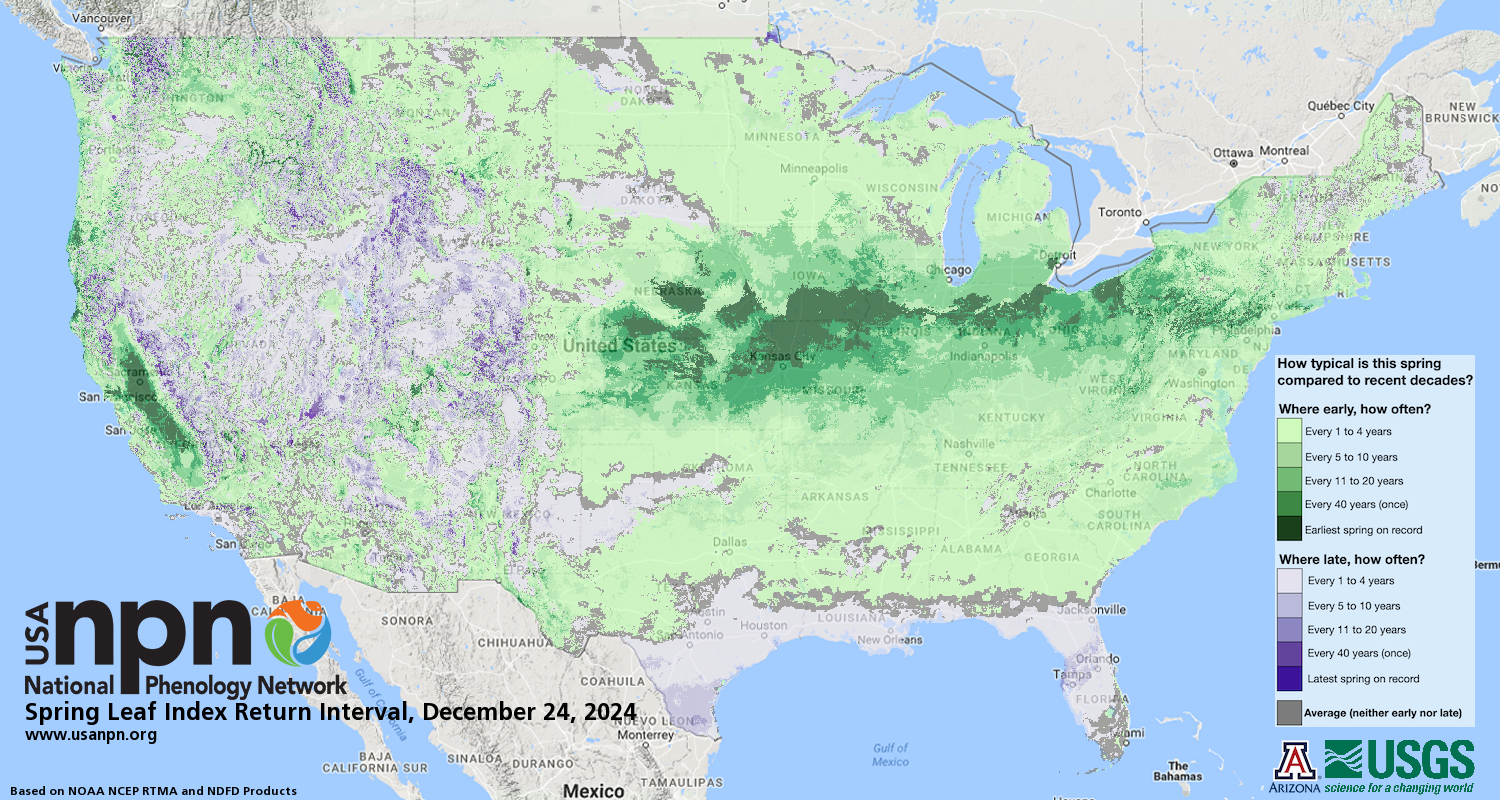
According to the National Phenology Network, spring this year is barely ahead of typical in our region, despite a much milder and less snowy winter than has been typical. That probably means next month is when the majority of wildflowers will be blooming and colorful song birds arriving. Tomorrow’s rain should help green things up in anticipation. On a selfish note, a delayed warmup will provide more opportunities to bake sourdough loaves before it gets too warm to heat up the kitchen. Today’s loaf turned out pretty well.

I’ve noticed that the more I watch for what’s happening, rather than focus on one or two events and wait in anxious anticipation, the more I manage to enjoy the transition of the seasons. That’s kind of how I’ve approached autumn for years, but I tend toward antsy in spring since I really want winter to be gone. Becoming a bread baker hasn’t done much to diminish my aversion to cold and snow.

Since we’re in the midst of National Poetry Month, let me suggest, for your reading pleasure in these taxing times, a volume the Better Half suggested to me the last time we were at a book store, The Wonder of Small Things: Poems of Peace and Renewal. I’m about halfway through and find that reading a handful of its poems in the morning helps ground me for a good part of the day. It also offers a heartening alternative to the daily headlines.


A Blessing


Just off the highway to Rochester, Minnesota,
Twilight bounds softly forth on the grass.
And the eyes of those two Indian ponies
Darken with kindness.
They have come gladly out of the willows
To welcome my friend and me.
We step over the barbed wire into the pasture
Where they have been grazing all day, alone.
They ripple tensely, they can hardly contain their happiness
That we have come.
They bow shyly as wet swans. They love each other.
There is no loneliness like theirs.
At home once more,
They begin munching the young tufts of spring in the darkness.
I would like to hold the slenderer one in my arms,
For she has walked over to me
And nuzzled my left hand.
She is black and white,
Her mane falls wild on her forehead,
And the light breeze moves me to caress her long ear
That is delicate as the skin over a girl’s wrist.
Suddenly I realize
That if I stepped out of my body I would break
Into blossom.


********************************************
Thanks for visiting. Come again when you can.
Please be kind to each other while you can.

Monday, March 25, 2024

A secret spring? A spring secret?

Today is the first day of the last week of March, 2024. The full moon (Ojibwe: Snow Crust Moon; Lakota: Snow Blindness Moon) occurred at 2:00 am this morning. In our neighborhood, it was well hidden by snow clouds. Tonight the aurora may be visible well south of the Arctic Circle, but rain clouds are expected to obscure it/them. As this is typed. heavy, very wet, melting snow covers almost everything outside. More snow is expected tomorrow, after tonight’s rain. By Easter Sunday, the snow may be gone and life returned to local flora. My anticipated wander to look for, or at, emerging skunk cabbage is rescheduled for much later this week or, maybe, Easter Monday.

photo of emerging skunk cabbage
emerging skunk cabbage
Photo by J. Harrington

An updated drought map should be issued later this week. It’ll be interesting to see if there’s any significant change. At the moment, most of Minnesota is rated as low fire danger and much of the state doesn’t require burning permits. Where we are, everything is too wet to burn, although we have several brush piles to be reduced to ashes. Maybe next month.

Meanwhile, there’s been an unusually large number of blue jays around today. I saw more than half a dozen along the driveway after I’d cleared the snow. They’ve been flitting amongst the trees and one even arrived at the bird feeder, which is quite rare in my experience, unless it’s a tray feeder, which ours isn’t. As more and more unusual events occur, I wonder if we’re well past time to redefine “normal.”


Winter: My Secret


I tell my secret? No indeed, not I;
Perhaps some day, who knows?
But not today; it froze, and blows and snows,
And you’re too curious: fie!
You want to hear it? well:
Only, my secret’s mine, and I won’t tell.

Or, after all, perhaps there’s none:
Suppose there is no secret after all,
But only just my fun.
Today’s a nipping day, a biting day;
In which one wants a shawl,
A veil, a cloak, and other wraps:
I cannot ope to everyone who taps,
And let the draughts come whistling thro’ my hall;
Come bounding and surrounding me,
Come buffeting, astounding me,
Nipping and clipping thro’ my wraps and all.
I wear my mask for warmth: who ever shows
His nose to Russian snows
To be pecked at by every wind that blows?
You would not peck? I thank you for good will,
Believe, but leave the truth untested still.

Spring’s an expansive time: yet I don’t trust
March with its peck of dust,
Nor April with its rainbow-crowned brief showers,
Nor even May, whose flowers
One frost may wither thro’ the sunless hours.

Perhaps some languid summer day,
When drowsy birds sing less and less,
And golden fruit is ripening to excess,
If there’s not too much sun nor too much cloud,
And the warm wind is neither still nor loud,
Perhaps my secret I may say,
Or you may guess.


********************************************
Thanks for visiting. Come again when you can.
Please be kind to each other while you can.

Thursday, March 21, 2024

“Winter’s” last g(r)asp?

I know. It seems as though I keep going on about the weather, but let me provide a clear context. Winter season is officially over. It is now spring. All winter of 2023-24, our official snow total was 14.3 inches The forecast is we’ll get more than that amount over the next week or so, mixed with rain. Three months of winter exceeded by one week of spring! Gimme a break!

photo of snow-covered field at sunset 3/22/233
the back yard a year ago
Photo by J. Harrington

Fuel tanks on tractor (diesel) and snow blower (gas) have been topped off. Each has been started. Now we wait and see what comes, hoping most of the precipitation falls as rain. Most of the state is droughty and, until we get wet and green, the fire danger is moderate to high. Early this morning a bird song from a tree in front of the house could have been a territorial defense or a warning to “Get out while you can!” For that matter, the latter, if heeded, is a way of achieving the former. Clever bird.

The dogs, after an essentially snowless winter, are going to be quite disconcerted at having to cope with white stuff all over the ground as they go to take care of business, especially the short-legged beagle, if we actually get the 9 ± inches forecast for Sunday.

Since you’ve stayed with me this long, this confession may come as no surprise at all. By this time of year, almost every year, I’m like a little kid stuck in the back seat for a too long journey. No matter how wonderful the destination, in fact the more wonderful, the more frequent the whiny question: “Are we there yet? When will we get there? I’m tired!!!!” 


Spring Snow


A kind of counter- 
blossoming, diversionary, 

doomed, and like 
the needle with its drop 

of blood a little 
too transparently in 

love with doom, takes 
issue with the season: Not 

(the serviceberry bright 
with explanation) not 

(the redbud unspooling 
its silks) I know I've read 

the book but not (the lilac, 
the larch) quite yet, I still 

have one more card to 
play. Behold 

a six-hour wonder: six 
new inches bedecking the 

railing, the bench, the top 
of the circular table like 

a risen cake. The saplings 
made (who little thought 

what beauty weighs) to bow 
before their elders. 

The moment bears more 
than the usual signs of its own 

demise, but isn't that 
the bravery? Built 

on nothing but the self- 
same knots of air 

and ice. Already 
the lip of it riddled 

with flaws, a sort 
of vascular lesion that 

betokens—what? betokens 
the gathering return 

to elementals. (She 
was frightened 

for a minute, who had 
planned to be so calm.) 

A dripline scoring 
the edge of the walk. 

The cotton batting blown 
against the screen begun 

to pill and molt. (Who 
clothed them out of 

mercy in the skins 
of beasts.) And even 

as the last of the 
lightness continues 

to fall, the seepage 
underneath has gained 

momentum. (So that 
there must have been a 

death before 
the death we call the 

first or what became 
of them, the ones 

whose skins were taken.) 
Now the more- 

of-casting-backward-than-of- 
forward part, which must 

have happened while I wasn't 
looking or was looking 

at the skinning knives. I think 
I'll call this mercy too.


********************************************
Thanks for visiting. Come again when you can.
Please be kind to each other while you can.

Sunday, February 4, 2024

Early Spring in the North Country?

Late last night, early this morning, a golden crescent moon rose behind the bare branches of the neighbor’s trees. It was one of the prettiest sights until sunrise showed the frost coated neighborhood. There was little, if any, hoar frost but lots of standard issue frost. The dogs didn’t seem too impressed as we took our walks, but I was.

As I’ve alluded to in recent posts, it’s challenging to look forward to much with the weather as anomalous as it’s been. On the other hand, I’m finally beginning to treat it as good training for living in and appreciating, as much as possible, the moment. Without naming names, some of us have been noted to spend lots of time focused on everything and anything but the here and now. All told, it seems the most hopeful approach will be to consider the next six to eight weeks as an extended March, with its typical mix of crazy weather shifts. In fact, sometime this week I’m going to collect some dogwood stems and try forcing them to leaf out about a month earlier than we’ve done in years past.

forcing dogwood leafout
Photo by J. Harrington

The Sunrise river is, in part, open water again, for the third or fourth time this winter. We drove over the Mississippi today, north of Minneapolis, it looked to be mostly open. I have no idea when lakes may experience ice out or how that may, or may not, relate to fishing openers. Nor have I taken a look at the National Phenology Network’s Status of Spring, but you can bet I’ll be checking regularly from now on.

My interest in phenology seems to wax and wane. This year it’s waxing and I’ll see if I can get it to stabilize at a higher than normal level.


Instructions on Not Giving Up


More than the fuchsia funnels breaking out
of the crabapple tree, more than the neighbor’s
almost obscene display of cherry limbs shoving
their cotton candy-colored blossoms to the slate
sky of Spring rains, it’s the greening of the trees
that really gets to me. When all the shock of white
and taffy, the world’s baubles and trinkets, leave
the pavement strewn with the confetti of aftermath,
the leaves come. Patient, plodding, a green skin
growing over whatever winter did to us, a return
to the strange idea of continuous living despite
the mess of us, the hurt, the empty. Fine then,
I’ll take it, the tree seems to say, a new slick leaf
unfurling like a fist to an open palm, I’ll take it all.


********************************************
Thanks for visiting. Come again when you can.
Please be kind to each other while you can.

Saturday, February 3, 2024

This new normal doesn’t seem normal

Trust me, I’m NOT complaining about the lack of snow, but it does leave the back yard and the countryside looking shopworn. Another day of cloudy skies doesn’t help. To prove that you can believe I’m NOT complaining, yesterday I fired up the snow blower to be ready, just in case. It went fine.

With what passes for normal weather patterns disrupted for now, I’m noting that the daily highs and lows are what is usually considered good for maple syruping (lows mid 20’s, highs mid 40’s), most years that happens next month. I wonder if this may catch some folks with their syruping buckets down. I’ll keep my eyes open as I wander through the countryside over the next week or so.

barred owl: winter visitor
Photo by J. Harrington

Two years ago we were visited by a barred owl in early February. No sign of any so far this year. Maybe some day soon we’ll at least get to hear a pair calling to each other as part of a mating ritual and I’m not giving up hope of a sighting since many of them have been in March.

I don’t know about you, but I definitely needed a push out of my mechanistic routine into a more organic pattern, I do believe we’ve got one with little sense of what comes next. Good luck to US.


Snowy Night 

by Mary Oliver


Last night, an owl
in the blue dark
tossed
an indeterminate number
of carefully shaped sounds into
the world, in which, 
a quarter of a mile away, I happened
to be standing.
I couldn’t tell
which one it was –
the barred or the great-horned
ship of the air –
it was that distant. But, anyway, 
aren’t there moments
that are better than knowing something, 
and sweeter? Snow was falling, 
so much like stars
filling the dark trees
that one could easily imagine
its reason for being was nothing more
than prettiness. I suppose
if this were someone else’s story
they would have insisted on knowing
whatever is knowable – would have hurried
over the fields
to name it – the owl, I mean.
But it’s mine, this poem of the night, 
and I just stood there, listening and holding out
my hands to the soft glitter
falling through the air. I love this world, 
but not for its answers.
And I wish good luck to the owl, 
whatever its name –
and I wish great welcome to the snow, 
whatever its severe and comfortless
and beautiful meaning. 


********************************************
Thanks for visiting. Come again when you can.
Please be kind to each other while you can.

Monday, January 1, 2024

Happy New Year! How long until new becomes normal?

This winter, or lack thereof until recently, has been unusual compared to the historical record in the North Country, but could well be a version of a “New Normal” according to climate scientists. It’s not only snow that’s been lacking. Most of the local lakes looked almost ice free as we drove past yesterday. With a New Year and the start of winter weather finallly here, there’s a list of neighbors we haven’t seen for weeks, months, or longer. Some examples:

pileated woodpecker, not seen for months
Photo by J. Harrington


barred owl, not seen for a year
Photo by J. Harrington


turkey flock, not seen for a year
Photo by J. Harrington

Not seen for weeks, approaching months, cardinals. Not seen so far this winter, purple finches. I'm not sure if the remarkably warmer weather in 2023 is a major cause of the apparent disappearances or if there’s some other reason for the pattern shift. I am looking forward to seeing at least some of our past neighbors and visitors sometime this month. We’ll report here when and if things start to become whatever may pass for normal. See how much trouble a shifting baseline can cause? Imagine if it started to happen in our politics!


Normalization


This happened long ago, before the onset 
of universal genetic correctness. 

Boys and girls would stand naked before mirrors 
studying the defects of their structure. 

Nose too long, ears like burdocks, 
sunken chin just like a mongoloid. 

Breasts too small, too large, lopsided shoulders, 
penis too short, hips too broad or else too narrow. 

And just an inch or two taller! 

Such was the house they inhabited for life. 

Hiding, feigning, concealing defects. 

But somehow they still had to find a partner. 

Following incomprehensible tastes—airy creatures 
paired with potbellies, skin and bones enamored of salt pork. 

They had a saying then: “Even monsters 
have their mates.” So perhaps they learned to tolerate their partners’ 
flaws, trusting that theirs would be forgiven in turn. 

Now every genetic error meets with such 
disgust that crowds might spit on them and stone them. 

As happened in the city of K., where the town council 
voted to exile a girl 

So thickset and squat 
that no stylish dress could ever suit her, 

But let’s not yearn for the days of prenormalization. 
Just think of the torments, the anxieties, the sweat, 
the wiles needed to entice, in spite of all. 


          Translated by Clare Cavanagh


********************************************
Thanks for visiting. Come again when you can.
Please be kind to each other while you can.

Tuesday, May 2, 2023

Are two seasons enough?

I have read that the ancients only recognized two seasons, summer and winter. This year Minnesota’s weather makes me think we should return to those ancient ways. Last winter was the wettest on record and the third snowiest in our area. Several places set snowfall records. And, for all time records, we only have one month in which it hasn’t snowed.

Another way to look at it is that Minnesotans joke there are only two seasons: winter and road construction. Many of us find that too true to be funny although, with some minor adjustments, it would accurately reflect what’s reported of the ancients.

Spring? Summer? Autumn? Winter?
Photo by J. Harrington

As this is written, we’ve gone from an extended period of below normal temperatures through a three-day phase of well-above normal temps, back to below normal. The upcoming week may begin to approximate seasonal temperatures, or it may not.

We’ve had about twice as much precipitation year to date as normal but are also under a red flag fire watch. A few days with some sunshine will be followed by five days or so of more precipitation starting this coming weekend.

The point I’m working toward is that climate and weather have become too variable and volatile. Trying to use four seasons to pattern our North Country weather is becoming undoable (I think that’s the technical term.). We could simplify things by reverting to Beltane (May 1) as the beginning of summer (light half) and Samhain (end of October/start of November) begins winter (dark half). That seems to match fairly well with road construction and winter. Maybe next legislative session we can get a bill introduced to make life simpler, at least in some ways, and reduce the official seasons to two. They coulld eliminate the daylight savings time change while they’re at it.


Seasons


Clouds so thick 
they put down 
roots 

Young aspen 
practising 
quakers 

Incoming geese 
Periwinkle sign passports 
brings remission with a V 
of the blues 

Feel the sun 
butting the buds 
open 

Blossoms 
Trout lilies nod expand 
they know the sky 
they know 

Lilac 
a scent by which 
we mark the calendar 

Weather report 
May? showers 
By all means and fresh rainbows 
Yes. You May 


2


Crickets 
ventriloquists 
of summer 

Loon cries 
increase the loneliness 
of lakes 

It’s untrue 
They leave that that bats 
to the silence make it darker 
of owls 

Morning warblers 
refresh 
the joy of hearing 

Comes the hedgehog 
And the bumblebee who lives on pins 
non-aerodynamic and needles 
existentialist 

Horses stand 
awash 
in the setting sun 

Anticipate 
Nighthawks if you can 
swoop the firefly’s flash 
gathering the evening 


3


Prophetic winds fill 
the graveyard 
with signposts 

Then a scurry 
of stormspurred 
sparrows 

A lamentation of geese 
Hummingbird leaves in the early 
to cruise dusk 
the Carribean 

Squirrels 
pad 
their acorn accounts 

Cedar waxwing 
Blue jay insists feathered scholar 
it’s never too late knows his berries 
to scold 

Grackle 
predicts a turn 
for the worse 

Flies buzz 
in this cast-iron against the chill 
autumn pane 
stained with rust 


4


Fly husks on sills 
reflect 
the year’s demise 

Ptarmigan advises 
“kuk-kuk-kuk 
go back-goback” 

Deer bundle 
Coyote lingers in the laurel 
to school us thickets 
in survival 

Fashionable spruce 
knows how 
to wear snow 

Strange angels 
Frostfeathers leave their three-D 
lace shadows 
the cabin glass 

Cabin Fever 
medicine 
runs low 

As 
Days does 
begin the woodpile 
to lengthen


********************************************
Thanks for visiting. Come again when you can.
Please be kind to each other while you can.

Sunday, September 18, 2022

What did we know; when did we know it?

 Yesterday we began an exploration of shifting baselines and some questions surrounding what’s normal. This morning my email inbox provided a fantastic example of such shifts. Emergence magazine shared a story on The Great Tree Migration:

Let’s step back to about 14,600 years ago, near the end of the Pleistocene, that phenomenal age of mile-high ice, when glaciers ebbed and flowed over the land. We might notice that as the Laurentide Ice Sheet begins its slow retreat as temperatures warm, spruce trees are flowing up from the south: we watch as pointed evergreens with splays of emerald needles work their way across present-day Maine and southern Quebec, spreading farther into Canada, settling along the rocky slopes and poorly drained soils that were recently carved from the ice. Fast-forward 3,000 years to the beginning of the Holocene. The climate is warmer and drier; the ice sheet is vanishing further; the range of the spruce is now shrinking as the trees are pushed farther northward and replaced by pine to the south. Then, in the mid-Holocene, roughly 6,000 years later, there is a period of drought. Much of the eastern hemlock disappears as the lack of water leaves the trees stressed and vulnerable to the infestation of a pest that overtakes the population. It takes 2,000 years for the hemlock to return. During this time spruce move southward again, settling into roughly the configuration that we find them in today.

In Minnesota, early voting starts soon
Photo by J. Harrington

Someone who read yesterday’s posting noted the issue of normalization affects politics by pointing me to a story in the Los Angeles Review of Books back in 2017: Against Normalization: The Lesson of the “Munich Post”.

And after Trump’s victory I began to follow the debate over how much deference Trump was owed, how much responsibility he had for the hate speech the alt-right morons cheered. Some found solace in the hashtag #notmypresident. David Remnick seemed to have woken the next morning with an especially felicitous gift of disgust, writing: “The fantasy of the normalization of Donald Trump — the idea that a demagogic candidate would somehow be transformed into a statesman of poise and deliberation after his Election Day victory — should now be a distant memory, an illusion shattered.”

We are clearly living in a time of disruption, strife and turmoil. It behooves each of US to carefully consider what we consider acceptable, tolerable and abnormal. There are no “alternative facts,” although there are often alternative interpretations of the same facts. We’d best be sure whether we’re voting for demagogs or statesmanlike leaders as we complete our ballots. Remember, much of North America was once covered by water, also by ice. Do we consider either of those normal?


Let Them Not Say

Let them not say:   we did not see it.
We saw.

Let them not say:   we did not hear it.
We heard.

Let them not say:     they did not taste it.
We ate, we trembled.

Let them not say:   it was not spoken, not written.
We spoke,
we witnessed with voices and hands.

Let them not say:     they did nothing.
We did not-enough.

Let them say, as they must say something: 

A kerosene beauty.
It burned.

Let them say we warmed ourselves by it,
read by its light, praised,
and it burned.

—2014


********************************************
Thanks for visiting. Come again when you can.
Please be kind to each other while you can.

Saturday, September 17, 2022

It’s getting harder every year to be “normal"

Most of last night’s rain passed us by. We won’t know until about this time tomorrow if tonight’s weather will be a repeat. We get along nicely without thunder and lightning, especially SiSi, but we could use more rain. Last time I noticed, we’re about six inches short of “normal” for the year. Perhaps we’ll catch up with the forecast with a La Nina winter, which is usually cooler and wetter than normal around here.

One of these days I want to explore how we establish what’s “normal.” We know that the global climate has been warming for quite some time, but, per NOAA:

NCEI updates the Climate Normals every 10 years, in accordance with the World Meteorological Organization offsite link, which mandates that each of its member nations compute these 30-year averages and recommends an update each decade. The latest 1991–2020 U.S. Climate Normals are an update to the Normals for the previous 3 decades, 1981-2010. 

However, lest we get concerned that regular updates will mask the effects of climate disruption:

To examine long-term climate change, NOAA uses the 20th-century average (1901-2000). If we compare the 1991-2020 annual temperature Normals to the 20th-century average, we see warming everywhere across the map. No region in the U.S. is cooler than it was during the 20th century, and much of the West and Northeast are one to two degrees warmer. The nation’s midsection — from the Gulf of Mexico to the Great Lakes — did not warm as much as other parts of the country due to a 5-to-15% increase in precipitation over the 20th-century average.

All of this has been prompted by my recent adventures exploring “shifting baselines.”  

Coined by Daniel Pauly in 1995, while speaking of increasing tolerance to fish stock declines over generations, SBS also has roots in psychology, where it is referred to as ‘environmental generational amnesia’. Simply put, Shifting Baseline Syndrome is ‘a gradual change in the accepted norms for the condition of the natural environment due to a lack of experience, memory and/or knowledge of its past condition’. In this sense, what we consider to be a healthy environment now, past generations would consider to be degraded, and what we judge to be degraded now, the next generation will consider to be healthy or ‘normal’.

how many “persons” here?
Photo by J. Harrington

From my long ago course in fundamentals of ecology, I seem to recall that organisms can often adapt to change if the rate of change is more gradual. I doubt that will be of much help to our current cold water fisheries (trout and salmon in particular) as they encounter the stresses of climate change. And, if they were successful at adapting, would they still be what we know today as trout and salmon? We’re starting to get very close to questions such as “If a tree falls in the forest, and there’s no one there to hear it, does it make a sound?” The answer to that depends, among other things, on what we mean by “no one,” which, in turn, gets to the definition of who and what we consider persons

Recognizing the rights of nature are modern expressions of long-practised Indigenous laws. Indigenous laws are as diverse as Indigenous cultures yet share an understanding that humans are an integral part of the natural world. These laws emphasize respect for all beings and responsibilities to care for lands and waters. Trees, mountains and plants are relatives, not commodities that can be privately owned and exploited.

Could it be that some baselines are shifting in a direction more positive for our home planet and all who live on it?


Personal History


This was in the year when
a ship took leave of the water
& floated out across the clouds.

When the clouds became
the opened palms of the angels.

The year when the angels strung
their wings across the telephone lines
like laundry drying in the sun.

Only there was no sun.
Not that year.

That came later,
when the children turned first
into horses & then into ghosts,

when the rain fell in love
with a poet,

when the poet forgot his own name
& then the names for everything else.

That was a good year.
A year without names.

A year when I learned to kneel
without my knees ever touching the ground,

& where the gods all prayed to us.

But I am getting ahead of myself.
I should start at the beginning.


********************************************
Thanks for visiting. Come again when you can.
Please be kind to each other while you can.

Monday, November 29, 2021

Whatcha got?

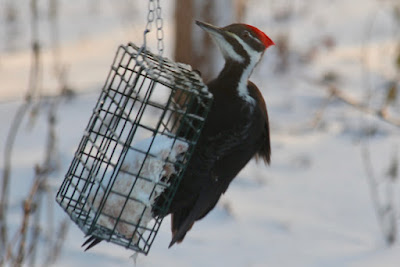
This afternoon a pileated woodpecker visited what’s left of the suet. [Note to self: get more suet soon.] It was the first visit of the season. Woodpeckers and gazillions of black-capped chickadees at the feeders are nice signs of normalcy these days. Temperatures have warmed enough that local waters are opening again. All in all a fairly typical late autumn heading into winter in the North Country.

pileated woodpecker on suet feeder
Photo by J. Harrington

We’re three weeks away from astronomical winter and a little more than a day until the start of meteorological winter. We’re also slightly more than a month away from the end of 2021 and the start of 2022. Part of what I’m wishing for this Christmas is the insight needed to have a more satisfying and joyous year next year than this year has been. I let the COVID and the climate crisis and politics and whatever get to me more than I should. Worst of all, I really have no one to blame but myself. I keep waiting for things to get better instead of making the best I can of what I have to work with.

A few years after the many years ago that I was born, Walt Disney released a movie called So Dear to My Heart. It included a song titled It’s Whatcha Do With Whatcha Got. The lyrics to that song are today’s poem because I suspect many of you may be feeling worn thin, as I am, from one or another, after another, conundrum to deal with. That’s not the way we want to enjoy the holiday season. The words below might help, if we take them to heart.


IT'S WHATCHA DO WITH WHATCHA GOT

Gene Vincent De Paul (m) Don Raye (l) as rec by Kay Starr

It's whatcha do with whatcha got, You never mind how much you've got, It's whatcha do with what you've got That pays off in the end! You gotta add how much you do, Then multiply by what you do; You think you can't win, but you do, And you get that dividend! It's the means you apply it That raises your stock; Look what David did to Goliath With a little old hunk o' rock! It's whatcha do with whatcha got, Never mind how much you've got, It's whatcha do with what you've got That pays off in the end! It's the means you apply it That raises your stock; Look what David did to Goliath With a little old sling and a hunk o' rock! It's whatcha do with whatcha got, Never mind how much you've got, It's whatcha do with what you've got That pays off in the end! Take my advice, brother, I have been through it! It ain't what you do, it's the way that you do it! Once you know how, well there ain't nothin' to it And it pays off in the end!


********************************************
Thanks for visiting. Come again when you can.
Please be kind to each other while you can.
Thursday, October 28, 2021

Shooting my blog mouth off?

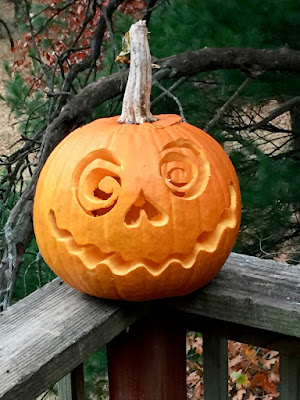
Spend too much (any?) time on social media or scanning the home pages of newspapers these days and you may well end up looking like poor Mr. Jack below:

too much time spent on social media
Photo by J. Harrington

And yet, doom scrolling has become somewhat akin to watching an impending train wreck or rubbernecking past a serious automobile accident. Fortunately, there’s also bits and pieces of, if not absolutely good news, at least better news, but we have to look hard for it. Good news doesn’t draw clicks?

Part of the issues seems to be the expectations we have to begin with and whether they’re derived from a shifting baseline. We suspect, and hope, that during the past five or six years you heard the phrase “don’t normalize it” more than once. Despite my perfectionist tendencies and the problems they cause, I’m sticking with my belief that our society / culture has lowered our expectations much more than we should have. Here’s one example:

No doubt you’ve heard about the tragic shooting and death on the set of the “Rust” movie. There’s been lots of finger pointing around an assistant director informing those on the set about a “cold gun.” According to the gun safety rules I learned when I first started hunting many years ago, that call should have been irrelevant. Recently I was given a handgun as a birthday / father’s day present. The Safety and Instruction manual that came with it documents that the safe gun handling rules I learned long ago still prevail. To quote:

  • Always keep your firearm pointed in a safe direction.
  • Always treat every firearm as if it is loaded and will fire.
  • Never place your finger inside the trigger guard or on the trigger unless you intend to fire.
  • Always be sure of your target and what is beyond it.
  • Safe gun handling is your personal responsibility at all times.
  • You are responsible for the firearm at all times.
  • Never allow a firearm to be used by individuals who do not understand its safe operation or have not read these firearm safety rules.
Each of the rules above, plus others not cited, is printed in the manual in ALL CAPS RED LETTERS. I haven’t seen reference to any of these rules in any of the articles about the tragedy. From what I have read, compliance with these basic safety precautions was conspicuous by its absence.

At the risk of overreaching a point, a similar criticism can be made these days about our politics, our economics, compliance with most of our basic legal and civic rules and the erosion of our public health and safety. We may not need more laws as much as we need to follow and enforce the ones we have. At the moment, we are suffering too much from the ignorance and tyranny of a minority. Some of the thinking in today’s posting results from an article I read this morning, one with which I don’t entirely agree by believe is worth thinking about. If you’re interested, follow the link to Review: ‘Gunfight, My Battle Against the Industry that Radicalized America’ 


Some Rules


by Wendy Cope


Stop, if the car is going “clunk”
Or if the sun has made you blind.
Don’t answer e-mails when you’re drunk.

You fire off something fierce. You’re sunk.
It’s irretrievable. It’s signed.
You feel your spirits going “clunk.”

Don’t hide your face with too much gunk,
Especially if it’s old and lined.
Don’t answer e-mails when you’re drunk.

Don’t live with thirty years of junk—
Those precious things you’ll never find.
Stop, if the car is going “clunk.”

Don’t fall for an amusing hunk, 
However rich, unless he’s kind.
Don’t answer e-mails when you’re drunk.

In this respect, I’m like a monk:
I need some rules to bear in mind. 
Stop, if the car is going “clunk.”
Don’t answer e-mails when you’re drunk.


********************************************
Thanks for visiting. Come again when you can.
Please be kind to each other while you can.