Showing posts with label time. Show all posts

Sunday, March 10, 2024

Captive on the carousel of time*

Our temperatures are consistently running above “normal” while precipitation is sparse to nonexistent. This is likely to present complications for greening up the North Country this spring. The buds on the maple trees in front of the house are beginning to swell but no bud burst yet. Once again local waters are becoming ice free. I’ve lost track whether this is the third or fourth time this year. There’s a better chance this time may last since the Spring Equinox is about a week and a half away and the next few days are forecast to bring high temperatures well into the sixties.

March maple buds beginning to swell
Photo by J. Harrington

We’re watching for signs of maladjustment attributable to our springing ahead an hour early this morning. So far, so good, although the sun’s warmth, when it finally arrives, induces a sleepiness we’re not accustomed to. We expect to adapt over the next few days and look forward to later sunsets bringing longer evenings. I think it’s fair to say that, for most of us, the best two-thirds or three quarters of the year lie ahead.

I’ve actually made some progress getting (some of) my fly fishing gear ready for the season. Two rods have fly lines that have been washed clean and leaders straightened. I discovered that some of my teeny-tiny flies (Tricos) may actually be based on hooks too small to hold a fish. Plus, the eyes are obscured enough that getting the tag end of a tippet through is a) a challenge or b) not doable. Better I should learn these things at home rather than when I’m in the stream and fish are rising.

Please be advised that this coming Thursday, March 14, is reported to be Pi Day. We’re planning on celebrating with French Silk.

[*  The Circle Game]


Baked Goods


Flour on the floor makes my sandals 
slip and I tumble into your arms. 

Too hot to bake this morning but
blueberries begged me to fold them

into moist muffins. Sticks of rhubarb 
plotted a whole pie. The windows

are blown open and a thickfruit tang
sneaks through the wire screen

and into the home of the scowly lady
who lives next door. Yesterday, a man 

in the city was rescued from his apartment
which was filled with a thousand rats. 

Something about being angry because
his pet python refused to eat. He let the bloom 

of fur rise, rise over the little gnarly blue rug, 
over the coffee table, the kitchen countertops

and pip through each cabinet, snip
at the stumpy bags of sugar,

the cylinders of salt. Our kitchen is a riot
of pots, wooden spoons, melted butter. 

So be it. Maybe all this baking will quiet
the angry voices next door, if only

for a brief whiff. I want our summers

to always be like this—a kitchen wrecked
with love, a table overflowing with baked goods
warming the already warm air. After all the pots

are stacked, the goodies cooled, and all the counters
wiped clean—let us never be rescued from this mess. 


********************************************
Thanks for visiting. Come again when you can.
Please be kind to each other while you can.

Wednesday, December 20, 2023

On Winter Solstice eve

Some folks consider tomorrow to be midwinter because it’s halfway between the autumn and spring equinoxes. Others count it as the first day of winter. Tomorrow’s high temperature is expected to be around 42℉. If we really are that warm at midwinter, we’ll be doing well. It’s what happens over the next eight to ten weeks that has me concerned. Unlike woods into which one can only go halfway, in the North Country some winters feel endless. Maybe this one won’t.

Today’s sunshine may be the last glimpse we get for the next week or so. It’s supposed to rain Christmas Eve, Christmas Day, plus the day after. That may help explain why Minnesota’s new state flag is mostly two shades of blue. Water, water everywhere or, as someone posted on social media: “Minnesota is now the LOON STAR STATE!” Look out Texas!

no critter complaints about our weather
Photo by J. Harrington

According to the Minnesota Weather Guide Calendar, sunrise and sunset occur at the same time today and tomorrow. However, the Time and Date web site lists similar times but tomorrow’s day length is four seconds shorter than today's and tomorrow night and Friday morning make up the longest night, I think (YMMV). Since locally days are always within a day, but nights are part of two “days” it does get a bit confusing. I just hope it doesn’t mess up Santa’s schedule next week. He has to stay ahead of, or is it behind?, the sunrise to get his work done. Then he, his elves, reindeer, and all the rest of us should take it easy until next year.


Re-Incarnation


The darkness draws me, kindly angels weep
Forlorn beyond receding rings of light,
The torrents of the earth’s desires sweep
My soul through twilight downward into night.

Once more the light grows dim, the vision fades,
Myself seems to myself a distant goal,
I grope among the bodies’ drowsy shades,
Once more the Old Illusion rocks my soul.

Once more the Manifold in shadowy streams
Of falling waters murmurs in my ears,
The One Voice drowns amid the roar of dreams
That crowd the narrow pathway of the years.

I go to seek the starshine on the waves,
To count the dewdrops on the grassy hill,
I go to gather flowers that grow on graves,
The world’s wall closes round my prisoned will.

Yea, for the sake of the wild western wind
The sphered spirit scorns her flame-built throne,
Because of primroses, time out of mind,
The Lonely turns away from the Alone.

Who once has loved the cornfield’s rustling sheaves,
Who once has heard the gentle Irish rain
Murmur low music in the growing leaves,
Though he were god, comes back to earth again.

Oh Earth! green wind-swept Eirinn, I would break
The tower of my soul’s initiate pride
For a gray field and a star-haunted lake,
And those wet winds that roam the country side.

I who have seen am glad to close my eyes,
I who have soared am weary of my wings,
I seek no more the secret of the wise,
Safe among shadowy, unreal human things.

Blind to the gleam of those wild violet rays
That burn beyond the rainbow's circle dim,
Bound by dark nights and driven by pale days,
The sightless slave of Time’s imperious whim;

Deaf to the flowing tide of dreams divine
That surge outside the closed gates of birth,
The rhythms of eternity, too fine
To touch with music the dull ears of earth—

I go to seek with humble care and toil
The dreams I left undreamed, the deeds undone,
To sow the seed and break the stubborn soil,
Knowing no brightness whiter than the sun.

Content in winter if the fire burns clear
And cottage walls keep out the creeping damp,
Hugging the Old Illusion warm and dear,
The Silence and the Wise Book and the Lamp.


********************************************
Thanks for visiting. Come again when you can.
Please be kind to each other while you can.

Thursday, September 21, 2023

Autumn #phenology

Once again I find myself wondering, if leaf color kept changing every season except bare branch winter, would we still find it as attractive as we do in autumn? I’ve noticed that, near the end of August, the green that was so exciting back in April and May has kind of overstayed its welcome. Is it just me or are we humans restless creatures always wanting more or different or both? As Wallace Stevens notes:

V
I do not know which to prefer,   
The beauty of inflections   
Or the beauty of innuendoes,   
The blackbird whistling   
Or just after.   

Even the pine tree along the drive has needles that are about half gold. They’ll drop and new ones will grow. I’ve not paid much attention to the tamarack swamp recently but when I looked within the past couple of weeks, those needle/leaves were still green. Their gold will come soon and, as Robert Frost informs us: Nothing Gold Can Stay.


leaf color is coming on
Photo by J. Harrington

As long as we’re mentioning not staying, today we saw numbers of flickers, probably those from Canada on their way to warmer, more southerly climes like here, east central Minnesota. (Things I never expected to write.) There are fewer, and fewer, hummingbird females and juveniles at the feeders this week. The males left earlier this month. It couldn’t have been the weather because we’re once again in the 80's today.

Perhaps I should stop analyzing and try to just enjoy the moment while living in it. That is all we ever really have while we’re here, isn’t it?


Fall Song

by Mary Oliver


Another year gone, leaving everywhere
its rich spiced residues: vines, leaves,

the uneaten fruits crumbling damply
in the shadows, unmattering back

from the particular island
of this summer, this NOW, that now is nowhere

except underfoot, moldering
in that black subterranean castle

of unobservable mysteries - roots and sealed seeds
and the wanderings of water. This

I try to remember when time's measure
painfully chafes, for instance when autumn

flares out at the last, boisterous and like us longing
to stay - how everything lives, shifting

from one bright vision to another, forever
in these momentary pastures. 


********************************************
Thanks for visiting. Come again when you can.
Please be kind to each other while you can.

Saturday, December 31, 2022

On the eve of a new year

This year, and a few preceding it, remind me of the opening of Charles Dickens’ A Tale of Two Cities.

It was the best of times, it was the worst of times, it was the age of wisdom, it was the age of foolishness, it was the epoch of belief, it was the epoch of incredulity, it was the season of Light, it was the season of Darkness, it was the spring of hope, it was the winter of despair, we had everything before us, we had nothing before us, we were all going direct to Heaven, we were all going direct the other way--in short, the period was so far like the present period, that some of its noisiest authorities insisted on its being received, for good or for evil, in the superlative degree of comparison only.

That assessment then makes me thing of the proverb “The more things change, the more they stay the same.” That prompts me to remember some of my Christmas presents, literary postcards that came from the Book Elves via the Better Half, or vice versa.

tomorrow brings the dawn of a new year
Photo by J. Harrington

I’ve not read much of Tolstoy so I was pleased to read his observation, printed on a card, that “Everyone thinks of changing the world, but no one thinks of changing themselves.” It seems to me to nicely complement the card with the quotation from T. S. Eliot that “And the end of all our exploring will be to arrive where we started and know the place for the first time.” [If interested, check here.]

Several times over the decade I’ve been posting here I’ve mentioned the poem Desiderata. To see how often, and in what contexts, follow this link. I can think of no better way to close out this year than to hope and pray that Desiderata is true for each of us.


Remember

 - 1951-


Remember the sky that you were born under,
know each of the star's stories.
Remember the moon, know who she is.
Remember the sun's birth at dawn, that is the
strongest point of time. Remember sundown
and the giving away to night.
Remember your birth, how your mother struggled
to give you form and breath. You are evidence of
her life, and her mother's, and hers.
Remember your father. He is your life, also.
Remember the earth whose skin you are:
red earth, black earth, yellow earth, white earth
brown earth, we are earth.
Remember the plants, trees, animal life who all have their
tribes, their families, their histories, too. Talk to them,
listen to them. They are alive poems.
Remember the wind. Remember her voice. She knows the
origin of this universe.
Remember you are all people and all people
are you.
Remember you are this universe and this
universe is you.
Remember all is in motion, is growing, is you.
Remember language comes from this.
Remember the dance language is, that life is.
Remember.


********************************************
Thanks for visiting. Come again when you can.
Please be kind to each other while you can.
Saturday, March 19, 2022

Spring, impending!

 Perhaps we’ve acted prematurely, overly optimistically, but the winter parkas and heaviest coats have been returned to the closet. It’s not that we think we won’t see snow or cold again until late this year, it’s that a week’s worth of consistent thawing and melting has made us willing to take a chance that spring may actually arrivve close to on time and last for more than a week or so this year.

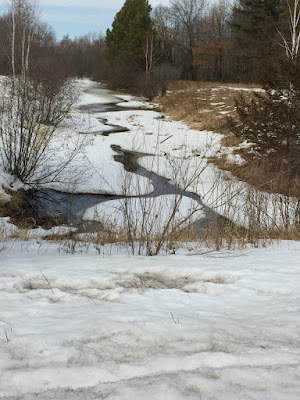
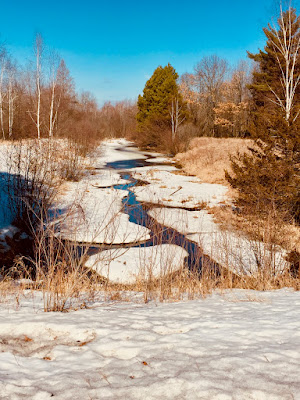
Tomorrow, as all of us in the Northern Hemisphere know, is the Vernal Equinox. Locally, it happens at 10:33 am CDT. But we also know that each  season is a series of progressions that precede and follow specific moments in time. Can you see much difference between the two photos below? They’re of the pond a little north of our property. The one on the left (top) was taken last Thursday. The one on the right (bottom), this morning. Thursday was partly cloudy. Today was sunny. Other than that, is the difference in open water between the two noticeable?


March 17, 2022
March 17, 2022
Photo by J. Harrington
March 19, 2022
March 19, 2022
Photo by J. Harrington


There looks to me to be slightly more open water today, but not an overwhelming amount, unlike the ice and snow disappearing from our driveway. Sometimes natures transitions can be abrupt. More often, they’re gradual and slow. Humans list sunsets and sunrises as specific times, but light grows and fades during dawns and dusk. Remember, the universe, and the earth, function organically. It’s for our convenience that we impose mechanistic frameworks on days, weeks, months and seasons. The Celts observe two seasons, winter and summer.

The Celtic year was divided into two halves, the dark and the light. Samhain was the beginning of the dark half, with its counterpart, Beltane beginning the light half. Between these two 'doors' or portals fell Imbolc, on February 1, and Lughnasadh or Lammas, celebrated on August 1, quartering the Celtic year. These quarters were again divided by the solstices and equinoxes, which were known as the four Albans.

Minnesotans jokingly refer to our two annual seasons as winter and road construction. To reinforce our assessment of how basically arbitrary much of our time and date frameworks are, remember that this week past the US Senate approved, by unanimous consent, legislation that would make daylight savings time permanent. Those with their wits about them, particularly in the medical profession, believe the Senate got it bass-ackwards. Shocking, I know. At least we weren’t around to cope with  the confusion when the annual calendar was changed from Julian to Gregorian.


Even-Keeled and At-Eased


But the truth is, I am Thursday on a Monday. I
Am the walking calendar alive of mixed-up days and dim hours. I have

A week inside of me, a week or a year, time out of order. I have contracted
With the world to behave, to try, hard, to be Monday on a Monday. I

Look like I am happiness, don’t you think? On Monday, to you I have
The right laugh, and seem always to be even-keeled and at-eased.


********************************************
Thanks for visiting. Come again when you can.
Please be kind to each other while you can.
Wednesday, December 29, 2021

An inspiration for the year’s start

Most year’s we take down the Christmas decorations and the tree about the time of the feast of the Epiphany, January 6, when the Three Wise Men visited the Christ child. That dedecoration usually leaves a void that I don’t begin thinking about filling much before Valentine’s. This year we’re going to try something different because two years of pandemic, four years of tRUMP, etc. needs a positive response.

As soon as we can after the decorations come down, we’re going to find floral and/or botanical decorations to replace the Christmas greenery, but probably on a reduced scale. Furthermore, we’re going to treat this as an adventure, not a chore. And, although we’ll lean toward natural, native plants, we’ll approach the search with an open mind and a questing spirit. That change right there will be an improvement over most past January days around here.

a fresh start  in January
a fresh start in January
Photo by J. Harrington

We’re open to cut bouquets or potted plants, or both. When the weather warms we’ll cut our own batches of pussy willow catkins and red osier dogwood, and later, cattails, but for now the options seem to require store bought. Although we have long agreed with Joan Walsh Anglund, that Spring is a New Beginning, we also know that a new year is also a new beginning, or can and should be.


Good Bones


Life is short, though I keep this from my children.
Life is short, and I’ve shortened mine
in a thousand delicious, ill-advised ways,
a thousand deliciously ill-advised ways
I’ll keep from my children. The world is at least
fifty percent terrible, and that’s a conservative
estimate, though I keep this from my children.
For every bird there is a stone thrown at a bird.
For every loved child, a child broken, bagged,
sunk in a lake. Life is short and the world
is at least half terrible, and for every kind
stranger, there is one who would break you,
though I keep this from my children. I am trying
to sell them the world. Any decent realtor,
walking you through a real shithole, chirps on
about good bones: This place could be beautiful,
right? You could make this place beautiful.


********************************************
Thanks for visiting. Come again when you can.
Please be kind to each other while you can.

Wednesday, December 22, 2021

Post solstice solace of space and time

Yesterday was winter solstice, the shortest day and longest night of the year. According to my copy of the Minnesota Weatherguide Engagement Calendar, the sun rose at 7:48 am and set at 4:34 pm. Today the sun rose at the same time as yesterday but sets at 4:35 pm. That doesn’t mean we gained a whole minute. It’s actually as little two seconds if on Tuesday 4:34 was actually 4:34:59 and today’s 4:35 was actually 4:35:01. But that’s not what I’m trying to figure out. Does the extra time come at the beginning, the middle, or the end of the day, or all three? It probably doesn’t make much, if any, difference, but I’ve become curious about whether we’re measuring time or daylight or both and how it works. The twenty-four hours in a day is reported to be comprised of “23 hours, 56 minutes and 4 seconds to complete one rotation and that we round up to 24-hour days. But that additional 3 minutes, 56 seconds takes actually into account Earth’s movement around the sun.” And remember, every four years we add a whole day at the end of February.

where in time-space are the tree lights?
Photo by J. Harrington

So, it appears that our time-keeping is somewhat arbitrary, but not necessarily capricious. Does this have anything to do with Einstein’s time-space continuum? Possibly, according to this description from What is the Space-Time Continuum for Dummies?:

But in a relativistic universe, time cannot be separated from the three dimensions of space. This is because the observed rate at which time passes depends on the velocity of an object relative to the observer. Also, any gravitational field strength slows down the passage of time.

I’m not enough of a physicist or philosopher to actually think I understand all this but the phrase "the observed rate at which time passes depends on the velocity of an object relative to the observer” makes me wonder if there may not be some significance to where in the day the extra light gets added. If you have thoughts about this, feel free to share them in the comments.

I spent part of the morning today helping the Daughter Person assemble some flatpak children’s furniture. I think that trying to follow the instructions may have caused my mind to slip into a different dimension. Plus, more cloudiness and cold is affecting my brain. I believe I need a dose of Alfred and the Chipmunks to get me back on the seasonal straight and narrow.

The Chipmunk Song (Christmas Don’t Be Late)

Alright you Chipmunks, Ready to sing your song?
I'd say we are
Yeah, Lets sing it now!
Okay, Simon?
OK
Okay, Theodore?
OK
Okay Alvin?...Alvin?...ALVIN!!!
OKAY!!

Christmas, Christmas time is near
Time for toys and time for cheer
We've been good, but we can't last
Hurry Christmas, hurry fast

Want a plane that loops the loop
Me, I want a Hula-Hoop
We can hardly stand the wait
Please Christmas don't be late

Ok Fellas, Get ready
That was very good, Simon
Naturally!
Very Good Theodore
He He He He
Uh Alvin, You were a little flat
Watch it, Alvin... Alvin?...ALVIN!!!
OKAY!!

Want a plane that loops the loop
I still want a Hula-Hoop
We can hardly stand the wait
Please Christmas don't be late
We can hardly stand the wait
Please Christmas don't be late


********************************************
Thanks for visiting. Come again when you can.
Please be kind to each other while you can.

Friday, January 8, 2021

As week 1 of 2021 ends

For those of you who may have thought that 2020 was a real shit-show, have you noticed that, so far,  2021's response has been "Hold my beer!" We'll hold off for now on further comments regarding yesterday's activities at the National Capitol. If it seemed hopeful that Democrats won both senate races in Georgia, please be aware that Democratic(?) Senator Manchin (WVA) opposes the proposed $2,000 COVID checks. The current regime is abandoning ship rather than taking action on the 25th Amendment. Congress is deferring action on any impeachment (Republicans still control the Senate). It's less than two weeks until the inauguration, to which tRUMP claims he's not going, and those are just among the more obvious anomalous events during the first week or so of the New Year.


hoarfrost covered pine needles
Photo by J. Harrington

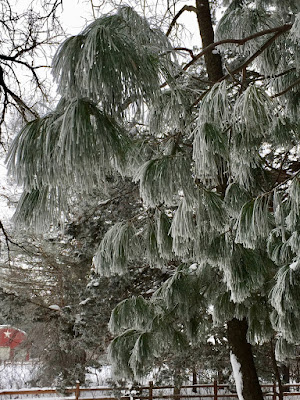
On the local scene, we've experienced about a solid week of clouds, fog and hoar frost covering tree branches and pine needles. It's been a damp, cold, raw week in more ways than one. If it weren't for multitudes of birds at the feeders, the outdoors would look like a drear, drab, dead domain. Meanwhile, rollout of the COVID-19 vaccine is slower than promised and the US its setting new records of the number of COVID-related daily deaths.

On the other hand, we haven't been getting blizzards, polar vortices, or similar North Country Winter weather events. We have a decent supply of coffee and good books to read on hand. Most of the family is mostly healthy. It's only 51 days until meteorological Spring and 70 days until Spring Equinox. Valentines Day is next month. All in all, if we're not making obvious progress, we may at least be holding our own. Sometimes, that's the most we can hope for.


Counting Blessings


 - 1946-


Joseph and Margaret Cavanaugh, ca. 1847

There’s Bridget and Michael and Catherine and Ann,
there’s Francis X., Moira, Theresa, and Sean:
none of them shivering, everyone fed,
head to feet sleeping, four butts to a bed.


The 1845 Irish potato crop failure resulted in widespread famine. More than one million Irish people—one out of every nine—died. Hundreds of thousands emigrated to England, Scotland, and the New World. Mortality rates of up to 30% were common on the “coffin ships” crossing the Atlantic.


********************************************
Thanks for visiting. Come again when you can.
Please be kind to each other while you can.
Saturday, June 20, 2020

Welcome to Summer, solstice!

Today, in the Northern hemisphere, the sun will reach its most northerly point at 4:23 this afternoon, our local time. If we stop to think about it, for one half of the year, the days get longer. For the other half, they get shorter. There is no extended period when they are all the same length. Things, including daylight and length of night, are always changing. And yet, unless we are among the relative few whose days are actually governed by the length of daylight, we pay little or no attention to anything but artificial time measured by mechanical or electric clocks.

Summer solstice, the dawning of a new season
Photo by J. Harrington

The (quasi-)mechanical portrait of our solar system that I was taught about in grammar school may have been an improvement over the concept that the sun revolved around the earth, but does it fit with the concept that "our" universe is expanding? Sometimes I ponder such questions as I pull buckthorn. Occasionally I wonder about them instead of pulling buckthorn. If I overindulge in heat, humidity, stubborn buckthorn, and bugs, I can do unhealthy things to my blood pressure.

a solstice celebration
Photo by J. Harrington

With luck, and some cooperation from the weather, this evening we'll celebrate the solstice by ignighting the brush pile (of mostly buckthorn) in the back yard. Perhaps some friends, whom we haven't seen in too long, may stop by. We'll maintain proper social distances. Some, perhaps all, of us will wear face masks. COVID-19 is slowly becoming but another speed bump in our lives' highways. Its repercussions may be more serious than the slowly healing tick bite on my leg, but with proper precautions and some luck, neither ticks, nor mosquitos nor COVID-19 will result in premature termination of our journey. Would you think Summer's heat had melted my brain if I asked "What was there before the big bang went boom?" May today's solstice bring us Northerners an enjoyable, healthy and safe Summer.

Solstice


How again today our patron star
whose ancient vista is the long view

turns its wide brightness now and here:
Below, we loll outdoors, sing & make fire.

We build no henge
but after our swim, linger

by the pond. Dapples flicker
pine trunks by the water.

Buzz & hum & wing & song combine.
Light builds a monument to its passing.

Frogs content themselves in bullish chirps,
hoopskirt blossoms

on thimbleberries fall, peeper toads
hop, lazy—

            Apex. The throaty world sings ripen.
Our grove slips past the sun’s long kiss.

We dress.
We head home in other starlight.

Our earthly time is sweetening from this.


********************************************
Thanks for visiting. Come again when you can.
Please be kind to each other while you can.

Tuesday, June 16, 2020

May the bluebird of happiness fly up your father's nose

Three days of temperatures at or near 90℉ several days prior to reaching Summer solstice makes me glad that the meteorologists started Summer on June 1st. I don't think I'd want to live where it climbs up to the 90's in Springtime.

We have an interesting weekend coming up. Summer solstice occurs on Saturday and Father's Day is on Sunday. We'll visit our son midday and our daughter at dinner time, maintaining appropriate social distancing and masking protocols. As our children have turned into adults, I find that, in addition to loving them as a parent, I like them as people. That's one of the nicest Father's Day presents I've ever received. We've been blessed that neither of our children has ever given us the amount  of grief and aggravation I caused my parents. Fortunately, I've gotten both a lot older and a little wiser since I was a teenager, sort of like Dylan's persona in My Back Pages. One of the interesting surprises of aging is that, instead of outgrowing them, I've come to appreciate most of Dylan's lyrics more and more each year. I suspect that says a lot more about his songwriting than it does about me.

bluebird on young pine
Photo by J. Harrington

We've not yet got around to replacing the bluebird house a bear took down last year. Despite a missing house, I believe I've seen a bluebird a couple of times this past week or so. Even in our current hot spell, I can make sure we set the replacement far enough from the lilac bush to allow the mower deck to easily pass between the lilac and the 4" X 4" replacement pole on which the box will be mounted. It's looking like this may be another year when we won't get to play with a Three Sisters' garden (still no sign of a repaired tiller), but there's no end of other projects that can use some attention and elbow grease. I'm even slowly learning to live with the idea that I'll never actually be "done" so I need to sit back and relax regardless.

May those of you who are able enjoy your fathers and your children, not just this coming weekend but every day. Each of us is here for such a short visit we can't afford to miss any opportunities to enjoy each other.

Landscape, Dense with Trees


When you move away, you see how much depends
on the pace of the days—how much
depended on the haze we waded through
each summer, visible heat, wavy and discursive
as the lazy track of the snake in the dusty road;
and on the habit in town of porches thatched in vines,
and in the country long dense promenades, the way
we sacrificed the yards to shade.
It was partly the heat that made my father
plant so many trees—two maples marking the site
for the house, two elms on either side when it was done;
mimosa by the fence, and as it failed, fast-growing chestnuts,
loblolly pines; and dogwood, redbud, ornamental crab.
On the farm, everything else he grew
something could eat, but this
would be a permanent mark of his industry,
a glade established in the open field. Or so it seemed.
Looking back at the empty house from across the hill,
I see how well the house is camouflaged, see how
that porous fence of saplings, their later
scrim of foliage, thickened around it,
and still he chinked and mortared, planting more.
Last summer, although he’d lost all tolerance for heat,
he backed the truck in at the family grave
and stood in the truckbed all afternoon, pruning
the landmark oak, repairing recent damage by a wind;
then he came home and hung a swing
in one of the horse-chestnuts for my visit.
The heat was a hand at his throat,
a fist to his weak heart. But it made a triumph
of the cooler air inside, in the bedroom,
in the maple bedstead where he slept,
in the brick house nearly swamped by leaves.


********************************************
Thanks for visiting. Come again when you can.
Please be kind to each other while you can.

Saturday, April 25, 2020

In anticipation! and welcome!

With less than a week left in April, I'd say it's officially "late April." According  to Minnesota Seasons, that means we can anticipate the arrival of male ruby-throated hummingbirds anytime soon. As much as I love the arrival of waterfowl and wading birds such as Canada geese and sandhill cranes, I am constantly delighted and amazed by the arrival of tiny sparks of life embodied in hummingbirds.

male ruby-throated hummingbird, mid-May
Photo by J. Harrington

If we get a  foot or so of snow anytime over the next couple of weeks, feel free to blame me and the hummingbirds for  our  optimism. I filled and hung a couple of feeders, based largely on the report of a hummingbird having been sighted today at Maiden Rock, WI.

Journey North web site

It'll probably be a week or two, or more, before a grape jelly feeder goes up for Baltimore orioles, but it's really encouraging to feel that we're coming into Spring instead of just out of Winter. Turning that corner at the end of this years Earth Week, more of us may be able to admit that some things in this world simply arrive as gifts and our responsibility is to pay attention and enjoy them and be thankful that they're sharing their lives with ours.

Think about this for a moment: in a universe whose very existence some find improbable, during a span of time beyond my comprehension, an improbable life such as mine, or yours, crosses that of an even less probable hummingbird so sometimes both arrive together in the same place and the same time in an impossibly huge universe is miraculous, isn't it? Looking at the size and duration of the universe, what's the probability of you or I seeing a hummingbird within arm's reach? But it happens. It's a gift from the universe to us.

“Hummingbirds”


by Mary Oliver


The female, and two chicks,
each no bigger than my thumb,
scattered,
shimmering
in their pale-green dresses;
then they rose, tiny fireworks,
into the leaves
and hovered;
then they sat down,
each one with dainty, charcoal feet –
each one on a slender branch –
and looked at me.
I had meant no harm,
I had simply
climbed the tree
for something to do
on a summer day,
not knowing they were there,
ready to burst the ledges
of their mossy nest
and to fly, for the first time,
in their sea-green helmets,
with brisk, metallic tails –
each tulled wing,
with every dollop of flight,
drawing a perfect wheel
across the air.
Then, with a series of jerks,
they paused in front of me
and, dark-eyed, stared –
as though I were a flower –
and then,
like three tosses of silvery water,
they were gone.
Alone,
in the crown of the tree,
I went to China,
I went to Prague;
I died, and was born in the spring;
I found you, and loved you, again.
Later the darkness fell
and the solid moon
like a white pond rose.
But I wasn’t in any hurry.
Likely I visted all
the shimmering, heart-stabbing
questions without answers
before I climbed down.


********************************************
Thanks for visiting. Come again when you can.
Please be kind to each other while you can.

Wednesday, January 1, 2020

Happy New Year! May your daze be full of beauty!

New years come infrequently.

New decades even more so.

Each day, though, begins with a new morning.

How we spend our days is, of course, how we spend our lives...."
― Annie Dillard, The Writing Life 


Winter dawn
Winter dawn
Photo by J. Harrington

Morning Poem


Every morning
the world
is created.
Under the orange

sticks of the sun
the heaped
ashes of the night
turn into leaves again

and fasten themselves to the high branches ---
and the ponds appear
like black cloth
on which are painted islands

of summer lilies.
If it is your nature
to be happy
you will swim away along the soft trails

for hours, your imagination
alighting everywhere.
And if your spirit
carries within it

the thorn
that is heavier than lead ---
if it's all you can do
to keep on trudging ---

there is still
somewhere deep within you
a beast shouting that the earth
is exactly what it wanted ---

each pond with its blazing lilies
is a prayer heard and answered
lavishly,
every morning,

whether or not
you have ever dared to be happy,
whether or not
you have ever dared to pray.

from Dream Work (1986) by Mary Oliver


********************************************
Thanks for visiting. Come again when you can.
Please be kind to each other while you can.

Friday, June 14, 2019

The future is now

As noted elsewhere, we are a recovering planner who spent most of a career focused on envisioning and facilitating the creation of various futures for someone, somewhere. We were pleased when we first came across William Gibson's saying "The future is already here, it's just not evenly distributed." Then, several years ago, we came across, and read, one of Wendell Berry's essays that argues To Save the Future, Live in the Present . In it, toward the end, he notes:
Or maybe we could give up saving the world and start to live savingly in it. If using less energy would be a good idea for the future, that is because it is a good idea. The government could enforce such a saving by rationing fuels, citing the many good reasons, as it did during World War II. If the government should do something so sensible, I would respect it much more than I do. But to wish for good sense from the government only displaces good sense into the future, where it is of no use to anybody and is soon overcome by prophesies of doom. On the contrary, so few as just one of us can save energy right now by self-control, careful thought, and remembering the lost virtue of frugality. Spending less, burning less, traveling less may be a relief. A cooler, slower life may make us happier, more present to ourselves, and to others who need us to be present. Because of such rewards, a large problem may be effectively addressed by the many small solutions that, after all, are necessary, no matter what the government might do. The government might even do the right thing at last by imitating the people.
dame's rocket: beautiful, fragrant, nonnative, invasive, blooming now
Photo by J. Harrington

We confess that, since we've spent most of our adult life future-oriented, and have become convinced that responding to climate breakdown cannot be done effectively on an individual basis, we have been more than skeptical toward Mr. Berry's insights despite our predilection for Gibson's observation. Then, earlier this week, we started reading a book titled Spiral to the Stars, Mvskoke Tools of Futurity, by Laura Harjo. It was given to us as a birthday present from our son. Imagine our surprise when we read, in the first chapter, the following:
... As community builders, we often ask tactical sets of questions to develop a concrete plan, and then tell people that they are going to have to sit and wait, knowing that conditions will not improve in their time: their dreams will be for someone else. In other words we tell them "not yet." We cannot say "not yet." I am not eschewing a long view of community; I am merely saying that futurity does not have to be limited to a future temporality, in which we have to wait to create and get to the place we want to be. ...
Harjo's perspective is, for our purposes, close enough to Berry's that we were reminded of the old joke about how, if someone calls you a donkey, ignore them. If two people call you a donkey, look for a saddle. We also recall the proverb to the effect that the longest journey is started with a single step. It's possible, no, probable, that we need to give serious consideration to how we can incorporate Berry's and Harjo's guidance into our worldview. Harjo, as far as we know, no relation to one of our favorite poets, Joy Harjo, tells us that one of Joy Harjo's poems offers "a call to action." What do you think?

A Map to the Next World


By Joy Harjo


                  for Desiray Kierra Chee 

In the last days of the fourth world I wished to make a map for
those who would climb through the hole in the sky.

My only tools were the desires of humans as they emerged
from the killing fields, from the bedrooms and the kitchens.

For the soul is a wanderer with many hands and feet.

The map must be of sand and can’t be read by ordinary light. It
must carry fire to the next tribal town, for renewal of spirit.

In the legend are instructions on the language of the land, how it
was we forgot to acknowledge the gift, as if we were not in it or of it.

Take note of the proliferation of supermarkets and malls, the
altars of money. They best describe the detour from grace.

Keep track of the errors of our forgetfulness; the fog steals our
children while we sleep.

Flowers of rage spring up in the depression. Monsters are born
there of nuclear anger.

Trees of ashes wave good-bye to good-bye and the map appears to
disappear.

We no longer know the names of the birds here, how to speak to
them by their personal names.

Once we knew everything in this lush promise.

What I am telling you is real and is printed in a warning on the
map. Our forgetfulness stalks us, walks the earth behind us, leav-
ing a trail of paper diapers, needles, and wasted blood.

An imperfect map will have to do, little one.

The place of entry is the sea of your mother’s blood, your father’s
small death as he longs to know himself in another.

There is no exit.

The map can be interpreted through the wall of the intestine—a
spiral on the road of knowledge.

You will travel through the membrane of death, smell cooking
from the encampment where our relatives make a feast of fresh
deer meat and corn soup, in the Milky Way.

They have never left us; we abandoned them for science.

And when you take your next breath as we enter the fifth world
there will be no X, no guidebook with words you can carry.

You will have to navigate by your mother’s voice, renew the song
she is singing.

Fresh courage glimmers from planets.

And lights the map printed with the blood of history, a map you
will have to know by your intention, by the language of suns.

When you emerge note the tracks of the monster slayers where they
entered the cities of artificial light and killed what was killing us.

You will see red cliffs. They are the heart, contain the ladder.

A white deer will greet you when the last human climbs from the
destruction.

Remember the hole of shame marking the act of abandoning our
tribal grounds.

We were never perfect.

Yet, the journey we make together is perfect on this earth who was
once a star and made the same mistakes as humans.

We might make them again, she said.

Crucial to finding the way is this: there is no beginning or end.

You must make your own map.


********************************************
Thanks for visiting. Come again when you can.
Please be kind to each other while you can.

Saturday, April 21, 2018

Poetry saving America Day 21 #NationalPoetryMonth

We have searched wide and deep on the internet and have not uncovered anything Tony Hoagland has written about C.D. Wright's "Our Dust" that would account for his listing it as the last of Twenty Poems That Could Save America. Furthermore, we have no prior experience with C.D. Wright's poetry, at least none we can recall. We'll have to start with the words on the page--what the poet actually wrote.

Our Dust by C. D. Wright


Our Dust

I am your ancestor. You know next-to-nothing
about me.
There is no reason for you to imagine
the rooms I occupied or my heavy hair.
Not the faint vinegar smell of me. Or
the rubbed damp
of Forrest and I coupling on the landing
en route to our detached day.

You didn’t know my weariness, error, incapacity,
I was the poet
of shadow work and towns with quarter-inch
phone books, of failed
roadside zoos. The poet of yard eggs and
sharpening shops,
jobs at the weapons plant and the Maybelline
factory on the penitentiary road.

A poet of spiderwort and jacks-in-the-pulpit,
hollyhocks against the tool shed.
An unsmiling dark blond.
The one with the trowel in her handbag.
I dug up protected and private things.
That sort, I was.
My graves went undecorated and my churches
abandoned. This wasn’t planned, but practice.

I was the poet of short-tailed cats and yellow
line paint.
Of satellite dishes and Peterbilt trucks. Red Man
Chewing Tobacco, Black Cat Fireworks, Triple Hut
Creme Soda. Also of dirt dobbers, nightcrawlers,
martin houses, honey, and whetstones
from the Novaculite Uplift. What remained
of The Uplift.

I had registered dogs 4 sale; rocks, dung,
and straw.
I was a poet of hummingbird hives along with
redhead stepbrothers.

The poet of good walking shoes—a necessity
in vernacular parts—and push mowers.
The rumor that I was once seen sleeping
in a refrigerator box is false (he was a brother
who hated me).
Nor was I the one lunching at the Governor’s
mansion.

I didn’t work off a grid. Or prime the surface
if I could get off without it. I made
simple music
out of sticks and string. On side B of me,
experimental guitar, night repairs and suppers
such as this.
You could count on me to make a bad situation
worse like putting liquid make-up over
a passion mark.

I never raised your rent. Or anyone else’s by God.
Never said I loved you. The future gave me chills.
I used the medium to say: Arise arise and
come together.
Free your children. Come on everybody. Let’s start
with Baltimore.

Believe me I am not being modest when I
admit my life doesn’t bear repeating. I
agreed to be the poet of one life,
one death alone. I have seen myself
in the black car. I have seen the retreat
of the black car.

whose ancestors lived or worked here?
Photo by J. Harrington

Our first thought is this is a poem of working America, rural America, too often forgotten America, the "wrong side" of both the tracks and the digital divide. Our second thought is that this poem is to rural America what Phillip Levine is to urban American, especially Detroit. Our third thought is "why didn't Tony Hoagland include any of Levine's poems in his list of twenty?

We absolutely agree that America, and Americans, need more poems like this, written by those who have "been there, done that." We should not leave poems and poets like this in our dust. They should be kept alive and part of our own vernacular. As Wendell Berry notes: “If you don't know where you're from, you'll have a hard time saying where you're going.” If you enjoyed this poem, you might want to take a look at William Least Heat-Moon's Blue Highways and Blue Highways Revisited, a photo journal of Heat-Moon's trip. Each of these, although prose more than poetry, shows us much of what's worth saving about America and Americans.

Thanks for following our thoughts on Tony Hoagland's Twenty Poems That Could Save America. We'll explore some similar themes during the rest of National Poetry Month. We may also get back to some phenology reports as the last of our snow melts and Spring temperatures finally reach our North Country.

********************************************
Thanks for visiting. Come again when you can.
Please be kind to each other while you can.

Saturday, May 20, 2017

Falling rain rarely hurries #phenology

This morning, driving through the rain, I started to wonder where the phrase "April showers bring May flowers" came from. It certainly doesn't seem to be a particularly good fit for our North Country where, with maybe some local exceptions, May receives more precipitation than April and June more than May. That's also reflected in the increased abundance of wild flower blossoms from April to May to June. The proverb is reported to have originated in England and is first found in Chaucer's Canterbury Tales. Native Americans appear to have no comparable saying in their naming of the moons. [If you find one I missed, please let me know.]

Cascade Falls, Osceola Creek
Photo by J. Harrington

The St. Croix River levels are listed as high or very high. The rain we've been getting has to go somewhere and one of a river's main jobs is to return to the sea rain that falls in its watershed. The wet conditions have, I'm guessing, also brought high water to many of the trout streams I'd otherwise have been visiting. "May showers bring June's falling water levels" doesn't have quite the same ring to it as "April showers ...", does it?

Spring rain
Spring rain
Photo by J. Harrington

One of the nice fringe benefits about fishing in general and trout fishing in particular is that almost always it gets participants into pretty, and often beautiful, country. A week or so ago, when the Better Half and I were searching for a relatively nearby trout stream, we discovered it ran at the base of a hillside abundantly covered with trillium. Spending more time on William Least Heat Moon's Blue Highways and local gravel roads leads to rewarding discoveries of beauty, delight and satisfaction not available to those always in a hurry to get somewhere. One of the pleasures of bioregionalism and zen is learning to enjoy and appreciate where you're at. These days I realize I'm surrounded by a lot more beauty than I've taken time to notice and appreciate. Is that true of you, too?

Hurry


By Marie Howe


We stop at the dry cleaners and the grocery store   
and the gas station and the green market and   
Hurry up honey, I say, hurry,   
as she runs along two or three steps behind me   
her blue jacket unzipped and her socks rolled down.   

Where do I want her to hurry to? To her grave?   
To mine? Where one day she might stand all grown?   
Today, when all the errands are finally done, I say to her,   
Honey I'm sorry I keep saying Hurry—   
you walk ahead of me. You be the mother.   

And, Hurry up, she says, over her shoulder, looking   
back at me, laughing. Hurry up now darling, she says,   
hurry, hurry, taking the house keys from my hands.


********************************************
Thanks for visiting. Come again when you can.
Please be kind to each other while you can.

Monday, December 29, 2014

Time's up

Are you looking forward to next year? I am. 2014 has been a pretty good year for us so far, but some things that I started this year I hope will really come together in 2015. Some opportunities I missed this year will reappear next. (Who knew the Hinckley Fire Museum closed during the Winter?) I'll admit to not having made the most of each and every moment this past year, but I'm improving. One of the discoveries I've made is that achieving a balance between repeatedly doing things I know I'll enjoy and starting new things I haven't yet tried is a pretty constant challenge. With the cold returned this morning and the cloud cover mostly gone, I did notice that today's sunrise looked a lot like the one from about this time last year.

late December, Winter sunrise
Photo by J. Harrington

Recently, I checked Alan Lightman's book, The Accidental Universe: The World You Thought You Knew, out of the library and started reading it. In his essay on The Temporary Universe, he mentions a duration of "ten billion billion years," which may or may not be little more than theoretically interesting, since our sun has but some 5 billion years to go before it flames out. I'm reading the book and thinking about time as part of an effort to try to understand what we can realistically mean by "sustainable." Loosely, it means we can continue doing something forever, which is more than "ten billion billion years." Clearly, that has essentially no meaning in human terms. Conversely, I believe we're also doing ourselves and our descendants irreparable harm with our fixation on short term profits, measured each three months. The wisdom of the Native American--Onondaga Nation focus on having "always in view not only the present but also the coming generations" -- which has been phrased as "...to make every decision that we make relate to the welfare and well-being of the seventh generation to come. . . ." is starting to become apparent. It gives us a time frame of about 140 to 175 years, sustainable for less than forever, but within a framework we humans can try to comprehend. If each succeeding generation uses the same time frame for its decisions, we humans might be around long enough to watch our sun grow cold. If not, ..? Something to think about next year, right? Or while we read Ms. Dickenson's lines.

Forever – is composed of Nows – (690)

By Emily Dickinson 

Forever – is composed of Nows –
‘Tis not a different time –
Except for Infiniteness –
And Latitude of Home –

From this – experienced Here –
Remove the Dates – to These –
Let Months dissolve in further Months –
And Years – exhale in Years –

Without Debate – or Pause –
Or Celebrated Days –
No different Our Years would be
From Anno Dominies –


********************************************
Thanks for visiting. Come again when you can.
Please be kind to each other while you can.