Some leaf bud scales have dropped. Our day lilies are a couple of inches tall. A few flowers have appeared in the front flower bed. Hints of leaves-to-be have appeared on the lilac bushes. Spring is getting sprung. This morning, in the dark early, we got about an inch of snow. Friday the wind chill was in the low teens. Such is Spring in our North Country.
The local high temperature forecast for Earth Day is 85℉, which will be about 40 ℉ higher than this weekend's highs. Clearly, the flora and fauna of our North Country have to be highly adaptable, resilient and regenerative. That includes us Homo saps. We'll head north or south, east or west, depending on the extant of the glacial and oceanic coverage, as the climate responds to our abuse of Earth's gifts.
If I had one wish that the Earth Fairies could grant me for Earth Day this year, it would be that everyone, everywhere, read, remember, adopt the philosophy and follow the guidance of Braiding Sweetgrass and The Serviceberry. My intent to celebrate Earth Day is to get out to somewhere near the St. Croix River, park my butt, be quiet, and pay attention to my surroundings. I'll hope to experience some awe and remember to feel gratitude for living in a basically beautiful region that I keep taking for granted because it's there every day.
May you enjoy the week and make every day an Earth Day.
Last week we saw a very rare occurrence for Minnesota in mid-February: not one but two separate and distinct motorcycles were on the road last Saturday! We've be experiencing an extended, unseasonably warm spell for about a week now, with several daytime high temperatures approaching or exceeding 50℉. Much of the snow on the driveway has melted down to the ice layer that was laid down last month with freezing rain. It will be interesting to see if most of the ice melts before it rains and snows later this week. This is not your grandpa's average North Country winter. However, the weather this past week does have me believing that spring iis not just a hypothetical possibility.
I'm getting close to finishing reading All We Can Save: Truth, Courage, and Solutions for the Climate Crisis. Over the weekend I read Judith D. Schwartz' essay "Water Is a Verb." In part it restated a theme from Hydrate the Earthas a significant solution to our emergent climate crisis. Agriculture and land management are affected by climate change, but the hydrologic cycle and the ability of plants and healthy soil to function as carbon sinks has not been given enough attention of an appropriate type.
Similar perspective adjusting themes are found in Paul Hawken's Carbon and Erica Gies' Water Always Wins. Each of the preceding sources helps us look through the correct end of the telescope to see that much of the solution to our problems involves better, more integrated management of what we do, rather than making a mess and cleaning it up afterward. Think more systems management rather than pollution control.
As I thought about some of these themes and approaches, I found myself reverting to Rachel Carson's Silent Spring, a book I read more than 50 years ago. She was much more successful at limiting the excessive reliance on the pesticides of her day than we have been at mitigating and adapting to our addiction to fossil fuel production and consumption. Improving our soil health and water health and therefore public health may turn out to be a healthier solution for our planet and its inhabitants. Check out one or more of the books and authors mentioned and see what you think.
She’s been in this world for over a year,
and in this world not everything’s been examined
and taken in hand.

The subject of today’s investigation
is things that don’t move by themselves.

They need to be helped along,
shoved, shifted,
taken from their place and relocated.

They don’t all want to go, e.g., the bookshelf,
the cupboard, the unyielding walls, the table.

But the tablecloth on the stubborn table
—when well-seized by its hems—
manifests a willingness to travel.

And the glasses, plates,
creamer, spoons, bowl,
are fairly shaking with desire.

It’s fascinating,
what form of motion will they take,
once they’re trembling on the brink:
will they roam across the ceiling?
fly around the lamp?
hop onto the windowsill and from there to a tree?

Mr. Newton still has no say in this.
Let him look down from the heavens and wave his hands.

This experiment must be completed.
And it will.
—Wisława Szymborska
********************************************
Thanks for visiting. Come again when you can.
Please be kind
to each other while you can.
Welcome to Sun Day! There's an (in)famous quote about news: "If it bleeds, it leads." Doom-scrolling social media, reading the US edition of The Guardian, and watching tv news leaves too many of US with the impression that everything's coming apart or, as Yeats tells US "Things fall apart; the centre cannot hold;"
Blue Marble, our only home Image Credit: NASA/NOAA/GSFC/Suomi NPP/VIIRS/Norman Kuring
I've never, to my knowledge, been accused of being a Pollyanna, but I confess that my sense of doom and gloom has been overdeveloped recently. There's more good and interesting work being accomplished these days than is readily conveyed in Mainstream Media (MSM). I reached this conclusion earlier today when I came across the Climate Action Now website. Check it out, we'll wait.
My email inbox and snail mail box are daily filled with pleas / please to help fund this or that effort to save the world, or at least bits and pieces thereof. The aggregate effect, too often, leaves me with the impression that almost any donation is part of a largely hopeless effort to shovel s_ _ t against the t_ _ e. What is missing from most of the requests is a positive vision of what's to be accomplished. Overturning Citizens United or presidential immunity would be the restoration of a former (imperfect) status quo instead of a positive step forward such as mandating pubic only funding for campaigns or prohibiting anyone convicted of a felony (misdemeanor?) from serving as president, VP, or in the cabinet.
Before starting today's posting, I tumbled into the Sun Day announcement as I was trying to decide if I wanted to reread James Lovelock's Gaia. While skimming through inline reviews, I found Book review – On Gaia: A Critical Investigation of the Relationship between Life and Earth. That in turn led me eventually to BECOMING EARTH, HOW OUR PLANET CAME TO LIFE, which I intend to order from my regular, local, independent bookstore and read instead of rereading Gaia. I wish I had known about evolutionary biology when I was in college but then it might not have been much more than a hypothesis back in those days.
Let's see if these days we can do more and better and prove Yeats a pessimist now that we're almost through the first quarter of the twenty-first century and still have no home but planet Earth.
Effective tomorrow, our days will be 20 minutes shorter than they were on the Solstice and daylight will continue to shrink until we reach and pass the Winter Solstice. Have you noticed the loss? For many, probably most of US, natural cycles are largely incidental to the significant aspects of our lives, especially if we work a 9 to 5, 5 day a week job. Joni Mitchell wrote and performs a song (Big Yellow Taxi) prescient for these times. It includes the refrain:
Don't it always seem to go
That you don't know what you've got
Till it's gone
They paved paradise
And put up a parking lot
I've been retired for some years now and have tried to become more aware of and sensitive to seasonal changes, but I don't get out fishing and hunting as much as I used to, am not really a gardener nor a forager, and am only indirectly dependent on nature for many of life's necessities. Yes, this weekend's Canadian wildfire smoke is a threat to breathing fresh air but it should be gone by tomorrow and, other than staying inside, there's not much I can do about it. We depend on our private well for drinking, cooking, and bathing water and have it tested a couple of times a year for hardness. We had a comprehensive test some years ago and there's no obvious local source of nitrates nor are there babies in the house anymore so we rarely follow the Health Department's testing recommendations.
In our county, we get siren alarms when there are severe thunderstorms. The house is outside the current 100 year flood plain. I'm not sure when, how or if climate breakdown will prompt a redelineation or the identification of a 500- or 1000-year flood plain. We lack the Texas' Hill Country's history of flash flooding so ....
It’s the middle of the last week of 2024. I’m contemplating a New Year’s Resolution to give up doom scrolling. That probably also means no more reading Guardian and slashdot. But, other than support the #resistance, there’s only so much you and I can do to increase sanity and kindness while we wait for evolution to do its job. Have you figured out how to not watch a MAGAt train wreck in progress?
On the other hand, one of the books I’m reading, What If We Get It Right?, is full of examples and good news on how smart, creative, folks are dealing with our “climate futures.” Based on what I’ve read so far, they seem to be having an awfully good time while they’re at it. Plus, the extended weather forecast, at least for the moment, has several days with sunshine (whatever that is) coming up around the start of the new year. I was about to write that we can’t create our weather when I realized that’s precisely what we’re doing by increasing climate volatility with our greenhouse gas emissions. Maybe we need to focus on fixing more than fighting while we wait for evolution to do its job.
One of my Christmas presents from the Better Half is a “spring morning” forced bulb garden. Green sprouts have already appeared, much like last year’s version. I’m looking forward to an early spring, at least indoor, and maybe even in the yard. We’re now in the midst of an early January thaw. The snow is melted. Mornings and nights are foggy / hazy / freezing, making for slippery travel. I remember reading, several years ago, a report that asserted climate change would make Minnesota’s winters more like Missouri’s. There appears to be a fair amount of accuracy in that assessment.
I do believe the world has entered a period of major transformation. Perpetual growth isn’t feasible on a finite planet. Our global economy is based on the necessity of perpetual growth. We must develop and implement alternatives such as Doughnut Economics and a Steady State Economy. The knowledge is available. It’s up to US to provide the political will to use it. Maybe the incoming administration will provide just the impetus we need to do much better in the future we help create.
For Calling the Spirit Back from Wandering the Earth in Its Human Feet
Put down that bag of potato chips, that white bread, that bottle of pop.
Turn off that cellphone, computer, and remote control.
Open the door, then close it behind you.
Take a breath offered by friendly winds. They travel the earth gathering essences of plants to clean.
Give it back with gratitude.
If you sing it will give your spirit lift to fly to the stars’ ears and back.
Acknowledge this earth who has cared for you since you were a dream planting itself precisely within your parents’ desire.
Let your moccasin feet take you to the encampment of the guardians who have known you before time, who will be there after time. They sit before the fire that has been there without time.
Let the earth stabilize your postcolonial insecure jitters.
Be respectful of the small insects, birds and animal people who accompany you. Ask their forgiveness for the harm we humans have brought down upon them.
Don’t worry. The heart knows the way though there may be high-rises, interstates, checkpoints, armed soldiers, massacres, wars, and those who will despise you because they despise themselves.
The journey might take you a few hours, a day, a year, a few years, a hundred, a thousand or even more.
Watch your mind. Without training it might run away and leave your heart for the immense human feast set by the thieves of time.
Do not hold regrets.
When you find your way to the circle, to the fire kept burning by the keepers of your soul, you will be welcomed.
You must clean yourself with cedar, sage, or other healing plant.
Cut the ties you have to failure and shame.
Let go the pain you are holding in your mind, your shoulders, your heart, all the way to your feet. Let go the pain of your ancestors to make way for those who are heading in our direction.
Ask for forgiveness.
Call upon the help of those who love you. These helpers take many forms: animal, element, bird, angel, saint, stone, or ancestor.
Call your spirit back. It may be caught in corners and creases of shame, judgment, and human abuse.
You must call in a way that your spirit will want to return.
Speak to it as you would to a beloved child.
Welcome your spirit back from its wandering. It may return in pieces, in tatters. Gather them together. They will be happy to be found after being lost for so long.
Your spirit will need to sleep awhile after it is bathed and given clean clothes.
Now you can have a party. Invite everyone you know who loves and supports you. Keep room for those who have no place else to go.
Make a giveaway, and remember, keep the speeches short.
Then, you must do this: help the next person find their way through the dark.
********************************************
Thanks for visiting. Come again when you can.
Please be kind
to each other while you can.
For quite some years, we’ve been purchasing shares in a community supported agriculture farm. Rarely have we shopped at a farmer’s market; sometimes at a roadside stand. We’ve bought quarter or half an animal for meat (beef and lamb) in bulk from local producers. Long ago we tried our hands at growing our own vegetables. That was a course in frustration involving poor soil, wildlife freeloaders, uncooperative weather, lack of training, plus excessive biting insects.
Something like a dozen or so fruit trees have been sacrificed in our efforts to start a small orchard of apple and pear trees. At this time of year I deeply regret not having planted any crab apples for just their blossoming beauty. The fruit tree deaths appear attributable to sandy, excessively drained soil and the taste pocket gophers have for fruit tree roots.
The Better Half [BH] and I share two memberships in local food co-ops, if we are liberal in our use of the term local. The BH took out a membership in a central city co-op back in the days when one or both of us were working in one Twin City or another. After we moved to the exurbs and headed “downtown” less frequently, I took out a membership in a Greater Minnesota city co-op next to a favorite book store.
We annually make what we consider meaningful contributions to a regional food shelf. I usually shop for native harvested, Minnesota grown wild rice. For several years we traveled to rural areas in the state to buy, roast, and eat at Thanksgiving a heritage breed turkey. In the years when I was more active as a waterfowler, we occasionally enjoyed a roast Canada goose at Christmas. We consider ourselves fortunate to have been able to indulge our food and taste preferences and to limit our dependence on industrial scale agriculture.
All of the preceding is lead up to my pleasant surprise at finding in my email inbox this week several announcements from organizations I’ve been following for some time. Rhey are now emphasizing their focus on food as part of a response to reducing greenhouse gases. For example:
Food is the forgotten frontier of climate action. While energy, transportation, and industry garner much of the attention, what we eat and how we grow is one of the biggest contributors to global greenhouse gas emissions. To equip those in the food systems sector with the tools and insights they need to reduce emissions, Project Drawdown is launching a major new initiative: Drawdown Food.
“Using available technologies and practices, we can meet every person’s food needs while also neutralizing the food system’s impact on climate,” says Project Drawdown executive director Jonathan Foley, who is leading the initiative. “We just need to apply the right combinations of solutions in the right place at the right time.” Be sure to follow along – and invite those in your network to do the same – as we advance food-based solutions in the weeks and months to come. Learn more >>
and
🌸 Announcing the 2024–26 Rural Regenerator Fellowship
Calling rural artists in the Upper Midwest: Applications are now open for Springboard's 2024–26 Rural Regenerator Fellowship!
We are excited to announce that this year’s Fellowship will focus on supporting artists whose work is connected to land, environment, and/or food systems.Rural artists who are using their creative practice to explore environmental justice, land and food sovereignty, agriculture, foodways, climate solutions, and/or sustainability are welcome to apply. We will select 12fellows total.
What the two-year Fellowship offers:
Unrestricted $10,000 stipend to continue or expand rural artist's existing work.
Opportunities for exchange and learning with other Rural Regenerator Fellows across the Upper Midwest.
A supportive platform to build solidarity across rural geographies.
This year’s new effort to amplify and support the urgent work of environmental stewardship aims to bring a new level of focus to the Fellowship in order to collectively contribute to long term change and support existing movements.
I’m encouraged by the concurrent serendipity evidenced above because for years I’ve experienced how challenging, and expensive, it can be to eat healthy while limiting one’s climate (and related) footprint. If we really want to see widespread systems change, we need to make it much easier for families and individuals to do the right thing. Maybe we’re finally headed in that direction.
There are sayings that “There is no waste in nature” and “Nature wastes nothing.” You may have seen writings about a “circular economy.” Based on a recent article in MinnPost, and related materials, the sayings are true, the writings are coming true, and the Green New Deal is turning blue. Here’s a reprint of the MinnPost piece to save you the trouble of following a link. Combining pollution control with economic development is what nonpoint source pollution has been waiting for. I’m on my way to sign up for more information. Enjoy!!
How innovation in technology used to manage and treat water could spur economic development
by Ava Kian, MinnPost March 7, 2024
The University of Minnesota is partnering with a consortium of science and engineering researchers across the Great Lakes region to develop technological innovations around water management and resource conservation.
The consortium, Great Lakes ReNEW, will receive up to $160 million over the next decade from the U.S. National Science Foundation to focus on how it could create new technologies and use them to boost the economies of Illinois, Indiana, Michigan, Minnesota, Ohio and Wisconsin.
“The basic concept is to make research investments at a regional scale that involves university researchers, but also partners in the corporate sector and in the community, and invest in a way that creates innovation that would lead to economic development in the region,” said Jeffrey Peterson, director of the university’s Water Resources Center and one of the school’s co-leads on the project.
The university put together a proposal to join the consortium last year. It was linked with a proposal from another group, Current, a Chicago-based organization that focuses on water innovation across the Great Lakes region.
Developing technologies
The work of the consortium includes technologies to manage and treat water that seek to minimize negative impacts on the climate. They can sometimes have added benefits like recovering waste from water and turning it into something economically valuable.
“There's many things that are connected to (water management) that might not be so obvious,” Peterson said.
Those include sensors or advancements in data science and analytics that can monitor large data streams that come from those sensors, he said.
The ultimate goal of the project is to get the ideas out of a lab and into the field. The researchers will look at how to improve productivity for Minnesota’s farmers by recovering nitrates from water and re-using them to fertilize land.
The University of Minnesota is working on a project torecover nutrients from water. It also has a project that focuses on sensors that can detect nutrients like nitrates, phosphates and heavy metals in water, which Tianhong Cui, the co-lead of the University of Minnesota project and professor of mechanical engineering, will be working on.
Jeffrey Strock, a professor and soil scientist at the University of Minnesota’s Southwest Research & Outreach Center in Lamberton, is involved with this effort. He works on different innovations to help crop and livestock farmers have good productivity, profitability and environmental quality.
He’s excited about the project because there’s so much collaboration from people in different disciplines.
Recycling water and nutrients
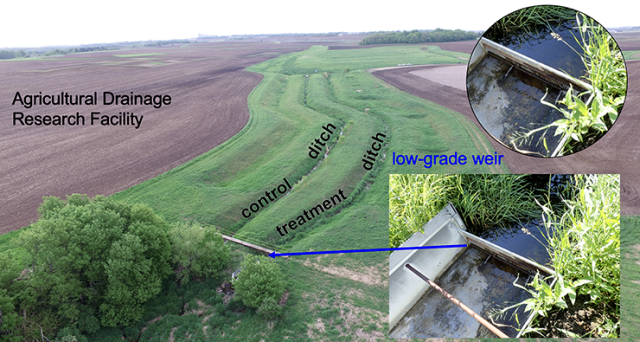
Some of the solutions Strock is looking at involve storing water on landscapes in ditches or farm ponds. By doing that, water could be “recycled” and irrigated back onto the landscape, allowing the resources like nitrogen and phosphorus — which were either applied as fertilizer or were already in the water — to not go to waste.
“If you think about the last three years … we've had moderate to severe droughts in different parts of the state. Some places like Southern Minnesota, we don't have wells for irrigating like you do in sandier soils in central Minnesota,” Strock said. “But what we do have are these farm ponds and these drainage ditches where we can take drainage water that's been temporarily stored, pump it back out of those reservoirs back onto the landscape and irrigate some of the land that might be under drought conditions. It ends up bringing that water full circle.”
He said most agricultural areas don’t have bodies of water that can be used for storage, so some innovations have involved adjustments to drainage ditches to slow the flow of water, similar to how urban drainage systems manage stormwater runoff.
Some of the solutions Jeffrey Strock, a professor and soil scientist, is looking at involve storing water on landscapes in ditches or farm ponds.
“(That) can potentially help with, you know, downstream flooding. It can potentially help with things like reducing nutrients, like nitrogen and phosphorus, that might be in the water,” Strock said.
Cui is developing sensors that can monitor nitrogen, phosphorus and heavy metals in drainage water in real time. Strock said having that data from the sensors will allow certain water management processes to happen in preparation for weather events, creating more productivity for farmers and keeping the water quality up to standards.
“Say they know there’s a storm coming — those sensors will allow water in water bodies to drain and create storage capacity. Before that storm event we can drain more rapidly some of the water … that's currently there,” Strock said. “Then that storm event happens, conceptually what our idea here is, you can actually then slow that water back down and create some storage capacity in that system, to then hold back the new flush of water and nutrients that might be coming out of our (agricultural) lands.”
Strock is working with the Cottonwood Soil and Water Conservation District, which has an 11,0000-acre watershed. He applied for a grant through the state’s Environment and Natural Resources Trust Fund, which he thinks could complement the larger U.S. National Science Foundation grant and help to manage and clean the water in the drainage ditches that lead to Cottonwood Lake.
The technology developed through the NSF research, he said, could really help the Cottonwood district. “There's an absolute application of the technology that we're developing in a watershed like that,” he said.
A ‘decarbonized’ economy
The “Great Lakes Water Innovation Engine,” which the University of Minnesota is part of, is one of ten such engines that seek to improve innovation across the nation and foster regional economic competitiveness through a near $1.6 billion investment from the NSF.
A central focus of the grant is creating a “decarbonized circular blue economy,” which Peterson described as a system of water managementthat can also generate economic value for the region.
Cui, for example, is in communication with companies in the water management sector who would be interested in implementing these technologies. Those private companies are who municipalities would then work with in implementing the technologies in water treatment plants.
“You're taking resources out and reusing them for other things and creating value along the way. That circular blue economy that's being referenced, there's the circularity of resources associated with water and, hopefully, finding technologies that generate new kinds of economic value,” Peterson said.
This article first appeared on MinnPost and is republished here under a Creative Commons license.
********************************************
Thanks for visiting. Come again when you can.
Please be kind
to each other while you can.
This winter, or lack thereof until recently, has been unusual compared to the historical record in the North Country, but could well be a version of a “New Normal” according to climate scientists. It’s not only snow that’s been lacking. Most of the local lakes looked almost ice free as we drove past yesterday. With a New Year and the start of winter weather finallly here, there’s a list of neighbors we haven’t seen for weeks, months, or longer. Some examples:
Not seen for weeks, approaching months, cardinals. Not seen so far this winter, purple finches. I'm not sure if the remarkably warmer weather in 2023 is a major cause of the apparent disappearances or if there’s some other reason for the pattern shift. I am looking forward to seeing at least some of our past neighbors and visitors sometime this month. We’ll report here when and if things start to become whatever may pass for normal. See how much trouble a shifting baseline can cause? Imagine if it started to happen in our politics!
There’s a summer thunderstorm size puddle in the driveway. The wet spot behind the house is showing open water that suggests our moderate drought is over and done for now. Somethings with vivid green leaves (vivid vernal?) have emerged in the woods in front of the house. The creek/pond up the road is almost all open water. It is not feeling very much like Christmas time in the North Country. If we try to adjust and adapt, it will most likely trigger several eighteen inch snowstorms in a row.
Although there was too much cloud cover to enjoy it, yesterday was the December full moon, know as Little Spirit Moon by the Ojibwe and Shedding Horns Moon by the Lakota. Come Saturday, days will be three minutes longer than they were a week prior. Spring Equinox is 83 days away (March 19, 10:06 pm locally). Around here, that rarely marks the end of winter weather. It’ll be interesting to see what next year brings.
We appear to be augmenting increasingly volatile weather patterns with comparable political instability. These are times when we should focus more and more on the reality that the future isn’t just something out there that happens to US, it’s something we create with every action we take and decision we make every single minute of each and every day.
There’s only a few days before the start of a new year. What kind of year will we make of it?
Last night someone must have left open the door between northern Minnesota and Canada. Today is about half the temperature yesterday was and tomorrow is expected to be. At least we’re finally enjoying some sunshine. My sister, who lives in a Boston suburb, informs me today’s weather on the East coast is like a hurricane, not what one expects around Boston in mid December. It’s almost like something has disrupted the climate.
With the exception of light pollution, satellites and space junk, I think earth's night skies are pretty much the same as they’ve always been. That isn’t true of the surface of the planet. The dinosaurs are no more. The atmosphere is now oxygen rich. At one time it wasn’t. At various times and places, parts of the earth’s surface have been covered by sheets of ice miles thick. Now there are forecasts that both poles could be mostly free of ice in less than one hundred years. When we consider baselines, I think we should learn to be more nuanced than we generally are. According to most historical records, there were no christians slightly more than two thousand years ago. That means there was a significant baseline shift about two millennia ago.
Although many (most?) of us would do well to live more in the present, i.e., now, we also need to become more sensitive to the realization that change is constant; that it frequently results in differential changes, some for the better for some folks, some not so much. We have reached a point at which our technology allows us to reach toward the star of Bethlehem but our ethical capabilities lag far behind. If you doubt this assessment, please consider Ukraine, Syria, Gaza, Israel and numerous other current war zones and the growing pushback against more inclusive cultures and politics. Once there were few, if any, oxygen-breathing creatures on earth. Is that a state of purity to be desired?
If evolution is to be believed, almost all of us are, or were at one time, immigrants. Our predecessors developed on the plains of Africa and/or China. Then again, at one time, before there were humans, all the continents are theorized to have been part of Pangaea.
In one week, we will again celebrate the birth of one who was first known as King of the Jews, not founder of Christianity. Is nothing sacred?
Predawn weather this morning at 7 am included patchy ground fog and rain. Combined with darkness and no fog lines or center stripes on township roads, the trip, with the Better Half [BH] in the passenger seat, to deliver several bags of Christmas and birthday presents to the Daughter Person, Son-In-Law, Granddaughter’s home was quite an adventure. Visibility was much improved, with dreariness increased, during the trip back to our place. Mission accomplished, per BH.
Today’s day length is less than half a minute more than that of the winter solstice on Thursday. That’s barely noticeable. The dreary days added to the long nights prompt conscious efforts to offset excessive moodiness. I’ve been preparing to take advantage of dark, but clearer, skies by reading a book, Spirits Dancing, about the aurora, Milky Way, and the universe in which we exist. In the twenty-five plus years we’ve lived in the country, light pollution has grown noticeably. I have seen the aurora a few times, but don’t recall ever seeing the Milky Way except in photos.
Next Thursday will bring astronomical winter into conformance with the meteorological season which began on December 1. If you wonder why they don’t match, you can find an explanation here. Our current atypical weather is consistent with the three month outlook from NOAA. Will El Nino continue until or past spring? We’ll see. Santa may need to add wheels to his sleigh’s runners this year.
Four years ago we had a large puddle in our driveway a few days after Christmas. Three years ago we watched boaters launch into an ice-free St. Croix river at Franconia in early December. At the moment, the forecast is for rain showers on Christmas Eve and a rain-snow mix the next day. One might almost think North Country winters are getting warmer and shorter.
I believe we’re in the process of setting a new high temperature record for today. The existing one is 87℉. In light of the temperatures, the Twin Cities Marathon, scheduled for today, has been canceled. Come midweek, high temperatures are forecast to peak in the upper 50s and low 60s. Meanwhile, we’re grateful that the air conditioning is working, in Minnesota! on October 1! We’ve reached a point where our weather is as absurd as our politics. We know what to do about each, but the question remains, will enough of US do what’s needed to turn down the heat in the atmosphere and in political capitals by turning up the heat under extremists who put personal gain ahead of community and country?
The Better Half and I stopped by to see our son in his group home midday. After the visit, we headed into the big city of Minneapolis and its suburb of St. Louis Park to visit Birchbark Books and Orvis, not in that order. Nothing was purchased at the outdoor clothing and fly fishing shop. At Birchbark, I picked up a copy of Heather Cox Richardson’s Democracy Awakening: Notes on the State of America. For some time I’ve been reading her Letters from an American and have been impressed. I’m looking forward to reading the book and hope her suggestions about how we get out of the state we’re in involve more than Vote. You’ll probably get exposed here from time to time to my reactions to Awakening’s content and prescriptions.
Sans segue, despite the heat and in honor of the start of Banned Books Week, I did wear my “Banned Books Club” sweatshirt to the book store and was mildly disappointed that there didn’t appear to be any specific display of banned books on the shelves or tables. I also recommenced reading Walt Whitman’s Leaves of Grass this morning. Later, I noted with interest, that Democracy Awakening begins with a Whitman epigram:
We have frequentlly printed the word Democracy. Yet I cannot too often repeat that it is a word the real gist of which stilll sleeps, quite unawaken’d.
Walt Whitman Democratic Vistas, 1871
It will be interesting to watch what plays out over the next 45 days as Congress again faces the need to fund the government. I’ve just about reached the conclusion that there are no good autocrats and most Republicans are autocrats.
We’ve lived in our house at the eastern edge of Carlos Avery Wildlife Management Area for a generation (25 years +/-). During our occupancy, we’ve infrequently heard coyotes howling and yipping at night. Today is the first time we’ve seen one on or around the property. Looks like not much more than a pup. It would be great if s/he returns and captures a few of the pocket gophers.
There are several maple trees growing in front of the house. One of them has one leaf that’s turned bright red, plus one or two others that are multicolored. It could be another sign of autumn sneaking up on us, step by step, but the outside temperature of 92+ makes it hard to believe the meteorologists know what they’re doing with their claim that autumn begins September 1. Where we live, it seems it could work as well if they tried Autumn: Oct., Nov., Dec.; Winter: Jan., Feb., Mar.; Spring: Apr., May, Jun.; Summer: Jul., Aug., Sep. That way there would be less divergence (~ 10 days after) from equinoxes etc. than we have now (~ 21 days before). Shall we start a movement to adjust the meteorological calendar to bring it more into alignment with the astronomical calendar?
I’m trying to rejuvenate my sourdough starter, rather than replace it. It will be interesting, as well as fun, to see if the instructions in Sourdough by Science, pay off. The weekend’s temperatures are too hot to try creating a starter from scratch by parking the mix outside, as I’ve done in the past. If the refresh fails, we’ll start from scratch later in the week. I’m enjoying rereading the book and am looking forward to cooler days and loaves of fresh bread.
Shorter and shorter now the twilight clips The days, as though the sunset gates they crowd, And Summer from her golden collar slips And strays through stubble-fields, and moans aloud,
Save when by fits the warmer air deceives, And, stealing hopeful to some sheltered bower, She lies on pillows of the yellow leaves, And tries the old tunes over for an hour.
The wind, whose tender whisper in the May Set all the young blooms listening through th’ grove, Sits rustling in the faded boughs to-day And makes his cold and unsuccessful love.
The rose has taken off her tire of red— The mullein-stalk its yellow stars have lost, And the proud meadow-pink hangs down her head Against earth’s chilly bosom, witched with frost.
The robin, that was busy all the June, Before the sun had kissed the topmost bough, Catching our hearts up in his golden tune, Has given place to the brown cricket now.
The very cock crows lonesomely at morn— Each flag and fern the shrinking stream divides— Uneasy cattle low, and lambs forlorn Creep to their strawy sheds with nettled sides.
Shut up the door: who loves me must not look Upon the withered world, but haste to bring His lighted candle, and his story-book, And live with me the poetry of Spring.
********************************************
Thanks for visiting. Come again when you can.
Please be kind
to each other while you can.