Showing posts sorted by relevance for query "edmund fitzgerald". Sort by date Show all posts

Thursday, November 9, 2017

In memoriam SS Edmund Fitzgerald #phenology storms

On this day, forty-two years ago, the ill-fated Edmund Fitzgerald left a dock in Superior, WI. The next day she was in trouble as "... the skies of November turn gloomy." The Great Lakes weather report for today includes gales of November  on the water and Winter storms in nearby coastal areas.

calm but gloomy Lake Superior in Summer
Photo by J. Harrington

Somehow, over the past few years, we seem to have missed the notice that Gordon Lightfoot revised one of the lines in the lyrics when he performed live versions of "Wreck." The changes are attributed to a 2010 report in the Toronto Star which, in turn, was based on a television documentary.
"In a documentary by a Toronto film company that debuted earlier this year on History Television, a father-and-son diving team suggests the ship was in fact sunk by a rogue wave _ a massive wall of water that can reach up to 10 storeys high but was previously dismissed as a sailors' myth." [NOTE: one storey is about 10 feet, making such a wave a 100 footer]
The details of The Storm That Sunk the Edmund Fitzgerald are described on a page at the University of Michigan Sea Grant's site. The original National Transportation Safety Board's report, issued in 1978, found "The National Transportation Safety Board determines that the probable cause of this accident was the sudden massive flooding of the cargo hold due to the collapse of one or more hatch covers."

small Summer whitecaps, large ship on Superior
Photo by J. Harrington

Even if one or more of the 29 crew members, all of whom perished when the ship sunk, had survived, it's not clear that the real reason for the sinking would be less of a mystery. We don't have any problems envisioning a "rogue wave" contributing to the collapse of hatch covers and other conditions that that led to
"And later that night when 'is lights went outta sight
came the wreck of the Edmund Fitzgerald."
Each time you leave those you love, be sure to hug them and tell them that you love them. Remember, whatever the cause of the sinking:
"The searchers all say they'd have made Whitefish Bay
if they'd put fifteen more miles behind 'er.
They might have split up or they might have capsized;
they may have broke deep and took water.
And all that remains is the faces and the names
of the wives and the sons and the daughters."
At a minimum, please honor those lost with a minute of silence tomorrow, for them and others lost due to Great Lakes weather. Cindy Hunter Morgan has a very recently published book of poems, Harborless, inspired by shipwrecks of the Great Lakes. Here's a sample:

PHILDELPHIA, 1893


Lake Huron
The ship sank with a load
of cast-iron stoves, which tumbled,
lopsided, through white foam,
green water, teal water, water
as dark as coal, then darker.
From deck to lake floor,
they dropped 200 feet,
plummeting past the white faces
of lost men, who stared, gaping.
One man, hit by a stove, grasping
for something, swung his legs around the belly
of another stove singing beside him
and rode it to the bottom.
When it settled in silt,
he slipped off—an arm floating across his forehead—
and slumped, exhausted, near the hearth:
wreck of a boy in November
done with chores.

********************************************
Thanks for visiting. Come again when you can.
Please be kind to each other while you can.

Saturday, November 10, 2018

In Memoriam, Edmund Fitzgerald

Forty-three years ago, the Edmund Fitzgerald, with all twenty-nine crew, was lost in Lake Superior. Today the Split Rock Light House will hold a memorial service to commemorate those lost in Great Lakes shipwrecks.

Split Rock Light House overlooking Lake Superior
Photo by J. Harrington

The wreck of the Edmund Fitzgerald has been memorialized in song by Gordon Lightfoot; in video on the History Channel; and in numerous books. Last year we did a more extensive posting about the storm and the wreck and the song and the history.

In reviewing our November postings on this blog, we've been disconcerted by the number of pictures and mentions of snow and cold. We persist in our belief that, even in the North Country, that kind of weather is supposed to hold off until after Thanksgiving, despite this morning's temperatures in the mid-teens. Could it be that our beliefs may have developed some errors over the years? Might our memories be of how we wish things were rather than how the actual occurrence?

An additional memorial occurs this weekend, tomorrow in fact, it is the centennial of the WWI Armistice (an event that even precedes our time). That's when we had the "war to end all wars." Didn't we?

Today we're grateful we never had to fight in trench warfare nor sail into a November gale on Lake Superior.

Diving into the Wreck


Adrienne Rich19292012


First having read the book of myths,
and loaded the camera,
and checked the edge of the knife-blade,
I put on
the body-armor of black rubber
the absurd flippers
the grave and awkward mask.
I am having to do this
not like Cousteau with his
assiduous team
aboard the sun-flooded schooner
but here alone.

There is a ladder.
The ladder is always there
hanging innocently
close to the side of the schooner.
We know what it is for,
we who have used it.
Otherwise
it is a piece of maritime floss
some sundry equipment.

I go down.
Rung after rung and still
the oxygen immerses me
the blue light
the clear atoms
of our human air.
I go down.
My flippers cripple me,
I crawl like an insect down the ladder
and there is no one
to tell me when the ocean
will begin.

First the air is blue and then
it is bluer and then green and then
black I am blacking out and yet
my mask is powerful
it pumps my blood with power
the sea is another story
the sea is not a question of power
I have to learn alone
to turn my body without force
in the deep element.

And now: it is easy to forget
what I came for
among so many who have always
lived here
swaying their crenellated fans
between the reefs
and besides
you breathe differently down here.

I came to explore the wreck.
The words are purposes.
The words are maps.
I came to see the damage that was done
and the treasures that prevail.
I stroke the beam of my lamp
slowly along the flank
of something more permanent
than fish or weed

the thing I came for:
the wreck and not the story of the wreck
the thing itself and not the myth
the drowned face always staring
toward the sun
the evidence of damage
worn by salt and sway into this threadbare beauty
the ribs of the disaster
curving their assertion
among the tentative haunters.

This is the place.
And I am here, the mermaid whose dark hair
streams black, the merman in his armored body.
We circle silently
about the wreck
we dive into the hold.
I am she: I am he

whose drowned face sleeps with open eyes
whose breasts still bear the stress
whose silver, copper, vermeil cargo lies
obscurely inside barrels
half-wedged and left to rot
we are the half-destroyed instruments
that once held to a course
the water-eaten log
the fouled compass

We are, I am, you are
by cowardice or courage
the one who find our way
back to this scene
carrying a knife, a camera
a book of myths
in which
our names do not appear.


********************************************
Thanks for visiting. Come again when you can.
Please be kind to each other while you can.

Sunday, November 9, 2025

November's heritage: memories and memorials

It was fifty years ago tomorrow that the Edmund Fitzgerald sank in Lake Superior. Gordon Lightfoot memorialized the tragedy with his song The Wreck of the Edmund Fitzgerald. Please pause for a moment of silence after following the link and listening to him perform. Then check some interesting background to the song.

Minnesota's Split Rock Lighthouse on Lake Superior
Photo by J. Harrington

Locally, on November 10 the Split Rock Lighthouse and the Minnesota Historical Society will host a memorial to commemorate the 50th anniversary of the Fitzgerald's sinking, as has been done for the past four decades or so.

Our area's firearm’s deer season opened yesterday with colder temperatures than we’ve seen so far this season. Warmer days are forecast for later in the week. One of the reasons I was more of a grouse and waterfowl hunter than a whitetail seeker is that I can't manage to sit still enough to blend into the landscape when experiencing the frequently cold temperatures we get during deer season in the North Country. Plus, when I tried deer hunting back in New England, before moving to Minnesota, I did it with a mixed group of bow hunters and bird hunters. It rarely failed that the bird hunters spooked deer and the bow hunters watched grouse strutting around their stands.

UPDATE: Local ponds are forming ice cover. First snow of the season is falling as graupel and forming snow snakes along the roads.

Since November is Native American Heritage month, as well as the season for early gales on Superior, and since Lightfoot referred to Superior by her Ojibwe/Anishinaabe name, Gitche Gumee, it seems fitting to close today with a Kimberly Blaeser poem. Water, in Great Lakes and elsewhere, has long been a source of both life and death.


Wellspring: Words from Water

A White Earth childhood water rich and money poor.
Vaporous being transformed in cycles—
the alluvial stories pulled from Minnesota lakes
harvested like white fish, like manoomin,
like old prophecies of seed growing on water.
Legends of Anishinaabeg spirit beings:
cloud bearer Thunderbird who brings us rain,
winter windigo like Ice Woman, or Mishibizhii
who roars with spit and hiss of rapids—
great underwater panther, you copper us
to these tributaries of balance. Rills. A cosmology
of nibi.  We believe our bodies thirst. Our earth.
One element. Aniibiishaaboo. Tea brown
wealth. Like maple sap. Amber. The liquid eye of moon.
Now she turns tide, and each wedded being gyrates
to the sound, its river body curving.
We, women of ageless waters, endure;
like each flower drinks from night,
holds dew. Our bodies a libretto,
saturated, an aquifer—we speak words
from ancient water.


********************************************
Thanks for visiting. Come again when you can.
Please be kind to each other while you can.

Thursday, November 10, 2022

November: storms of the season

In commemoration of the 47th anniversary of the sinking of the Edmund Fitzgerald, Minnesota’s Split Rock Light House will be holding a Memorial Beacon Lighting and related activities. For those unable to attend the event, a portion of the beacon lighting will be streamed live on YouTube. I would be remiss if I failed to include a link to Gordon Lightfoot’s haunting song about the wreck, so here it is.


Split Rock Light House
Photo by J. Harrington

This week’s weather makes me glad I haven’t spent all year looking forward to the firearms deer hunting season that started last Saturday. It’s been a week of howling winds, rain, thunderstorms, I think they got some snow up north. Deer don’t like strong winds. Speaking only for myself, I never enjoyed sitting on a tree stand in the rain, but then I never had a tree stand with a roof like some of the ones I’ve seen at the edges fo several of the farm fields around here. A little bit of snow, known as “tracking snow,” is usually seen as helpful, but there’s none of that to speak of around here.


The sleeping giant (thunder bay, lake superior)

Emily Pauline Johnson 1861 – 1913


When did you sink to your dreamless sleep

Out there in your thunder bed?

Where the tempests sweep,

And the waters leap,

And the storms rage overhead.


Were you lying there on your couch alone

Ere Egypt and Rome were born?

Ere the Age of Stone,

Or the world had known

The Man with the Crown of Thorn.


The winds screech down from the open west,

And the thunders beat and break

On the amethyst

Of your rugged breast,--

But you never arise or wake.


You have locked your past, and you keep the key

In your heart 'neath the westing sun,

Where the mighty sea

And its shores will be

Storm-swept till the world is done. 


********************************************
Thanks for visiting. Come again when you can.
Please be kind to each other while you can.


Sunday, June 29, 2014

The Climate it is a-changin'

Have you heard Gordon Lightfoot's Wreck of the Edmund Fitzgerald with its reference to "the gales of November came early?" I was thinking of that today when we visited the Minnesota Historical Society in St. Paul. They have an exhibit on the construction of the Split Rock Lighthouse. "Shipwrecks from a mighty 1905 November gale prompted this rugged landmark's construction." That storm came on November 28, definitely not early.

Split Rock Lighthouse
Split Rock Lighthouse                    © harrington

I've been (belatedly) reading Bill McKibbon's eaarth the past few days. One of his major points is that the old earth we knew, which offered a sense of stability and, in general, predictability, is gone, even if we reduce our greenhouse gas emissions starting now. A topic I haven't seen written about (but neither have I looked hard for it) is the effect of increased volatility of weather and water levels on Great Lakes shipping. The Edmund Fitzgerald sank in 1975, which wasn't all that long ago. The water levels in the Great Lakes are being affected by global warming.
"There has been a significant decrease in ice cover in the Great Lakes. The loss of Great Lakes ice has allowed more water to evaporate in winter, resulting in heavier lake effect snow near the shore, and lower lake levels. Overall, the Great Lakes have lost 71% of their ice cover since 1973, according to a study by the Great Lakes Environmental Research Laboratory (GLERL). Lake Ontario saw an 88% decline in ice cover, Superior lost 79% of its ice, Michigan lost 77%, Huron lost 62%, and Erie lost 50%. The loss of ice is due to increasing air and water temperatures."
How early can the gales of November arrive, and does it make a difference?Since the Iron Range has historically shipped its ore over (through?) the lakes (another exhibit at the History Center), I wonder if global warming is going to affect the viability of taconite mining. There also could be a question about whether the volatility of storm's frequency and intensity will affect the cost and availability of insurance for the ships used to transport the ore. This is just one set of questions that comes to mind regarding how Minnesota will need to look at options and issues as we begin to adapt to global warming. Most of the emphasis I've seen so far has been on the impact to farming and forestry. Those are the obvious considerations, but the more we look at the systems we've come to depend on, the more we need to look at alternatives, robustness, resilience and replacement, it seems to me, just as Weldon Kees describes changes not desired at

Land’s End

By Weldon Kees 
A day all blue and white, and we
Came out of woods to sand
And snow-capped waves. The sea
Rose with us as we walked, the land
Built dunes, a lighthouse, and a sky of gulls.

Here where I built my life ten years ago,
The day breaks gray and cold;
And brown surf, muddying the shore,
Deposits fish-heads, sewage, rusted tin.
Children and men break bottles on the stones.
Beyond the lighthouse, black against the sky,
Two gulls are circling where the woods begin. 
********************************************
Thanks for visiting. Come again when you can.
Please be kind to each other while you can.

Wednesday, November 10, 2021

Beware November’s gales and other storms

On this, the 46th anniversary of the sinking of the Edmund Fitzgerald, we offer for your consideration


Split Rock light house
Photo by J. Harrington

Although not a November gale, today’s weather forecast brings a threat of the season’s first local snowfall sometime during the next several days with significant snowfall forecast for northern Minnesota and Canada. We’re hoping that whatever we get will melt shortly after it falls. We’d be happy if we got lasting snow on Christmas Eve that melted about New Year’s, but our drainfield tells us it needs the insulation of snow cover.


Storm Fear


 - 1874-1963


When the wind works against us in the dark,
And pelts the snow
The lower chamber window on the east,
And whispers with a sort of stifled bark,
The beast,
‘Come out! Come out!’—
It costs no inward struggle not to go,
Ah, no!
I count our strength,
Two and a child,
Those of us not asleep subdued to mark
How the cold creeps as the fire dies at length,—
How drifts are piled,
Dooryard and road ungraded,
Till even the comforting barn grows far away
And my heart owns a doubt
Whether 'tis in us to arise with day 
And save ourselves unaided.


********************************************
Thanks for visiting. Come again when you can.
Please be kind to each other while you can.

Sunday, November 10, 2019

On cold weather and thankfulness

Today, 18 days until Thanksgiving, I'm thankful for flannel-lined jeans and warm sweaters. The high temperatures today are in the mid-20s. Tomorrow the high is forecast to be in the teens and with an overnight low in the single digits. It's not even mid-November! I'm also thankful that neither of the dog walkers slipped and fell on the icy road this morning. Walking along the ditch edge was fine. Something to keep in mind should your township ever decide to pave your gravel road. We're still on the bubble about whether or not we're thankful the road's been paved.

We're thankful the Son-In-Law got a small 8 point buck yesterday, opening day. He was hunting in his own "back yard." I'm thankful for his success and that he's creating some great memories at the house he and Daughter Person bought almost a year ago. Those memories will be, I suspect, very different than the ones I have from hunting with friends out of several different deer camps in Northern New England (New Hampshire and Vermont) and Northern Minnesota. Not better, not worse, just very different. I'm thankful I learned the concept that "there's more than one path through the woods" and wish I were better at remembering that more frequently.

unless it's large and deep, or flowing, it's iced in
Photo by J. Harrington

From what we saw driving around today, only the largest, deepest lakes are still open. Large but shallow water bodies are all frozen over. I'm thankful for heated seats and a heated steering wheel in the Jeep. If you're getting a picture that Winter is a season I tolerate more than celebrate, you're correct. I'm thankful that Winter in Minnesota is only about 6 months long. At least it diminishes the road construction going on in the area.

unless it's large and deep, or flowing, it's iced in
do I want to allow this again this year?
Photo by J. Harrington

The chickadees and downy and hairy woodpeckers are thankful we filled and hung up the suet feeder. We're still debating whether to hang feeders in front of the house this Winter. We suspect that the deer that came to feed on the sunflower seeds may well be the ones that returned come Spring and munched down our black chokeberry bushes. We're thankful there's anything left of those bushes and will remember to spray repellant on them now that rain season seems ended for the year.

(We know that today is the 44th anniversary of the loss of the Edmund Fitzgerald. Past postings have said about all we can on that tragedy.
* * * * * * * * * * * * * * * * * * * * * * * * * * * * *
* = ship's bell rung)

Fortuna


The wind blows east, the wind blows west, 
And the frost falls and the rain: 
A weary heart went thankful to rest, 
And must rise to toil again, ’gain, 
And must rise to toil again. 

The wind blows east, the wind blows west, 
And there comes good luck and bad; 
The thriftiest man is the cheerfulest; 
’Tis a thriftless thing to be sad, sad, 
’Tis a thriftless thing to be sad. 

The wind blows east, the wind blows west; 
Ye shall know a tree by its fruit: 
This world, they say, is worst to the best;— 
But a dastard has evil to boot, boot, 
But a dastard has evil to boot. 

The wind blows east, the wind blows west; 
What skills it to mourn or to talk? 
A journey I have, and far ere I rest; 
I must bundle my wallets and walk, walk, 
I must bundle my wallets and walk. 

The wind does blow as it lists alway; 
Canst thou change this world to thy mind? 
The world will wander its own wise way; 
I also will wander mine, mine, 
I also will wander mine.


********************************************
Thanks for visiting. Come again when you can.
Please be kind to each other while you can.

Thursday, September 28, 2017

When will our poetry go with our flow?

Today is National Poetry Day in the United Kingdom. It comes right in the middle of Banned Books Week in the U.S. (We're sure you know that on our side of the pond, National Poetry Month comes in April.) The Academy of American Poets has assembled a list of 10 Deliciously Dangerous Poetry Books, including Lewis Carroll's Alice In Wonderland and A Light in the Attic by Shel Silverstein. Those choices make sense, right? After all, Plato banned poets in his Republic, right?

fishing the Sunrise River, a St. Croix tributary
Photo by J. Harrington

We might almost think that Minnesota had banned all, or any, of its poets from writing about our major rivers, or their tributaries, that flow through and from this state. We've done some quick searches and were hard pressed to find much in the way of poems about the Red River, the Minnesota, Mississippi or St. Croix. Somewhere we have a copy of a few locally published poems about the St. Croix, and recently finished reading K.S. Lubinski's Things that Flow, which includes poems specific to almost any river like the Mississippi, but, all told, Minnesota (or other) poets writing about Minnesota rivers yield mighty shallow water, so to speak. [For now, let's hold aside Gordon Lightfoot's Wreck of the Edmund Fitzgerald, even though Lake Superior is one of Minnesota's major waters.]

"paddlewheeler" on the St. Croix
Photo by J. Harrington

English poets, especially one in particular, have written not just poems but entire volumes about single rivers. Alice Oswald's A Sleepwalk On The Severn as well as another of her volumes, Dart, each provide a model worth emulating. The former, "written for the 2009 festival of the Severn, aims to record what happens when the moon rises over us -- its effect on water and its effect on voices." Dart "is made from the language of people who live and work on the Dart.... into a sound-map of the river...."

To borrow briefly from my exposure to Aristotle's fundamentals of logic:

  • Water Is Life.
  • Rivers Are Water, therefore;
  • Rivers are Life
If Minnesotans had more poems about our waters, especially our rivers, would we care more for and about them? How long will it be until it's possible to produce a volume of poetry about Minnesota's rivers? Finally, we'll be delighted rather than upset to be proven wrong and be flooded with names and links to poems about Minnesota's rivers. Fill the comments form with your suggestions, please.


The Negro Speaks of Rivers


Langston Hughes, 1902 - 1967


I’ve known rivers:
I’ve known rivers ancient as the world and older than the
     flow of human blood in human veins.

My soul has grown deep like the rivers.

I bathed in the Euphrates when dawns were young.
I built my hut near the Congo and it lulled me to sleep.
I looked upon the Nile and raised the pyramids above it.
I heard the singing of the Mississippi when Abe Lincoln 
     went down to New Orleans, and I’ve seen its muddy 
     bosom turn all golden in the sunset.

I’ve known rivers:
Ancient, dusky rivers.

My soul has grown deep like the rivers.


********************************************
Thanks for visiting. Come again when you can.
Please be kind to each other while you can.

Monday, November 11, 2013

November notables

Yesterday was the 38th anniversary of the sinking of the Edmund Fitzgerald. If we had timed our recent North Shore adventure a little differently, we could have seen the interior of the Split Rock Light House when the beacon is lit in memoriam.

Split Rock Lighthouse
Split Rock Lighthouse      © harrington

Gordon Lightfoot, still performing at 74, which makes him an inspiration to many of us, wrote and performs an absolutely haunting song about The Wreck.

Later this month we on the american side celebrate Thanksgiving. Our neighbors north of the border celebrated theirs in mid-October. After our Thanksgiving, we have to decide where we fall on the consumerism scale. Friday, November 29 is both Black Friday and "Buy Nothing Day." Minnesota companies like Best Buy and Target seem to be leading a movement away from Buy Nothing day by starting Black Friday activities on Thanksgiving eve. Halloween candy sales were still happening as Christmas decorations were being put on display at one local big box. I'm reminded of Ross Perot's quote about "that sucking sound you hear," only now the jobs and profits are not even remaining on the North American continent. Vermont is showing leadership with their New Economy activities. Our Minnesota might want to take a look, although, according to Lee Egerstrom at Minnesota 2020, we've got some things right with our protection of the "family farm." This year, when we slow down, at least for a few hours to give thanks, maybe we should also take some time to think about what, in 2014, we want to be able to give thanks for that we don't have this year. An effective climate change adaptation strategy, a new local economy strategy, a Vikings Superbowl win (no way)? The other two might be attainable if we decide they're important to us. Which values are priorities for Minnesotans in the 21st century? Does shopping on Thanksgiving represent the best and highest use of family time so a few of us can save a few bucks? Is that what we want our children to be grateful for or are we substituting HDTV for quality times? How about we pass on shopping and try a walk after dinner on Thanksgiving, sharing the beauty of our Minnesota with our families and friends?

Minnesota's Autumn beauty
Minnesota's Autumn beauty    © harrington

See if Robert Frost's poem gift to us captures something to which you think we should pay more attention.

The Gift Outright

By Robert Frost 
The land was ours before we were the land’s.
She was our land more than a hundred years
Before we were her people. She was ours
In Massachusetts, in Virginia,
But we were England’s, still colonials,
Possessing what we still were unpossessed by,
Possessed by what we now no more possessed.
Something we were withholding made us weak
Until we found out that it was ourselves
We were withholding from our land of living,
And forthwith found salvation in surrender.
Such as we were we gave ourselves outright
(The deed of gift was many deeds of war)
To the land vaguely realizing westward,
But still unstoried, artless, unenhanced,
Such as she was, such as she would become.


*******************************************
Thanks for listening. Come again when you can. Rants, raves and reflections served here daily.

Wednesday, October 14, 2020

Changing seasons?

 If I'm reading the map correctly, the gales of November have come to Lake Superior in October this year.


I actually went to the NWS Duluth site to confirm that accumulating snow is in their forecast for Saturday. It is. If this were back in New England when I was younger, I could point out that I'm unaware of any time Boston  got excited about a forecast of snow in Portland, ME. (The distance between Boston and Portland is a little less than that between St. Paul and Duluth.) Then again, Boston, as far as I know, has never come close to October snowfall such as the Twin Cities received in the 1991 Halloween Blizzard. One of the advantages of being located near the tempering affect of the Atlantic Ocean.


October 14, 2018: a trace of snow fell locally
Photo by J. Harrington


On this date a couple of years ago we received a trace or dusting of snow that melted shortly thereafter. For now, we'll hold off for several weeks before we remind folks about the wreck of the Edmund Fitzgerald, but we have reached that time of year when the "buckskin choppers" get pulled from the cedar chest or the back of the closet and rain jackets get traded for parkas. It's been wet and windy enough the past several days that I've put off climbing up on the roof to clean the gutters and replace the chimney cap that got blown off awhile ago. With luck we'll get enough of a break in the weather to safely finish up autumn's outside chores before winter actually sets in. If not, we'll make do until spring thaw. Meanwhile, we've little doubt that the deer hunters are hoping for some tracking snow early next month to accompany the firearms season.


First Snow


A rabbit has stopped on the gravel driveway:

           imbibing the silence,
           you stare at spruce needles:

                                          there's no sound of a leaf blower, 
                                          no sign of a black bear;

a few weeks ago, a buck scraped his rack
           against an aspen trunk;
           a carpenter scribed a plank along a curved stone wall.

                        You only spot the rabbit's ears and tail:

when it moves, you locate it against speckled gravel,
but when it stops, it blends in again;

           the world of being is like this gravel:

                        you think you own a car, a house,
                        this blue-zigzagged shirt, but you just borrow these things. 

Yesterday, you constructed an aqueduct of dreams
                        and stood at Gibraltar,
                                                but you possess nothing.

Snow melts into a pool of clear water;
     and, in this stillness,

                        starlight behind daylight wherever you gaze. 


********************************************
Thanks for visiting. Come again when you can.
Please be kind to each other while you can.

Friday, November 10, 2017

Winter's here. Spring's not far behind. #phenology

This morning's dog walk took place in a 7℉ temperature, with the wind chill even lower. If we get the more seasonal temperatures forecast for next week, it will be interesting to see how much, if at all, the current ice cover retreats. There are only 110 days until the start of meteorological Spring, 129 until astronomical Spring. With this cold weather, we're a little surprised the deer haven't yet been noshing on the decorative pumpkins. After gun season ends, we'll see about putting the pumpkins out in the field and replacing them near the steps with Christmas greens.

deer-chewed pumpkins
Photo by J. Harrington

Swans and Canada geese are still hanging around, although even much of the Sunrise River is now ice covered. We admit we haven't paddled around to check, but we suspect there's open water near the center of Carlos Avery Pool 1. Large numbers of geese were seen heading out of that area about mid-day today. Waters such as Forest Lake still have large areas of open water and the row crop fields aren't yet snow covered, so waterfowl, especially the larger ones, are likely to stay until open water or food, or both, are no more. Although we enjoy seeing both swans and geese well into November, those sightings lack the abundance of hope we enjoy as they return each Spring. We know most of  them will leave, it's just a question of when. There are supposed to be swans that Winter over on the St. Croix. We'll try again this year to see if we can get some photos. It's been awhile since we've visited the river, which should still be pretty much open water.

St. Croix River, early November
Photo by J. Harrington

Our observations happened as we left for and returned from "The Cities." We made one of our seasonal trips to Birchbark Books this morning. Among other delights they had was a copy of 1621  A New Look at Thanksgiving. We once lived about 15 or 20 miles from the Plimoth Plantation in Plymouth [Patuxet] and have visited it a few times. I don't remember much emphasis on a Wampanoag perspective in those days and am glad to see the broadened version of the story in the book. Something we don't expect but would be very thankful to see this year would for our capitalist, global economy to include much more of a seventh generation perspective when considering making investments and developing projects.

Anyhow, despite the cold, cold air and the cloudy, cloudy sky, there's been much to appreciate about today, unlike 42 years ago for some. Thanksgiving must have been very tough that year for the families of the crew of the

SS Edmund Fitzgerald     * * * * * * * * * * * * * * * * * * * * * * * * * * * * *
* = ship's bell rung

Thanksgiving


We walk on starry fields of white
   And do not see the daisies;
For blessings common in our sight
   We rarely offer praises.
We sigh for some supreme delight
   To crown our lives with splendor,
And quite ignore our daily store
   Of pleasures sweet and tender.
Our cares are bold and push their way
   Upon our thought and feeling.
They hand about us all the day,
   Our time from pleasure stealing.
So unobtrusive many a joy
   We pass by and forget it,
But worry strives to own our lives,
   And conquers if we let it.
There’s not a day in all the year
   But holds some hidden pleasure,
And looking back, joys oft appear
   To brim the past’s wide measure.
But blessings are like friends, I hold,
   Who love and labor near us.
We ought to raise our notes of praise
   While living hearts can hear us.
Full many a blessing wears the guise
   Of worry or of trouble;
Far-seeing is the soul, and wise,
   Who knows the mask is double.
But he who has the faith and strength
   To thank his God for sorrow
Has found a joy without alloy
   To gladden every morrow.
We ought to make the moments notes
   Of happy, glad Thanksgiving;
The hours and days a silent phrase
   Of music we are living.
And so the theme should swell and grow
   As weeks and months pass o’er us,
And rise sublime at this good time,
   A grand Thanksgiving chorus.


********************************************
Thanks for visiting. Come again when you can.
Please be kind to each other while you can.

Saturday, November 10, 2012

Safe harbor

photo of a freighter leaving Duluth harbor
© harrington
A ship in the harbor is safe, but that's not what ships are for. Thirty-seven years ago, on November 10,1975, the Edmund Fitzgerald sailed from Superior, Wisconsin. It was lost, together with its crew of 29, on the way to Zug Island on the Detroit River. It left behind a great mystery and greater miseries suffered by the crews' families and loved ones. Superior is one of the Twin Ports, the other Twin is Duluth. Taconite, grain and wind turbine blades are shipped through the Twin Ports contributing to the past and future economies of My Minnesota. I suspect many of us who daily commute by car to our jobs seldom give a thought to those who actually risk their lives to earn a living. With so many wonders and opportunities in our Minnesota, do we daily take safety and beauty for granted and so fail to appreciate what we have?

Sunday, September 27, 2020

Autumn, a restless season

Perhaps it's the energy visible and vibrating in flaming orange, red, and yellow leaves. Perhaps it's the gusty winds that blow more frequently than not. Perhaps it's the hustle and bustle of farmers getting harvest done before snow covers the fields. Perhaps it's the birds and waterfowl and insects that migrate South from our North Country. When I lived in Massachusetts, an urge for going was felt first by bluefish and, later, by striped bass as they headed for Wintering waters around the Chesapeake and points South. It was often a dilemma of the best kind deciding whether to chase departing stripers or greet waterfowl arriving from the North.


maples are alive and vibrating with color
Photo by J. Harrington


Most of the music I associate with autumn relates to restless movement. Here's a few examples:


Summer is a hazy, lazy season. Winter's cold and snow often slow life down as if made of molasses. Spring, when it finally arrives, bursts briefly with energy and then everything's green and shady (see lazy, hazy). Autumn is when I feel most alive with way more fun to be had than time to fit it all in.

Driving through a shower last evening, we watched several frogs hopping across the wet road, probably heading for Wintering grounds where, half or more frozen, they'll spend the freezing season buried under mud or leaves. Some autumn migrations are fairly local.

Song for Autumn


by Mary Oliver

 
In the deep fall
don’t you imagine the leaves think how
comfortable it will be to touch
the earth instead of the
nothingness of air and the endless
freshets of wind? And don’t you think
the trees themselves, especially those with mossy,
warm caves, begin to think
 
of the birds that will come — six, a dozen — to sleep
inside their bodies? And don’t you hear
the goldenrod whispering goodbye,
the everlasting being crowned with the first
tuffets of snow? The pond
vanishes, and the white field over which
the fox runs so quickly brings out
its blue shadows. And the wind pumps its
bellows. And at evening especially,
the piled firewood shifts a little,
longing to be on its way.


********************************************
Thanks for visiting. Come again when you can.
Please be kind to each other while you can.

Monday, September 1, 2014

Happy Labor Day to My Minnesota's Superior readers

Do you suppose it's true that the 1% don't understand what Labor Day is all about because they're so busy working 24 x 7 x 365 creating Work Jobs for the rest of us? They've never had a hot dog, or brat or marched in a small town parade? Poor them! They probably aren't huge fans of one of my favorites, who has an interview in Saturday's issue of the guardian.

To help celebrate our year's worth of labor, and because The Daughter Person wanted us elsewhere while she and her bridesmaids had a bachelorette party, the Better Half and I took an overnight trip to Port Wing, WI. Up until recently, my experiences with beaches on Lake Superior had been limited to the cobblestone strands along Minnesota's North Shore. Then I visited the sand spit that runs out from Duluth. Now I've been to sandy beaches along Wisconsin's North Shore, which is also Superior's South Shore. They have lots of sand, with interesting rock outcrops in some places (and a few cobblestones in others).

Port Wing beach and boreal forest
Photo by J. Harrington

We stayed at a B&B that I can recommend if you want peace and quiet, a wonderful breakfast and, if you want, convivial conversation. Check out Larson Creek Farm if you've a desire or need to head in the direction of Port Wing. Coming back we took a different route and were surprised (at least I was) to find that there is a notable difference in topography within 25 or 50 miles east to west. Driving on the "blue highways," looking at forests, fields and swamps, both alder and tamarack, heightened my awareness of why Native Americans and European explorers traveled so much by canoe and of how much work much have gone into turning some of the forests into the fields and pastures we drove by. Settlers didn't have 8-wheel-drive tractors to pull stumps. That was back and heart-breaking work.

As a follow up to our trip and my new learnings about Superior, I discovered that Lorine Niedecker has a book by the title of Lake Superior. In lieu of a poem today, why don't you check the linked review. It looks interesting and it's too early in the season for Gordon Lightfoot's Wreck of the Edmund Fitzgerald.

********************************************
Thanks for visiting. Come again when you can.
Please be kind to each other while you can.

Friday, November 10, 2023

A month of several kinds of gales

In recognition of the anniversary of the sinking of the Edmund Fitzgerald, please follow this link to read our prior postings on that tragedy. Locally, this week’s winds haven’t reached gale force (39 - 46 mph), but they have been strong enough to strip most of the leaves from the deciduous trees, including many of the oaks. My failure to remember, from year to year, about the gales of November probably means I’m repressing something related to my general distaste of winter.

not quite gale force
Photo by J. Harrington

It’s also hard to contemplate November’s gales when the weather forecast includes the prospect of several days with high temperatures at or near 60℉ next week. Our weather is getting crazier. our politics have followed suite, our governance is rapidly following along (any bets on whether the government will have to shut down in a week?), wars and/or international terrorism attacks are breaking out on several continents, and the international community is failing to adequately respond to climate breakdown and biodiversity losses. There are things for which we can and should be thankful later this month, but the list is getting shorter by the week.

On that shortened list we need to be sure to remember to thank those who have served US in uniform. Tomorrow is officially Veterans Day. We’ll be remembering my father (WWII, Korea) and father-in-law (WWII). Some years ago I learned about a wonderful program that benefits some veterans with an activity close to my heart, Project Healing Waters Fly Fishing, Inc. In recognition of the season’s holidays and the state of the world, you could consider sending them a donation. Living in a world where there is no need for such an organization is a much to be wished for but improbable circumstance. Until then, we all need to do the best we can with what we have and practice being kind(er) to each other.


Not to Keep


They sent him back to her. The letter came
Saying... and she could have him. And before
She could be sure there was no hidden ill
Under the formal writing, he was in her sight—
Living.— They gave him back to her alive—
How else? They are not known to send the dead—
And not disfigured visibly. His face?—
His hands? She had to look—to ask,
“What was it, dear?” And she had given all
And still she had all—they had—they the lucky!
Wasn’t she glad now? Everything seemed won,
And all the rest for them permissible ease.
She had to ask, "What was it, dear?"
                                                               “Enough,
Yet not enough. A bullet through and through,
High in the breast. Nothing but what good care
And medicine and rest—and you a week,
Can cure me of to go again.” The same
Grim giving to do over for them both.
She dared no more than ask him with her eyes
How was it with him for a second trial.
And with his eyes he asked her not to ask.
They had given him back to her, but not to keep. 


********************************************
Thanks for visiting. Come again when you can.
Please be kind to each other while you can.

Monday, November 1, 2021

A list of November’s happenings

November is:

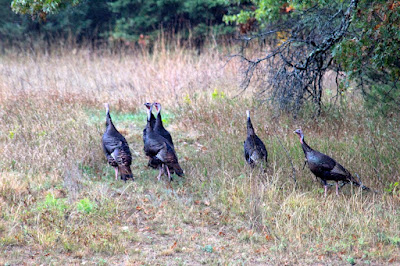
autumn flock of tom turkeys
Photo by J. Harrington

What have we missed about  November? We may, or may not, get snow cover this month. Daylight will shrink all month. If you don’t do it year round, today would be a good day to start listing the things for which you will express your thanks on or before Thanksgiving day.


November


Show's over, folks. And didn't October do
A bang-up job? Crisp breezes, full-throated cries
Of migrating geese, low-floating coral moon.

Nothing left but fool's gold in the trees.
Did I love it enough, the full-throttle foliage,
While it lasted? Was I dazzled? The bees

Have up and quit their last-ditch flights of forage
And gone to shiver in their winter clusters.
Field mice hit the barns, big squirrels gorge

On busted chestnuts. A sky like hardened plaster
Hovers. The pasty river, its next of kin,
Coughs up reed grass fat as feather dusters.

Even the swarms of kids have given in
To winter's big excuse, boxed-in allure:
TVs ricochet light behind pulled curtains.

The days throw up a closed sign around four.
The hapless customer who'd wanted something
Arrives to find lights out, a bolted door.


********************************************
Thanks for visiting. Come again when you can.
Please be kind to each other while you can.

Tuesday, November 10, 2015

It's not wise to fool with Mother Nature

A year ago today, we were in the midst of getting ferociously snowed on. Starting late tomorrow we're forecast to get a bunch of rain. Forty years ago today, the Edmund Fitzgerald sank near Whitefish Bay in the midst of a storm on Lake Superior. The Armistice Day blizzard, seventy-five years ago tomorrow, killed almost 150 people. More recently, the 1991 Halloween blizzard was another clear example of the gales of November coming early.

November 6, 2013 snowfall
Photo by J. Harrington

Much of what I've read about the effects of global warming on the weather notes that storms will be more intense. Future Novembers hold the prospect of being very interesting, and dangerous, if past events are a baseline for intensity and volatility. Now, while we're enjoying today's sunshine and relative warmth, imagine if either of the recent train derailments in Wisconsin had occurred in the midst of any one of those historical storms. Cleanup and restoration of rail service would be even more challenging. Depending on the weather, environmental cleanup might not even be possible. Would you care to speculate why today's politicians behave as if they've successfully repealed Murphy's Law? There's limited concern expressed about acute disasters like oil train explosions in heavily populated areas. Less so, by quite a bit it seems to me, regarding chronic issues such as elevated mercury levels in a high percentage of children in the St. Louis River watershed. Then, when I look at the field of Republican presidential candidates, I'm willing to confirm the Murphy was an optimist. The more I consider who we elect theses days, and what they do to us after election, the more I find Homo sapiens to be a notable misnomer. Or, are we actually smart but just unlucky? I grew up in a neighborhood that firmly believed "fool me once, shame on you; fool me twice, shame on me." After the next election, will we end up ashamed of ourselves? How will we know?

The New Optimism

By Dean Young 

The recital of the new optimism
was oft interrupted, rudeness
in the ramparts, an injured raven
that needed attendance, pre-op
nudity. The young who knew everything
was new made babies who unforeseeably
would one day present their complaint.
Enough blame to go around but the new
optimism didn’t stop, helped one
pick up a brush, another a spatula
even as the last polar bear sat
on his shrinking berg thinking,
I have been vicious but my soul is pure.
And the new optimism loves the bear’s
soul and makes images of it to sell
at fair-trade craft fairs with laboriously
knotted hunks of rope, photos of cheese,
soaps with odd ingredients, whiskey,
sand, hamburger drippings, lint,
any and everything partaking of the glowing
exfoliating cleanup. And the seal
is sponged of oil spill. And the broken
man is wheeled in a meal. War finally
seems stupid enough. You look an animal
in the eye before eating it and the gloomy
weather makes the lilacs grow. Hello,
oceans of air. Your dead cat loves you
forever and will welcome you forever home.


********************************************
Thanks for visiting. Come again when you can.
Please be kind to each other while you can.

Tuesday, October 20, 2015

No safe port for the storms of climate change?

My Better Half is at a conference in Duluth for a few days. She reports today that the big lake has "visible whitecaps and breaking waves far out on the lake." Her message reminded me that it's getting to be time to dig out my CD of Gordon Lightfoot's songs with The Wreck of the Edmund Fitzgerald on it. (When she gets home, I'll have to thank her for the inspiration for today's posting.)

rain squall, Lake Superior's south shore
Photo by J. Harrington
The current constriction of the international steel markets may be reducing the iron ore being shipped through Duluth. Although much (all?) of that is headed for domestic markets, I keep reading about "foreign steel dumping." Continuing reductions in coal burning, needed to respond to climate change, will also reduce transshipments of that cargo I imagine. On the other hand, increased development of wind power will probably bring more turbine pieces through the port for the foreseeable future. I've seen the blades being hauled up the hill on I-35 just south of Duluth. I've never seen one unloaded though or even seen one on a ship. That's something to keep my eyes open for when I visit in the future.

freighter headed to Duluth Harbor
Photo by J. Harrington
I grew up in a port city, Boston, which is facing a future imperiled by rising sea levels. Follow this link. The Inner Harbor is comparable to Duluth. Scroll down to the Dorchester Section. The beach I swam from as a teenager will be lost. Further south by about forty miles, in Marshfield, the neighborhood in which I lived just before moving to Minnesota will be underwater (literally, not just mortgages) with a four foot rise in sea level. Climate change is really starting to hit home. My past is going to be washed out to sea, just the opposite of what the folks around Lake Superior can expect, according to the folks at Sea Grant.

For Edwin Wilson

By A. R. Ammons 

Did wind and wave design the albatross's wing,
honed compliances: or is it effrontery to
suggest that the wing designed the gales and

seas: are we guests here, then, with all the
gratitude and soft-walking of the guest:
provisions and endurances of riverbeds,

mountain shoulders, windings through of tulip
poplar, grass, and sweet-frosted foxgrape:
are we to come into these and leave them as

they are: are the rivers in us, and the slopes,
ours that the world's imitate, or are we
mirrorments merely of a high designing aloof

and generous as a host to us: what would
become of us if we declined and staked out
a level affirmation of our own: we wind

the brook into our settlement and husband the
wind to our sails and blades: what is to
be grateful when let alone to itself, as for

a holiday in naturalness: the albatross, ah,
fishes the waves with a will beyond the
waves' will, and we, to our own doings, put

down the rising of sea or mountain slope: except
we do not finally put it down: still, till
the host appears, we'll make the masters here.


********************************************
Thanks for visiting. Come again when you can.
Please be kind to each other while you can.