Showing posts with label economy. Show all posts

Sunday, September 7, 2025

In service to the Serviceberry

Last Spring, about the time our pear tree was in bloom, I finally stumbled onto a local source of serviceberry bushes, of a species noted for producing good fruit, Saskatoon serviceberry (Amelanchier alnifolia). I drove to northern Dakota county and bought two at Gertens. Some time thereafter, I managed to plant them in accord with the directions. Several weeks later, despite watering them regularly between rainy spells, both bushes were leafless and dead. Rabbits? Deer? Pocket gophers? I wasn't sure but I was unhappy since the bushes were, to my mind, expensive plus the physical cost of planting them. I was slightly consoled by remembering the story by one of the Aldo Leopold kids about planting, and replanting, hundreds or thousands of conifers on their sand county farm.

pear tree in bloom, May 2025
Photo by J. Harrington

I spent bits and pieces of the Summer mumbling and grumbling about Amelanchier failures until the Better Half got tired of listening to me and called Gertens to confirm that my bushes were covered by a warranty. I could get replacements if I showed up with a receipt and photos of the dead bushes. Several weeks after getting the confirmation, I did so and the replacement process actually went better than I expected. It was smooth and pleasant.

Today's plantings added the prompt installation of wire cage protectors and the addition of bark mulch around the outside of each cage. The serviceberry bushes are supposed to show their own white flowers about the time the pear tree does, but won't grow nearly as tall. Now that the replacement planting is done, I'm now typing up this posting and will then keep my fingers and toes crossed that these bushes make it through the Autumn and Winter and Spring etc. Stay tuned and, if you haven't read Robin Wall Kimmerer's latest book, The Serviceberry, here's the original essay as a sample. It's the one that started me on this adventure.


Tobacco Origin Story, Because Tobacco Was a Gift Intended to Walk Alongside Us to the Stars

From a story of how the tobacco plant came to our people, told to me by my cousin George Coser Jr.

It was way back, before there was a way back
When time threaded earth and sky.
Children were conceived, were born, grew, and walked tall
In what we now call a day.
There must have been two suns, a bright moon, somehow
We had more light than now, sheen
Of falling in love playing about Earth’s body
In a wild flicker which lit
Us up. We who were this planet and yearned for touch.
Every planted thought grew plant
Ladders to the stars, way back, before there was
No way back, Miss Mary Mack.
We used to sing along the buttons of her
Dress. Our babies are always
Our babies. Even back then when time waved through
The corn. We knew our plants like
Relatives. Their stories were our stories, there
Were songs for everything — I
Should say “are” songs for every transformation
They link between way back and
Now, the forever now, a time when a young
Mvskoke man and woman
Walked through the shimmer of the early evening.
They had become as one song.
They lay down when it was dark. I can hear their
Intimate low-voice talking.
How they tease one another with such gut love.
Earth makes a bed, with pillow
Mounds. And it is there as the night insects sing
They conceived their first child. They
Will look back as they walk East toward the sunrise.
The raw stalks of beginning
Will drink the light, root deeply dark into earth.
In the tracks of their loving
The plant-child emerges, first the seed head, then
Leafy, long male body and the white female
Flowers of tobacco, or
Hece, as the people called it when it called
To them. Come here. We were brought
To you from those who love you. We will help you.
And that’s how it began, way
Back, when we knew how to hear the songs of plants
And could sing back, like now
On paper, with marks like bird feet, but where are
Our ears? They have grown to fit
Around earbuds, to hear music made for cold
Cash, like our beloved smoke-
Making threaded with addiction and dead words.
Sing this song back to me, girl.
In the moonlight, tobacco plant had silver
Moon buttons all up her back.
We’re getting dressed to go plant new songs with words.
Our sun is dimming faster.
Mvto hece, mvto hvse, mvto e — 
Kanvchaga, mvto ah


********************************************
Thanks for visiting. Come again when you can.
Please be kind to each other while you can.

Sunday, June 22, 2025

Let's not waste this crisis!!!

 Long, long, ago, in a country far, far, away, I seem to recall lending my young daughter my copy of Saul Alinsky's Rules for Radicals. I may need to ask for it back unless one or more of the strongly worded letters from a Democrat actually has an effect. I'm tired of reading extended statements purporting to describe things like "I study the resistance against the Nazis. Here’s what the US left can learn from it," that seem very short on substantive, relevant, strategies and / or tactics.

sunrise, dawn of a new era
Photo by J. Harrington

There's a range of opinion regarding whether the advice "Never let a crisis go to waste" should be attributed to Saul, Winston Churchill, or someone else. Whoever was the source, I think it's advice we should follow these days and do our best to dismantle the neoliberal, global capitalist economy while also establishing the Rights of Nature all over the Earth. Mother Nature seems to have caught on to the ad tag line "You can pay me now or you can pay me later." Meanwhile, governments and regimes in power now are doing their best to toady up to extractive economy corporate donors so owned (or rented) politicians can continue to scam their constituents. (Remember the Howard Beale line from Network: "'I'm as mad as hell and I'm not gonna take this anymore!'")

We don't want to fix a broken system that needs to be replaced, we want to replace it. Here's some options to consider as you think about what we need next:

Since I seem to be on a kick of citing old sayings these days, let's also remember this one: "The best defense is a good offense." It fits nicely with Bucky Fuller's observation: “You never change things by fighting the existing reality. To change something, build a new model that makes the existing model obsolete.”

On the Fifth Day

On the fifth day
the scientists who studied the rivers
were forbidden to speak
or to study the rivers.

The scientists who studied the air
were told not to speak of the air,
and the ones who worked for the farmers
were silenced,
and the ones who worked for the bees.
Someone, from deep in the Badlands,
began posting facts.
The facts were told not to speak
and were taken away.
The facts, surprised to be taken, were silent.
Now it was only the rivers
that spoke of the rivers,
and only the wind that spoke of its bees,
while the unpausing factual buds of the fruit trees
continued to move toward their fruit.
The silence spoke loudly of silence,
and the rivers kept speaking
of rivers, of boulders and air.
Bound to gravity, earless and tongueless,
the untested rivers kept speaking.
Bus drivers, shelf stockers,
code writers, machinists, accountants,
lab techs, cellists kept speaking.
They spoke, the fifth day,
of silence.


********************************************
Thanks for visiting. Come again when you can.
Please be kind to each other while you can.

Wednesday, July 17, 2024

Make America Great Again, Vote, but NOT for Felons!

I may have known, but forgot, or maybe I missed the announcement when it was made, but today I (re?)learned that there’s no incumbent in our Legislative District in this year’s election. I’m doubtful that will lead to being represented by a Democrat in our area, although that was the case when we first moved in. According to Ballotpedia, our district has leaned more and more Republican for the past decade or so. Since I have neither aspirations to nor any probability of becoming a billionaire, I lean heavily toward the left and find few, if any, uses for Republicans and even fewer for MAGAts. I truly never thought I’d live to see the day when a major political party would nominated a convicted felon and adjudicated rapist as its presidential candidate. So much for American exceptionalism. How about Make America Great Again, Don’t Vote for Felons!

Then again, the contrarian in me (yes, me) raises the question: If Joe Biden were more like Mitch McConnell, would we have Clarence Thomas, aided and abetted by Gini, on the SCOTUS? And why, when they had their trifecta, didn’t the Democrats incorporate Roe V. Wade in legislation? As long as I’m at it, the country would be better served, in my opinion, if we had a mandatory retirement age of 70 or so for all those elected or appointed folx who are on the federal payroll.

If you’d like to gain some insight into why I’m negative on both major parties and both elected and appointed officials, pick up a copy of Andrea Wulf's The Founding Gardners and read it. Those who first served as POTUS seemed to have a preference for the real life of the plantation and/or garden more so than a life of politics. We should be wise enough these days to realize that anyone’s strong aspiration to be elected nationally should disqualify them from office. If major sports leagues can have a draft, why not politics? As a former Speaker of the House from Massachusetts, Tip O’Neill, noted “All politics is local.” If you haven’t played on farm teams, you shouldn’t be allowed to buy your way into the big leagues. That would also help the bench strength of booth parties, but we shouldn’t be limited to two. Can you imagine if there were only two banks, two sports leagues, two tv networks, two internet providers? Why are there only two major political parties who are more indebted to a few corporations than to millions of taxpayers?


Why I Voted the Socialist Ticket


I am unjust, but I can strive for justice.
My life’s unkind, but I can vote for kindness.
I, the unloving, say life should be lovely.
I, that am blind, cry out against my blindness.

Man is a curious brute—he pets his fancies—
Fighting mankind, to win sweet luxury.
So he will be, though law be clear as crystal,
Tho’ all men plan to live in harmony.

Come, let us vote against our human nature,
Crying to God in all the polling places
To heal our everlasting sinfulness
And make us sages with transfigured faces.


********************************************
Thanks for visiting. Come again when you can.
Please be kind to each other while you can.

Thursday, July 11, 2024

Please don’t tell me how the story ends*

photo of day lilies leaning over the road’s shoulder
leaning day lilies
Photo by J. Harrington

About this time each summer, local day lilies put on a show like the one above. For some years now the stem posture of the lilies has made me think of the haunting lines from Leonard Cohen’s wonderful song Suzanne:

They are leaning out for love
And they will lean that way forever

During the past few days, due to the writings of Heidi Barr, I’ve (re?)encountered an essay by Charles Eisenstein, The Space Between Stories. It resonates strongly with me because over the past few years I’ve developed my own sense that we are living in times of significant transition. One of the more concerning aspects, to me, can be found in the gross inconsistency between a global economic system based on the concept of perpetual growth and the status of our planetary boundaries


screen capture of planetary boundaries violated
PLANETARY BOUNDARIES

From much of the reading I’ve been doing over the past few years, I’m coming to believe that integrating Native American worldviews with our stories and, eventually displacing our treating Nature as an object subject to our exploitation can give US the new story we need. Will we learn to tell the necessary stories to keep democracy alive on a habitable planet? That’s up to US and those like us.

*<https://oldtimemusic.com/w3/the-meaning-behind-the-song-please-dont-tell-me-how-the-story-ends-by-kris-kristofferson-rita-coolidge/>


Remember

Remember the sky that you were born under,
know each of the star’s stories.
Remember the moon, know who she is.
Remember the sun’s birth at dawn, that is the
strongest point of time. Remember sundown
and the giving away to night.
Remember your birth, how your mother struggled
to give you form and breath. You are evidence of
her life, and her mother’s, and hers.
Remember your father. He is your life, also.
Remember the earth whose skin you are:
red earth, black earth, yellow earth, white earth
brown earth, we are earth.
Remember the plants, trees, animal life who all have their
tribes, their families, their histories, too. Talk to them,
listen to them. They are alive poems.
Remember the wind. Remember her voice. She knows the
origin of this universe.
Remember you are all people and all people
are you.
Remember you are this universe and this
universe is you.
Remember all is in motion, is growing, is you.
Remember language comes from this.
Remember the dance language is, that life is.
Remember.


********************************************
Thanks for visiting. Come again when you can.
Please be kind to each other while you can.

Wednesday, July 3, 2024

Happy Interdependence Day

As we approach yet another Independence Day, it may be wise to recall a wonderful quotation that Bill McKibben offered about 25 years ago:

The laws of Congress and the laws of physics have grown increasingly divergent, and the laws of physics are not likely to yield.

I offer his quotation because this morning I read an assessment that purports to explain why so much of the world is turning toward the right. A link is offered below in hopes you’ll consider following it and reading the article, not because I believe it’s entirely explanatory, but because so far it’s the only attempt I’ve seen that even tries to provide an explanation of what’s going on in our world. (I’m not including my theory of Martians hiding behind the moon with a ray that makes people even more stupid.) Here’s the link, courtesy of the good folks at Centre for the Advancement of a Steady State Economy: Democracy Trumped at the Limits to Growth. Our society is, and has been for a long time, based on the premise of perpetual growth to make things better. That’s inconsistent with living on a finite planet, as we’ve been experiencing the past few decades. Not only is there No Planet B, there is no “away” to which we can throw things. Perhaps it’s time for independence to be realized as interdependence day?


I am the People, the Mob

I am the people—the mob—the crowd—the mass.
Do you know that all the great work of the world is done through me?
I am the workingman, the inventor, the maker of the world's food and clothes.
I am the audience that witnesses history. The Napoleons come from me and the Lincolns. They die. And then I send forth more Napoleons and Lincolns.
I am the seed ground. I am a prairie that will stand for much plowing. Terrible storms pass over me. I forget. The best of me is sucked out and wasted. I forget. Everything but Death comes to me and makes me work and give up what I have. And I forget.
Sometimes I growl, shake myself and spatter a few red drops for history to remember. Then—I forget.
When I, the People, learn to remember, when I, the People, use the lessons of yesterday and no longer forget who robbed me last year, who played me for a fool—then there will be no speaker in all the world say the name: "The People," with any fleck of a sneer in his voice or any far-off smile of derision.
The mob—the crowd—the mass—will arrive then.

Tuesday, June 25, 2024

When will we ever learn?*

Many decades ago, when I was in college, a sociology professor teaching one of the courses I took noted that technology changes much faster than the ability of humans to adapt to those changes. It seems to me the times we are living in confirm the validity of that sociological assessment, scaled almost to global dimensions. I also remember, from somewhere or other, encountering the concept of running faster (and faster) to remain in place. Does that feel about right to you?

photo of small town Main Street with wires
how vulnerable is our infrastructure?
Photo by J. Harrington

We arrived home yesterday evening after visiting the Daughter Person, Son-In-Law, and Granddaughter, to discover there had been a power outage (the garage door was unresponsive to the remote opener signal) plus our internet service was down. The power had been restored just before we returned home and our internet connection was restored mid-morning today. This all makes me wonder if electric and internet service are so essential to contemporary life, and getting made more so by the powers that be, why they aren’t made more reliable. Both the power and the Frontier phone and DSL have been down a couple of times in the past month or so. All of this reminds me of yet another saying from my younger days: “We have created a world with no one in charge.” If internet service is important enough to be subsidized as infrastructure and for those with limited incomes, why isn’t it important enough to be better regulated by local, state and/or federal government entities?

If child care costs and availability have become essential to support our labor force, why not extend and expand child care services as part of the school systems. Isn’t economy of scale supposed too be one of the benefits of a capitalist-industrial economy? At least so far, I’ve not seen any proposals to outsource child care overseas to take advantage of lower labor rates.

Forgive me (or don’t) for yet another rant. Today is George Orwell’s birthday and, it appears to me, we’ve been busy creating a society that incorporates the worst aspects of both Animal Farm and 1984. Someone seems to have failed to realize both books were intended as fiction, not as operating manuals.

*with apologies to Pete Seeger and Where have all the flowers gone?


Manifesto: The Mad Farmer Liberation Front

by Wendell Berry


Original Language English

Love the quick profit, the annual raise,
vacation with pay. Want more
of everything ready-made. Be afraid
to know your neighbors and to die.
And you will have a window in your head.
Not even your future will be a mystery
any more. Your mind will be punched in a card
and shut away in a little drawer.
When they want you to buy something
they will call you. When they want you
to die for profit they will let you know.

So, friends, every day do something
that won't compute. Love the Lord.
Love the world. Work for nothing.
Take all that you have and be poor.
Love someone who does not deserve it.
Denounce the government and embrace
the flag. Hope to live in that free
republic for which it stands.
Give your approval to all you cannot
understand. Praise ignorance, for what man
has not encountered he has not destroyed.

Ask the questions that have no answers.
Invest in the millennium. Plant sequoias.
Say that your main crop is the forest
that you did not plant,
that you will not live to harvest.
Say that the leaves are harvested
when they have rotted into the mold.
Call that profit. Prophesy such returns.

Put your faith in the two inches of humus
that will build under the trees
every thousand years.
Listen to carrion - put your ear
close, and hear the faint chattering
of the songs that are to come.
Expect the end of the world. Laugh.
Laughter is immeasurable. Be joyful
though you have considered all the facts.
So long as women do not go cheap
for power, please women more than men.
Ask yourself: Will this satisfy
a woman satisfied to bear a child?
Will this disturb the sleep
of a woman near to giving birth?

Go with your love to the fields.
Lie down in the shade. Rest your head
in her lap. Swear allegiance
to what is nighest your thoughts.
As soon as the generals and the politicos
can predict the motions of your mind,
lose it. Leave it as a sign
to mark the false trail, the way
you didn't go. Be like the fox
who makes more tracks than necessary,
some in the wrong direction.
Practice resurrection.


********************************************
Thanks for visiting. Come again when you can.
Please be kind to each other while you can.

Sunday, May 5, 2024

Where’s the reset button?

Now that leaves are opening, it’s easier to see where winter kill has affected some of our trees. There seem to be more blowdowns this year than in any past year I can recall. Both conifers and deciduous are dying, presumably from different causes. I’ve heard of oak wilt and we had several oaks taken down and out last year. Something killed a large, mature white pine that was growing in front of the house and that was taken down along with the oaks. Other, smaller confers have died and been left standing. Now, this spring, it appears that a cluster(?) of aspens has died over the winter. Our woods are smalll enough that any commercial options are very limited I believe and I don’t feel like paying the rates for local crews to come in, cut down trees, go and sell the fire wood, and leave me with another mess of small branches to clean up. Dying tree management and disposal is one of the down sides of country living. Plus, we’re still trying to find someone to fix the flue in our fireplace which broke pre-pandemic.

photo of an aspen grove
did these trees die last winter?
Photo by J. Harrington

These, and similar malfunctions, make me yearn for the days of yesteryear when a tv repairman would come to the house to replace a burnt out vacuum tube so I could watch The Lone Ranger. In those times, all bills came in the mail and were paid by mail or in person. I wasn’t being harassed by some damn utility company to sign up for auto payment, thereby exposing not only personal, but banking information via incompetent corporate IT departments, so when hacking occurs, some overpaid CEO can tell those personally affected how “deeply sorry” he is.

It’ could be worse. I could be trying to live in Gaza or Ukraine. It could also be better if, for example, those in authority did a good job of enforcing the laws we have instead of passing more laws that will only inconvenience, and possibly criminalize, innocent folks while being ignored by scofflaws and criminals. How about if parents let their offspring have unsupervised access to loaded firearms, we let the parents keep the firearms and take the child(ren) permanently and place them in responsible foster homes. We seem to be moving more and more to a society that’s soft on criminals, especially ex-presidents, at the expense of everyone else. All of this is making it harder and harder for me to maintain my record of voting Democratic and coulld make it impossiblle for US to maintain a democracy..


While I Wash My Face I Ask Impossible Questions of Myself and Those Who Love Me

Specks of toothpaste fleck the mirror.

A fan spins dust in the hall.

I find this is it impossible to accept

So I wait for a new starting point

As though life will begin there and then.

Do you know what I mean?

Not what I’m saying, what I mean.

Is it possible my function is to hold

All the intricate, interstitial pain

And articulate clarity?

Tie a boat to my wrist, I sprout wings.

Give me a pair of shoes, I grow fins.

Once an hour I trick myself into focus:

I look into the glass as I look through it.

When the new beginning comes, what then?

Does life suddenly reset like an Atari?

Does meaning emerge

Assertively and without invitation?

The task is to live well enough with you.

But how? How do you know what you want

If you don’t tell you? If you don’t hear you?


********************************************
Thanks for visiting. Come again when you can.
Please be kind to each other while you can.

Wednesday, March 27, 2024

Mine, all mine (almost)!

Last evening, for the first time in a long while, I saw a pair of cardinals visit the feeder on the back deck. After days of clouds and flocks of dark-eyed juncos, the splash of bright color was heart-warming. Maybe it’s worth encouraging freeloading squirrels by hanging the kind of feeder preferred by cardinals (and squirrels).

photo of male and female cardinals on snowy railing
cardinal pair on snowy rail
Photo by J. Harrington

Despite below freezing temperatures today, there’s enough warmth in the sun to begin melting snow, especially where there’s a dark color (e..g., tree trunks and plowed roads) to absorb and concentrate that warmth. I’m hoping most of the ground will again be bare by Easter.

We now come to a sudden transition from observations about weather to touch on an economic and environment issue that is significant here in Minnesota's Congressional District 8: mining, in particular, iron mining. There are those who have asserted that Minnesota’s mining rules and regulations are among “the most stringent in the world,” or words to that effect. And yet, to the best of my knowledge, neither Minnesota nor the mining companies that operate here, are active participants in the Initiative for Responsible Mining Assurance (IRMA), which has recently announced a webinar to review the results of audits of two iron mines in Africa. {The obvious question that occurs to me is, if Minnesota’s requirements are among the best, how would an IRMA audit of a Minnesota mine compare to those done in Africa?) Here’s an extract from an email I received yesterday:

First IRMA Audits of African Iron Ore Mines Released

Anglo American subsidiary Kumba Iron Ore's Kolomela, Sishen both achieve IRMA 75


Webinar to discuss the audits on 4 April


Today, March 27th, IRMA released independent audits of Kumba Iron Ore's Kolomela and Sishen (IRMA 75) iron ore mines in South Africa.  

IRMA 75 means the audit firm ERM-CVS verified that the operations met all critical requirements of the IRMA Standard, as well as at least 75% of the Standard’s criteria in each of the four areas: social responsibility, environmental responsibility, business integrity, and planning for positive legacies.

To learn more, join us April 4th for a webinar about the meaning of the audit results, and how the increased transparency an IRMA audit provides can be used by stakeholders to drive more responsible mining:

Many of Minnesota’s mining proponents are quick to point out that elsewhere in the world, mining doesn’t have to meet Minnesota’s standards. There’s often an uneasy silence about the recent court decisions about how the states’s regulatory agencies have enforced those standards (or not). Wouldn’t it make sense to require all mining operations in the state to participate in IRMA so we would be able to compare not just standards, but in the ground and in the community results?

Locally, MCEA is beginning to broach such questions with a special event on Monday, April 1, on

Global Mining Justice: Water, Climate, and Community Advocacy from Honduras to Minnesota

I hope you'll look into either or both of these events. As Carl Sandburg reminds us, mining is important.


IRON

By Carl Sandburg


GUNS,
Long, steel guns,
Pointed from the war ships
In the name of the war god.
Straight, shining, polished guns,
Clambered over with jackies in white blouses,
Glory of tan faces, tousled hair, white teeth,
Laughing lithe jackies in white blouses,
Sitting on the guns singing war songs, war chanties.

Shovels,
Broad, iron shovels,
Scooping out oblong vaults,
Loosening turf and leveling sod.

     I ask you
     To witness--
     The shovel is brother to the gun.


********************************************
Thanks for visiting. Come again when you can.
Please be kind to each other while you can.

Saturday, March 9, 2024

We’ve been here before

I admit that I don’t remember the 1964 political conventions and presidential campaigns very clearly, but a quick search on the internet gives me a sense of, as Yogi Berra put it: “It’s deja vu all over again!” At the time, Goldwater was probably considered as radical as the likely Republican nominee for 2024, although without the foreign baggage. Lyndon Johnson (D) defeated Goldwater (R) by a landslide. As I recall, neither candidate was particularly well liked. Seem familiar? Let’s work like hell and hope that the presidential electoral pattern of 1964 repeats itself this year.

The 1964 elections were overshadowed by the assassination of President John F. (Jack) Kennedy in 1963. When he was campaigning for the presidency, there was concern that, as a Catholic, he would be unduly influenced by the Pope. Those concerns were much less well founded than current concerns about the excessive influence of foreign oligarchs on one of the likely candidates this year. (If I have to spell out which one, you should do more homework before November.)

Are you ready to Vote?  LWV Upper St. Croix Valley
Are you ready to Vote?
Photo by J. Harrington

Frankly, I believe that our divisions have much more to do with our economics than our politics, if we can try to separate the two. It was another Kennedy, who was assassinated while a candidate for the presidency, who described what I now believe is the source of many, probably most, of our conflicts. Bobby Kennedy, in his Remarks at the University of Kansas, March 18, 1968, noted:

And this is one of the great tasks of leadership for us, as individuals and citizens this year.  But even if we act to erase material poverty, there is another greater task, it is to confront the poverty of satisfaction - purpose and dignity - that afflicts us all.  Too much and for too long, we seemed to have surrendered personal excellence and community values in the mere accumulation of material things.  Our Gross National Product, now, is over $800 billion dollars a year, but that Gross National Product - if we judge the United States of America by that - that Gross National Product counts air pollution and cigarette advertising, and ambulances to clear our highways of carnage.  It counts special locks for our doors and the jails for the people who break them.  It counts the destruction of the redwood and the loss of our natural wonder in chaotic sprawl.  It counts napalm and counts nuclear warheads and armored cars for the police to fight the riots in our cities.  It counts Whitman's rifle and Speck's knife, and the television programs which glorify violence in order to sell toys to our children.  Yet the gross national product does not allow for the health of our children, the quality of their education or the joy of their play.  It does not include the beauty of our poetry or the strength of our marriages, the intelligence of our public debate or the integrity of our public officials.  It measures neither our wit nor our courage, neither our wisdom nor our learning, neither our compassion nor our devotion to our country, it measures everything in short, except that which makes life worthwhile.  And it can tell us everything about America except why we are proud that we are Americans.

We’ve not yet erased material poverty but, between now and November, please ask yourself which candidate is more likely to help US “confront the poverty of satisfaction - purpose and dignity - “ and which is more likely to pour salt into our festering wounds.


Becoming Seventy

Knoxville, December 27, 2016, for Marilyn Kallet’s 70th birthday.
This poem was constructed to carry any memory you want to hold close.

We
 

arrived
 

when the days
 

grew legs of night.
 

Chocolates were offered.
 

We ate latkes for hours
 

to celebrate light and friends.
 

We will keep going despite dark
 

or a madman in a white house dream.
 

Let’s talk about something else said the dog
 

who begs faithfully at the door of goodwill:
 

a biscuit will do, a voice of reason, meat sticks — 
 

I dreamed all of this I told her, you, me, and Paris — 
 

it was impossible to make it through the tragedy
 

without poetry. What are we without winds becoming words?
 

Becoming old children born to children born to sing us into
 

love. Another level of love, beyond the neighbor’s holiday light
 

display proclaiming goodwill to all men who have lost their way in the dark
 

as they tried to find the car door, the bottle hidden behind the seat, reason
 

to keep on going past all the times they failed at sharing love, love. It’s weak they think — 
 

or some romantic bullshit, a movie set propped up behind on slats, said the wizard
 

of junk understanding who pretends to be the wise all-knowing dog behind a cheap fan.
 

It’s in the plan for the new world straining to break through the floor of this one, said the Angel of
 

All-That-You-Know-and-Forgot-and-Will-Find, as she flutters the edge of your mind when you try to


sing the blues to the future of everything that might happen and will. All the losses come tumbling
 

down, down, down at three in the morning as do all the shouldn’t-haves or should-haves. It doesn’t matter, girl —
 

I’ll be here to pick you up, said Memory, in her red shoes, and the dress that showed off brown legs. When you met
 

him at the age you have always loved, hair perfect with a little wave, and that shine in your skin from believing what was
 

impossible was possible, you were not afraid. You stood up in love in a French story and there fell ever
 

a light rain as you crossed the Seine to meet him for café in Saint-Germain-des-Prés. You wrote a poem beneath the tender
 

skin from your ribs to your hip bone, in the slender then, and you are still writing that song to convince the sweetness of every
 

bit of straggling moonlight, star and sunlight to become words in your mouth, in your kiss — that kiss that will never die, you will all
 

ways fall in love. It doesn’t matter how old, how many days, hours, or memories, we can fall in love over and over
 

again. The Seine or Tennessee or any river with a soul knows the depths descending when it comes to seeing the sun or moon stare
 

back, without shame, remorse, or guilt. This is what I remember she told her husband when they bedded down that night in the house that would begin
 

marriage. That house was built of twenty-four doves, rugs from India, cooking recipes from seven generations of mothers and their sisters,
 

and wave upon wave of tears, and the concrete of resolution for the steps that continue all the way to the heavens, past guardian dogs, dog
 

after dog to protect. They are humble earth angels, and the rowdiest, even nasty. You try and lick yourself like that, imagine. And the Old
 

Woman laughed as she slipped off her cheap shoes and parked them under the bed that lies at the center of the garden of good and evil. She’d seen it all. Done it
 

more than once. Tonight, she just wanted a good sleep, and picked up the book of poetry by her bed, which was over a journal she kept when her mother was dying.
 

These words from May Sarton she kept in the fourth room of her heart, “Love, come upon him warily and deep / For if he startle first it were as well / to bind a fox’s
 

throat with a gold bell /As hold him when it is his will to leap.” And she considered that every line of a poem was a lead line into the spirit world to capture a
 

bit of memory, pieces of gold confetti, a kind of celebration. We all want to be remembered, even memory, even the way the light came in the kitchen
 

window, when her mother turned up the dial on that cool mist color 
of a radio, when memory crossed the path of longing and took 
mother’s arm and she put down her apron
 

said, “I don’t mind if I do,” and they danced, you watching, as you began your own cache of remembering. Already you had stored the taste of mother as milk, father as a labor
 

of sweat and love, and night as a lonely boat of stars that took you into who you were before you slid through the hips of the story. There are no words when you cross the
 

gate of forbidden waters, or is it a sheer scarf of the finest silk, or is it something else that causes you to forget. Nothing is ever forgotten says the god of remembering
 

who protects the heartbeat of every little cell of knowing from the Antarctic to the soft spot at the top of this planetary baby. Oh baby, come here, let me tell you the story
 

of the party you will never forget, no matter where you go, where you are, or where you will be when you cross the line and say, no more. No more greedy kings, no more disappointments, no more orphans,
 

or thefts of souls or lands, no more killing for the sport of killing. No more, no more, except more of the story so I will understand exactly what I am doing here, and why, she said to the fox
 

guardian who took her arm to help her cross the road that was given to the care of Natives who made sure the earth spirits were fed with songs, and the other things they loved to eat. They like sweets, cookies, and flowers.
 

It was getting late and the fox guardian picked up her books as she hurried through the streets of strife. But it wasn’t getting late. There was no late, only a plate of tamales on the counter waiting to be
 

or not to be. At this age, said the fox, we are closer to the not to be, which is the to be in the fields of sweet grasses. Wherever you are, enjoy the evening, how the sun walks the horizon before cross
 

sing over to be, and we then exist under the realm of the moon. There’s where fears slay us, in the dark of the howling mind. We all battle. Befriend them, the moon said as a crab skittered under her skirt, her daughter in
 

the high chair, waiting for cereal and toast. What a girl she turned out to be, a willow tree, a blessing to the winds, to her family. There she is married, and we start the story all over again, said her father
 

in a toast to the happiness of who we are and who we are becoming as Change in a new model sedan whips it down the freeway toward the generations that follow, one after another in the original
 

lands of the Mvskoke who are still here. Nobody goes anywhere though we are always leaving and returning. It’s a ceremony. Sunrise occurs everywhere, in lizard time, human time, or a fern uncurling time. We
 

instinctually reach for light food, we digest it, make love, art or 
trouble of it. The sun crowns us at noon. The whole earth is a queen. Then there are always goodbyes. At sunset say goodbye to hurt, to suffering, to the pain you caused others,
 

or yourself. Goodbye, goodbye, to Carrie Fisher, the Star Wars phenomenon, and George Michael, the singer. They were planets in our emotional universe. Some of my memories are opened by the image of love on screen in an
 

imagined future, or broken open when the sax solo of “Careless Whisper” blows through the communal heart. Yes, there’s a cosmic consciousness. Jung named it but it was there long before named by Vedic and Mvskoke scientists. And, there is
 

a cosmic hearteousness — for the heart is the higher mind and nothing can be forgotten there, no ever or ever. How do I sing this so 
I don’t forget? Ask the poets. Each word is a box that can be opened or closed. Then a train of words, phrases
 

garnered by music and the need for rhythm to organize chaos. Like right here, now, in this poem is the transition phase. I remembered it while giving birth, summer sun bearing down on the city melting asphalt but there we were, my daughter
 

and I, at the door between worlds. I was happier than ever before to welcome her, happiness was the path she chose to enter, and 
I couldn’t push yet, not yet, and then there appeared a pool of the 
bluest water. We waited there for a breath
 

to catch up, and then it did, and she took it that girl who was beautiful beyond dolphin dreaming, and we made it, we did, to the other side of suffering. This is the story our mothers tell but we couldn’t hear it in our ears stuffed with Barbie advertising,
 

with our mothers’ own loathing set in place by patriarchal scripture, the smothering rules to stop insurrection by domesticated slaves, or wives. It hurt everybody. The fathers cannot know what they are feeling in such a spiritual backwash. Worship
 

boxes set into place by the need for money and power will not beget freedom. Only warships. For freedom, freedom, oh freedom sang the slaves, the oar rhythm of the blues lifting up the spirits of peoples whose bodies were worn out, or destroyed by a man’s slash,
 

hit of greed. This is our memory too, said America. Heredity is a field of blood, celebration, and forgetfulness. Don’t take on more than you can carry, said the eagle to his twin sons, fighting each other in the sky over a fox, dangling between
 

them. It’s that time of the year, when we eat tamales and latkes. We light candles, fires to make the way for a newborn child, for fresh 
understanding. Demons will try to make houses out of jealousy, anger, 
pride, greed, or more destructive material. They place them in a
 

part of the body that will hold them: liver, heart, knee, or brain. So, my friend, let’s let that go, for joy, for chocolates made of ashes, mangos, grapefruit, or chili from Oaxaca, for sparkling wine from Spain, for these children who show up in our dreams and want to live at any cost because
 

we are here to feed them joy. Your soul is so finely woven the silkworms went on strike, said the mulberry tree. We all have mulberry trees in the memory yard. They hold the place for skinned knees earned by small braveries, cousins you love who are gone, a father cutting a

watermelon in the summer on the porch, and a mother so in love that her heart breaks — it will never be the same, yet all memory bends to fit. The heart has uncountable rooms. We turn to leave here, and so will the hedgehog who makes a home next to that porch. We become birds, poems.


********************************************
Thanks for visiting. Come again when you can.
Please be kind to each other while you can.

Friday, March 8, 2024

A step in a hopeful direction

There are sayings that “There is no waste in nature” and “Nature wastes nothing.” You may have seen writings about a “circular economy.” Based on a recent article in MinnPost, and related materials, the sayings are true, the writings are coming true, and the Green New Deal is turning blue. Here’s a reprint of the MinnPost piece to save you the trouble of following a link. Combining pollution control with economic development is what nonpoint source pollution has been waiting for. I’m on my way to sign up for more information. Enjoy!!

How innovation in technology used to manage and treat water could spur economic development

The University of Minnesota is partnering with a consortium of science and engineering researchers across the Great Lakes region to develop technological innovations around water management and resource conservation. 

The consortium, Great Lakes ReNEW, will receive up to $160 million over the next decade from the U.S. National Science Foundation to focus on how it could create new technologies and use them to boost the economies of Illinois, Indiana, Michigan, Minnesota, Ohio and Wisconsin. 

“The basic concept is to make research investments at a regional scale that involves university researchers, but also partners in the corporate sector and in the community, and invest in a way that creates innovation that would lead to economic development in the region,” said Jeffrey Peterson, director of the university’s Water Resources Center and one of the school’s co-leads on the project.  

The university put together a proposal to join the consortium last year. It was linked with a proposal from another group, Current, a Chicago-based organization that focuses on water innovation across the Great Lakes region. 

Developing technologies

The work of the consortium includes technologies to manage and treat water that seek to minimize negative impacts on the climate. They can sometimes have added benefits like recovering waste from water and turning it into something economically valuable. 

“There's many things that are connected to (water management) that might not be so obvious,” Peterson said. 

Those include sensors or advancements in data science and analytics that can monitor large data streams that come from those sensors, he said. 

The ultimate goal of the project is to get the ideas out of a lab and into the field. The researchers will look at how to improve productivity for Minnesota’s farmers by recovering nitrates from water and re-using them to fertilize land. 

The University of Minnesota is working on a project to recover nutrients from water. It also has a project that focuses on sensors that can detect nutrients like nitrates, phosphates and heavy metals in water, which Tianhong Cui, the co-lead of the University of Minnesota project and professor of mechanical engineering, will be working on. 

Jeffrey Strock, a professor and soil scientist at the University of Minnesota’s Southwest Research & Outreach Center in Lamberton, is involved with this effort. He works on different innovations to help crop and livestock farmers have good productivity, profitability and environmental quality. 

He’s excited about the project because there’s so much collaboration from people in different disciplines. 

Recycling water and nutrients

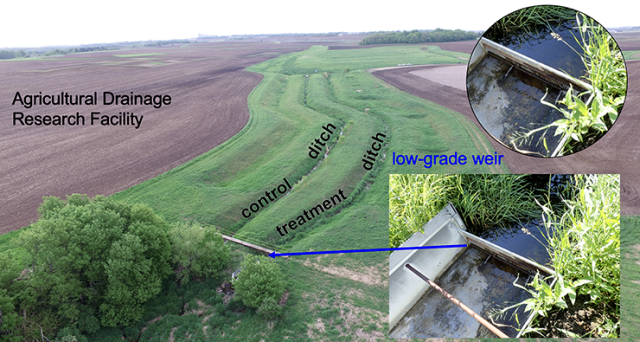
Some of the solutions Strock is looking at involve storing water on landscapes in ditches or farm ponds. By doing that, water could be “recycled” and irrigated back onto the landscape, allowing the resources like nitrogen and phosphorus — which were either applied as fertilizer or were already in the water — to not go to waste. 

“If you think about the last three years … we've had moderate to severe droughts in different parts of the state. Some places like Southern Minnesota, we don't have wells for irrigating like you do in sandier soils in central Minnesota,” Strock said. “But what we do have are these farm ponds and these drainage ditches where we can take drainage water that's been temporarily stored, pump it back out of those reservoirs back onto the landscape and irrigate some of the land that might be under drought conditions. It ends up bringing that water full circle.” 

He said most agricultural areas don’t have bodies of water that can be used for storage, so some innovations have involved adjustments to drainage ditches to slow the flow of water, similar to how urban drainage systems manage stormwater runoff.

Some of the solutions Strock is looking at involve storing water on landscapes in ditches or farm ponds.
Some of the solutions Jeffrey Strock, a professor and soil scientist, is looking at involve storing water on landscapes in ditches or farm ponds.

“(That) can potentially help with, you know, downstream flooding. It can potentially help with things like reducing nutrients, like nitrogen and phosphorus, that might be in the water,” Strock said. 

Cui is developing sensors that can monitor nitrogen, phosphorus and heavy metals in drainage water in real time. Strock said having that data from the sensors will allow certain water management processes to happen in preparation for weather events, creating more productivity for farmers and keeping the water quality up to standards. 

“Say they know there’s a storm coming — those sensors will allow water in water bodies to drain and create storage capacity. Before that storm event we can drain more rapidly some of the water … that's currently there,” Strock said. “Then that storm event happens, conceptually what our idea here is, you can actually then slow that water back down and create some storage capacity in that system, to then hold back the new flush of water and nutrients that might be coming out of our (agricultural) lands.” 

Strock is working with the Cottonwood Soil and Water Conservation District, which has an 11,0000-acre watershed. He applied for a grant through the state’s Environment and Natural Resources Trust Fund, which he thinks could complement the larger U.S. National Science Foundation grant and help to manage and clean the water in the drainage ditches that lead to Cottonwood Lake. 

The technology developed through the NSF research, he said, could really help the Cottonwood district. “There's an absolute application of the technology that we're developing in a watershed like that,” he said. 

A ‘decarbonized’ economy

The “Great Lakes Water Innovation Engine,” which the University of Minnesota is part of, is one of ten such engines that seek to improve innovation across the nation and foster regional economic competitiveness through a near $1.6 billion investment from the NSF. 

A central focus of the grant is creating a “decarbonized circular blue economy,” which Peterson described as a system of water management that can also generate economic value for the region. 

Cui, for example, is in communication with companies in the water management sector who would be interested in implementing these technologies. Those private companies are who municipalities would then work with in implementing the technologies in water treatment plants.

“You're taking resources out and reusing them for other things and creating value along the way. That circular blue economy that's being referenced, there's the circularity of resources associated with water and, hopefully, finding technologies that generate new kinds of economic value,” Peterson said.

This article first appeared on MinnPost and is republished here under a Creative Commons license.


********************************************
Thanks for visiting. Come again when you can.
Please be kind to each other while you can.

Sunday, March 3, 2024

Putting kids and families first

Can someone, anyone, explain any significant differences between child care. pre-K and kindergarten? The reason I ask is the Minnesota legislature is proposing to spend $500 million on child care subsidies. Meanwhile, as noted by MPR: Analysis: How Minnesota’s school funding leaves the most in-need districts behind. There’s also this recent report from MinnPost: Why $2B in new school funding is leaving Minnesota districts scrambling for cash. Just last session, the good news was: House passes massive K-12 education funding, policy package. That triggered the bad news: Districts worry about cost of new mandates [in the same bill].

photo of school graduation ceremony
“it takes a village to care for and educate a child” 
Photo by J. Harrington

There are continuing references to our school system, but many, especially in the legislature, seem determined to not treat it as a system. It’s largely like playing whack-a-mole. Recent reports raise significant questions about the advisability of providing public funds to charter schools. Rather than repeat that mistake, and rely on the private sector to provide child care, and subsidize that to make it more affordable, why not consider expanding the school system to incorporate childcare and, if it makes sense after a study of the system, make school a year round effort. Many parents have to work year round and need help with supervising children when school’s out. Staffing up for additional children during the summer isn’t likely to work well for a system that has staffing problems right now. Let’s look at better ways to support all Minnesota’s children, families and wage earners by building a real system to serve each and all of them.

Hills of Bureaucracy

In the event
that the engagement 
shall be prevented
by reason of war, 
Act of God, strike, 
civic tumult, epidemic 
or any other cause 
beyond the control 
of either agreeing party, 
which is deemed 
to be “force majeure,” 
the agreed parties 
shall be respectively 
relieved of their obligations
contained herein and 
return to the rolling hills
of bureaucracy, 
a deep green field 
of barley, more hills 
with hay bales, no sky: 
an argyle of crops, 
following emergency exits  
and evacuation plans
to the long and winding 
road that leads
to your door.

That would be 15 A 
on the updated form,
the red door 
with a mat and rack 
for your shoes
of a cottage in the village.
Let the minutes state 
you’ve had a tiresome    
journey through various causes
on the lengthy lavender road
past blaze orange fields
that shall include revolutions,
riots, wars, acts of enemies, 
national state local 
emergency, strikes, 
floods, fires, epidemics, 
quarantine, embargoes, 
or unusually severe weather, 
and that we’re not responsible 
or liable for any loss 
or damage, for delays
in performance 
or failure to perform. 
The 10 point font path
has brought you to the Open Forum
on Comprehensive 
Internationalization, 
where the committee 
invites input from the whole
community about where
we are at and where 
we should go,             
which thatched houses   
for which gas stations
in the settlements of 
educational plans, mission 
statements, internal hiring.
The designated spokesperson 
from the institutional 
advancement office is explaining:
This is a plan for all 
of us. A family reunion 
hosted by Human Resources 
in partnership
with Business Intelligence, 
Focus on Core Academic Function, 
so the member
at the back of the conference room
knitting wooly yarn clouds 
as stress relief
should get a grip.
We’ve all stopped 
our planting in favor 
of administering to 
attend this conference 
on the administration of planting,
Cc: all: the assistant to, vice-, 
associate, interim, acting,
chief, head of, associate director. 
Staples for vineyards. 
Collated construction 
plans are in departmental 
mail boxes. Approving 
the minutes from yesterday,
let’s send the next presenter back 
like a salmon stunned w/ frustration
who weeps with frustration
into the whirling vortex 
of a policy about policy,
a few hay bales, 
shade trees for cattle
or the sub-committee to 
this committee,
though Party 1 is not a fish
but a person who must drive 
back in his rental Kia,
the application form 
was incomplete. 
Next order of business: 
those ornamental wild
grasses planted 
last year for the parade,
tall, on the highway divide
on Route 2 South, 
junction of JFK Boulevard
and South Main, 
a deathtrap or death wish?


********************************************
Thanks for visiting. Come again when you can.
Please be kind to each other while you can.

Saturday, March 2, 2024

Is an anti-rescue curmudgeon all wet?

There’s lots of open water showing on local lakes and ponds. The Minnesota legislature is considering a bill to reimburse counties for “ice rescues.” Apparently counties are already reimbursed for surface water rescues. The article troubles me the same way that seeing boaters act stupidly on the Atlantic Ocean used to trouble my friends and I. Since it was, and probably still is, possible to take a small craft handling and seamanship course, we argued that completion of that course should be required to enable anyone to purchase a marine radio that could be used to summon the Coast Guard if one got in trouble on the water.

An outdoor writer I read years ago, possibly John Gierach, proposed in a story that “wilderness” trailheads should have signs posted to the effect that visitors were informed “You’re on your own if you get in trouble! Don’t expect rescues beyond this point.” Not doing so seems to violate the very concept of wilderness, and could do wonders for reducing competition for permits for the BWCA.

photo of northern Minnesota lake
should lakes like this be declared “wilderness?"
Photo by J. Harrington

Contemporary societies are doing a horrendously bad job of managing our commons of air, water, land and culture. In part because we allow distortions such as obscuring the distinctions between human beings and legal persons. Otherwise, corporations, which could in theory be eternal, should be faced with the prospect of a death penalty if convicted of ecocide or equally horrendous, but all too common, behavior.

In order to instill more respect for informed and appropriate behavior, why not declare all the water bodies in central and northern Minnesota as wilderness areas. No rescues permitted. If resorts want to support untrained and uninformed folks venturing forth, let those resorts provide the rescue teams and reflect the costs in their rates, providing a discount for a stay that doesn’t trigger a rescue effort.


Come wilderness into our homes

By Daniela Danz
Translated by Monika Cassel


break the windows come
with your roots and your worms
spread yourself over our wishes
our waste-sorting systems our protheses
and outstanding payments
cover us with your rustling greenery
and your spores cover us that we may
become green: green and reverent
green and manifestly green and replaceable
come weather with your storms
and sweep the slates off the roofs come
with snow and hail smash
through the collective sleep
we are all enjoying in our beds
our worn rationalizations come ice
and form glaciers over the shadow banks
and our drive for liquidity
come through the cracks under the doors
you desert with your sands fill
our desolation up until it forms into a solid mass
rise up over the search-and-rescue teams
and our growth compulsion trickle into
the control panels of the missiles
and the missile defense systems into
the think tanks and the hearts of internet trolls
just leave the hedgehogs with their
snuffling so that it may calm us
come rising sea levels
up over our shorelines both the developed
and the undeveloped the homey
lowland areas wash
jellyfish into our soup bowls
and ramshorn snails into our hair
as we swim in each other’s direction panicked
with our yearning for one another
because almost nothing is left because it’s all gone
and thoroughly soaked through with regrets
finger-pointing and tranquilizers
come earthquakes shatter the apartments
which we built on the foundations
of how we always did everything
come tremors fill the mine shafts
the end of work and
the literature of redemption bury anger
and affection and all manner of added values
swallow up the memories come tremors
hurry so that the bedrock covers us
so we are covered with water desert weather
and over everything that which covers all the wilderness
Translated from the German

Notes:

Read the German-language original, “Komm Wildnis in unsere Häuser,” and the translator’s note by Monika Cassel.


********************************************
Thanks for visiting. Come again when you can.
Please be kind to each other while you can.

Saturday, February 10, 2024

Sorcerer’s apprentice opens Pandora’s box

Yesterday the Better Half and I drove past one of the local sugarbushes. She noticed they had their sap collection tubing strung. A little farther down the road, as we crossed the St. Croix river, she spotted a fisherman, in a boat, on the open water of the river. This is not usual for early February in the North Country.

Today, as we drove home from a mid-morning visit to the Daughter Person, Son-In-Law and Granddaughter, in 28℉ temperatures, with cloud covered skies, we noticed the dusting of snow on the road edges was melting. Neither of us has the slightest idea how to explain that, since the overnight temperatures had stayed well below freezing and there had been no noticeable sunshine all morning.

phone lines: threads by which we hang?
Photo by J. Harrington

Yesterday’s ultra-ultra-slow internet service has been restored to its usual less than broadband speeds, after only about 36 hours of effective outage. I suspect things will get worse before they get better. Why? Here’s some examples:

We have created, and are becoming increasingly dependent on, systems that are insufficiently reliable relative to their criticality. Who in the US government is the systems agency responsible for thinking about the system of systems we depend on? It might be helpful to think about something more than short term self indulgence come next November.


The Battle of Silicon Valley at Daybreak

In a countryside green as a dollar bill,
with the much handled commercial vegetation
from around mall parking lots or in freeway divides,
in a landscape where the wireless has been shut off,
emoji are at war. Emoji are at war
in the mural outside the employee cafeteria
for reading The Things They Carried or Yellow Birds
or The Red Badge of Courage: instead of eating,
emoji are at war.

Outfitted in a list supplied by Wikipedia,
(breastplates, gauntlets, steel collars, mail shirts,
vambrace, pouldron, bassinet, barbute, aventail),
chain armor from a 3-d printer for a smaller budget,
emoji are at war: Blushing Emoji, Frustrated, Weeping,
Smiling Emoji near the village firewall, 
& a thousand spears like toothpicks,
emoji are at war.

It’s like Where’s Waldo. It’s like Pac Man.
I spot with my little eye in the “watch-fires of a hundred
circling camps” two generals outside a recharging tent,
a tiny banner unfurling PRIVACY  *  NET NEUTRALITY  
* DEREGULATION. Sound of emoji blood 
as the Smiling Emoji advance, swallowing everything,
going postal, kamikaze, road rage, suicide bomber
“hurling down to the House of Death so many sturdy souls,”
sound of emoji blood.

A sword pierces Blushing Emoji #956, Pram’s son, 
below the groin, and “the dark came whirling down 
across his eyes”; a hurled spear is shot through the temple of 
Angry Emoji #23, only son of Matthew Thornton 
of Boston, and “the dark came swirling thick across his eyes,”
sound of emoji blood. Sound of Emoji blood as Weeping 
Emoji #3,418, daughter of the river god, a bullet 
plunging into her lung, lodges in the “mortal spot,”
scream fumes.

Outside the village firewall, internet access was slowing 
wayway down until the CEO who has her eye on Jim,
a Cubicle Emoji, petitions the Board of Directors
to rescue Jim from his jangling fate of war, seduces him, 
gives birth to a daughter ½ Hollywood, ½ New Jersey mortal, 
with a weak ankle…Emoji were at war.

                         The CAPS LOCK is on,
so this story ends at the door to the men’s restroom. 
For we have seen,

I have seen, you have seen, they have seen how emoji blood sounds
like a ring tone of a 50 gun salute in a thousand wavy ploughed
lines, lines, lines, lines where truth is marching on.


********************************************
Thanks for visiting. Come again when you can.
Please be kind to each other while you can.