Showing posts with label gravel road. Show all posts

Tuesday, March 7, 2023

It’s finally mud season in our neck of the woods

Based on firsthand experience this morning, I can attest that township gravel roads have become very muddy. I even saw melt water flowing in one of the roadside ditches where, in the not too distant future, I expect to see marsh marigolds.

mud season on gravel roads
Photo by J. Harrington

The kind folks in the Twin Cities and at least one of the local tv stations did a report that made me feel better about the shape of our driveway. Even good-sized cities like Minneapolis and St. Paul are having problems with removing ice and compacted snow and where to put it all after it’s been removed. We’re very close to the stage of “Mother Nature put it there, let her take it away.” 

The pond to our north is displaying hints that it wants to open its water and flow. Our snow-covered roof is not covered as deeply as it was a couple of days ago. Dark spots on the driveway, like leaves that fell last autumn, are absorbing enough heat from the little sun we get to melt the ice on top of them. Winter, like many of us, has grown old and is beginning to fall apart.


To the Thawing Wind

 - 1874-1963


Come with rain, O loud Southwester!
Bring the singer, bring the nester;
Give the buried flower a dream;
Make the settled snowbank steam;
Find the brown beneath the white;
But whate’er you do tonight,
Bathe my window, make it flow,
Melt it as the ice will go;
Melt the glass and leave the sticks
Like a hermit’s crucifix;
Burst into my narrow stall;
Swing the picture on the wall;
Run the rattling pages o’er;
Scatter poems on the floor;
Turn the poet out of door.


********************************************
Thanks for visiting. Come again when you can.
Please be kind to each other while you can.

Wednesday, July 20, 2022

The neutrality of gravel roads

We’re enjoying another windy day, although the direction from which it’s blowing has changed. I noticed corn at the tasseling stage in several cornfields this morning as I drove to the Granddaughter’s to share readings. The drive also showed roadsides are now beautified with scattered clumps and clusters of bee balm and black-eyed Susans. Sumac bushes are developing fruit clusters. We must be approaching peak summer. As to the visit,  I think I enjoyed “The Cat on the Mat” more than she did, but she’s a little young to appreciate the finer nuances of verse and rhymes like cat, mat, rat, hat, fat. I found them inspirational.

Early this morning, in the field behind the house, we saw the first wild turkey poults of the year. It looks as though a whitetail doe was working as a guard deer while the hens showed the poults around. Scenes like that are part of what folks talk about when they mention the healing powers of nature. Being able to notice the beauty of flower-filled roadside ditches while driving past at 30 mph instead of twice that is another.

gravel road: where people are just people
Photo by J. Harrington

There were a couple of folks walking the gravel country roads this morning. We waved as I slowly drove past. It occurred to me that civility and neighborliness comes easier if we don’t try to pass that kind of behavior through a political filter. I might have been neighborly with a MAGA tRump supporter to whom I wouldn’t give the time of day if I knew that’s what they were. Each of the walkers might have extended a middle finger instead of an open-handed wave if they knew I was a left-leaning liberal who votes Democratic. Might country roads, the ditch-lined, gravel-surfaced, hobby farm surrounded kind, be a kind of neutral corner where we could meet as people not wearing labels? Could that help turn down the intensity of chronic irritation many of us are constantly experiencing? Right up until a couple of teens come roaring past on ATVs.


Night Drive

by Ted Kooser


Ten seconds ahead, a red reflector
on a fence post turns and looks back,
and, seeing our headlights, skips into

the weeds on the shoulder. It’s never in
much of a hurry but it sees that we are,
and lifts a glowing mitten as we pass.


********************************************
Thanks for visiting. Come again when you can.
Please be kind to each other while you can.

Friday, June 17, 2022

Do you know how to get to...?

Many of the north-south routes in our neck of the woods are impaired by road construction. Interstate 35 is backed up at least from Stacy south to Highway 97 near the Columbus / Forest Lake boundary. Old Highway 61 has some sort of construction around Stacy and much further south in Hugo. Traffic bailing from I-35 has impacted Forest Lake and jammed the round-a-bouts. If this were Scowhegan, ME, we’d be living the punch line: “Can’t get they-ahh from hee-yahhh!” or something like that.


North Country winters can tear up roads
Photo by J. Harrington


I suspect that I may have blogged previously about our seasonal alternative to North Country winters, road construction season. In all seriousness, I’d like to propose a piece of legislation, if we can ever get the Minnesota Legislature to do something for us citizens instead of just taking care of their corporate donors. For at least the seven county Twin Cities metropolitan area, and, preferably, for the thirteen county standard metropolitan statistical area, we need a road construction coordination czar who can prevent the detours from detouring drivers into yet more road construction. That’s it. That’s all. But it would significantly improve the quality of life for almost half the year and might even save money, let alone tempers and fenders.

To prove that we’re not entirely unreasonable, the coordination would not apply initially to gravel roads, even though the other day we were trapped for a mile or more behind a township road grader doing no more than 5 mph. The driver wouldn’t stop to let us and the vehicles behind us pass so we took our chances at a slightly wider spot where a driveway intersected. Obviously, we succeeded.


The Spring

by Gary Snyder


Beating asphalt into highway potholes
pickup truck we'd loaded
road repair stock shed & yard
a day so hot the asphalt went in soft.
pipe and steel plate tamper
took turns at by hand
then drive the truck rear wheel
a few times back and forth across the fill–
finish it off with bitchmo around the edge.

the foreman said let's get a drink
& drove through the woods and flower fields
shovels clattering in back
into a black grove by a cliff
a rocked in pool
feeding a fern ravine
tin can to drink
numbing the hand and cramping in the gut
surging through the fingers from below
& dark here–
let's get back to the truck
get back on the job.


********************************************
Thanks for visiting. Come again when you can.
Please be kind to each other while you can.

Sunday, February 6, 2022

One reason people don’t trust governments

 Once upon a time we lived on a township gravel road. Against our wishes, the township elected to pave the road. I presume that means that the likelihood of the township deciding to abandon our road is  very limited, but who can tell these days. Although I haven’t reviewed the file recently, I don’t recall anything in the seller’s disclosure form hinting at the possibility that the roadway ever could be abandoned. In fact, years before we bought our property in a township, I read the book Country Living: A Guide for City People. I find not a hint of possible problems with road abandonments.

a township gravel road in winter
Photo by J. Harrington

In Minnesota, the Minnesota Association of Townships has an information library on resources regarding:

Township Roads

Overview and statute reference, minimum maintenance, ditches, Snow/Ice, town road flowchart, drainage, lines, cartways, and more

There are several resources on vacating or abandoning a townships interest in a road, but there doesn’t appear to be any requirement for townships to maintain an official map, comparable to a zoning map, of which roads are the townships and which are private. Lack of such a map makes it difficult for a potential property owner to determine if access to a property is public or private.

The information problem appears to be compounded by a potential oversight on Minnesota’s required seller’s disclosure form [M.S.B.A. Real Property Form No. 15 (2005, 2016, 2017)]. To quote:

The disclosure must include all
material facts of which the seller is aware that could adversely and
significantly affect: (1) an ordinary buyer's use and enjoyment of the
property; or (2) any intended use of the property of which the seller is
aware. (b) The disclosure must be made in good faith and based upon
the best of the seller's knowledge at the time of the disclosure.

All of the preceding has been triggered by news coverage, yet again, of an ongoing battle between a resident family and Hillman Township. One aspect the news stories haven’t mentioned, as far as I recall, is whether the family knew the status of the road before they purchased the property. A check of the Hillman Township section of the Kanabec County web site is not helpful to any potential property owner in identifying whether a road is public or private. The state law(s) in question seem to have a number of requirements, none of which provide ongoing public notice of the status of a roadway in any township.

The purpose of today’s posting isn’t to take sides or find fault on the case in question. It is a reminder that, all too often, “It’s the system that’s at fault.” Perhaps the township association, the bar association and the legislature could, and should, visit the statutes in question and revise them to limit the number of times such contentious issues may arise in the future.


Gravel


 - 1954-


Weed-wrack and wild grape 
                                                       hanging from the dusty trees 
that touch above the narrow road. 
                                                       I’m driving my way back 

—rough passage over gravel— 
                                                       back the slow miles over 
the creek, the lapsed meadow 
                                                       we walked for arrow points 

until the road narrows to path. 
                                                       I park the car.  I pick my step           
past rusty barbed wire through 
                                                       a clearing to the house. 

Back the house. Back the years. 
                                                      Back with him now with me 
over broken floorboards,      
                                                      stone footers, the pot stove—  

a whippoorwill, years distant 
                                                      through the paneless frames. 
Half a staircase leading up 
                                                      over the century of beams. 

Back now again the old road 
                                                      disappearing through white woods, 
where he lay down and breathed 
                                                      no more. 


********************************************
Thanks for visiting. Come again when you can.
Please be kind to each other while you can.

Friday, June 25, 2021

Weed control?

For the past week the roadsides in our neighborhood have been full of crown vetch in bloom. In 2017 crown vetch was added to the Minnesota list of restricted noxious weeds. According to the Minnesota Department of Agriculture:

crown vetch in bloom
Photo by J. Harrington

Mowing can be effective to slow the spread if done on schedule to prevent seed formation, and for successive years. For complete eradication, mowing will need to be performed in conjunction with another control method, like herbicide application.

Minnesota Statutes complicate the mowing solution somewhat since 160.232 Mowing Ditches Outside Cities states:

(a) To provide enhanced roadside habitat for nesting birds and other small wildlife, road authorities may not mow or till the right-of-way of a highway located outside of a home rule charter or statutory city except as allowed in this section and section 160.23.

(b) On any highway, the first eight feet away from the road surface, or shoulder if one exists, may be mowed at any time.

(c) An entire right-of-way may be mowed after July 31. 

Judging by the condition of the blooms in late June, crown vetch may well have gone to seed by July 31. Although we haven't taken a tape measure to the local roadsides, it's not hard to guess that at least a notable amount of the crown vetch extends back more than eight feet from the road surface or shoulder. Perhaps this helps explain why we're seeing more and more crown vetch growing in the roadsides. It seems too many entities in government will never grasp the idea that, if you want to encourage a certain behavior, make it easy to do. Then, again, will US governments ever adopt the precautionary principle?


Rose Pogonias


 - 1874-1963


A saturated meadow,
     Sun-shaped and jewel-small,
A circle scarcely wider
     Than the trees around were tall;
Where winds were quite excluded,
     And the air was stifling sweet
With the breath of many flowers,—
    A temple of the heat.

These were bowed us in the burning,
     As the sun’s right worship is,
To pick where none could miss them
     A thousand orchises;
For though the grass was scattered,
    Yet every second spear
Seemed tipped with wings of color,
     That tinged the atmosphere.

We raised a simple prayer
     Before we left the spot,
That in the general mowing
     That place might be forgot;
Or if not all is favoured,
     Obtain such grace of hours,
That none should mow the grass there
     While so confused with flowers. 


********************************************
Thanks for visiting. Come again when you can.
Please be kind to each other while you can.

Saturday, August 15, 2020

Watch for spots before your eyes

Yesterday morning, as we neared the pick-up location for our Community Supported Agriculture [CSA] share, I noticed movement on the right-hand side of the road ahead and slowed down. As we approached, a spotted fawn looked toward us, lifted its head, looked ahead, across the road, and scampered in front of the jeep. We stopped and waited for it to cross the road and enter the woods. It did and we proceeded.


August: spotted fawn time
Photo by J. Harrington


Not two hundred yards beyond the fawn, a buck, its antlers in velvet, bounded across the road and into the woods. We saw no sign of a doe, which is unusual with a fawn out wandering around. Another hundred yards or so and we rolled into the drive of the CSA pick-up barn. No harm, no foul.

We collected our share box, put the contents in the jeep, and started the return trip. At about the same place we saw the fawn enter the woods earlier, we noticed it had returned and was lurking behind a roadside bush. Driving slowly, we eased past the fawn and then picked up some speed, but not too much. A mile or so down the road, as we approached a sweeping left hand turn on the gravel road, I noticed a whitetail doe standing at attention in the ditch on the passenger side of the jeep. I doubly slowed, once for the turn and once for the doe, just in case she did something foolish like dash in front of the jeep just as we were about to pass her. Fortunately, she stayed in the ditch until we got close and then bolted into the woods on her side of the road.

From now until about Thanksgiving you should expect deer to, as Harry Potter fans would say, "apparate" in front of you, often at a distance too short to enable avoiding a serious collision. For the sake of the deer, especially cute, young, fawns, and your sheet metal and air bags and passengers, reducing your travel speed to something well this side of sane would be a good idea. Spots in front of your eyes are much easier to deal with at a reasonable distance.


Here, now, gone


Bob Hicok


We’re standing in the road
looking at a dead fawn. His truck facing town,
mine headed toward home. It appears to be sleeping
on the double yellow, curled as if in tall grass
or on a down comforter in a video someone has posted
on YouTube about her pet deer. No sign of collision
or gunshot, garroting, heart attack: nothing but spots,
cuteness. The name on his door means he works
on the natural gas pipeline that’ll run
from West Virginia to North Carolina.
The company that pays him has a reputation for ruin
worse than syphilis. Employees have been told
to stay away from locals. They stick to a hotel
near the freeway with a decor I’d call modern roach,
drink there, hone boredom, look at stars.
We both crouch to make sure the fawn is dead.
“What the fuck,” he says, staring at the desert
of my face, where there’s no rain or hope,
only cactus, as I search the dry lake-bed of his.
He looks back at the fawn, brings his hands together
as if waiting for a Communion host,
makes a scooping motion with his hands,
then slides his eyes to the side of the road:
I’m being asked to help save a dead fawn
from the bonus carnage of traffic, the shredding
that suggests life isn’t just delicate
but deserves to be erased.
We are the briefest couple
joined by common cause, move the fawn
and stand briefly as men who have respected loss
for sentimental reasons. Then nod, become ghosts
of a moment we are the custodians of, holders
of the unholdable, wind telling the story of itself
to itself.


********************************************
Thanks for visiting. Come again when you can.
Please be kind to each other while you can.

Wednesday, June 19, 2019

Why didn't the turtle cross the road?

Yesterday, as we were headed off to retrieve our tractor from the Daughter Person and Son-In-Law, we noticed an new and different "lump" on our gravel drive. Since the Better Half [BH] was standing next to the Jeep so she could check the trailer taillights as we pulled out, we said: "Is that a turtle in the drive?" and pointed. BH took the hint, walked over, looked at it, and said "Yep." It was a good sized painted turtle. (No photos of that one.) It's our first turtle sighting of the year. We feel almost like the mountain must have felt when Muhammad went to it.

painted turtle crossing gravel road
Photo by J. Harrington

We suspect the turtle was looking for a friendly location to lay some eggs and had clambered several hundred yards through the woods in search of one. The BH didn't watch to see where the turtle went. It could have headed back for the pond North of the property; to the wet spot behind the house, or off into the sandy field to excavate a nest. We were pleased we didn't see a squashed, or squished, turtle shell on our township road yesterday or today. It's possible a local coyote might have grabbed it, or it now might be ensconced back where it came from. One of life's mysteries we'll never resolve, and that's probably as it should be. Past years we've had the honor of helping turtles across our once gravel road. This year none have been seen trying to cross the new and improved paved road.

Summer Solstice brush pile burn
Photo by J. Harrington

We got some grass cut today, before the next rainy spell descends on us. There's a little buckthorn pulling still to be done on the one area we want to replant with native bushes, and the BH has finished rescuing her day lily bed from the grass invaders. It's about time to order up another MNDNR born permit so we'll be legal to celebrate either the Summer Solstice this Friday or Independence Day in a couple of weeks by burning last Winter's brush pile. After that, we can start on next year's. The rabbits and snakes and some songbirds seem to appreciate having a brush pile on, in or under which to rest and relax from predators. Maybe that's where the turtle headed for. We'll be sure to make a big commotion and watch carefully when we finally get around to igniting the pile.

Painted Turtle


Summer road the ring around the lake, we drove mostly in silence.

Why aren’t I your wife?

You swerved around a turtle sunning itself.

I wanted to go back. To hold the hot disc of it and place it in the grass.

We were late for dinner.

One twentieth of a mile an hour, I said. Claws in tar. You turned the car around.

Traffic from the direction of the turtle, and you saw before I did, the fifty bones of the carapace,

crushed roman dome, the surprise of red blood.

I couldn’t help crying, couldn’t keep anything from harm.

I’m sorry, you said, and let it hurt.

The relief, always, of you in the seat beside me, you’ll never know.

Driving that road next winter, you remembered that place in the road. Your turtle.

During hibernation, a turtle’s heart beats once for every ten minutes.

It cannot voluntarily open its eyes.


********************************************
Thanks for visiting. Come again when you can.
Please be kind to each other while you can.

Saturday, May 18, 2019

Where are Turtle Island's turtles this May? #phenology?

our township probably needs more signs like this
Photo by J. Harrington

To many Native Americans and First Nations people North America is known as Turtle Island. We live in an area, once inhabited by the Dakota and the Anishinaabe, that has many wetlands and water bodies. Many years during May we see, at various times, a number of turtles crossing local roads as they go to lay their eggs. This year we've seen none.

Blanding's turtle crossing our formerly gravel road
Photo by J. Harrington

In part, we're wondering if some part of the turtles' life cycle is occurring later this month, along with many other Spring events. Or, is the lack of sightings due, in part, to our recently blacktopped township road?

snapping turtle crossing a paved road
Photo by J. Harrington

Blanding's turtles, which we've seen nearby a number of times in years past, typically nests in June, according to the Minnesota Department of Natural Resources. A similar pattern is followed by snapping turtles. Blanding's, snapping and painted are the three turtle species we've seen crossing roads, but there are many more species native to Minnesota.

painted turtle crossing our formerly gravel road
Photo by J. Harrington

Turtle Island is also the title of Gary Snyder's Pulitzer Prize-winning book of poems but, as far as we can recall, there's no poem in it mentioning a turtle. Snyder's homage to Turtle Island in a poem comes in a different volume (Axe Handles) with the poem:

For All


Gary Snyder


Ah to be alive
on a mid-September morn
fording a stream
barefoot, pants rolled up,
holding boots, pack on,
sunshine, ice in the shallows,
northern rockies.

Rustle and shimmer of icy creek waters
stones turn underfoot, small and hard as toes
cold nose dripping
singing inside
creek music, heart music,
smell of sun on gravel.

I pledge allegiance

I pledge allegiance to the soil
of Turtle Island,
and to the beings who thereon dwell
one ecosystem
in diversity
under the sun
With joyful interpenetration for all.


********************************************
Thanks for visiting. Come again when you can.
Please be kind to each other while you can.

Monday, January 7, 2019

The thaw continues

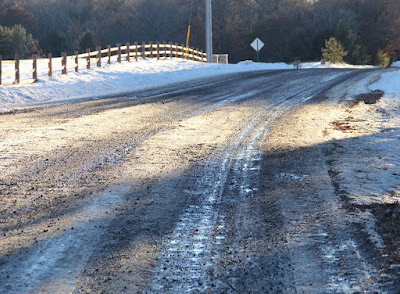
Neither rain nor snow fell upon us last night, but we did get the dark of night. Part of us thinks we got lucky. A different part thinks "we'll pay for this." We can, and do, get significant snow storms in April in our North Country. We hope we won't still be shoveling blowing snow come May of this year to make up for the minimal snow cover we have today in fields and woods. At least we haven't had, so far, much in the way of really cold temperatures driving frost deep into the soil. The picture below captures what a January thaw looked like before the township paved our road. Blacktop absorbs more heat when the sun shines on it so much of the icy coating has melted and, for much of the road, we're back to bare pavement. We didn't cover our driveway with impermeable asphalt and it spends most of its time shaded by trees on the North and South sides, so it is now a puddle and ice covered hazard. Even the dogs were walking a little slower today while on the drive.

January thaw on a gravel road
Photo by J. Harrington

In anticipation of the eventual arrival of Spring, we've been reading one of the books we got for Christmas, Dave Hughes' Essential Trout Flies [ETF]. Over the years we've read a multitude of books on fly-fishing, especially for trout. ETF is the first one that presents the information in an organized way that makes sense to us. Maybe we needed to have read that multitude of other books for this one to make sense? [When the pupil is ready, the teacher will appear.] Our strategy for 2019, of focusing on bread, fly-fishing for trout, and poetry, seems to be working. We knew we had become too much like the old description of the Platte River, "a mile wide and an inch deep." In fact, that phrase and river links us to Nebraska, which links us to Ted Kooser, of Nebraska and his friend and fellow poet Jim Harrison, who had a love for the Sand Hills and set some of his fiction there. From what we've read of Harrison, Hughes and Kooser (no, it's not a law firm), they are "plain spoken" writers with a deep-seated appreciation of the natural environment. That's the kind of company we like to keep. If you share that interest, see if you can find a copy of Winter Morning Walks: 100 Postcards to Jim Harrison (2001) or Braided Creek: A Conversation in Poetry (2003). Below is Kooser's poem from Winter Morning Walks for this day in the Winter. It could almost be describing our place, if we had had the forecast light snow last night.

whitetail deer track in melting snow
Photo by J. Harrington

january 7
five degrees and light snow

An elaborate braiding of deer tracks
close to the house this morning early,
within a few yards of our two dogs
asleep on the porch. A dozen or more
walking soundlessly east in the night,
a half moon rising before them.
I like the long deft brush stroke
as each hoof swung into and out of the snow,
and the little splash kicked out ahead
as they stripped sweet bark from the darkness,
afraid of everything but not afraid.


********************************************
Thanks for visiting. Come again when you can.
Please be kind to each other while you can.

Friday, September 28, 2018

the wilds of Autumn

Each day we see more and more color in the local leaves. Still not dominant, but coming along nicely, especially around the low areas and wetlands. Tonight we have the season's first freeze / frost warning covering most of the state. We'll bring the mums and asters into the front hall and throw a sheet over the plant pots outside. Probably time to disconnect the hoses, too.

Autumn's colors developing
Photo by J. Harrington

This shift in temperatures is happening the same day the township and their contractors are paving our gravel road. We have, at best, mixed feelings about that change. Dust reduction will be nice but not if it comes at the expense of greater dangers from increased vehicle speeds. Plus, we'll not be expecting to see deer, or any other, tracks in the blacktop, nor many reptiles warming themselves on an early Spring day, although we may be proven wrong about the warming. We just don't know.

We've been reading another of Ed Abbey's books. This one a collection of essays titled One Life at a Time, Please. Mr. Abbey is known for having a dim view of much of what contemporary civilization refers to as "progress." As we age, we find ourself coming to be more and more in agreement with him about the downsides to many of the "benefits" of civilization. Climate change, confined animal feeding operations with flooded manure lagoons plus flooded and/or breached ash basins among them.

He's also known to have been a fierce defender of wild country, especially in the Southwest. Here are examples of what he fought to save: Rethinking Wilderness: Of Prairies and Deserts. We have a wild and scenic river just down the road apiece. It too looks like it needs more defenders. From the St. Croix 360 newsletter: Scandia gravel pit overflows, buries St. Croix Valley spring creek.

As we watched the heavy trucks, the blacktop machine, and the steam roller slowly proceed down what once was our gravel road, we remembered with fondness another of Abbey's works, The Monkey Wrench Gang. Try it! You might like it.

Wilderness


There is a wolf in me … fangs pointed for tearing gashes … a red tongue for raw meat … and the hot lapping of blood—I keep this wolf because the wilderness gave it to me and the wilderness will not let it go.

There is a fox in me … a silver-gray fox … I sniff and guess … I pick things out of the wind and air … I nose in the dark night and take sleepers and eat them and hide the feathers … I circle and loop and double-cross.

There is a hog in me … a snout and a belly … a machinery for eating and grunting … a machinery for sleeping satisfied in the sun—I got this too from the wilderness and the wilderness will not let it go.

There is a fish in me … I know I came from saltblue water-gates … I scurried with shoals of herring … I blew waterspouts with porpoises … before land was … before the water went down … before Noah … before the first chapter of Genesis.

There is a baboon in me … clambering-clawed … dog-faced … yawping a galoot’s hunger … hairy under the armpits … here are the hawk-eyed hankering men … here are the blond and blue-eyed women … here they hide curled asleep waiting … ready to snarl and kill … ready to sing and give milk … waiting—I keep the baboon because the wilderness says so.

There is an eagle in me and a mockingbird … and the eagle flies among the Rocky Mountains of my dreams and fights among the Sierra crags of what I want … and the mockingbird warbles in the early forenoon before the dew is gone, warbles in the underbrush of my Chattanoogas of hope, gushes over the blue Ozark foothills of my wishes—And I got the eagle and the mockingbird from the wilderness.

O, I got a zoo, I got a menagerie, inside my ribs, under my bony head, under my red-valve heart—and I got something else: it is a man-child heart, a woman-child heart: it is a father and mother and lover: it came from God-Knows-Where: it is going to God-Knows-Where—For I am the keeper of the zoo: I say yes and no: I sing and kill and work: I am a pal of the world: I came from the wilderness.


********************************************
Thanks for visiting. Come again when you can.
Please be kind to each other while you can.
Thursday, September 20, 2018

Equinox approaches

It's another rainy day. We may, or may not, get some severe weather this afternoon. The most excitement so far today was triggered by the discovery that one of the neighbor's yaks had wandered loose and was calmly munching the grasses growing in the roadside ditch. We noticed the errant yak as we were headed off to do some errands and notified a neighbor who in turn notified the yak's owner. The beast was nowhere to be seen as we returned so we assume a yak-herder was sent to reclaim the wayward animal.

neighbor's yaks where they belong, behind a fence
Photo by J. Harrington

On our trip out, we next noticed, another half a mile or so down the road, a small herd of four whitetail deer standing on a hillside next to the road. The deer were on the opposite side of the road from the yak. As we passed, they continued uphill and into the woods with no undue incidents. We wonder how the deer, and yak, populations will fare once the town board has its way and our gravel road is paved. Will increased speeds on the part of those just passing through lead to increased fatalities?

late Autumn deer-nibbled pumpkins
Photo by J. Harrington

Yesterday, the Better Half arrived home with four moderate sized pumpkins and a table-top's worth of gourds and small pumpkins. The larger four are now lining the North side of the driveway in approximately the same location that the chrysanthemums are usually placed. In years past, proximity to the house has not deterred deer from nibbling on the decorative pumpkins. In any case, we should now be almost all set to celebrate Autumn Equinox and Halloween, but not necessarily Samhain. If, as forecast, the sun actually returns on Saturday, we think we'll celebrate Equinox with a cup of coffee on the patio of one of our favorite local coffee shops. If it doesn't shine, we'll at least try to not grump very much. Equinox is a good day to try to maintain a balance, right?

In Autumn


When within ourselves in autumn we feel the autumn
I become very still, a kind of singing, and try to move
like all things green, in one direction, when within ourselves
the autumn moves, thickening like honey, that light we smear
on faces and hands, then touch the far within one another,
something like autumn, and I think when those who knew
the dead, when they fall asleep,then what, then what in autumn
when I always feel I’m writing in red pencil on a piece
of paper growing in thickness the way a pumpkin does,
traveling at fantastic speed toward orange, toward rot, when
in autumn I remember that we are cold-smitten as I continue
smearing red on this precipice, this ledge of paper over which
I lean, trying to touch those I love, their bodies rusting
as I keep writing, sketching their red hands, faces lusting for green.


********************************************
Thanks for visiting. Come again when you can.
Please be kind to each other while you can.

Saturday, May 19, 2018

It must be Summer! #phenology?

The Minnesota Department of Transportation has work going on at two locations on I-35, near the crossovers at Hwy 97 and separately at Hwy 8. The North / South traffic between the Twin Cities and Duluth, plus lots of daily commuters, face delays or detours.

Before there was I-35, there was Hwy 61 (sometimes revisited), an alternative North / South route. Chisago County and the City of Stacy have a long section of that closed from County Road 19 North. So much for that alternative route to I-35.

not needed come Winter
Photo by J. Harrington

Our own township road also runs North / South but we hadn't noticed a large increase in traffic despite the closures and delays on I-35 and (old) Hwy 61. So, this past week, the township did a culvert replacement which, for some time, essentially closed our North / South travels. We understand the need for road maintenance and improvements, most of which can't be done in our North Country Winters. That helps explain why Minnesota is sometimes said to have two seasons: Winter and Road Construction. Highway departments do their best to minimize the inconvenience, we're sure. But there doesn't seem to be any requirement or process that mandates work be coordinated so that detours off of a state road don't get routed onto a county highway that's also experiencing road work. We think there needs to be a much better set of requirements, or better enforcement of any signage requirements that exist.

sign of Summer road sign
Photo by J. Harrington

The township crew had put a "Road work ahead" sign on the side of the road a couple of hundred yards before their culvert work which had the entire road block off. Drivers got to notice this as they came downhill and around a curve leading into a "steam shovel" and ditch closing the complete cartway. We think it would have worked much better if the township had put a "Road Closed Ahead" sign back where drivers could have readily taken a detour. That would have minimized the inconvenience to both drivers and the work crew which experienced at least one stoppage to let us pass after we had skidded to a halt at their blockage.

There are other road signs that indicated Summer will soon be here. We've shared a couple above. Yet one more sign that Summer is practically upon us? Today we had our first ice cream cone of the season.

Road


This is what poetry is (says the Road), 
a laying down of uniform pattern 
across a land you can't control 
but which you think it best to flatten. 
It's far from vivid. Look at the whole 
flamboyant forest! Look at the paths 
that can't be uttered by a mouth 
and at the scattered arcs of light 
more integral to this wide planet 
than words will ever be. Your lines? 
Like railroad tracks that cut the bracken, 
bring something through, then disappear. 
No one knows what speck was taken 
or where it moved, and no one cares.


********************************************
Thanks for visiting. Come again when you can.
Please be kind to each other while you can.

Wednesday, February 14, 2018

It's Valentine's Day! Look for "flowers" soon! #phenology

Happy Valentine's Day!
Photo by J. Harrington

The sun is shining. Temperatures have climbed enough to warm even our black Irish heart. Gravel roadsides are lined with mud and ditches are developing puddles. Not Spring in our North Country, but close to it. Faux Spring perhaps? At least we're closer to the end of Winter than its midpoint. Only two weeks now until the start of meteorological Spring.

British soldier lichen, end of February
Photo by J. Harrington

Although far too early in the season to begin looking for them yet, over the past several years we've found a number of locations where we can enjoy wildflowers such as trillium and trout lilies. It occurred to us today that, if we sketched a map and marked it with wildflower glens or glades or whatever, other than a prairie, one calls a place where native wildflowers grow wild, we might begin to feel more at home in our adopted bioregion. We'll give that some more thought.

skunk cabbage, end of March
Photo by J. Harrington

As we get increasing numbers of above-freezing days, and the snow cover shrinks, we can start looking for early signs of life returning. British soldier lichen have been seen to emerge while there are still patches on snow-covered ground. Since snowdrops aren't wildflowers, we'll look for British soldiers as an early indicator. We think they (the lichen) even show up before skunk cabbage has emerged, but that's something we can try to confirm this season. It obviously didn't take much warmer weather for us to start to get excited about coming attractions. This year we even know where to look locally for prairie smoke, although we're still searching for somewhere that pasque flowers grow.

                     Springtime in the Rockies, Lichen


All these years I overlooked them in the
racket of the rest, this
symbiotic splash of plant and fungus feeding
on rock, on sun, a little moisture, air —
tiny acid-factories dissolving
salt from living rocks and
eating them.


Here they are, blooming!
Trail rock, talus and scree, all dusted with it:
rust, ivory, brilliant yellow-green, and
cliffs like murals!
Huge panels streaked and patched, quietly
with shooting-stars and lupine at the base.


Closer, with the glass, a city of cups!
Clumps of mushrooms and where do the
plants begin? Why are they doing this?
In this big sky and all around me peaks &
the melting glaciers, why am I made to
kneel and peer at Tiny?


These are the stamps of the final envelope.


How can the poisons reach them?
In such thin air, how can they care for the
loss of a million breaths?
What, possibly, could make their ground more bare?


Let it all die.


The hushed globe will wait and wait for
what is now so small and slow to
open it again.


As now, indeed, it opens it again, this
scentless velvet,
crumbler-of-the-rocks,


this Lichen!


********************************************
Thanks for visiting. Come again when you can.
Please be kind to each other while you can.

Monday, February 5, 2018

Speak now, or forever hold your head!

This morning we headed off to do some errands. Just down the road a single coyote dash across about 50 yards or so in front of us. Native Americans know the coyote as a trickster, or a helper, or a creator. Since we're a little familiar with the myths surrounding coyote, we were promptly reminded that tomorrow night is precinct caucus. Time for "crafty intelligence, stealth, and voracious appetite."

Here's an up-to-date version of 

How to caucus in Minnesota


The linked page in turn contains a link to the Minnesota Secretary of State's web site, where you can find the location of your caucus if you don't already know.

What we haven't yet found is a cheat sheet summarizing each candidate's position on a number of key issues, copper-sulfate mining and single payer health insurance being to we find of particular interest. Some candidates have noted that the governor should be sure that the laws are followed and any permit that's issued for a copper-sulfate mine must be rigorously enforced. (Some of us are familiar with the lack of enforcement activities by some of our regulatory agencies when it comes to taconite and related mining activities.)

We understand the problems political candidates face with the need to not offend too many people in order to get elected in the first place. We also think that the pablum and pandering that passes for political discourse has become a large part of our national, state and local governance problem. Since we're going to be at our local Roads and Bridges committee meeting this evening, infrastructure offers a classic example. For some time now the US has been getting grades of D or less  on its infrastructure maintenance and development. Two people were killed recently in a train crash that's been described as avoidable. Minnesota hasn't increased its gas tax, or provided a meaningful alternative funding source for transportation, especially roads, for years. Meanwhile, our township has board members who think the solution is to pave every gravel road but haven't shown any analysis of what that would, or could, do to future budgets. Strong Towns keeps pointing out its concerns that we can't afford the roads we have. Meanwhile, we'd be happy if we could find some clear, definitive criteria for when a rural road should, or should not, be paved.

should this be paved? when? why?
Photo by J. Harrington

Absent any rational approach to managing where and how we live and get around, we strongly recommend participating in local government and attendance at precinct caucuses. It's barely better than undergoing root canal, but it seems to be all we have if we hope to maintain the facade we're at least nominally a democracy.


                     Developing the Land


For six nights now the cries have sounded in the pasture:
coyote voices fluting across the greening rise to the east
where the deer have almost ceased to pass
now that the developers have carved up yet another section,
filled another space with spars and studs, concrete, runoff.

Five years ago you saw two spotted fawns rise
for the first time from brome where brick mailboxes will stand;
only three years past came great horned owls
who raised two squeaking, downy owlets
that perished in the traffic, skimming too low across the road
behind some swift, more fortunate cottontail.

It was on an August afternoon that you drove in,
curling down our long gravel drive past pasture and creek,
that you saw, flickering at the edge of your sight,
three mounted Indians, motionless in the paused breeze,
who vanished when you turned your head.

We have felt the presence on this land of others,
of some who paused here, some who passed, who have left
in the thick clay shards and splinters of themselves that we dig up,
turn up with spade and tine when we garden or bury our animals;
their voices whisper on moonless nights in the back pasture hollow
where the horses snort and nicker, wary with alarm.


********************************************
Thanks for visiting. Come again when you can.
Please be kind to each other while you can.

Wednesday, September 13, 2017

Turtle crossings #phenology

Over the past week or so the Better Half [BH] has several times reported noticing turtles crossing a local road. This morning, we saw two Blanding's turtles, one on a township gravel road, the other, several miles away,on a paved county road. We stopped at each sighting to help ensure the road crossing was successful. The first turtle turned as we approached, hissed at us, and hustled (for a turtle) the rest of the way across the road and into the roadside grasses. The second turtle simply withdrew into its shell so we picked it up at shell's rear edges and carried it to the side of the road toward which it seemed headed. Both turtles had several leeches attached to their shells. Does anyone have a clue if leeches can suck blood through a turtle's shell?

[UPDATE: Three families of leeches, the Piscicolidae, the Hirudinidae, and the Glossiphoniidae, contain representatives that are blood-feeding, usually temporary ectoparasites of aquatic turtles, such as Placobdella spp. (Siddal and Desser 1991). Turtle leeches may be a significant component of macroinvertebrate diversity in some freshwater habitats. 
p. 26 Blanding’s Turtle ( Emydoidea blandingii ): A Technical Conservation Assessment]

Blanding's turtle crossing gravel road
Photo by J. Harrington

Although turtles move from one habitat to another during the period they're not actually overwintering, we wonder if some of what we've been seeing can also be attributable to basking on roads to raise their body temperature after a series of unseasonal cool nights? There's a Turtle Crossing sign on one east-west road through our section of Carlos Avery Wildlife Management Area (we keep meaning to take a photo) but not where we saw either Blanding's turtle this morning. Perhaps the Carlos Avery management team could consider adding a few more signs around the perimeter of the Sunrise River pools. As is often the case in real life, we've seen more Blanding's in places without Turtle Crossing signs than anywhere near where the signs are.

leech on Blanding's turtle shell
Photo by J. Harrington

Anyhow, we were pleased to notice that, when we retraced our morning route several hours later on our way back from "The Cities," there were no signs of squashed turtles. At least for today, our efforts to help little old lady(?) turtles cross the street may actually have been helpful.

           On Finding a Turtle Shell in Daniel Boone National Forest


This one got tired
of lugging his fortress
wherever he went,
was done with duck and cover
at every explosion
through rustling leaves
of fox and dog and skunk.
Said au revoir to the ritual
of pulling himself together. . .  

I imagine him waiting
for the cover of darkness
to let down his hinged drawbridge.
He wanted, after so many
protracted years of caution,
to dance naked and nimble
as a flame under the moon—
even if dancing just once
was all that the teeth
of the forest would allow.


********************************************
Thanks for visiting. Come again when you can.
Please be kind to each other while you can.