Showing posts with label environmental protection. Show all posts

Sunday, May 4, 2025

for the children

 Leaf buds are burst. Leaf out has begun. The creeping Charlie in front of the house  has pretty little blue flowers. The lily of the valley patch along the driveway is about half a foot tall. Spring is sprunging everywhere. Today's temperature is in the upper 70's approaching 80. Next Sunday is Mother's Day. The humming bird / oriole feeder has been filled and hung.

Earthrise Image Credit: NASA/NOAA/GSFC/Suomi NPP/VIIRS/Norman Kuring
Image Credit: NASA/NOAA/GSFC/Suomi
NPP/VIIRS/Norman Kuring

I'm trying, and sometimes failing, to not let the craziness emanating out of the state and national capitols sour me on the world and many of its inhabitants. When I stop doom scrolling and look around I can find beauty and goodness. Let's see if I feel optimistic enough this week to go buy a fishing license. 🤞

I bet you know that Minnesota's constitution has provisions governing spending lottery funds on environmental projects but doesn't have a "Green Amendment" establishing our right to clean air, clean water and a healthy environment. That strikes me as being a cart before the horse kind of deal. There's an organization / movement, Green Amendments For the Generations, with the mission:

to ensure every person and community across the United States is able to experience the health, quality of life, education, joy and economic prosperity provided by a clean, safe and healthy environment; to end environmental racism; and to help ensure that nature itself is able to thrive, by constitutionally empowering all people to secure and enforce their inalienable human right to pure water, clean air, a stable climate, healthy ecosystems and environments.

Minnesota is not listed as one of the states active in the Green Amendment movement. I'm curious to see if I can get a handle on why and how we might be able to change that. Please feel free to share thoughts in the comments

The Green Amendments movement is similar to but not the same as the Rights of Nature movement. The former focuses on anthropocentric values and the latter on nature's intrinsic values. I think we should look toward a "both and" approach rather than an either / or situation, but it may well turn out to be a one step at a time movement. Now that Minnesota is the headwaters of America's Most Threatened River, the Mississippi, perhaps the powers that be may become more amenable to the proverbial "clean up our act" effort. Stay tuned.

Today's poem is one of my own that I was fortunate enough to find a home for in a book by a friend of ours, Krista Detor's Flat Earth Diary. Most of those who will benefit from Green Amendments aren't yet born or grown up.


        A Way 

Earth's children grow
leave home
go away where
dragons roam

dragons fly aweigh
to lands on maps
filled with children grown
away from home

Hubble captures dragons a way from home
away from children
aweigh in space

children young and old
pass away as dragons fly
where earth aweigh
finds a way
to roam
home 
J Harrington


********************************************
Thanks for visiting. Come again when you can.
Please be kind to each other while you can.

Monday, November 4, 2024

Fall Back! fall down!

We  have definitely entered the darker half of the year here in the northern hemisphere. Daylight savings time ended yesterday. The results of tomorrow’s election will largely determine how deep and for how long the darkness may last. The current weather pattern of dank, cloudy, drizzly days, compounding a Halloween snowfall and windblown leafdrop, are, quite literally, putting a damper on what is usually one of my favorite times of year.

autumn leaves leaving
Photo by J. Harrington

Then again, I seem to have solved the problem of my boules of sourdough  bread coming out of the oven much darker than I prefer. I’m combining elements of two basic recipes, including lowering the oven temperature for the second half of the baking period, after attaining oven spring.

Halloween was brightened with a Trick or Treat visit  from our Granddaughter and her parents. She showed off one the the cutest costumes, it made her look as if she was riding  a dinosaur. The only thing that could have made it better would have been of the dinosaur were a dragon, but that’s mostly my bias for flying, fire-breathing, critters showing.

November, as I hope you know, is Native American Heritage Month. I intend to help celebrate by rereading parts of Robin Wall Kimmerer’s Braiding Sweetgrass and getting a copy of her latest, The  Serviceberry. That will provide just the excuse I need for another trip to Louise Erdrich’s Birchbark Books. I truly believe we would be much closer to resolving the climate breakdown and loss of biodiversity catastrophes if more of US incorporated much more of the Native American relationship to nature.


Without 

The world will keep trudging through time without us

When we lift from the story contest to fly home

We will be as falling stars to those watching from the edge

Of grief and heartbreak

Maybe then we will see the design of the two-minded creature 

And know why half the world fights righteously for greedy masters 

And the other half is nailing it all back together

Through the smoke of cooking fires, lovers’ trysts, and endless 

Human industry—

Maybe then, beloved rascal

We will find each other again in the timeless weave of breathing

We will sit under the trees in the shadow of earth sorrows 

Watch hyenas drink rain, and laugh.


********************************************
Thanks for visiting. Come again when you can.
Please be kind to each other while you can.

Wednesday, July 3, 2024

Happy Interdependence Day

As we approach yet another Independence Day, it may be wise to recall a wonderful quotation that Bill McKibben offered about 25 years ago:

The laws of Congress and the laws of physics have grown increasingly divergent, and the laws of physics are not likely to yield.

I offer his quotation because this morning I read an assessment that purports to explain why so much of the world is turning toward the right. A link is offered below in hopes you’ll consider following it and reading the article, not because I believe it’s entirely explanatory, but because so far it’s the only attempt I’ve seen that even tries to provide an explanation of what’s going on in our world. (I’m not including my theory of Martians hiding behind the moon with a ray that makes people even more stupid.) Here’s the link, courtesy of the good folks at Centre for the Advancement of a Steady State Economy: Democracy Trumped at the Limits to Growth. Our society is, and has been for a long time, based on the premise of perpetual growth to make things better. That’s inconsistent with living on a finite planet, as we’ve been experiencing the past few decades. Not only is there No Planet B, there is no “away” to which we can throw things. Perhaps it’s time for independence to be realized as interdependence day?


I am the People, the Mob

I am the people—the mob—the crowd—the mass.
Do you know that all the great work of the world is done through me?
I am the workingman, the inventor, the maker of the world's food and clothes.
I am the audience that witnesses history. The Napoleons come from me and the Lincolns. They die. And then I send forth more Napoleons and Lincolns.
I am the seed ground. I am a prairie that will stand for much plowing. Terrible storms pass over me. I forget. The best of me is sucked out and wasted. I forget. Everything but Death comes to me and makes me work and give up what I have. And I forget.
Sometimes I growl, shake myself and spatter a few red drops for history to remember. Then—I forget.
When I, the People, learn to remember, when I, the People, use the lessons of yesterday and no longer forget who robbed me last year, who played me for a fool—then there will be no speaker in all the world say the name: "The People," with any fleck of a sneer in his voice or any far-off smile of derision.
The mob—the crowd—the mass—will arrive then.

Thursday, June 27, 2024

Are you a Solutionary?

I don’t know about you, but it doesn’t feel to me like next week should be the 4th of July, but here we are. One week from today is Independence Day! Tonight is the first presidential (presumed) candidate debate of this election season, at 8 pm our local (Central Daylight) time. I’m leaning toward the idea that it will make US think of one of Shakespeare’s plays. I would be delighted to be proven wrong.

On a brighter, more positive note, this morning I came across a refreshing source for optimism. The founder of the Institute for Humane Education, Zoe Weil, has a recently published book, The Solutionary Way. It ticks almost all of the checkboxes on my list for systems solutions, plus it covers most of the substantive sectors we need to be concerned with. The author and her approach are one of the more encouraging prospects I’ve seen in a long time.

photo of Trout in the Classroom aquarium
Trout in the Classroom aquarium
Photo by J. Harrington

In another aspect related to education, I may be reengaging in Minnesota Trout Unlimited’s Trout in the Classroom [TIC] activities. For one class years ago I did a quick summary of the history of fly fishing for trout. Today I started to refresh and update my knowledge of the program by looking at the Minnesota and National web sections on TIC. I don’t really believe in coincidences, and the fact that this morning, as I was in a doom and gloom mode, two emails showed up related to The World Becomes What We Teach and shattered my dark ceiling can’t be coincidental.

There are lots of good, helpful, folks doing lots of positive work to make this world a much better place. They all too often get thirty seconds of human interest air time rather than being acknowledged as resources that can help US address many of the issues troubling US. Imagine if the evening news content didn’t emphasize “If it bleeds, it leads.” It could be time for US to adopt the line from Network: “I’m mad as hell and I’m not going to take this any more!”


A House Called Tomorrow

You are not fifteen, or twelve, or seventeen—
You are a hundred wild centuries

And fifteen, bringing with you
In every breath and in every step

Everyone who has come before you,
All the yous that you have been,

The mothers of your mother,
The fathers of your father.

If someone in your family tree was trouble,
A hundred were not:

The bad do not win—not finally,
No matter how loud they are.

We simply would not be here
If that were so.

You are made, fundamentally, from the good.
With this knowledge, you never march alone.

You are the breaking news of the century.
You are the good who has come forward

Through it all, even if so many days
Feel otherwise.  But think:

When you as a child learned to speak,
It’s not that you didn’t know words—

It’s that, from the centuries, you knew so many,
And it’s hard to choose the words that will be your own.

From those centuries we human beings bring with us
The simple solutions and songs,

The river bridges and star charts and song harmonies
All in service to a simple idea:

That we can make a house called tomorrow.
What we bring, finally, into the new day, every day,

Is ourselves.  And that’s all we need
To start.  That’s everything we require to keep going. 

Look back only for as long as you must,
Then go forward into the history you will make.

Be good, then better.  Write books.  Cure disease.
Make us proud.  Make yourself proud.

And those who came before you?  When you hear thunder,
Hear it as their applause.


********************************************
Thanks for visiting. Come again when you can.
Please be kind to each other while you can.

Sunday, June 23, 2024

Time to stop clowning around

June is almost gone, taking the first half of 2024 with her. My favorite season, autumn, lies ahead. I need to work harder to keep politics from spoiling what should be the better half of the year. (It would be the best half but it doesn’t include spring’s snow melt, Father’s Day, nor my birthday.) My inbox keeps refilling with messages from democrats informing me that the world will end if tRUMP and the GOP win in November. I don’t necessarily disagree with them but would much prefer to learn what wonderful things will happen to make the world a better place if democrats prevail. I’m not holding my breath.

photo of Gaylord Nelson quotation on cement wall
“The ultimate test of man's conscience may be his willingness to sacrifice something today for future generations whose words of thanks will not be heard.” ― Gaylord Nelson
Photo by J. Harrington

Most years I make a contribution to our local DFL senate district committee. This year I’m hesitating because of stuff like this: Environmental groups call for hearings over MPCA issues. Even with democrats controlling the executive and legislative branches, the environment, and therefore the public, keeps losing to “business" interests. As an aside, has anyone seen any studies about how much peoples’ health could improve, and health costs drop, if environmental regulations were rigorously enforced? Instead, we get reports such as: Research reveals toxic PFAS ‘forever chemicals’ accumulate in testes.

Does anyone really expect the presidential debate to engage in a substantive debate of significant issues? I think it would be a totally unexpected and therefore a very pleasant surprise. Speaking of presidents and debates, have we yet reached agreement on “what the meaning of is is?” My expectations for the debate between the sitting president and a convicted felon who once pretended to fill that office is about what I would expect of a debate between Buffalo Bob and Clarabell. I’ll probably watch some just to see if it’s as bad as I fear, but I doubt very much I’ll enjoy it and it certainly isn’t likely to affect my vote. Now I think it’s time to go listen to one of my favorite Judy Collins’ recordings, Stephen Sondheim's Send in the Clowns.


Send in the Clowns

Judy Collins version


Isn't it rich?
Are we a pair?
Me here at last on the ground
You in mid-air
Where are the clowns?

Isn't it bliss?
Don't you approve?
One who keeps tearing around
One who can't move
Where are the clowns?
There ought to be clowns

Just when I'd stopped opening doors
Finally knowing the one that I wanted was yours
Making my entrance again with my usual flair
Sure of my lines
No one is there

Don't you love farce?
My fault, I fear
I thought that you'd want what I want
Sorry, my dear
But where are the clowns?
Send in the clowns
Don't bother, they're here

Isn't it rich?
Isn't it queer
Losing my timing this late
In my career?

But where are the clowns?
There ought to be clowns
Well, maybe next year...


********************************************
Thanks for visiting. Come again when you can.
Please be kind to each other while you can.

Friday, June 21, 2024

It’s the stupid system, stupid

Where we live, today is the first full day of Summer. We’re expecting rain and/or thunderstorms all afternoon, which may, or may not, be part of a new normal. Flooding and road washouts are reported all around the state, but not a sign of a hurricane to be seen. It’s almost like the climate’s been broken, but I’m sure if that were the case, world leaders would all be doing everything possible to fix it. Right?

photo of a rainbow
no rainbow without some rain
Photo by J. Harrington

Don’t mind me today. With all the real issues the world is facing, I’m disheartened to have read in The Guardian that Missouri attorney general to sue New York over Trump prosecutions. I mean really? Each time I think the world can’t get much crazier, I’m proven wrong! We’ve reached the point at which I’m desperately clinging to Hanlon’s Razor: Never attribute to malice that which is adequately explained by stupidity. What I’m unable to resolve is whether the level and types of human stupidity have increased markedly or the level of reporting of stupid acts and behaviors has increased markedly, or both. Perhaps it’s a consequence of all the microplastics and forever chemicals and whatever else our bodies are absorbing that don’t belong there.

It seems to me that being stupid is better than being evil since it doesn’t involve the perpetrator’s intentions. Also, it may be that we’re so stupid because we haven’t been around long enough to have learned any better. But that begs another very important question. Do you know what it is?


The Good God and the Evil God


The Good God and the Evil God met on the mountain top.
 
The Good God said, “Good day to you, brother.”
 
The Evil God did not answer.
 
And the Good God said, “You are in a bad humour today.”
 
“Yes,” said the Evil God, “for of late I have been often mistaken for you, called by your name, and treated as if I were you, and it ill-pleases me.”
 
And the Good God said, “But I too have been mistaken for you and called by your name.”
 
The Evil God walked away cursing the stupidity of man.


********************************************
Thanks for visiting. Come again when you can.
Please be kind to each other while you can.

Wednesday, June 19, 2024

Another aspect of equity

I bet you know that the first ten amendments to the U.S. Constitution are known as the Bill of Rights. It has an interesting and contentious history, as does the country. Did you know there’s also a Universal Declaration of Human Rights. Some of the reading I’ve been doing recently made me wonder if there is any sort of declaration of human responsibility. It seems to me that the exercise of rights implies certain corresponding responsibilities, kind of like the golden rule. (I remember once upon a time learning of a version of the golden rule that ended “.... but do it first.”) So today I did an on line search for universal declaration of human responsibilities, not expecting to find much.

photo of “I voted” sticker
does a right to vote imply a responsibility to be informed?
Photo by J. Harrington

Indeed, I didn’t find much but did find a version of A Universal Declaration of Human Responsibilities. That was encouraging, until I skimmed through it and then searched the page and found no mention of Earth or our environment. At best, I find this short-sighted. Fortunately there are a number of authors, indigenous to America, who have provided the basis for a necessary expansion of our (all humans) responsibilities to the environment of which we are a member and on which we depend for life-sustaining services and goods. One of the better examples that comes to mind is Robin Wall Kimmerer’s Honorable Harvest.

Another aspect of human responsibilities that I found conspicuous by its absence from the Declaration is the issue of decolonizing our society and economy and the integration, or at least acknowledgement, of indigenous and western knowledge and world views. We do seem to be making some progress on those fronts. I hope it won’t end up being a classic example of “too little, too late.”


Covalent Bonds

we are
dream carriers
child bearers
those burdens borne
with hope
and intensity
under the gravity
of responsibility
history and
love
not guilt
love
and hope
for those who
will dream
and share
these burdens born
we do not give up
willingly
but attract and repel
balance and share
stronger
in that bond of
love


********************************************
Thanks for visiting. Come again when you can.
Please be kind to each other while you can.

Monday, May 20, 2024

A modest proposal*

The other day I was fussing and fuming here about the Minnesota legislature, among other things. These recent articles (Chaotic end leaves Democratic Legislature with a few wins and Legislature adjourns with mega-omnibus, loud finger-pointing as DFL leaders shut down GOP delays to meet deadline) reinforce my negative assessment. We have reached a point at which scoring points is more important than solving problems. Politics is (pardon me) trumping governance. But, much of the issue stems from a process problem. Hence, my borrowing the *Jonathan Swift phrase for today’s title. Here’s my proposal to help the kids do a better job of playing together in the sand box we pay them to play in.

“I Voted” sticker in red with white text
I Voted
Photo by J. Harrington

Let's create and get enacted a constitutional amendment that structures the legislative process to minimize the type of endings that have become all too typical. I presume you know that our legislature meets in biennial (2 year) sessions. The amendment would prohibit, except for emergencies, enacting laws the first year of a session. That year would be spent holding hearings, crafting language, outreaching to stakeholders, including taxpayers, and answering the question a former state senator used to ask in conference committees [at about 2 am]: “What’s the problem we’re here to solve?”

The second year of a session would be used to ensure the required processes and procedures are followed to preclude whatever got enacted being promptly declared invalid for some legal, technical rationale. In that vein, the last week of the session would be reserved for action only on revisor’s corrections to previously passed legislation. No last minute negotiating nor games played. That all has to get done in year one of the biennium.

If voters didn’t have such short memories, or paid more attention in the first place, we wouldn’t find that representatives and senators paid more attention to lobbyists than to constituents. We would then more regularly “Vote the rascals out!”

Does the proposal above seem like a concept worth developing to bring democracy back to our governance? Feel free to leave a comment.


On Laws


Then a lawyer said, But what of our Laws,
master?
    And he answered:
    You delight in laying down laws,
    Yet you delight more in breaking them.
    Like children playing by the ocean who
build sand-towers with constancy and then
destroy them with laughter.
    But while you build your sand-towers the
ocean brings more sand to the shore,
    And when you destroy them the ocean
laughs with you.
    Verily the ocean laughs always with the
innocent.
 
    But what of those to whom life is not an
ocean, and man-made laws are not sand-
towers,
    But to whom life is a rock, and the law
a chisel with which they would carve it in
their own likeness?
    What of the cripple who hates dancers?
    What of the ox who loves his yoke and
deems the elk and deer of the forest
stray and vagrant things?
    What of the old serpent who cannot
shed his skin, and calls all others naked
and shameless?
    And of him who comes early to the
wedding-feast, and when over-fed and tired
goes his way saying that all feasts are
violation and all feasters lawbreakers?
 
    What shall I say of these save that they
too stand in the sunlight, but with their
backs to the sun?
    They see only their shadows, and their
shadows are their laws.
    And what is the sun to them but a caster
of shadows?
    And what is it to acknowledge the laws
but to stoop down and trace their shadows
upon the earth?
    But you who walk facing the sun, what
images drawn on the earth can hold you?
    You who travel with the wind, what
weather-vane shall direct your course?
    What man’s law shall bind you if you
break your yoke but upon no man's prison
door?
    What laws shall you fear if you dance
but stumble against no man’s iron chains?
    And who is he that shall bring you to
judgment if you tear off your garment yet
leave it in no man’s path?
 
    People of Orphalese, you can muffle the
drum, and you can loosen the strings of the
lyre, but who shall command the skylark
not to sing?


********************************************
Thanks for visiting. Come again when you can.
Please be kind to each other while you can.

Sunday, May 12, 2024

How about a Mother Nature’s Day?

Wishing a happy day to all the Mothers out there and those who made them such. On the way home from a visit with our son, the Jeep was reporting air temperatures of 87℉. The rest of the week is forecast to be more seasonable. Unfortunately, these days the season includes wildfires and we’re under an air quality alert due to smoke from British Columbia fires that’s being brought in on the cold front that’s chilling the temps. At least no one is dropping bombs on or shooting artillery at US (yet).

photo of Canada goose with goslings
Canada goose with goslings
Photo by J. Harrington

The yard is beautified by lots of white violet blooms with dark centers. Lilacs have begun to blossom. Canada goose goslings and sandhill crane colts have been observed in the vicinity. Soon it will be time for does to drop their fawns and wild turkey poults to hatch. Mornings are not as full of birdsong as they were a week or two ago. Nature is doing her best to rejuvenate our biodiversity, with insufficient help from us.

What would it take to get humans to honor Mother Nature as much as many (most?) do their own mothers? When is it Mother Nature’s Day and what does that mean? We need her as much as we need our own mothers, don’t we?


The Raincoat


When the doctor suggested surgery
and a brace for all my youngest years,
my parents scrambled to take me
to massage therapy, deep tissue work,
osteopathy, and soon my crooked spine
unspooled a bit, I could breathe again,
and move more in a body unclouded
by pain. My mom would tell me to sing
songs to her the whole forty-five minute
drive to Middle Two Rock Road and forty-
five minutes back from physical therapy.
She’d say, even my voice sounded unfettered
by my spine afterward. So I sang and sang,
because I thought she liked it. I never
asked her what she gave up to drive me,
or how her day was before this chore. Today,
at her age, I was driving myself home from yet
another spine appointment, singing along
to some maudlin but solid song on the radio,
and I saw a mom take her raincoat off
and give it to her young daughter when
a storm took over the afternoon. My god,
I thought, my whole life I’ve been under her
raincoat thinking it was somehow a marvel
that I never got wet.


********************************************
Thanks for visiting. Come again when you can.
Please be kind to each other while you can.

Friday, April 19, 2024

Best management practices? US?

The sky has been spitting graupel off and on all day. The windchill is around 27℉. We just spent about an hour wandering around the property with a nice woman from the county Soil and Water Conservation District. We’re exploring the feasibility of turning an acre or so of Anoka sand plain into a patch for pollinators, especially monarch butterflies. We’ll post reports here from time to time as the project moves ahead (or doesn't).

photo of fields to be improved for pollinators
fields to be improved for pollinators
Photo by J. Harrington

Temperatures dropped below freezing last night and are forecast to repeat that tonight and tomorrow. I’m amazed that any wildflowers manage to survive around here. The reality seems to be that nature is, in many instances, profligate with procreation to compensate for high mortality rates. The cold temps and graupel is no doubt coming as a shock to the forsythia. All three bushes have flowers on them. Sigh! Then, again, thousands of years ago our property was probably something like a mile under a glacier and there were no plants at all. Human time frames don’t align well with geologic periods.

Yesterday the dogs and I noticed a fresh dandelion flower along the road. This is the second time this year yellow blooms have appeared. The first time was ended when winter weather visited us for a week or two at the beginning of astrological spring, after our milld and largely snow-free winter.

As climate disruption and environmental pollution and species extinctions and ecosystem destruction continues, it might be wise to reconsider how we think we’re “managing the environment” and practicing restoration and responding to invasive species with herbicides and pesticides. There are few invasive species on a scorched earth but neither are there many indigenous inhabitants. What do you know about permaculture?


Franklin's Bees


Not seen for a decade, diver of lupine, horsemint, vetch in the high meadows
    of the coast
and Sierra-Cascade ranges, 190 miles south to north, from Mount Shasta to
    Roseburg, OR,

rarest of bumble bees, with the flamboyants—Wandering Skipper, Gabb’s
    Checkerspot,
Sonoran Blue, Santa Monica Mountains Hairstreak, California Dogface

(my father caught them, collected into cellophane envelopes each pair of
    wings hinged to dry
bodies, from the Sierras, the meadows above Tahoe his mother painted, the
    lake

a jag of sea-green blue through maize and ochers in her landscapes, after
    she stopped
playing the violin and tired of her sister’s theosophy; for years all I had of
    his was a cigar box

of light, all this to keep from sliding into darkness, each thing saved part of
    a constellation,
one chip of  light necessitating the next one’s proximity, forming an outline

someone will trace again and again, into wing or antennae, or hive, or a
    storm of bees
from a hollow, from the retreat of another form back into darkness,
    through a vent,

underground, and my father, gone for longer than my daughters’ lives,
    floats somewhere, talking
to me, whispering my wrongs, my failures, each syllable a bit of dust from
    wings),

the disappearing Frosted Elfin and Karner Blue, Mitchell’s Satyr, Taylor’s
    Checkerspot.
Who was Gabb or Taylor or Karner, to have their names attached to a streak
    of blue,

brushed flakes of cerulean, or orange, or drab brown; or Franklin, who
    noticed
the solid black abdomen or the gold U on the anterior of the thorax,

cohabitant on this range with the Western bumble bee, itself rare, and what
    we know
pinned to balsa wood, through abdomens, a bee or wasp,

a solitary zebra-stripe, above milkweed, vetch, or top-heavy goldenrod
netted and gassed, how quickly the last ones are with us

then not, a specimen tray in a cabinet pulled out, rows of  bodies, wings
    flared mineral
light, chitin brittle as pressed leaves. Pollinators, foragers. Signals of 

    summer’s height, the race

of wildflowers blooming before the dry grass fires. In a season, to spawn,
    wrap in self-made
husks, then unfold, moist, and float up toward the sun or nest and lay the
    colony

over the summer, queen and workers, caretakers of the burrow, foragers,
    and autumnal queens
to wait through winter laden with the future, laid on a mound of nectar, in a
    cup of wax.

This year the cherry-tree had no fruit—or if there was, it was high in the
    tree, out of sight—
no bees meticulous in their work, the tree was silent all spring and summer.

(Perhaps my father sought to find a Lepidoptera not yet named, in New
    Guinea or Borneo, something
mistaken for sky leaded between the tree canopy, but found none unknown—

or this would be my story, since he told nothing of time, his time in the war,
    working
the wounds, the tropic diseases, like most who returned, slowly from their
    theaters of conflict,

in silence, so turned to growing orchids, Phalaenopsis, white moth-orchids,
    dozens on a spray,
he would cross, hoping some new variant would take, our house filled then
    with possibility.)

One monarch drifted over the scattered milkweed plants. A cool spring and
    summer, warm
fall, the absence of dragonflies over the meadows and warm lawns. So I
    think of the entomologist

waiting in the August meadows of Mt. Ashland where he found the last
    Franklin bumble bee
and has come back each year to look again, his specimen box holds three,
    pinned, in the light

their thorax bristles golden as though always stained by pollen shaken loose
    by their thrum in C,
sorting across scents and chromatics, compounding the nectars, mortal
    pollens.

Does one know one is the last, no one answers, or there are no others on the
    path
across the wildflower meadows of Mt. Ashland, or no path, the last ones
    along it have been gone

for a season or two, the last one a leftover cell deep in a vole’s lair, or a
    half-buried fox, sun-
warmed from sleep’s knots. If gone, who would miss them—someone,
    searching for one

like a word hovering just beyond the tongue, its meaning he shapes with his
    hands, something
infirm, shapeless, “you know what I mean,” just to keep the conversation
    going or return it

to where we were, start again, a memory, you are still pitch-perfect, a 

    middle-C to tune
the rest by, or is it an A, the oboist’s, then picked up others, that dis-

ease you refuse to talk about, it can’t be you, to be the last one to remember
    this and then
no one afterward to call it back, say its name as you gently cup the stunned bee

to show the golden U, in moments it is released, groggy, knowing it must
    find its way, picking
its alphabet back from vetch, lupine, horsemint, to bone-hollowed-hive.


********************************************
Thanks for visiting. Come again when you can.
Please be kind to each other while you can.

Monday, April 8, 2024

What’s normal for me and mine?

I thought any remaining snow would have been erased by recent warm temperatures and rain, and I was wrong. There are still scattered patches of snow along the roads and in shaded areas of fields. The few piles on our property disappeared sometime over the weekend. The “wet spot” in our back yard is actually showing a little water. Spring conditions are approximating something like normal.

photo of wood duck pair on ephemeral pond
we don’t have this much water this year
Photo by J. Harrington

We’re well beyond the main path of the eclipse, and the sky is covered with a thick layer of clouds. No mid-afternoon darkness for us, nor have we seen any fundamentalists floating skyward in the Rapture. Again, an approximation of “normal.”

During a visit this morning to our favorite local book store, the Better Half and I each picked up some more reading material. That’s also as normal for us. If I keep away from politics and international affairs, what can pass for normal sometimes prevails. I think a message is lurking in there, somewhere.

Last Friday’s newsletter from Trout Unlimited [TU] reminded me of something that’s far from normal. The basic legislation governing mining in the US “was passed when Ulysses S. Grant was president in 1872.” TU, among others, is supporting revisions. Did you know that:

Unlike every other commodity produced from our public lands, there is no royalty or tax on rare earth elements, critical minerals, and luxury items such as gold and silver. 

By contrast, since 1977, coal mining has provided over $11 billion from a tax on each ton of produced coal. That funding is used to clean up abandoned coal mines across Appalachia and parts of the western United States.

You might want to read the whole TU article and think about contacting your members of congress to see if they support an update and, if not, why not. One of the basic principles of environmental management is supposed to be the “Polluter pays.” (Don’t talk to me about agriculture, please.)

Something that’s probably missing from any mining revisions is any reference to the Initiative for Responsible Mining Assurance (IRMA). That’s a major oversight in my opinion. See what you think.

It seems our world has gotten too complex and contentious for us to get away with simply voting for our party’s candidate and forgetting about politics. As long as we don’t get too carried away, that’s probably good for US. To paraphrase an old title, “No One is an Island.”


No Man Is An Island

John Donne 1572 (London) – 1631 (London)


No man is an island,
Entire of itself.
Each is a piece of the continent,
A part of the main.
If a clod be washed away by the sea,
Europe is the less.
As well as if a promontory were.
As well as if a manor of thine own
Or of thine friend's were.
Each man's death diminishes me,
For I am involved in mankind.
Therefore, send not to know
For whom the bell tolls,
It tolls for thee. 


********************************************
Thanks for visiting. Come again when you can.
Please be kind to each other while you can.

Thursday, March 28, 2024

Why the kids aren’t alright

 From today’s US edition of The Guardian:

Climate Crisis headllines

COMBINED WITH

'NUFF  SAID [almost]


Let Them Not Say


Let them not say:   we did not see it.
We saw.

Let them not say:   we did not hear it.
We heard.

Let them not say:     they did not taste it.
We ate, we trembled.

Let them not say:   it was not spoken, not written.
We spoke,
we witnessed with voices and hands.

Let them not say:     they did nothing.
We did not-enough.

Let them say, as they must say something: 

A kerosene beauty.
It burned.

Let them say we warmed ourselves by it,
read by its light, praised,
and it burned.

—2014


********************************************
Thanks for visiting. Come again when you can.
Please be kind to each other while you can.

Wednesday, March 27, 2024

Mine, all mine (almost)!

Last evening, for the first time in a long while, I saw a pair of cardinals visit the feeder on the back deck. After days of clouds and flocks of dark-eyed juncos, the splash of bright color was heart-warming. Maybe it’s worth encouraging freeloading squirrels by hanging the kind of feeder preferred by cardinals (and squirrels).

photo of male and female cardinals on snowy railing
cardinal pair on snowy rail
Photo by J. Harrington

Despite below freezing temperatures today, there’s enough warmth in the sun to begin melting snow, especially where there’s a dark color (e..g., tree trunks and plowed roads) to absorb and concentrate that warmth. I’m hoping most of the ground will again be bare by Easter.

We now come to a sudden transition from observations about weather to touch on an economic and environment issue that is significant here in Minnesota's Congressional District 8: mining, in particular, iron mining. There are those who have asserted that Minnesota’s mining rules and regulations are among “the most stringent in the world,” or words to that effect. And yet, to the best of my knowledge, neither Minnesota nor the mining companies that operate here, are active participants in the Initiative for Responsible Mining Assurance (IRMA), which has recently announced a webinar to review the results of audits of two iron mines in Africa. {The obvious question that occurs to me is, if Minnesota’s requirements are among the best, how would an IRMA audit of a Minnesota mine compare to those done in Africa?) Here’s an extract from an email I received yesterday:

First IRMA Audits of African Iron Ore Mines Released

Anglo American subsidiary Kumba Iron Ore's Kolomela, Sishen both achieve IRMA 75


Webinar to discuss the audits on 4 April


Today, March 27th, IRMA released independent audits of Kumba Iron Ore's Kolomela and Sishen (IRMA 75) iron ore mines in South Africa.  

IRMA 75 means the audit firm ERM-CVS verified that the operations met all critical requirements of the IRMA Standard, as well as at least 75% of the Standard’s criteria in each of the four areas: social responsibility, environmental responsibility, business integrity, and planning for positive legacies.

To learn more, join us April 4th for a webinar about the meaning of the audit results, and how the increased transparency an IRMA audit provides can be used by stakeholders to drive more responsible mining:

Many of Minnesota’s mining proponents are quick to point out that elsewhere in the world, mining doesn’t have to meet Minnesota’s standards. There’s often an uneasy silence about the recent court decisions about how the states’s regulatory agencies have enforced those standards (or not). Wouldn’t it make sense to require all mining operations in the state to participate in IRMA so we would be able to compare not just standards, but in the ground and in the community results?

Locally, MCEA is beginning to broach such questions with a special event on Monday, April 1, on

Global Mining Justice: Water, Climate, and Community Advocacy from Honduras to Minnesota

I hope you'll look into either or both of these events. As Carl Sandburg reminds us, mining is important.


IRON

By Carl Sandburg


GUNS,
Long, steel guns,
Pointed from the war ships
In the name of the war god.
Straight, shining, polished guns,
Clambered over with jackies in white blouses,
Glory of tan faces, tousled hair, white teeth,
Laughing lithe jackies in white blouses,
Sitting on the guns singing war songs, war chanties.

Shovels,
Broad, iron shovels,
Scooping out oblong vaults,
Loosening turf and leveling sod.

     I ask you
     To witness--
     The shovel is brother to the gun.


********************************************
Thanks for visiting. Come again when you can.
Please be kind to each other while you can.

Friday, March 8, 2024

A step in a hopeful direction

There are sayings that “There is no waste in nature” and “Nature wastes nothing.” You may have seen writings about a “circular economy.” Based on a recent article in MinnPost, and related materials, the sayings are true, the writings are coming true, and the Green New Deal is turning blue. Here’s a reprint of the MinnPost piece to save you the trouble of following a link. Combining pollution control with economic development is what nonpoint source pollution has been waiting for. I’m on my way to sign up for more information. Enjoy!!

How innovation in technology used to manage and treat water could spur economic development

The University of Minnesota is partnering with a consortium of science and engineering researchers across the Great Lakes region to develop technological innovations around water management and resource conservation. 

The consortium, Great Lakes ReNEW, will receive up to $160 million over the next decade from the U.S. National Science Foundation to focus on how it could create new technologies and use them to boost the economies of Illinois, Indiana, Michigan, Minnesota, Ohio and Wisconsin. 

“The basic concept is to make research investments at a regional scale that involves university researchers, but also partners in the corporate sector and in the community, and invest in a way that creates innovation that would lead to economic development in the region,” said Jeffrey Peterson, director of the university’s Water Resources Center and one of the school’s co-leads on the project.  

The university put together a proposal to join the consortium last year. It was linked with a proposal from another group, Current, a Chicago-based organization that focuses on water innovation across the Great Lakes region. 

Developing technologies

The work of the consortium includes technologies to manage and treat water that seek to minimize negative impacts on the climate. They can sometimes have added benefits like recovering waste from water and turning it into something economically valuable. 

“There's many things that are connected to (water management) that might not be so obvious,” Peterson said. 

Those include sensors or advancements in data science and analytics that can monitor large data streams that come from those sensors, he said. 

The ultimate goal of the project is to get the ideas out of a lab and into the field. The researchers will look at how to improve productivity for Minnesota’s farmers by recovering nitrates from water and re-using them to fertilize land. 

The University of Minnesota is working on a project to recover nutrients from water. It also has a project that focuses on sensors that can detect nutrients like nitrates, phosphates and heavy metals in water, which Tianhong Cui, the co-lead of the University of Minnesota project and professor of mechanical engineering, will be working on. 

Jeffrey Strock, a professor and soil scientist at the University of Minnesota’s Southwest Research & Outreach Center in Lamberton, is involved with this effort. He works on different innovations to help crop and livestock farmers have good productivity, profitability and environmental quality. 

He’s excited about the project because there’s so much collaboration from people in different disciplines. 

Recycling water and nutrients

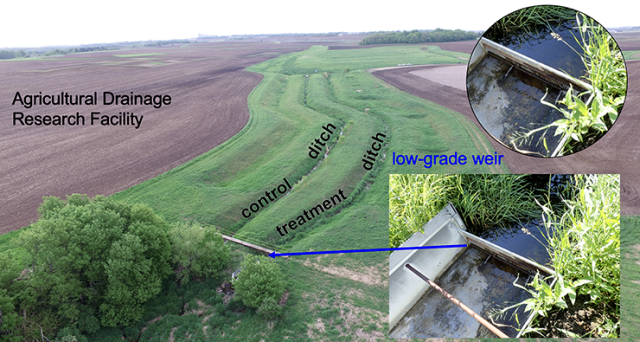
Some of the solutions Strock is looking at involve storing water on landscapes in ditches or farm ponds. By doing that, water could be “recycled” and irrigated back onto the landscape, allowing the resources like nitrogen and phosphorus — which were either applied as fertilizer or were already in the water — to not go to waste. 

“If you think about the last three years … we've had moderate to severe droughts in different parts of the state. Some places like Southern Minnesota, we don't have wells for irrigating like you do in sandier soils in central Minnesota,” Strock said. “But what we do have are these farm ponds and these drainage ditches where we can take drainage water that's been temporarily stored, pump it back out of those reservoirs back onto the landscape and irrigate some of the land that might be under drought conditions. It ends up bringing that water full circle.” 

He said most agricultural areas don’t have bodies of water that can be used for storage, so some innovations have involved adjustments to drainage ditches to slow the flow of water, similar to how urban drainage systems manage stormwater runoff.

Some of the solutions Strock is looking at involve storing water on landscapes in ditches or farm ponds.
Some of the solutions Jeffrey Strock, a professor and soil scientist, is looking at involve storing water on landscapes in ditches or farm ponds.

“(That) can potentially help with, you know, downstream flooding. It can potentially help with things like reducing nutrients, like nitrogen and phosphorus, that might be in the water,” Strock said. 

Cui is developing sensors that can monitor nitrogen, phosphorus and heavy metals in drainage water in real time. Strock said having that data from the sensors will allow certain water management processes to happen in preparation for weather events, creating more productivity for farmers and keeping the water quality up to standards. 

“Say they know there’s a storm coming — those sensors will allow water in water bodies to drain and create storage capacity. Before that storm event we can drain more rapidly some of the water … that's currently there,” Strock said. “Then that storm event happens, conceptually what our idea here is, you can actually then slow that water back down and create some storage capacity in that system, to then hold back the new flush of water and nutrients that might be coming out of our (agricultural) lands.” 

Strock is working with the Cottonwood Soil and Water Conservation District, which has an 11,0000-acre watershed. He applied for a grant through the state’s Environment and Natural Resources Trust Fund, which he thinks could complement the larger U.S. National Science Foundation grant and help to manage and clean the water in the drainage ditches that lead to Cottonwood Lake. 

The technology developed through the NSF research, he said, could really help the Cottonwood district. “There's an absolute application of the technology that we're developing in a watershed like that,” he said. 

A ‘decarbonized’ economy

The “Great Lakes Water Innovation Engine,” which the University of Minnesota is part of, is one of ten such engines that seek to improve innovation across the nation and foster regional economic competitiveness through a near $1.6 billion investment from the NSF. 

A central focus of the grant is creating a “decarbonized circular blue economy,” which Peterson described as a system of water management that can also generate economic value for the region. 

Cui, for example, is in communication with companies in the water management sector who would be interested in implementing these technologies. Those private companies are who municipalities would then work with in implementing the technologies in water treatment plants.

“You're taking resources out and reusing them for other things and creating value along the way. That circular blue economy that's being referenced, there's the circularity of resources associated with water and, hopefully, finding technologies that generate new kinds of economic value,” Peterson said.

This article first appeared on MinnPost and is republished here under a Creative Commons license.


********************************************
Thanks for visiting. Come again when you can.
Please be kind to each other while you can.
Monday, February 19, 2024

Prevention beats cleanup

Early this morning, or very late last night, the clouds and the bare, clustered tree branches provided a faint, ghostly portrait of the moon approaching full. According to this year’s Minnesota WeatherGuide Calendar, come Saturday the 24th, the full moon we’ll experience is an Ojibwe Sucker Fish Moon. also known as the Popping Trees Moon by the Lakota.

geese and swans on open water, late Feb. 2017
Photo by J. Harrington

On our way to deliver our "tax organizer, “ plus attachments, to our tax preparer, we glimpsed a pair of swans close to County Road 36 on the Sunrise River pools of Carlos Avery Wildlife Management Area. The fact that there were no other waterfowl to be seen makes me think the ones we saw are overwintering somewhere nearby but also heightened my anticipation of spring migration.

Also this morning, we received a notice from the good folks at Water Legacy that comments are being solicited on Minnesota Pollution Control Agency PFAS Rulemaking. An extract from the notice notes:

Why Comment on PFAS Rulemaking?

Last year, the Minnesota Legislature passed a statute (Minn. Stat. § 116.943) that would prohibit PFAS in many types of products unless their use in those products was “currently unavoidable.” This was an important positive step to keep PFAS out of surface water and groundwater.

Now the MPCA is developing rules that will determine how the PFAS statute will be interpreted. The details will determine if Minnesota waters and human health are protected.

PFAS “forever chemicals” have a wide range of serious health consequences including cancers, liver damage, increased cholesterol and obesity, reduced immune response to fight infection, dangerous high blood pressure in pregnancy, reduced infant birth weight, and developmental delays in children

The MPCA will receive many comments from industries seeking less transparency and more exclusions to allow continued use of PFAS. Your comments will push back on the pressure from special interests.

You might want to read the whole thing and consider commenting. Something I’ve not seen mentioned yet, but is in an article in The Guardian today, is that 

Among the main sources of food contamination are tainted water, greaseproof food wrappers, some plastics, pesticides, or farms where PFAS-tainted sewage sludge is spread as fertilizer.

That’s all for now. Enjoy the thaw. 

[UPDATE: At least 60% of US population may face ‘forever chemicals’ in tap water, tests suggest]


The Commodity Sings to its Beloved


I am here
for a very particular reason:
to buy a 6-pack of beer
and berries out of season
 
 
                    all for you, i did it all for you
 
 
I noticed an oil spill
on my drive past the bay,
emergency broadcast on the radio
—What do you have to say?
 
 
                    all for you, i did it all for you
 
 
You chopped down the plant
that used to grow my pants,
resurrected it in Indonesia
like a blow-up doll with amnesia
 
 
                    all for you, i did it all for you
 
 
Poor people once lived here
but you flooded the valley
with psilocybin carcinogens,
and forced the kids into shooting galleries
 
 
                    all for you, i did it all for you
 
 
You gave poor people jobs
then you forced them to act
like robots lining up
for a real live heart attack,
made them take apart their futures
then you sold the parts back,
repurposed the sutures
to close a robocaller’s rap
 
 
                    all for you, i did it all for you
 
 
You got children in slums
to make things that break,
your unspoken credo—
“If it lasts, it’s fake.”
 
 
But you were there first
when we were dying of thirst,
with a pint of chilled water
each, for me, my wife and two daughters,
 
 
and even a kewpie doll
and a tiny stuffed puppy
—for my wife some paper slippers,
for me, a stuffed yuppie
 
 
—You saw every decision
that I would make first,
and you did get there first
when we were dying of thirst
 
 
                    every decision
                    i make is part yours,
                    every step i take,
                    i take on your floor
 
 
You mangled my fingers,
polluted my streams,
screamed in my face,
closed deals over my dreams
 

                     all for you, i did it all for you
 

(and now it fades out,
 

                    “The Commodity Sings to its Beloved” song. 


They’ll say it was a good idea
done wrong
—“They should have got a bigger budget,

done it as a singalong.”) 


********************************************
Thanks for visiting. Come again when you can.
Please be kind to each other while you can.