Showing posts with label weeds. Show all posts

Monday, June 3, 2024

What’s a role for invasive species?

Yesterday we promised to share some questions we believe should be answered before any species is officially designated as invasive. We have extracted these questions from a book by Tao Orion, titled: Beyond the War on Invasive Species, A Permaculture Approach to Ecosystem Restoration. See what you think about getting answers to these questions rather than just a decision that a species may cause harm, per Minnesota laws.

photo of dame’s rocket (invasive species) in bloom
dame’s rocket (invasive species) in bloom
Photo by J. Harrington


Some Questions to Guide Observation of Ecosystem Function for Plants

    • What type of root structure does it have (taproot, fibrous root rhizome)?

    • Does it provide nectar or pollen? At what time of year? Are there other services available at this time in the area?

    • Does it provide shade, shelter, nesting sites, or refuge for any bird,, animal or insect?

    • Does it fix nitrogen?

    • Does it accumulate heavy metals? PCBs? Other toxins?

    • Does it concentrate other nutrients or minerals?

    • Does it provide a significant source of biomass (organic material)? Think of its entire life cycle.

    • Does it provide an edible nut, seed, leaf, root, or fruit for humans or other creatures?

    • Does the plant have any mycological associates? If so, which ones? What ecological function do they serve?

    • Does the plant serve a role in water filtration and purification?

    • Does it help with erosion control or floodwater abatement?

    • Does it ameliorate the  process of soil salinization or other  trends of desertification?

    • What is its successional status? Early, mid, late? How can you tell?

    • What is its ecological history? Does it thrive in disturbed soil, high- or low-nutrient profiles, sun, or shade?


Some Questions to Guide Observation of Ecosystem Function for animal

    • What part of the food web  does it feed in? Is it a secondary, tertiary, or quaternary consumer?

    • What organisms feed upon it?

    • Is it recycling nutrients? Where do they come from? Where would they end up otherwise?

    • Does it accumulate heavy metals or other toxins in its tissues?

    • How is it contributing to the succession of the ecosystem?

    • What potential yields could it have?


The Weavers Were the First to Know

The invasion came like a whisper,
and the leaves changed shapes, 
and the niyok grew sick.

Coconut trees,
our culture’s tree of life,
dying slowly 
as invasive beetles 
eat their hearts 
like world powers 
devour islands.

Weavers hold culture in their 
palms,
weave tradition into their families,
tuck young palms 
into their fingers,
mold them into 
entities.

But now,
our culture’s tree of life 
has grown ill from 
foreign settlement.

Palms severed,
bent like a salute
the way Chamorros are cut like cards
and dealt in front lines of American wars.

The weavers were the first to know
that our niyok is 
sick,
in need of healing.

The same way our island is 
sick,
in need of healing.

I’ve taken up the craft,
so I can weave
traditions
into the palms of my children.

I can only hope that when 
I master it,

palms will remain
for them

to weave into our future. 


********************************************
Thanks for visiting. Come again when you can.
Please be kind to each other while you can.

Friday, October 1, 2021

Autumn’s prairie patches

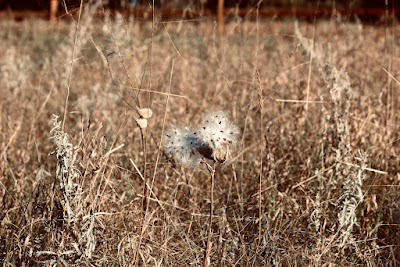
We’re fortunate to live somewhere that has a few out of the way fields that are either regenerating prairie or the owners have worked to restore patches of prairie as buffers between row crop fields and alongside the township’s gravel road. During much of the summer we had the pleasure of viewing prairie flowers such as black-eyed Susans and bee balm. Recently, the roadsides have been full of milkweed with seed pods opened and seeds awaiting the autumn winds. There’s a difference between seeing an occasional seed pod and a long ditch embankment full of them, looking like the remains of a prairie pillow fight.

milkweed seed pods in field
Photo by J. Harrington

October, in our neighborhood, is prime time to watch for woollybear caterpillars. We’ve not noticed any yet this autumn and we’re getting really curious to find some and see what their banding foretells about our upcoming winter. Then again, we remember how accurate any weather forecast is once it gets beyond twelve hours or so. For the upcoming winter, NOAA forecasts that our region has equal chances of above or below average temperature and precipitation. Using woollybears seems about as accurate and more fun. If you’ve been paying any attention to the stock market recently, you may have seen a pattern similar to that which we’re anticipating for this winter’s weather: a roller coaster ride, up and down ad nauseam.

Most of the leaves in which the woollybears will spend the winter are still on the trees. We’re not close to peak color yet, but the spatters and speckles of scarlet, crimson, gold, yellow, tan, bronze, brass, and maroon are increasing night after night. This year’s color change pattern seems more fragmented or dispersed than past years, but that may just be how I’m seeing it.

We’re looking forward to Indigenous People’s Day on October 11, Halloween on the 31st, and in between, the Falling Leaves full moon on the 20th. We’re also delighted to report that we just noticed a bloom from one of last year’s asters planted near the end of the drive. All summer there was no sign of life in either  of the plants. Now, one flower and some buds have appeared, almost miraculously. That’s almost enough to help us believe Congress might actually do something to benefit ordinary folks, one of these days, if we can just survive long enough.


October


O hushed October morning mild,
Thy leaves have ripened to the fall;
Tomorrow’s wind, if it be wild,
Should waste them all.
The crows above the forest call;
Tomorrow they may form and go.
O hushed October morning mild,
Begin the hours of this day slow.
Make the day seem to us less brief.
Hearts not averse to being beguiled,
Beguile us in the way you know.
Release one leaf at break of day;
At noon release another leaf;
One from our trees, one far away.
Retard the sun with gentle mist;
Enchant the land with amethyst.
Slow, slow!
For the grapes’ sake, if they were all,
Whose leaves already are burnt with frost,
Whose clustered fruit must else be lost—
For the grapes’ sake along the wall.


********************************************
Thanks for visiting. Come again when you can.
Please be kind to each other while you can.

Saturday, August 14, 2021

The Ides of August observations #phenology

(Actually, we’re fudging a little. The real Ides of August were on August 13.) The past few days have brought delightful weather, gentle breezes, coolish seasonable temperatures, blue skies, although we’re still in a drought. Earlier this afternoon I met a young garter snake near the foot of the driveway as I was headed for the mail box. Roadsides in our area have lost the lavender blooms of bee balm but are showing more flowers on goldenrod, Joe Pye weed, and thistles. Soon we’ll be able to enjoy the pale and faded whitish/purple/bluish aster blooms.


Spicebush Swallowtail (Papilio troilus) on Joe Pye  weed
Spicebush Swallowtail (Papilio troilus) on Joe Pye  weed
Photo by J. Harrington

The extended precipitation forecast gives us hope for above normal precipitation through the end of the month. If the forecast proves true, we may yet be able to safely torch the brush pile on or before the autumn equinox.


In Response to a Question:
”What Does the Earth Say?”


The earth says have a place, be what that place
requires; hear the sound the birds imply
and see as deep as ridges go behind
each other. (Some people call their scenery flat,
their only pictures framed by what they know:
I think around them rise a riches and a loss
too equal for their chart - but absolutely tall.)

The earth says every summer have a ranch
that’s minimum: one tree, one well, a landscape
that proclaims a universe - sermon
of the hills, hallelujah mountain,
highway guided by the way the world is tilted,
reduplication of mirage, flat evening:
a kind of ritual for the wavering.

The earth says where you live wear the kind
of color that your life is (grey shirt for me)
and by listening with the same bowed head that sings
draw all things into one song, join
the sparrow on the lawn, and row that easy
way, the rage without met by the wings
within that guide you anywhere the wind blows.

Listening, I think that’s what the earth says.

+ William Stafford


********************************************
Thanks for visiting. Come again when you can.
Please be kind to each other while you can.

Tuesday, August 3, 2021

Removing burs from under our ...

Several days ago the township mowed the road's shoulders. Unfortunately, their mower was set too high  and the mowing date was too late to eliminate the sandburs growing at the road's edge along our property. This would be of limited concern except that we walk our dogs along that edge and they don't know enough to not step in or on the sandburs.


Sandbur (Cenchrus longispinus)
Photo by J. Harrington

Last year we mowed the offending strip with the tractor and mower deck, discharge chute pointed toward the road, so that passing tires could pick up the burrs. This year there's a mulching kit on the mower deck so burrs would remain in place if we tried that approach. Instead, we used our new self-propelled push mower, set on bagging option, and, when done, dumped the bag's contents into our fire pit. We even went so far as to use a vacuum to clean the remaining burrs from the interior of the bag. The fewer burrs spread around, the fewer sandbur plants next year.

Was it worth the extra effort? On the one hand, we didn't use herbicide. and we think we collected more than 90% of the visible burrs. On the other hand, we haven't walked the dogs along that edge since we've mowed it. Plus, we won't really know how well it worked until next year, when we get to see if there's a notable decrease in sandbur plants. Of course, next year, if we remember to mow in mid-July instead of early August, we might not see any burrs at all. The dogs won't have to hobble and we won't have to remember to keep a pair of needle-nose pliers in our pocket during August and September. Stay tuned for updates. 

By the way, if you're wondering about the difference between bur and burr, go here.


Please Don't


tell the flowers—they think
the sun loves them.
The grass is under the same
simple-minded impression

about the rain, the fog, the dew.
And when the wind blows,
it feels so good
they lose control of themselves

and swobtoggle wildly
around, bumping accidentally into their
slender neighbors.
Forgetful little lotus-eaters,

solar-powered
hydroholics, drawing nourishment up
through stems into their
thin green skin,

high on the expensive
chemistry of mitochondrial explosion,
believing that the dirt
loves them, the night, the stars—

reaching down a little deeper
with their pale albino roots,
all Dizzy
Gillespie with the utter
sufficiency of everything.

They don't imagine lawn
mowers, the four stomachs
of the cow, or human beings with boots
who stop to marvel

at their exsquisite
flexibility and color.
They persist in their soft-headed

hallucination of happiness.
But please don't mention it.
Not yet. Tell me
what would you possibly gain

from being right?


********************************************
Thanks for visiting. Come again when you can.
Please be kind to each other while you can.

Friday, June 25, 2021

Weed control?

For the past week the roadsides in our neighborhood have been full of crown vetch in bloom. In 2017 crown vetch was added to the Minnesota list of restricted noxious weeds. According to the Minnesota Department of Agriculture:

crown vetch in bloom
Photo by J. Harrington

Mowing can be effective to slow the spread if done on schedule to prevent seed formation, and for successive years. For complete eradication, mowing will need to be performed in conjunction with another control method, like herbicide application.

Minnesota Statutes complicate the mowing solution somewhat since 160.232 Mowing Ditches Outside Cities states:

(a) To provide enhanced roadside habitat for nesting birds and other small wildlife, road authorities may not mow or till the right-of-way of a highway located outside of a home rule charter or statutory city except as allowed in this section and section 160.23.

(b) On any highway, the first eight feet away from the road surface, or shoulder if one exists, may be mowed at any time.

(c) An entire right-of-way may be mowed after July 31. 

Judging by the condition of the blooms in late June, crown vetch may well have gone to seed by July 31. Although we haven't taken a tape measure to the local roadsides, it's not hard to guess that at least a notable amount of the crown vetch extends back more than eight feet from the road surface or shoulder. Perhaps this helps explain why we're seeing more and more crown vetch growing in the roadsides. It seems too many entities in government will never grasp the idea that, if you want to encourage a certain behavior, make it easy to do. Then, again, will US governments ever adopt the precautionary principle?


Rose Pogonias


 - 1874-1963


A saturated meadow,
     Sun-shaped and jewel-small,
A circle scarcely wider
     Than the trees around were tall;
Where winds were quite excluded,
     And the air was stifling sweet
With the breath of many flowers,—
    A temple of the heat.

These were bowed us in the burning,
     As the sun’s right worship is,
To pick where none could miss them
     A thousand orchises;
For though the grass was scattered,
    Yet every second spear
Seemed tipped with wings of color,
     That tinged the atmosphere.

We raised a simple prayer
     Before we left the spot,
That in the general mowing
     That place might be forgot;
Or if not all is favoured,
     Obtain such grace of hours,
That none should mow the grass there
     While so confused with flowers. 


********************************************
Thanks for visiting. Come again when you can.
Please be kind to each other while you can.

Friday, July 10, 2020

A time of butterflies, tassels and connections

Drove through some  pretty country this morning while picking up our Summer Community Supported Agriculture (CSA) Share box 1. Birds are starting to flock up and perch together on the telephone wires. Some of the fields of corn have started to tassel. Others are barely more than knee high. Signs that the  slide of Summer into Autumn has begun?

butterfly-weed (Asclepias tuberosa)
Photo by J. Harrington

Lots of roadsides, and some "abandoned" fields in some parts of the county have many butterfly-weeds in bloom. More and more monarch butterflies can be seen. One pair I noticed this morning was probably either a pair of males in a territorial battle or a male and female in a prelude to mating. Funny how those actions can sometimes look a like.

Every once in awhile, I learn something that embarrasses me for not having learnt it some time ago. That happened today, first thing this morning. Earlier this week I finally started reading Walt Whitman's Leaves of Grass, Deathbed Edition. That's where I encountered Whitman's poem "TO THE STATES," which begins
To the States or any one of them, or any city of the states,
     Resist much, obey little,
It's the second line that really caught my attention. I've always associated it with Ed Abbey. It begin's the title of Resist Much Obey Little : Remembering Ed Abbey (James R. Hepworth, Gregory McNamee). I confess that, so far at least, I've been much more a fan of Abbey than of Whitman. At least I've read lots more by and about Abbey. As I already  noted, sometimes it's embarrassingly clear that my education has some notable holes in it. I'm glad this one has been filled.

Summer of the Ladybirds


Can we learn wisdom watching insects now,
or just the art of quiet observation?
Creatures from the world of leaf and flower
marking weather’s variation.

The huge dry summer of the ladybirds
(we thought we’d never feel such heat again)
started with white cabbage butterflies
sipping at thin trickles in the drain.

Then one by one the ladybirds appeared
obeying some far purpose or design.
We marvelled at their numbers in the garden,
grouped together, shuffling in a line.

Each day a few strays turned up at the table,
the children laughed to see them near the jam
exploring round the edges of a spoon.
One tried to drink the moisture on my arm.

How random and how frail seemed their lives,
and yet how they persisted, refugees,
saving energy by keeping still
and hiding in the grass and in the trees.

And then one day they vanished overnight.
Clouds gathered, storm exploded, weather cleared.
And all the wishes that we might have had
in such abundance simply disappeared.


********************************************
Thanks for visiting. Come again when you can.
Please be kind to each other while you can.

Tuesday, July 7, 2020

Are we really trying to control invasive species?

Over  the past few days, the Better Half and  I have been trying to identify a "new" plant with pinkish flowers that's suddenly appeared in the township roadway easement along part of our property. Today we agreed that it appears to be spotted knapweed, an invasive terrestrial plant according to the Department of Natural Resources, a prohibited plant according to the Minnesota Department of Agriculture. It is not until or unless one clicks on the link to the MDA Spotted Knapweed Fact Sheet that the phrase "Spotted knapweed is listed as a Prohibited – Control noxious weed in Minnesota" appears. Now I'm not a lawyer [INAL], but, the consistent use of proper, accurate terms seems significant when looking at Minnesota statutes noted below. There doesn't appear to be any reference to "prohibited weeds" in either 160.23 or 160.232. (Maybe state agencies should be mandated to hire  the revisor's office to edit regulations for consistency.)

State Prohibited Noxious Weeds have two categories: eradicate and control. Spotted knapweed was added to the control list in 2001. [There are separate lists for: Restricted noxious weeds; Specially regulated plants; County noxious weeds; and, Federal terrestrial and parasitic listed noxious weeds.] It might be helpful if someone, someday, added a reference to the "official?" Minnesota Noxious Weed List to appropriate sections of chapter 160.

does this look like spotted knapweed to you?
Photo by J. Harrington

Following MnDNR's recommendation, we duly reported our "discovery" of what we think is knapweed (neither the Better Half nor I are botanists nor invasive species experts) via email to ArrestThePest. It will be interesting to see what, if any, followup occurs.

In the process of trying to sort out who might be responsible for destroying what may be a noxious weed, I checked the Minnesota Statutes. That revealed a potential additional concern since mowing as a control measure for knapweed may be limited or prohibited under 160.232. It's almost as if no one wanted to make it easy to manage roadsides and noxious weeds. Do we have too many entities involved in invasive, noxious plant management as we have way too many entities involved in managing water quality and quantity and uses in Minnesota? (See the Minnesota Water Sustainability Framework.)
160.23 MS 1953 [Repealed, 1957 c 943 s 72]

160.23 DESTRUCTION OF NOXIOUS WEEDS.

Road authorities, including road authorities of cities shall cause all noxious weeds on their respective highways and streets to be cut down or otherwise destroyed or eradicated as often as may be necessary to prevent the ripening or scattering of seed and other propagating parts of such weeds.


160.232 MOWING DITCHES OUTSIDE CITIES.

(a) To provide enhanced roadside habitat for nesting birds and other small wildlife, road authorities may not mow or till the right-of-way of a highway located outside of a home rule charter or statutory city except as allowed in this section and section 160.23.
(b) On any highway, the first eight feet away from the road surface, or shoulder if one exists, may be mowed at any time.
(c) An entire right-of-way may be mowed after July 31. From August 31 to the following July 31, the entire right-of-way may only be mowed if necessary for safety reasons, but may not be mowed to a height of less than 12 inches.
(d) A right-of-way may be mowed as necessary to maintain sight distance for safety and may be mowed at other times under rules of the commissioner, or by ordinance of a local road authority not conflicting with the rules of the commissioner.
(e) A right-of-way may be mowed, burned, or tilled to prepare the right-of-way for the establishment of permanent vegetative cover or for prairie vegetation management.
(f) When feasible, road authorities are encouraged to utilize low maintenance, native vegetation that reduces the need to mow, provides wildlife habitat, and maintains public safety.
(g) The commissioner of natural resources shall cooperate with the commissioner of transportation to provide enhanced roadside habitat for nesting birds and other small wildlife.

The Lost Colony


They never learned to tell
one bird from another, a shrub

from a weedy sapling, 
or when the season had

forced a flower’s bloom, not 
even if a berry

had ripened into poison.
And yet they drew endless

distinctions between
colors and polish and

coarseness of weave, 
and would not let

their daughters 
marry out.

They didn’t keep
their children, though they

gave them tests and fed 
them. They were known

for meticulous records, for 
trophies and peeling stars.

They burned things up
or wore them down, had ranks

and staff and lecterns, 
machines that moved them

from place to place, bright 
jewels and playing cards.

They were old when they could 
have been young, and young

when they could have been old. 
They left a strange word

in a tree: croatoan,
and a track in the dust of Mars.


********************************************
Thanks for visiting. Come again when you can.
Please be kind to each other while you can.

Friday, June 26, 2020

Summer's harbingers

Today the air feels sultry. A classic case of "it's not the heat, it's the humidity." I've been in Sun City, Arizona, in the Summer and know what a "dry heat" feels like. What we have in East Central Minnesota today isn't it. There have been scattered, very light sprinkles of rain, not even what  I'd consider showers, but no real thunderstorms or rainfall overnight or today so far.

ladybug on hoary alyssum
Photo by J. Harrington

Roadside fields, those not planted to corn, soybeans or sod, are showing nice colors of white (common boneset, I believe, or, maybe, hoary alyssum) and lavender (crown vetch, probably). The days are already getting shorter (about one minute less than solstice). Hoards of mosquitos and deer flies continue to harass dog walkers and their charges. Some local dog, more likely the black border collie cross than the yellow lab cross, has been sneaking both kinds of biting insects into the house. (Insects are more noticeable by far on blond dog hair, so they can be, and usually are, removed before the dog is allowed into the house. Noticing deer flies on black border collie fur is a fool's errand.)

One of the local avian critters has built a nest (of twigs) in the restored bluebird house. One day soon we'll take a peek and see if anyone is actually home. Any cleanout can wait until after Autumn migration. Unlike the current regime in Washington, D.C., I don't believe in breaking up migrant families.

daytime firefly(?)
daytime firefly(?)
Photo by J. Harrington

The Better Half informed me this morning that there were observable fireflies in the fields behind the house last night. With the outside chores I've been getting caught up on the past few days, I was too tuckered out to see them. Maybe sometime over this weekend I'll have the energy to stay alert and bushy-tailed (or is that bushy-taled?) enough to enjoy a show of fireworks without the bangs.

The Summer Day


Who made the world?
Who made the swan, and the black bear?
Who made the grasshopper?
This grasshopper, I mean-
the one who has flung herself out of the grass,
the one who is eating sugar out of my hand,
who is moving her jaws back and forth instead of up and down-
who is gazing around with her enormous and complicated eyes.
Now she lifts her pale forearms and thoroughly washes her face.
Now she snaps her wings open, and floats away.
I don't know exactly what a prayer is.
I do know how to pay attention, how to fall down
into the grass, how to kneel down in the grass,
how to be idle and blessed, how to stroll through the fields,
which is what I have been doing all day.
Tell me, what else should I have done?
Doesn't everything die at last, and too soon?
Tell me, what is it you plan to do
with your one wild and precious life?

Mary Oliver


********************************************
Thanks for visiting. Come again when you can.
Please be kind to each other while you can.

Wednesday, July 31, 2019

Should only monarchs reign over milkweed?

Once again this year we've not seen any monarch caterpillars on our abundance of milkweed plants. Numerous monarch butterflies have been visiting our swamp milkweed and common milkweed plants, but nary a caterpiggly have we found.

several instars of milkweed tussock moth caterpillars
Photo by J. Harrington

On the other hand, we have an overabundance of milkweed tussock moth caterpillars (Euchaetes egle) on several of the milkweed plants near the house and along the road. It did take us awhile to identify the creatures that have been decimating the common milkweed plants. Several were eaten right down to the stem and even parts of that looked like they were missing.

monarch butterfly not laying eggs on blazing star
Photo by J. Harrington

Some monarch butterfly supporters have a longer list of monarch pests, including the tussock moth caterpillar. Fortunately for our ecosystems, the basic recommendation is to live and let live. If necessary, plant more milkweed of a variety of types. They also suggest that
Exterminating all milkweed pests can have unintended consequences to your local ecosystem. If you want to boost the survival rate of your garden monarchs without tampering with mother nature, try raising a few indoors.
We've seen, but not read carefully, some reports that monarchs raised indoors don't migrate naturally. Our inclination is to do what we can to improve the available habitat and let Mother Nature take it from there. This is pretty much consistent with the following conclusion from an Ohio State University blog:
I support monarch recovery.  However, we should embrace all native insects with equal affection; I mean this figuratively since tussock moth caterpillars have defensive hairs.  The tussock moths should enjoy the same natural born rights to milkweeds as monarchs.  The bottom line:  liberty, equality, and fraternity for all insects that you may find sharing milkweeds with monarchs.

Milkweed


I tell myself softly, this is how love begins—
the air alive with something inconceivable,
seeds of every imaginable possibility
floating across the wet grasses, under
the thin arms of ferns. It drifts like snow
or old ash, settling on the dust of the roadways
as you and I descend into thickets, flanked
by the fragrance of honeysuckle and white
primrose.

I recall how my grandmother imagined
these wanderers were living beings,
some tiny phylum yet to be classified as life.
She would say they reminded her of maidens
decked in white dresses, waltzing through air.
Even after I showed her the pods from which
they sprang, blossoming like tiny spiders,
she refused to believe.

Now, standing beside you in the crowded
autumn haze, I watch them flock, emerge from
brittle stalks, bursting upon the world as
young lovers do—trysting in the tall grasses,
resting fingers lightly in tousled hair.
Listen, and you can hear them whisper
in the rushes, gazing out at us, wondering—
what lives are these? 


********************************************
Thanks for visiting. Come again when you can.
Please be kind to each other while you can.

Thursday, July 18, 2019

The prickly sides of Summer

Yesterday was meteorological mid-Summer. Astronomical mid-Summer arrives on August 7. About midway between those two dates, on July 29, we will reach Earth Overshoot Day. That's for the world average. The United States reached it on March 15. Only four countries reached their Overshoot Day earlier in the year. (Later is better.) As far as we're concerned, the only options are whether we end up with a hard or a soft landing. The laws of nature will always take precedence over the laws of humans in the long run.

sandburs on their stems
Photo by J. Harrington

Of more immediate note, yesterday we plucked the year's first sandburs (Cenchrus longispinus) from our roadside gravel strip. We can now add them to the other troublesome annoyances of mosquitos, deer flies, ticks, heat, humidity, thunderstorms and occasional tornadoes. Once upon a time we thought we liked Summer better than Winter. After several decades of noticing the every single year brings Summertime "sandburs, mosquitos, deer flies, ticks, heat, humidity, thunderstorms," but not every Winter brings a blizzard or a polar vortex to our neighborhood, we have to admit we're questioning "what were we thinking?" We seriously doubt that we'll live long enough to admit a preference for Winter over Summer, despite the differential in types of annoyances. Many years ago a friend pointed out that you can always put on more clothes but you can only take off everything. Even that wasn't enough to overcome our level of discomfort at being chilled to the bone which, come to think of it, seems to happen as often with Summer's air conditioning as it does when the temperature drops and the wind picks up during a Winter storm.

We're rambling and prattling, we know. The heat must have gotten to us, or maybe we've got a sandbur in our jeans. How long is it until November 3, 2020? 474 days. Between next Summer's weather, climate breakdown incidents, and the hot air blowing from political campaigns, we bet next year will be one for the record books. We also fervently hope that we're wrong about that. We haven't asked them yet but we suspect both dogs and the Better Half join us in that wish. Last time we checked, none of that trio liked "sandburs, mosquitos, deer flies, ticks, heat, humidity, thunderstorms" any more than we do.

cruel, cruel summer


either the postagestamp-bright inflorescence of wild mustard 
or the drab tassel of prairie smoke, waving its dirty garments 

either the low breeze through the cracked window 
or houseflies and drawn blinds to spare us the calid sun 

one day commands the next to lie down, to scatter:      we're done 
with allegiance, devotion, the malicious idea of what's eternal 

picture the terrain sunk, return of the inland sea, your spectacle 
your metaphor, the scope of this twiggy dominion pulled under 

crest and crest, wave and cloud, the thunder blast and burst of swells 
this is the sum of us:      brief sneezeweed, brief yellow blaze put out 

so little, your departure, one plunk upon the earth's surface, 
one drop to bind the dust, a little mud, a field of mud 

the swale gradually submerged, gradually forgotten 
and that is all that is to be borne of your empirical trope: 

first, a congregated light, the brilliance of a meadowland in bloom 
and then the image must fail, as we must fail, as we 

graceless creatures that we are, unmake and befoul our beds 
don't tell me deluge.      don't tell me heat, too damned much heat


********************************************
Thanks for visiting. Come again when you can.
Please be kind to each other while you can.

Wednesday, October 24, 2018

Bucking backyard buckthorn

It's a very pleasant surprise to notice how much more attractive understory looks without the clutter of buckthorn. If this Autumn we don't get all the buckthorn pulled from one small patch of woods behind the house, we'll finish next Spring. Over the Winter we'll scatter a couple of bags of Prairie Restoration's "Short/Dry Wildflower Mix" in the areas we have cleared and hope for the best come next year's growing season. Maybe we'll end up with a pollinators' garden if enough sunshine gets through the overstory. If not, we'll try a different mix next year.

backyard buckthorn before pulling
Photo by J. Harrington

The bird bath heater has finally been plugged in for the season (until next April or early May?). This afternoon we were roundly cursed by a blue jay who arrived for a drink and found instead a layer of ice. We'll put out some suet in the next week or so and cross our fingers the local bears have by now fattened up and settled in for their long Winter's nap.

Did you get to see the moon last night or early this morning? Tonight clouds are supposed to return and hang around for several days. Our shoulders and legs will appreciate the excuse to take a break from pulling buckthorn. A couple or three times we've pulled the classic "just one more," but as often happens, we said that two or three or four times each session. We haven't quite yet adjusted to the idea that we'll be pulling buckthorn for the rest of our active life. We still have the mental model that it's a "project" that we'll finish rather than a lifestyle we're adopting. From time to time we check the Minnesota DNR web page to see if anyone has come up with a biological control agent. No luck so far. Since we broke down (again) this year and sprayed some of the poison ivy with glyphosate, we're weakening on the idea of using that on some of the seedlings. We'll see how much exercise we think we need come Spring.

Japanese Knotweed Killers 


By Jan Wrede


We smote and killed.
No broken needle.
Some chemical remains.
Needle too large for small stalks.
Injector refill problematic.

Victim mortally wounded.
Time for mercy
And finishing spray?
When is the coup de gras?
Killers are ready


********************************************
Thanks for visiting. Come again when you can.
Please be kind to each other while you can.

Wednesday, September 26, 2018

Attack of the sandburs

One of the things we really hate about late Summer and early Autumn is that's sandbur time.

sandburs on the plant (shown upside down)
Photo by J. Harrington

Today it was Franco who picked up the sandbur in his pad. Last week, a couple of times, it was SiSi. We've noticed that there's a relatively standard sequence of events that follows the attack of the sandbur.

  1. The dog looks accusingly at his/her walker, with an expression that says "Why'd you do this to me?"
  2. On being told to sit, the dog looks uncertain. "What's going to happen next? Can we negotiate this?"
  3. Walker approaches dog. Reaches to lift the wounded paw.
  4. Dog pulls paw away, afraid that removal will hurt more than leaving the sandbur in place.
  5. Dog walker gently reaches again for wounded paw. Quickly finds and removes sandbur, impaling walker's finger.
  6. Walker again curses self for being an idiot who left several pair of needle nose pliers in the house.
  7. Dog promptly forgets discomfort and trots down the gravel road without so much as a look of gratitude.
That's about all we've got for today. It's kind of a quiet time for local phenology, although the percent leaves that have turned color keeps increasing. Another reason for the short posting is we're under the weather with a head cold.

Dog


The dog trots freely in the street
and sees reality
and the things he sees
are bigger than himself
and the things he sees
are his reality
Drunks in doorways
Moons on trees
The dog trots freely thru the street
and the things he sees
are smaller than himself
Fish on newsprint
Ants in holes
Chickens in Chinatown windows
their heads a block away
The dog trots freely in the street
and the things he smells
smell something like himself
The dog trots freely in the street
past puddles and babies
cats and cigars
poolrooms and policemen
He doesn’t hate cops
He merely has no use for them
and he goes past them
and past the dead cows hung up whole
in front of the San Francisco Meat Market
He would rather eat a tender cow
than a tough policeman
though either might do
And he goes past the Romeo Ravioli Factory
and past Coit’s Tower
and past Congressman Doyle
He’s afraid of Coit’s Tower
but he’s not afraid of Congressman Doyle
although what he hears is very discouraging
very depressing
very absurd
to a sad young dog like himself
to a serious dog like himself
But he has his own free world to live in
His own fleas to eat
He will not be muzzled
Congressman Doyle is just another
fire hydrant
to him
The dog trots freely in the street
and has his own dog’s life to live
and to think about
and to reflect upon
touching and tasting and testing everything
investigating everything
without benefit of perjury
a real realist
with a real tale to tell
and a real tail to tell it with
a real live
              barking
                         democratic dog
engaged in real
                      free enterprise
with something to say
                             about ontology
something to say
                        about reality
                                        and how to see it
                                                               and how to hear it
with his head cocked sideways
                                       at streetcorners
as if he is just about to have
                                       his picture taken
                                                             for Victor Records
                                  listening for
                                                   His Master’s Voice
                      and looking
                                       like a living questionmark
                                                                 into the
                                                              great gramaphone
                                                           of puzzling existence
                 with its wondrous hollow horn
                         which always seems
                     just about to spout forth
                                                      some Victorious answer
                                                              to everything

Notes:
Correction: "a seriously dog" was corrected to "a serious dog" on 10/20/2010.

Lawrence Ferlinghetti, “Dog” from A Coney Island of the Mind: Poems. Copyright © 1958 by Lawrence Ferlinghetti. Reprinted by permission of New Directions Publishing Corporation.

Source:A Coney Island of the Mind: Poems(New Directions Publishing Corporation, 1958)


********************************************
Thanks for visiting. Come again when you can.
Please be kind to each other while you can.

Sunday, July 29, 2018

Summertime Blues

No,not the Eddie Cochran song. Our lilac bush has belatedly(?) produced some bluish-purple flowers. The feral lilacs up the road, and most of the others in our neck of the woods, blossomed back in May and June. We're not sure what's going on with ours. Is it a cultivar with a later in the Summer flower pattern?

spotted horsemint
spotted horsemint
Photo by J. Harrington

We've also noticed the growth of several large patches of spotted horsemint (Monarda punctata) in the fields. According to one of our field guides, it's a favorite nectar source of the karner blue butterfly, an endangered species. A 1990 survey failed to confirm the butterfly's presence in Chisago county but did note the presence of a large population of lupine (needed flower for garner blues) in Wild River state park and noted the butterfly's existence across the St.Croix River in Wisconsin. We've seen some small blue butterflies around here this Summer and last, but haven't been able to confirm an identification.

Buckthorn pulling season has started again, although it's too warm to do much at a time. We're also pulling weeds since we're contemplating starting a butterfly garden behind the house, but need to find shade tolerant plants. Despite a West facing location, some oaks to the South shade until late in the day the location we've in mind.

Finally, for today, we think we've found another active pocket gopher location so we will once again set some traps, being ever mindful of Samuel Beckett's observation, "Ever tried. Ever failed. No matter. Try Again. Fail again. Fail better."

The Blue


One will live to see the Caterpillar rut everything
they walk on—seacliff buckwheat cleared, relentless
ice plant to replace it, the wild fields bisected
by the scenic highway, canyons covered with cul-de-sacs,
gas stations, comfortable homes, the whole habitat
along this coastal stretch endangered, everything,
everyone, everywhere in it danger as well—
but now they're logging the one stilling hawk
Smith sights, the conspiring grasses' shh shhhh ssh,
the coreopsis Mattoni's boot barely spares,
and, netted, a solitary blue butterfly. Smith
ahead of him chasing the stream, Mattoni wonders
if he plans to swim again. Just like that
the spell breaks. It's years later, Mattoni lecturing
on his struggling butterfly. How fragile.  
           •


If his daughter spooled out the fabric
she's chosen for her wedding gown,
raw taffeta, burled, a bright hued tan,
perhaps Mattoni would remember
how those dunes looked from a distance,
the fabric, balanced between her arms,
making valleys in the valley, the fan
above her mimicking the breeze.
He and his friend loved everything
softly undulating under the coyest wind,
and the rough truth as they walked
through the land's scratch and scrabble
and no one was there, then, besides Mattoni
and his friend, walking along Dolan's Creek,
in that part of California they hated
to share. The ocean, a mile or so off,
anything but passive so that even there,
in the canyon, they sometimes heard it smack
and pull well-braced rocks. The breeze,
basic: salty, bitter, sour, sweet. Smith trying
to identify the scent, tearing leaves
of manzanita, yelling: "This is it. Here! This is it!"
his hand to his nose, his eyes, having finally seen
the source of his pleasure, alive.

               •

In the lab, after the accident, he remembered it,
the butterfly. How good a swimmer Smith had been,
how rough the currents there at Half Moon Bay, his friend
alone with reel and rod—Mattoni back at school
early that year, his summer finished too soon—
then all of them together in the sneaker wave,
and before that the ridge, congregations of pinking
blossoms, and one of them bowing, scaring up the living,
the frail and flighty beast too beautiful
to never be pinned, those nights Mattoni worked
without his friend, he remembered too.
He called the butterfly Smith's Blue.


********************************************
Thanks for visiting. Come again when you can.
Please be kind to each other while you can.

Wednesday, October 11, 2017

Hold outs hangin' on #phenology

This morning was spent moving some of the recently pulled buckthorn from the front of the property to the burn pile out back, pulling some sort of thorny vines (we don't think they're blackberries) so they'll have fewer opportunities to trip us or rip our ankles, and checking the pocket gopher traps (there's one less gopher on the property). In our wanderings about, we noticed two tiny flowers still in bloom. Those of us who've lived in the North Country for a while are rugged souls. It takes more than an evening's hard freeze or so to do us in.

a pair of hard-frost holdouts, one white, one yellow
Photo by J. Harrington

Last night may, or may not, have qualified as once again having frost / freeze temperatures. The lowest we saw locally was 33℉. We neglected to cover the mums and asters because we didn't expect another overnight freeze. This morning the mums are looking healthier and hardier than the asters so we'll just keep an eye on things and see who may still be alive over the next day or two.

wooly bear with (only) two bands
Photo by J. Harrington

The other pleasant surprise we encountered today was our discovery of a real, live wooly bear caterpillar. This one wasn't on the road or hiding under leaves or in the wood pile. As you can see, it's hanging onto a plant. If you look closely, you can see that it barely has all three bands. With the relatively wide band of brown in the middle, we're thinking this caterpillar believes it's going to be a relatively mild Winter. Our personal beliefs are that that would be nice if it doesn't bring too many ice storms. If this caterpillar is still hanging around later today, we think it's going to become a subject for observation  if we can set up and suitably fit out a container. Last time we tried this, the wooly bear escaped before we got the dirt and twigs into its Winter home. This time we'll rig the container first.

A Caterpillar on the Desk


by Robert Bly


           Lifting my coffee cup, I notice a caterpillar crawling over my sheet of ten-cent airmail stamps. The head is black as a Chinese box. Nine soft accordions follow it around, with a waving motion, like a flabby mountain. Skinny brushes used to clean pop bottles rise from some of its shoulders. As I pick up the sheet of stamps, the caterpillar advances around and around the edge, and I see his feet: three pairs under the head, four spongelike pairs under the middle body, and two final pairs at the tip, pink as a puppy's hind legs. As he walks, he rears, six pairs of legs off the stamp, waving around the air! One of the sponge pairs, and the last two tail pairs, the reserve feet, hold on anxiously. It is the first of September. The leaf shadows are less ferocious on the notebook cover. A man accepts his failures more easily-or perhaps summer's insanity is gone? A man notices ordinary earth, scorned in July, with affection, as he settles down to his daily work, to use stamps.  


********************************************
Thanks for visiting. Come again when you can.
Please be kind to each other while you can.