Showing posts with label hunger. Show all posts

Sunday, January 22, 2023

Seasonal sightings

Late yesterday two whitetail deer poked their way along the edge of the woods behind the house. First whitetail sightings of the year on our property. This morning a couple of hen wild turkeys pecked at the seed droppings underneath the deck bird feeders. Later, a flock of about a dozen turkeys followed in the tracks left by the deer. First turkey sightings of the year on our property.

whitetails at a sunflower seed feeder a few years ago
Photo by J. Harrington

We saw one of the deer stop and browse on a young cedar tree. Last autumn’s acorn crop was close to nonexistent around here so I can’t begin to guess what the turkeys are feeding on and how they’re getting through a foot or so of mixed snow and ice cover. Ground hog day falls about midway through astronomical winter. We’re already past the midpoint of meteorological winter but March 1 doesn’t often resemble anything like actual spring here in the North Country. Late winter, early spring, is a hungry time for the wild animals that don’t have access to a bird feeder refilled by a two-legged animal.

To get to a fresh  food supply, most animals have to survive during the next couple of months. The sightings of the past 24 hours were a treat. I hope we get a better, complete, thaw soon and that winter’s toll is limited this year, although that may well mean a hunger season for the scavengers of the woods and fields. Spring is a new beginning only for those who make it ’til then.


Hunger Moon


The last full moon of February stalks the fields; barbed wire casts a shadow.
Rising slowly, a beam moved toward the west
stealthily changing position
 
until now, in the small hours, across the snow
it advances on my pillow
to wake me, not rudely like the sun
but with the cocked gun of silence.
 
I am alone in a vast room
where a vain woman once slept.
The moon, in pale buckskins, crouches
on guard beside her bed.
 
Slowly the light wanes, the snow will melt
and all the fences thrum in the spring breeze
but not until that sleeper, trapped
in my body, turns and turns.


********************************************
Thanks for visiting. Come again when you can.
Please be kind to each other while you can.

Thursday, January 21, 2021

Do you know beans about beans?


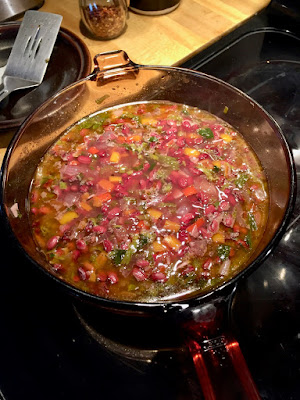
Do you remember the phrase "you don't know beans about ...?" Today, and ever since Christmas, when we were given a package of heirloom beans from Rancho Gordo, we've been discovering that we don't know beans about beans. Earlier today we were poking around and discovered a Northern Minnesota source for some heirloom bean seeds. We think we learned last Spring, when we were planning to plant a three sisters garden, something about the differences between bush (not a good fit for a three sisters planting) and pole (the kind that uses corn stalks to climb) beans.

Then there's the whole beans, legumes, and pulses classification scheme. Who knew? Well, obviously those who've been paying more attention than we have. Our limits were rapidly approached once we had distinguished between Boston baked beans, which came in and from cans, and dried beans which went into soups and stews. We're currently trying to discern if we're in the process of eating the seed beads, and how one can tell if a dried bean is plantable.

a pot of red beans cooking
Photo by J. Harrington

From what we can discover with our searches of the internets the past few days, Minnesota doesn't know beans about how reliant the state is on outside sources of food. The only real examples we've found so far focus on Northern Minnesota's Native Americans' efforts toward food sovereignty. That's progress, but since agriculture is such a large sector of Minnesota's economy, knowing how much we can feed ourselves is likely to become a more significant issue as climate breakdown affects places like California, a major source for food crops. In Minnesota, we find lots of indications of activity, but limited evidence of coordination or cooperation. Perhaps we're not yet looking in the right places?


The Bean Eaters


They eat beans mostly, this old yellow pair.   
Dinner is a casual affair.
Plain chipware on a plain and creaking wood,   
Tin flatware.

Two who are Mostly Good.
Two who have lived their day,
But keep on putting on their clothes   
And putting things away.

And remembering ...
Remembering, with twinklings and twinges,
As they lean over the beans in their rented back room that is full of beads and receipts and dolls and cloths, tobacco crumbs, vases and fringes.


********************************************
Thanks for visiting. Come again when you can.
Please be kind to each other while you can.

Saturday, March 2, 2019

At the "bird" feeder, late February

It's been a tough Winter. Meteorologically, it ended with February. We've been going through lots of sunflower seeds and suet, but we haven't been feeding just birds. May March be a kinder, gentler month!

sunrise tangled up in snow
Photo by J. Harrington

a snowy dunce cap on the bluebird house
Photo by J. Harrington

the tall one knocks seeds down for the short one
Photo by J. Harrington

then helps herself
then helps herself
Photo by J. Harrington

and Runny Babbit gets some leftovers
Photo by J. Harrington

Late February


The first warm day,
and by mid-afternoon
the snow is no more
than a washing
strewn over the yards,
the bedding rolled in knots
and leaking water,
the white shirts lying
under the evergreens.
Through the heaviest drifts
rise autumn’s fallen
bicycles, small carnivals
of paint and chrome,
the Octopus
and Tilt-A-Whirl
beginning to turn
in the sun. Now children,
stiffened by winter
and dressed, somehow,
like old men, mutter
and bend to the work
of building dams.
But such a spring is brief;
by five o’clock
the chill of sundown,
darkness, the blue TVs
flashing like storms
in the picture windows,
the yards gone gray,
the wet dogs barking
at nothing. Far off
across the cornfields
staked for streets and sewers,
the body of a farmer
missing since fall
will show up
in his garden tomorrow,
as unexpected
as a tulip.


********************************************
Thanks for visiting. Come again when you can.
Please be kind to each other while you can.

Friday, February 15, 2019

Counting the days

Today is February 15. When we awoke this morning, the temperature was -5℉. Local windchills are in the -20℉ range and colder to the West of us. After today (that is, not counting February 15), in seven days (February 23) the normal daytime high should reach 32℉. After today there are 13 days until March 1, the first day of meteorological Spring. After today there are22 days until Daylight Savings time starts on March 10. After today, there are 32 days until the Vernal Equinox on March 20, the start of astronomical Spring. Unfortunately, Shakespeare's Hamlet had it all too correct when he spoke the lines:
Tomorrow, and tomorrow, and tomorrow,
Creeps in this petty pace from day to day,
He might well have been describing the pace at which Winter departs and Spring arrives in our North Country.  The weather app on our "smartphone" extends out nine days past today. It includes no temperatures forecast to warm to 32℉. Snow is included in the forecast for five of those nine days. It's not exactly that we don't like Winter (although we don't). Even if we liked snow and cold and freezing rain and ice, there's such a thing as too much of a good thing, and about this time each year, that's what we've had when it comes to Winter, too much of it.

amaryllis from Christmas 2017 to Valentine's 2019
amaryllis from Christmas 2017 to Valentine's 2019
Photo by J. Harrington

Unless something radically untoward and unforeseen happens, today's posting will be our last Winter's rant for this season. We will, henceforth, celebrate signs of Spring's arrival or preparations thereof. The sun is now warm enough to trigger melting around the edges of the few streaks of blacktop showing on our road. The Christmas amaryllis from 2017 have become Valentine's amaryllis this year. It's great to see flowers blooming. Slowly, snow will be blown from or melt off of tree branches, revealing leaf buds awaiting warmer days. Perhaps, one day soon, even the whitetail deer will start feeding on Spring's new growth and leave our sunflower seed feeder alone?

four-hoofed bird seed snitchers
Photo by J. Harrington

As an aside, we haven't lost track of our ongoing research for Native American place-names in the St. Croix Valley. In fact, yesterday we read something we believe and want to share. It's from the book Ojibwe: Waasa Inaabidaa: We Look In All Directions. It's a quotation from the late Walt Bressette:
So I think our rights, indigenous rights, treaty rights, will become a vital tool in the role in the restabilization of this economy. In addition I think the indigenous knowledge that we have with our elders will become a tool that will be used. (p. 62)
The recognition and honoring of "indigenous rights, treaty rights" has become more critical during the past several years as the rights of more and more of us have been threatened. It's been said the we are "a government of laws, not of men." We don't see any way that can be true if the same laws don't apply equally to all peoples and if a dominant culture claiming to be a democracy refuses to respect and reflect the bedrock beliefs and values on which it is supposedly formed.

Democracy


When you’re cold—November, the streets icy and everyone you pass
homeless, Goodwill coats and Hefty bags torn up to make ponchos—
someone is always at the pay phone, hunched over the receiver

spewing winter’s germs, swollen lipped, face chapped, making the last
tired connection of the day. You keep walking to keep the cold
at bay, too cold to wait for the bus, too depressing the thought

of entering that blue light, the chilled eyes watching you decide
which seat to take: the man with one leg, his crutches bumping
the smudged window glass, the woman with her purse clutched

to her breasts like a dead child, the boy, pimpled, morose, his head
shorn, a swastika carved into the stubble, staring you down.
So you walk into the cold you know: the wind, indifferent blade,

familiar, the gold leaves heaped along the gutters. You have
a home, a house with gas heat, a toilet that flushes. You have
a credit card, cash. You could take a taxi if one would show up.

You can feel it now: why people become Republicans: Get that dog
off the street. Remove that spit and graffiti. Arrest those people huddled
on the steps of the church.If it weren’t for them you could believe in god,

in freedom, the bus would appear and open its doors, the driver dressed
in his tan uniform, pants legs creased, dapper hat: Hello Miss, watch
your step now.But you’re not a Republican. You’re only tired, hungry,

you want out of the cold. So you give up, walk back, step into line behind
the grubby vet who hides a bag of wine under his pea coat, holds out
his grimy 85 cents, takes each step slow as he pleases, releases his coins

into the box and waits as they chink down the chute, stakes out a seat
in the back and eases his body into the stained vinyl to dream
as the chips of shrapnel in his knee warm up and his good leg

flops into the aisle. And you’ll doze off, too, in a while, next to the girl
who can’t sit still, who listens to her Walkman and taps her boots
to a rhythm you can’t hear, but you can see it—when she bops

her head and her hands do a jive in the air—you can feel it
as the bus rolls on, stopping at each red light in a long wheeze,
jerking and idling, rumbling up and lurching off again.


********************************************
Thanks for visiting. Come again when you can.
Please be kind to each other while you can.

Tuesday, September 18, 2018

Crossing permaculture with #phenology?

Minnesota has several wildflowers of the Gentiana family. The Minnesota Wildflowers web site lists five Gentiana and three other "Gentians" that bloom in September. The plants in our front flower garden are, we think, bottle gentians, but don't hold us to that. Our listing of Chisago County wildflowers includes only two Gentianas, but also has two "gentians" from the Triostium family. This has possibly been a classic exercise in why scientists rely on Linnaean rather than common names.

bottle gentian(?) in September
Photo by J. Harrington

The leaves on the remnants of the black chokeberry bushes left by our local whitetail herd have started to change to bright orangey-yellow instead of the reddish-purple (purplish-red?) many cultivars are listed as producing. Perhaps it's the lack of full sun that's altered the color? We're now thinking that, instead of transplanting some of the existing bushes, maybe we should buy more and see if we can convince the deer to leave at least some of them alone? The photo shows a partial yield several years ago from one bush before the deer discovered them.

a rare harvest of black chokeberries
Photo by J. Harrington

We discovered on-line this morning a resource we'll check more thoroughly over the next few days. PERMACULTURE 101: AN INTRODUCTION TO REGENERATIVE DESIGN may, or may not, offer helpful suggestions on dealing with the pocket gophers, rabbits and whitetails that seem determined to help themselves to "our foods." Actually, the real problems is each of these critters, in their own way, tends to kill the geese that lay the golden eggs, if we may thoroughly mix our metaphors. Pocket gophers have eaten the roots of most of the fruit trees we've planted, and replanted. The results are dead trees. Rabbits and deer browse on the bushes to the point that few flowers and no fruit is produced, and several of the branches die from browsing. It's hard to share the yield of a dead or non-producing plant or tree. Mr. Frost, Robert, not Jack, certainly seems familiar with our trials and tribulations.

Good-bye, and Keep Cold


This saying good-bye on the edge of the dark
And cold to an orchard so young in the bark
Reminds me of all that can happen to harm
An orchard away at the end of the farm
All winter, cut off by a hill from the house.
I don't want it girdled by rabbit and mouse,
I don't want it dreamily nibbled for browse
By deer, and I don't want it budded by grouse.
(If certain it wouldn't be idle to call
I'd summon grouse, rabbit, and deer to the wall
And warn them away with a stick for a gun.)
I don't want it stirred by the heat of the sun.
(We made it secure against being, I hope,
By setting it out on a northerly slope.)
No orchard's the worse for the wintriest storm;
But one thing about it, it mustn't get warm.
"How often already you've had to be told,
Keep cold, young orchard. Good-bye and keep cold.
Dread fifty above more than fifty below."
I have to be gone for a season or so.
My business awhile is with different trees,
Less carefully nourished, less fruitful than these,
And such as is done to their wood with an axe—
Maples and birches and tamaracks.
I wish I could promise to lie in the night
And think of an orchard's arboreal plight
When slowly (and nobody comes with a light)
Its heart sinks lower under the sod.
But something has to be left to God.


********************************************
Thanks for visiting. Come again when you can.
Please be kind to each other while you can.

Tuesday, April 17, 2018

Poetry saving America Day 17 #NationalPoetryMonth

[UPDATE: we don't know how we missed this, but we did. Here's Hoagland's section from his "Twenty Pieces" essay:]
poems teach aesthetics that are of broad application
Another dividend of even a basic investment in poetry is the way it refines our sensitivity for tone, for subtleties of inflection, which in turn enables us to navigate the world more skillfully. Take the delicate, tentative mix of irony and affection in “The Geraniums,” by Genevieve Taggard:
Even if the geraniums are artificial
Just the same,
In the rear of the Italian cafƩ
Under the nimbus of electric light
They are red; no less red
For how they were made. Above
The mirror and the napkins
In the little white pots . . .
. . . In the semi-clean cafe
Where they have good
Lasagna . . . The red is a wonderful joy
Really, and so are the people
Who like and ignore it. In this place
They also have good bread.
Taggard’s poem, delivered in a reflective, tender, meditative voice, is about aesthetics. It asks an interesting question: Can a thing be simultaneously false and beautiful? Is the modern world, with its manifold illusions, nonetheless an environment in which the soul can find nourishment? What do we see and what do we habitually ignore? Can we train ourselves to appreciate anyenvironment? Consider the loveliness of the humble fake flowers! To cultivate an ear for tone is, oddly enough, to cultivate one’s own perceptual alertness. In “The Geraniums,” irony and wonder (the “semi-clean” cafe and the “wonderful joy, really” of red) collaborate intricately in the speaker’s casually unfolding voice. To develop an ear for such delicate modulations is in fact a survival skill that can aid one for a lifetime.

About the only other hints we could find for why Tony Hoagland included "The Geraniums" by Genevieve Taggard as the sixteenth of Twenty Poems That Could Save America came from a BloodAxe Books web page on Hoagland and his books, which included a video that we haven't watched yet. If we're tracking this correctly, of the five examples listed under the American poetic voice, only Taggard's work carries into the "Twenty Poems" list.
Tony Hoagland: The American Poetic Voice
What is most distinctive about the American poetic voice? It may be its democratic vernacular, its elasticity, its plainness of style, its life-giving vulgarity, its pragmatism, its materialism, its self-regard, or its humour. All of these features are embedded in that mysterious element we call Voice, that rhythmic undulating metabolism which transports and delivers whatever "information" a poem contains. In this talk, given at Ledbury Poetry Festival on 3 July 2017, Tony Hoagland uses examples to analyse, admire and illustrate some of the specific secrets of the American voice, providing a means for considering the craft of any poetic voice. His examples include poems by Frank O'Hara, Ezra Pound, Louise Glück, Adrian Blevins and Genevieve Taggard.

Italian cafe with red artificial geraniums?
Photo by J. Harrington

Is there something in particular about an the American poetic voice that could save America? Let's consider one by one the reported characteristics Hoagland mentions [our assessment]:

  • democratic vernacular [probably not]
  • elasticity [maybe]
  • plainness of style [possibly]
  • life-giving vulgarity [yes and no]
  • pragmatism [definitely]
  • materialism [probably not]
  • self-regard [probably not]
  • humour [absolutely]

Your mileage may vary. Our biases are showing. Fake, but good-looking, geraniums, detract little if anything from the primary purpose of an Italian cafe, one that's semi-clean at least. The food is good. The bread is good. That's more important (more authentic?) to the people who go there for the good food and the good bread. They tend to "ignore the small stuff." There's an aphorism we need to better take to heart. Is the glass half full or half empty? When you go to a restaurant is it for the ambiance or the food? Would you let artificial geraniums spoil a good plate of lasagna? Is America becoming too preoccupied with supercilious details? Are we focused more on what separates us (real versus artificial geraniums) than on what we have in common (good food)? Are we letting our differences ruin a good family meal? Are the differences only unimportant, artificial details? What are our priorities that could save America?

********************************************
Thanks for visiting. Come again when you can.
Please be kind to each other while you can.

Tuesday, April 18, 2017

Rising to the rhyming recipe #NPM17

In our neck of the woods, we're back into several days of cloudy, showery weather, conditions conducive to following the suggested eighteenth way to celebrate National Poetry Month, "Recreate a poet’s favorite food or drink by following his or her recipe." If you find nothing to your taste  among the Academy's half-dozen or so offerings, take a look at The Favorite Recipes of American Poets. (I was not at all surprised to find reference that the creatively ubiquitous Maria Popova had uncovered the linked gem.) Then, feel free to act on the Recipe for Writing prompt provided by Poets & Writers. Writing about recipes and cook books, especially Keats's Porridge, even makes it into The Paris Review's blog. There's definitely substance to Omar Khayyam's Rubaiyat lines about "a book of verses underneath the bough, a jug of wine, a loaf of bread, and thou..."

bread and poetry, staffs of life
Photo by J. Harrington


As tempting as the preceding options may seem, the loaf of bread mention is, in part, because I'm about to start on a different kind of recipe. I've been reading Michael Pollan's Cooked and have now reached the chapter about creating a sour dough starter from scratch. Since I've been using "store boughten" starter from King Arthur for the past several years, and before that baked 5 minutes a day artisan bread, I'm curious to see what happens as I follow Michael's guidance. Perhaps, if all goes well, I'll be able to knead a poem which rose from very basic ingredients. Wish me success. (If performers are wished "break a leg," and writers are wished "break a lead," does one hope that a baker "breaks bread?")

Trees Need Not Walk the Earth


Trees need not walk the earth  
For beauty or for bread;  
Beauty will come to them  
Where they stand.  
Here among the children of the sap
Is no pride of ancestry:  
A birch may wear no less the morning  
Than an oak.  
Here are no heirlooms  
Save those of loveliness, 
In which each tree  
Is kingly in its heritage of grace.  
Here is but beauty’s wisdom  
In which all trees are wise.  
Trees need not walk the earth 
For beauty or for bread;  
Beauty will come to them  
In the rainbow—  
The sunlight—  
And the lilac-haunted rain;
And bread will come to them  
As beauty came:  
In the rainbow—  
In the sunlight—  
In the rain.


********************************************
Thanks for visiting. Come again when you can.
Please be kind to each other while you can.

Thursday, January 19, 2017

Can a dark age have a dawn?

If a dark age can have a dawn, it may occur about noon tomorrow. Did anyone ever find out what "Make America Great Again" is supposed to really mean? So far, I'm seeing "greatness" means proposals to:
  • Gut funding for the arts,
    by eliminating funds for the National Endowment and the Corporation for Public Broadcasting

  • Gut funding for the working poor and those with disabilities,
    by severely cutting medicaid

  • Gut funding for the elderly and those with disabilities
    through cuts to medicare

  • Bait and switch the Affordable Care Act with "Repeal and Replace" with?
So far, "greatness" seems defined by being really mean to the vulnerable among us?

is tomorrow the dawn of a dark age?
Photo by J. Harrington

Does a "Great America" have much need for ethics in its leadership? Or, will "greatness" be attained through "Caveat emptor." "Let losers beware." Is the program to have America also become "great" through a strategy of allowing competitors to move into unchallenged lead roles in new energy technologies and growth economies while we spend billions cleaning up after more and more hurricanes like Katrina and Sandy and other megastorms? Wil we be busy watching greatness in tomorrow's America be defined the way many great apes do, whichever one yells loudest and stamps longest is "the greatest." That phrase had much more meaning years ago when it was said, by himself, about a black, American, Muslim boxer. That level of greatness isn't likely to be attained over the next few years.

I've been around long enough to recognize that much of what's being proposed are long-standing Republican fantasies. What's missing this time are enough Democrats to save those Republicans from themselves as Democrats try to save the rest of us in the process. This time around, Republicans, and those who support them, might want to carefully consider the old saying "be careful what you wish for, you may get it." The money from corporations and the 1% won't help if there's no one left to vote for you or work in your factories or flip your burgers. Even if robots can do lots of the work, who in hell (that's what it may well be on earth) buys your products? Emerging country citizens who are all fleeing rising seas and local war lords?

Without affordable health care, people die. Without arts and meaningful employment, they often feel as though they might as well be dead. If the T***p administration and the Republican congress continue on their present course, we can probably expect America to become as great as today's Syria or Iraq. Is that what was meant?

America


Then one of the students with blue hair and a tongue stud   
Says that America is for him a maximum-security prison

Whose walls are made of RadioShacks and Burger Kings, and MTV episodes   
Where you can’t tell the show from the commercials,

And as I consider how to express how full of shit I think he is,   
He says that even when he’s driving to the mall in his Isuzu

Trooper with a gang of his friends, letting rap music pour over them   
Like a boiling Jacuzzi full of ballpeen hammers, even then he feels

Buried alive, captured and suffocated in the folds   
Of the thick satin quilt of America

And I wonder if this is a legitimate category of pain,   
or whether he is just spin doctoring a better grade,

And then I remember that when I stabbed my father in the dream last night,   
It was not blood but money

That gushed out of him, bright green hundred-dollar bills   
Spilling from his wounds, and—this is the weird part—,

He gasped “Thank god—those Ben Franklins were   
Clogging up my heart—

And so I perish happily,
Freed from that which kept me from my liberty”—

Which was when I knew it was a dream, since my dad   
Would never speak in rhymed couplets,

And I look at the student with his acne and cell phone and phony ghetto clothes
And I think, “I am asleep in America too,

And I don’t know how to wake myself either,”
And I remember what Marx said near the end of his life:

“I was listening to the cries of the past,
When I should have been listening to the cries of the future.”

But how could he have imagined 100 channels of 24-hour cable
Or what kind of nightmare it might be

When each day you watch rivers of bright merchandise run past you
And you are floating in your pleasure boat upon this river

Even while others are drowning underneath you
And you see their faces twisting in the surface of the waters

And yet it seems to be your own hand
Which turns the volume higher?


********************************************
Thanks for visiting. Come again when you can.
Please be kind to each other while you can.

Monday, January 9, 2017

To the season bread #phenology

The Christmas tree is down. Dropped needles have been vacuumed up. The base of a replacement brush pile is in place behind the house. Snow showers are falling. Pure Winter is finally here.

snow showers
snow showers
Photo by J. Harrington

Meteorological Winter begins December 1. Astrological Winter on December 21. Each of those is encumbered by the "Holiday Season." Now that we are beyond New Years and the Epiphany, real Winter can be experienced without distractions.

Last night I fed the sourdough starter, but I neglected to first remove a cup or so of the saved starter. Overnight, the newly fed starter grew faster and bigger than anything I've experienced before. This morning, once I'd cleaned up the mess of exploded sourdough starter droppings that were all over the counter, I made a fresh batch of bread dough and baked two loaves of sourdough bread. The house smells wonderful.

home made sourdough bread
Photo by J. Harrington

Tonight we'll have beef stew. Tomorrow, split pea soup. Each thanks to the Better Half. My contribution is the bread that goes well with either. Soups and stews are hearty Winter comfort foods, best accompanied by homemade bread. The combination gives me a sense, however misguided, that in one small part of today's world, some things are as they should be, especially with a couple of dogs sleeping on the couch. I fear that will be a challenge to hang on to for the next four years or so and wish us all the serenity to accept things we cannot change and, to paraphrase another part of that prayer, the courage to change things we cannot accept. Meryl Streep set an example for us last night on things we should not accept but must make them as they should be in the larger world.

Bread


By Richard Levine


Each night, in a space he’d make
between waking and purpose,
my grandfather donned his one
suit, in our still dark house, and drove
through Brooklyn’s deserted streets
following trolley tracks to the bakery.

There he’d change into white
linen work clothes and cap,
and in the absence of women,
his hands were both loving, well
into dawn and throughout the day—
kneading, rolling out, shaping

each astonishing moment
of yeasty predictability
in that windowless world lit
by slightly swaying naked bulbs,
where the shadows staggered, woozy
with the aromatic warmth of the work.

Then, the suit and drive, again.
At our table, graced by a loaf
that steamed when we sliced it,
softened the butter and leavened
the very air we’d breathe,
he’d count us blessed.


********************************************
Thanks for visiting. Come again when you can.
Please be kind to each other while you can.

Wednesday, July 22, 2015

How you live -- Fast Food

Earlier this week I started reading Michael Pollan's The Omnivore's Dilemma. His coverage on fast food would have been more than enough to turn me away from it, had I not mostly given it up many years ago. He writes that fast food provides lots of calories for the buck as a tradeoff for obesity, diabetes and heart disease and the environmental and economic damage done by industrial agriculture. From the available Teacher's Guide:
"Among the many ingenious technologies and marketing techniques that it has taken to turn a surplus of commodity corn into a McDonald’s meal, Pollan is particularly struck by the way that fast food itself is, as he puts it, “more schemat- ic” than actual food. “The more you concentrate on how it tastes, the less like anything it tastes,” he writes...."
If you haven't read Dilemma, give it a try from your local library or independent bookstore. I'll get down off the soap box now and we can work on "How you live" bioregional quiz question number three.

harvested corn field
Photo by J. Harrington

Where is the closest fast food restaurant to your home?

To be honest, I had to look up the answers below. We (too often) pick up a pizza for dinner on the way home or, from time to time, get locally broasted or fried chicken at the supermarket. The younger members of the household, based on the trash I see unloaded from their car, would probably answer this differently. I am much more of a locavore and supporter of local economies, which means I don't want the soy bean and corn-based, profits leaving the community, food served by most national fast food chains. I'd rather get a Juicy Lucy in The Cities, thank you very much.

early season farm field for corn or soy beans
Photo by J. Harrington

The closest fast food restaurants to home are:
  • McDonalds      Hwy 8 - Chisago City 5+ miles
  • KFC                Broadway - Forest Lake 11.5 miles

Food

By Brenda Hillman 

In a side booth at MacDonald’s before your music class
you go up and down in your seat like an arpeggio
under the poster of the talking hamburger:
two white eyes rolling around in the top bun, the thin
patty of beef imitating the tongue of its animal nature.
You eat merrily. I watch the Oakland mommies,
trying to understand what it means to be “single.”

*

Across from us, females of all ages surround the birthday girl.
Her pale lace and insufficient being
can’t keep them out of her circle.
Stripes of yellow and brown all over the place.
The poor in spirit have started to arrive,
the one with thick midwestern braids twisted like thought
on her head; usually she brings her mother.
This week, no mother. She mouths her words anyway
across the table, space-mama, time-mama,
mama who should be there.

*

Families in line: imagine all this
translated by the cry of time moving through us,
this place a rubble. The gardens new generations
will plant in this spot, and the food will go on
in another order. This thought cheers me immensely.
That we will be there together, you still seven,
bending over the crops pretending to be royalty,
that the huge woman with one blind eye
and dots like eyes all over her dress
will also be there, eating with pleasure
as she eats now, right up to the tissue paper,
peeling it back like bright exotic petals.

*

Last year, on the sun-spilled deck in Marin
we ate grapes with the Russians;
the KGB man fingered them quickly and dutifully,
then, in a sad tone to us
“We must not eat them so fast,
we wait in line so long for these,” he said.

*

The sight of food going into a woman’s mouth
made Byron sick. Food is a metaphor for existence.
When Mr. Egotistical Sublime, eating the pasta,
poked one finger into his mouth, he made a sound.
For some, the curve of the bell pepper
seems sensual but it can worry you,
the slightly greasy feel of it.

*

The place I went with your father had an apartment to the left, and in the window, twisted like a huge bowtie,
an old print bedspread. One day, when I looked over,
someone was watching us, a young girl.
The waiter had just brought the first thing:
an orange with an avocado sliced up CCCC
in an oil of forceful herbs. I couldn’t eat it.
The girl’s face stood for something
and from it, a little mindless daylight was reflected.
The businessmen at the next table
were getting off on each other and the young chardonnay.
Their briefcases leaned against their ankles.
I watched the young girl’s face because for an instant
I had seen your face there,
unterrified, unhungry, and a little disdainful.
Then the waiter brought the food,
bands of black seared into it like the memory of a cage.

*

You smile over your burger, chattering brightly.
So often, at our sunny kitchen table,
hearing the mantra of the refrigerator,
I’ve thought there was nothing I could do but feed you;
and I’ve always loved the way you eat,
you eat selfishly, humming, bending
the french fries to your will, your brown eyes
spotting everything: the tall boy
who has come in with his mother, repressed rage
in espadrilles, and now carries the tray for her.
Oh this is fun, says the mother,
You stand there with mommy’s purse.
And he stands there smiling after her,
holding all the patience in the world. 


********************************************
Thanks for visiting. Come again when you can.
Please be kind to each other while you can.

Tuesday, July 7, 2015

How about certified "green" farms?

I've been involved with environmental planning and regulation for much of my adult life. I've been actively participating in green building and sustainable development for at least the past decade. In both of those sectors, I've noticed that there are many honest folks who are focused on doing what's needed while others try to game the system. I've come to believe that our approach to resource management is entirely too fragmented and that we'll never be willing and able to pay for enough enforcement staffing to be successful with an entirely legalistic set of solutions. What we need is something more like the income tax compliance system, based on voluntary compliance and penalties severe enough to dissuade those who would derive unfair advantage by cheating. I hope we could achieve such a system without the contortions our tax code currently encompasses but recognize we're dealing with people and their endless and creative flaws as they try to achieve unfair advantage.

sandhill crane in corn stubble
Photo by J. Harrington

What I think might work for agriculture is something like the Leadership in Energy and Environmental Design (LEED) green building certification system combined with and integrated into our farm policy legislation, environmental requirements tied to crop subsidies. There are several green building certification systems which could be considered to cover various market segments. (I believe much more work needs to be done on that aspect of green building.) There could be comparable segmentation of the agricultural production economies, from commodities to specialty crops and whatever other jargon we need to deal with. To be clear, we're thinking holistically here about both product and process.

Fortunately, there seem to be a number of already available building blocks that can serve as foundation elements for such a system. To start there's the:

isolating silos on a farm
Photo by J. Harrington

Just as LEED and other green building certification programs are transforming the building sector, we (as in all of us) need a more efficient, effective, healthier, resilient and sustainable system for producing our foods. Most of the pieces of the puzzle to do that are there already, we just need to be sure we have the correct top of the box with the picture we want to fit the pieces together. As with the key to successful green building, we'll need an integrative design process to create that picture and fit the pieces together. We can do it. We just need to break down the silos we've placed our food systems in. The alternatives are unacceptable. We'll slowly but surely run out of food to eat and water to drink and places worth living in.

Poem

By Maureen N. McLane 

As a man may go to Costco,
Buy the jumbo pak of diapers, double liters of
Coke and Diet Coke and a sixpack and stock up on
Doritos and Cheetos and
Eveready batteries, so I perhaps
Formless in the vast republic
Grasp the metaphysical thing, commodity, crucially desired
Hologram of national intent. Caught
In the managed aisle the
Jargon of experts washes o'er the perfectly stacked Special
K, Cheerios, Wheaties, Apple Jacks, and Count Chocula
Low on the shelves that toddlers might harry their
Mothers for sweet breakfast treats. In
Niger the children and livestock go hungry
Once more but a fortified peanut butter paste
Plumpy'nut promises to revive those babies
Quickly who are not yet too far gone.
Research has given us hope that all
Shall be well and all manner of thing shall be well
Till the moment it's not. It's not.
Unto the lord Julian of Norwich poured forth her
Voice. Into the desert the Tuareg
Wander, their herds and children starved. Between ocean
Expanses a people of plenty' chatter brawl and sometimes
Yawn. Days so short it seems the earth is
Zooming unto its longsought anonymous abyss. 


********************************************
Thanks for visiting. Come again when you can.
Please be kind to each other while you can.

Tuesday, February 10, 2015

Snow squalls, flurries, flocks and swan songs

When I was growing up on the east coast, I learned the adage "red sky at night, sailor's delight; red sky in morning, sailors take warning." The photo shows this morning's sun rise. (Lots Some of the red in it washed out saving the photo for the blog.)

red sky in morning
red sky in morning
Photo by J. Harrington

Two or three hours later, there were snow squalls that put the local flocks of birds into a panic. They all decided they needed to chow down in case Winter was really returning. Chickadees were the first to arrive. Then other flocks flocked to the food troughs. The finch family was represented by the gold and purple clans. Mrs. Cardinal was there with no sign of hubby.

birds of a feather, and others, at the feeders
Photo by J. Harrington

Although outnumbered by the birds, the local squirrel populations, both red and gray, threw their weight around and chased the feathered lightweights away, until the local sheriff, who is also the feeder filler, ran the "bad guys" out of town. As soon as the squirrels were out of sight, the chickadees ventured back, which signaled an all clear for the others to join them.

red squirrel on its way to the feeders
Photo by J. Harrington

This morning's feeding frenzy was fun to watch, but yesterday's bird watching was even better. Just north of Stillwater, about where Brown's Creek enters the river, there's usually some open water. In the past I've often seen Canada geese and mallard ducks loafing on the ice next to the water. Yesterday there were neither ducks nor geese. In their place was a small flock of 8 to 10 trumpeter swans. For years I've heard rumors and read reports of swans wintering along the St. Croix. Yesterday I actually saw some. I was by myself and couldn't find a place to safely stash the car so no photos, this time. I'll keep trying.

Small Study

Sparrows swiveling the feeder
so the seed whorls
so the dove can come from its fix
in the waver of cedars.
Some one makes a husk note
that a pair can flare into as if 
built from that scutch
of the undergrowth—
roughening birds, birds skimming into 
slits they fit into in trees between 
loads of the branches—
through paths
through encampment
go dozens who work the steep yews
combing the motes of the dove or
milling its ground, shifting its bandings
of gray and mole gray, taupe and slate gray
beginning to scuff
into lozenges, drab and saxe blue—
one of them nicking
the field where there’s tilt
off center
flocked in the shreds of new balsam
or come from the rendering
junctions or sorts through the deal—
afterward seamed in the fledge—
coal and flush gray, fuse and rush wove or
let go

********************************************
Thanks for visiting. Come again when you can.
Please be kind to each other while you can.

Sunday, March 10, 2013

March's many moons

photo of ghost doe
© harrington
Welcome. Thanks for dropping in. Have you reset your clocks yet? What about the one in your car? It's that time of year. The doe pictured above has her biological clock set. It doesn't need adjustment. She wasn't fifteen feet from the north side of the house when I took this. (It would have come out better if I had turned off the flash and used manual focus. Live and learn.) This end of Winter/beginning of Spring is a tough time of year for our native wildlife. New growth hasn't started. Fresh snow and melting ice cover the ground. The Anishnaabe call March's full moon (the 27th) the "snow crust moon." Dakota/Lakota refer to it as the "moon of the sore eyes". It will be the first full moon of both astronomical and meteorological Spring. The Algonquin referred to it as full worm moon, welcoming back the robins. New life in wombs started during last Autumn's mating season demands scarce nutrition for growth. In our well-fed house, we've started the annual Spring debate about when to bring in the bird feeders to keep the bears from snacking on them. Sometime in the next few weeks, hibernation should end. Between then and about the end of May, bird feeders and trash cans are particularly vulnerable around here. Maybe this is the year I'll actually suspend a feeder or two on a clothes line running from the deck to a nearby oak tree. Have you seen clothes drying on lines between pulleys? I assume the advice about hanging your food high in bear country could also work for bird feeders. Bears and deer and birds aren't the only creatures hungry these days. Many Americans, U.S. citizens living right here, go to bed hungry each night while we waste 40% of our food. That strongly suggests to me that we don't have a production problem. We don't have a shortage of farmland. We don't have to convert the little remaining prairie to cropland. We have a management and market problem. Here in My Minnesota, as in the rest of the country, it seems to me that our distorted politics have created even more distorted markets. Or, maybe it's the other way around. In any case, it's not working and we can fix it, if we try to agree on a better way. What do you think a better way might be to preserve, conserve and better serve our Minnesota? Stop by again tomorrow. Rants and raves served daily.