Showing posts with label oak. Show all posts

Tuesday, September 5, 2023

Nutty weather

Where we live, it looks very much like a mast year for acorns. The bur oak has been dropping nuts for a couple of weeks and the other oaks are now joining in, in abundance. The deck and driveway are covered with acorns. That should make many of the neighbors (non-human types) pleased.

With an outside temperature nearing 90℉ this afternoon, it felt strange to have the technician show up to check out our furnace for the upcoming heating season. Now we’re squared away unless we get a power outage like the one yesterday that was triggered by a fire near the power lines a few miles away. Several hours later, power was restored, but that revealed our phone line and internet connection were dead. Some holiday weekends end up being full of all the wrong kind of exciting!

what winter weather will woolly worm forewarn
Photo by J. Harrington

We are definitely looking forward to getting some rain tonight and tomorrow plus cooler temperatures for the foreseeable future. I’ve noticed a few ducks, woodies, I believe, flying over the neighborhood during the past few days. It will be fun watching the gradual assemblage of bigger flocks in anticipation of migration over the next few months. Teal and woodies will head south first. Now that it’s becoming more tolerable to hang around outside for more than a few minutes, I’ll spend time poking around and see who’s up to what. I especially want to see what the woolly worms have to say about the upcoming winter while the best of autumn is still ahead of us.


Blackberry Eating


I love to go out in late September
among the fat, overripe, icy, black blackberries
to eat blackberries for breakfast,
the stalks very prickly, a penalty
they earn for knowing the black art
of blackberry-making; and as I stand among them
lifting the stalks to my mouth, the ripest berries
fall almost unbidden to my tongue,
as words sometimes do, certain peculiar words
like strengths or squinched,
many-lettered, one-syllabled lumps,
which I squeeze, squinch open, and splurge well
in the silent, startled, icy, black language
of blackberry-eating in late September.


********************************************
Thanks for visiting. Come again when you can.
Please be kind to each other while you can.

Thursday, August 31, 2023

From little acorns...

There’s quite a few bur oak acorns on the ground under the tree at the end of our drive. So far there’s not much sign that anyone’s been feeding on them. Perhaps we are experiencing something like this sequence described by Arbor Masters: “Bur oak acorns take two years to mature. The first year, the tree produces small, green acorns that fall to the ground and are not eaten by animals. The second year, the tree produces larger, brown acorns that are eaten by animals.” If that’s what’s going on, we won’t know until next year’s acorn fall. However, most other reports on bur oak acorns are similar to this one: “The acorns mature in one season, ripening in early- to mid-autumn.” from the Columbus Dispatch. [I’ve doubts about the two years to mature.]

bur oak acorn
bur oak acorn
Photo by J. Harrington

In our neighborhood, we have bears, deer, wild turkeys, and squirrels that I would expect to be feeding, if not feasting, on the acorns. Perhaps the fact that they’re right next to a paved road is deterring (detouring?) the critters from chowing down. Most of the nuts are the pale green color you see above, not the brown color I associate with ripe acorns. The “definitive” Trees and Shrubs of Minnesota, by Welby R. Smith, notes bur oak acorns “maturing early August to early mid-September of the 1st year; ...”

In addition to pondering acorns, I’ve also spent a little time today trying to sort out if there’s an environmentally beneficial solution to all the dead branches our oaks drop every year. Composting would take space and time, like years, to let the branches beak down. Chipping would take a chipper and storage space for the chips, plus some of the dead branches are the size of small trees. Stacking branches along the woods line presents the problem of providing wildfire fuel. This looks like another case of choosing the least worst alternative. Sigh!!


Black Oaks

by Mary Oliver


Okay, not one can write a symphony, or a dictionary,

or even a letter to an old friend, full of remembrance
and comfort. 

Not one can manage a single sound though the blue jays
carp and whistle all day in the branches, without
the push of the wind. 

But to tell the truth after a while I'm pale with longing
for their thick bodies ruckled with lichen

and you can't keep me from the woods, from the tonnage

of their shoulders, and their shining green hair.

Today is a day like any other: twenty-four hours, a
little sunshine, a little rain. 

Listen, says ambition, nervously shifting her weight from
one boot to another -- why don't you get going?

For there I am, in the mossy shadows, under the trees.

And to tell the truth I don't want to let go of the wrists
of idleness, I don't want to sell my life for money,

I don't even want to come in out of the rain.


********************************************
Thanks for visiting. Come again when you can.
Please be kind to each other while you can.

Thursday, August 17, 2023

Hints of days to come

Yesterday I think I caught a glimpse of at least some pears in our pear tree. If so, there should be a few whitetail deer seeking some freebies come autumn. Last year there was nary a fruit on the tree. I think a lack of pollinators was the problem. Nearly a decade ago, we had quite a few pears, and visitors, come mid-October.

autumn visitors to our pear tree
Photo by J. Harrington

The driveway and yard under the bur oak are covered with acorns. They don’t look like they’re fully developed, but I’m far from an expert. So far there are few no signs anyone has been feeding on them but we’ll keep our eyes open just in case. I don’t know if it’s a mast year for the bur oak or not.

Today’s high temperature hasn’t yet reached 70℉ at mid-day. Hardly the kind of weather we expect in August. The forecast has us roller-coastering up into the low 90’s a couple of times over the next ten days. It feels as though we’re transitioning more than enjoying peak summer. We just haven’t yet reached a point at which I feel more energized than enervated. Maybe in a couple of weeks? By then the summer community supported agriculture season will have ended. Autumn shares will start mid-September, just before the equinox. Meanwhile, I’m slowly getting back into my routine of sourdough bread baking. Another loaf will go into the oven Friday or over the weekend. This time I think we’ll add some kernza flour for flavor.


Pear

after Susan Stewart

No one ever died for a bite
of one, or came back from the dead
for a single taste: the cool flesh
cellular or stony, white

as the belly of the winter hare
or a doe's scut, flicking,
before she mates. Even an unripe one

is delicious, its crisp bite cleaner
almost than water and its many names
just as inviting: Bartlett and Comice, 

Anjou, Nashi, Concorde
and Seckel, the pomegranate-skinned
Starkrimson, even the medieval 

Bosc, which looks like it dropped
from an oil painting. It is not a sin
to eat one, though you may think

of a woman's body as you do it,
the bell-shaped swell of it
rich in your hand, and for this reason

it was sacred to Venus, Juno, all women
celebrated or dismissed 
in its shape, that mealy sweetness
tunneling from its center, a gold 

that sinks back into itself with age. 
To ripen a pear, wrap it in paper, 
lay it in cloth by an open window

or slip a rotten one beside it
on a metal dish: dying cells call always
to the fresh ones, the body's 

siren song that, having heard 
it once, we can't stop singing.
This is not the fruit

that will send you to hell
nor keep you there;
it will not give you knowledge,

childbirth, power, or love;
you won't know more pain
for having eaten one, or choke
on a bite to fall asleep

under glass. It has no use
for archer or hero, though
anything you desire from an apple

you can do with the pear, like a dark sister
with whom you might live out
your secret desires. Cook it

in wine, mull it with spices, roast it
with honey and cloves. Time sweetens
and we taste it, so gather the fruit

weeks before ripeness,
let summer and winter both
simmer inside, for it is 

a fall fruit whose name in China
means separation, though only the fearful
won't eat one with those they love.

To grow a tree from seed,
you'll need a garden
and a grafting quince, bees, a ladder, 

shears, a jug; you'll need water
and patience, sun and mud,
a reverence for the elders

who told no true stories
of this fruit's origin,
wanting to give us the freedom
of one thing that's pleasure alone. 

Cool and sweet, cellular and stony,
this is the fruit I'll never die for, 
nor come back from the dead

for a single taste. 
The juice of the pear
shines on my cheeks.

There's no curse in it. I'll eat
what I like and throw the rest
to the grasses. The seeds

will find whatever soils they were meant for.


********************************************
Thanks for visiting. Come again when you can.
Please be kind to each other while you can.

Monday, August 14, 2023

The shape of time

More and more acorns are dropping from the bur oaks, and being joined on the ground by ripened fruits and berries. Signs of impending autumn increase by the week. “And the seasons they go round and round,” as Joni Mitchell tells us in her wonderful lyrics to The Circle Game. Six months from now, some of us will be praying for a prompt end to winter, but first we have to harvest and store the products of the current growing season. Those who make it through the winter will be able to plant again next spring. The circle continues, though we age as it does. Is our passage through time a straight line? Do we pass through our own seasons as we age? Is there another universe to which we will pass at the end of our time on earth?

bur oak acorn
bur oak acorn
Photo by J. Harrington

Einstein tells us that space-time is a continuum. I have as much trouble picturing what that means as I do picturing an oak when I look at an acorn or a butterfly when I look at a chrysalis. If a continuum never ends, what was there before the big bang? If the universe is all that exists, into what is it expanding? Can we ask “how big is a light-year?” Or, do we need to stick with how far light travels in a year? Got a headache yet?

I got pulled into thinking about these kinds of questions when I tried to follow a simple direction this morning, “travel sunwise.” My first thought was: Is that clockwise or counterclockwise? Then, I was on to the sun rises in the east and sets in the west, but that’s not actually the sun moving, that’s the earth spinning on her axis. The seasons are caused by the earth’s orbit around the sun, neither days nor seasons are clockwise or counter. See how all of this circles around like a game?

By now you may be feeling as I did the first time I realized that Joni Mitchell’s lyrics from Woodstock aren't simply a metaphor, they're also literally true.

We are stardust
We are golden
And we've got to get ourselves
Back to the garden

I hope you’ve enjoyed this brief excursion through space-time as much as I have. Now, let’s put on our gloves and get back to work. We have a garden (earth) to tend. It’s time to shape up.


Squaring the Circle


It’s a little-known fact that God’s headgear — 
A magician’s collapsible silk top hat,
When viewed from Earth, from the bottom up — 
Is, sub specie aeternitatis,

A pluperfect halo, both circle and square,
And a premonition of this truth
Spurred on an ancient philosopher,
Anaxagoras, to make numerous vain

Attempts to approximate the circle
Of his concerns with the square of the cell
He was jailed in for impiety.
Doomed calculations which God acknowledged

By doffing then pancaking his topper.
He was still bareheaded millennia later,
When he learned of von Lindemann’s proof that pi
Is not the root of a polynomial

With rational coefficients, hence
Squaring the circle’s impossible.
God un-collapsed, re-donned his hat!
But — it was 1882,

Progress was a juggernaut
And the public had no patience for “proof.”
From below, God’s gesture looked like a signal
For all hat- and cap-wearing men,

Proper in their headgear, for nations,
Well-stocked with helmets for delicate brainwork,
To take up “the compass and straightedge”
And prepare for a singular all-out attack

On this seductive conundrum, so men 
Enlisted en masse in Geometry’s army,
Tossing up and away all hats
Of cloth, opaque haloes, hurray!


********************************************
Thanks for visiting. Come again when you can.
Please be kind to each other while you can.

Wednesday, March 22, 2023

Return of the raptor?

A barred owl (the barred owl?) is on the same branch occupied several days ago by either the same bird or a different one that looks very much  the same. Since, as far as I know, it’s not possible to put ear tags on barred owls, I have real difficulties telling one from another. The one on the perch today doesn’t look quite like the one previously seen, but that could as well be my  eyes or memory. In any  event, we’re more than pleased that the perch is again occupied by a barred owl, right out where we can watch from our easy chair.

today’s barred owl
today’s barred owl
Photo by J. Harrington

If it’s not the same owl, what are the odds that the one branch on an oak tree is so ideal that two separate owls would choose it? If it is the same owl, where was it yesterday and the day before? Maybe owls are also guided by conditions like “When the moon is in the Seventh House // And Jupiter aligns with Mars” that help them determine where to perch.

I have two books about owls, Intriguing Owls and Twelve Owls. It’s been awhile since I’ve read either. Time to pull them off the shelf and see what they say about barred owls. Seems the least I can do to get to know more about a new neighbor.


The Owl

 - 1878-1917


Downhill I came, hungry, and yet not starved;
       Cold, yet had heat within me that was proof
       Against the North wind; tired, yet so that rest
       Had seemed the sweetest thing under a roof.

Then at the inn I had food, fire, and rest,
       Knowing how hungry, cold, and tired was I.
       All of the night was quite barred out except
       An owl’s cry, a most melancholy cry

Shaken out long and clear upon the hill,
       No merry note, nor cause of merriment,
       But one telling me plain what I escaped
       And others could not, that night, as in I went.

And salted was my food, and my repose,
       Salted and sobered, too, by the bird’s voice
       Speaking for all who lay under the stars,
       Soldiers and poor, unable to rejoice.


********************************************
Thanks for visiting. Come again when you can.
Please be kind to each other while you can.

Tuesday, March 21, 2023

Welcome, Spring!

On our first full day of Spring, the midday snow showers were mercifully brief and light. Melting commenced by midafternoon. I’m hoping by this time next week it will seem not unreasonable to go exploring for emerging skunk cabbage. The ten day forecast makes it look like we’ll get a slow melt with nightly refreezing, which should help limit flooding concerns. I’m old enough that visits from Santa don’t get me very excited, but the arrival of open water and bare ground after a winter like the one just ended has me gleeful.

emergent skunk cabbage
Photo by J. Harrington

In honor of the arrival of Spring, today I transplanted two shamrock plants from their plastic pots to a more respectable planter. We hope the effort proves successful. Gardening is not one of my strong points. I’m much more of a hunter/fisher/gatherer/forager. As I was removing the plants from their plastic pots, it appeared I’ve overwatered them and they haven’t been getting enough sunlight. The next week will give us an insight into whether the transplant will be accepted or rejected. Meanwhile, I’d like to find some potted crocuses (croci?) to brighten the place.

The pair of wild turkey hens that visit from time to time were back this morning. It would be great if they’d clean up the mess the squirrels and birds have made feeding on the whole, unshelled, sunflower seeds. As I was headed to visit the Granddaughter this morning, I almost ran over a wild turkey jake that decided to dash across the road about 75 yards in front of the Jeep. We tapped the brakes and swerved slightly left as the bird dashed frantically right and everyone went on their way unharmed.

The past few days have brought another sign of Spring’s arrival. Increased numbers of dead oak leaves are falling from the trees, their connections loosened as the buds for this years green leaves begin to swell. We know that Minnesota has experienced snow fall every month but one. I suspect the same may be true about oak leaves, they fall every month but one.


Skunk Cabbage

by Mary Oliver


And now as the iron rinds over
the ponds start dissolving,
you come, dreaming of ferns and flowers
and new leaves unfolding,
upon the brash
turnip-hearted skunk cabbage
slinging its bunches leaves up
through the chilling mud.
You kneel beside it. The smell
is lurid and flows out in the most
unabashed way, attracting
into itself a continual spattering
of protein. Appalling its rough
green caves, and the thought
of the thick root nested below, stubborn
and powerful as instinct!
But these are the woods you love,
where the secret name
of every death is life again - a miracle
wrought surely not of mere turning
but of dense and scalding reenactment. Not
tenderness, not longing, but daring and brawn
pull down the frozen waterfall, the past.
Ferns, leaves, flowers, the last subtle
refinements, elegant and easeful, wait
to rise and flourish.
What blazes the trail is not necessarily pretty. 


********************************************
Thanks for visiting. Come again when you can.
Please be kind to each other while you can.

Friday, February 10, 2023

Shining some light on the season

Sunrise in our area is clearly returning toward the north. Around Christmas it rose far enough south that it didn’t get in my eyes when I was at my desk looking out the window facing east. This morning I had to draw the drape on the southern side of that window to keep the sun out of my eyes so I could see the computer screen in front of me. By May, sunrise will have moved far enough north that it once again won’t be bothersome but for the next couple of months it will be rising in the middle half of the window.

February sunrise
February sunrise
Photo by J. Harrington

Many of the oak trees around the house are still holding onto their dead leaves. Some will loosen their grip from time to time but many will hold on until this year’s leaf buds begin to swell along about late April. I’m not sure if any foresters have checked, but I wouldn’t be too surprised to learn that Minnesota oaks drop leaves almost every one of the eleven months of the year that it snows in this state.

Based on what I glimpsed late yesterday afternoon after posting the day’s blog, I’m not the only one anticipating spring’s arrival. I saw what I think were four sandhill cranes fly over the house and treeline toward the Sunrise river pools in Carlos Avery Wildlife Management Area. Alternatively, it might have been four Canada geese but the wing shapes looked more like cranes. By the time I noticed them they were too far away to be sure of the size/distance relationship. In either case, it was a sign of spring even if somewhat premature. I’ll be keeping my eyes and ears open to affirm any  additional arrivals in the weeks ahead.


Day After Daylight Savings


Blue numbers on my bedside clock
tell I forgot to change the hour.
This sets routines on haywire.
 
Like a domestic goat staked
to its circle of earth,
I don’t do well untethered.
 
I have no hunger for early dinner,
become confused by the sound
of children who seem out
 
too late for a school night.
They’ve found an extra helping
of daylight to romp on new grass
 
and can’t contain themselves,
strip off jackets, scatter
like a rag of ponies.
 
Whatever time says,
their joy insists
on springing forward.


********************************************
Thanks for visiting. Come again when you can.
Please be kind to each other while you can.

Thursday, September 1, 2022

It’s beginning to look a lot like Autumn

It’s the official start of our transition from summer to autumn. Today is the first day of meteorological autumn, but you already knew that, right? Locally, the autumnal equinox will occur in the evening three weeks from today. So that provides, as I see it, a three week transition from summer’s end to full autumn. The reality that today isn’t really a real autumn day is reinforced by the temperature as this is being written (87℉) and the need to pick up our last Community Supported Agriculture [CSA] summer share today or tomorrow. Autumn’s boxes begin a week before the equinox.

Here’s what we’ll find in the last CSA box of summer:

  • CABBAGE
  • CUCUMBERS
  • DELICATA SQUASH
  • GREEN PEPPER
  • LETTUCE
  • RED CARMEN PEPPERS
  • SUMMER SQUASH, and
  • TOMATOES

We may put together a table of what was in each week’s share as a sort of garden phenology for this year.

Meanwhile, we are pleased to share some very unexpected good news on the political front. A Democrat, Mary Peltola, won the House seat special election in Alaska. She will become the first Alaska Native to serve in Congress. If Democrats actually manage to retain control of Congress, I may have to revise my assessment of the intelligence and moral terpitude of much of the electorate. That is a sacrifice I’m willing to make.

some years oak leaves show yellow underbellies
Photo by J. Harrington

There’s sourdough in a boule banneton in the refrigerator. I had thought to bake it today or tomorrow, but Saturday’s temperatures are supposed to be cooler so maybe we’ll cheat with an extra long proof. The last loaf turned out wonderful, but the dough keeps ending up stickier than I’m used to. Too much hydration maybe. Perhaps I’ll need to learn to live with some imperfection.


Poem Beginning with a Line from It’s the Great Pumpkin, Charlie Brown


Just look—nothing but sincerity 
as far as the eye can see—
the way the changed leaves,

flapping their yellow underbellies
in the wind, glitter. The tree
looks sequined wherever

the sun touches. Does anyone
not see it? Driving by a field
of spray-painted sheep, I think

the world is not all changed.
The air still ruffles wool
the way a mother’s hand

busies itself lovingly in the hair
of her small boy. The sun
lifts itself up, grows heavy

treading there, then lets itself
off the hook. Just look at it
leaving—the sky a tigereye

banded five kinds of gold
and bronze—and the sequin tree
shaking its spangles like a girl

on the high school drill team,
nothing but sincerity. It glitters
whether we’re looking or not.


********************************************
Thanks for visiting. Come again when you can.
Please be kind to each other while you can.

Wednesday, August 17, 2022

Natural foragers

We have one swamp milkweed in bloom. I just noticed it today while doing some chores. It’s just a few feet away from several clusters of elderberries which may, or may not, be beneficially consumed by humans, depending on which source we give the most weight to. Birds and small mammals are reported to feed on the berries, so they probably won’t go to waste if we don’t cook ‘em.

Swamp Milkweed (Asclepias incarnata)
Photo by J. Harrington

Meanwhile, I’ve convinced myself that there are, indeed, a number of milkweed plants without flowers that eventually turn into seed pods. But, despite repeated efforts at internet searches, I can find no mention of the significance or causation of why some plants flower and produce seed pods while others don’t. Feel free to share a resource or two in the comments if you can provide a clue.

The bur oak at the end of the drive has been dropping green acorns for more than a week now. And yet, every other day or so, there are no acorns on the ground. Squirrels? Deer? Chipmunks? The fact that today I noticed several wild turkey feathers around the yard and along the drive provides some clues as to who the primary culprits may be.

We are now in the midst of our second downpour this afternoon. Fortunately, there’s been little thunder so far which means SiSi’s anxiety hasn’t yet been triggered. We’ll keep our fingers crossed that the rest of the day continues in a like vein. We’ll also keep them crossed that we continue to be able to schedule our walks between, not during, the downpours. When Dylan wrote A Hard Rain’s A-Gonna Fall he may well have been imagining precipitation like today’s. As I look at the morning headlines these days, I truly wish he hadn’t been so prescient.


Milkweed

by Philip Levine

Remember how unimportant
they seemed, growing loosely
in the open fields we crossed
on the way to school. We
would carve wooden swords
and slash at the luscious trunks
until the white milk started
and then flowed. Then we'd
go on to the long day
after day of the History of History
or the tables of numbers and order
as the clock slowly paid
out the moments. The windows
went dark first with rain
and then snow, and then the days,
then the years ran together and not
one mattered more than
another, and not one mattered.

Two days ago I walked
the empty woods, bent over,
crunching through oak leaves,
asking myself questions
without answers. From somewhere
a froth of seeds drifted by touched
with gold in the last light
of a lost day, going with
the wind as they always did.


********************************************
Thanks for visiting. Come again when you can.
Please be kind to each other while you can.
Friday, November 12, 2021

Becoming naturalized

Harry the beagle, the Better Half’s new rescue dog, is settling in nicely. There’s still a few adjustments that are needed but the situation looks promising. Yesterday the Better Half got a COVID vaccine booster. Today it was my turn. Our diligence is due in part to self-preservation tendencies and also because we have a one year old granddaughter who’s not eligible yet for any COVID vaccine. Except for the last item, we can add each of these things to our list of what we have to be grateful for this Thanksgiving.

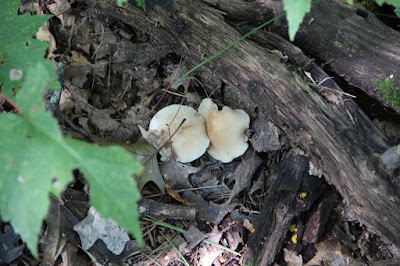
some mushrooms thrive on or near dead wood
Photo by J. Harrington

As of this morning, I’m adding to that list Aldo Leopold’s essay, A Mighty Fortress from A Sand County Almanac. I’ve read and reread his description of the benefits of tree diseases to many forms of wildlife, but it keeps slipping my mind every time there’s a new batch of broken branches covering the driveway and yard. Such was the case this morning after yesterday’s and last night’s storms. That’s when I get tempted to just "get rid of all these dead branches and diseased trees," forgetting once again that nature’s way is not the way of middle-class America’s tendency to excessive neatness.

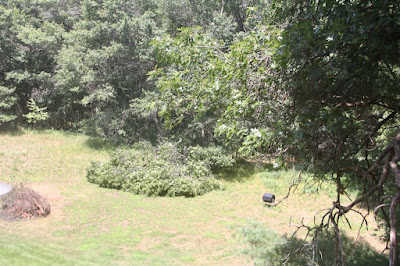
brush pile and lightning-struck oak
Photo by J. Harrington

Most years by this time the brush pile in the backyard would have been reduced to ashes at least once and maybe twice. The folks at the Xerces Society have educated me to the benefits of brush piles for pollinators and other creatures. We’ll let the brush pile stand throughout winter and, barring the unexpected, let the dead oaks stay as they are. The pileated woodpeckers seem to appreciated that and, no doubt, so do a number of other critters we haven’t noticed.


The Nurse Tree


Why waste away in a box
when you could be a nurse tree?
That’s what they call dead logs:
mushroomeries of the woods.

Your living room’s a wood
of couches, books, and chairs.
You’re dead not at all, but
could you be preparing

for things to grow inside
the chest of the log
you plan to become:
cherished compost heap

where heat turns the brown
mess of feelings, sorry,
that’s peelings, into comp-o-
sition? For we who love

our hands in dirt, a leaf skirt
decomposing seems an ideal
station between this life and
next: I visit your room

as on a forest walk. Passing
a fallen log — is that you? — 
I see a scarlet fungus cap
pop up from friable bark.


********************************************
Thanks for visiting. Come again when you can.
Please be kind to each other while you can.
Friday, November 5, 2021

Mysteries in November

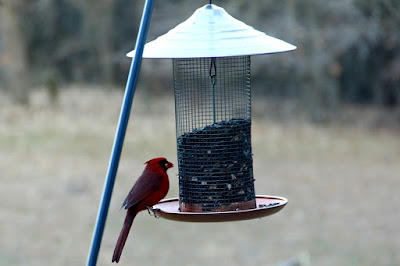
Yesterday’s post mentioned that it had been a long time since we’d seen a cardinal at the feeder. Today a cardinal arrived and perched on the deck railing and then flew away without visiting the feeder. That increases our suspicions that local cardinals don’t really care for our squirrel-proof feeder with the “cardinal ring” on the base. We’ll fill and rehang a feeder with a tray base and  see if that helps. It was popular with cardinals once upon a time [see photo below].


male cardinal at tray-base feeder
Photo by J. Harrington

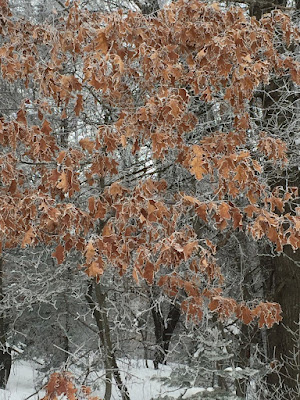
Today’s breeze is approaching wind velocity. We’re going to defer mulching the backyard leaves until the air is calmer. Unless I’m trying to duck hunt, winds approaching 20 mph are unpleasant to be out and about in. Meanwhile, I’m fascinated at the way most of the oak trees along the north side of our property  are still hanging onto their leaves. One of the better explanations we’ve come across for this phenomenon  can be found on the International Oak Society’s web site description of marcescence and abscission.


some oak leaves holding on in January
Photo by J. Harrington

Sourdough laced with kernza flour is rising in a bowl. We’ll probably not get to baking until Sunday morning. Tomorrow morning we’ll shape it and put ot in the refrigerator to chill whille we head off to a workshop on green burials. Slowly, but inevitably, nature, including human nature, is settling into winter patterns.

[UPDATE: we just remembered it was nine years ago today that we first posted at My Minnesota. We’ve made it a daily habit since then.]


Gathering Leaves


Spades take up leaves
No better than spoons,
And bags full of leaves
Are light as balloons.
 
I make a great noise
Of rustling all day
Like rabbit and deer
Running away.
 
But the mountains I raise
Elude my embrace,
Flowing over my arms
And into my face.
 
I may load and unload
Again and again
Till I fill the whole shed,
And what have I then?
 
Next to nothing for weight,
And since they grew duller
From contact with earth,
Next to nothing for color.
 
Next to nothing for use,
But a crop is a crop,
And who’s to say where
The harvest shall stop?


********************************************
Thanks for visiting. Come again when you can.
Please be kind to each other while you can.
Thursday, October 21, 2021

Peeking at autumn’s peak

Our growing season is over. Today we pick up our final community supported agriculture [CSA] share. Samhain is ten days from now. Even the oak leaves are reaching peak color. Most of the local farm fields have been harvested. We are deep into autumn and cooler temperatures are finally beginning to show it.

hard to believe oak leaves are this color
Photo by J. Harrington

This year we’ve planted two potted asters that lived on the front steps for awhile in a different location, behind the house rather than near the road in front. Some time in early November, pending the possibility of another Halloween blizzard thwarting autumnal planting, will probably see seed scattering for the wildflowers we hope to see next spring and summer.

After the yard dries from yesterday’s rains we’ll take another pass at mulching and/or collecting leaves and call it a season for the mower deck. All too soon we’ll mount the back blade on the tractor to clean up any slush falls. Then it’ll be time to settle in for long winter’s naps, plus Christmas, winter solstice, New Year’s and then winter’s deep cold and snowdrifts. Our hopes are up and  our fingers crossed that the rest of autumn and all of winter will be more sunny than cloudy. We do not like the way our climate breakdown / global warming has increased the apparent number of cloudy days although we understand that warmer air holds more moisture than does cold.

We’re finding that paying attention to the rhythm of the seasons is slowly helping us focus more on what pleasures the day offers in the present moment, or in the moment's anticipation of future pleasures, than on life's deficiencies. It’s a challenging adjustment for those of us from upwardly mobile middle class backgrounds, trained to always seek more and better than whatever we have. It’s taken the better part of a lifetime to learn that seeking is all too often a distraction from enjoying.


Gathering Leaves


 - 1874-1963


Spades take up leaves
No better than spoons,
And bags full of leaves
Are light as balloons.

I make a great noise
Of rustling all day
Like rabbit and deer
Running away.

But the mountains I raise
Elude my embrace,
Flowing over my arms
And into my face.

I may load and unload
Again and again
Till I fill the whole shed,
And what have I then?

Next to nothing for weight,
And since they grew duller
From contact with earth,
Next to nothing for color.

Next to nothing for use,
But a crop is a crop,
And who’s to say where
The harvest shall stop?


********************************************
Thanks for visiting. Come again when you can.
Please be kind to each other while you can.
Sunday, August 15, 2021

Adapting to a world of difference

We’ve reached a time of year when acorns are dropping from bur oak trees. They are among the more interesting looking acorns around. I’m doubtful that there’ll be much of an acorn crop this year, but neither am I anywhere near an expert on oaks or acorns. That’s one of the reasons I bought and have thoroughly enjoyed reading so far about the first half of The Nature of Oaks.

bur oak acorn
bur oak acorn
Photo by J. Harrington

The list of benefits oak trees provide to humans and the multitude of insects, birds and animals that find food and shelter in, on, and around oaks has done wonders to temper my dislike of oak leaves falling for about  half the year in our area. (Of course, when one lives in a state in which there has been recorded snow 11 of the  12 months in a year, what can one expect.)

As much  as I dislike raking leaves, I’ve learned that oak leaves can be very beneficial in restoring a greener world. According to the transcript of a Grow, Podcast with the book’s author

The best leaf litter is leaf litter that will not degrade quickly, Doug says, and that’s where oaks come in. Maple, birch and tulip tree leaves don’t make it through the summer because they degrade rapidly, but whole oak leaves are so full of tannins and lignans that a single oak leaf can take up to three years to break down. In an oak forest, there’s never bare soil, and that’s exactly what the doctor ordered to keep organisms in soil happy, Doug says.

There’s also the fact that oaks are very effective at carbon capture and storage, since, under normal circumstances, they’re very long-lived. If anyone had suggested a decade or more ago that a book about oak trees would have a major impact on my attitude, and consequently, my life, I would have rolled on the floor in laughter. Not only are the times changing, so am I. I think it’s called adaptation to a climate crisis.


Black Oaks


by Mary Oliver


Okay, not one can write a symphony, or a dictionary,

or even a letter to an old friend, full of remembrance
and comfort. 

Not one can manage a single sound though the blue jays
carp and whistle all day in the branches, without
the push of the wind. 

But to tell the truth after a while I'm pale with longing
for their thick bodies ruckled with lichen

and you can't keep me from the woods, from the tonnage

of their shoulders, and their shining green hair.

Today is a day like any other: twenty-four hours, a
little sunshine, a little rain. 

Listen, says ambition, nervously shifting her weight from
one boot to another -- why don't you get going?

For there I am, in the mossy shadows, under the trees.

And to tell the truth I don't want to let go of the wrists
of idleness, I don't want to sell my life for money,

I don't even want to come in out of the rain.


********************************************
Thanks for visiting. Come again when you can.
Please be kind to each other while you can.
Tuesday, July 6, 2021

Turning over an old leaf...

Today's rain won't hurt, but it may not be enough to really help the plants very much. At least the temperature isn't in the 90's. That, I think, is better for most plants and animals.

Today I finally ordered a mulching kit for the mower deck on our tractor. The idea is to make the clippings, and the autumn leaves, cut small enough to decompose readily and feed the soil.  Bagging the clippings makes the  place look neater but reduces nutrient recycling and we never fertilize except occasionally in the flower beds. I hate raking and have been going back and forth and round and round about how to get maximum results with a minimum expenditure of elbow grease and time. The fact that I suffer from mild perfectionist tendencies doesn't help. Left to her own devcices, Nature tends toward messiness.

oak leaves on the tree
Photo by J. Harrington

To be candid, a book I'm reading, The Nature of Oaks, is convincing me that it's unlikely I'll have a yard that is both healthy for pollinators and other critters and simultaneously looks the way I'd like, neat and clean and spiffy. I'm much more a hunter-gatherer than a gardener. If I have to choose, I pick natural, healthy, functional for plants and animals, and taking limited time so I can spend more time fishing, foraging and photographing. The front yard has been turning into an attractive mix of violets, creeping Charlie and wild strawberries that I don't want buried under oak leaves. We'll see if we can work out a system of mowing / mulching, raking / hauling, and bagging that serves both aesthetic and ecological purposes. At least we don't have to mow or mulch by hand.


Mowing


There was never a sound beside the wood but one,
And that was my long scythe whispering to the ground.
What was it it whispered? I knew not well myself;
Perhaps it was something about the heat of the sun,
Something, perhaps, about the lack of sound—
And that was why it whispered and did not speak.
It was no dream of the gift of idle hours,
Or easy gold at the hand of fay or elf:
Anything more than the truth would have seemed too weak
To the earnest love that laid the swale in rows,
Not without feeble-pointed spikes of flowers
(Pale orchises), and scared a bright green snake.
The fact is the sweetest dream that labor knows.
My long scythe whispered and left the hay to make.


********************************************
Thanks for visiting. Come again when you can.
Please be kind to each other while you can.

Friday, June 11, 2021

Learning to be rooted

In the thrall of our heat wave, I went summer crazy at our local [big box] grocery store and came home with watermelon and peaches that weren't on the list. This week I've been gorging on ice cream cones. As this is being typed, I'm patiently watching to see if any of the forecast thunderstorms deliver some rain to our parched little corner of the Anoka sand plain. Once upon a time, before the Anthropocene, June used to be the wettest month in Minnesota. It's not looking like that will be the case in 2021, although the wettest days fall toward the end of the month so we'll see how it goes.

oak trees and storm clouds
Photo by J. Harrington

Last night I began to read The Nature of Oaks by Douglas Tallamy. There's a fair amount of information regarding the beneficial roles oak trees play in their ecosystem, and a factoid I hadn't even considered before reading it. Blue jays play the most significant role in spreading oak trees into new areas. I knew about squirrels and chipmunks, but jays bury acorns up to a mile from the tree of origin. It's becoming clear that, as annoying as I find oak tree leaf drop going on month after month, the benefits of oaks to ecosystem services more than offsets their annoying habits. Since we live in the country and are, from time to time, harassed and/or annoyed by pocket gophers, biting insects, moles, voles, whitetail deer, black bears, chipmunks and squirrels, poison ivy and nettles, adding oak trees to the list isn't a big deal. It is also a pleasant surprise to learn about a positive aspect to having blue jays around. Their bright colors add to a winter landscape but during summer they've mostly been known for their raucous cries.


Black Oaks


by Mary Oliver


Okay, not one can write a symphony, or a dictionary,

or even a letter to an old friend, full of remembrance
and comfort. 

Not one can manage a single sound though the blue jays
carp and whistle all day in the branches, without
the push of the wind. 

But to tell the truth after a while I'm pale with longing
for their thick bodies ruckled with lichen

and you can't keep me from the woods, from the tonnage

of their shoulders, and their shining green hair.

Today is a day like any other: twenty-four hours, a
little sunshine, a little rain. 

Listen, says ambition, nervously shifting her weight from
one boot to another -- why don't you get going?

For there I am, in the mossy shadows, under the trees.

And to tell the truth I don't want to let go of the wrists
of idleness, I don't want to sell my life for money,

I don't even want to come in out of the rain.


********************************************
Thanks for visiting. Come again when you can.
Please be kind to each other while you can.

Thursday, April 29, 2021

Tree of Life, oaks #phenology

The oak trees leaf buds are swollen and beginning to open. No sightings so far of ruby-throated hummingbirds or Baltimore orioles. Black-capped chickadees have been enjoying tasting the grape jelly in the oriole feeder. Dandelion flowers are appearing in increasing abundance. Tomorrow is the last day of April. Saturday is Beltane, the start of the last month of meteorological spring, and about half-way through astronomical spring.


oak tree leaf buds opening
Photo by J. Harrington


Today, for the first time this season, I wore my Celtic Tree of Life t-shirt. I'll wear it, or something comparable, again tomorrow in honor of Arbor Day. The signs are looking good for starting this year's clean-up of dead branches and fallen leaves. Cold, damp, rainy cloudy weather could not induce me to exercise any ambition or enthusiasm. Sunny, even partly cloudy, warmer weather will do it. We'll even see if we can fit in a small bonfire on Beltane's eve.

Celtic Tree of Life
Celtic Tree of Life


The Oak


. . . It is the last survivor of a race
Strong in their forest-pride when I was young.
I can remember when, for miles around,
In place of those smooth meadows and corn-fields,
There stood ten thousand tall and stately trees,
Such as had braved the winds of March, the bolt
Sent by the summer lightning, and the snow
Heaping for weeks their boughs. Even in the depth
Of hot July the glades were cool; the grass,
Yellow and parched elsewhere, grew long and fresh,
Shading wild strawberries and violets,
Or the lark's nest; and overhead the dove
Had her lone dwelling, paying for her home
With melancholy songs; and scarce a beech
Was there without a honeysuckle linked
Around, with its red tendrils and pink flowers;
Or girdled by a brier-rose, whose buds
Yield fragrant harvest for the honey-bee
There dwelt the last red deer, those antler’d kings . . .
But this is as dream,—the plough has pass’d
Where the stag bounded, and the day has looked
On the green twilight of the forest-trees.
This oak has no companion! . . . . 


********************************************
Thanks for visiting. Come again when you can.
Please be kind to each other while you can.

Sunday, March 21, 2021

Spring -- cleaning the leaves

Oak leaves that have hung on all winter are being stripped from their branches today. The breeze is blowing at 25 mph and gusting up to 40+ mph at the same time warmer temperatures are causing the leaf buds for this years leaves to swell, loosening the holdfast at the base of the old leaf stem. By the end of the upcoming week, the branches should be bare and ready for a new season's growth. Meanwhile, we try to not get demoralized by oak leaves that fall from October or November through March, but the dogs persist in trying to eat some and the humans keep tracking some into the house, and the flower garden keeps getting buried under layers of fallen leaves. Would that our woods held many more maple trees than oaks. We'd have home made syrup and leaf fall that only occurred once a year.

Spring's green sprouts pushing up through oak leaves
Photo by J. Harrington

On the other hand, oaks provide mast (acorns) that helps feed squirrels (red and gray), chipmunks, turkeys, deer, and the occasional bear. The shape of burr oaks is often enchanting and the metallic hues of autumn's oak leaves are stunning. Perhaps we don't know as much about what "our" woods should hold as we think we do.

mid-Summer acorn
mid-Summer acorn
Photo by J. Harrington


. . . It is the last survivor of a race
Strong in their forest-pride when I was young.
I can remember when, for miles around,
In place of those smooth meadows and corn-fields,
There stood ten thousand tall and stately trees,
Such as had braved the winds of March, the bolt
Sent by the summer lightning, and the snow
Heaping for weeks their boughs. Even in the depth
Of hot July the glades were cool; the grass,
Yellow and parched elsewhere, grew long and fresh,
Shading wild strawberries and violets,
Or the lark's nest; and overhead the dove
Had her lone dwelling, paying for her home
With melancholy songs; and scarce a beech
Was there without a honeysuckle linked
Around, with its red tendrils and pink flowers;
Or girdled by a brier-rose, whose buds
Yield fragrant harvest for the honey-bee
There dwelt the last red deer, those antler’d kings . . .
But this is as dream,—the plough has pass’d
Where the stag bounded, and the day has looked
On the green twilight of the forest-trees.
This oak has no companion! . . . . 


********************************************
Thanks for visiting. Come again when you can.
Please be kind to each other while you can.

Wednesday, November 25, 2020

Shades of gratitude

The other day we posted a complaint about our oak tree leaves that seem to fall from October through March into April. We were focused on the inconvenience that on the ground oak leaves may cause. If we shift our focus to the good those trees and their leaves do, they bring shades of green to Spring, shade from the sun in Summer, and sussurating sounds as they are caressed by warm breezes. Oaks also provide acorn forage that helps feed turkeys, deer, squirrels and other local wildlife. We have a burr oak at the end of our drive that exhibits character in abundance. We're grateful we've learned to not take it for granted.


trees that share their neighborhood with us
Photo by J. Harrington

We're also grateful we're learning how to shift and broaden our focus to see a multitude of perspectives on many subjects. Our life would be diminished were it not for creative folks such as writer Robert Macfarlane and painter Jackie Morris producing treats such as The Lost Spells, which includes this perspective on the oak and other trees.

OAK

Out on the hill, old Oak still stands:
stag-headed, fire-struck, bare-crowned,
stubbornly holding its ground.

Poplar is the whispering tree,
Rowan is the sheltering tree,
Willow is the weeping tree —
and Oak is the waiting tree.

Three hundred years to grow,
three hundred more to thrive,
three hundred years to die —
nine hundred years alive.

Then there are artists such as Katie Holten, who have created works such as The Irish Tree Alphabet. We've not yet played with this version of a tree alphabet, but we've read her book, About Trees, and enjoyed every page. We're full of gratitude that we share a world with so many close to us that are part of our lives, and others, more distant, whose talent and efforts bring joys to our life through their arts. If we limit our focus to what needs fixing, we may become depressed and despairing since there's plenty of room for improvement almost everywhere we look. If we work toward a more balanced focus, enjoying and supporting and sharing what's going well, in addition to objecting to what's not, we'll probably live a longer, happier and more beneficial life. That would be something for which we can give thanks, today, tomorrow and every day, even if we lived nine hundred years.


********************************************
Thanks for visiting. Come again when you can.
Please be kind to each other while you can.