Showing posts with label butterflies. Show all posts

Monday, July 6, 2026

After Independence, what?

Are you familiar with Joni Mitchell's wonderful song, The Circle Game? It's one of my all time favorites. Despite my grumbles, I really enjoy the seasons. Some more so than others. I'm trying to learn to appreciate each season for its own delights, even heat and humidity that gives me a good excuse to stay inside and read or write. For my birthday aa while back, my son gave me a copy of Emergence Magazine Vol. 6: SEASONS. I'm enjoying its reads and the provoked thoughts that accompany. I take too much for granted and fail to appreciate and enjoy the day-to-day beauties and pleasures in my life. Can you relate?

Swamp Milkweed (Asclepias incarnata)
Photo by J. Harrington

One of our seasonal beauties recently came into bloom in the wet spot behind our house. Swamp milkweed is in flower. That may help to explain the orange butterflies we're seeing flutter around the property. I wish I were better at distinguishing Monarchs from Viceroys as they herky-jerky around.

Yesterday I was trying to get caught up (as if...) on outside chores, over-deferred due to uncooperative weather and persistent summer laziness. Progress was made but more work lies ahead than behind. Part of the challenge is attributable to dew-wet grasses early that becomes humidity as the grasses dry and the day's heat builds and work outside gets deferred to cooler times.

I missed getting a burn permit in time to have an Independence Day bonfire. Maybe we'll see if we can celebrate Lughnasadh / Lammas on August 1 with a fire. Most of the local corn was well above knee high on the 4th of July. The Better Half did a really creative job for the holiday dinner. She made white(ish) pancakes with embedded blueberries and strawberry slices for a red, white and blue meal that exceeded patriotism with tastiness. Yes, we enjoyed a relatively quiet holiday weekend, thank you for asking.


There are no kings in America


we are not that kind of country.

We are sanctuary for the hungry,

the homeless, the huddled,

held together by an idea

our immigrant fathers believed in.

Rendered, it meant independence.

Pursued, it kindled war, ordinance,

a fighting chance. Forty thousand

musket balls, by themselves, did not

shape the boundaries on which we

map our days. To draw our borders,

we needed more than firecakes.

More than a pound of meat

with bone and gristle,

or salt fish and a gill of peas.

We needed the faith and grit of people

who were not yet Americans.

To be an American is to

recognize the sacrifice

of the widow and the orphan;

it is to understand the weft of tent

cities expecting caravans,

and the heft of a child in a camp

not meant for children, or sitting

before a judge awaiting judgement.

What do we say to the native

whose lands we now inhabit?

What do we say to our immigrant

fathers who held certain truths

to be self-evident?

Do we now still pledge to each

other our lives, our fortunes,

our sacred honor.

There are no kings in America.

Only gilded men we can topple

again and again.


********************************************
Thanks for visiting. Come again when you can.
Please be kind to each other while you can.

Sunday, July 20, 2025

Summertime, and the living is ...?

Some of the local corn fields have started to tassel. Deer fly numbers have erupted. Temperatures have been above what's considered "normal." Although it seems like it's been a wet year, year-to-date precipitation is close to normal according to the state climatology office. It's once again becoming clear to me why Autumn is my favorite season, although we've been enjoying lots of berries (and ice cream) for desert and that helps offset the discomfort recent humidity has been creating.

Swamp Milkweed (Asclepias incarnata)
Photo by J. Harrington

Over the past couple of weeks, mouse activity has increased to a level we usually see in late August and early September. I can't even begin to guess why. Almost every day I've had to empty and reset at least one of the traps.

On a more cheery topic, some of the wild flower seeds we've scattered over the past few years are producing blossoms this year. We have some black-eyed Susans joining the butterfly weed on the slope behind the house. There's also a different yellow flower that's not yet been identified. The pear tree looks to have at least some pears this year and one of the whitetail does was regularly feeding under the tree for a week or so in the afternoon. Last, for now, but far from least, swamp milkweed is blooming near the wet spot behind the house. While doing some yard work today I saw what I think was a Monarch butterfly on one of the purple(?) flowers.

Despite some anomalous episodes, I find it reassuring to note that much of nature is behaving pretty much as expected and/or as climate scientists told us to expect. Decades ago a little llater in this season, I enjoyed watching Janis Joplin in concert at Harvard Stadium. Here's a version of one of the high points from her set list that night: Summertime (sorry about the opening ads).


Answer July

by Emily Dickinson

386


Answer July -

Where is the Bee -

Where is the Blush -

Where is the Hay?


Ah, said July -

Where is the Seed -

Where is the Bud -

Where is the May -

Answer Thee - Me -


Nay - said the May -

Show me the Snow -

Show me the Bells -

Show me the Jay!


Quibbled the Jay -

Where be the Maize -

Where be the Haze -

Where be the Bur?

Here - said the Year -


********************************************
Thanks for visiting. Come again when you can.
Please be kind to each other while you can.

Wednesday, June 26, 2024

June showers bring summer flowers

I was distressed that the city’s ditch mower had knocked out every milkweed plant growing between our driveway and the field entrance on our property, until this morning when I noticed how many milkweed plants are growing in the field behind the house. Rarely have we seen many milkweed plants growing in those fields, but this year’s rains have been far more than normal. Will that bring pollinators back to our property? We’ll see. Once again our pear tree, which was covered with blooms earlier this spring, has no fruit that I can see. I believe it’s due to a lack of pollinators but it could also be that there’s nothing to cross pollinate with, or both. Anyhow, our fields are full of rarely seen wildflowers and that pleases me more than the rainy, cloudy days have annoyed me.

photo of back yard pear tree in bloom
back yard pear tree in bloom
Photo by J. Harrington

The blossoms on the elderberry bush are looking much more abundant than usual. If any pollinators arrive in time, we could have a bumper crop of elderberries. Again, we’ll see. As we move into a less rainy pattern, I have to keep reminding myself that living here and managing the property is a life style, not a series of chores to get done. I “decided” toward the end of winter that I was going to take a more relaxed, less middle-class suburbanite approach to yard work. We can add one more to the list of easier said than done. Can you say OCD-type symptoms?

The tray of bergamot seedlings continues to look happy. Some day soon the Better Half and I will sketch out where we want to plant them but that’s a challenge for another day especially since the guides I’ve seen suggest planting them 18 inches apart and we have almost three dozen “cubes" of seedlings in the tray. This is beginning to remind me of the story of The Man Who Planted Trees.


Come slowly – Eden! (205)


Come slowly – Eden!
Lips unused to Thee –
Bashful – sip thy Jessamines –
As the fainting Bee –

Reaching late his flower,
Round her chamber hums –
Counts his nectars –
Enters – and is lost in Balms.


********************************************
Thanks for visiting. Come again when you can.
Please be kind to each other while you can.

Wednesday, September 20, 2023

A rising tide of color

I’m sitting looking west, out the picture window, at the trees behind the house. If I watch long and carefully enough, I think I may get to actually see a leaf change color. That thought is based on the phenomenal increase in yellow, orange and scarlet leaves over the past few days. Much of the northern half of the state is approaching 50% peak color. We’re getting close to 25%. Is it possible leaves only change color in the privacy of nighttime, when no one can see them changing?

solitary dandelion
solitary dandelion
Photo by J. Harrington

This morning we saw an orange and black butterfly land on the sole dandelion in the back yard. It was too far away to tell if it was a Viceroy or a Monarch. There still seem to be a few hummingbirds around. I expect them to be headed south by the weekend or shortly thereafter. Waterfowl, on the other hand, will hang around until there’s almost no open water and feeding fields are snow covered.

Moles are still active. I set a trap on a new tunnel yesterday. So far, no action. I’ll move it tomorrow if it’s still unsprung. That will also be a good time to check for fresh pocket gopher mounds. If critters that live under the surface didn’t make such a mess on the surface, I’d be more inclined to live and let live, but ....

We’re just a few days from the Autumn Equinox. The forecast for the weekend is showers and thunderstorms, so the odds are against a celebratory brush pile fire on Saturday evening. There’s always the prospect of curling up with a good book as “Plan B.” Meanwhile, the current temperature is in the low 80s and there’s a nice southerly breeze so it’s feeling more summerish than autumnish. It’s a good time to go enjoy a brief burst of nature bathing and see what’s happening up at the ponds.


I Don’t Know What Will Kill Us First: The Race War or What We’ve Done to the Earth

so I count my hopes: the bumblebees
are making a comeback, one snug tight
in a purple flower I passed to get to you;

your favorite color is purple but Prince’s
was orange & we both find this hard to believe;
today the park is green, we take grass for granted

the leaves chuckle around us; behind
your head a butterfly rests on a tree; it’s been
there our whole conversation; by my old apartment

was a butterfly sanctuary where I would read
& two little girls would sit next to me; you caught
a butterfly once but didn’t know what to feed it

so you trapped it in a jar & gave it to a girl
you liked. I asked if it died. you say you like
to think it lived a long life. yes, it lived a long life.


********************************************
Thanks for visiting. Come again when you can.
Please be kind to each other while you can.

Saturday, July 15, 2023

Who’s the real invasive species?

As close as I can figure out, we have four or five pairs of ruby-throated hummingbird nesting around the house, two or three behind the house and two or three in front. Or, there are only two or three pair in all and they use both the front and back feeders. Looking at the size of a female at the feeder hanging from the deck as I type this, I’m astonished at the distance something that size migrates. Since, in my younger days, I’ve been miles out on the open ocean in a 19 foot boat, I think I have a decent sense of relative size to distance traveled.

female ruby-throated hummingbird
Photo by J. Harrington

I know monarch butterflies also undertake a long migration, but they take several generations to do it in one season, which is also astonishing. Most of the time, unfortunately, I tend to take for granted the wonders in front of me. In part because I don’t get to personally watch the details of those trips, just as I don’t recall my embryonic development, which limits my ability to relate to what goes on in a chrysalis.

Do you suppose the increase in fine particle pollution from Canadian and Western U.S. wildfires will affect birds or butterflies or other critters in more ways than habitat loss? What, if anything, do we know about the effects of PFAS/PFOS on fish, wildlife and invertebrates? I’m pondering these questions after reading several articles on felt wading boots and fly fishers as vectors in spreading aquatic invasive species such as 

"rock snot" (Didymosphenia geminata); a gastropod, New Zealand mud snails (Potamopyrgus antipodarum); and particularly out west, whirling disease which is caused by a cnidarian (Myxobolus cerebralis) of the class Myxosporea. Viruses are another potential threat to coldwater streams. Viral hemorrhagic septicemia (VHS) has garnered the most attention recently but there are other potential viruses that can be considered AIS

The definition of an invasive species usually involves creating some sort of economic or ecological harm to the human species and its environs. Now that we’re in the Anthropocene, haven’t we, by definition, become the only species with negative global impacts? Isn’t there a biblical saying about the qualifications of who should cast the first stone? And shouldn’t we do a better job of remembering that denial is not just a river in Egypt?

Maybe after the current air quality warning ends I’ll be less cranky, if another one doesn’t come along soon.


Prayer for the Mutilated World


what will be left after the last fidget
spinner’s spun its last spin

after the billboards accrue their thick
layer of grit masking advertisements
for teeth paste & tanqueray gin

after the highways are overtaken
by invasive forests

after the ministers give up their gods
& the rabbis their congregations
for drink

after new men rise to lead us sheep
toward our shearing, to make bed
sheets from our hair

after the high towers have no airplanes
to warn away & instead blink purely
toward heaven like children
with one red eye

after phone lines do nothing
but cut the sky into sheet music
& our phones are just expensive
bricks of metal & glass

after our cloud of photographs collapses
& all memories retreat back
into their privatized skulls

after the water taps gasp out their final
blessing
what then?

when even the local militias run
out of ammunitions

when the blast radii have been
chalked & the missiles do all they were
built to

when us jews have given up our state
for that much older country of walking
& then that even older religion of dirt

when all have succumbed to illness
inside the church of our gutted pharmacies

when the seas eat their cities

when the ground splits like a dress

when the trash continent in the mid-atlantic
at last opens its mouth to spit

what will be left after we’ve left

i dare not consider it

instead dance with me a moment
late in this last extinction

that you are reading this
must be enough


********************************************
Thanks for visiting. Come again when you can.
Please be kind to each other while you can.

Friday, June 9, 2023

Less is more, more or less

It looks like I’ll be hand watering the new plants on our sandy hill for awhile still. We may get a few showers tonight or tomorrow but then, again, nothing for a week or so and temperatures will be in the summer range. Some of the plants are beginning to show flower buds so the watering effort has its rewards. Plus I’m outside where I can see dragonflies and butterflies like the one below.

White Admiral (Limenitis arthemis arthemis) AKA Red-spotted Admiral
White Admiral (Limenitis arthemis arthemis)
AKA Red-spotted Admiral
Photo by J. Harrington

The other day a male bluebird was perched on top of the front yard bluebird house. So far, that one hasn’t been attacked by a neighborhood bear, but I felt guilty at not taking down the house out front as a precautionary measure. Then I remembered that nature tends toward profligacy rather than caution in perpetuating many species. At least that’s the impression I get from my readings and observations. In any event, this morning a kingbird was perched on the front house. I need to see if anyone is actually nesting in that spot. I should also check to see who, if anyone, is nesting on top of the garage yard lights this summer. I think the kingbirds were there last year.

I’m back from a quick check. It looks like a pair of kingbirds are nesting on the garage lights. There’s a nest, but no eggs, in the front bluebird house. I’ll need to drag out a ladder to see if there are eggs in the nest over the lights and that’s an effort for another day. As long as they don’t block the movement receptor or short out the fixture, I’m only too happy to share some space.

This has been a strange summer so far, between bears destroying bluebird houses, Canada’s excessive wildfires and smoke, our local return to moderate drought conditions and unusual political events, I’m becoming more and more concerned about what the future holds, although I’m also aware that we, that’s you and I and the next one over, do a lot to create our own futures. Is it time to claim “we’re better than this!” and then walk that talk?


The Exposed Nest

You were forever finding some new play. 
So when I saw you down on hands and knees 
In the meadow, busy with the new-cut hay, 
Trying, I thought, to set it up on end, 
I went to show you how to make it stay, 
If that was your idea, against the breeze, 
And, if you asked me, even help pretend 
To make it root again and grow afresh. 
But 'twas no make-believe with you to-day, 
Nor was the grass itself your real concern, 
Though I found your hand full of wilted fern, 
Steel-bright June-grass, and blackening heads of clover. 
'Twas a nest full of young birds on the ground 
The cutter-bar had just gone champing over 
(Miraculously without tasting flesh) 
And left defenseless to the heat and light. 
You wanted to restore them to their right 
Of something interposed between their sight 
And too much world at once—could means be found. 
The way the nest-full every time we stirred 
Stood up to us as to a mother-bird 
Whose coming home has been too long deferred, 
Made me ask would the mother-bird return 
And care for them in such a change of scene 
And might our meddling make her more afraid. 
That was a thing we could not wait to learn. 
We saw the risk we took in doing good, 
But dared not spare to do the best we could 
Though harm should come of it; so built the screen 
You had begun, and gave them back their shade. 
All this to prove we cared. Why is there then 
No more to tell? We turned to other things. 
I haven't any memory—have you?—
Of ever coming to the place again 
To see if the birds lived the first night through, 
And so at last to learn to use their wings. 


********************************************
Thanks for visiting. Come again when you can.
Please be kind to each other while you can.

Sunday, May 28, 2023

It’s freedom (from frost) season

Here in the North Country, we have definitely left Spring behind and entered Summer mode. Temperatures over 80; thunderstorms in the forecast Tuesday through Friday; and it’s still almost a month until Summer solstice. One of my favorite singers, Janice Joplin, had a great hit with a song titled Get It While You Can. The lyrics and the attitude Janis lived seem at least as needed today as they were when she recorded them five decades plus ago.

it’s swallowtail and monarch season
Photo by J. Harrington

I was doing a few outside chores this afternoon and the bugs and the heat were wearing on my nerves. It turned out that, if I shifted my attention to the beauty of different flowers that were blooming around me, and kept my eyes open so that I could, and did, see the first monarch butterfly of the season, the bugs and the heat were less troublesome than if I continued to focus only on the annoyances and excluded the good parts of the day. Don’t tell our dogs, but I think I’m picking up this attitude adjustment from them. They’re always ready to enjoy food, or a walk, even if they just had a tick pulled from an ear.

We’ll spend part of tomorrow fondly remembering and reminiscing about my father and father-in-law and their service in the armed forces during the last century. It’s sad that the war to end all wars wasn’t; that the Civil War continues to be fought in a very uncivil manner; and that the freedoms the Second World War was fought to protect are threatened in our country by the same kind of attitudes that helped the Nazis gain power. We’ll also celebrate the fact that we will officially be beyond the threat of frost season after tomorrow.

May we all have a holiday full of better memories.


So Much Happiness

 - 1952-


It is difficult to know what to do with so much happiness.
With sadness there is something to rub against,
a wound to tend with lotion and cloth.
When the world falls in around you, you have pieces to pick up,
something to hold in your hands, like ticket stubs or change.

But happiness floats.
It doesn’t need you to hold it down.
It doesn’t need anything.
Happiness lands on the roof of the next house, singing,
and disappears when it wants to.
You are happy either way.
Even the fact that you once lived in a peaceful tree house
and now live over a quarry of noise and dust
cannot make you unhappy.
Everything has a life of its own,
it too could wake up filled with possibilities
of coffee cake and ripe peaches,
and love even the floor which needs to be swept,
the soiled linens and scratched records . . .

Since there is no place large enough
to contain so much happiness,
you shrug, you raise your hands, and it flows out of you
into everything you touch. You are not responsible.
You take no credit, as the night sky takes no credit
for the moon, but continues to hold it, and share it,
and in that way, be known.


********************************************
Thanks for visiting. Come again when you can.
Please be kind to each other while you can.

Wednesday, August 17, 2022

Natural foragers

We have one swamp milkweed in bloom. I just noticed it today while doing some chores. It’s just a few feet away from several clusters of elderberries which may, or may not, be beneficially consumed by humans, depending on which source we give the most weight to. Birds and small mammals are reported to feed on the berries, so they probably won’t go to waste if we don’t cook ‘em.

Swamp Milkweed (Asclepias incarnata)
Photo by J. Harrington

Meanwhile, I’ve convinced myself that there are, indeed, a number of milkweed plants without flowers that eventually turn into seed pods. But, despite repeated efforts at internet searches, I can find no mention of the significance or causation of why some plants flower and produce seed pods while others don’t. Feel free to share a resource or two in the comments if you can provide a clue.

The bur oak at the end of the drive has been dropping green acorns for more than a week now. And yet, every other day or so, there are no acorns on the ground. Squirrels? Deer? Chipmunks? The fact that today I noticed several wild turkey feathers around the yard and along the drive provides some clues as to who the primary culprits may be.

We are now in the midst of our second downpour this afternoon. Fortunately, there’s been little thunder so far which means SiSi’s anxiety hasn’t yet been triggered. We’ll keep our fingers crossed that the rest of the day continues in a like vein. We’ll also keep them crossed that we continue to be able to schedule our walks between, not during, the downpours. When Dylan wrote A Hard Rain’s A-Gonna Fall he may well have been imagining precipitation like today’s. As I look at the morning headlines these days, I truly wish he hadn’t been so prescient.


Milkweed

by Philip Levine

Remember how unimportant
they seemed, growing loosely
in the open fields we crossed
on the way to school. We
would carve wooden swords
and slash at the luscious trunks
until the white milk started
and then flowed. Then we'd
go on to the long day
after day of the History of History
or the tables of numbers and order
as the clock slowly paid
out the moments. The windows
went dark first with rain
and then snow, and then the days,
then the years ran together and not
one mattered more than
another, and not one mattered.

Two days ago I walked
the empty woods, bent over,
crunching through oak leaves,
asking myself questions
without answers. From somewhere
a froth of seeds drifted by touched
with gold in the last light
of a lost day, going with
the wind as they always did.


********************************************
Thanks for visiting. Come again when you can.
Please be kind to each other while you can.

Saturday, August 13, 2022

As the signs align

It’s mid-afternoon, Saturday, August 13, here in the North Country. The temperature hasn’t yet reached 70℉. Returning from a visit with the Son Person, the Better Half and I noticed a maple tree whose leaves have turned from green to autumn colors. Roadside ditches are full of goldenrod, joe pye weed flowers, wild cucumber in bloom and some thistle flowers.

Hummingbirds are still at the sugar water feeder. Purple finches again are showing up at the sunflower seed feeder. The folks at Journey North remind us:

Time to think fall migration. During August, the monarch super generation will emerge and start their migratory journey south. 

monarch butterflies on blazing star
Photo by J. Harrington

We’ve seen very few monarchs this summer. Of several possible sightings, the critters didn’t hold still long enough for me to be sure whether I was looking at a monarch or a viceroy.

There’s about 2 1/2 weeks of meteorological summer remaining. September 1 starts meteorological autumn. We have once again entered a season in which I’m never sure what to put on when I get up in the morning. It seems as though I’m usually over or underdressed. The Better Half and I are now regularly turning the ceiling fan on or off. Soon it will be time to get the furnace tuned up for heating season.

And the seasons they go round and round ...” 


As If


How do you explain why elephants
appear to move their unwieldy hulks
with greater dignity than most humans do
in their finest moments,
as if they had evolved beyond wanting
anything but what they have?
Why does the field begin to ripple
before the wind arrives in whispers,
as if there were a communication,
as if the landscape were poorly dubbed,
and we weren’t expected to notice?
What butterfly does not dart away from us
as if it could sense our latent cruelties,
and yet return to check and double-check? 
Has the night not gotten recently darker,
as if to insinuate that we have squandered 
the light that was there?
Have we made too much of our own?
And did you notice afterward the dawn 
opening up with a tentative eagerness
as if there were something crucial to illumine,
as if we would wake up early just to see it?
I imagine you reading this now 
with an expression of quiet trouble
itself troubled by currents of hope, 
as if you imagined me here with you, 
as if I might be able to see your expression,
and at least answer it with mine.


********************************************
Thanks for visiting. Come again when you can.
Please be kind to each other while you can.

Thursday, July 21, 2022

Is there a Jurassic Park for butterflies?

This year there seem to be more bees and/or hornets and/or wasps at the nectar feeder than I remember from years past. Yesterday, I saw what I believe was a baldfaced hornet (actually a yellowjacket) emerge from one of the feeding ports as I brought the feeder in for the night. Several yellowjackets, normal kind, have managed to get themselves trapped in the feeder and drowned. The insect activity doesn’t seem to bother the occasional Baltimore oriole that shows up at the feeder, but the hummingbirds are much more skittish.

You may have seen the announcement that the International Union for the Conservation of Nature (IUCN) has declared the monarch butterfly endangered. That doesn’t make it subject to the provisions of the United States Endangered Species Act since the US Fish and Wildlife Service has not listed it.

“We conducted an intensive, thorough review using a rigorous, transparent science-based process and found that the monarch meets listing criteria under the Endangered Species Act. However, before we can propose listing, we must focus resources on our higher-priority listing actions,” said U.S. Fish and Wildlife Service Director Aurelia Skipwith. “While this work goes on, we are committed to our ongoing efforts with partners to conserve the monarch and its habitat at the local, regional and national levels. Our conservation goal is to improve monarch populations, and we encourage everyone to join the effort.”

monarch butterfly emerging
Photo by J. Harrington

Several years ago we were fortunate enough to have a monarch chrysalis on the front of the house. I was lucky enough to be around with a camera when the butterfly began to emerge. This year we’ve seen a few monarchs around the property over the past week or so. I’m both surprised and disappointed there aren’t more since we have quite a few common milkweed clusters on the property. None of the plants along the road have signs of being gnawed on by caterpillars and I’ve not been back into the fields to check those plants.

Have you ever read the stories of lemmings driving themselves off a cliff to their death? The stories are untrue but seem to provide an example of how the human species has been behaving for the past century or so. The Earth will continue just fine without us, but we won’t survive, let alone thrive, without a habitable home planet. It is the only one we have.


I Don’t Know What Will Kill Us First: The Race War or What We’ve Done to the Earth

so I count my hopes: the bumblebees
are making a comeback, one snug tight
in a purple flower I passed to get to you;

your favorite color is purple but Prince’s
was orange & we both find this hard to believe;
today the park is green, we take grass for granted

the leaves chuckle around us; behind
your head a butterfly rests on a tree; it’s been
there our whole conversation; by my old apartment

was a butterfly sanctuary where I would read
& two little girls would sit next to me; you caught
a butterfly once but didn’t know what to feed it

so you trapped it in a jar & gave it to a girl
you liked. I asked if it died. you say you like
to think it lived a long life. yes, it lived a long life.


********************************************
Thanks for visiting. Come again when you can.
Please be kind to each other while you can.
Thursday, November 11, 2021

Leaf me alone!

On this Veterans’ Day, let US proudly remember all the soldiers’ sacrifices. Let US bow our heads to honor them and thank them for everything.

Before the storm, the back, side and front yards were in “fair to middlin’” shape having been cleared of leaves two or three times already. They are now covered again in leaves, wet leaves. What is even more astounding is the amount of leaves still attached to branches. Many of those leaves won’t come down until next spring, when the buds of new leaves swell and loosen the old year’s stems.

If we get some sunshine and drying, I’ll mulch the latest batch of fallen leaves. I’ve not the heart nor motivation to rake, and have run out of edges to which the leaves can be blown. The weather patterns are making it tough to plan what to do next for outside chores. We still have wildflower and clover seeds to be scattered on bare patches of dirt. It would be helpful, I think, to get the seeds spread just before snow cover comes and stays but it’s a real challenge guessing when that may be.

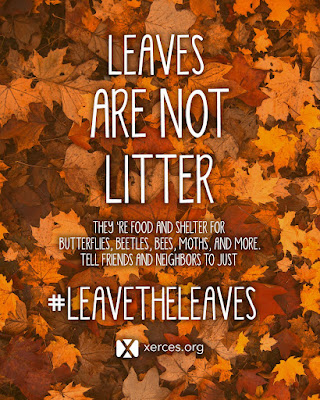
The Xerces Society, among other folks, have some guidance about leaf cover helping pollinators and others overwinter. Creeping charlie and violets have taken over much of what  used to be the front lawn. The north side is almost entirely shaded. The south is wooded and the west (backyard) is abandoned farm field and failed orchard full of pocket gopher mounds. Naturalizing seems like the wisest course and I’m grateful for the excuse of helping polllinators. With a little more study and resolve, I may finally learn to go with the flow instead of constantly trying to swim upstream. [Yes, I know I mixed my metaphors. Consider it misdirected poetic license.]


Leaves are not litter
#leavetheleaves


Leaves Fell


By Juhan Liiv


Translated from the Estonian by H.L. Hix & Jüri Talvet

A gust roused the waves,
leaves blew into the water,
the waves were ash-gray,
the sky tin-gray,
ash-gray the autumn.

It was good for my heart:
there my feelings were ash-gray,
the sky tin-gray,
ash-gray the autumn.

The breath of wind brought cooler air,
the waves of mourning brought separation:
autumn and autumn
befriend each other.


c ********************************************
Thanks for visiting. Come again when you can.
Please be kind to each other while you can.

Tuesday, September 7, 2021

Autumn: color of phenology or phenology of color?

Before we even arrive at noteworthy color change in the local leaves, purple-lovegrass (a.k.a. tumble grass) has ripened. Now, with autumn’s breezes, florets with seeds attached are carried tumbling across fields and spiraling into the air like micro-tornados. Soon they’ll accumulate along fencerows or in corners, waiting to be collected with the season's fallen leaves. Those that are left for spring cleanup can sometimes be blown loose around Halloween to float through the air like lost spirits.

purple-lovegrass in summer
Photo by J. Harrington

airborne tumble grass florets
Photo by J. Harrington

We’re pleased to report that last week’s seeking for potted aster plants was successful. We now have a pair perched in all their purple plumpness on the stoop steps. This all reminds us of the many  shades of purple listed on the color thesaurus by Ingrid Sundberg.


shades of purple, color thesaurus

Although we have tumble grass seed heads in abundance, we can’t report the same for milkweed. There are lots of stems that didn’t develop any seed pods, perhaps due to the summer’s drought? This, among other reasons, may help account for our lack of monarch butterflies this year. [The linked study attributes monarch  population declines to the consequences of "climate change.”] We’ve only seen a few monarchs all summer. Next spring we’ll make an effort to plant some joe pye weeds and blazing star plants to attract any monarchs  that may make it to our neighborhood. The biggest challenge we keep facing is remembering to order or buy plant before nurseries are all sold out.


Lullaby


 - 1916-1992


Purple,
Purple,
Twilight
Sky light.

Purple as a king's cape
Purple as a grape.

Purple for the evening
When daylight is leaving.

Soft and purry,
Gentle and furry,
Velvet evening-time.

Purple,
Purple.
Sky light
Goodbye light.

Dusky
Musky
Into night.


********************************************
Thanks for visiting. Come again when you can.
Please be kind to each other while you can.

Saturday, August 14, 2021

The Ides of August observations #phenology

(Actually, we’re fudging a little. The real Ides of August were on August 13.) The past few days have brought delightful weather, gentle breezes, coolish seasonable temperatures, blue skies, although we’re still in a drought. Earlier this afternoon I met a young garter snake near the foot of the driveway as I was headed for the mail box. Roadsides in our area have lost the lavender blooms of bee balm but are showing more flowers on goldenrod, Joe Pye weed, and thistles. Soon we’ll be able to enjoy the pale and faded whitish/purple/bluish aster blooms.


Spicebush Swallowtail (Papilio troilus) on Joe Pye  weed
Spicebush Swallowtail (Papilio troilus) on Joe Pye  weed
Photo by J. Harrington

The extended precipitation forecast gives us hope for above normal precipitation through the end of the month. If the forecast proves true, we may yet be able to safely torch the brush pile on or before the autumn equinox.


In Response to a Question:
”What Does the Earth Say?”


The earth says have a place, be what that place
requires; hear the sound the birds imply
and see as deep as ridges go behind
each other. (Some people call their scenery flat,
their only pictures framed by what they know:
I think around them rise a riches and a loss
too equal for their chart - but absolutely tall.)

The earth says every summer have a ranch
that’s minimum: one tree, one well, a landscape
that proclaims a universe - sermon
of the hills, hallelujah mountain,
highway guided by the way the world is tilted,
reduplication of mirage, flat evening:
a kind of ritual for the wavering.

The earth says where you live wear the kind
of color that your life is (grey shirt for me)
and by listening with the same bowed head that sings
draw all things into one song, join
the sparrow on the lawn, and row that easy
way, the rage without met by the wings
within that guide you anywhere the wind blows.

Listening, I think that’s what the earth says.

+ William Stafford


********************************************
Thanks for visiting. Come again when you can.
Please be kind to each other while you can.

Sunday, July 18, 2021

Coming into bloom #phenology

We now have about 25 minutes less daylight than we did back at Summer Solstice. Our daylight is now decreasing at 2 minutes or so a day. Personally, I've noticed it more in the mornings than evenings because, for a very brief period, there was light  in the sky when SiSi and I took our early morning walks back in June.

Monarda punctata (Spotted Horsemint)
Spotted Horsemint (Monarda punctata)
Photo by J. Harrington

Earlier today I was fussing about how, in years past, our fields behind the house were full of spotted horsemint (Monarda punctata) and there's none to be seen this year. Silly me! When I checked the dates on my pictures of the spotted horsemint, they were all taken in very late July to late August. Minnesota Wildflowers web site says Monarda blooms from July - September, and a more detailed chart of what's blooming by week of the month shows it blooming each week of July. This prompted me to take a quick look through binoculars at our fields and I think I saw a few blooms beginning to show. We'll keep an eye open and see what, if anything, develops further. As Minnesota Wildflowers notes "Factors such as temperature and precipitation play a large role in how a plant fares year after year." This year we're ahead on temperature and behind on precipitation.

There's still no sign of swamp milkweed flowering around our wet spot, although there seem to be more common milkweeds flowering in ditches this year than I remember seeing in past years. That may, or may not, explain the increased number of butterflies flittering over and around township gravel roads these days. At a risk of jinxing us, I'll note that the deerfly population seems diminished these days, but then so does the dragonfly population.


Today


Mary Oliver


Today I’m flying low and I’m

not saying a word

I’m letting all the voodoos of ambition sleep.


The world goes on as it must,

the bees in the garden rumbling a little,

the fish leaping, the gnats getting eaten.

And so forth.


But I’m taking the day off.

Quiet as a feather.

I hardly move though really I’m traveling

a terrific distance.


Stillness. One of the doors

into the temple.


********************************************
Thanks for visiting. Come again when you can.
Please be kind to each other while you can.

Tuesday, June 22, 2021

It's #PollinatorWeek

Do you remember the beginning of Rachel Carson's Silent Spring, the Fable for Tomorrow?

There was a strange stillness. The birds, for example where had they gone? Many people spoke of them, puzzled and disturbed. The feeding stations in the backyards were deserted. The few birds seen anywhere were moribund; they trembled violently and could not fly. It was a spring without voices. On the mornings that had once throbbed with the dawn chorus of robins, catbirds, doves, jays, wrens, and scores of other bird voices there was now no sound; only silence lay over the fields and woods and marsh.

a friendly, local pollinator
Photo by J. Harrington

As the old saying goes, "today is tomorrow's yesterday."  We've mostly banned DDT in the US, but there's a plethora of other pesticides, herbicides and insecticides that have been approved for widespread use since 1972. The number of pollinators has diminished precipitously. Now we are faced with a prospect of a colorless Spring, lacking blossoms and blooms because we lack pollinators. Faced with that prospect, and the potential loss of many food crops, a few years ago, National Pollinator Week was established.


National Pollinator Week logo

I'm not sure if it was the weather, or a lack of pollinators, or both, but the pear tree is looking quite barren of fruit despite an abundance of flowers this spring. The "abnormally dry" conditions, not quite a real drought, seems to have suppressed many of the prairie flowers we often see in our patch of the Anoka Sand Plain. Today we downloaded a copy of Selecting Plants for Pollinators, A Regional Guide for Farmers, Land Managers and Gardners in the Eastern Broadleaf Forest Continental Province. We'll see if that offers strategies for keeping pollinator-friendly plants alive for more than one season around here. It seems as if the deer don't eat the plant, pocket gophers eat the roots! Then again, I'd really like to establish a field of bergamot so we'll see what the guide suggests.


To the Field of Scotch Broom That Will Be Buried by the New Wing of the Mall


Half costume jewel, half parasite, you stood
swaying to the music of cash registers in the distance
while a helicopter chewed the linings
of the clouds above the clear-cuts.
And I forgave the pollen count
while cabbage moths teased up my hair
before your flowers fell apart when they
turned into seeds. How resigned you were
to your oblivion, unlistening to the cumuli
as they swept past. And soon those gusts
will mill you, when the backhoe comes
to dredge your roots, but that is not
what most impends, as the chopper descends
to the hospital roof so that somebody's heart
can be massaged back into its old habits.

Mine went a little haywire
at the crest of the road, on whose other side
you lay in blossom.
As if your purpose were to defibrillate me
with a thousand electrodes,
one volt each.


********************************************
Thanks for visiting. Come again when you can.
Please be kind to each other while you can.

Wednesday, June 9, 2021

Are we creating a new normal for summer?

If I'm correctly reading the year-to-date precipitation chart for Wild River State Park, we're about 3 or 4 inches below normal YTD, and May and June look pretty dry. A graph of normal highs, lows and precipitation for June can be found at this link. We're doing our best to not completely avoid outside chores, but are limiting work times until 10 or 11 am. Then it's inside to the air conditioning for the hottest parts of the day. If you had asked me before this week, I would have told you there's no such thing as summer cabin fever, but now I think I have a case most every afternoon.

red admiral a.k.a. white admiral butterfly
Photo by J. Harrington

Butterflies have started to appear from time to time and place to place. One, a white or red-spotted admiral, stopped at the bird bath to grab a quick drink. Another admiral, or, perhaps the same one, has been hanging around the flower garden in front of the house. Every once in awhile what looks like a monarch flits from flower to flower. We've not yet started to check milkweed for eggs or caterpillars. There's also been a hatch of some sort of vicious biting flies, possibly deer, but not horse, nor black as far as I can tell, that took a couple of chunks out of my bare arm this morning and then, after I put on a shirt with  built-in bug repellant, spent time chewing on the sleeve cuff.

Did you ever read about Tom Sawyer Whitewashing the Fence? I'm trying to work some of Tom's psychology on myself, to convince me that doing yard chores is actually fun and yields a sense of satisfaction and accomplishment when the day's to do list is done. On a good day it works. Days when the bugs and the heat and the humidity are all up there make it more challenging. At least as more of the grass gets cut, the number of ticks the dogs bring into the house, or we go and collect on our own, seem to be diminishing. It's going to be interesting to see if the remainder of summer continues to be as atypical, and in which ways, or if we get a July and August that are cooler and wetter than normal to compensate.


The Butterfly’s Dream


A tulip, just opened, had offered to hold 
   A butterfly, gaudy and gay; 
And, rocked in a cradle of crimson and gold, 
   The careless young slumberer lay. 

For the butterfly slept, as such thoughtless ones will, 
   At ease, and reclining on flowers, 
If ever they study, ’t is how they may kill 
   The best of their mid-summer hours. 

And the butterfly dreamed, as is often the case 
   With indolent lovers of change, 
Who, keeping the body at ease in its place, 
   Give fancy permission to range. 

He dreamed that he saw, what he could but despise, 
   The swarm from a neighbouring hive; 
Which, having come out for their winter supplies, 
   Had made the whole garden alive. 

He looked with disgust, as the proud often do, 
   On the diligent movements of those, 
Who, keeping both present and future in view, 
   Improve every hour as it goes. 

As the brisk little alchymists passed to and fro, 
   With anger the butterfly swelled; 
And called them mechanics – a rabble too low 
   To come near the station he held. 

‘Away from my presence!’ said he, in his sleep, 
   ‘Ye humbled plebeians! nor dare 
Come here with your colorless winglets to sweep 
   The king of this brilliant parterre!’ 

He thought, at these words, that together they flew, 
   And, facing about, made a stand; 
And then, to a terrible army they grew, 
   And fenced him on every hand. 

Like hosts of huge giants, his numberless foes 
   Seemed spreading to measureless size: 
Their wings with a mighty expansion arose, 
   And stretched like a veil o’er the skies. 

Their eyes seemed like little volcanoes, for fire,—   
   Their hum, to a cannon-peal grown,— 
Farina to bullets was rolled in their ire, 
   And, he thought, hurled at him and his throne. 

He tried to cry quarter! his voice would not sound, 
   His head ached – his throne reeled and fell; 
His enemy cheered, as he came to the ground, 
   And cried, ‘King Papilio, farewell!’ 

His fall chased the vision – the sleeper awoke, 
   The wonderful dream to expound; 
The lightning’s bright flash from the thunder-cloud broke, 
   And hail-stones were rattling around. 

He’d slumbered so long, that now, over his head, 
   The tempest’s artillery rolled; 
The tulip was shattered – the whirl-blast had fled, 
   And borne off its crimson and gold. 

’T is said, for the fall and the pelting, combined 
   With suppressed ebullitions of pride, 
This vain son of summer no balsam could find, 
   But he crept under covert and died.


********************************************
Thanks for visiting. Come again when you can.
Please be kind to each other while you can.

Wednesday, March 24, 2021

Is there a phenology of migration triggers?

Yesterday afternoon we drove a circuit on the local roads around a large chunk of Carlos Avery Wildlife Management Area in Chisago County. We were looking for robins and red-winged blackbirds. Not a feather of either was to be seen, although we did see an osprey and two turkey hens on the northern leg, plus the waterfowl we've been reporting, and the Better Half spotted a cluster of pussy willows near a wetland on the southern leg.

Spring arrival, male red-winged blackbird
Photo by J. Harrington

This morning we had to drive the southern leg of the same loop to run an errand, picking up heart worm and flea & tick meds for the dogs. Blond SiSi showed the season's first tick the day before yesterday. On our way to get the meds, we noticed two robins and two or three red-winged blackbirds. Where were they yesterday? Did they just arrive overnight? Was the time of day a significant factor? We'll probably never know, but their recent appearance puts the season's migration phenology back into a more usual framework.

Elsewhere, Journey North shows that both robins and blackbirds have been arriving in much of Minnesota only within the past week or two, while monarch butterflies and ruby-throated hummingbirds are still well south of our North Country. According to All About Birds:

The mechanisms initiating migratory behavior vary and are not always completely understood. Migration can be triggered by a combination of changes in day length, lower temperatures, changes in food supplies, and genetic predisposition.


Redwing Blackbird


Feet firmly perch 
thinnest stalks, reeds, bulrush. 
Until all at once, they attend my 
female form, streaked throat, brownness.

Three fly equidistant 
around me, flashing. 
Each, in turn, calls territorial 
trills, beckons ok-a-li, ok-a-li! 

Spreads his wings, extends 
inner muscle quivering red 
epaulet bands uniquely bolden. 

Turn away each suitor, 
mind myself my audience. 
Select another to consider, 
He in turn quiver thrills. 

Leave for insects. 
Perhaps one male follows. 
Maybe a few brood of young, 
line summertime. 

Silver Maple samaras 
wing wind, spread clusters 
along with mine, renewing Prairie. 

As summer closes, I leave 
dragonflies, damselflies, butterflies, 
mosquitoes, moths, spiders, crickets for 

grain, see, Sunflower; 
join thousands to flock Sky— 
grackles, blackbirds, cowbirds, starlings— 
Swarming like distant smoke clouds, rising.

Allison Adelle Hedge Coke 


********************************************
Thanks for visiting. Come again when you can.
Please be kind to each other while you can.