Showing posts with label Aldo Leopold. Show all posts

Tuesday, April 23, 2024

A full moon of Spring

Night before last, an almost full moon, surrounded by a glowing halo, played peek-a-boo behind a thin layer of clouds. Last night [this morning], it shone in a clear sky. Tonight it will be full. Cloud cover remains to be seen, or not. Our copy of the Minnesota Weather Guide Calenday notes that the Ojibwe call this full moon Maple Sap Boiling Moon and to the Dakota, it’s Fattening Moon. (Other sources list the Fattening Moon in June.) Regardless of the name, moonrise tonight occurs a little after 8 pm and moonset about 6 am tomorrow.

photo of two sandhill cranes in our  back yard
two sandhill cranes in our back yard
Photo by J. Harrington

As days lengthen and temperatures warm, migrations from southern locales continue and locals become more active. Yesterday evening on the way to and from a visit with the Daughter Person, Son-In-Law, and Granddaughter, the Better Half and I saw swans, geese, pheasants, deer, turkeys, multiple species of song birds, and sandhill cranes. The trip reminded me of Aldo Leopold’s wonderful observation:

“There are some who can live without wild things, and some who cannot. These essays are the delights and dilemmas of one who cannot.” - A Sand County Almanac foreword

Another sign of warmer days arriving is the increasing number of locations where road work of one kind or another is getting underway. Those who claim there are only two seasons in Minnesota, winter and road work, aren’t entirely joking. I wish work crews would put signs face down when not relevant, instead of just moving them to the shoulder.

Uncharacteristically, I’m going to take in stride the fact that my plans for the week have been disrupted by wet weather and slow to germinate bergamot seeds (which are showing increasing signs of life, thank you for asking). If I can’t play outside, I’ll read inside about the outside, and bake bread. Tomorrow’s project: a whole wheat sourdough rustic boule, The dough is currently undergoing bulk fermentation in preparation for oven time tomorrow.


My Debt


Like all
who believe in the senses,
I was an accountant,
copyist,
statistician.

Not registrar,
witness.

Permitted to touch
the leaf of a thistle,
the trembling
work of a spider.

To ponder the Hubble’s recordings.

It did not matter
if I believed in
the party of particle or of wave,
as I carried no weapon.

It did not matter if I believed.

I weighed ashes,
actions, 
cities that glittered like rubies,
on the scales I was given,
calibrated
in units of fear and amazement.

I wrote the word it, the word is.

I entered the debt that is owed to the real.

Forgive,
spine-covered leaf, soft-bodied spider,
octopus lifting
one curious tentacle back toward the hand of the diver
that in such black ink
I set down your flammable colors.

—2018


********************************************
Thanks for visiting. Come again when you can.
Please be kind to each other while you can.

Sunday, April 21, 2024

On the eve of Earth Day

Leaves are emerging on some bushes and tree tops, really noticeable on aspens. It’s near time to watch for wild plums to bloom. A few hours ago I began reading a digitized version of a book I’ve been attracted to for some time now, Traditional Ecological Knowledge. I was pleased to note references to Leopold’s land ethic and works by other authors with whom I’m familiar mentioned in the introduction. The three sisters garden I wanted to plant last year never happened so, with luck, maybe this year will see seeds planted. The Better Half gave me a couple of packets of glass gem corn seeds at Christmas, so I’ve even more motivation this year. Where to plant is a major question and last year the persistent drought was a disincentive to starting.

photo of tree crowns at leaf out
it’s leaf out time
Photo by J. Harrington

Blogger’s software seems much better behaved today, although we can’t be sure until this is actually posted. I’m now facing a question of whether I want to and can download/backup more than a decade’s worth of daily postings. I know, it would have been better if I’d done backups all along, but who knew I’d keep at this?

Last week a purple or house finch, or one of each, showed up at the feeder. Dark-eyed juncoes were pecking away at the back yard until a day or so ago. Warmer, wetter, weather in the week upcoming should bring more indicators of spring. One we’re reasonably certain of is the first community supported agriculture share should be available Friday or Saturday. That’s up-lifting, as is the increasing number of bergamot seeds that are germinating. Isn’t it wonderful what some sunshine and water can help make happen?

Until Earth Day...


Gidiskinaadaa Mitigwaakiing/Woodland Liberty


Apii dibikong gaashkendamyaan miinawaa goshkoziyaan
When in the night I am weary and awake wondering
endigwenh waa ezhichigewag bagoji Anishinaabensag odenang,
what the wild young Anishinaabeg of the cities will do,
mitigwaakiing izhaayaan miinawaa anweshinyaan.
into the woods I go and rest.
Nimawadishaag zhingwaakwag miinawaa okikaandagoog
I visit with the white pines and the jack pines.
Nibizindaawaag zhashagiwag miinawaa ajiijaakwag.
I listen to the herons and the cranes.
Nimaatookinaag zaagaa’igan ogaawag miinawaa apakweshkwayag.
I share the lake waters with the walleye and the cattails.
Niwaabaandaanan wesiinhyag-miikanan miinawaa nakwejinaanig
I marvel at the complexity of wild paths and webs woven.
Miidash apii bidaaban niswi giosewag miinawaa
Then when the dawn hides the three hunters
niizhwaaswi nimisenhyag dibiki-giizhigong gaazhad
and seven sisters of the night sky
baabimoseyaan nikeye naawakweg zoongide’eyaan.
I walk bravely toward the noonday.
 

This poem was written in response to "The Peace of Wild Things" by Wendell Berry.


********************************************
Thanks for visiting. Come again when you can.
Please be kind to each other while you can.

Monday, August 7, 2023

This is only a test

The universe is estimated to be almost 15 billion years old; the Earth about 4.5 billion; humans (Homo sapiens) less than a million. I need to remind myself of this so I can keep in perspective that we are, literally, not only "a child of the universe,” but children on a universal timescale. Is it any wonder that we continue to make monumental mistakes? Plus, there are indications that this whole existence thing is just an experiment, to see if it works. Maybe, by the time time has run its course, everything will just disappear into a last singularity, a mega black hole.

Meanwhile, I don’t give a damn about a cage match between X-man and Zuckface. I do need to do more to break my current pattern of awakening in the morning, walking dogs, getting coffee, checking local and international news, watch my mood go to hell again, check social media, watch my mood worsen. If I reframe life as an experiment in which I (and you) are involuntary participants, and realize how many failed experiments often precede any kind of success, it doesn’t all seem as bad.

Leopold shack and pines
Photo by J. Harrington

An example? from Estella Leopold’s Stories from the Leopold Shack

“The first phase of the family’s annual pine planting ran from spring 1936 until spring 1939. Those were the dust bowl years, and during the first droughty summer of 1936 almost all the little pines died....

We continued to plant thousands of pines the next year, and most of those died, ...” 

These days, the pines that finally made it are being thinned so the mature trees can be replaced with seedlings.

There are also stories about Edison and his inventions that highlight the nature of experiments: “‘Results! Why, man, I have gotten a lot of results! I know several thousand things that won’t work.’” I think you get the picture.

So, much as I find it challenging to accept, henceforth, I shall spend less time doom-scrolling and more time rereading this:


Desiderata: Original Text

This is the original text from the book where Desiderata was first published.

Go placidly amid the noise and the haste, and remember what peace there may be in silence. As far as possible, without surrender, be on good terms with all persons.

Speak your truth quietly and clearly; and listen to others, even to the dull and the ignorant; they too have their story.

Avoid loud and aggressive persons; they are vexatious to the spirit. If you compare yourself with others, you may become vain or bitter, for always there will be greater and lesser persons than yourself.

Enjoy your achievements as well as your plans. Keep interested in your own career, however humble; it is a real possession in the changing fortunes of time.

Exercise caution in your business affairs, for the world is full of trickery. But let this not blind you to what virtue there is; many persons strive for high ideals, and everywhere life is full of heroism.

Be yourself. Especially do not feign affection. Neither be cynical about love; for in the face of all aridity and disenchantment, it is as perennial as the grass.

Take kindly the counsel of the years, gracefully surrendering the things of youth.

Nurture strength of spirit to shield you in sudden misfortune. But do not distress yourself with dark imaginings. Many fears are born of fatigue and loneliness.

Beyond a wholesome discipline, be gentle with yourself. You are a child of the universe no less than the trees and the stars; you have a right to be here.

And whether or not it is clear to you, no doubt the universe is unfolding as it should. Therefore be at peace with God, whatever you conceive Him to be. And whatever your labors and aspirations, in the noisy confusion of life, keep peace in your soul. With all its sham, drudgery and broken dreams, it is still a beautiful world. Be cheerful. Strive to be happy.

by Max Ehrmann ©1927


********************************************
Thanks for visiting. Come again when you can.
Please be kind to each other while you can.

Friday, March 3, 2023

interested in a land ethic?

We spent part of the morning watching and listening to the introduction to this year’s Leopold Week. My favorite part was Kim  Blaeser reading several of her poems, including new works. In the process, I learned that she was the Founding Director of Indigenous Nations Poets [IN-NA-PO].

the Aldo Leopold “shack"
Photo by J. Harrington

There are a couple of other Leopold Week presentations I really don’t want to miss and, although I don’t really need more books to read, I bet I’ll find some I can’t live without on the IN-NA-PO site. Plus, Scott Russell Sanders is one of the presenters I’m looking forward to seeing and I’ve put off for a few years reading his A Conservationist Manifesto and now seems to be the time to correct that deficiency.

That’s mostly all for today. We’re busy with some family celebratory stuff so it’s a briefer than usual posting. We’ll explore some of the underlying themes of a land, or water, ethic in future postings.


The Way We Love Something Small


The translucent claws of newborn mice

this pearl cast of color,

the barely perceptible

like a ghosted threshold of being:

here     not here.

The single breath we hold

on the thinnest verge of sight:

not there   there.

A curve nearly naked 

an arc of almost, 

a wisp of becoming

a wand—

tiny enough to change me.


********************************************
Thanks for visiting. Come again when you can.
Please be kind to each other while you can.

Sunday, January 15, 2023

On comings and goings

About 90%+ of the snow is gone from most of the deciduous trees behind the house. Behind the bare branches blue sky brightens the day. We are about halfway through January and 65 days from Spring Equinox. Fortunately, February is the shortest month of the year. It’s too early in the year to even fantasize about bud burst, but we are moving in the right direction, at least as far as the seasons are concerned.

We had a first at the feeder the other day, as far as I can recall that is. A Northern (yellow-shafted) flicker flashed away as I approached the door to the deck for a better look. I didn’t get a clear enough look to tell if it was a male or female. We’ll watch for a return visit.

Aldo Leopold “shack,” late April
Photo by J. Harrington

I just glanced at the Leopold phenology calendar and it lists, in late January, Canada geese starting to return just a few days before the last of the sandhill cranes migrate south. That makes it very clear to me that phenology occurrences aren’t nearly as neatly structured as I’ve been envisioning. In all the  years I was an active waterfowler, I based my assessments on migrations to the south ending in late November or early December and return flights headed north occurring in March. Perhaps I’ve not been paying enough  attention to the details? But the Minnesota WeatherGuide Calendar doesn’t mention waterfowl returning until mid-March, so I can’t be too far off. Maybe the area around Baraboo, WI is just far enough south of our neighborhood to offer more open water in late January. If anyone has any solid ideas about the earlly arrival of geese around Leopold’s “shack,” please share in the comments.


To One Coming North


At first you'll joy to see the playful snow, 
  Like white moths trembling on the tropic air, 
Or waters of the hills that softly flow 
  Gracefully falling down a shining stair.
 
And when the fields and streets are covered white 
  And the wind-worried void is chilly, raw, 
Or underneath a spell of heat and light 
  The cheerless frozen spots begin to thaw,
 
Like me you'll long for home, where birds' glad song 
  Means flowering lanes and leas and spaces dry, 
And tender thoughts and feelings fine and strong, 
  Beneath a vivid silver-flecked blue sky.
 
But oh! more than the changeless southern isles, 
  When Spring has shed upon the earth her charm, 
You'll love the Northland wreathed in golden smiles 
  By the miraculous sun turned glad and warm.


********************************************
Thanks for visiting. Come again when you can.
Please be kind to each other while you can.

Thursday, June 16, 2022

What’s your bottom line?

The market is once again going to hell. Monkeypox (or whatever less discriminatory name is bestowed upon it) continues to spread. Congress is holding hearings on a recent attempt to overthrow our government and install an autocrat(?), oligarch(?), dictator(?), what? The wind is strong enough to inhibit fly-fishing, or spraying the poison ivy. Although we were scheduled to have a tech work on our water softener today, it got rescheduled to late this month. This weekend and next week are forecast to be unseasonably hot. There are also lots of less important annoyances occurring. A multitude of explanations exist for why I join many others in a less than joyful mood these days.

Then again, the bright side is: we aren’t in a war zone like Ukraine or Palestine or...; we don’t own property along the Yellowstone River (a one-time fantasy). The township is very unlikely to harass us about a failure to mow. Father’s Day is coming up. I have a stack of new (to me) books to read. We have food, water and shelter for the foreseeable future. The family seems to be moderately to reasonably healthy at the moment. On a scale of zero to ten, ten being best, we’d rate our life a ... what? Compared to what or whom?

If you’ve been to a doctor in the past few years, it’s possible you were asked about how painful your “owie” was. Is it possible that more than one scale is needed? One mosquito bite is rarely painful, but the itch can be annoying. Are ten bites painful, or just ten times as annoying as one? At some point does annoyance cross over into pain?

an example of "stability, and beauty of the biotic community"
Photo by J. Harrington

Philosophers have been know to debate how many angels will fit on the head of a pin, thereby explaining the origin of the phrase “pin-headed philosopher.” The Catholic church has twisted a straightforward declarative sentence “Thou shalt not kill.” to accommodate “unless in a just war.” 

Are Liz Cheney and Mike Pence real heroes? Quite likely. Would I have predicted it? No, not in this lifetime. Today is Bloomsday. James Joyce’ masterpiece was not very popular when first published. What literature or scientific theories are unpopular today that may come to be considered classics in twenty five or fifty years?

I’m not making a case for alternate facts here. I’m pondering the multitude of belief systems against which facts can be judged. I’m taking a long-winded way to get back to part of Aldo Leopold’s Land Ethic. Leopold wrote: “Examine each question in terms of what is ethically and esthetically right, as well as what is economically expedient. A thing is right when it tends to preserve the integrity, stability, and beauty of the biotic community. It is wrong when it tends otherwise.” Does even this wisdom help us determine if we are, or should be, satisfied or dissatisfied with where we are and the direction in which we’re traveling?


The Journey

One day you finally knew
what you had to do, and began,
though the voices around you
kept shouting
their bad advice–
though the whole house
began to tremble
and you felt the old tug
at your ankles.
“Mend my life!”
each voice cried.
But you didn’t stop.
You knew what you had to do,
though the wind pried
with its stiff fingers
at the very foundations,
though their melancholy
was terrible.
It was already late
enough, and a wild night,
and the road full of fallen
branches and stones.
But little by little,
as you left their voices behind,
the stars began to burn
through the sheets of clouds,
and there was a new voice
which you slowly
recognized as your own,
that kept you company
as you strode deeper and deeper
into the world,
determined to do
the only thing you could do–
determined to save
the only life you could save.

Mary Oliver


********************************************
Thanks for visiting. Come again when you can.
Please be kind to each other while you can.

Wednesday, April 20, 2022

What is a “thinking community?"

 It was late April several years ago that the Better Half and I made a pilgrimage to Wisconsin’s Sand County and visited Aldo Leopold’s “shack.” If you’ve not read A Sand County Almanac, you’ve been deprived of enjoying one of the better pieces of “nature writing” that’s been written.

Aldo Leopold’s “shack"
Photo by J. Harrington

Later today I’ll be Zooming into the first session of an online nature writing course I’ve registered for, but first I want to pose a challenge, based on Leopold’s land ethic.

Leopold also recognized that the relationship between people and each other and people and land was a complex one, and an evolutionary process. Near the end of the essay, he explains:

“I have purposely presented the land ethic as a product of social evolution because nothing so important as an ethic is ever ‘written.’ Only the most superficial student of history will suppose that Moses ‘wrote’ the Decalogue; it evolved in the minds of a thinking community, and Moses wrote a tentative summary of it for a ‘seminar.” I say tentative because evolution never stops. The evolution of a land ethic is an intellectual as well as an emotional process.” 

Spend a little time scanning headlines or doom scrolling on social media, and I believe it will become apparent that today’s “thinking community” is not as large as it should be to support the wide-spread adoption of the land ethic we so desperately need. The challenge is: How do we first enlarge a thinking community to encompass those for whom thinking is a new and unusual experience? Or, do we expect to see evolution, over its own time scale, diminish the number of unthinking members through pandemics and similar catastrophes?


I Don’t Know What Will Kill Us First: The Race War or What We’ve Done to the Earth


so I count my hopes: the bumblebees
are making a comeback, one snug tight
in a purple flower I passed to get to you;

your favorite color is purple but Prince’s
was orange & we both find this hard to believe;
today the park is green, we take grass for granted

the leaves chuckle around us; behind
your head a butterfly rests on a tree; it’s been
there our whole conversation; by my old apartment

was a butterfly sanctuary where I would read
& two little girls would sit next to me; you caught
a butterfly once but didn’t know what to feed it

so you trapped it in a jar & gave it to a girl
you liked. I asked if it died. you say you like
to think it lived a long life. yes, it lived a long life.


********************************************
Thanks for visiting. Come again when you can.
Please be kind to each other while you can.
Tuesday, January 11, 2022

Best wishes on Aldo Leopold’s birthday

It isn't really a January thaw if the temperature doesn't reach at least 32℉, right? I’m feeling as though  we’re coming close to, but being robbed of, a January thaw. Rather than rely on thermometers, we’re going to see if we can observe signs of melting on the deck, patio or front stoop.

January sunrise
January sunrise
Photo by J. Harrington

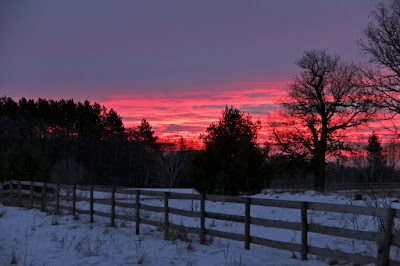
This morning’s sunrise was, again, spectacular. The picture above, from several years ago, doesn’t even capture the strength of all the magentas and hot pinks in the dawn sky prior to sunrise. It’s one of my favorite aspects of winter in the North Country. I’ve been looking around for better guidance on how to better capture the red end of the spectrum, but to no avail so far.

Today is the 135th anniversary of the birth of Aldo Leopold. We’re once again rereading his masterpiece, A Sand County Almanac, with emphasis on the land ethic. As the urban / rural; Red /Blue; vaxx / antivaxx divide continues to have US at each other’s throats, we continue to hope and believe that the benefits of adopting such an ethic have increased geometrically since
Ethics direct all members of a community to treat one another with respect for the mutual benefit of all. A land ethic expands the definition of “community” to include not only humans, but all of the other parts of the Earth, as well: soils, waters, plants, and animals, or what Leopold called “the land.”

If  you have concerns about the importance of belonging to a “community,” perhaps you could spend some time thinking about where the air we breathe, the food we eat, the water we drink are produced if not from Leopold’s “the land.”


Our Land


 - 1902-1967


We should have a land of sun, 
Of gorgeous sun, 
And a land of fragrant water
Where the twilight is a soft bandanna handkerchief 
Of rose and gold, 
And not this land
Where life is cold. 

We should have a land of trees, 
Of tall thick trees, 
Bowed down with chattering parrots
Brilliant as the day, 
And not this land where birds are gray. 

Ah, we should have a land of joy, 
Of love and joy and wine and song, 
And not this land where joy is wrong. 


********************************************
Thanks for visiting. Come again when you can.
Please be kind to each other while you can.

Tuesday, December 28, 2021

A thinking community? Yes!!!

 Cloudy, dreary, snowing. Bitter cold through New Years weekend. These are indeed the darkest days of the year, both literally and psychologically. And the pundits tell us the new year will bring lots of uncertainty. All of which, plus spending too much time on social media, has me wondering about taking  the shifting baseline syndrome from ecology, applying it to the natural, cultural, social and political worlds (economic fits in there somewhere) and working on restoration sociology or anthropology.

Aldo Leopold refers to a “thinking community” as he writes about a land ethic.

Leopold recognized that his dream of a widely accepted and implemented set of values based on caring – for people, for land, and for all the connections between them – would have to “evolve… in the minds of a thinking community.”

“It evolves in the minds of a thinking community."
Photo by J. Harrington

I believe we need to focus on creating a thinking community as well as "simply caring: about people, about land, and about strengthening the relationships between them.” Much of the behavior we see, read about, and too often exhibit is based very little on either thinking or caring. We have become reactors (other-directed) rather than actors (inner-directed, check The Lonely Crowd).

Slowly, we are learning how to do restoration ecology more effectively. Perhaps that means we can actually (re)create a thinking community that honors a land ethic and will be better prepared to respond to whatever the James Webb Space Telescope will soon begin transmitting.

I think I’ve just added to my New Year’s wish list.


Remember


 - 1951-


Remember the sky that you were born under,
know each of the star's stories.
Remember the moon, know who she is.
Remember the sun's birth at dawn, that is the
strongest point of time. Remember sundown
and the giving away to night.
Remember your birth, how your mother struggled
to give you form and breath. You are evidence of
her life, and her mother's, and hers.
Remember your father. He is your life, also.
Remember the earth whose skin you are:
red earth, black earth, yellow earth, white earth
brown earth, we are earth.
Remember the plants, trees, animal life who all have their
tribes, their families, their histories, too. Talk to them,
listen to them. They are alive poems.
Remember the wind. Remember her voice. She knows the
origin of this universe.
Remember you are all people and all people
are you.
Remember you are this universe and this
universe is you.
Remember all is in motion, is growing, is you.
Remember language comes from this.
Remember the dance language is, that life is.
Remember.


********************************************
Thanks for visiting. Come again when you can.
Please be kind to each other while you can.

Tuesday, December 21, 2021

Happy Solstice!

We hope that today, and all the days that follow, will find you healthy, happy and hopeful. Although Solstice brings the longest night of the year, it also brings the assurance of days that grow longer and a new season that will arrive in 89 days, on March  20, 2022. For now we must keep hope warm on our hearths and in our hearts. I know, easier said than done, but this morning I found a quotation that helped ease my doom and gloom.

“Watching the morning break, I realize again that darkness doesn't kill the light—it defines it.” 
― Richard Wagamese, Embers: One Ojibway's Meditations

Winter Solstice 9:59 am 12/21/21
Winter Solstice: 9:59 am 12/21/21
Photo by J. Harrington

It’s been too long since I last read Embers. It’s now in the stack of books to begin reading next year, along with whatever may end up under the tree or in my stocking, plus Aldo Leopold’s A Sand County Almanac. That’s where Leopold writes about his concept of a Land Ethic.

Ethics direct all members of a community to treat one another with respect for the mutual benefit of all. A land ethic expands the definition of “community” to include not only humans, but all of the other parts of the Earth, as well: soils, waters, plants, and animals, or what Leopold called “the land.”

It’s the emphasis on community that I believe all of US need to be more attentive too. We have forgotten just how interdependent we are. Perhaps this winter, compounded by COVID-19 and its never-ending variants, plus the consequences of climate breakdown and loss of biodiversity, and supply chain disruptions, and related matters, will help US remember how much we need each other. If we do so, and act accordingly, perhaps spring will bring about a renewal of life that exceeds our current expectations. Wouldn’t that be a wonderful, if belated, Christmas present?


    The Shortest Day


    by Susan Cooper


    And so the Shortest Day came and the year died

    And everywhere down the centuries of the snow-white world

    Came people singing, dancing,

    To drive the dark away.

    They lighted candles in the winter trees;

    They hung their homes with evergreen;

    They burned beseeching fires all night long

    To keep the year alive.

    And when the new year’s sunshine blazed awake

    They shouted, reveling.

    Through all the frosty ages you can hear them

    Echoing behind us—listen!

    All the long echoes, sing the same delight,

    This Shortest Day,

    As promise wakens in the sleeping land:

    They carol, feast, give thanks,

    And dearly love their friends,

    And hope for peace.

    And now so do we, here, now,

    This year and every year.

    Welcome, Yule!


********************************************
Thanks for visiting. Come again when you can.
Please be kind to each other while you can.
Friday, November 12, 2021

Becoming naturalized

Harry the beagle, the Better Half’s new rescue dog, is settling in nicely. There’s still a few adjustments that are needed but the situation looks promising. Yesterday the Better Half got a COVID vaccine booster. Today it was my turn. Our diligence is due in part to self-preservation tendencies and also because we have a one year old granddaughter who’s not eligible yet for any COVID vaccine. Except for the last item, we can add each of these things to our list of what we have to be grateful for this Thanksgiving.

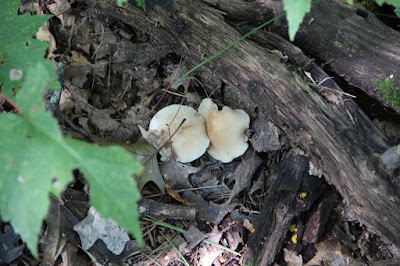
some mushrooms thrive on or near dead wood
Photo by J. Harrington

As of this morning, I’m adding to that list Aldo Leopold’s essay, A Mighty Fortress from A Sand County Almanac. I’ve read and reread his description of the benefits of tree diseases to many forms of wildlife, but it keeps slipping my mind every time there’s a new batch of broken branches covering the driveway and yard. Such was the case this morning after yesterday’s and last night’s storms. That’s when I get tempted to just "get rid of all these dead branches and diseased trees," forgetting once again that nature’s way is not the way of middle-class America’s tendency to excessive neatness.

brush pile and lightning-struck oak
Photo by J. Harrington

Most years by this time the brush pile in the backyard would have been reduced to ashes at least once and maybe twice. The folks at the Xerces Society have educated me to the benefits of brush piles for pollinators and other creatures. We’ll let the brush pile stand throughout winter and, barring the unexpected, let the dead oaks stay as they are. The pileated woodpeckers seem to appreciated that and, no doubt, so do a number of other critters we haven’t noticed.


The Nurse Tree


Why waste away in a box
when you could be a nurse tree?
That’s what they call dead logs:
mushroomeries of the woods.

Your living room’s a wood
of couches, books, and chairs.
You’re dead not at all, but
could you be preparing

for things to grow inside
the chest of the log
you plan to become:
cherished compost heap

where heat turns the brown
mess of feelings, sorry,
that’s peelings, into comp-o-
sition? For we who love

our hands in dirt, a leaf skirt
decomposing seems an ideal
station between this life and
next: I visit your room

as on a forest walk. Passing
a fallen log — is that you? — 
I see a scarlet fungus cap
pop up from friable bark.


********************************************
Thanks for visiting. Come again when you can.
Please be kind to each other while you can.
Sunday, May 16, 2021

Noisy neighbors

Yesterday, late morning, I worked up enough energy to again clean up after our two dogs. I started along the road ditch on the south  side of the drive. My view and attention were focused downward, so I was startled by cacophonous calling from the hay field across the road. I looked up to discover I was being yelled at, or called?, by a pair of sandhill cranes walking through the field. Naturally, my camera was back in to house, so I just listened for awhile. Aldo Leopold describes crane calls beautifully near the beginning of his Marshland Elegy essay.


sandhill cranes near Baraboo, WI
Photo by J. Harrington


"High horns, low horns, silence, and finally a pandemonium of trumpets, rattles, croaks, and cries that almost shakes the bog with its nearness, but without disclosing whence it comes."


sandhill cranes, Carlos Avery WMA marshes
Photo by J. Harrington


It's been a continuing source of pleasure to watch the local sandhill population grow during the twenty-five or so years that we've lived here. These days, we frequently but irregularly see cranes in farm and hay fields and the marshes in and around Carlos Avery Wildlife Management Area, although rarely in the numbers that  we saw. mixed with Canada geese when  we visited the Aldo Leopold Foundation late one summer, as the cranes were gathering for for autumn migration (top picture). They've visited several of the nearby fields, but I've yet to see any in our fields behind the house. That leaves something else I can continue to look forward to.


The Sandhills


The language of cranes
we once were told
is the wind. The wind
is their method,
their current, the translated story
of life they write across the sky.
Millions of years
they have blown here
on ancestral longing,
their wings of wide arrival,
necks long, legs stretched out
above strands of earth
where they arrive
with the shine of water,
stories, interminable
language of exchanges
descended from the sky
and then they stand,
earth made only of crane
from bank to bank of the river
as far as you can see
the ancient story made new.


********************************************
Thanks for visiting. Come again when you can.
Please be kind to each other while you can.

Tuesday, May 11, 2021

Smoke season?

While poking through the photo archives, seeking inspiration and/or distraction, I was reminded that it's time to go check our nearby patch of prairie smoke. The photo below was taken on May 10, 2017. Somehow, my mind had latched onto the idea to look for prairie smoke about 2 weeks later than that. Tomorrow, a short prairie smoke trip may be just the thing to ease into a phase of recovery from a spring cold.


Geum triflorum (Prairie Smoke)
Photo by J. Harrington


There were no signs that our few pasque flowers survived the winter and/or the pocket gophers. We'll think about replacing them this autumn or next spring. Or, possibly not. Gardening is clearly not my forte and it seems much of what get's planted is simply sacrificed to the short term needs of the neighborhood wildlife. Then again, I remember the thousands of pines that Aldo Leopold and his family planted and replanted in their sand county and I don't feel quite as bad. Their persistence and commitment is admirable.


Vision


 - 1905-1989


I shall build me a house where the larkspur blooms
        In a narrow glade in an alder wood,
Where the sunset shadows make violet glooms,
        And a whip-poor-will calls in eerie mood.

I shall lie on a bed of river sedge,
        And listen to the glassy dark,
With a guttered light on my window ledge,
        While an owl stares in at me white and stark. 

I shall burn my house with the rising dawn,
        And leave but the ashes and smoke behind,
And again give the glade to the owl and the fawn,
        When the grey wood smoke drifts away with the wind.


********************************************
Thanks for visiting. Come again when you can.
Please be kind to each other while you can.

Saturday, March 27, 2021

Do we need an Agricultural Code of Ethics?

This morning I received a very pleasant surprise, the work of one of my long time environmental heroes was cited in a very recent editorial in the Times of Storm Lake Iowa [Editorial: Reaching our limits]. After spending a number of paragraphs describing Iowa's agricultural pollution and its consequences, Art Cullen, the Storm Lake Times editor, notes:

This was all foreseen more than 70 years ago by native Iowan Aldo Leopold, who predicted that all our chemicals and engineering would destroy us as we destroyed the land. He suggested in a key 1949 essay, The Land Ethic, while at the University of Wisconsin that we develop conservation agriculture as our ethos. Everything he suggested came true: the rivers have lost their former lives, the soil is washing down them, and in dominating the landscape we diminish ourselves. He suggested that we live as citizens of the land rather than over it. 

In the decades since we moved to Minnesota, we've observed a growing number of instances in which our adopted home has chosen to participate in races to the bottom with contenders such as Iowa. That's part of the problem resulting from the consolidation of economic, and consequently political, power.

agriculture in the Driftless Area
Photo by J. Harrington

A truism that's been with us since New Testament times is that “A prophet is not without honor except in his own country, among his own relatives, and in his own house.” Perhaps that helps explain why Leopold's Land Ethic [Aldo Leopold Foundation The Land Ethic] is not acknowledged and followed more in the restorative agriculture sector.

Unless we are missing a significant distinction between "ethic" and "ethics," which is all too possible, we would quibble with Leopold's thinking and writing when he asserts that “I have purposely presented the land ethic as a product of social evolution because nothing so important as an ethic is ever ‘written.’ Our experience with ethics has been in the context of the codes of conduct they articulate. For example, there's the Boone and Crockett Club's statement on hunter ethics and fair chase and Trout Unlimited's Code of Ethics. Maybe what we need is the broad, overarching Land Ethic from which we could derive an Agricultural Code of Ethics. What should that look like and encompass?


Ethics


In ethics class so many years ago 
our teacher asked this question every fall: 
if there were a fire in a museum 
which would you save, a Rembrandt painting 
or an old woman who hadn't many 
years left anyhow? Restless on hard chairs 
caring little for pictures or old age 
we'd opt one year for life, the next for art 
and always half-heartedly. Sometimes 
the woman borrowed my grandmother's face 
leaving her usual kitchen to wander 
some drafty, half imagined museum. 
One year, feeling clever, I replied 
why not let the woman decide herself? 
Linda, the teacher would report, eschews 
the burdens of responsibility. 
This fall in a real museum I stand 
before a real Rembrandt, old woman, 
or nearly so, myself. The colors 
within this frame are darker than autumn, 
darker even than winter — the browns of earth, 
though earth's most radiant elements burn 
through the canvas. I know now that woman 
and painting and season are almost one 
and all beyond saving by children.


********************************************
Thanks for visiting. Come again when you can.
Please be kind to each other while you can.

Thursday, August 20, 2020

It's Earth Overshoot Day, 2020!!!

“All ethics so far evolved rest upon a single premise: that the individual is a member of a community of interdependent parts.The land ethic simply enlarges the boundaries of the community to include soils, waters, plants and animals, or collectively the land.” The Land Ethic, A Sand County Almanac.
1972 was the year the Clean Water Act amendments became law. In anticipation of their enactment, Massachusetts had been engaged in a pilot study with the USACE looking at how areawide water quality management plans, as called for by Section 208 of that act, could appropriately be implemented. The United States has yet to meet the water quality goals called for in the act, despite massive expenditures of public dollars to collect and treat urban and industrial wastewater. Little has been done to address agricultural water pollution. Neither has much been done to respond to the issues and challenges identified in the 1972 report: Limits To Growth.

Blue Marble
Blue Marble,
Image Credit: NASA/NOAA/GSFC/Suomi NPP/VIIRS/Norman Kuring

Although I once debated, on MIT radio, Dennis Meadows, one of authors of that report, it would be presumptuous of me to attempt to summarize the report here, Instead, I offer the following excerpts from: The History of The Limits to Growth
A pioneering report, The Limits to Growth, published in 1972, marked a turning point in thinking about the environment, selling some 30 million copies in 30 languages.1 The two-year study behind the report took place at the Massachusetts Institute of Technology at the request of the Club of Rome, an international group of distinguished business people, state officials, and scientists founded by Aurelio Peccei, a former Fiat executive and president of Olivetti.
What have Western societies been doing in the thirty-five years since the appearance of LtG and similar warnings from the same period?17,18 When it comes to taking serious action, little has been done to reach a sustainable form of development, with the exception of some modest technical adjustments. On the other factors, such as population, consumption, and production, the political steps taken have generally been in the opposite direction from sustainability, and they have more than offset any benefits of technical progress. The result is that global environmental pressure, as for example indicated by humanity’s ecological footprint,19 is today much worse. And there are few signs of significant action toward changing this trend.
A sustainable future is not a matter of technology alone, partly because of the rebound effect.33 It must build on new ways to live and organize societies, for instance recognizing that today “corporations have even less incentive than individuals to keep the Commons in order; in fact they have a (legal) clear line of responsibility to their shareholders alone and have continuously resisted government and international efforts to regulate the Commons.”34 This is referring to G. Hardin’s classical paper on the problems of sharing the limited capacity of the Commons.35 Elinor Ostrom won the 2009 Nobel Prize in Economics for her analysis of economic governance, and especially of the commons, that understands this conundrum. She shared the prize with Oliver A. Williamson, who was lauded for his analysis of economic governance, especially in regard to the boundaries of the modern corporation.36 Both study how individuals can work together and share scarce resources, an ethos shared by the authors of LtG.37

So, here we are on Earth Overshoot Day, 2020. We are living in a world faced with

  • climate breakdown, and all that brings with it
  • a sixth extinction, and breakdown of the ecosystems on which we depend for clean air and water
  • a pandemic disrupting global economies, with the prospect of more pandemics on the horizon
  • no quick solutions in sight to any of the above
  • several long-standing democracies faced with economic and/or civic collapse
It looks more and more as if Western knowledge and economics alone isn't sufficient to motivate us to change our ways enough to save ourselves from each other. It's encouraging that some communities are adapting Doughnut Economics to a local scale. Personally, I believe we'd all be better off, as, certainly, would any descendants we have, if we also adopted and adapted to Traditional Ecological Knowledge.

A Map to the Next World


           for Desiray Kierra Chee

In the last days of the fourth world I wished to make a map for
those who would climb through the hole in the sky.

My only tools were the desires of humans as they emerged
from the killing fields, from the bedrooms and the kitchens.

For the soul is a wanderer with many hands and feet.

The map must be of sand and can’t be read by ordinary light. It
must carry fire to the next tribal town, for renewal of spirit.

In the legend are instructions on the language of the land, how it
was we forgot to acknowledge the gift, as if we were not in it or of it.

Take note of the proliferation of supermarkets and malls, the
altars of money. They best describe the detour from grace.

Keep track of the errors of our forgetfulness; the fog steals our
children while we sleep.

Flowers of rage spring up in the depression. Monsters are born
there of nuclear anger.

Trees of ashes wave good-bye to good-bye and the map appears to
disappear.

We no longer know the names of the birds here, how to speak to
them by their personal names.

Once we knew everything in this lush promise.

What I am telling you is real and is printed in a warning on the
map. Our forgetfulness stalks us, walks the earth behind us, leav-
ing a trail of paper diapers, needles, and wasted blood.

An imperfect map will have to do, little one.

The place of entry is the sea of your mother’s blood, your father’s
small death as he longs to know himself in another.

There is no exit.

The map can be interpreted through the wall of the intestine—a
spiral on the road of knowledge.

You will travel through the membrane of death, smell cooking
from the encampment where our relatives make a feast of fresh
deer meat and corn soup, in the Milky Way.

They have never left us; we abandoned them for science.

And when you take your next breath as we enter the fifth world
there will be no X, no guidebook with words you can carry.

You will have to navigate by your mother’s voice, renew the song
she is singing.

Fresh courage glimmers from planets.

And lights the map printed with the blood of history, a map you
will have to know by your intention, by the language of suns.

When you emerge note the tracks of the monster slayers where they
entered the cities of artificial light and killed what was killing us.

You will see red cliffs. They are the heart, contain the ladder.

A white deer will greet you when the last human climbs from the
destruction.

Remember the hole of shame marking the act of abandoning our
tribal grounds.

We were never perfect.

Yet, the journey we make together is perfect on this earth who was
once a star and made the same mistakes as humans.

We might make them again, she said.

Crucial to finding the way is this: there is no beginning or end.

You must make your own map.


********************************************
Thanks for visiting. Come again when you can.
Please be kind to each other while you can.

Friday, August 7, 2020

"More important than television" (or social media)

 In my life, I have seen few things more majestic and stirring than a skein of Canada geese in flight. Nor have I seen many things much more humorous than flocks of geese waddling through harvested (or recently planted) fields as they glean their way to a full stomach. This morning, on the way to get our weekly Community Supported Agriculture [CSA] share, we got to watch the latter.

Canada geese gleaning a field
Photo by J. Harrington

For reasons I won't even try to guess, a large flock of Canada geese had landed in a field right next to the county road. You can see the edge of the pavement in the lower left corner of the photo. Just East of the geese [behind the jeep] were a pair of sandhill cranes. Perhaps one of the morning's cloudbursts had forced all of them out of the sky. Perhaps the field looked like the equivalent of an avian truck stop. I don't know. I do know that watching 25 to 50 or so geese hustle away from road's edge as the jeep slowed to a stop was better than an Abbott and Costello routine. (The camera I had handy couldn't quite capture all the geese in the field through the rain-washed windshield.)


sandhill cranes (not this morning's)
Photo by J. Harrington


Yesterday, or the day before, a pair of sandhill cranes stopped to explore and feed in the field across from our property. We've yet to entice either geese or cranes to land in our fields which attract mostly pocket gophers, rabbits, wild turkeys and whitetail deer. Having grown up in the city or near the ocean back in New England, wildlife sightings were rare. One of the real pleasures of country living are the frequent, serendipitous, views of the other than humans with whom we share the area. Joni Mitchell's song Big Yellow Taxi asks "Don't it always seem to go / That you don't know what you've got / Till it's gone..." 

Aldo Leopold raises a similar cautionary view with an equally lyrical but more specific phrasing

“Like winds and sunsets, wild things were taken for granted until progress began to do away with them. Now we face the question whether a still higher 'standard of living' is worth its cost in things natural, wild and free. For us of the minority, the opportunity to see geese is more important than television.” 

We have reached the time of year when geese goslings and sandhill crane colts are grown and feathered. Practice flights, in training for Autumns migration, have begun. A new season approaches. Summer will soon be gone.


The Season of Phantasmal Peace


Then all the nations of birds lifted together
the huge net of the shadows of this earth
in multitudinous dialects, twittering tongues,
stitching and crossing it. They lifted up
the shadows of long pines down trackless slopes,
the shadows of glass-faced towers down evening streets,
the shadow of a frail plant on a city sill—
the net rising soundless as night, the birds' cries soundless, until
there was no longer dusk, or season, decline, or weather,
only this passage of phantasmal light
that not the narrowest shadow dared to sever.

And men could not see, looking up, what the wild geese drew,
what the ospreys trailed behind them in silvery ropes
that flashed in the icy sunlight; they could not hear
battalions of starlings waging peaceful cries,
bearing the net higher, covering this world
like the vines of an orchard, or a mother drawing
the trembling gauze over the trembling eyes
of a child fluttering to sleep;
                                                     it was the light
that you will see at evening on the side of a hill
in yellow October, and no one hearing knew
what change had brought into the raven's cawing,
the killdeer's screech, the ember-circling chough
such an immense, soundless, and high concern
for the fields and cities where the birds belong,
except it was their seasonal passing, Love,
made seasonless, or, from the high privilege of their birth,
something brighter than pity for the wingless ones
below them who shared dark holes in windows and in houses,
and higher they lifted the net with soundless voices
above all change, betrayals of falling suns,
and this season lasted one moment, like the pause
between dusk and darkness, between fury and peace,
but, for such as our earth is now, it lasted long.


********************************************
Thanks for visiting. Come again when you can.
Please be kind to each other while you can.