Showing posts with label prairie. Show all posts

Thursday, April 18, 2024

Return with us now...

Today is day fourteen of the 10 to 14 day germination period listed for the bergamot seeds we planted in two seed trays. There are minuscule signs of life in about 20% of the tray cells. We have our fingers crossed that more seeds will germinate over time since the trays have only had one day of warm sunshine for a couple of hours. Weather forecasts are threatening frost this weekend so... no planting yet. In fact, we’re not even ready to park the trays outside daily so seedlings can harden off. The wind has been gusting enough to blow over the trays. Plus, the “safety date” for frost is Memorial Day weekend. Welcome to spring in the North Country.

photo of wild bergamot in bloom
wild bergamot in bloom
Photo by J. Harrington

A pocket gopher has been creating mounds in the real back yard, not just out in the fields behind the house. We’ll see about setting some traps tomorrow or later, after the Soil and Water Conservation person has visited. We’re exploring the possibility of getting some funding to help turn our fields into wild prairie, helping create habitat for local pollinators. Maybe some of our bergamot seedlings will become a step in our prairie restoration?

The day lilies are coming along nicely. Maple buds have burst and their “shells” now cover the ground. The Better Half recently dug out some CDs from our [much] younger days, including early Judy Collins, Ani DiFranco + Utah Phillips, and Janis Joplin. I’m taking that music plus my rapidly growing frustration with today’s “culture” as a cue that it’s time to revert, not to a second childhood (there are some who would claim I never left my first) but to a second Hippie-hood. It feels like a wonderful way to spend the rest of the year, and maybe the rest of my life. At least I could make more sense of people’s actions and inactions way back when. Now, not so much. (If you’re not old enough to remember the Lone Ranger, the rest of the title goes “to those thrilling days of yesteryear.......”)


Back Up Quick They’re Hippies


That was the year we drove
into the commune in Cornwall.
“Jesus Jim,” mam said,
“back up quick they’re hippies.”

Through the car window,
tents, row after row, flaps open,
long-haired men and women
curled around each other like babies

and the babies themselves
wandered naked across the grass.

I reached for the handle, ready, almost,
to open the door, drop out and away
from my sister’s aggressive thighs,
Daddy’s slapping hands.

Back home in the Dandelion Market
I unlearnt the steps my mother taught,
bought a headband, an afghan coat,
a fringed skirt — leather skin.

Barefoot on common grass I lay down with kin.


********************************************
Thanks for visiting. Come again when you can.
Please be kind to each other while you can.

Friday, October 1, 2021

Autumn’s prairie patches

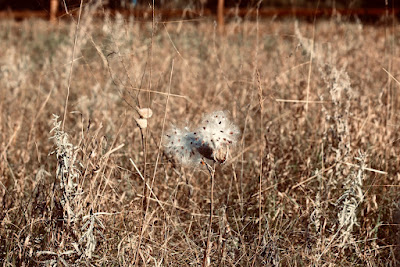
We’re fortunate to live somewhere that has a few out of the way fields that are either regenerating prairie or the owners have worked to restore patches of prairie as buffers between row crop fields and alongside the township’s gravel road. During much of the summer we had the pleasure of viewing prairie flowers such as black-eyed Susans and bee balm. Recently, the roadsides have been full of milkweed with seed pods opened and seeds awaiting the autumn winds. There’s a difference between seeing an occasional seed pod and a long ditch embankment full of them, looking like the remains of a prairie pillow fight.

milkweed seed pods in field
Photo by J. Harrington

October, in our neighborhood, is prime time to watch for woollybear caterpillars. We’ve not noticed any yet this autumn and we’re getting really curious to find some and see what their banding foretells about our upcoming winter. Then again, we remember how accurate any weather forecast is once it gets beyond twelve hours or so. For the upcoming winter, NOAA forecasts that our region has equal chances of above or below average temperature and precipitation. Using woollybears seems about as accurate and more fun. If you’ve been paying any attention to the stock market recently, you may have seen a pattern similar to that which we’re anticipating for this winter’s weather: a roller coaster ride, up and down ad nauseam.

Most of the leaves in which the woollybears will spend the winter are still on the trees. We’re not close to peak color yet, but the spatters and speckles of scarlet, crimson, gold, yellow, tan, bronze, brass, and maroon are increasing night after night. This year’s color change pattern seems more fragmented or dispersed than past years, but that may just be how I’m seeing it.

We’re looking forward to Indigenous People’s Day on October 11, Halloween on the 31st, and in between, the Falling Leaves full moon on the 20th. We’re also delighted to report that we just noticed a bloom from one of last year’s asters planted near the end of the drive. All summer there was no sign of life in either  of the plants. Now, one flower and some buds have appeared, almost miraculously. That’s almost enough to help us believe Congress might actually do something to benefit ordinary folks, one of these days, if we can just survive long enough.


October


O hushed October morning mild,
Thy leaves have ripened to the fall;
Tomorrow’s wind, if it be wild,
Should waste them all.
The crows above the forest call;
Tomorrow they may form and go.
O hushed October morning mild,
Begin the hours of this day slow.
Make the day seem to us less brief.
Hearts not averse to being beguiled,
Beguile us in the way you know.
Release one leaf at break of day;
At noon release another leaf;
One from our trees, one far away.
Retard the sun with gentle mist;
Enchant the land with amethyst.
Slow, slow!
For the grapes’ sake, if they were all,
Whose leaves already are burnt with frost,
Whose clustered fruit must else be lost—
For the grapes’ sake along the wall.


********************************************
Thanks for visiting. Come again when you can.
Please be kind to each other while you can.

Tuesday, May 11, 2021

Smoke season?

While poking through the photo archives, seeking inspiration and/or distraction, I was reminded that it's time to go check our nearby patch of prairie smoke. The photo below was taken on May 10, 2017. Somehow, my mind had latched onto the idea to look for prairie smoke about 2 weeks later than that. Tomorrow, a short prairie smoke trip may be just the thing to ease into a phase of recovery from a spring cold.


Geum triflorum (Prairie Smoke)
Photo by J. Harrington


There were no signs that our few pasque flowers survived the winter and/or the pocket gophers. We'll think about replacing them this autumn or next spring. Or, possibly not. Gardening is clearly not my forte and it seems much of what get's planted is simply sacrificed to the short term needs of the neighborhood wildlife. Then again, I remember the thousands of pines that Aldo Leopold and his family planted and replanted in their sand county and I don't feel quite as bad. Their persistence and commitment is admirable.


Vision


 - 1905-1989


I shall build me a house where the larkspur blooms
        In a narrow glade in an alder wood,
Where the sunset shadows make violet glooms,
        And a whip-poor-will calls in eerie mood.

I shall lie on a bed of river sedge,
        And listen to the glassy dark,
With a guttered light on my window ledge,
        While an owl stares in at me white and stark. 

I shall burn my house with the rising dawn,
        And leave but the ashes and smoke behind,
And again give the glade to the owl and the fawn,
        When the grey wood smoke drifts away with the wind.


********************************************
Thanks for visiting. Come again when you can.
Please be kind to each other while you can.

Monday, August 17, 2020

This Summer Day #phenology

I checked in my copy of the Minnesota Weatherguide Engagement Calendar this morning. Sunrise is now about forty-five minutes later than it was on the Summer solstice. Sunset has shrunk by about the same amount. We're now enjoying an hour and a half less daylight than we did about eight weeks ago.


white admiral butterfly and bumblebee nectaring
butterfly and bee nectaring
Photo by J. Harrington


We have lots of goldenrod in bloom around the "wet spot" in the back yard. The swamp milkweed is attracting butterflies and bees. Today's temperatures and humidity have dropped enough that it's a pleasure to have windows and doors open around the house to let a very pleasant breeze waft through. In response to the lower humidity and temps, I'm beginning to show a few indications of ambition but nothing serious enough  to warrant concern.

I have no idea what species they were, but today, while doing some outdoor chores, I noticed two different dragonflies in the back yard. There are several dozen possibilities for this time of Summer, according to the cheatsheet I created from Kurt Mead's Dragonflies of the North Woods, but it's been awhile since I've noticed any dragonflies flying about. Maybe I need to pay more attention and spend more time outside.

spotted horsemint
spotted horsemint
Photo by J. Harrington


The first tumbling seed heads from the purple love grass started bouncing across the fields today. Or, today was the first time I saw any pretending to be tumbleweeds. Late afternoon sun has the grass stems glowing pinkish-purple. If it was growing closer to the spotted horsemint's green-tinted white leaves, the combination would be spectacular.

Earlier today it dawned on me that, as I've written these posts over the years, I've identified quite a few different plants that are growing on our property, but haven't tried to list them all in one place. That probably means I know more than I know I know. I'm going to start a consolidated listing as a way to focus on what I've learned rather than how much there still is to discover. I suspect that will let me feel at least a little better about the state of my own little world. It has more biodiversity than I've acknowledged.

The Summer Day


Who made the world?
Who made the swan, and the black bear?
Who made the grasshopper?
This grasshopper, I mean-
the one who has flung herself out of the grass,
the one who is eating sugar out of my hand,
who is moving her jaws back and forth instead of up and down-
who is gazing around with her enormous and complicated eyes.
Now she lifts her pale forearms and thoroughly washes her face.
Now she snaps her wings open, and floats away.
I don't know exactly what a prayer is.
I do know how to pay attention, how to fall down
into the grass, how to kneel down in the grass,
how to be idle and blessed, how to stroll through the fields,
which is what I have been doing all day.
Tell me, what else should I have done?
Doesn't everything die at last, and too soon?
Tell me, what is it you plan to do
with your one wild and precious life?

—Mary Oliver


********************************************
Thanks for visiting. Come again when you can.
Please be kind to each other while you can.

Monday, June 15, 2020

Mid-June Musings

The driveway is covered with male pine cones and more dead branches, each an indicator that my complaints about windy weather have been well-founded. As of sometime today, the 90's previously forecast for tomorrow and Wednesday have disappeared from the weather app on my "smart phone." Highs of only 89 will feel much cooler, no doubt.

a good year for wildflowers: 2014
Photo by J. Harrington

Today we declared last Autumn's efforts to start a wildflower patch next to the burr oak at the end of the drive a failure. The corners of the driveway where it meets the township road have been mowed. This past Autumn, I did little more to prepare the site than rake heavily with a metal tined rake and then scattered the seeds. That's consistent with a number of other failures we'd had trying to get wild flowers, ones we've  planted, to grow anywhere on our property. On the other hand, the feral oregano keeps expanding and taking over the "lawn," and the little bluegrass we seeded about twenty years ago is still thriving.

asters with bee
asters with bee
Photo by J. Harrington

The years when we've had wet Springs and Summers have brought an abundance of wildflowers by this time in June. Most "normal" years, no so much. That's likely an example of seeds lying dormant until conditions are conducive for a successful germination. Maybe, if the small engine specialists ever return our tiller, we can till, fertilize, and seed the area again this Autumn. That should improve the conditions and we'll then  see if anything comes up next year. I also want to look for more robust aster plants. None of those we planted for the past several years have made it through a Winter.

Where Does the Dance Begin, Where Does It End?


By Mary Oliver


Don’t call this world adorable, or useful, that’s not it.
It’s frisky, and a theater for more than fair winds.
The eyelash of lightning is neither good nor evil.
The struck tree burns like a pillar of gold.

But the blue rain sinks, straight to the white
feet of the trees
whose mouths open.
Doesn’t the wind, turning in circles, invent the dance?
Haven’t the flowers moved, slowly, across Asia, then Europe,
until at last, now, they shine
in your own yard?

Don’t call this world an explanation, or even an education.

When the Sufi poet whirled, was he looking
outward, to the mountains so solidly there
in a white-capped ring, or was he looking

to the center of everything: the seed, the egg, the idea
that was also there,
beautiful as a thumb
curved and touching the finger, tenderly,
little love-ring,

as he whirled,
oh jug of breath,
in the garden of dust?


********************************************
Thanks for visiting. Come again when you can.
Please be kind to each other while you can.

Saturday, March 7, 2020

Prairie poem published!

I am excited, delighted, and thrilled to be published in such company as Gary Paul Nabhan. One of his books sits on our shelves. I  thank those at the Center for Humans and Nature for including one of my poems (Prairie Grasses) in Minding Nature, Vol. 13. No. 1 (Winter 2020). Perhaps, indeed, it is true that "Spring is a New Beginning." Feel free to follow the preceding link to read the poem and check out the rest of that issue. That is all for now.


Prairie smoke (Geum triflorum)
Photo by J. Harrington


********************************************
Thanks for visiting. Come again when you can.
Please be kind to each other while you can.

Saturday, June 1, 2019

Prairie burning, prairie smoke #phenology

We're reporting on two very different kinds of "prairie smoke". One is filling much of Minnesota's skies with smoke from fires in Alberta, CA. Alberta is one of our Northern Neighbor's three prairie provinces. So, this year, if the skies aren't cloudy all day, they're full of smoke. Sunshine is getting to be damn hard to come by.

The other kind of prairie smoke we're reporting on is a wildflower that, this year, is blooming almost a month behind the way it had developed in 2017.

Geum triflorum (Prairie Smoke) May 10, 2017
Photo by J. Harrington

Geum triflorum (Prairie Smoke) May 28, 2017
Photo by J. Harrington

We stopped today and checked on this stand(?), patch(?) of prairie smoke plants. The flower development is about the same as it was on May 10, 2017. That puts it about three weeks behind 2017's phenology.

If you're interested in the timing of the natural signs of Minnesota's Spring and Summer, we'd like to point you towards the recent work of Greta Kaul, a reporter for MinnPost. We're now looking forward to seeing what she produces for Autumn and Winter, she's portrayed Spring and Summer so nicely. We especially like the early / late occurrence dates and her sketches are a delight.

Prairie Sure


Would I miss the way a breeze dimples
the butter-colored curtains on Sunday mornings,
or nights gnashed by cicadas and thunderstorms?
The leaning gossip, the half-alive ripple
of sunflowers, sagging eternities of corn
and sorghum, September preaching yellow, yellow
in all directions, the windowsills swelling
with Mason jars, the blue sky bluest borne
through tinted glass above the milled grains?
The dust, the heat, distrusted, the screen door
slapping as the slat-backed porch swing sighs,
the hatch of houseflies, the furlongs of freight trains,
and how they sing this routine, so sure, so sure—
the rote grace of every tempered life?


********************************************
Thanks for visiting. Come again when you can.
Please be kind to each other while you can.

Monday, December 10, 2018

Doesn't that just frost you?

Minneapolis and St. Paul get an average of 42% sunshine in December. Duluth gets a little less, 39%. We're between the Twin Cities and Duluth, so, to make this easy, let's say we average 40% sunshine. That means that 60% of our daylight hours are cloudy. This would be even more disruptive of our normally sunny personality (see what we did there?) if it weren't for the ghostly beauty added by the combination of fields and wood lots covered with fog/mist/frozen fog and, sometimes, honest to goodness hoarfrost. Today, and for the past few days, we've been seeing lots of frost-covered grasses and forbs in our piece of prairie/sand plain, plus some pine needles coated with frost. The ethereal quality of the dead and sleeping plants shrouded in frost provides a wabi-sabi patina to the area.

frost-covered local marsh grasses
Photo by J. Harrington

Speaking of impermanence, the loaf of bread we baked to go with last night's beef stew is almost gone. The Daughter Person and Son-In-Law arrived about dinner time to facilitate some sort of Christmas cookie swap and help consume the stew and bread. We had tried a new kind of flour for the first time. The loaf of bread turned out more "off-white" than we would have expected and the taste of wheat overpowered any hint of sourdough. The bread tasted good and looked good and was fun to make, but we prefer more of a sourdough flavor. We'll probably play some games with a mixture of the organic wheat flour and some of our regular King Arthur bread flour and see if we like that any better. Now that the Daughter Person has nudged us out of our bread-baking rut, there's no telling what may happen. Meanwhile, the Christmas cookies may have a slightly greater air of permanence, but only because there is a greater quantity of them and it will take us longer to work our way through the supply. If Christmas came every Winter month, we would soon take on the dimensions of a certain portly old elf and. come Spring, probably wouldn't fit into our waders.

the latest bread experiment
Photo by J. Harrington

After Apple-Picking


Robert Frost, 1874- 1963


My long two-pointed ladder’s sticking through a tree
Toward heaven still,
And there’s a barrel that I didn’t fill
Beside it, and there may be two or three
Apples I didn’t pick upon some bough.
But I am done with apple-picking now.
Essence of winter sleep is on the night,
The scent of apples: I am drowsing off.
I cannot rub the strangeness from my sight
I got from looking through a pane of glass
I skimmed this morning from the drinking trough
And held against the world of hoary grass.
It melted, and I let it fall and break.
But I was well
Upon my way to sleep before it fell,
And I could tell
What form my dreaming was about to take.
Magnified apples appear and disappear,
Stem end and blossom end,
And every fleck of russet showing clear.
My instep arch not only keeps the ache,
It keeps the pressure of a ladder-round.
I feel the ladder sway as the boughs bend.
And I keep hearing from the cellar bin
The rumbling sound
Of load on load of apples coming in.
For I have had too much
Of apple-picking: I am overtired
Of the great harvest I myself desired.
There were ten thousand thousand fruit to touch,
Cherish in hand, lift down, and not let fall.
For all
That struck the earth,
No matter if not bruised or spiked with stubble,
Went surely to the cider-apple heap
As of no worth.
One can see what will trouble
This sleep of mine, whatever sleep it is.
Were he not gone,
The woodchuck could say whether it’s like his
Long sleep, as I describe its coming on,
Or just some human sleep.


********************************************
Thanks for visiting. Come again when you can.
Please be kind to each other while you can.

Sunday, October 15, 2017

Blue-joint grass? #phenology

In various locations and mixtures on our property we have both big and little bluestem grasses. Little bluestem predominates. We also have a variety of other grasses and sedges and maybe some reeds. This autumn, one sunny mid-afternoon, some grasses glowed golden.

blue-joint grass (Calamagrostis canadensis)
Photo by J. Harrington

At first we thought they were little bluestem, but then we looked more closely and decided they're not. That's when the trouble started. We've been through each of our field guides and online guides several times, trying to determine what we had photographed. The seeds align in the wrong direction on the stem to be side-oats gamma. It's fairly easy to skim through the grasses sections and decide lots of "it's nots." The greater challenge is to conclude, with at least a modicum of certainty, "it is."

blue-joint grass (Calamagrostis canadensis) seed heads
Photo by J. Harrington

As usual, if any reader believes the identification is incorrect, please feel free to let us know your preferred identification. Meanwhile, we're proceeding with the idea that we have Calamagrostis canadensis identified. (The photo on the USDA web page threw us for awhile.) We're using the description and photos in Prairie Plants of the University of Wisconsin Arboretum and this photo as our basis.

                     Grasses


So still at heart,
They respond like water
To the slightest breeze,
Rippling as one body,

And, as one mind,
Bend continually
To listen:
The perfect confidants,

They keep to themselves,
A web of trails and nests,
Burrows and hidden entrances—
Do not reveal

Those camouflaged in stillness
From the circling hawks,
Or crouched and breathless
At the passing of the fox.


********************************************
Thanks for visiting. Come again when you can.
Please be kind to each other while you can.

Tuesday, February 7, 2017

Being there for #phenology

Tuesdays in the Tallgrass [see sidebar] has a wonderful posting today, titled The Perils of Reading About Prairie. It's a valuable reminder that words are important as handles on, but not as substitutes for, the real world. Reading it this morning brought to mind one of my all-time favorite short essays, Gene Hill's Being There. Here's a sample:
I just like being there--wet, cold or a little bit lost. I'm there, like you, to listen to the promises on the wind. To watch the soaring of the hawk, to catch the evening call "bobwhite, bobwhite," to see a sunset that I've never seen before or to have the day unfold and offer some small adventure I've never had.
prairie restoration at Wild River State Park
Photo by J. Harrington

I was born and raised in New England, which is not prairie country, neither tallgrass nor shortgrass, nor anything in between. And yet I am attracted to prairies much more so than to the North Woods. I think it has to do with the fact that the places in New England where I was raised were always within easy reach of the Atlantic Ocean. There's a similarity in distant horizons, whether on land or at sea. There's a shared openness, an airyness to the surroundings. Whether on the ocean or the prairie, you can see a storm coming from a long way off. Except for large mamals like bison or pronghorns, it's as difficult to see creatures hidden in prairie grasses as it is to see fish or schools of fish under the water's surface. I find the similarities comforting and satisfying.

thimbleweed on Wild River State Park prairie
Photo by J. Harrington

It is too easy to be lulled inside during Minnesota's Winter, or, for that matter, to escape into air conditioning on a hot, humid Summer day; to read about prairies, oceans or rivers instead of being there, to read about life instead of living it. Finding the balance and the skill to live, write, read  and enjoy it all may be the challenge to which we're each suppose to rise while we're here. If we're up to it, and lucky enough, that way we'll reap many rewards in this world before we even get to the next.

Now that I'm on record of having predicted six more weeks of Winter, a blast of Spring is locally forecast for the day after tomorrow and a number of days thereafter. "Being there" includes responding to and taking advantage of unanticipated opportunities. I'm looking forward to whatever small adventures I can arrange during our upcoming warm spell. Stay tuned.

Prairie Sure


By Carol Light


Would I miss the way a breeze dimples
the butter-colored curtains on Sunday mornings,
or nights gnashed by cicadas and thunderstorms?
The leaning gossip, the half-alive ripple
of sunflowers, sagging eternities of corn
and sorghum, September preaching yellow, yellow
in all directions, the windowsills swelling
with Mason jars, the blue sky bluest borne
through tinted glass above the milled grains?
The dust, the heat, distrusted, the screen door
slapping as the slat-backed porch swing sighs,
the hatch of houseflies, the furlongs of freight trains,
and how they sing this routine, so sure, so sure—
the rote grace of every tempered life?


********************************************
Thanks for visiting. Come again when you can.
Please be kind to each other while you can.

Friday, August 12, 2016

August gold I saw today #phenology

On the way home from this morning's dental appointment, and mid-day while walking dogs, this insight occurred to me: August is, literally, golden moments in time.

Distant clusters of goldenrod
Photo by J. Harrington

Roadsides brightened by bird's-foot trefoil
Photo by J. Harrington

Scattered stalks of common evening primrose(?)
Photo by J. Harrington

Fields of black-eyed susans
Photo by J. Harrington

Goldfinch males
 Goldfinch males
Photo by J. Harrington

Unfortunately, last night our cloud cover kept it from being like:

August 12 in the Nebraska Sand Hills Watching the Perseids Meteor Shower


By Twyla Hansen


In the middle of rolling grasslands, away from lights,
a moonless night untethers its wild polka-dots,
the formations we can name competing for attention
in a twinkling and crowded sky-bowl.

Out from the corners, our eyes detect a maverick meteor,
a transient streak, and lying back toward midnight
on the heft of our car hood, all conversation blunted,
we were at once unnerved and somehow restored.

Out here, a furrow of spring-fed river threads
through ranches in the tens of thousands of acres.
Like cattle, we are powerless, by instinct can see
why early people trembled and deliberated the heavens.

Off in the distance those cattle make themselves known,
a bird song moves singular across the horizon.
Not yet 2:00, and bits of comet dust, the Perseids,
startle and skim the atmosphere like skipping stones.

In the leaden dark, we are utterly alone. As I rub the ridges
on the back of your hand, our love for all things warm
and pulsing crescendos toward dawn: this timeless awe,
your breath floating with mine upward into the stars.

********************************************
Thanks for visiting. Come again when you can.
Please be kind to each other while you can.

Thursday, August 4, 2016

Early August report #phenology

Earlier today I translocated chipmunk number 2016-8. We're halfway to 2014's total of 16. Last year there were fewer than that. We'll see how 2016 finishes. "Where do they all come from?" is a strictly rhetorical question, sort of like the line in Elinore Rigby "All the lonely people, where do they all come from?" Unlike New England, there aren't any stone walls to speak of around here. If all the lonely chipmunks would settle for living in wood piles or fallen, hollow trees and stop chewing holes in the patio screens, setting up a home in the downspout extension, or creating underground burrows that undermine the front stoop, I'd put away the live trap. I'm not holding my breath until that happens.

three turkey hens with poults
Photo by J. Harrington

Meanwhile, out in our little sand plain patch of prairie, the Round-headed Bush Clover is thinking about blooming, goldenrod is in flower and I'm still waiting for the monarchs to discover our milkweed. This morning's field trip to collect some sumac seed pods got a rain delay but I've noticed more sumac leaves are turning red and yellow, an indication we can hope for an eventual end to the hot, humid, very humid, weather we're "enjoying." And, another reason for hope, the three turkey hens I've seen wandering poultless for several weeks finally paraded through the back yard with the kids in tow and hung around long enough for me to grab a camera.

For the Chipmunk in My Yard


By Robert Gibb


I think he knows I’m alive, having come down
The three steps of the back porch
And given me a good once over. All afternoon
He’s been moving back and forth,
Gathering odd bits of walnut shells and twigs,
While all about him the great fields tumble
To the blades of the thresher. He’s lucky
To be where he is, wild with all that happens.
He’s lucky he’s not one of the shadows
Living in the blond heart of the wheat.
This autumn when trees bolt, dark with the fires
Of starlight, he’ll curl among their roots,
Wanting nothing but the slow burn of matter
On which he fastens like a small, brown flame.

********************************************
Thanks for visiting. Come again when you can.
Please be kind to each other while you can.

Sunday, June 7, 2015

If the prairie won't come to the photographer

For the past several Springs, I have unsuccessfully searched for American Pasqueflowers (Anemone patens) in bloom. They are listed as being native, not rare in Washington county to the south, and Anoka county to the west, and across the St. Croix River in several counties to the east. Today, in an effort to get some photographs next Spring, we planted some in our Chisago county sand plain back yard, along with Prairie Smoke, which shows a distribution similar to Pasqueflowers, and Gray-headed Coneflower, which has a very unusual distribution in Minnesota.

monarch butterflies on Northern Plains Blazing Star
Photo by J. Harrington

We also added four swamp milkweed plants as another of our contributions to bringing the monarch and bee populations back to some semblance of health. It's still unclear whether the Northern Plains Blazing Star we planted last year made it through the winter. I'm slowly starting to feel a very little bit like The Man Who Planted Trees, except I'm planting prairie and swamp flowers.

roadside common milkweed
Photo by J. Harrington

While driving around Washington and Chisago counties, many of the roadsides were brightened by patches of Dame's Rocket and what I think are Ox-eye Daisies, another plant identified as invasive. I'm beginning to think that there is an interesting similarity between Minneapolis' spitting and lurking ordinances and Minnesota counties' noxious weed approach. I might not be too bothered by that except for the selective enforcement issues it raises, that, and the fact that some "invasive" plants seem to serve beneficial uses. Dame's Rocket attracts moths, butterflies(?) and bees and provides both pollen and nectar. I haven't yet found any listing of what native plants it displaces. If I had my choices, I'd declare Kentucky blue grass a noxious weed. Probably time to read some more of Walt and repeat the serenity prayer again or to study:

Hesitation Theory

By Reginald Shepherd 

I drift into the sound of wind,
how small my life must be
to fit into his palm like that, holly
leaf, bluejay feather, milkweed fluff,
pin straw or sycamore pod, resembling
scraps of light. The world
slips through these fingers
so easily, there’s so much
to miss: the sociable bones
linked up in supple rows, mineral
seams just under the skin. I hold
my palm against the sun and don’t see
palm or sun, don’t hold anything
in either hand. I look up, look
away (what’s that?), I trip
and stumble (fall
again), find myself face down
in duff, a foam of fallen live oak
leaves, with only
this life, mine at times.


********************************************
Thanks for visiting. Come again when you can.
Please be kind to each other while you can.

Sunday, December 7, 2014

The story of "North?"

The house Home is redolent with the aroma of Christmas cookies, evoking the spirits of Christmas past and those to be. It's possible I've put on a couple of pounds just by inhaling while my Better Half and the Daughter Person take turns at the oven. The stockings are hung on the stairway with care, and I'm debating with myself whether to laugh or cry about the recent effort to rebrand and/or reposition MSP's, and /or Minnesota's "national identity". The first time we noted some of these efforts, we shared some preliminary thoughts here and then here. MinnPost has recently (re)published Camille LeFevre's article from The Line. The gist of the reasoning seems to be that either the state, or the Twin Cities, or the Cities plus Duluth and Rochester (our major urban areas) needs differentiation from the rest of the Midwest in order to be competitive in the new world order. I suspect that, if we were writing a letter to Santa asking for a new identity other than flyover land, Santa might be mightily confused about our lack of clear geographic identification.

stockings hung with care
Photo by J. Harrington

As most of us (all of us?) know, The Twin Cities are very different than Duluth which is also quite distinctive from Rochester (medical destination center anyone?). And yet, as Ms. LeFevre writes:
"Minnesota, as all East and West Coasters know, is famous for its emotionally minimalist, anti-drama approach to life’s challenges, along with a refusal to boast about our accomplishments. And for being a blank screen in the national consciousness, fly-over country in other words. Haven’t we had enough already? Of being misunderstood, overlooked, flown over and disparaged? And of being lumped in with all of the rest of the amorphous Midwest?"
As I can speak to only too well, knowing what you don't want is often a far cry from knowing what you do want. It isn't enough to want to be distinguished from the rest of the Midwest. What do we (all of us, urban us, if the latter, then what about the Iron Rangers and or the farmers?) want to be know as, what do we want to be known for?

Minneapolis -- Mill City
Photo by J. Harrington

I don't believe I'll ever be able to think of Chicago without also remembering Carl Sandburg's wonderful line: "City of the Big Shoulders:" Read the rest of the poem. Then think of a comparable literary description of all or much of Minnesota. Minnesota has been blessed with being home to a fantastically talented assembly of writers and poets. Do any of their lines capture the state of The Cities or the state as Sandburg does Chicago? If not, why?

Some time ago, My Minnesota wrote about 25 books every Minnesotan should read. We never quite got to 25, but the list is notable. One of the wisest marketing folks I know of, Seth Godin, consistently points out the necessity of story in marketing / branding / change. See if what he writes makes sense and how it might apply to Minnesota's brand. I'm still really partial to "the state that works." That way we can include Mill City (Minneapolis), the Saintly City (St. Paul), Medical Center (Rochester), and the air-conditioned city (Duluth) and all of greater Minnesota. When I think of North, I look for Alaska, Inuit, and igloos. (Do you remember the song North to Alaska?) In Minnesota, I think of up to the lake (north being up on most maps). I believe our identity for the 21st century, to be authentic, will also need to include our past.

Earth Day Story

By Stephen Sandy 

I remember the dusty floorboards of wood in the streetcar
Of the Minneapolis Street Railway Company
And the varnished yellow banquettes of tight-knit rattan
Worn smooth by decades of passengers
The worn gleaming brass grips at the corners of the seats
And the motorman’s little bell
Windows trembling in their casings as we crossed the avenue
Liberty dimes falling softly into the steel-rimmed hour glass
The gnarled hand of the motorman near.
My grandmother arranged herself against the seat
Her back as straight as a soldier’s beside me
Her navy hat with velvet band
And net veil down making her head seem distant,
Her dreaming smile and the patient Roman nose,
A repose so deep; from my place
I watched her when we rode like princes
Rattling past traffic stopped on the granite cobbles
Riding downtown together, my hands in hers;
All that so much
That I love yet but feel no sadness for, that
Time crossed out like the trolley tracks taken up
Or entombed under the pliant blacktop of the modernized. 


********************************************
Thanks for visiting. Come again when you can.
Please be kind to each other while you can.

Friday, August 15, 2014

Sustaining change and alignment

The field behind the house is nowhere near as pretty as it was a month or two ago. The purple and yellow and white flowers have gone to seed. Now the view is dominated in greens and yellows and tans, with an occasional sunflower brightening the scene with splashes of yellow and dark brown. We live in four seasons country which means, if we pay attention, we're constantly exposed to changes in our environment, many of which we tend to take for granted, or ignore.

late June prairie wildflowers
Photo by J. Harrington
Nature has been changing since about day one, although I wasn't there at the time so, personally, I can't testify to that. We call natural changes over time, and adaptations to a different environment, evolution. If Nature weren't always trying something new, we wouldn't often have "invasive" species looking for new niches to grow into. Life seems to involve accommodating, or adapting to, lots of changes. One of the big questions we humans face is how we want to adapt to changes in our lives. Lots of us resist change. I've heard several contractors and their subs, when faced with green building requirements, express concern since "we've never done it that way before." We need to get better at managing change and adapting to new circumstances, especially in light of global warming.

Some places and some organizations seem to be setting good examples the rest of us could follow if we wanted. The first one I want to mention today is home-grown in Minnesota. Brian DeVore, of the Land Stewardship Project (I'm a member), has a recent blog posting on Saving Minnesota's grasslands: Conservation, cattle and community. He notes the push back the new approach is generating and the acknowledged need for proper training before using the new management system. Contractors and subs were more amenable to changes if training in the new system was provided. If we want to live in a sustainable world, we need to change and get training so we can get better at replicating the work Nature has been doing since the start. (There's another article that gives more background and insight into the reality that managed rotational grazing isn't a silver bullet for all sites.)

early August field
early August field
Photo by J. Harrington

A different kind of change happened to Vermont, which I often think of as kind of a mini-Minnesota, when it got beaten up pretty badly by Hurricane Tropical Storm Irene. Vermonters responded by, among other things, trying something new. They prepared a Comprehensive Economic Development Strategy. It's intended to "help Vermont build become more resilient in the face of economic and natural challenges..." Minnesota's Department of Employment and Economic Development has a strategic roadmap. I couldn't find mention of resilience, although there is a recognition of global competition. The guidance for the agency is a listing of federal and state laws and DEED policies. Alignment appears to be up to the reader.

The purpose of this comparison isn't to suggest that Minnesota should become Vermont. It is to suggest that, as Dana Meadows noted in her speech that we linked to yesterday, the basic start to sustainability is to have a shared vision. Minnesota used to have a clearer vision for itself as a sustainable place to live, work and play, back in the early 1990's. Now, as far as I can tell, not so much. That's going to make it harder, and possibly more expensive, to achieve the future we want and need. We could take a major step forward by agreeing that the human economy depends on the environment, and not the other way around. Vermont is starting to do that by including the Genuine Progress Indicator (GPI) in their economic strategy. That's an example Minnesota would be wise to consider. (I think, as a recovering planner, I just suffered a "slip." Time for a meeting of Planners Anonymous before I end up elliptical.)

Elliptical

By Harryette Mullen 

They just can’t seem to . . . They should try harder to . . . They ought to be more . . . We all wish they weren’t so . . . They never . . . They always . . . Sometimes they . . . Once in a while they . . . However it is obvious that they . . . Their overall tendency has been . . . The consequences of which have been . . . They don’t appear to understand that . . . If only they would make an effort to . . . But we know how difficult it is for them to . . . Many of them remain unaware of . . . Some who should know better simply refuse to . . . Of course, their perspective has been limited by . . . On the other hand, they obviously feel entitled to . . . Certainly we can’t forget that they . . . Nor can it be denied that they . . . We know that this has had an enormous impact on their . . . Nevertheless their behavior strikes us as . . . Our interactions unfortunately have been . . .     


********************************************
Thanks for visiting. Come again when you can.
Please be kind to each other while you can.

Wednesday, June 25, 2014

Prairie and pines

Yesterday, early morning, we had clear skies, a waning crescent moon and a bright, shiny Venus right next to it just before sunrise. What I didn't have was my camera on a tripod, so all my shots are streaky due to the amount of time the shutter was open, even though I bumped the ISO up to 1600. This morning, I had my camera on a tripod and very cloudy skies. Sigh. At least it hasn't rained (or snowed) yet today.

back yard prairie, flowers and grass seed heads
back yard prairie, flowers and grass seed heads       © harrington

If this were a forest, the flowers would be understory. I'm not sure if the same terminology applies to grasses and prairies. The different forms the seed heads from different grass species are taking is amazing and, to me, delightful. I'm also in awe that, on the same small (relatively) patch on Minnesota, we have prairie and pines within shouting distance (or less) of each other.

pine trees next to (in?) the prairie
pine trees next to (in?) the prairie           © harrington

Is Karen An-hwei Lee trying to convince us pines and grass are mirror images of each other?

Dream of Ink Brush Calligraphy

By Karen An-hwei Lee

In prayer:
quiet opening,
my artery is a thin    
shadow on paper—
margin of long grass,
ruderal hair, sister to this
not yet part of our bodies
your lyric corpus of seed
in rough drafts of pine ash,
chaogao or grass calligraphy  
in rough drafts of pine ash—
your lyric corpus of seed
not yet part of our bodies:
ruderal hair, sister to this  
margin of long grass,
shadow on paper,
my artery is a thin
quiet opening
in prayer.


********************************************
Thanks for visiting. Come again when you can.
Please be kind to each other while you can.

Sunday, June 22, 2014

Quiet Sunday

Yesterday, the Daughter Person helped her Fiancee (who did most of the work) put together, paint and install our own Little Free Library. We'll get it registered in the next few days ($34.95 for the Steward's Packet and charter sign) and then do some more promotion. Obviously, we're also going to have to do some mowing before we promote it too much (or just let the readers beat a path for themselves?). It's mounted on the bur oak to keep it back from the road and because at least one member of the crew thought it had to be there or the magic would be lost.

Little Free Library in the Woods
Little Free Library in the Woods         © harrington

The weather forecast this morning called for a 40% chance of thunderstorms this afternoon. We just hit 100% probability where we are. I spent much of the morning working on a poem while watching darkening clouds roll in, so before it poured, the Better Half and  I went for a walk up "The Hill" and inspected the wild flower paririe on "The Property." After only twenty years or so, it's beginning to look a little like I think a prairie (shortgrass) should. See for yourself. This might be one of the best things to come out of our rainy, extended Spring.

 back yard prairie
 back yard prairie                          © harrington

A pair of rose breasted grosbeaks showed up back at the feeder this morning. We hadn't seen any around for the past couple of weeks or so so it was nice to confirm they hadn't moved out of the area. After all, without relocating except to look out different windows or be in the front instead of the back yard, we have a Little House in the Big Woods or a Little House on the Prairie. That definitely makes for an interesting neighborhood, although Carol Light has more pieces of prairie included in her poem.

Prairie Sure

By Carol Light

Would I miss the way a breeze dimples
the butter-colored curtains on Sunday mornings,
or nights gnashed by cicadas and thunderstorms?
The leaning gossip, the half-alive ripple
of sunflowers, sagging eternities of corn
and sorghum, September preaching yellow, yellow
in all directions, the windowsills swelling
with Mason jars, the blue sky bluest borne
through tinted glass above the milled grains?
The dust, the heat, distrusted, the screen door
slapping as the slat-backed porch swing sighs,
the hatch of houseflies, the furlongs of freight trains,
and how they sing this routine, so sure, so sure—
the rote grace of every tempered life?


********************************************
Thanks for visiting. Come again when you can.
Please be kind to each other while you can.