Showing posts sorted by relevance for query sustainable mining. Sort by date Show all posts

Friday, December 8, 2017

Sustainable mining resources

Here's a list of many of the sustainable mining resources we've come across over the past several years:

North Country Lake at Boundary Waters Canoe Area
Photo by J. Harrington

There are others and we'll see about adding them when we aren't hindered by outrageously slow wifi bandwidth.

For now, we'll settle for asking these questions:
  • Does the US have a major initiative for moving mining beyond compliance toward sustainability?

  • Does Minnesota have an initiative to bring mining into a certification program for sustainableity, as it has with state forests?


 Ode to the Electric Fish that Eat Only the Tails of Other Electric Fish,


which regenerate their tails
and also eat only the tails of other electric eels,
presumably smaller, who, in turn, eat ... 
Without consulting an ichthyologist — eels
are fish — I defer to biology’s genius.
I know little of their numbers
and habitat, other than they are river dwellers.
Guess which river. I have only a note,
a note taken in reading
or fever — I can’t tell, from my handwriting, which. All
I know is it seems
sensible, sustainable: no fish dies,
nobody ever gets so hungry he bites off more
than a tail; the sting, the trauma
keeps the bitten fish lean and alert.
The need to hide while regrowing a tail teaches guile.
They’ll eat smaller tails for a while.
These eels, these eels themselves are odes!

********************************************
Thanks for visiting. Come again when you can.
Please be kind to each other while you can.

Tuesday, July 31, 2018

Sustainability delayed is sustainability denied

This morning we downloaded the Mining Association of Canada's 2017 Towards Sustainable Mining (TSM) Progress Report. As we were browsing the contents, we wondered if Minnesota and Minnesotans might ever benefit from a similar comprehensive overview of mining company activities. Here's a link to Minnesota Department of Natural Resources Division of Lands and Minerals publications page. We couldn't find any performance reports there. The Division also has a 2017-2027 Strategic Plan. We didn't notice any reference to performance measures for mining there either. In fact, none of the links on the Division's home page look promising if one were hoping to learn about the overall impact of mining, both ferrous and non-ferrous on Minnesota. If anyone can point us toward anything like the MAC's report, please do so.

2017 Towards Sustainable Mining (TSM) Progress Report
why doesn't Minnesota have one of these reports?

The Minnesota Pollution Control Agency's web site also has a page on Mining. Lots of interesting looking links there, but noting we noted that appears to lead to any kind of mining performance report.

Minnesota state government also has a Minerals Coordinating Committee [MCC] web page. The MCC was created "To provide for the diversification of the State's mineral economy through long term support of mineral exploration, development, production, and commercialization".  Their web site has a page to facilitate "Doing Business in Minnesota," but no report we could find on the impacts of mining on the state's resources, environment or people.

There's nothing on the Minnesota Department of Commerce's web site that would lead one to look for the performance of the mining sector in Minnesota. The Minnesota Mining web site makes some general statements about compliance with Minnesota's strict environmental standards, but no report on how any mines have actually met standards and what those standards are. WHY HASN'T MINNESOTA MINING PROPOSED PROCESSES, STANDARDS AND REPORTING COMPARABLE TO CANADA'S TOWARD SUSTAINABLE MINING? Is Minnesota becoming "low-hanging fruit" in the international mining sector, or has it already attained that status?

There are at least two noteworthy aspects of Canada's TSM approach that we admire. First, it involves representatives from a broad spectrum of interests (Community of Interests) in an oversight and confirmation role. Second, they've been at this for a number of years and seem to be demonstrating real world performance improvements. This is not simply a "we're meeting permit requirements" effort. The number of sectors involved should help minimize "greenwashing" opportunities. (For how many years did Minnesota's water quality "sulfate standard" go unenforced? How many Minnesota mines continued to operate for years under expired discharge permits because the mine operator had applied for a renewed or new permit on a timely basis and the Pollution Control Agency had higher, other priorities than processing those permits?)

At Tower Peak


by Gary Snyder


Every tan rolling meadow will turn into housing
Freeways are clogged all day
Academies packed with scholars writing papers
City people lean and dark
This land most real
As its western-tending golden slopes
And bird-entangled central valley swamps
Sea-lion, urchin coasts
Southerly salmon-probes
Into the aromatic almost-Mexican hills
Along a range of granite peaks
The names forgotten,
An eastward running river that ends out in desert
The chipping ground-squirrels in the tumbled blocks
The gloss of glacier ghost on slab
Where we wake refreshed from ten hours sleep
After a long day's walking
Packing burdens to the snow
Wake to the same old world of no names,
No things, new as ever, rock and water,
Cool dawn birdcalls, high jet contrails.
A day or two or million, breathing
A few steps back from what goes down
In the current realm.
A kind of ice age, spreading, filling valleys
Shaving soils, paving fields, you can walk in it
Live in it, drive through it then
It melts away
For whatever sprouts
After the age of
Frozen hearts. Flesh-carved rock
And gusts on the summit,
Smoke from forest fires is white,
The haze above the distant valley like a dusk.
It's just one world, this spine of rock and streams
And snow, and the wash of gravels, silts
Sands, bunchgrasses, saltbrush, bee-fields,
Twenty million human people, downstream, here below.


********************************************
Thanks for visiting. Come again when you can.
Please be kind to each other while you can.

Thursday, December 15, 2016

Mining for sustainability?

The federal agencies with responsibility for the decision have decided not to renew the two mineral leases associated with copper-nickel mining near the Boundary Waters Canoe Wilderness Area. (The entity holding those leases had already filed suit to ensure their renewal.) On the one hand, I'm very pleased with the decision and hope the courts affirm it. On the other hand, I wonder if such a decision would be necessary if the mining sector were known to be better stewards of the environment.

Birch Lake on the Gunflint Trail
Photo by J. Harrington

Because it's Christmas season, I'll be brief in enumerating what I see as some critical points.
On the other hand,
If mining in Minnesota and the United States could demonstrate a successful period of contributing to the world's sustainable development, avoiding environmental disasters and cleaning and rehabilitating the sites it uses, federal, state and environmental interests might not find as many objections to new endeavors. Can Twin Metals or PolyMet point to any major successes in sustainable mining that they have participated in? If so, what, where, how did it come about, when? Resources might be better spent on getting answers to these questions than in courtroom battles, wouldn't you think?

An Identity Crisis


By Garry Gottfriedson


I certainly know who I am . . .

I can get away with being politically incorrect.
I am the ambassador to First Nations’ poetic expressions
& as Kinsella pompously put it straight
“I have the license to do so.”

what a magical way to escape tyranny!
just like Trudeau & Chrétien hiding beneath cowboy hats

nevertheless & back to the point,

call me cowboy
call me First Nations
call me aboriginal
call me native
call me chug
call me skin

if you must,
but never call me Indian.
I call myself that!

& if you feel guilty when I say so,
this is not about postcolonial rhetoric
it is about an identity crisis


********************************************
Thanks for visiting. Come again when you can.
Please be kind to each other while you can.

Wednesday, June 26, 2019

Can mining be sustainable in Minnesota?

Back around the turn of the millennium, I read a book by John Elkington titled Cannibals With Forks. The title derives from a question the Polish poet Stanislaw Lec asked, “Is it progress if a cannibal uses a fork?” Reading recent articles about mining in Minnesota and the degree to which environmental regulators might be aiding and abetting mining companies who cannibalize Minnesota's social and natural environment, leads me to believe that, if we want to progress, it's past time for a new and more rigorous framework for permitting mines and mining in this state. We offer the following outline not because we expect it to be fully adopted, but because we've seen so little recognition that others have already mined the vein of making mining sustainable. (Sorry, couldn't resist.)

Let's start with four principles identified as a basis for The Natural Step approach to sustainability:
In a sustainable society, nature is not subject to systematically increasing …
  1. … concentrations of substances from the earth’s crust (such as fossil CO2 and heavy metals),
  2. … concentrations of substances produced by society (such as antibiotics and endocrine disruptors),
  3. … degradation by physical means (such as deforestation and draining of groundwater tables),
…and in that society …
  1. … there are no structural obstacles to people’s health, influence, competence, impartiality and meaning.
These factors are explored in some detail at Is there Mining in a Sustainable Society.

Another basic approach is described by Donella Meadows in Indicators and Information Systems for Sustainable Development, in which she wrote:
The three most basic aggregate measures of sustainable development are the sufficiency with which ultimate ends are realized for all people, the efficiency with which ultimate means are translated into ultimate ends, and the sustainability of use of ultimate means.
Those aggregate measures translate into the following basic hierarchy (see page 42 in the linked report for a more complete description):
  • Well-being (ultimate ends)
  • Social capital (intermediate ends)
  • Human capital (intermediate means/ends)
  • Built capital (intermediate means)
  • Natural capital (ultimate means) 
To put it in simple terms related to mining, the natural capital of ore is extracted and processed using built and human capital that creates jobs in healthy communities (social capital) inhabited by fulfilled, healthy families living in a healthy environment (well-being).

iron mine "spoils" Minnesota's Iron Range
Photo by J. Harrington

Not many / any mining operations function sustainably today and, in historical terms, the situation has been even worse. That's why there are so many abandoned mines continuing to pollute the environment with toxic substances. We'll touch on some of those details in coming days. For now, be aware that there's a significant gap between any mining operation and a sustainable community, but, it may not have to be that way. To get near sustainable mining in Minnesota will require more than more stringent regulations. Would that it were that simple.

We're going to share the usual poem we put here a stanza at a time. It's a long poem but, we believe, fits really well with the theme.

Conflict Resolution for Holy Beings

By Joy Harjo


I am the holy being of my mother's prayer and my father's song
                                                      —Norman Patrick Brown, Dineh Poet and Speaker

1. SET CONFLICT RESOLUTION GROUND RULES:

Recognize whose lands these are on which we stand.
Ask the deer, turtle, and the crane.
Make sure the spirits of these lands are respected and treated with goodwill.
The land is a being who remembers everything.
You will have to answer to your children, and their children, and theirs—
The red shimmer of remembering will compel you up the night to walk the perimeter of truth for understanding.
As I brushed my hair over the hotel sink to get ready I heard:
By listening we will understand who we are in this holy realm of words.
Do not parade, pleased with yourself.
You must speak in the language of justice.


********************************************
Thanks for visiting. Come again when you can.
Please be kind to each other while you can.

Wednesday, January 10, 2018

Should Minnesota have a minerals strategy?

The New York Times recently published a story about mining in Sweden and its growing dependence on robots. That started us thinking about whether Sweden is moving toward "sustainable mining." The answer is yes, according to Sweden’s Minerals Strategy For sustainable use of Sweden’s mineral resources that creates growth throughout the country. Did it catch your eye that the strategy refers to minerals and not simply mining?

Minnesota has a mining history, national register
Photo by J. Harrington

We found it interesting that, as of the Fraser Institute's 2015 Survey of Mining Companies, Sweden ranked notably above Minnesota in its attractiveness for mining investment (13 versus 21, p9). Since we had already learned that Finland is adopting the Mining Association of Canada's Toward Sustainable Mining protocol, we checked and yes, Finland also has a "Minerals Strategy." Finland ranks 5th in the 2015 attractiveness survey. Out of curiosity, we checked to see if Quebec has a minerals strategy. It's titled Preparing the Future of Quebec's Mineral Sector. Quebec ranks 8th in the 2015 survey, between Finland and Sweden.

An internet search on the phrase Minnesota Minerals Strategy finally shows, as item 7, a 2008 report by the Governor's Committee on Minnesota's Mining Future. A quick glance at its contents indicates substantially less strategic thinking about the broader role of minerals (it's not the Governor's Committee on Minnesota's Minerals Future) than can be found in the documents by Quebec, Sweden and Finland.

We find ourselves wondering if there's any relationship between the relative attractiveness to mining investors of Minnesota, compared to Finland, Quebec and Sweden, and the approach toward mineral strategies exhibited by the four governments we've referenced today. A long time ago we learned not to confuse correlation with causation. We often balance that lesson with the old "if it walks like a duck, quacks like a duck, etc."

What do you think? Does Minnesota need a minerals strategy that includes increased emphasis on sustainable mineral utilization and, as the Quebec document references among other factors:
  • Strengthening the possibility of making certain areas off-limits to mineral activities, and
  • ...require claim holders [of subsurface mineral rights]  to inform land owners and tenants about the issue of a claim on private land.
Mining is an international activity. Minnesota's minerals are in competition with those extracted globally, and with recycled metals. According to those in the sector, Minnesota's minerals strategy, or lack thereof,  does not seem as attractive as that of other countries, many of which are also noted for their rigorous environmental protections. Hmmm! What would Yoda say? "Behind the curve, you are. Race not to the bottom but to the top, hmm?"

What the businessman said


the business
man I shook
hands with
drinking local
whiskey at the
party Christmas
winter I mean non
religious for the
green
group where
his wife
donates her
hours bought
just bought
an old Victorian cheaper
than a Craftsman in
one of Portland’s
oldest best said
cost the cost
of doing
business one
cost of
doing
business all of
life of costs
a cost the business
man made
exercise machines
in China for
the bodies of
Americans
to sweat upon
the muscles heart
and blood vessels
the lungs he said
they never
even counted
labor
costs the labor
lives so cheap it was
the metal minerals
the plastic
parts they had
to calculate the labor
lives so
cheap they didn’t
even count


********************************************
Thanks for visiting. Come again when you can.
Please be kind to each other while you can.

Sunday, June 30, 2019

Should mining be governed by international or regional standards?

Mining is clearly an international business that has contributed jobs to the economies and pollution to  the environment of Minnesota and several other Great Lakes States. Historical results frame the issue as one of jobs or the environment. This continues to be the situation in many countries less economically developed than the U.S. or Canada. North America's environmental regulations, however, are fragmented and have had limited success in moving the metals and mining sector toward responsible mining and sustainable development. Over the past few decades, however, as we've noted elsewhere in this series, international efforts to make development sustainable and to include the mining sector in that effort have occurred. One of the more holistic approaches has been followed by the United Nations, a major international player.

UN Sustainable Development Goals

The United Nations has adopted 17 Sustainable Development Goals. With a specific focus on the mining sector, it has fostered the preparation of the report: Mapping Mining to the Sustainable Development Goals: An Atlas.
The Atlas maps the relationship between mining and the SDGs by using examples of good practice in the industry and existing knowledge and resources in sustainable development that if replicated or scaled up could make useful contributions to the SDGs. Mining companies, their staff, management and boards are the primary audience for the Atlas. The Atlas is also intended to advance the conversation about how mining companies, can work collaboratively with governments, communities, civil society and other partners to contribute to achieve the SDGs.
In some ways even more relevant to Minnesota and the Great Lakes region, the United Nations has crafted a multi-year strategy, the UN Global Compact, to drive business awareness and action in support of achieving the Sustainable Development Goals by 2030 . One aspect of the compact is The CEO Water Mandate, which has, as of this writing, almost 150 business signatories, including a handful from the metals and mining sector. Unfortunately, neither Glencore/PolyMet nor Antofagasta/Twin Metals are listed as having signed that Mandate.
The Mandate is a commitment platform for business leaders and learners to advance water stewardship. Endorsing companies commit to action across six key elements and report annually on progress. In implementing water stewardship, endorsing companies also  identify and reduce critical water risks to their businesses, seize water-related opportunities, and contribute to water security and the Sustainable Development Goals.
Either or both Glencore/Polymet or Antofagasta/Twin Metals could add credibility to their claims of responsible mining and development if they actually walked their talk. Instead, what we see are behaviors based on compliance with watered-down environmental and financial requirements imposed by the state's permitting agencies. Compliance is not a valid substitute for ethical corporate behavior. Conversely, while it's possible we've missed something significant, we've seen no indication Minnesota has given thought to or been engaged in any of the activities that could offer substantial contributions to help protect both the state's economy and its environment. Inaction or inept action won't get us there. Sitting on laurels for too long may result in an uncomfortable rash.

These are the last two stanzas of the poem we've picked to complement this series. It's a long poem but, we believe, fits really well with the theme we've developed. If we truly want a future with both good jobs and a healthy, sustainable environment, conflict resolution offers a more productive strategy than does continuing conflict. we hope you concur.

Conflict Resolution for Holy Beings

By Joy Harjo


5. ELIMINATE NEGATIVE ATTITUDES DURING CONFLICT:

A panther poised in the cypress tree about to jump is a panther poised in a cypress tree about to jump.

The panther is a poem of fire green eyes and a heart charged by four winds of four directions.

The panther hears everything in the dark: the unspoken tears of a few hundred human years, storms that will break what has broken his world, a bluebird swaying on a branch a few miles away.

He hears the death song of his approaching prey:

I will always love you, sunrise.
I belong to the black cat with fire green eyes.
There, in the cypress tree near the morning star.


6. AND, USE WHAT YOU LEARN TO RESOLVE YOUR OWN CONFLICTS AND TO MEDIATE OTHERS' CONFLICTS:

When we made it back home, back over those curved roads
that wind through the city of peace, we stopped at the
doorway of dusk as it opened to our homelands.
We gave thanks for the story, for all parts of the story
because it was by the light of those challenges we knew
ourselves—
We asked for forgiveness.
We laid down our burdens next to each other.


********************************************
Thanks for visiting. Come again when you can.
Please be kind to each other while you can.

Monday, January 29, 2018

Is copper-nickel mining in Minnesota responsible? Not so's we can tell!

Copper-nickel mine proposers would have us believe that Minnesota's requirements are world class. We've been posting about sustainable mining, or responsible mining, or green mining, for several years. We have, based on what we've read, major doubts about the "world classness" of what's being proposed to be issued permits to mine in Minnesota. Today, we're going to list key points from a definition of responsible mining, as found in the late Robert Goodland's Responsible Mining:The Key to Profitable Resource Development-Defining “Best Practice Responsible Mining."


would it be responsible to mine near here?
Photo by J. Harrington

Goodland asserts that there are eight principles to responsible mining:
Principle 1: Social and Environmental Assessment
An objective, skilled assessment team is the starting point to determine the path toward responsible mining.

Principle 2: Transparency vs. Secrecy
No social and environmental assessment should be kept secret from potentially impacted stakeholders.

Principle 3: Acceptance by Stakeholders
If stakeholders don’t want the proposed project, it should not go ahead.

Principle 4: Food Production Trumps Questionable Mining
Mining must not decrease resources in areas of scarce land or water.

Principle 5: Compliance with International Standards
Responsible mining corporations will uphold all international social and environmental agreements.

Principle 6: Prequalification or certification of potential mining permit seekers
The best practice is for all mines to engage in a rigorous independent certification regime, as suggested in the IUCN World Conservation Congress’ Resolution 4.088.

Principle 7: Insurance and Performance Bonds
Insurance and performance bonds, mechanisms to foster compliance with contractual obligations and to improve the quality of results, should become standard in mining.

Principle 8: Royalties, Taxes and Fees
Responsible mining accurately assesses all relevant costs and benefits to ascertain whether the proposed mine will earn a significant net benefit.

We believe that, at best, Minnesota would rate about a gentle person's "C" on the preceding principles. Woodland then proceeds to consider that "Five types of socially or environmentally sensitive areas need special consideration in mining regulations." We are unaware of provisions in Minnesota's mining regulations that create what Goodland refers to as "No-Go Zones for Mining:" (something Minnesota probably needs)
  • Indigenous Peoples Reserves:

  • Conflict Zones:

  • Fragile Watersheds:

  • Biodiversity, Habitats, and Wildlands:

  • Cultural Property:

is it responsible to expand a tailings dam upstream of this state park?
Photo by J. Harrington

We further believe Minnesota, and those who would undertake copper-nickel mining here, would be well served if each mining proposal were reviewed by third party auditors to determine just how responsible the proposed mining project may be. From what we've read so far, we doubt any would pass muster. Read Goodland's paper and the assertions by those proposing to undertake copper-nickel mining. Form your own opinion. We'd sleep much better at night if we were proven in error in our assessments of the status of "responsible mining" in Minnesota.

                     We Are Not Responsible


We are not responsible for your lost or stolen relatives. 
We cannot guarantee your safety if you disobey our instructions. 
We do not endorse the causes or claims of people begging for handouts. 
We reserve the right to refuse service to anyone. 

Your ticket does not guarantee that we will honor your reservations. 
In order to facilitate our procedures, please limit your carrying on. 
Before taking off, please extinguish all smoldering resentments. 

If you cannot understand English, you will be moved out of the way. 
In the event of a loss, you’d better look out for yourself. 
Your insurance was cancelled because we can no longer handle
your frightful claims. Our handlers lost your luggage and we
are unable to find the key to your legal case. 

You were detained for interrogation because you fit the profile. 
You are not presumed to be innocent if the police 
have reason to suspect you are carrying a concealed wallet. 
It’s not our fault you were born wearing a gang color. 
It is not our obligation to inform you of your rights. 

Step aside, please, while our officer inspects your bad attitude. 
You have no rights we are bound to respect. 
Please remain calm, or we can’t be held responsible 
for what happens to you. 


********************************************
Thanks for visiting. Come again when you can.
Please be kind to each other while you can.

Thursday, December 7, 2017

Sustainable Mining for Minnesota?

From the reading we've been doing over the past several years, and in light of EPA's recent decision about dropping rules for mining cleanup of pollution, we ask you to consider a few questions.

St. Louis River, downstream of proposed PolyMet mine
Photo by J. Harrington

Even though Minnesota has state financial assurance rules, do they cover the potential of a catastrophic failure like occurred recently at Mount Polley?

Do we want to continue to have mining activities be based on current regulations, or best practices in the mining sector?

How do we get mining companies to recognize the need and value added by going beyond compliance?

Do you know that the United Nations has adopted Sustainable Development Goals and that there's a pilot study of how they relate to mining?

Are you aware that the international mining sector, with the help of major foundations, is exploring how to become more sustainable and have thus better access to financing and markets? (They often go together because of improved risk management.)

We believe there is a better way forward unless we can create a society that doesn't rely on metals. Do you have an open mind about the questions: Where do environmental protection and sustainable development best come together? Does making mining sustainable involve achieving agreement on where mining should NOT be done?

Father’s Memory of a Mexican Mining Camp


Softly, it always began softly.
Then slowly swelled to a wail.
Men’s voices. Maybe seven of them
up on the hill behind the house.
A breeze through the window
stirred the curtains like clouds.
I was five, or six. Around midnight
it would start—such a doleful sound.
They were drinking. It was Saturday
and the mines were closed. Their song
would wake me—their longing.
It was a language I knew,
though I couldn’t make out the words.
But the music—that was theirs.
Some ancient secret. A string of notes
piecing together who they once were.
My twin brother slept soundly.
I was alone with this mystery.
It haunts me even now, this lament
to their gods. If flowers were songs—
if the marigold sang, it would mourn
like this. I imagine them still
sitting on a dark hill chanting
their dirge. Some nights I wake—
I hear them. I don’t remember
my dreams, so I dutifully make
my way to the window.
All I see are clouds and mist.

********************************************
Thanks for visiting. Come again when you can.
Please be kind to each other while you can.

Friday, February 9, 2018

A proposal re: PolyMet; try IRMA

The reports we've read suggest there were about 1500 people in attendance at the Duluth meeting on the proposed permit to mine for the PolyMet NorthMet project. Those same reports estimated that the attendees ran about 2 to 1 against the permit as drafted.

From what we've seen thus far, if the proposed permit, and any and all other permits related to the proposed project, aren't been written in such a way that they can withstand strong legal challenges, they may not be worth the paper they're printed on. Even more time will be lost before the issues are resolved, if they ever are under the current system. This could make the legal battles surrounding Minnesota's Reserve Mining discharge to Lake Superior look like a (we almost wrote "tea party," but that has too many conflicting connotations) walk in the park. And, all of this is occurring at a time when one of Minnesota's most revered corporations, 3M, is being portrayed by Minnesota's current Attorney General as callous and irresponsible for the way they dissed of their wastes. Social licenses to pollute with impunity are becoming harder to come buy. (No, that's not a typo.)

The world has changed a hell of a lot since the passage of the General Mining Act of 1872. We've learned that the sources of needed materials are not limitless and are declining in quality,  the environmental sinks into which we can dispose of our wastes are overflowing more and more. Sources and sinks, and the flows between them, are what jobs and the economy and environmental protection are all about, so we can maintain a sustainable earth fit for jobs and economies. Even many in the international mining sector are beginning to recognize the need for behavior that is much more responsible than historical standards called for. That's part of the reason the Initiative for Responsible Mining Assurance [IRMA] is beginning to launch its certification system this year.
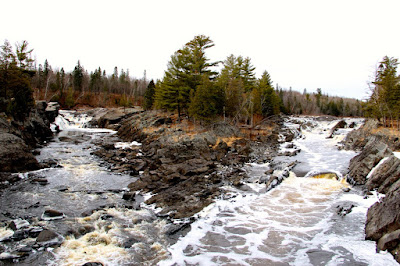
Jay Cooke State Park, downstream from proposed tailings dam
Photo by J. Harrington

If we were major investors in the PolyMet NorthMet project (which we're not), at this point in the permitting process we would be insisting that PolyMet management volunteer to be a test case for implementing IRMA or something like it but more acceptable. If we were Governor Dayton, or his Department of Natural Resources Commissioner, we would look into the feasibility of including participation in IRMA, or an alternative, as a condition of any permit to mine. If Minnesota has world class environmental requirements for mining, there'll be little, if any, additional effort on PolyMet's part to meet a standard for responsible and sustainable mining. If Minnesota's current requirements don't cover everything in such a standard (which we believe may be the case), then Minnesota will gain additional protections if the permit is ever finalized.

Among alternative systems available, for example, is Canada's Toward Sustainable Mining [TSM]. The Mount Polley tailings dam failure has triggered efforts to improve the tailings management practices in the TSM requirements. A critical point, however, is that any standard include independent certification systems, with compliance verified by a third party, to offer a substantially higher degree of assurance that required environmental protection requirements will be met than the current system Minnesota has, where some permits for taconite facilities haven't been updated for decades.

It may be that miners and environmentalists in Minnesota would prefer to continue to battle, project by project, for decades, even forever. Perhaps some participants would rather fight than win. Alternatively, it might offer an opportunity to get better environmental results, on a shorter time line, if Minnesota and the copper-nickel mining sector decided to try a better system with more transparency than we have at the moment. How energy efficient is Minnesota's mining sector? What other critical issues may not be included in our current permit requirements?


Salvage


Amy Clampitt

     
Daily the cortege of crumpled 
defunct cars 
goes by by the lasagna-
layered flatbed 
truckload: hardtop 

reverting to tar smudge,
wax shine antiqued to crusted 
winepress smear, 
windshield battered to
intact ice-tint, a rarity

fresh from the Pleistocene. 
I like it; privately 
I find esthetic 
satisfaction in these 
ceremonial removals

from the category of
received ideas
to regions where pigeons’ 
svelte smoke-velvet
limousines, taxiing 

in whirligigs, reclaim 
a parking lot,
and the bag-laden
hermit woman, disencumbered 
of a greater incubus,

the crush of unexamined
attitudes, stoutly
follows her routine,
mining the mountainsides
of our daily refuse

for artifacts: subversive
re-establishing
with each arcane
trash-basket dig
the pleasures of the ruined.


********************************************
Thanks for visiting. Come again when you can.
Please be kind to each other while you can.

Friday, January 8, 2016

On the other hand -- UN SDGs and mining

I think it was Harry Truman who used to say he was looking for one-armed economists, so they couldn't say "one the one hand, ... on the other hand." I have a similar reaction to the prospect of copper mining in Minnesota. One the one hand, I absolutely don't want to see it happen. One the other hand, I fear our government's ability to show enough common sense to say "No, it's not worth it." I used to know a joke about the fellow in a small town who lost money every week in a Friday night poker game. When asked why he continued to play in an obviously crooked game, he replied "but it's the only game in town."

iron mining tailings mound, northern Minnesota
Photo by J. Harrington

If Minnesota does allow copper mining, I'd like to see us attain maximum local benefits with minimal negative impacts. Are you old enough to remember Bing Crosby's version of "Ac-Cent-Tchu-Ate the Positive?" Well, the Columbia Center on Sustainable Investment, the Sustainable Development Solutions Network, UNDP and the World Economic Forum have released an Executive Summary draft of Mapping Mining to the Sustainable Development Goals: A Preliminary Atlas. It lists as the first key finding:
Mining impacts all 17 SDGs, to varying degrees, across a wide range of issue areas that present both challenges and opportunities. Challenges require mitigating the negative impacts of mining; opportunities require enhancing the positive impacts of mining. The specific opportunities and implications of the SDGs, targets, and actions will differ depending on company strategy, commodity, location, mine cycle stage, and legacy.
If Minnesota is unwise enough to permit copper mining, allowing it only within the context of increasing the state's sustainable development makes the most sense to me. Reading through the draft, I think there are a number of missed opportunities created by the way we've gone about regulating mining in the past, up to today. The world in which Minnesota and mining exist is far, far different that the world in which mining started here and Minnesota became a state. We're past time for a major adjustment and that, I believe, involves more than adequate financial assurance. Here's a quick for instance: how much cooperation and collaboration occurs between local and state government, mining operations and utilities to maximize minings role in infrastructure development, things like renewable energy and broadband? I suspect not enough but I don't know. To quote, again, from the draft report:

"...there is a strong and proven business case for companies to contribute to the realization of each SDG.

"This is especially true for the mining and metals sector."

Maybe we won't be able to cooperate until the anticipated round of court battles is over. I know I'd rather see those resources go into creating a better way to manage mining and still protect the environment. Cutting regulations and subsidizing the industry isn't the way to get where we want and need to be. Don't be surprised to find more to read about that in future postings.

Meanwhile, I hope the Vikings game turns out to be worth watching and that the development of frost bite over the next week or so becomes an indication of the common sense Minnesotans frequently display.

Developers

By Alice Lyons  
Read the Q & A 
Greed got in the way. We built a fake estate.
Levinas said to see ourselves we need each other yet

doorbells, rows of them, glow in the night village
a string of lit invitations no elbow has leaned into

(both arms embracing messages). Unanswered
the doors are rotting from the bottom up.

It’s another perplexing pothole in our road, loves.
Hard core from the quarry might make it level,

hard core and cunning speculation into matters
concerning love and doubt, concerning want and plenty.

O the places where pavement runs out and ragwort
springs up, where Lindenwood ends but doesn’t abut

anywhere neatly, a petered-out plot of Tayto
tumbleweeds, bin bags, rebar, roof slates, offcuts,

guttering, drain grilles, doodads, infill, gravel!
A not-as-yet nice establishment, possessing potential

where we have no authorized voice but are oddly fitted
out for the pain it takes to build bit by bit.

When the last contractions brought us to the brink
of our new predicament, we became developers.

********************************************
Thanks for visiting. Come again when you can.
Please be kind to each other while you can.

Monday, September 10, 2018

Two more ways to protect the BWCA and Lake Superior

Within the past week, this story was in the local news:

Feds reopen forests near Boundary Waters to mining

Thanks more our general level of skepticism about Minnesotans' reliance on our current mine permitting-environmental protection systems, rather than any particular prescience, we posted, during July of this year, the following:

Might International Mining Sustainability Standards help protect our Boundary Waters?

Much of the rest of the world is moving toward sustainable production and procurement of commodity raw materials and products created therefrom. Minnesota had representatives from three of its entities at a recent sustainable procurement conference. Perhaps someone from the economic development and materials production side of the state should also be involved.

We've been tracking the potential for sustainable or responsible mining for several years now, in part because of our prior experience as a member of the board of directors when Minnesota was an independent chapter of the United States Green Building Council [USGBC], an international organization that brought us Leadership in Energy and Environmental Design [LEED] standards.
As a point of reference, below is the wording used in the most of current draft version of LEED v4:
Mined or quarried materials. For raw materials that are mined or quarried using practices covered in the Framework for Responsible Mining or USGBC-approved equivalent, obtain signed letters from the owners of the manufacturing companies and their raw materials suppliers, stating that they have reviewed and understood the Framework for Responsible Mining and publicly declared their commitment to responsible mining. Each raw material supplier must provide an independently audited checklist listing all of the Framework for Responsible Mining’s Leading Edge Issues, and identifying which Leading Edge measures they are currently taking.
As we read it, the Framework for Responsible Mining was/is a predecessor to the standards being developed by the Initiative for Responsible Mining Assurance [IRMA], about which we've posted here a number of times.

should areas like this be protected from mining?
Photo by J. Harrington

There may be a very good reason, that we can't think of at the moment, that would preclude one or more of Minnesota's mine permitting agencies, that hasn't already issued which permit(s) it's responsible for, from including a requirement that the permit holder obtain and maintain an IRMA certification for the site(s) covered by the permit. This seems particularly relevant to the PolyMet project. If the certification lapsed or was withdrawn, the permit would immediately become invalid and operations would need to cease, and whatever financial assurance funds were available could then begin to be used to minimize problems associated with the cessation.

Minnesota seems to be lagging further and further behind the best practices in world-wide mining development and management. Relying on political solutions or strictly technical or financial options is not likely to provide adequate protection for our resources, including our taxpayers. We need a more holistic effort. Becoming a participant, and then a leader, in helping make mining sustainable, including confirming the extent to which the BWCA and Voyagers National Park could and should qualify as "no-go zones" for mining seems overdue. If participation in the development of IRMA standards is good enough for the United Steel Workers, perhaps such standards might even benefit the  economy of the Iron Range.

Descartes' Loneliness


Toward evening, the natural light becomes
intelligent and answers, without demur:
“Be assured! You are not alone. . . .”
But in fact, toward evening, I am not
convinced there is any other except myself
to whom existence necessarily pertains.
I also interrogate myself to discover
whether I myself possess any power
by which I can bring it about that I
who now am shall exist another moment.

Because I am mostly a thinking thing
and because this precise question can only
be from that thoughtful part of myself,
if such a power did reside within me
I should, I am sure, be conscious of it. . . .
But I am conscious of no such power.
And yet, if I myself cannot be
the cause of that assurance, surely
it is necessary to conclude that
I am not alone in the world. There is

some other who is the cause of that idea.
But if, at last, no such other can be
found toward evening, do I really have
sufficient assurance of the existence
of any other being at all? For,
after a most careful search, I have been
unable to discover the ground of that
conviction—unless it be imagined a lonely
workman on a dizzy scaffold unfolds
a sign at evening and puts his mark to it.


********************************************
Thanks for visiting. Come again when you can.
Please be kind to each other while you can.

Friday, December 22, 2017

'Twas the Day After Solstice, a seasonal wish

We have an early Christmas present for some, perhaps all of you. It depends on how much of a William Gibson fan you are. We loved the Neuromancer and quite enjoyed some of his other works. Gibson offers an observation that we find to be quite cheering, if we look in the right places. He's reported to have noted that "The future is already here — it's just not very evenly distributed."

If we turn our minds and hearts from the idiocy currently being perpetrated in Washington, D.C., we can find good news scattered about. For example, we recently learned that Kinross Gold preserved fish and wildlife habitat with Trout Unlimited and RMEF. That's not the kind of behavior we would have expected historically from a mining company.

In a similar vein (sorry, we couldn't resist), the Northern Plains Resource Council has a several times amended Good Neighbor Agreement with the Stillwater Mining Company. The key provisions of which are that it:
  • Provides for citizen oversight of mining operations to ensure protection of the area’s quality of life and productive agricultural land;

  • Establishes clear and enforceable water quality standards that go above and beyond state requirements;

  • Provides local communities with access to critical information about mining operations and the opportunity to address potential problems before they occur;

  • Ensures public safety and security while protecting the interest of miners through traffic plans designed to reduce mining traffic on country roads;

  • Raises the bar for environmental excellence by setting goals and objectives for developing new technologies. This is accomplished through a cooperative framework of local citizens, third-party experts, and the mining company.

St. Louis River, downstream of proposed PolyMet project
Photo by J. Harrington

We find ourselves wonder if a similar agreement might be possible in Minnesota, and what it might take to bring one about for something like the proposed PolyMet project. Could an agreement be crafted that would adequately address the concerns of many of the stakeholders who currently, and with good reason, strongly oppose copper-nickel sulfide mining that puts precious Minnesota water resources at unacceptable risk?
Gibson's premise makes me wonder if the emergence of things like Good Neighbor Agreements, the growing interest in the possibility of "sustainable" mining and the increasing recognition that our earth's resources have limits, both in sources and sinks may not be signs of an unevenly distributed future we need to bring about more broadly. That's at least one of our Christmas wishes for this year.

near the entrance of the Boundary Waters
Photo by J. Harrington

Oh, and lest any of you think we may have eaten too many holiday sweets and become Pollyanna-is,   today we also signed up to help Save Bristol Bay from a resurgent Pebble Mine proposal. It seems to us that there needs to be a much better balance between the need for metal resources and the quality of the other natural resources that are put at risk. Search our prior postings on sustainable mining if this interests you. We need to make mining companies, and government regulators and our elected leaders, more sensitive to the idea that a social license to mine doesn't include a license to kill places or their inhabitants.

The Everglades


Green and blue and white, it is a flag
for Florida stitched by hungry ibises.

It is a paradise of flocks, a cornucopia
of wind and grass and dark, slow waters.

Turtles bask in the last tatters of afternoon,
frogs perfect their symphony at dusk—

in its solitude we remember ourselves,
dimly, as creatures of mud and starlight.

Clouds and savannahs and horizons,
its emptiness is an antidote, its ink

illuminates the manuscript of the heart.
It is not ours though it is ours

to destroy or preserve, this the kingdom
of otter, kingfisher, alligator, heron.

If the sacred is a river within us, let it flow
like this, serene and magnificent, forever.

********************************************
Thanks for visiting. Come again when you can.
Please be kind to each other while you can.

Monday, November 23, 2015

Should a PolyMet Health Impact Assessment include Sustainable Mining Standards?

In past postings, My Minnesota has:
  1. Advocated that any mining done in Minnesota needs to be done "sustainably."
  2. Argued that the PolyMet project, and those financing and supporting it, do not appear to be committed to doing more than the legally required minimum on environmental issues, if that. (See the Timberjay's opinion that the PolyMet EIS is more a political than a scientific document.)
  3. Noted that many of the leading companies in the mining industry were working toward the development of an IRMA "Standard for Responsible Mining."
  4. "Suggested" that Minnesota would be wise to help develop the IRMA Standard and to make compliance with the Standard's elements a minimum requirement in mining and water quality permits.
northern Minnesota's future: mountains or mine tailings?
Photo by J. Harrington

My Minnesota learned today that the first test of the (draft) Standard has been completed. "The primary purpose of this simulated audit was to reflect on the draft Standard and see if the requirements as written were clear, reasonable, auditable, and met their intent of protecting social and environmental values." One of the contributions Minnesota could make to the development of a final Standard is to go forward with the Health Impact Assessment on the PolyMet project and, as part of that effort, review any work completed on the Standard for Responsible Mining to see where and how much alignment there may be between Minnesota's Health Impact Assessment scoping and the content of the IRMA Standard.

The same email message that brought the information about the completion of an initial audit of the Standard, also contained this piece of news:

Tiffany & Co.’s Chairman makes case for mining and business responsibility

Mike Kowalski, founding member of the Steering Committee of IRMA and former CEO and current Chairman of the Board at Tiffany & Co., recently published an op-ed in the New York Times on the business case for an international, third-party certification process for industrial-scale mine sites. ["The conclusion we reached was inescapable: No amount of corporate profit or share price value could justify our participation, however indirectly, in the degradation of such indescribable beauty."]  He writes on the market demand for a program like IRMA that will offer assurance that mined materials are extracted and processed in a socially and environmentally responsible manner.
If Minnesota seriously wants to consider keeping industrial scale mining as part of its economic base, doesn't it need to insist such be done in accordance with "best practices?" We don't seem to be there yet but there doesn't seem to be anything but a lack of political will and a reluctance to miss delay some job opportunities keeping us from becoming a leader in making mining sustainable. Unless we panic and give away the ranch (mine?) so to speak, the minerals will still be there when the rest of the world, and commodity prices, support safe mining. Without the most stringent regulations, and their rigorous enforcement, we have too much at stake to make the risk worthwhile. I think every Minnesotan would give thanks if we collectively get this decision right.

To oversimplify things, we can decide there will be no more mining, unlikely but possible; or proceed with business as usual, which probably gives us more of the North Country Blues; or, we can realize that mining's value lies more in the process than in the product which leads us to The Thanksgivings.

********************************************
Thanks for visiting. Come again when you can.
Please be kind to each other while you can.

Friday, October 20, 2017

North to sustainability?

Long, long ago (2010), in a country far, far away, it came about that
"The U.S. Environmental Protection Agency (EPA) defines sustainability as the satisfaction of basic economic, social, and security needs now and in the future without undermining the natural resource base and environmental quality on which life depends. From a business perspective, the goal of sustainability is to increase long-term shareholder and social value, while decreasing industry’s use of materials and reducing negative impacts on the environment.4" 
"4 U.S. EPA, Sustainability, Basic Information, http://www.epa.gov/sustainability/ basicinfo.htm#sustainability (last visited Apr. 2, 2010)."
We learned this from a paper by Jane Kloeckner titled Developing a Sustainable Hardrock Mining and Mineral Processing Industry: Environmental and Natural Resource Law for Twenty-First Century People, Prosperity, and the Planet. If it's not clear yet, we're strongly in favor of people, prosperity and the planet, but without the latter, the first two don't do very well. In fact, although we reserve the right to revise our opinion at some future time, we prefer the cited EPA definition to that of the oft quoted Brundtland Commission [p. 41]:
"Sustainable development is development that meets the needs of the present without compromising the ability of future generations to meet their own needs. It contains within it two key concepts:
  • the concept of 'needs', in particular the essential needs of the world's poor, to which overriding priority should be given; and
  • the idea of limitations imposed by the state of technology and social organization on the environment's ability to meet present and future needs."
All of the preceding has been triggered by our continuing and growing interest in the possibility of helping Minnesota become a world leader in sustainable mining. [We'll pause here so you can either recover and catch your breath or finish laughing uproariously.] Canada, our friend and competitor to the North, has been working for some time on an approach called Toward Sustainable Mining. We like to believe that the "Toward" may be in recognition that an extractive industry may not ever get to be truly sustainable. Perhaps not, but we can certainly do better in Minnesota in increasing long-term shareholder and social value while we further reduce negative impacts on the environment. (See why we like the EPA definition?)

Duluth harbor, steel hulls and taconite pellets
Photo by J. Harrington

Even the steel industry itself is getting into the "sustainability business." Unfortunately, they seem to have missed the significance of the early parts of their supply chain, the entire mining sector. Fortunately, others are busy helping the industry focus on such concerns and offering strategic guidance. For example, from "Steel Available ... a data-driven supplier relationship management and sourcing platform that connects buyers and suppliers while ensuring compliance and visibility in the heavy industry." we learn:
"Often required by different sustainability advocates nowadays, companies need to adopt ‘ethical sourcing practice’. Therefore, they have to select suppliers with high economic, social, and environmental value and work with them. Recall a principle from operations management: a stable partnership with only a few suppliers is usually more favourable. Along the process of selection, suppliers with similar values and operation systems can be relied on and even grow together in the long term. This pushes for mutual reliance of supplier and buyer, achieving a better power balance in the buying process as well."
While the world is changing around us, some folks are pursuing what seems to be a least cost commodity tactic for Minnesota's mining industry, reducing or eliminating or not enforcing environmental requirements. It doesn't have to be like that. For example, did you know that "Today, DNR is the largest single FSC-certified land manager in the U.S." (Forest certification is a voluntary third-party process that identifies and recognizes well-managed forest land. It takes into consideration the ecological, economic, and social components of forests and surrounding communities.)

solar panels on a northern Minnesota farm
Photo by J. Harrington

We now live in a world where engagement rings need to hold blood-free diamonds in fair trade gold settings. Next thing we know, companies like Ford (you can buy any color you want as long as it's black) will have lots that look like rainbows and will be advertising fair trade steel in their EVs. Take a look at their sustainable materials strategy.

Wouldn't you think Minnesota would want a piece of that kind of action? To get it, we'll need healthy communities in a healthy environment with mines that meet stringent requirements, won't we? Or else Chinese steel from Canadian ore might be a more sustainable source, because Minnesota failed to value and use its assets to increase shareholder and social value. We have most of the necessary tools, but that's a posting for another day or two (or three).

Prayers of Steel


Carl Sandburg, 1878 - 1967


Lay me on an anvil, O God.  
Beat me and hammer me into a crowbar.  
Let me pry loose old walls.  
Let me lift and loosen old foundations.  
  
Lay me on an anvil, O God.
Beat me and hammer me into a steel spike.  
Drive me into the girders that hold a skyscraper together.  
Take red-hot rivets and fasten me into the central girders.  
Let me be the great nail holding a skyscraper through blue nights into white stars.

********************************************
Thanks for visiting. Come again when you can.
Please be kind to each other while you can.