Showing posts sorted by relevance for query corridor. Sort by date Show all posts

Saturday, March 8, 2014

Becoming native to this place
(with thanks to Wes Jackson)

Toward the end of February, My-Minnesota posted two photo essays on the American Indian Cultural Corridor in Minneapolis. The photos were taken last Summer and a good opportunity to post them didn't come up until recently. Accompanying the photo essays, was a written essay questioning Minnesota's need for a statement of cultural identity, using the Dakotas' statement (North and South) as an example. At the time those postings were published, My-Minnesota was unaware of the impending show at All My Relations Gallery. We were delighted by the serendipity when we learned that Maggie Thompson's solo exhibit, Where I Fit, which features her textile works, will be on display through the end of May. My wife is a textile artist, and I'm increasingly interested in the question of emerging cultural identity in a changing Midwest, so maybe we'll see you at Where I Fit.

"Later in March, there's a different kind of American Indian cultural event, The Native American Literature Symposium 2014. It will be held March 27-29 at the Mystic Lake Casino Hotel, Minneapolis, Minnesota. I'd really like to attend but will need to check my budget very carefully. At least if my biggest problems stem from having too many desirable options to choose from, I have to admit "things" must be going pretty well.

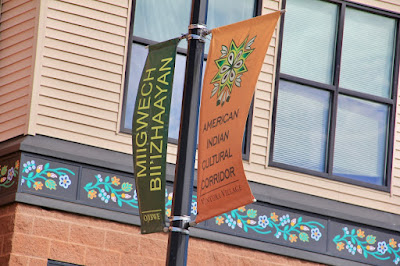
American Indian Cultural Corridor street furniture
American Indian Cultural Corridor street furniture  © harrington

I think I've mentioned previously that I'm originally from Boston, of Irish "extraction," and that one of my biggest heroes is Robert F. Kennedy. Recently, when I was doing some background research on RFK, I discovered a book by Arthur Schlesinger, Jr., with this description of the history of the Irish: "The nineteenth-century Irish saw themselves as the victims of history. Memories of dispossession and defeat filled their souls. They had lost their national independence, their personal dignity, their land, even their language, to intruders from across the sea." [Robert Kennedy and His Times, page 3]. I was struck by the similarities between the treatment of the Irish in their own country, and the treatment of Native Americans in what would become the United States. My-Minnesota hopes those who have been disposessed successfully regain a sense of identity and culture. Perhaps the American Indian Cultural Corridor, and exhibits such as Where I Fit, will offer a better kind of home than that described by Louise Erdrich. I hope so.

American Indian Cultural Corridor street furniture
 American Indian Cultural Corridor street furniture © harrington

Indian Boarding School: The Runaways

By Louise Erdrich 
Home’s the place we head for in our sleep.   
Boxcars stumbling north in dreams
don’t wait for us. We catch them on the run.   
The rails, old lacerations that we love,   
shoot parallel across the face and break   
just under Turtle Mountains. Riding scars
you can’t get lost. Home is the place they cross.

The lame guard strikes a match and makes the dark   
less tolerant. We watch through cracks in boards   
as the land starts rolling, rolling till it hurts   
to be here, cold in regulation clothes.
We know the sheriff’s waiting at midrun
to take us back. His car is dumb and warm.
The highway doesn’t rock, it only hums
like a wing of long insults. The worn-down welts   
of ancient punishments lead back and forth.

All runaways wear dresses, long green ones,
the color you would think shame was. We scrub   
the sidewalks down because it's shameful work.   
Our brushes cut the stone in watered arcs   
and in the soak frail outlines shiver clear
a moment, things us kids pressed on the dark   
face before it hardened, pale, remembering
delicate old injuries, the spines of names and leaves.

********************************************
Thanks for visiting. Come again when you can.
Please be kind to each other while you can.

Wednesday, February 26, 2014

Minneapolis' American Indian Cultural Corridor I

Today, instead of writing about the Winter that's here or the Spring that's coming, let's do something very different. Last Summer I went into Minneapolis to take a number of photos of the American Indian Cultural Corridor on Franklin Avenue. Reading the stories today about Minnesota's current sulfate standard being "about right" and MPCA's forthcoming efforts to specify which waters are wild rice habitat, made me think that now might be a good time to share many of the pictures I took as part one of a photo essay. The next time I do anything like this, I'll be sure to include people in my pictures of places.

American Indian Cultural Corridor signage
American Indian Cultural Corridor signage  © harrington

All My Relations Gallery
All My Relations Gallery       © harrington

All My Relations Gallery signage
All My Relations Gallery signage   © harrington

on display at All My Relations Gallery
on display at All My Relations Gallery   © harrington

bicycle racks (hitching posts?)
bicycle racks (hitching posts?)       © harrington

Many Rivers East, affordable housing
Many Rivers East, affordable housing   © harrington

Many Rivers East, entrance
Many Rivers East, entrance      © harrington

street "furniture"
street "furniture"            © harrington
There's more to come later this week or sometime next. If your haven't been to this part of Minneapolis for awhile, you might find it worthwhile and interesting to check out after the snow melts. Meanwhile, I wonder how universal the role of a kitchen table is. Joy Harjo's description captures much of the kitchen tables of my childhood.

Perhaps the World Ends Here

By Joy Harjo 

The world begins at a kitchen table. No matter what, we must eat to live.

The gifts of earth are brought and prepared, set on the table. So it has been since creation, and it will go on.

We chase chickens or dogs away from it. Babies teethe at the corners. They scrape their knees under it.

It is here that children are given instructions on what it means to be human. We make men at it, we make women.

At this table we gossip, recall enemies and the ghosts of lovers.

Our dreams drink coffee with us as they put their arms around our children. They laugh with us at our poor falling-down selves and as we put ourselves back together once again at the table.

This table has been a house in the rain, an umbrella in the sun.

Wars have begun and ended at this table. It is a place to hide in the shadow of terror. A place to celebrate the terrible victory.

We have given birth on this table, and have prepared our parents for burial here.

At this table we sing with joy, with sorrow. We pray of suffering and remorse. We give thanks.

Perhaps the world will end at the kitchen table, while we are laughing and crying, eating of the last sweet bite.

********************************************
Thanks for visiting. Come again when you can.
Please be kind to each other while you can.

Monday, October 14, 2019

Ways to honor #IndigenousPeoplesDay 2019

Let me begin by thanking Orion magazine for the inspiration on how I might honor this day. On this day their web site features only stories that celebrate indigenous artists and writers. We did something similar celebrating Native American and indigenous resources we're familiar with. To begin, if you're in or near The Cities, check out


a gallery of American Indian art
Photo by J. Harrington

Apprenticed to Justice


The weight of ashes
from burned-out camps.
Lodges smoulder in fire,
animal hides wither
their mythic images shrinking
pulling in on themselves,
all incinerated
fragments
of breath bone and basket
rest heavy
sink deep
like wintering frogs.
And no dustbowl wind
can lift
this history
of loss.

Now fertilized by generations—
ashes upon ashes,
this old earth erupts.
Medicine voices rise like mists
white buffalo memories
teeth marks on birch bark
forgotten forms
tremble into wholeness.

And the grey weathered stumps,
trees and treaties
cut down
trampled for wealth.
Flat Potlatch plateaus
of ghost forests
raked by bears
soften rot inward
until tiny arrows of green
sprout
rise erect
rootfed
from each crumbling center.

Some will never laugh
as easily.
Will hide knives
silver as fish in their boots,
hoard names
as if they could be stolen
as easily as land,
will paper their walls
with maps and broken promises,
scar their flesh
with this badge
heavy as ashes.

And this is a poem
for those
apprenticed
from birth.
In the womb
of your mother nation
heartbeats
sound like drums
drums like thunder
thunder like twelve thousand
walking
then ten thousand
then eight
walking away
from stolen homes
from burned out camps
from relatives fallen
as they walked
then crawled
then fell.

This is the woodpecker sound
of an old retreat.
It becomes an echo.
an accounting
to be reconciled.
This is the sound
of trees falling in the woods
when they are heard,
of red nations falling
when they are remembered.
This is the sound
we hear
when fist meets flesh
when bullets pop against chests
when memories rattle hollow in stomachs.

And we turn this sound
over and over again
until it becomes
fertile ground
from which we will build
new nations
upon the ashes of our ancestors.
Until it becomes
the rattle of a new revolution
these fingers
drumming on keys.


********************************************
Thanks for visiting. Come again when you can.
Please be kind to each other while you can.

Friday, November 24, 2023

REMEMBER

Today is Native American Heritage Day. November is Native American Heritage Month. In Minnesota, Native American Heritage is acknowledged in and through:

American Indian Cultural Corridor Minneapolis
Photo by J. Harrington

The linked resources above include additional resources that can help US learn about and honor our diversity while acknowledging the high and low points of our histories and conflicts.


Remember


Remember the sky that you were born under,
know each of the star’s stories.
Remember the moon, know who she is.
Remember the sun’s birth at dawn, that is the
strongest point of time. Remember sundown
and the giving away to night.
Remember your birth, how your mother struggled
to give you form and breath. You are evidence of
her life, and her mother’s, and hers.
Remember your father. He is your life, also.
Remember the earth whose skin you are:
red earth, black earth, yellow earth, white earth
brown earth, we are earth.
Remember the plants, trees, animal life who all have their
tribes, their families, their histories, too. Talk to them,
listen to them. They are alive poems.
Remember the wind. Remember her voice. She knows the
origin of this universe.
Remember you are all people and all people
are you.
Remember you are this universe and this
universe is you.
Remember all is in motion, is growing, is you.
Remember language comes from this.
Remember the dance language is, that life is.
Remember.


********************************************
Thanks for visiting. Come again when you can.
Please be kind to each other while you can.

Sunday, November 1, 2020

Come November has arrived

Welcome to November. We're getting closer to having survived 2020. Two months to go, t-shirts and trinkets are already available. But enough of this silliness.

November is National American Indian Heritage Month. Other informative web sites include:


American Indian Cultural Corridor, Minneapolis
Photo by J. Harrington

Locally, we would suggest a visit to Birchbark Books, but they're online and phone orders only due to COVID-19. You might take a look at Minneapolis' American Indian Cultural Corridor on Franklin Avenue. The Minnesota Humanities Center hosts the bdote memory map while the Historical Society has information on both the Dakota and the Ojibwe peoples. There's also an Ojibwe People's Dictionary. 

This year Joy Harjo, our current Poet Laureate, has finished editing and Norton has published "When the Light of the World Was Subdued, Our Songs Came Through -- an anthology of poetry from more than 160 poets, representing close to 100 indigenous nations." We're almost halfway through our copy and have enjoyed every page so far. 


When the Light of the World Was Subdued, Our Songs Came Through: A Norton Anthology of Native Nations Poetry

On our own home front, we did remember to put out two saucers of milk last night for any Cat Sith that came by. One saucer was empty this morning. The other only half gone. We hope that means no Cat Sith curse on our home and family this year. Last night was also the continuance of no trick or treaters in the quarter century or so that we've lived here. Looks like once again someone will have to volunteer to do something about the undistributed candy.

Remember


 - 1951-


Remember the sky that you were born under,
know each of the star's stories.
Remember the moon, know who she is.
Remember the sun's birth at dawn, that is the
strongest point of time. Remember sundown
and the giving away to night.
Remember your birth, how your mother struggled
to give you form and breath. You are evidence of
her life, and her mother's, and hers.
Remember your father. He is your life, also.
Remember the earth whose skin you are:
red earth, black earth, yellow earth, white earth
brown earth, we are earth.
Remember the plants, trees, animal life who all have their
tribes, their families, their histories, too. Talk to them,
listen to them. They are alive poems.
Remember the wind. Remember her voice. She knows the
origin of this universe.
Remember you are all people and all people
are you.
Remember you are this universe and this
universe is you.
Remember all is in motion, is growing, is you.
Remember language comes from this.
Remember the dance language is, that life is.
Remember.


********************************************
Thanks for visiting. Come again when you can.
Please be kind to each other while you can.

Sunday, October 11, 2020

How are you going to honor Indigenous People tomorrow?

Tomorrow is Indigenous People's Day. Here are a few suggestions on how you might want to honor it and them.


Native American Cultural Corridor, Minneapolis
Photo by J. Harrington


It's highly likely we may have more to suggest on this topic between now and late next month, when it's time to celebrate Thanksgiving.


The Theft Outright


     after Frost


We were the land's before we were.

Or the land was ours before you were a land.
Or this land was our land, it was not your land.

We were the land before we were people,
loamy roamers rising, so the stories go,
or formed of clay, spit into with breath reeking soul—

What's America, but the legend of Rock 'n' Roll?

Red rocks, blood clots bearing boys, blood sands
swimming being from women's hands, we originate,
originally, spontaneous as hemorrhage.

Un-possessing of what we still are possessed by,
possessed by what we now no more possess.

We were the land before we were people,
dreamy sunbeams where sun don't shine, so the stories go,
or pulled up a hole, clawing past ants and roots—

Dineh in documentaries scoff DNA evidence off.
They landed late, but canyons spoke them home.
Nomadic Turkish horse tribes they don't know.

What's America, but the legend of Stop 'n' Go?

Could be cousins, left on the land bridge,
contrary to popular belief, that was a two-way toll.
In any case we'd claim them, give them some place to stay.

Such as we were we gave most things outright
(the deed of the theft was many deeds and leases and claim stakes
and tenure disputes and moved plat markers stolen still today . . .)

We were the land before we were a people,
earthdivers, her darling mudpuppies, so the stories go,
or emerging, fully forming from flesh of earth—

The land, not the least vaguely, realizing in all four directions,
still storied, art-filled, fully enhanced.
Such as she is, such as she wills us to become.


********************************************
Thanks for visiting. Come again when you can.
Please be kind to each other while you can.

Thursday, February 27, 2014

Minneapolis American Indian Cultural Corridor II

Before we get to the second part of the American Indian Cultural Corridor photo essay, let me share a couple of "factoids" that surprised me. The 2012 Native American population for all of Minnesota, according to Census Bureau estimates, is [was] 1.1% of a total state population of 5,379,646, or about 59,176 Native Americans. The Native American percentage in Minneapolis, at 2% is greater than that for Minnesota, but since the city's population is much lower (392,880) the actual Native American population in Minneapolis is about 7,858, but that's more than 13% of Minnesota's total Native American population. To put this in a different perspective, the Native American population in Minneapolis is greater than the total 2012 population of each of twelve of Minnesota's 87 counties, I think that's more than enough to help support activities on an urban commercial corridor.

part of "Ancient Traders Market" [ATM]   © harrington

Northland Visions at Ancient Traders Market
Northland Visions at ATM       © harrington

place making at Ancient Traders Market
place making at ATM      © harrington

raven(?) and turtle and (?) at ATM
raven(?) and turtle and (?) at ATM   © harrington

ATM's Maria's Cafe black bear window bars
ATM's Maria's Cafe black bear window bars  © harrington

OJIBWA license plate on Volvo
in the ATM parking lot        © harrington

stylized deer bike rack
stylized deer bike rack         © harrington

Heid Erdrich writes of something I think we all hope to see soon for this season, but not forever.

Last Snow

By Heid E. Erdrich 

Dumped wet and momentary on a dull ground
that’s been clear but clearly sleeping, for days.
Last snow melts as it falls, piles up slush, runs in first light
making a music in the streets we wish we could keep.
Last snow. That’s what we’ll think for weeks to come.
Close sun sets up a glare that smarts like a good cry.
We could head north and north and never let this season go.
Stubborn beast, the body reads the past in the change of light,
knows the blow of grief in the time of trees’ tight-fisted leaves.
Stubborn calendar of bone. Last snow. Now it must always be so.

********************************************
Thanks for visiting. Come again when you can.
Please be kind to each other while you can.

Monday, November 9, 2020

Which Native American should be Biden's Interior Secretary?

We wish we could claim this idea originated with us, but, alas... we saw it first on Twitter.

"I want a Native American to be named Secretary of the Interior." 

It seems like a wonderful idea that's long overdue. If ever there was a time when we needed Traditional Ecological Knowledge applied to our public lands, it's now. We need to address climate breakdown and adaptation to its impacts, restoration of indigenous food systems and languages, actually honoring treaties rather than providing lip service. I can think of several Native Americans who deserve consideration as Interior Secretary. Not doubt there are others. Should we submit names to the Biden Transition Team? Is this an appropriate way to honor Native American Heritage Month this year? Do you have any thoughts to share (in the comments)?

wolf sculpture, American Indian Corridor, Minneapolis
Photo by J. Harrington

This country has the precedent of having had a Native American, Charles Curtis, as a Republican Vice President. There's lots of reasons why having a Native American Interior Secretary makes sense these days. Some background can be found here. The names suggested don't include Honor the Earth's co-founder, Winona LaDuke, who has been a nominee for Vice President of the United States as the candidate of the Green Party. It's unclear how the progressive wing of the Democrats might respond to being "out-Greened."

There's an interesting article in The American Prospect: Corporate Democrats Are Rural America’s Biggest Losers. Mainstream Democrats are becoming more and more identified with supporting corporate interests over those of the working and middle class. Wouldn't it be wonderful if one of tRUMP's legacies turns out to be the return of Democrats to farmers, laborers, and Native American patriots as well as neoliberal, global, corporatists. Something, something, something BIG TENT!


The Theft Outright


      after Frost

We were the land's before we were.

Or the land was ours before you were a land.
Or this land was our land, it was not your land.

We were the land before we were people,
loamy roamers rising, so the stories go,
or formed of clay, spit into with breath reeking soul—

What's America, but the legend of Rock 'n' Roll?

Red rocks, blood clots bearing boys, blood sands
swimming being from women's hands, we originate,
originally, spontaneous as hemorrhage.

Un-possessing of what we still are possessed by,
possessed by what we now no more possess.

We were the land before we were people,
dreamy sunbeams where sun don't shine, so the stories go,
or pulled up a hole, clawing past ants and roots—

Dineh in documentaries scoff DNA evidence off.
They landed late, but canyons spoke them home.
Nomadic Turkish horse tribes they don't know.

What's America, but the legend of Stop 'n' Go?

Could be cousins, left on the land bridge,
contrary to popular belief, that was a two-way toll.
In any case we'd claim them, give them some place to stay.

Such as we were we gave most things outright
(the deed of the theft was many deeds and leases and claim stakes
and tenure disputes and moved plat markers stolen still today . . .)

We were the land before we were a people,
earthdivers, her darling mudpuppies, so the stories go,
or emerging, fully forming from flesh of earth—

The land, not the least vaguely, realizing in all four directions,
still storied, art-filled, fully enhanced.
Such as she is, such as she wills us to become.


********************************************
Thanks for visiting. Come again when you can.
Please be kind to each other while you can.

Monday, October 12, 2015

Becoming native to our place

Today is the day we used to celebrate only as Columbus Day. Now, in many places, we celebrate today as Indigenous People's Day and, in some places, both are celebrated. Here are some links to resources to help celebrate and become educated about the day.

wolf sculpture outside Ancient Traders Market
Photo by J. Harrington

My personal celebration of this day will take me to Birchbark Books one day this week. There I will purchase a copy of Joy Harjo's Conflict Resolution for Holy Beings: Poems. I've been reading her works for years and was delighted when I learned that she recently won the Academy of American Poets Wallace Stevens Award. Anyone who looks around these days knows the world needs to get lots better at conflict resolution. Maybe as one way to become holy?

********************************************
Thanks for visiting. Come again when you can.
Please be kind to each other while you can.

Friday, November 25, 2022

Pieces of women’s history for today

 In addition to being the day after Thanksgiving (Bye, Nothing Day), today is also Women’s Merry Making Day and Native American Heritage Day. I can think of no better way to honor all of those themes than to share Joy Harjo’s signature project as poet laureate, Living Nations, Living Words. 

I hope you follow the link and enjoy her work as much  as I do. As she wrote:

We understand poetry to be a living language—whether it is in our tribal languages, or in English, or another language. We use poetry to mark transformations, as in love letters, elegies, or epithalamium. Poetry can be useful for praise and even to help deter a storm. Or poetry is a tool to uncover the miraculous in the ordinary.

American Indian Cultural Corridor
Photo by J. Harrington


From the “Living”  collection, Louise Erdrich’s poem fits the day and the times really well

Advice to Myself

by Louise Erdrich


Leave the dishes.
Let the celery rot in the bottom drawer of the refrigerator
and an earthen scum harden on the kitchen floor.
Leave the black crumbs in the bottom of the toaster.
Throw the cracked bowl out and don’t patch the cup.
Don’t patch anything. Don’t mend. Buy safety pins.
Don’t even sew on a button.
Let the wind have its way, then the earth
that invades as dust and then the dead
foaming up in gray rolls underneath the couch.
Talk to them. Tell them they are welcome.
Don’t keep all the pieces of the puzzles
or the doll’s tiny shoes in pairs, don’t worry
who uses whose toothbrush or if anything
matches, at all.
Except one word to another. Or a thought.
Pursue the authentic-decide first
what is authentic,
then go after it with all your heart.
Your heart, that place
you don’t even think of cleaning out.
That closet stuffed with savage mementos.
Don’t sort the paper clips from screws from saved baby teeth
or worry if we’re all eating cereal for dinner
again. Don’t answer the telephone, ever,
or weep over anything at all that breaks.
Pink molds will grow within those sealed cartons
in the refrigerator. Accept new forms of life
and talk to the dead
who drift in through the screened windows, who collect
patiently on the tops of food jars and books.
Recycle the mail, don’t read it, don’t read anything
except what destroys
the insulation between yourself and your experience
or what pulls down or what strikes at or what shatters
this ruse you call necessity.


********************************************
Thanks for visiting. Come again when you can.
Please be kind to each other while you can.

Friday, November 26, 2021

In honor of Native American Heritage Day

After too many broken treaties, it took yet another Act of Congress, in the 21st century, to begin to really recognize treaties. Then came oil and gas pipelines. When will we ever learn?


American Indian Cultural Corridor, Minneapolis
Photo by J. Harrington

Native American Heritage Day: 2009 Congressional Act
SEC. 3. HONORING NATIVE AMERICAN HERITAGE IN THE UNITED STATES.

    Congress encourages the people of the United States, as well as 
Federal, State, and local governments, and interested groups and 
organizations to honor Native Americans, with activities relating to--
            (1) appropriate programs, ceremonies, and activities to 
        observe Native American Heritage Day;
            (2) the historical status of Native American tribal 
        governments as well as the present day status of Native 
        Americans;
            (3) the cultures, traditions, and languages of Native 
        Americans; and
            (4) the rich Native American cultural legacy that all 
        Americans enjoy today.

    Approved June 26, 2009.


from the Editors at the Poetry Foundation

Native American Poetry and Culture

A selection of poets, poems, and articles exploring the Native American experience.


discover who's territory you're living on:

Native Land map


A Quest for Universal Suffrage

I.

Suffrage:

In late middle English

intercessory prayers,

a series of petitions.

Not the right—but the hope.


Universal:

applicable to all cases—

except those marginalized

and unnamed.

A belief, but not a fact.


II.

In the trombone slide of history

I hear the suffer in suffragette

the uni uni uni in universal—

each excluded ikwe: women

from five hundred tribal nations

mindimooyenh or matriarchs

of ancient flourishing cultures

still disenfranchised by race,

still holding our world together

in the dusky and lawless violence

manifest in colonial america.


Twenty-six million american women

at last granted the right to vote.

Oh, marginal notes in the sweet anthem

of equality, Indigenous non-citizens

turn to the older congress of the sun

seek in the assembled stories of sky

a steady enlightenment—natural laws

(the mathematics of bending trees,

sistering of nutrients—maizebeanssquash,

or wintering wisdom of animal relatives)

each seasonal chorus colored with resilience—

earth voices rising in sacred dream songs.


Even now listen, put on the moon-scored

shell of turtle, wear this ancient armour

of belonging. In the spiral of survivance

again harvest the amber sap of trees

follow the scattered path of manoomin

the wild and good seed that grows on water.

Oh water, oh rice, oh women of birch dreams

and baskets, gather. Here reap and reseed

raise brown hands trembling holy with endurance.

Now bead land knowledge into muklaks

sign with the treaty X of exclusion.

Kiss with fingers and lips the inherited

woodland flutes and breathy cedar songs. 

Say yea, eya, and yes. Here and here cast

your tended nets—oh suffered and sweetly mended

nets of abundance. This year and each to follow

choose, not by paper but by pathway, a legacy:

woman’s work—our ageless ballad of continuance.


********************************************
Thanks for visiting. Come again when you can.
Please be kind to each other while you can.

Friday, November 8, 2019

Approaching Thanks giving

Thanksgiving is late this year, so, of course, retailers are holding Christmas sales early. Instead of ranting about that, today we would rather focus on a bunch of things for which we should, and too often don't, give thanks. In fact, we may even try to honor the spirit of the emergent season and refrain from, or at least limit, our frequent focus on what's wrong with the world. We have much more to be thankful for than is listed below. These are but the first steps in a journey to the Thanksgiving holiday later this month.


wolf statue, American Indian Cultural Corridor, Minneapolis
Photo by J. Harrington

  • We're grateful that we have the family and friends, two and four-legged, we've be able to share our life with.

  • We're thankful we live in a country that hasn't (yet) repealed the Endangered Species Act.

  • Despite the increasing incivility of our politics, we're thankful we don't (yet) live in an actual war zone.

  • We're thankful there's still some time to craft and implement adequate and effective responses to greenhouse gas emissions so we can limit the disruptions we caused by breaking the climate.

  • We're thankful and hopeful there may be enough intelligent, sane, beneficent people to actually craft and implement all the actions necessary to limit and Drawdown greenhouse gas emissions and adapt to the effects we can't avoid.

  • We're thankful there are Native Americans willing and able to show and teach us how to live sustainably on earth, our home planet.

  • We're thankful the Native Americans who encountered the Pilgrims at Plymouth Rock didn't treat those English immigrants the way the current regime and many of our fellow Americans(?) treat those trying to come here to live a better life. The original Americans didn't arrive on the Mayflower, they were here already to greet a ship full of emigrants from England.

  • We're thankful that Birchbark Books and other independent book stores are within easy driving distance.

  • We're thankful that National Geographic, Catherine O’Neill Grace, Sisse Brimberg, and Plimoth Plantation have put together a more balanced story of "1621, the first Thanksgiving."

  • November is Native American Heritage Month. We're thankful for that and that this year the United States Poet Laureate is Joy Harjo, a member of the Mvskoke/Creek Nation and that she writes poems like the one below.

Art from Indian Territory (Oklahoma) poster
Photo by J. Harrington


This Morning I Pray for My Enemies


 - 1951-


And whom do I call my enemy?
An enemy must be worthy of engagement.
I turn in the direction of the sun and keep walking.
It’s the heart that asks the question, not my furious mind.
The heart is the smaller cousin of the sun.
It sees and knows everything.
It hears the gnashing even as it hears the blessing.
The door to the mind should only open from the heart.
An enemy who gets in, risks the danger of becoming a friend.


********************************************
Thanks for visiting. Come again when you can.
Please be kind to each other while you can.

Monday, October 8, 2018

#IndigenousPeoplesDay2018

It is the start of the second week of October. According to A Sand County Almanac, it is the month of ruffed grouse, woodcock, smoky gold tamaracks, hunting, geese, early mornings, "red lanterns," partridge (grouse) dogs and saplings scraped by whitetail bucks troubled by itchy, velvet-covered antlers. If you've never read A Sand County, try it and start with October. You'll soon know lots more about why we love this month so much.

"smoky gold tamaracks"
Photo by J. Harrington


Yet another reason we enjoy this month is that October 8 is Indigenous Peoples' Day on our calendar. Earlier today we came across a Letter from Indigenous Activists in the Sierra Club magazine on line. We included a link because we believe it would be worth your time and effort to read it. We'll be here when you get back. (You do know how to use your browser's "Back" button, right?)

Native American Community Clinic in the American Indian Cultural Corridor
Photo by J. Harrington

[UPDATE: Listen To A 'Native American Poets Playlist' For Indigenous People's Day, At Harvard's Peabody Museum. We're part way through reading the Heid Erdrich anthology, published by Milkweed Books, on which the Playlist is based.]

Today is also the day that much of main stream media and social media ae discussing and commenting on a new report from the Intergovernmental Panel on Climate Change, Global Warming of 1.5 °C an IPCC special report on the impacts of global warming of 1.5 °C above pre-industrial levels and related global greenhouse gas emission pathways, in the context of strengthening the global response to the threat of climate change, sustainable development, and efforts to eradicate poverty. If we believed in coincidence, we'd think that the release of the report's Summary for Policy Makers on or about Indigenous Peoples' Day was a coincidence. More and more people are raising serious concerns about the (in)compatibility of capitalism, its dependance on perpetual growth, and a sustainable future. The limitations and errors of colonialism are being flagged more and more in works such as An Indigenous People’s History of the United States.

We're both surprised and disappointed that there seem to be few, if any, mentions of Drawdown, the most comprehensive plan ever proposed to reverse global warming, in coverage of the IPCC report. It seems to us that one of the first steps in taking a whole systems approach to complex problems is to complete due diligence. The second is to connect the dots. We've seen too little evidence of either of these steps being taken by either main stream media or the Democrats. (We have no expectation of Republicans taking either step.) In fact, the Democrats seem to have included responding to global warming and "protecting the environment" right up there with "g_d, motherhood and apple pie" as something they think we should do something about. How we're going to "get 'er done," and what priority those actions should have gets a little less specific. We wonder if any Democrats have actually read "Drawdown." Improving diversified family farms and rural economies rank, or should rank, right up there with "becoming a clean energy superpower."

The Powwow at the End of the World


I am told by many of you that I must forgive and so I shall   
after an Indian woman puts her shoulder to the Grand Coulee Dam   
and topples it. I am told by many of you that I must forgive   
and so I shall after the floodwaters burst each successive dam   
downriver from the Grand Coulee. I am told by many of you   
that I must forgive and so I shall after the floodwaters find   
their way to the mouth of the Columbia River as it enters the Pacific   
and causes all of it to rise. I am told by many of you that I must forgive   
and so I shall after the first drop of floodwater is swallowed by that salmon   
waiting in the Pacific. I am told by many of you that I must forgive and so I shall   
after that salmon swims upstream, through the mouth of the Columbia   
and then past the flooded cities, broken dams and abandoned reactors   
of Hanford. I am told by many of you that I must forgive and so I shall   
after that salmon swims through the mouth of the Spokane River   
as it meets the Columbia, then upstream, until it arrives   
in the shallows of a secret bay on the reservation where I wait alone.   
I am told by many of you that I must forgive and so I shall after   
that salmon leaps into the night air above the water, throws   
a lightning bolt at the brush near my feet, and starts the fire   
which will lead all of the lost Indians home. I am told   
by many of you that I must forgive and so I shall   
after we Indians have gathered around the fire with that salmon   
who has three stories it must tell before sunrise: one story will teach us   
how to pray; another story will make us laugh for hours;   
the third story will give us reason to dance. I am told by many   
of you that I must forgive and so I shall when I am dancing   
with my tribe during the powwow at the end of the world.


********************************************
Thanks for visiting. Come again when you can.
Please be kind to each other while you can.