Showing posts with label attachment. Show all posts

Tuesday, February 14, 2023

πŸ’– Happy Valentine’s Day ❗πŸ’šπŸ’

sweets for our sweeties
Photo by J. Harrington

As you go about your day, and the  rest of your life, think about today’s poem. What are we missing? Who and what waits to be found? Are we paying attention enough?


Love at First Sight

 - 1923-2012


They’re both convinced
that a sudden passion joined them.
Such certainty is beautiful,
but uncertainty is more beautiful still.

Since they’d never met before, they’re sure
that there’d been nothing between them.
But what’s the word from the streets, staircases, hallways—
perhaps they’ve passed by each other a million times?

I want to ask them
if they don’t remember—
a moment face to face
in some revolving door?
perhaps a “sorry” muttered in a crowd?
a curt “wrong number” caught in the receiver?—
but I know the answer.
No, they don’t remember.

They’d be amazed to hear
that Chance has been toying with them
now for years.

Not quite ready yet
to become their Destiny,
it pushed them close, drove them apart,
it barred their path,
stifling a laugh,
and then leaped aside.

There were signs and signals,
even if they couldn’t read them yet.
Perhaps three years ago
or just last Tuesday
a certain leaf fluttered
from one shoulder to another?
Something was dropped and then picked up.
Who knows, maybe the ball that vanished
into childhood’s thicket?

There were doorknobs and doorbells
where one touch had covered another
beforehand.
Suitcases checked and standing side by side.
One night, perhaps, the same dream,
grown hazy by morning.

Every beginning
is only a sequel, after all,
and the book of events
is always open halfway through.


********************************************
Thanks for visiting. Come again when you can.
Please be kind to each other while you can.

Thursday, February 11, 2021

A trip to "The City"

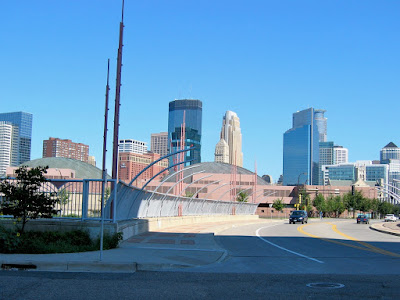
We had an adventure this morning, a small one. At the invitation of the State of Minnesota, we hied ourselves into the big city of Minneapolis, to the Convention Center, wherein our aged body received its first COVID-19 vaccine shot. All went well except for the ten minutes or so during which we had misplaced where we parked the Jeep and the brief consternation when we read the sign that said parking validation for the 2nd Street Parking Garage wasn't needed and we read our parking ticket which said we had parked in the Plaza garage. Slight case of mixed nomenclature. Our left arm is a little sore but other than that, we think we're doing ok although we are feeling slightly stressed out.


Minneapolis, "The City," near the Convention Center
Photo by J. Harrington

The other thing we learned this morning is that our ears won't support three masks. Having recently read that double masking has been found to be more effective than a single mask, we had two masks on as we traipsed through the skyway  and Convention Center hallways. Upon arrival at the checkin for the vaccination activities, we were handed another mask and politely instructed to put it on also. The first one we tried promptly broke one of the elastic connections to the mask, thereby freeing our right ear from a third binding. The second try at a third mask lasted until we completed checkin and bent forward to get out temperature taken. At that point the second third mask had an elastic to mask connection failure. We replaced that one and the third third mask did hold together until we were back in the Jeep.

It's possible, maybe even probable, that the mask failures were due, in part, to the amount of space behind our ears occupied by our hearing aids. To the best of our knowledge, no one took our picture while our left ear was bent directly out from our head by three ear straps, making us look like one side of the old Mad Magazine mascot and cover boy, Alfred E. Neuman. All in all, as with many things these days, it could have been worse. Then again, some years it could have been warmer than -17℉ on February 11 and other years vaccines against COVID-19 and its mutations didn't require a trip to the big city. It has changed since we last worked or played there.

We have been neglectful of the fact that Black History Month is continuing. Fortunately, the academy of american poets, of which we've been a long-time member, suggests in "poems to read and share"
 

"to celebrate the rich tradition of Black poetry this month and year-round, browse the following classic and contemporary poems:


Still I Rise” by Maya Angelou

Forever” by Paul Laurence Dunbar

Frederick Douglass” by Robert Hayden

Let America Be America Again” by Langston Hughes

Making History” by Marilyn Nelson

little prayer” by Danez Smith

This Body II” by RenΓ©e Watson

Declaration” by Tracy K. Smith

This Is Not a Small Voice” by Sonia Sanchez 


********************************************
Thanks for visiting. Come again when you can.
Please be kind to each other while you can.

Monday, July 13, 2020

Buy two, too!

There's an old saying to the effect that "if you find something you really like, buy two before they stop making it." I've done that for a few things, some of which they're still making. For those that aren't being made anymore, I've managed to still have two, apparently due to karma. If I had only one I'd have lost, broken, worn out or otherwise ended up with none. What does this have to do with a day near mid-July?

For the past several weeks I've been wearing a light-weight, synthetic cloth bug-shirt. It came permeated with permethrin. Wearing it on occasion for fishing seemed to work well. This Summer I've been wearing it while doing outside chores. It helps with the  deer flies but it doesn't breathe. The ventilation panels in the sleeves and torso are inadequate for this Summer's humidity. Each time I wear this shirt for more than five minutes, I end up soaked in sweat. And the deer flies still attack my ears and  the back of my neck.

buckthorn with berries
Photo by J. Harrington

This morning that all happened again as I was dismembering a large buckthorn bush that had lots of berries on it. The bush pieces are now on the brush pile to be burned later. The bug shirt ended up in the wash and, when walking the dog at mid-day I dug out a different fishing shirt that's mostly cotton. It's off-white and felt much more comfortable than the synthetic cloth and the light color is less attractive to deer flies and the material is just heavy enough to keep them from biting through it. Unfortunately, the company that made it no longer offers it, so I can't buy two. Fortunately, I've found something similar, polyester in a mesh weave, with a hood to protect ears and neck, that should be delivered today. If it works well at deterring bugs and "wicking away moisture," I'll do my best to order another later this Summer. That may help "protect" my mostly cotton fishing shirt too. There's a real timing challenge to owning something long enough to be sure it works well for you and that you really like it so you can order another before they're gone.

Fork with Two Tines Pushed Together

It's fast and cool as running water, the way we forget
the names of friends with whom we talked and talked
the long drives up and down the coast.

I say I love and I love and I love. However, the window
will not close. However, the hawk searches
for its nest after a storm. However, the discarded
nail longs to hide its nakedness inside the tire.

Somewhere in Cleveland or Tempe, a pillow
still smells like M_____'s hair.
In a bus station, a child is staring
at L____'s rabbit tattoo. I've bartered everything
to keep from doing my soul's paperwork.

Here is a partial list of artifacts:
mirror, belt, half-finished 1040 form (married, filing jointly), mateless walkie-talkie, two blonde eyelashes, set of acrylic paints with all the red and yellow used up, buck knife, dog collar, camping tent (sleeps two), slivers of cut-up credit cards, ashtray in the shape of a naked woman, pen with teeth marks, bottom half of two-piece bathing suit, pill bottles containing unfinished courses of antibiotics, bank statements with the account number blacked out, maps of London, maps of Dubuque, sweatshirts with the mascots of colleges I didn't attend, flash cards for Spanish verbs (querer, perder, olvidar), Canadian pocket change, fork with two tines pushed together.

Forgetfulness means to be full
of forgetting, like a glass

overflowing with cool water, though I'd always
thought of it as the empty pocket

where the hand finds
nothing: no keys, no ticket, no change.

One night, riding the train home from the city,
will I see a familiar face across from me? How many times
will I ask Is it you? before I realize
it's my own reflection in the window?


********************************************
Thanks for visiting. Come again when you can.
Please be kind to each other while you can.

Tuesday, February 18, 2020

Finding a cure for hiraeth?

hiraeth definition

I moved to Minnesota more than forty years ago. (Yes, I am that old.) As much as I've found to love about my adopted home: the Driftless Area, the rivers, the North Shore and Boundary Waters Area, Western prairies, the writing and reading communities, the pockets of New England architecture along the St. Croix, ..., I've yet to feel comfortably at home here. I think I've come across an explanation in a book called The Old Ways, by Robert Macfarlane.  Citing Barry Cunliffe's Facing the Ocean, Macfarlane writes:
"... a shared cultural identity developed over ten millennia along this Atlantic facade, such that Galicians, Celts, Bretons and Hebrideans might be said to have had more in common with one another than with their 'inland kin'. Kenneth White proposes the recovery of 'lost wavelengths' and 'Atlantic sensations,' the suggestion that  there are ways of feeling and thinking that are inspired and conditioned by the fact of long-term living on an ocean edge...."
I see no reason why such assessments should be limited to the Eastern shores of the "big pond." So, as I've mentioned numerous times, I was born in Boston, a Western Atlantic port city, grew up there and suburbs South of it, but always within a few miles of the Atlantic. Summers I often spent as much or more time in or on salt water than inland.

in many ways, Duluth is reminiscent of Boston
Photo by J. Harrington

It's now reassuring to learn that an ocean affinity is far from mine alone and that the differences between my natal and my adopted home places isn't just social (I still don't do "Minnesota Nice" at all well) but a more deeply embedded cultural identity. Perhaps now that I've found out about my Atlantic cultural identity, I'll be more able to relax and follow a version of Stephen Stills advice from my youth, "if you can't be in the place you love, love the place you're in." The version I follow, however, will not fail to remember that Winters close to the Atlantic were milder and briefer than those  found in the North Country, even now that we've broken the climate.

Home


 - 1878-1967


Here is a thing my heart wishes the world had more of:
I heard it in the air of one night when I listened
To a mother singing softly to a child restless and angry
 in the darkness.


********************************************
Thanks for visiting. Come again when you can.
Please be kind to each other while you can.

Friday, February 14, 2020

Thoughts on Valentine's Day

Sorry, no hearts and flowers today. This Valentine's Day it seems particularly appropriate to share Carl Sagan's iconic Pale Blue Dot monologue, especially since NASA has recently updated (reprocessed) the original Voyager 1 photograph. For now, this pale blue dot is all we have. We need to take better care of it. That means we need to do better caring for each other. We're all in, and on, this together. It's past time we Get Together.

 Enlarged version of the new Pale Blue Dot release. (NASA/JPL-Caltech)
Enlarged version of the new Pale Blue Dot release. (NASA/JPL-Caltech)

    From this distant vantage point, the Earth might not seem of any particular interest. But for us, it’s different. Consider again that dot. That’s here. That’s home. That’s us. On it everyone you love, everyone you know, everyone you ever heard of, every human being who ever was, lived out their lives. The aggregate of our joy and suffering, thousands of confident religions, ideologies, and economic doctrines, every hunter and forager, every hero and coward, every creator and destroyer of civilization, every king and peasant, every young couple in love, every mother and father, hopeful child, inventor and explorer, every teacher of morals, every corrupt politician, every ‘superstar,’ every ‘supreme leader,’ every saint and sinner in the history of our species lived there — on a mote of dust suspended in a sunbeam.

    The Earth is a very small stage in a vast cosmic arena. Think of the rivers of blood spilled by all those generals and emperors so that in glory and triumph they could become the momentary masters of a fraction of a dot. Think of the endless cruelties visited by the inhabitants of one corner of this pixel on the scarcely distinguishable inhabitants of some other corner. How frequent their misunderstandings, how eager they are to kill one another, how fervent their hatreds. Our posturings, our imagined self-importance, the delusion that we have some privileged position in the universe, are challenged by this point of pale light. Our planet is a lonely speck in the great enveloping cosmic dark. In our obscurity — in all this vastness — there is no hint that help will come from elsewhere to save us from ourselves. The Earth is the only world known, so far, to harbor life. There is nowhere else, at least in the near future, to which our species could migrate. Visit, yes. Settle, not yet. Like it or not, for the moment, the Earth is where we make our stand. It has been said that astronomy is a humbling and character-building experience. There is perhaps no better demonstration of the folly of human conceits than this distant image of our tiny world. To me, it underscores our responsibility to deal more kindly with one another and to preserve and cherish the pale blue dot, the only home we’ve ever known.


Residence on Earth


As we approached the front door, I noticed
grills on the windows, bullet pockmarks

in the wall; inside, a maid served us salad,
potato and cilantro soup—and I saw,

in the amphitheater above MedellΓ­n,
the stage where twenty-eight poets read;

clouds gathered; in the ensuing downpour,
I expected the five thousand people to rush out;

instead, a sea of umbrellas appeared,
and people swayed under them; when the readings

resumed, a poet stood, chanted in Vietnamese,
and when I stepped up to the podium,

two rivers flowed down the steps to the far right
and left; as I read our emotions resemble leaves

and alive to their shapes we are nourished, 
I understood how poets from all over the world

had come for peace, solidarity, justice—
and when my host, and reader of my poems

in Spanish, invited me into his home, I saw
one way to live during our residencia en la tierra.


********************************************
Thanks for visiting. Come again when you can.
Please be kind to each other while you can.

Sunday, January 26, 2020

If you don't know where you are, you don't know who you are. ~ W. Berry

This morning I finished reading a couple of books that had been in my morning meditation collection and, in their place, added A Literary Field Guide to Southern Appalachia, Ed. by Rose McLarney and Laura-Gray Street. I've also recently begun to read McLarney's Its Day Being Gone as an example of poetry of place. All of which indicates my readings and mediations are slowly bringing me back to roots as a bioregionalist. I started many years ago with a degree in English and a job as a regional systems planner. That, to my way of thinking, fits nicely under  the heading of bioregional, although I hadn't heard of that term back in those days.

is the St. Croix River watershed a bioregion?
Photo by J. Harrington

I'm continuing to work at getting an understanding of Minnesota's bioregions. I'm not referring strictly to the ecoregions of Minnesota, although they are elements of the identification of a bioregion. Peter Berg and Raymond Dasmond have crafted art least the four following definitions of "bioregion":
  1. Definitions of Bioregion

    “A bioregion is defined in terms of the unique overall pattern of natural characteristics that are found in a specific place. The main features are generally found throughout a continuous geographic terrain and include a particular climate, local aspects of seasons, landforms, watersheds, soils, and native plants and animals.” (Peter Berg)

    “A bioregion can be determined initially by use of climatology, physiography, animal and plant geography, natural history and other descriptive natural sciences. The final boundaries of a bioregion, however, are best described by the people who have lived within it, through human recognition of the realities of living-in-place.” (Peter Berg & Raymond Dasmann)

    “People are also counted as an integral aspect of a place’s life, as can be seen in the ecologically adaptive cultures of early inhabitants, and in the activities of present day reinhabitants who attempt to harmonize in a sustainable way with the place where they live.” (Peter Berg)

    “A bioregion refers both to geographical terrain and a terrain of consciousness -- to a place and the ideas that have developed about how to live in that place.” (Peter Berg and Raymond Dasmann)

a black bear statue in the Minnesota Goose Garden
Photo by J. Harrington

Part of what refocused my attention onto bioregions is the recognition that several of the species in the Appalachia Field Guide are also found in Minnesota, the smallmouth bass and the lake sturgeon among fishes and the black bear among mammals. I'll work toward a more complete comparison during the upcoming week. I'm more convinced than ever that we humans need to redevelop a closer and better identification with the places we "live, work and play" as the saying goes. Globalism has become unbalanced and will continue doing the same to us until we reach a (tipping) point at which our initial identity is as a citizen of Earth and a member of her community. We have a way to go yet.

The Poem that Took the Place of a Mountain


There it was, word for word,
The poem that took the place of a mountain.

He breathed its oxygen,
Even when the book lay turned in the dust of his table.

It reminded him how he had needed
A place to go to in his own direction,

How he had recomposed the pines,
Shifted the rocks and picked his way among clouds,

For the outlook that would be right,
Where he would be complete in an unexplained completion:

The exact rock where his inexactnesses
Would discover, at last, the view toward which they had edged,

Where he could lie and, gazing down at the sea,
Recognize his unique and solitary home.


********************************************
Thanks for visiting. Come again when you can.
Please be kind to each other while you can.

Wednesday, February 6, 2019

Home territory

This is the time of year for cold and snow and wolves mating. We've got the cold. We're getting the snow. If their territory keeps expanding, we may soon have mating wolves. They're already in the general vicinity North and West of our county. That definitely gives us something positive to look forward to. The local coyote packs seem to be ineffective at keeping the local deer herd nervous enough to stay away from our low-hanging bird feeder and our landscape shrubbery.

members of the International Wolf Center pack
Photo by J. Harrington

We admit that, when we lived there, Massachusetts was not noted for its wolf population nor as a center of copper mining. The paper linked at the end of this sentence provides an overview of the current status of wolves in New England. [No resident populations.] Frank Woolner, in one of his stories published in My New England, describes a late Winter encounter between a whitetail deer and three --- dogs, not wolves!

There are many other points of comparison between our two home territories. For better, or worse, both New England and Minnesota fields yield bounteous root crops of stones. We know that, in New England, each Spring's harvest of stones are crafted into walls. We've noticed few stone walls anywhere in rural Minnesota but we do seem to recall reading Bill Holm, or Paul Gruchow, or both, expounding on stone piles growing in Minnesota's prairie regions. Come to think on it, Massachusetts, at least the Eastern end I'm most familiar with, was short on prairies too.

a stone wall in St. Paul that needs some mending
Photo by J. Harrington

In case you're wondering, we're not actually trying to compare Minnesota and Massachusetts/New England. We are pondering why it seems to be that, despite having lived in Minnesota for more than half of our life, we still think of New England as "home." Perhaps the best explanation is no explanation at all, but a statement of premise. Woolner, in the Foreword to My New England, succinctly notes:
Know this, and know it very certainly: a man or a woman born in New England will never be completely happy anywhere else on earth. In his dreams, if not in reality, this is "the place to return to, to be buried in."
Fortunately, it's a bit premature for us to fully concur with Woolner's premise, but we must admit his track record on the subject is awfully good so far. Maybe that's why we feel a need, from time to time, to see if we can no more understand why we can't be completely happy in Minnesota than we can explain why good fences make good neighbors.

Mending Wall


Something there is that doesn't love a wall,
That sends the frozen-ground-swell under it,
And spills the upper boulders in the sun;
And makes gaps even two can pass abreast.
The work of hunters is another thing:
I have come after them and made repair
Where they have left not one stone on a stone,
But they would have the rabbit out of hiding,
To please the yelping dogs. The gaps I mean,
No one has seen them made or heard them made,
But at spring mending-time we find them there.
I let my neighbour know beyond the hill;
And on a day we meet to walk the line
And set the wall between us once again.
We keep the wall between us as we go.
To each the boulders that have fallen to each.
And some are loaves and some so nearly balls
We have to use a spell to make them balance:
"Stay where you are until our backs are turned!"
We wear our fingers rough with handling them.
Oh, just another kind of out-door game,
One on a side. It comes to little more:
There where it is we do not need the wall:
He is all pine and I am apple orchard.
My apple trees will never get across
And eat the cones under his pines, I tell him.
He only says, "Good fences make good neighbours."
Spring is the mischief in me, and I wonder
If I could put a notion in his head:
"Why do they make good neighbours? Isn't it
Where there are cows? But here there are no cows.
Before I built a wall I'd ask to know
What I was walling in or walling out,
And to whom I was like to give offence.
Something there is that doesn't love a wall,
That wants it down." I could say "Elves" to him,
But it's not elves exactly, and I'd rather
He said it for himself. I see him there
Bringing a stone grasped firmly by the top
In each hand, like an old-stone savage armed.
He moves in darkness as it seems to me,
Not of woods only and the shade of trees.
He will not go behind his father's saying,
And he likes having thought of it so well
He says again, "Good fences make good neighbours."


********************************************
Thanks for visiting. Come again when you can.
Please be kind to each other while you can.

Sunday, February 3, 2019

Season's end? Which "local" team's season?

Yesterday and today we enjoyed March-like weather, including pervasive fog. Tomorrow, and for the near future, it's back to and maybe below typical North Country late Winter conditions, cold and snowy, with maybe a bit of freezing drizzle thrown in. The good news is that, today at least, the Better Half reported hearing chickadees singing their Spring "fee-bee" call. This was the first time this year the call has been heard by anyone in our household.

chickadees now sing of Spring
Photo by J. Harrington

Effective tomorrow, football season will be over until about August. (The Minnesota Vikings season ended last year, on December 30.) Although we're originally from Massachusetts, one of six New England states, we found it hard, while living back East, to identify with a team named for six states. The original Boston Patriots offered the kind of local identity we could relate to. (See, we're back on that "what's local?" theme again.) If we were to turn it around, we might be inclined to suggest that Minnesota is far from a coherent identity. The state contains at least four major biomes. More than one fifth of the entire state's population lives in just one of its 87 counties: Minnesota - 2017 - 5.6 million; Hennepin County - 2017 - 1.2 million. Massachusetts had a 2017 population of 6.9 million in a state a little more than 10% of Minnesota's size.

In Massachusetts, other non NFL local professional sports teams are:

  • Boston Celtics (basketball)
  • Boston Bruins (hockey)
  • Boston Red Sox (baseball), and
  • New England Revolution (soccer)

As we recall, from many years ago when we lived there, Boston fans were more enthusiastic (rabid?) than New England fans. But, in those days, there was no local soccer team. How much do professional sports really contribute to a local identity? That's a good question. "What comprises a local identity?" may be an even better one.


Football


I take the snap from the center, fake to the right, fade back...
I've got protection. I've got a receiver open downfield...
What the hell is this? This isn't a football, it's a shoe, a man's
brown leather oxford. A cousin to a football maybe, the same
skin, but not the same, a thing made for the earth, not the air.
I realize that this is a world where anything is possible and I
understand, also, that one often has to make do with what one
has. I have eaten pancakes, for instance, with that clear corn
syrup on them because there was no maple syrup and they
weren't very good. Well, anyway, this is different. (My man
downfield is waving his arms.) One has certain responsibilities,
one has to make choices. This isn't right and I'm not going
to throw it.


********************************************
Thanks for visiting. Come again when you can.
Please be kind to each other while you can.

Sunday, August 26, 2018

our celebration of #NationalDogDay

Because it's #NationalDogDay, the dogs to whom the Better Half and we belong insisted we post their pictures.

Our own four-legged friend is SiSi, a yellow lab X ? cross. She has two speeds, bubbling

SiSi, with the bubbling personality
Photo by J. Harrington
and off!

SiSi, in the "Off" position
Photo by J. Harrington

Our Better Half belongs to Franco, a border collie X ? cross, who is noisier but more circumspect than his blond companion.

Franco, whose human is our Better Half
Photo by J. Harrington

Each is a rescue dog, which means that each rescued their respective, if not overly respectable, human from a dogless existence. The pair of rescuers have agreed that, if we do a good enough job with today's posting,  they'll reward us with a treat. They would also like all of you to know that, if you don't currently have a dog, you should head for your nearest shelter and let one rescue you.

“The Sweetness of Dogs”


by Mary Oliver


What do you say, Percy? I am thinking
of sitting out on the sand to watch
the moon rise. It’s full tonight.
So we go

and the moon rises, so beautiful it
makes me shudder, makes me think about
time and space, makes me take
measure of myself: one iota
pondering heaven. Thus we sit, myself

thinking how grateful I am for the moon’s
perfect beauty and also, oh! how rich
it is to love the world. Percy, meanwhile,
leans against me and gazes up
into my face. As though I were just as wonderful
as the perfect moon.
“The Sweetness of Dogs” by Mary Oliver from Dog Songs 


********************************************
Thanks for visiting. Come again when you can.
Please be kind to each other while you can.

Saturday, June 30, 2018

Seamus Heaney tells us "Don't be afraid"

This morning we read a warm, lengthy and caring portrait of Seamus Heaney, 1995 Nobel Laureate, Irish poet and family man. It was in the US edition of The Guardian, titled Seamus Heaney’s family on life with the great poet: ‘He was always just Dad at home'. If you follow the link and read the piece you'll find the origin of today's title. We find it fitting because it bridges, at least in our mind and heart, the history of Ireland's "troubles" with the troubles we're going through in our country these days.

darkened cobbles in a brook bed
Photo by J. Harrington

As we tried to read the photo of Heaney's handwritten original "Trout," we decided to see if a more legible version was available online. That lead us to a resource, previously undiscovered, Connecting with Seamus Heaney, an exploration of the style, content and composition of many of Heaney's poems. We're at least doubly delighted because of the mention of Heaney's writing about rivers and that the "Connecting" resource "is written so as to be accessible to students whose first language may not be English." That offers a bridge to events happening today throughout our country - protesting the treatment, especially the separation of families, of immigrants seeking asylum from the dangers of living in their countries of origin. It also mirrors, a bit, the unfriendly relations between the English and the Irish over an extended period.

Fortunately, the poems included in "Connecting" include Heaney's Anahorish, which we first encountered in The River's Voice anthology. We'll read the "Connecting" material carefully to better understand what Heaney is saying in that poem, something that eluded us in our first (and second) readings. This experience has definitely been an example of the old saying that "the joy is in the journey, not the destination." If we exchanged Heaney's "place of clear water" to a "place of salt water," we might well be describing our own boyhood.

Anahorish 


Seamus Heaney


My 'place of clear water,'
the first hill in the world
where springs washed into
the shiny grass

and darkened cobbles
in the bed of the lane.
Anahorish, soft gradient
of consonant, vowel-meadow,

after-image of lamps
swung through the yards
on winter evenings.
With pails and barrows

those mound-dwellers
go waist-deep in mist
to break the light ice
at wells and dunghills. 


********************************************
Thanks for visiting. Come again when you can.
Please be kind to each other while you can.

Wednesday, January 18, 2017

On the Nature of Winnie the Pooh Day!

The fact that today is Winnie-the-Pooh Day may have something to do with the fact that it's also A.A. Milne's birthday. I have a confession to make. I didn't become a fan of Winnie until long after I left childhood. Perhaps that's what makes him and his friends so extra special to me? It could have absolutely nothing to do with the unfounded accusations from those who "no" me that I've a large Eeyore-like streak running through my personality. Someone close to me even had the audacity to give me an Eeyore plush doll which lives on one of my desks. There's also a small, framed print of Pooh and Piglet walking through the Hundred Acre Wood and an unframed, large map of that same wood.

my alter ego? not at all
Photo by J. Harrington

  • My favorite sweatshirt is emblazoned with the poster for the October 8 Joan Baez / Grateful Dead Peace Concert. A framed reproduction of that self-same poster is on the wall of our "scriptorium."

  • We once had a yellow labrador pup named "Winnie" by the Daughter Person.
Our library currently includes:
    • The Tao of Pooh and

    • The Te of Piglet, plus

    • Winnie the Pooh on Management
      (in my opinion, one of the best management books going), plus

    • The Natural World of Winnie-the-Pooh,
    • a walk through the forest that inspired the Hundred Acre Wood
Childhood reading memories don't include Pooh, although I vaguely recall reading, and/or having read to me, Paddle-to-the Sea, which was originally published a few years before I was born. Looking at the Caldecott medal nominees doesn't yield any other titles that ring a bell, although The Wind in the Willows haunts my memory.

can you pick out the Woozle tracks?
Photo by J. Harrington

All of this thinking and writing about the adventures and life of Pooh made me go out and double check the tracks in the back yard, the ones coming out of our part of our own hundred acre wood. Some are deer, as we noted a few days ago, but on careful, close-up inspection, I believe some are Woozle tracks. I couldn't make out if any of the others belonged to a very important bear or a very small piglet, but, if we get fresh snow, I'll check again.

Us Two


By A.A. Milne


Wherever I am, there's always Pooh,
There's always Pooh and Me.
Whatever I do, he wants to do,
"Where are you going today?" says Pooh:
"Well, that's very odd 'cos I was too.
Let's go together," says Pooh, says he.
"Let's go together," says Pooh.

"What's twice eleven?" I said to Pooh.
("Twice what?" said Pooh to Me.)
"I think it ought to be twenty-two."
"Just what I think myself," said Pooh.
"It wasn't an easy sum to do,
But that's what it is," said Pooh, said he.
"That's what it is," said Pooh.

"Let's look for dragons," I said to Pooh.
"Yes, let's," said Pooh to Me.
We crossed the river and found a few-
"Yes, those are dragons all right," said Pooh.
"As soon as I saw their beaks I knew.
That's what they are," said Pooh, said he.
"That's what they are," said Pooh.

"Let's frighten the dragons," I said to Pooh.
"That's right," said Pooh to Me.
"I'm not afraid," I said to Pooh,
And I held his paw and I shouted "Shoo!
Silly old dragons!"- and off they flew.

"I wasn't afraid," said Pooh, said he,
"I'm never afraid with you."

So wherever I am, there's always Pooh,
There's always Pooh and Me.
"What would I do?" I said to Pooh,
"If it wasn't for you," and Pooh said: "True,
It isn't much fun for One, but Two,
Can stick together, says Pooh, says he. "That's how it is," says Pooh.


********************************************
Thanks for visiting. Come again when you can.
Please be kind to each other while you can.

Wednesday, March 23, 2016

Going to the dogs? Damn right!

Yesterday was #WorldWaterDay but I didn't go out and dig a well or buy a canteen. Today is National Puppy Day and that's a much tougher challenge to resist. In past postings we've already introduced you to our (no longer) puppies: Franco and SiSi, each a "rescue" dog, although the rescuing goes both ways.

Franco, the Better Half's part border collie
Photo by J. Harrington

SiSi, my part yellow Lab
Photo by J. Harrington

Franco has dedicated his life to raucously greeting anyone and everyone who approaches or enters the front door, no matter how well he knows them. He also does his best to keep the bird feeders safe from squirrels and the property unmolested by tigers, both of which actions require more raucousness. Fortunately, when not acting as a greeter or protector, he naps a lot.

SiSi may be the happiest and most energetic creature I've encountered, with the possible exception of Tigger in the Hundred Acre Wood. Hence, her name, Spanish for "Yes, Yes" meaning "I'm ready any time to try any thing. Let's go!"

Neither of our aged-out puppies has shown much interest in flowers, but those are one of the few things they don't regularly try to eat. Franco, in particular, shows a disconcerting interest in oak leaves, dead and dried. SiSi is a bit more discerning and frequently causes me to remember the prayer "Lord, help me to be the person my dog thinks I am." Despite occasional trials and tribulations, remember that puppies and dogs are one of our few sources, perhaps our only source, of unconditional love.

My Puppy Loves Flowers

By Bruce Lansky

My puppy’s in the garden.
He loves to smell the flowers.
To help them grow my puppy always
sprinkles them with showers.


********************************************
Thanks for visiting. Come again when you can.
Please be kind to each other while you can.

Wednesday, March 16, 2016

In place of home

Gusting winds, temperature in the low 40s, scattered rain, snow up north -- this kind of Minnesota March weather makes me feel "at home" in the season. We've had a really productive day around here. The "tax organizer" is completed and delivered to the accountant; fishing licenses for this season are now in the possession of The Better Half and I; I finally got to see one of my photos from last month's exhibit on display on the wall of the local coffee shop [it's the one of the Winter tree in the upper left]; and, despite being neglected for a couple of weeks, my sourdough starter seems to be responding nicely to yesterday's feeding. Tomorrow will be baking day.

"That's What Eye Saw" elements at The Nesting Grounds
Photo by J. Harrington

On top of all of the preceding, I've started to put some thoughts together for an essay about what's "home ground" for us humans and how that may relate to hiraeth and whether some or all of us are susceptible to being "imprinted" with our home grounds. I don't have, and may never find, answers to these questions, that's what make an essay so interesting. Annie Dillard explores some of these themes in Pilgrim at Tinker Creek and An American Childhood. Pursuing questions instead of answers probably applies to poems also, or else Robert Frost wouldn't have written or said “No surprise for the writer, no surprise for the reader.” Minnesota weather, particularly in March, is often full of surprises and raises the question of how much weather is a part of being home.

Unusually Warm March Day, Leading to Storms

By Francesca Abbate

Everything is half here,
like the marble head
of the Roman emperor
and the lean torso
of his favorite.
The way the funnel cloud
which doesn't seem
to touch ground does—
flips a few cars, a semi—
we learn to walk miles
above our bodies.
The pig farms dissolve,
then the small hills.
As in dreams fraught
with irrevocable gestures,
the ruined set seems larger,
a charred palace the gaze
tunnels through
and through. How well
we remember the stage—
the actors gliding about
like petite sails, the balustrade
cooling our palms.
Not wings or singing,
but a darkness fast as blood.
It ended at our fingertips:
the fence gave way
to the forest.
The world began.


********************************************
Thanks for visiting. Come again when you can.
Please be kind to each other while you can.

Saturday, March 12, 2016

Preview of coming events

Highs in the mid 60s, such as we're enjoying today, are more typical for late April or early May in this part of the world. Don't put away your Winter jackets and snow boots just yet, you'll only be tempting the weather gods. Instead, just enjoy this gift from Mother Nature and say "Thank you" to her.

mid-March 2014 snow cover
Photo by J. Harrington

If I were back in Massachusetts at this time of year in this kind of weather, I know exactly where I'd be, on the bay side of the isthmus that divides Duxbury Bay from the Atlantic Ocean, fishing for flounder. In Minnesota, we're at that awkward time of year when the ice is pretty chancy for ice fishing and open water seasons haven't yet begun except for some catch and release trout waters. On the other hand, two years ago we were still in the midst of snow season.

mid-March 2015 no snow cover
Photo by J. Harrington

Earlier this morning, while drinking coffee and reading a piece in the 10th Anniversary issue of Ecotone, I started thinking about what it means to know a place. The author was observing the advantages of having lived in several very different locations and being able to "compare and contrast." Having, just yesterday, been confronted with the challenge of being able to identify the plants growing on my own little piece of Minnesota, I pondered whether being able to "name" some or all of the local flora and fauna is a requisite for "becoming indigenous," or naturalized, as the case may be. Then there's the question of local folklore, or lack thereof. Does folklore coincide with bioregional boundaries?

The Better Half recently lent me her copy of the journal GeoHumanities: Space, Place and the Humanities. I suspect I'll spend some time skimming through the articles and wading through the academic prose as I continue to try to come to some "sense of place" that may, or may not, match a "sense of people and culture." If I had never encountered Schroediger's cat or Heisenberg's uncertainty principle, such topics would no doubt be of less concern. In simple terms, I'm still trying to figure out what it means to be at home in this place where I live on this planet in this universe. Quotations from two of my favorite writers may frame this better. Wendell Berry notes that "People exploit what they have merely concluded to be of value, but the defend what they love..." Theodore Roethke wrote "I learn by going where I have to go." Why do some of us simply "value" a place, while others defend it? I have to go try to find and understand answers to that question. I'm sure they're at a place we all need to find.

Value Added


By Stephen Sandy

No one knew what the stones like squatting frogs
signified. There they were, fuming in rows, out
of the ground; every critic had his explanation
or hers. But—we had to remember—they
came to nothing, every one; those large stones
out of the earth served the systems
of those who considered them, as explaining
something about the past it was important
for the explainer to explain. And yet
no one had any idea truly; there was no
basis in fact for any view of them, and
they remained like their origins—or like
smiling Olmec babies, sweet but ominous figures
come from the earth to reproach us, almost
cheerfully, for our ignorance—a mystery, just
as the probe of our feelings came up with nothing.


********************************************
Thanks for visiting. Come again when you can.
Please be kind to each other while you can.

Sunday, February 14, 2016

Love the place you're at!

Happy Valentine's Day! Although it's not quite the same as a valentine, the Nature Conservancy gave me a pleasant surprise in the current issue of their magazine. I want to share parts of it with you as our valentine and a reminder that we need to care about places as well as people.

Valentine's evening sky 2013
Photo by J. Harrington

Amanda Fiegl wrote, and Stan Fellows illustrated, an article titled Writers By Nature. Here's a list of the writers, their writing, and the places written about that were mentioned in the article:
  • John Steinbeck -- East of Eden -- Gabilan Mountains, California

  • Ralph Waldo Emerson -- The Adirondacs -- Adirondack Mountains, New York

  • Ernest Hemingway -- NA -- Ketchum, Idaho

  • Willa Cather -- My Antonia -- Nebraska Prairie

  • Rachel Carson -- The Edge of the Sea -- New Harbor, Maine

  • Wallace Stegner -- Crossing to Safety -- Greensboro, Vermont

  • T.C. Boyle -- When the Killing's Done -- Channel Islands, California

  • Annie Dillard -- Pilgrim at Tinker Creek -- Blue Ridge Mountains

Poet's Corner

  • W.S. Merwin

  • Carl Sandburg

  • William Weaver Christman
It came as a pleasant surprise to see that I've read at least something, if not the work listed, by most of these authors. In a different kind of surprise, I've always associated Sandberg with Chicago, but he's listed at his family farm in Flat Rock, North Caroline. I'm delighted to see two New England locations listed (Vermont and Maine) but disappointed to find Minnesota missing. (I think that's due to a lack of alignment between Minnesota writers and Conservancy activity locations here.) I need to, and will, add Cather and Stegner to my short list of folks to read this year. I also want to do some research and see if I can learn why there's no listings for Edward Abbey and the Southwest; or Beston and/or Melville and Cape Cod and/or the Islands of Nantucket, Martha's Vineyard or the Elizabeth's.

An Inquiry into the Nature and Causes of the Wealth of Nations

By Simon Armitage
Compiling this landmark anthology of poetry in English
about dogs and musical instruments is like swimming through bricks.
To date, I have only, “On the Death of Mrs. McTuesday’s Pug,
Killed by a Falling Piano,” a somewhat obvious choice.
True, an Aeolian harp whispers alluringly
in the background of the anonymous sonnet, “The Huntsman’s
      Hound,”
but beyond that — silence.

I should resist this degrading donkey-work in favor of my own
      writing,
wherein contentment surely lies.
But A. Smith stares smugly from the reverse of the twenty pound
      note,
and when my bank manager guffaws,
small particles of saliva stream like a meteor shower
through the infinity of dark space
between his world and mine.


********************************************
Thanks for visiting. Come again when you can.
Please be kind to each other while you can.

Saturday, August 15, 2015

Celebrating 30 Ides of August

Thirty years ago today, on a day not nearly as humid, my Better Half and I married. One way or another, I've been celebrating and enjoying my luck ever since. Today, to celebrate, we're headed for dinner at the Harborview Cafe in Pepin where we'll enjoy local food surrounded by booklined shelves. The Daughter Person and the Son-In-Law will be joining us to assist in the celebration. It's been several years since we wandered down that way. Our trip then was later in the year. Here's some of what it looked like.

Lake Pepin in the Mississippi River
Photo by J. Harrington

small town Wisconsin bakery
Photo by J. Harrington

Pepin storefront
Pepin storefront
Photo by J. Harrington

window box with pansies and bee
Photo by J. Harrington

I'm looking forward to a pleasant trip, good food, great company and, perhaps, with luck, thirty years more of the same.

To my Better Half: Thank you for the best thirty years of my life so far.

Most Like an Arch This Marriage

By John Ciardi 

Most like an arch—an entrance which upholds   
and shores the stone-crush up the air like lace.   
Mass made idea, and idea held in place.   
A lock in time. Inside half-heaven unfolds.

Most like an arch—two weaknesses that lean   
into a strength. Two fallings become firm.   
Two joined abeyances become a term   
naming the fact that teaches fact to mean.

Not quite that? Not much less. World as it is,   
what’s strong and separate falters. All I do   
at piling stone on stone apart from you   
is roofless around nothing. Till we kiss

I am no more than upright and unset.   
It is by falling in and in we make
the all-bearing point, for one another’s sake,   
in faultless failing, raised by our own weight. 


********************************************
Thanks for visiting. Come again when you can.
Please be kind to each other while you can.