Showing posts with label energy. Show all posts

Tuesday, September 12, 2023

Pondering the imponderable

Tonight’s frost advisories end one county north of us. Yesterday, I turned the furnace on for the first time this season. The outside temperatures had dropped below 50℉ when I did it. Soon it will be time to break out the fleece-lined winter pjs. Autumn is settling in.

frost: it’s coming
frost: it’s coming
Photo by J. Harrington

A year from now we’ll be approaching election 2024. Do you suppose the question of whether The Former Guy is eligible to be listed on a ballot will be resolved by then? I’m annoyed that Minnesota’s SOS, Steve Simon, has deferred to the courts the decision on ballot eligibility. (I’m not suggesting he’s incorrect, given the state law, just that I find it annoying that a SOS doesn’t have to first make a determination that can then be reviewed by the court system.) The presidential election section of the office’s web site avoids mention of Sec. 3 of the 14th Amendment to the Constitution as an eligibility requirement. At least some Minnesotans have now petitioned the Minnesota Supreme Court for a ruling. Will all or any of the individual state cases get to SCOTUS before the election? Will it make any difference? Stay turned! Isn’t it fun to live in unprecedented presidential times?

Meanwhile, our federal Secretary of Energy is doing a great job of demonstrating why it is that we can’t just rapidly “phase out” fossil fuels, as an author of a recent report suggests. I haven’t read even the summaries of the IPCC reports, so I may have missed it but I don’t recall ever seeing a summary of the staging and development of alternative energy systems needed to enable the phase out of fossil fuels without crippling the world economy and bringing any transition to a premature halt. The lack of systems planning and the failure to create alternate scenarios as education and communication strategies seems to be a significant oversight. Al Gore was absolutely correct about the fact that effectively responding to climate breakdown and its effects means we have to deal with a lot of inconvenient truths. Instead, the Republicans are beginning a fool’s exercise in opening impeachment proceedings against President Biden. Do you know the title of the movie about our two political parties? How about “Dumb and Dumber?” 


Statement on Energy Policy


It’s true we have invented quark-extraction,
and this allows our aiming gravity at will;
it’s true also that time
can now be made to flow
backward or forward by

the same process. It may be true as well that
what is happening at the focal point,
the meristem of this process,
creates a future kind of space,
a tiny universe that has

quite different rules. In this, it seems,
whatever one may choose to do or be becomes
at once the case. In short,
we have discovered heaven and
it’s in our grasp. However,

the Patent Office has not yet approved and cites
less positive aspects of this invention. First, it
does not generate profit, and
it does make obsolete all present
delivery systems for our nukes. Then,

it will let private citizens do things that only
a chosen few, that is, OUR sort, should be allowed—
fly freely from one country
to any other, spreading diseases
and bankrupting transportation.

Home-heating, auto-making industries will be trashed,
employment shelled, depressions spread worldwide,
sheer anarchy descend.
For these and other reasons,
no one must know of this. . . .


********************************************
Thanks for visiting. Come again when you can.
Please be kind to each other while you can.

Sunday, January 23, 2022

Overlooking the objectively obvious?

Today we barely climbed into the single digits. Also at some point today, the Star Tribune added a story to its online edition: What will best keep Xcel's grid reliable in a pinch: Gas plants or batteries?

With the kinds of cold we get in winter, and heat with humidity in summer. the answer to that question is of significance to quite a few Minnesotans, including our household, for which the monthly energy costs for December increased by $100 between 2020 and last year.

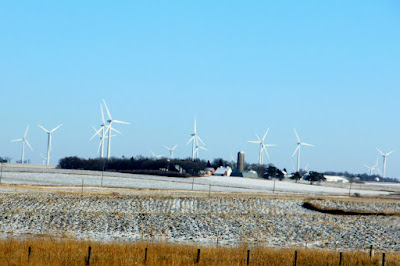
if the wind blows or the sun shines...
Photo by J. Harrington

As a long time fan of the Massachusetts Institute of Technology’s Systems Dynamics section and their work on Limits to Growth, I searched the internet using the phrase “MIT US grid modeling.” I was pleasantly surprised to discover a research report online: “The Future of the Electric Grid.” I was even more pleasantly surprised to learn it’s one of a series.

Other Reports in This Series

  • The Future of Nuclear Power (2003)
  • The Future of Geothermal Energy (2006)
  • The Future of Coal (2007)
  • Update to the Future of Nuclear Power (2009)
  • The Future of Natural Gas (2011)
  • The Future of the Nuclear Fuel Cycle (2011) 
I fear that our state government, including and perhaps especially the Public Utilities Commission, may be overly reliant on testimony from those with “skin in the game” or a “dog in the fight,” depending on which cliche you prefer. Does Minnesota have a legal requirement that state agencies seek and use relevant information from neutral parties in adjudicating contentious issues? If not, why not?

That’s it for today from a taxpayer who doesn’t mind paying taxes but hates to see them wasted on poor decision-making systems crafted, and often run, by undereducated and untrained amateurs such as those regularly elected to office in this state.


Statement on Energy Policy


It’s true we have invented quark-extraction,
and this allows our aiming gravity at will;
it’s true also that time
can now be made to flow
backward or forward by

the same process. It may be true as well that
what is happening at the focal point,
the meristem of this process,
creates a future kind of space,
a tiny universe that has

quite different rules. In this, it seems,
whatever one may choose to do or be becomes
at once the case. In short,
we have discovered heaven and
it’s in our grasp. However,

the Patent Office has not yet approved and cites
less positive aspects of this invention. First, it
does not generate profit, and
it does make obsolete all present
delivery systems for our nukes. Then,

it will let private citizens do things that only
a chosen few, that is, OUR sort, should be allowed—
fly freely from one country
to any other, spreading diseases
and bankrupting transportation.

Home-heating, auto-making industries will be trashed,
employment shelled, depressions spread worldwide,
sheer anarchy descend.
For these and other reasons,
no one must know of this. . . .


********************************************
Thanks for visiting. Come again when you can.
Please be kind to each other while you can.

Thursday, May 6, 2021

Are we putting ourselves in an electric chair?

Today's posting will be relatively short but not so sweet. Do you rememberer what happened in Texas last winter? How the Texas power grid failed and what could stop it from happening again.

A couple of decades ago, around 2013, there were a number of articles about power grid failures in the United States. Here's an example: Comparison of major power grid failures in US and around the world (1). You can search for more using your favorite search engine. The terms I used are: US grid failure. If you do a separate search and add the word "response" I don't think you'll find much coverage of solutions to grid failure that have already been started, let alone completed, and that was before we started putting almost all our eggs in the electric basket.


generation, transmission and distribution are all necessary
Photo by J. Harrington


So here's my version of where we're at:

  1. Our electric grid wasn't stable at the start of the millennium.
  2. We've done little to improve it.
  3. We're nowhere near close to reducing our greenhouse gases as much as we should.
  4. We're becoming increasingly reliant on a power grid that's subject to increasing amounts of severe storms and power demands due largely to our failure to respond to climate disruption.
  5. Our political system is breaking down.
  6. We have no where near the unified approach we once had toward "putting a man on the moon by the end of the decade."
  7. Those in positions of power have, for the most part, had it too easy for too long and don't know how to lead or respond to a real crisis.
  8. American exceptionalism has now come to stand for exceptionally shortsighted and self-centered.
Superstorm Sandy made US aware that generators need fuel. If we leave it all in the ground, on what will our generators run until the system is back up? If we continue to produce gasoline, will there be power to pump it into cans for the local generators? Will the grid system have sufficient battery backup to last for several days or weeks? I don't know the answers to these and related questions. This country has been reliant on for profit public utilities and has permitted situations such as Texas' grid isolation to occur. We believe it's past time for US to follow an "everyone for themselves" strategy. We are all in this together, just as with responding to COVID-19 and getting vaccinated. Much as I hate to agree with former president George Bush about anything, it's time we realized, on some issues, "if you're not for US, you're against US." That's especially true of today's Republicans.


Statement on Energy Policy


It’s true we have invented quark-extraction,
and this allows our aiming gravity at will;
it’s true also that time
can now be made to flow
backward or forward by

the same process. It may be true as well that
what is happening at the focal point,
the meristem of this process,
creates a future kind of space,
a tiny universe that has

quite different rules. In this, it seems,
whatever one may choose to do or be becomes
at once the case. In short,
we have discovered heaven and
it’s in our grasp. However,

the Patent Office has not yet approved and cites
less positive aspects of this invention. First, it
does not generate profit, and
it does make obsolete all present
delivery systems for our nukes. Then,

it will let private citizens do things that only
a chosen few, that is, OUR sort, should be allowed—
fly freely from one country
to any other, spreading diseases
and bankrupting transportation.

Home-heating, auto-making industries will be trashed,
employment shelled, depressions spread worldwide,
sheer anarchy descend.
For these and other reasons,
no one must know of this. . . .


********************************************
Thanks for visiting. Come again when you can.
Please be kind to each other while you can.

Friday, February 5, 2021

Will the legislature get its energy act together again?


Sun shining, wind blowing, temperature barely crept into double digits, fields covered in snow, water ice covered. Thanks to the thaw earlier this week, we've also got icicles hanging from the gutters. Sounds like mid-winter in our North Country. At least we've seen a couple of reports that we're now through the (literally) darkest days of winter. Tomorrow brings us ten hours of daylight.


each winter's sun rise brings a new day
each winter's sunrise starts a new day
Photo by J. Harrington


In an interesting coincidence to yesterday's posting about Minnesota's climate change failures, this morning we noticed a story in the Star Tribune that Legislators push to shrink Minnesota's carbon footprint to zero by 2050. The 2007 Next Generation Energy Act is, in our opinion, long overdue for an update. We were delighted to see the following in the Strib article:

The proposal also creates enforceability and accountability, for the first time, beyond utilities. The original act contained clear mandates for electric utilities but not for other sectors such as transportation, now the state's No. 1 source of greenhouse gas emissions, or agriculture.

We've noted, more than once or twice, that if government really wants to rely on voluntary compliance, we no longer need traffic cops. We'll take that further today and say that the IRS can get rid of all its auditors and any computer auditing program if we rely on voluntary tax compliance. Have you seen a reasonable explanation why some government functions warrant oversight and enforcement and others, such as agricultural conservation, don't? That's what we thought. We look forward to reading whatever bill gets introduced.


Letter to Someone Living Fifty Years from Now


Most likely, you think we hated the elephant,
the golden toad, the thylacine and all variations
of whale harpooned or hacked into extinction.

It must seem like we sought to leave you nothing
but benzene, mercury, the stomachs
of seagulls rippled with jet fuel and plastic. 

You probably doubt that we were capable of joy,
but I assure you we were.

We still had the night sky back then,
and like our ancestors, we admired
its illuminated doodles
of scorpion outlines and upside-down ladles.

Absolutely, there were some forests left!
Absolutely, we still had some lakes!

I’m saying, it wasn’t all lead paint and sulfur dioxide.
There were bees back then, and they pollinated
a euphoria of flowers so we might
contemplate the great mysteries and finally ask,
“Hey guys, what’s transcendence?”   

And then all the bees were dead.


********************************************
Thanks for visiting. Come again when you can.
Please be kind to each other while you can.

Thursday, August 15, 2019

A Green New Deal for Minnesota?

August is the month of the Sturgeon Moon
Photo by J. Harrington

Today is the day of August's full moon, the Sturgeon Moon. Yesterday we posted about the federal efforts to establish a national Green New Deal. Today we call to your attention the fact that Minnesota could have its own, locally grown, version. Last April HF 2836 was introduced. The Revisor's Office web site lists no companion bill in the Republican-controlled Senate and there's no House Research summary available. If you follow the House File link above, you can read the entire bill as introduced.

For today, let's limit ourselves to taking a look at Section 2 of the bill, the findings:
1.9  Sec. 2. FINDINGS; CLIMATE CHANGE; GREENHOUSE GAS EMISSIONS.
1.10  The legislature finds:
1.11  (1) Minnesota is already experiencing the impacts of climate change, as evidenced by 
1.12  changes in climate and weather patterns, temperature, rain and snowfall events, water 
1.13  availability, and alteration of the variety of plant and animal species present in the state;
1.14  (2) climate change is the result of increased levels of greenhouse gases entering the 
1.15  atmosphere, largely as a result of human activity;
1.16  (3) the Special Report of the Intergovernmental Panel on Climate Change issued in 
1.17  October 2018 found that greenhouse gas emissions must be reduced from 2010 levels by 
1.18  45 percent by 2030 and to net zero by 2050 in order to limit the rise in atmospheric 
1.19  temperature to 1.5 degrees Celsius, a level that results in severe ecological, health, and 
1.20  economic impacts;
1.21  (4) the impacts of burning fossil fuels are spread unequally, reinforcing economic 
1.22  disparities that reduce the capacity of some Minnesotans to cope with the impacts; and
2.1  (5) the urgency to address the challenge of climate change compels the state to accelerate 
2.2  the greenhouse gas emissions-reduction goal established under Minnesota Statutes, section 
2.3  216H.02, subdivision 1, by establishing a goal of net zero greenhouse gas emissions by 
2.4  2030.
We find the Findings to be pretty straightforward and, even for us, contain nothing to quibble about. On Finding (1), ask a farmer how usual this Spring's weather was. Or track the amount of money being provided to farmers who suffered planting prevention or have and or will be experiencing crop loss due to weather and muddy fields. Finding (2) is now a scientific consensus of 99% or more of climate scientists. Finding (3) simply restates a major conclusion of the October 2018 IPCC report, that a rapid reduction in greenhouse gases is needed to limit the disruptions and economic costs of breaking the current climate's patterns. Finding (4) is consistent with assessments by the U.S. Global Change Research Program that
Vulnerable groups of people, described here as populations of concern, include those with low income, some communities of color, immigrant groups (including those with limited English proficiency), Indigenous peoples, children and pregnant women, older adults, vulnerable occupational groups, persons with disabilities, and persons with preexisting or chronicmedical conditions.
That doesn't seem to leave very many populations to not be concerned about, does it? Finally, Finding (5) requires acceleration of the attainment of a previously adopted goal in light of the new information and the increased urgency of a response to protect Minnesotans, their economy, their environment and their well-being.

Even putting our curmudgeon hat on as tight as we can, we can't find anything to really argue about in the proposed legislative findings. If you can, please feel free to submit a comment so we can consider responding. All of the preceding, and yesterday's posting, and the fact that the Project Drawdown book has a copyright in 2017, leaves us wondering how long our leaders and elected officials will continue to argue about what colors the deck chairs on the Titanic should be painted before they have us start to rearrange those same deck chairs.

If those politicians that get much of their campaign financing from corporations can't realize that corporations depend on workers and customers, each group of which is at significant risk from the effects of a broken climate, then it's up to us voters to find wiser and better informed elected leaders.

Who's leading the push to get Minnesota's Green New Deal introduced in the Senate and on Governor Walz's desk by the end of the 2020 session?

The Question


by Theo Dorgan


When the great ships come back,
and come they will,
when they stand in the sky
all over the world,
candescent suns by day,
radiant cathedrals in the night,
how shall we answer the question:

What have you done
with what was given you,
what have you done with
the blue, beautiful world?


********************************************
Thanks for visiting. Come again when you can.
Please be kind to each other while you can.

Wednesday, August 14, 2019

Should more Minnesotans support a Green New Deal?

If you follow these pages at all irregularly, it will come as no surprise that we rarely find opportunity to thank Minnesota politicians. For the most part, we have a perspective that too many of today's Democrats aren't good (progressive) enough and Republicans are much, much worse. That's why we were delighted to discover today that Representative Betty McCollum [CD-4] is a co-sponsor of Rep. Ocasio-Cortez, Alexandria [D-NY-14]'s Green New Deal resolution [H.Res.109 - Recognizing the duty of the Federal Government to create a Green New Deal.]

We would be severely remiss if we didn't also note that Amy Klobuchar, Minnesota's senior senator, and current candidate for president, joined many of the other senatorial Democratic presidential candidates in becoming an original cosponsor of of Senator Markey's S.Res.59 - A resolution recognizing the duty of the Federal Government to create a Green New Deal. Could there be something in the resolution that Senator Smith doesn't support? [see below]

We now return to our curmudgeonly review of the House and find, when we do the math, that only 20% of Minnesota's Democratic members of the House of Representatives have signed on as cosponsors of H.Res. 109. Is there something the matter with the content of the resolution or is it something wrong with representatives:
Here, in summary from the Congressional Research Service, is what the resolution calls for:
  • achieving net-zero greenhouse gas emissions; 
  • establishing millions of high-wage jobs and ensuring economic security for all; 
  • investing in infrastructure and industry; 
  • securing clean air and water, climate and community resiliency, healthy food, access to nature, and a sustainable environment for all; and 
  • promoting justice and equality. 
The resolution calls for accomplishment of these goals through a 10-year national mobilization effort. The resolution also enumerates the goals and projects of the mobilization effort, including
  • building smart power grids (i.e., power grids that enable customers to reduce their power use during peak demand periods); 
  • upgrading all existing buildings and constructing new buildings to achieve maximum energy and water efficiency; 
  • removing pollution and greenhouse gas emissions from the transportation and agricultural sectors; 
  • cleaning up existing hazardous waste and abandoned sites;
  • ensuring businesspersons are free from unfair competition; and
  • providing higher education, high-quality health care, and affordable, safe, and adequate housing to all. 
We wonder if the four members of Congress listed above oppose any or all of the goals or the mobilization efforts, of if it's simply that enough of their constituents haven't made it clear to their representatives how important the Green New Deal can be to Minnesota and Minnesotans. If any of you readers think you have good reasons to contact your member of Congress to encourage them to sign onto H.Res 109 as a co-sponsor, please feel free to do so. If you're not sure why it might be important in your congressional district, check back here from time to time. In future postings we'll point out what we believe are many of the benefits that a Green New Deal can deliver to Minnesota.

A Language of Change


by David Sergeant 


‘as late capitalism writhed in its internal decision concerning whether to destroy Earth’s biosphere or change its rules’ – Kim Stanley Robinson

We’re sat by the ocean and this
could be a love poem; but that lullaby murderer
refuses each name I give it
and the icebergs seep into our sandwiches,
translated by carbon magic. And even this might be
to say too much. But the muse of poetry
has told me to be more clear – and don’t,
s/he said, for the love of God, please, screw things up.
Ambiguous, I didn’t reply; as we’re sat
by the ocean and I could make it
anything you wanted, for this moment
of speaking – but we have made it
something forever. Together
the weather
is a language we can barely understand;
but confessional experts detect
in the senseless diktat of hurricane
a hymning of our sins, our stupid counterpoint.
Love has served its purpose, now must be
transformed by an impersonal sequester
of me into the loves I will not see,
or touch, or in any way remember.
Perhaps it was always like this – take my hand,
horizon – ceding this land.


********************************************
Thanks for visiting. Come again when you can.
Please be kind to each other while you can.

Friday, June 21, 2019

Happy Summer Solstice to our new Poet Laureate!

Astronomical Summer has finally caught up with Meteorological Summer. We have from now until September 23 to enjoy Summer, unless we are meteorologists, in which case Summer ends on September 1st. In either case, the odds are at least fair that we'll get to enjoy Summer's warmth until mid-October. We humans seem to have a phenomenal ability to make things complicated, don't we?

Summer Solstice often brings misty dawns
Photo by J. Harrington

Druids call the Summer Solstice "Alban Hefin, The Light of the Shore." The sun is the source for almost all the energy that supports life on this Earth of ours. Some think Summer is a time of extra energy. Others find the heat and humidity to be enervating. We're sure that this Summer will be delightfully portentous because, just prior to the Solstice, one of our favorite poets was named Poet Laureate of the United States. Joy Harjo will begin her term a few days before the Autumnal Equinox, on September 19.

We look forward to seeing what she does with the opportunity this appointment presents to the first Native American to hold this position. We cannot think of a more deserving poet to be selected for the 2019-2020 term, particularly in light of the title of one of her most recent volumes of poetry, Conflict Resolution for Holy Beings (Norton, 2015). These times we are living in drive us to need all the help possible with the growing numbers of daily and monumental conflicts we encounter or create. Perhaps we would have fewer conflicts and would enjoy life and poetry more if we took time to celebrate more folk festivals like today's Solstice and, as Harjo has written, to

Remember

Joy Harjo- 1951-


Remember the sky that you were born under,
know each of the star's stories.
Remember the moon, know who she is.
Remember the sun's birth at dawn, that is the
strongest point of time. Remember sundown
and the giving away to night.
Remember your birth, how your mother struggled
to give you form and breath. You are evidence of
her life, and her mother's, and hers.
Remember your father. He is your life, also.
Remember the earth whose skin you are:
red earth, black earth, yellow earth, white earth
brown earth, we are earth.
Remember the plants, trees, animal life who all have their
tribes, their families, their histories, too. Talk to them,
listen to them. They are alive poems.
Remember the wind. Remember her voice. She knows the
origin of this universe.
Remember you are all people and all people
are you.
Remember you are this universe and this
universe is you.
Remember all is in motion, is growing, is you.
Remember language comes from this.
Remember the dance language is, that life is.
Remember.


********************************************
Thanks for visiting. Come again when you can.
Please be kind to each other while you can.

Saturday, May 25, 2019

"Failure is not an option," better legislating is required.

The 2019 Minnesota legislative session, and the special session needed because the #mnleg couldn't finish its work within the constitutional deadline, is now history. Unfortunately, at a time when the effects of climate breakdown are becoming more and more apparent, the session(s) response to a climate emergency ended as, according to MinnPost,
‘An absolute failure’: Why the Legislature’s energy and climate budget does a whole lot of nothing
 If you're old enough, or enough of a movie buff, you may remember the wonderful quote from the 1995 movie, Apollo 13, "Failure is not an option." The same is true of our need to transition from fossil fuels to renewable energy and incorporate energy efficiency as expediently and safely as possible. Minnesotans should be ashamed of this recent legislative failure. Too many opportunities will get missed with essentially no time to make up for those misses. We're facing a deadline of 2030, 11 years away.

solar panels, organic farm, Northern Minnesota
Photo by J. Harrington

If you were ever a child, if you have a child or children, if you hope to have a child or children, if you care about any child or children, DO NOT LET THOSE WHO CLAIM TO REPRESENT US FAIL US THIS WAY! If we want to be able to honestly claim "we're better than this," we need to demonstrate it.

We, as citizens, residents, inhabitants, occupants, and/or voters in Minnesota have a chance to further convince our elected "leaders" of the absolute necessity to fix their failure as soon as possible. A call for a global strike on September 20, 2019, has been issued. We've received reports that a group called Minnesotans for a Livable Planet are organizing Community Summits on September 22, 2019 to coincide with a United Nations Summit in New York City on September 23, 2019.

solar powered business, Ely, Minnesota
Photo by J. Harrington

We plan to be involved with other Minnesotans in the strike and the summits. The county in which we live has had solar farms erupting like mushrooms after a wet Spring. Many of them could be improved and economically enhanced by incorporating pollinator-friendly plantings under the solar panels, providing an economic boost to farmers and rural Minnesota. We are rapidly entering an age in which we need to design and develop not one-fers, but two-fers, three-fers, and more-fers. There's more than enough work to be done. Please consider joining us.

My Century


Alan Feldman


The year I was born the atomic bomb went off.
Here I’d just begun, and someone
found the switch to turn off the world.

In the furnace-light, in the central solar fire
of that heat lamp, the future got very finite,
and it was possible to imagine time-travelers

failing to arrive, because there was no time
to arrive in. Inside the clock in the hall
heavy brass cylinders descended.

Tick-tock, the chimes changed their tune
one phrase at a time. The bomb became
a film star, its glamorous globe of smoke

searing the faces of men in beach chairs.
Someone threw up every day at school.
No time to worry about collective death,

when life itself was permeated by ordeals.
And so we grew up accepting things.
In bio we learned there were particles

cruising through us like whales through archipelagoes,
and in civics that if Hitler had gotten the bomb
he’d have used it on the inferior races,

and all this time love was etching its scars
on our skins like maps. The heavens
remained pure, except for little white slits

on the perfect blue skin that planes cut
in the icy upper air, like needles sewing.
From one, a tiny seed might fall

that would make a sun on earth.
And so the century passed, with me still in it,
books waiting on the shelves to become cinders,

what we felt locked up inside, waiting to be read,
down the long corridor of time. I was born
the year the bomb exploded. Twice

whole cities were charred like cities in the Bible,
but we didn’t look back. We went on thinking
we could go on, our shapes the same,

darkened now against a background lit by fire.
Forgive me for doubting you’re there,
Citizens, on your holodecks with earth wallpaper—

a shadow-toned ancestor with poorly pressed pants,
protected like a child from knowing the future.


********************************************
Thanks for visiting. Come again when you can.
Please be kind to each other while you can.

Sunday, October 14, 2018

Climate change checklist manifesto: energy and materials

There's an organization called the Regenesis Group that specializes in Integrative Design:
"The benefits of this process include higher efficiency, lower costs, reduced waste, faster time to market, and the realization of exponential value to the social, ecological, financial and human qualities of a project, the community and its ecosystem."
solar and wind help power the Audubon Center of the North Woods
Photo by J. Harrington

We believe that most, if not all, of the options listed below would benefit immensely by being embedded in a more complete context through integrative design. Technology, and behavior change, need to be fit into a broader context than the ones described below, if they are to have an optimum impact. We have social systems and economic systems and technical systems and many other systems that warrant consideration when looking toward behavior change by individuals, families, farmers and others.

ENERGY AND MATERIALS


6 . Rooftop solar — Installing rooftop photovoltaic systems under one megawatt
We've looked at getting a photovoltaic (ground mounted) system. One major drawback is the battery backup available is insufficient to serve as a backup during any longer term failure of the grid. No electricity: no water from the electric pump, no (gas) heat, no refrigeration. We remember reading about the longer term failure of gas station pumps after Sandy, so portable generators have notable limitations. This option needs better systems integration.

14 . Solar water — Using solar radiation to pre-heat or heat water for building use
Our electric water heater is about due for replacement. We'll consider a solar option along with a tankless option starting with this evaluation by the Minnesota Sustainable Housing Initiative.

20 . Methane digesters — Adopting technologies that produce biogas for household heating through anaerobic digestion of organic waste
Not applicable unless we add livestock.

21 . LED lighting — Using energy efficient lighting in households
Over the years we've replaced incandescent bulbs, first with compact fluorescents and then with LEDs. The quality of white light from most LEDs we find unappealing. Perhaps it's atavism and relating to the hearth fires that makes us prefer warm light to cool.

23 . Household water saving — Using water saving devices in homes such as low-flow showerheads
We've done this on all except the utility sink and the external faucets.

24 . Smart thermostats — Using devices that reduce heating and cooling demand through sensors and settings in the home
When members of the household are at home much of each day, these are of less utility than when folks head for work and school all day.

27 . Household recycling and recycled paper — Recycling paper, metal, plastic, and glass materials
We do this and have for years.

30 . Micro wind — Installing small wind turbines to provide household electricity needs
This may serve as an alternative to or complement to photovoltaic, but doesn't address the battery limitation issue.

Statement on Energy Policy


It’s true we have invented quark-extraction,
and this allows our aiming gravity at will;
it’s true also that time
can now be made to flow
backward or forward by

the same process. It may be true as well that
what is happening at the focal point,
the meristem of this process,
creates a future kind of space,
a tiny universe that has

quite different rules. In this, it seems,
whatever one may choose to do or be becomes
at once the case. In short,
we have discovered heaven and
it’s in our grasp. However,

the Patent Office has not yet approved and cites
less positive aspects of this invention. First, it
does not generate profit, and
it does make obsolete all present
delivery systems for our nukes. Then,

it will let private citizens do things that only
a chosen few, that is, OUR sort, should be allowed—
fly freely from one country
to any other, spreading diseases
and bankrupting transportation.

Home-heating, auto-making industries will be trashed,
employment shelled, depressions spread worldwide,
sheer anarchy descend.
For these and other reasons,
no one must know of this. . . . 


********************************************
Thanks for visiting. Come again when you can.
Please be kind to each other while you can.

Tuesday, September 25, 2018

A different kind of power

Chicago county is at the southern end of Minnesota's Eighth Congressional District. With the exception of some sand and gravel operations, we don't know of any significant mining operations in the county. Toward the northern extremities of the CD, iron/taconite mining has been in operation for some time. More recently, "hard rock" sulfite ore mining is being proposed, primarily for copper-nickel mining. From what we've read, mining is an energy intensive operation with numerous opportunities to improve energy efficiency. Electricity is the second largest fuel consumed in the US mining industry. The United Nations has identified how mining can contribute to the world's Sustainable Development Goals. Minnesota continues to oppose the prospect of copper mining because of the risk/reward profile of such untested operations. Meanwhile, at the southern end of the CD, Chisago county has been successfully moving ahead with a previously untested approach to providing power to the school system and enhancing the profitability of marginally useful spaces such as school roof tops and sub-prime farm land. Is there a lesson here that would help diversify the economy of the entire CD?


What we've been trying to understand for months and months and ... is how such a "leftish, progressive" sequence of actions took hold and got implemented in a basically conservative, Republican county that supported Trump over Clinton by almost 2 to 1.

source: Politico

Part of an explanation can be found in this piece from MinnPost: "Chisago County has become a case study in the possibilities and politics of solar energy in Greater Minnesota." [We'll wait while you read it.]

Chisago county solar farm under construction
Photo by J. Harrington

There's a theory and strategy in the economic development field known as "plugging the leaks." Picture a local economy as a bucket that has some holes in it. The holes are where funds (electric utility profits?) leave the community rather than recirculating as a local flow. Chisago county and the school district are plugging holes in their local economy, in addition to adding to its diversity. And yet, the Chisago voters went heavily for a candidate who's doing his best to revive coal power and expand oil development, climate change be damned. Are people not connecting the dots, or are they connecting dots in ways that progressives and neoliberal don't yet understand?

Chisago county solar farm in operation
Photo by J. Harrington

It's becoming more and more clear to us that, if humans have much of a future ahead of them, then the future needs to be much more sustainable, even restorative, than has been the case in the past. Chisago county seems, in at least some surprising ways, headed in the right direction. (No pun or political observation implied.) We're constantly surprised as we drive around the county with the way "solar farms" seem to pop up like mushrooms during a wet Spring.

Minnesota is becoming known more and more for its growth in clean energy jobs. But, conservative think(?) tanks such as the Center of the American Experiment would have us return to those dirty energy days of yesteryear (Rising Electricity Prices Threaten Mining Jobs, the Iron Range). The mining industry itself is turning more and more to renewable energy. Here's a link to a data base of Solar & wind systems in the mining industry. Perhaps Minnesota's Iron Range leadership, as well as the Center of the American Experiment, should spend some time talking to those in Chisago county who helped bring about the transformation of marginal lands (and unused roof tops) into profitable, cost saving, energy generating activities. Could it be time for mining in northern Minnesota to help lead the way back to the future?

Heaven's Light
(lyrics) 

Playful waves of water
Caught the colors of the sky,
And cast the hues of sunset
Rippling softly in my eyes.

Mesmerizing moments,
Opened...wide to heaven's,
Heaven's light.

Then the lovely moon arose
She shimmered on the sea;
Sunlight beaming from her face,
To playful waves, then me...

Memserizing moments,
Opened...wide to heaven's,
Heaven's light.
Mesmerizing moments,
Opened...wide to heaven's,
Heaven's light...
Mind adrift,
From troubled shores...

[Guitar Solo]

Then the lovely moon arose
She shimmered on the sea;
Sunlight beaming from her face,
To playful waves, then me...


Mesmerizing moments,
opened...
Wide to heaven's,
heaven's light...
Mesmerizing moments,
opened...
Wide to heaven's, heaven's light...
Mind adrift
from troubled shores...


My mind adrift from
troubled shores...
I feel the gift of heaven's light...
Mmmm Mmmm
Heaven's light... Mmmm


Composed and performed by
Cherilynn Morrow and Jeff Ballard

********************************************
Thanks for visiting. Come again when you can.
Please be kind to each other while you can.

Sunday, August 26, 2018

our celebration of #NationalDogDay

Because it's #NationalDogDay, the dogs to whom the Better Half and we belong insisted we post their pictures.

Our own four-legged friend is SiSi, a yellow lab X ? cross. She has two speeds, bubbling

SiSi, with the bubbling personality
Photo by J. Harrington
and off!

SiSi, in the "Off" position
Photo by J. Harrington

Our Better Half belongs to Franco, a border collie X ? cross, who is noisier but more circumspect than his blond companion.

Franco, whose human is our Better Half
Photo by J. Harrington

Each is a rescue dog, which means that each rescued their respective, if not overly respectable, human from a dogless existence. The pair of rescuers have agreed that, if we do a good enough job with today's posting,  they'll reward us with a treat. They would also like all of you to know that, if you don't currently have a dog, you should head for your nearest shelter and let one rescue you.

“The Sweetness of Dogs”


by Mary Oliver


What do you say, Percy? I am thinking
of sitting out on the sand to watch
the moon rise. It’s full tonight.
So we go

and the moon rises, so beautiful it
makes me shudder, makes me think about
time and space, makes me take
measure of myself: one iota
pondering heaven. Thus we sit, myself

thinking how grateful I am for the moon’s
perfect beauty and also, oh! how rich
it is to love the world. Percy, meanwhile,
leans against me and gazes up
into my face. As though I were just as wonderful
as the perfect moon.
“The Sweetness of Dogs” by Mary Oliver from Dog Songs 


********************************************
Thanks for visiting. Come again when you can.
Please be kind to each other while you can.

Monday, October 2, 2017

Clear choice: clean air, clean water, clean jobs

This morning's Star Tribune has two pieces that, it seems to us, clearly frame Minnesota's future, sort of the way last November 8 framed our present. The parenthetical notes list the section of the paper in which each piece can be found. That, in itself, should give us a clue. Herewith are the pieces in question:
The commentary reads like an attempt to counter Minnesota's Department of Commerce expert analysis, released early last month, of the proposed pipeline project. (The Commerce Department's mission includes protecting the public interest and serving as a trusted public resource.)
"Oil market analysis indicates that Enbridge has not established a need for the proposed project; the pipeline would primarily benefit areas outside Minnesota; and serious environmental and socioeconomic risks and effects outweigh limited benefits" [emphasis added]

clean air
clean air
Photo by J. Harrington

The business story emphasizes how rapidly Minnesota is outgrowing its historic reliance on foreign energy sources, and growing its economy at the same time.
...Minnesota’s clean-energy jobs grew 5.3 percent in 2016 to 57,351 jobs. That compares with all-industry growth of 1.4 percent and 4.2 percent for professional and business services, the fastest-growing of the 11 major industrial sectors tracked by the Minnesota Department of Employment and Economic Development.
Those claiming the need for and prudence of a replacement pipeline (primarily to serve non-Minnesota interests) claim that it would put "...6,500 Minnesotans to work over two years..." That would be roughly equivalent to two or three years worth of clean energy job growth, many of which would be "permanent" jobs. Which do you think is more sustainable?

clean water
clean water
Photo by J. Harrington

If there's a solar spill, we get a sunny day. Oil spills are a whole different story. Enbridge has a history of oil spills at their facilities. (If some argue that clean energy jobs are different than pipeline construction jobs, please talk to Republican legislators about fully funding Minnesota's transportation system and create beneficial construction jobs.)

clean jobs
clean jobs
Photo by J. Harrington

The preceding, we hope, should help reinforce the realization that an alleged choice between jobs or the environment is a false choice. A wise choice is to create a future that protects our environment, reduces health costs by contributing to cleaner air and water, and build a better Minnesota with a New Economy.

                     Statement on Energy Policy


It’s true we have invented quark-extraction,
and this allows our aiming gravity at will;
it’s true also that time
can now be made to flow
backward or forward by

the same process. It may be true as well that
what is happening at the focal point,
the meristem of this process,
creates a future kind of space,
a tiny universe that has

quite different rules. In this, it seems,
whatever one may choose to do or be becomes
at once the case. In short,
we have discovered heaven and
it’s in our grasp. However,

the Patent Office has not yet approved and cites
less positive aspects of this invention. First, it
does not generate profit, and
it does make obsolete all present
delivery systems for our nukes. Then,

it will let private citizens do things that only
a chosen few, that is, OUR sort, should be allowed—
fly freely from one country
to any other, spreading diseases
and bankrupting transportation.

Home-heating, auto-making industries will be trashed,
employment shelled, depressions spread worldwide,
sheer anarchy descend.
For these and other reasons,
no one must know of this. . . .

********************************************
Thanks for visiting. Come again when you can.
Please be kind to each other while you can.

Monday, December 5, 2016

A raw deal #phenology

We started the day with a beautiful peach and pink sunrise. Then the rest of the clouds filled in. Since mid-day, it's been spitting rain and the inch or two of tracking snow that had covered our fields as the sun rose is now melting. The damp, raw air, combined with a southeast to east wind reminds me a little of December along the East Coast. I mean within a mile or so of the ocean, where there was rarely ice and precipitation was rain almost as often as it was snow.

pink sky at morning... ?
Photo by J. Harrington

I've been to the Phoenix, Arizona area in the Summer and remember well the phrase "but it's a dry heat." Once the temperature got over one hundred degrees F, dry or not the heat wore me down. A similar pattern seems to be my Winter problem. If it's a dry cold, I can tolerate it better than if the humidity creeps up, but once the temperature or wind chill drops much below 20°F, I'm ready to go inside no matter how dry the cold. Of course, sunshine also adds a psychological boost that makes it seem warmer than it is in Winter. At least, so I vaguely remember from past years when there was sunshine in Winter.

tracks in the snow
tracks in the snow
Photo by J. Harrington

Even though I'm complaining about the weather, I know it could be much worse. We're not getting freezing rain, which helps the roads, drivers and wildlife. So far, at least, we haven't been buried in multiple inches of snow. Last Autumn there was lots of fussing and fuming about La Nina and whether this Winter would be colder than normal, or not; snowier than normal, or not. Is the Old Farmer's Almanac forecast going to be accurate, or not? I'm becoming fascinated by the idea that we now seem to have a much better grasp of our long term climate trends than we do for the weather over the next several months, or our energy future over the next several years.

I hope the Winter at Standing Rock and the Oceti Sakowin Camp is tolerable for those determined to stay in the camp. I'm truly grateful for the leadership shown by Native Americans in opposing the Dakota Access Pipe Line. Unfortunately, it's likely to be just one of several such issues coming to a head during the next several years. Some of the turbulence affecting the pipeline front can be expected to move east into Minnesota over the next several months. If you're interested, here's some background from Honor the Earth. (One day very soon we'll pull together a more complete posting on Line 3 and oil pipelines in Minnesota.) If the oil industry fades as rapidly as the coal industry has, it's hard to see how investments in new infrastructure can get a return on investment that matches the risk profile of the projects being financed. That would be a different kind of raw deal, and, I fear, one that could fall on the shoulders of the taxpayers more than the investors. Mining and oil and other extractive industries are often like that.

UPDATE: Excellent explanation of the current status and issues at Standing Rock

A Short Story of Falling


By Alice Oswald


It is the story of the falling rain
to turn into a leaf and fall again

it is the secret of a summer shower
to steal the light and hide it in a flower

and every flower a tiny tributary
that from the ground flows green and momentary

is one of water's wishes and this tale
hangs in a seed-head smaller than my thumbnail

if only I a passerby could pass
as clear as water through a plume of grass

to find the sunlight hidden at the tip
turning to seed a kind of lifting rain drip

then I might know like water how to balance
the weight of hope against the light of patience

water which is so raw so earthy-strong
and lurks in cast-iron tanks and leaks along

drawn under gravity towards my tongue
to cool and fill the pipe-work of this song

which is the story of the falling rain
that rises to the light and falls again


********************************************
Thanks for visiting. Come again when you can.
Please be kind to each other while you can.