Showing posts with label environmental writing. Show all posts

Friday, January 26, 2024

Serendipitous!

When the Daughter Person was in college, the Better Half and I would stop on occasion at a coffee shop know as the Ginko. It’s been quite a while since I’ve been in that neighborhood, so I don’t know if it’s still there. It’s where we first saw Carrie Newcomer perform live. If memory serves correctly, it may also have been where we “discovered” Krista Detor.

A little while ago I was reminded of that when I stumbled across the web site for The Ginko Prize, “... a major international award for ecopoetry ....” Before today I had been unaware of its existance. Since at least several regular readers here are fans of poetry, and others are environmentalists, and some are both, I’m sharing my discovery in hopes that it may be a previously undiscovered source of entertainment and education for those who partake.

In a similar vane (subconsciously I wanted to type “vain" there), I’ll share a link to the Alaskan Quarterly’s you tube channel and their presentation of:

Poet Jane Hirshfield, Stephanie Holthaus (Climate Action Advisor for The Nature Conservancy Alaska), Nancy Lord (Former Alaska Writer Laureate), and Marie Tozier (Iñupiaq poet) in conversation for "Ways of Knowing: Poetry, Science, and the Environment.”

Now, if you’ll excuse me, I need to go explore some more of today’s discoveries. 


Perishable, It Said


Perishable, it said on the plastic container,
and below, in different ink, 
the date to be used by, the last teaspoon consumed. 

I found myself looking:
now at the back of each hand,
now inside the knees,
now turning over each foot to look at the sole.

Then at the leaves of the young tomato plants, 
then at the arguing jays.

Under the wooden table and lifted stones, looking. 
Coffee cups, olives, cheeses, 
hunger, sorrow, fears—
these too would certainly vanish, without knowing when.

How suddenly then
the strange happiness took me,
like a man with strong hands and strong mouth,
inside that hour with its perishing perfumes and clashings.


********************************************
Thanks for visiting. Come again when you can.
Please be kind to each other while you can.

Tuesday, August 1, 2023

An unnatural moon?

The Minnesota Weatherguide notes that tonight’s full moon is the ricing moon (Ojibwe) or the harvest moon (Lakota). At month’s end, we’ll have a “blue moon.” Since there are 13 full moons but only 12 months in a year, I’m not sure what the Ojibwe name is for the second full moon this month. Here’s a resource if you want to try to sort it out. The Lakota named their 13 moons by the season, not the month.

full August moon
full August moon
Photo by J. Harrington

Purple loosestrife is in bloom in local wetlands and marshes. Bees and butterflies don’t seem to care that it’s an invasive plant on which they’re foraging. Unless there’s a blockage (dam) on the river, local water levels are very to extremely low on the St. Croix.

Over the years, I’ve been poking around the National Park Service wild and scenic river web site, but it wasn’t until today that I discovered these natural resources inventories for the St. Croix. I’m looking forward to scanning them someday soon. (We could use more than a few rainy days this August.)

It is now mid-afternoon on Tuesday, August 1, 2023. I have so far managed to avoid logging onto Elon’s Xfiles, for this first tweetless Tuesday. I’ll defer posting this link there until tomorrow morning. I will post it to Mastodon @JohnHthePoet https://mstdn.party/home. I noticed that my scanning the online versions of Star Tribune and Guardian did nothing to really improve my perspective on the state of the world. There are so many problems about which I can do little or nothing that I’m not sure why I should kknow about them. Maybe one of these days it will be time for me to question why neither of those “papers” does much by way of solutions journalism. Meanwhile, I’m feeling more human after spending time exploring geopoetics in practice and literary field guides.


Moon Ghazal


I can’t remember the first time I saw it, seems it was
always there, even with me in the womb, the moon.

It must have been night, above the ocean, making a path
on the waves, gilded invitation, the parchment moon.

Or the day moon, see-through-y wafer over desert, caught
in the arms of saguaro, thin-skinned, heart-stuck moon.

Blue as new milk, aquarium water, Mexican tile, blue
as cold-bitten fingertips, nailbeds’ quick-blue arcs, half-moons.

How I felt when I saw my first grown boy, round-eyed,
all sinew and muscle, his calves, his biceps, plump as moons.

Buttons, doorknobs, volleyballs, clocks, egg yolk, orange
slice, violet iris, our planet a pupil, mote in the eye of the moon.

The cell inside me splitting and splitting, worm of the fetus,
tadpole, the glazed orb of the eye, my belly taut as the moon.

The blood-streaked moon of her head pushing through, moons
of the faces above me, urging me, pulling, promising the moon.

There are earthquakes on the moon, water, not geologically dead,
still acting like a planet: upheaval, turmoil, shaking her head, the moon.

When I see the earth of you I still feel moonquakes, even now, after
so many moons my round breasts swoon, your fingertips, small moons.


********************************************
Thanks for visiting. Come again when you can.
Please be kind to each other while you can.

Friday, April 22, 2022

Some ponderings on #EarthDay 2022

 It seems clear to me that, over the years since 1970, the environmental movement has lost considerable momentum. Many of the Earth Day messages I’m seeing this year are trying to get me to buy something to celebrate Earth Day. I consider those messages to be a form of greenwashing. There’s another, better way to celebrate Earth Day, we can and should honor and acknowledge those who helped establish the first Earth Day,

“The ultimate test of man's conscience may be his willingness to sacrifice something today for future generations whose words of thanks will not be heard.”  ― Gaylord Nelson
“The ultimate test of man's conscience may be his willingness to sacrifice something today for future generations whose words of thanks will not be heard.”  ― Gaylord Nelson
Photo by J. Harrington

April is, among other things, National Poetry Month. I wish the Academy of American Poets would do more to take advantage of the annual overlap between Poetry Month and Earth Day. Here’s some suggestions for your reading pleasure. See if your local library has a copy of any of these volumes.

If you’re among those who much prefer prose to poetry, we offer for your consideration Aldo Leopold’s Odyssey: Rediscovering the Author of A Sand County Almanac by Julianne Lutz Newton.

Restoring the earth, and protecting the little that we’ve not harmed yet, is not a technical nor economic challenge. It is a challenge to which our hearts and wills must rise. We must remember how much we are dependent on earth for all that we need. The earth is the only home we have. It IS OUR PLANET B!


Remember

 - 1951-


Remember the sky that you were born under,
know each of the star's stories.
Remember the moon, know who she is.
Remember the sun's birth at dawn, that is the
strongest point of time. Remember sundown
and the giving away to night.
Remember your birth, how your mother struggled
to give you form and breath. You are evidence of
her life, and her mother's, and hers.
Remember your father. He is your life, also.
Remember the earth whose skin you are:
red earth, black earth, yellow earth, white earth
brown earth, we are earth.
Remember the plants, trees, animal life who all have their
tribes, their families, their histories, too. Talk to them,
listen to them. They are alive poems.
Remember the wind. Remember her voice. She knows the
origin of this universe.
Remember you are all people and all people
are you.
Remember you are this universe and this
universe is you.
Remember all is in motion, is growing, is you.
Remember language comes from this.
Remember the dance language is, that life is.
Remember.


********************************************
Thanks for visiting. Come again when you can.
Please be kind to each other while you can.

Tuesday, April 5, 2022

Fishing openers are for real anglers, not scribblers

 Several writers in the Star Tribune have recently managed to get their underwear in a bunch over this year’s Minnesota Governor’s Fishing Opener. I read both columns and was embarrassed to see the Strib reduced to publishing such snits. I’m intentionally not linking because I don’t want to help promote such retrograde thinking and writing.

As I read them, although ymmv, this year the opener won’t be providing all the junkett fringe benefits outdoor scribes have become accustomed to, they won’t be spoon fed story lines and they may actually have to think about what fishing means in contemporary Minnesota to families comprised of real people and not just “rugged outdoorsmen.”

sharing trout waters
Photo by J. Harrington

Since last month was National Women’s History Month, I should have posted this then, but I wasn’t annoyed about male self-centeredness complaining about intrusion into the “old boys’ club” at that point. Our state is lucky to have the following:

  • Women Anglers of Minnesota (WAM) “supports women and children in the sport of fishing. With a 45-year history and over 900 members, we offer an educational, safe, and supportive environment that seeks to connect anglers of all experience levels and ages.” 
  • Fly Fishing Women of Minnesota “are here to help women unravel the mysteries of fly fishing. An Affiliate Club of Fly Fishers International” 
  • Women on the Fly, a Minnesota Steelheader's program
I’ve long been a member of Trout Unlimited and am particularly pleased by its recognition that “The majority of TU members are and always have been male, but the ranks of female TU members are growing, and we know that many TU member households include spouses and other family members who also fish and care about conservation.” I may be biased by the fact that my mom did more to get me outdoors and into fishing since dad was in those years involved in a “police action” regarding North Korea. My spouse fishes and supports conservation. My daughter fishes and is involved in conservation. I’m doing all I can think of to be sure my granddaughter will be able, and want to, get involved in fishing and conservation. 

Although I don’t regularly read either of the writers castigated at the beginning of this posting, neither do I remember either of them writing much about the growing influence of women in outdoor sports, nor about the negative impact of climate change on Minnesota’s fisheries. Each and both of those topics seem much more worthy of column inches in the Strib instead of a screed like “Tradition, ritual — and Minnesotans — are losers in Governor's Fishing Opener fiasco” 

Fishing


The two of them stood in the middle water,
The current slipping away, quick and cold,
The sun slow at his zenith, sweating gold,
Once, in some sullen summer of father and daughter.
Maybe he regretted he had brought her—
She'd rather have been elsewhere, her look told—
Perhaps a year ago, but now too old.
Still, she remembered lessons he had taught her:
To cast towards shadows, where the sunlight fails
And fishes shelter in the undergrowth.
And when the unseen strikes, how all else pales
Beside the bright-dark struggle, the rainbow wroth,
Life and death weighed in the shining scales,
The invisible line pulled taut that links them both.


********************************************
Thanks for visiting. Come again when you can.
Please be kind to each other while you can.

Wednesday, October 20, 2021

What did they know, and when?

One of my personal heroes is Gus Speth. He’s the author of a recently published book, They Knew: The US Federal Government’s Fifty-Year Role in Causing the Climate Crisis, and was recently interviewed in Orion magazine about the book and its background. We suggest you read the whole interview, followed by the whole book. As a teaser, here’s Speth’s optimistic response at the interview’s conclusion:

MMB: Looking at all this increasing urgency, where do you advise Orion readers to find hope? 

GS: I see hope coming from three possibilities. One is from a massive outpouring of civic action and activism, an unprecedented popular mobilization, strong and unrelenting. Definitely not the comfortable advocacy of the past. Bring it on! Second, we have witnessed continuing failure from the executive and legislative branches of our government, and the situation now demands judicial intervention. In particular, it demands a constitutional remedy that persists throughout coming administrations. That is what Our Children’s Trust is seeking in its litigation. And third, if we have learned anything, it is that our current political economy is not up to the climate challenge. Indeed, it is the source of the problem. What we have here is a fifty-year system failure. If we want fifty years of sustained solution, we are going to have to change the system, including its priorities. As the popular banner at climate marches says, “System change, not climate change!” There is hope, I find, in the number of people coming to see this imperative after all these years.


THEY  KNEW cover


Our Children’s Trust has a web site that summarizes the background and current status of Juliana V. United States.

Orion magazine provides access to some of Speth’s other writing, which they’ve previously published:


Mr. Speth is also a poet who creates poems such  as


Thinking Like a Mountain 


By Gus Speth


Aldo Leopold knew nature

like few before or after.

He urged those who listened

“to think like a mountain.” 

Well, hell, I say, I am a mountain!

I am Storm King, here beside the Hudson,

a sentinel with which to reckon.


From my shining east flank I 

often heard Pete Seeger singing,

notes forming tunes and rising

from the bow of the sloop Clearwater

as it tacked the Highland’s wind gate.

From far on my top I’ve seen

many times, way past when, 

Clearwater and Pete were strongest

sailing upstream against the wind.


Pete sang to all the parts of me, 

not just my verdant slopes rising steep

from the fast-flowing river, but the parts that 

move around, rub brown fur against 

the parts that sink deep in me and share

my waters and my nourishment. 

I give it freely, as do critters too small to see.

They too are part of me.

My leaves shimmer in chartreuse,

for spring I am bringing back.

I want to hear the ovenbird again,

to help the goldfinch find its gold,

to see soon the evening grosbeak

dancing among my limbs and leaves.


If you want to think like a mountain,

you must come to see me whole.

Energy flows coursing through me;

life each day from entropy stole.         


Can you come to see me sacred,

all the beauty consecrated? 

I am alive and fertile and fecund,

providing sustenance and refuge.


I know then what I am, 

what I do in this world,

how to weather many threats,

how yet to sing back to the river, 

how I am old, yes also that.

But even now I, Storm King,

am not clear on all that we

mountains are supposed to think.

I have told what Aldo meant.

Perhaps that is enough. 

But there may be other thoughts,

thoughts waiting to be remembered.


********************************************
Thanks for visiting. Come again when you can.
Please be kind to each other while you can.

Monday, August 9, 2021

Summary for Policy Makers, really?

A long, long time ago, I had a job that included, as one of its responsibilities, drafting the proverbial “one pager for the governor.” If the memo exceeded a single page, the governor wouldn’t read it because he was a busy man and his staff wouldn’t forward the memo to him. So, if something couldn’t be summarized in one page, there was not much point in crafting it in the first place. Today’s Intergovernmental Panel on Climate Change report Climate Change 2021: The Physical Science Basis, Summary for Policymakers is 42 pages long. [The full report approaches 4,000 pages.]

Let me be quite blunt about this, having skimmed the "summary report" earlier today, no way in hell is any policy maker ever likely to read that report, plus, the way it’s crafted, preparing a one page summary would be a monumental challenge. Please keep in mind I’m not disagreeing with the substance of the report, only with the way it’s presented. Getting from the report to the core of the upcoming COP 26 conference is going to be much more challenging than would be optimum.


controlled, prescribed burn
controlled, prescribed burn, or wildfire? our choice
Photo by J. Harrington

Fortunately, there are writers who can frame issues in a way that even policy makers find hard to avoid. Here’s a sample:

I’ve never seen a perfect world. I never will. But, I know that a world warmed by 2 degrees Celsius is far preferable to one warmed by 3 degrees, or 6. And that I’m willing to fight for it, with everything I have, because it is everything I have. I don’t need a guarantee of success before I risk everything to save the things, the people, the places that I love. Before I try to save myself.

Do yourself, and the rest of US, a favor by reading the whole essay Home is Always Worth It. Then get in touch with your favorite policy maker and ask why they’re not doing enough to salvage the only home we have or will ever have.


Opening the Hands between Here and Here


 - 1953-


On the dark road, only the weight of the rope.
Yet the horse is there.

—2006


********************************************
Thanks for visiting. Come again when you can.
Please be kind to each other while you can.

Friday, July 10, 2020

A time of butterflies, tassels and connections

Drove through some  pretty country this morning while picking up our Summer Community Supported Agriculture (CSA) Share box 1. Birds are starting to flock up and perch together on the telephone wires. Some of the fields of corn have started to tassel. Others are barely more than knee high. Signs that the  slide of Summer into Autumn has begun?

butterfly-weed (Asclepias tuberosa)
Photo by J. Harrington

Lots of roadsides, and some "abandoned" fields in some parts of the county have many butterfly-weeds in bloom. More and more monarch butterflies can be seen. One pair I noticed this morning was probably either a pair of males in a territorial battle or a male and female in a prelude to mating. Funny how those actions can sometimes look a like.

Every once in awhile, I learn something that embarrasses me for not having learnt it some time ago. That happened today, first thing this morning. Earlier this week I finally started reading Walt Whitman's Leaves of Grass, Deathbed Edition. That's where I encountered Whitman's poem "TO THE STATES," which begins
To the States or any one of them, or any city of the states,
     Resist much, obey little,
It's the second line that really caught my attention. I've always associated it with Ed Abbey. It begin's the title of Resist Much Obey Little : Remembering Ed Abbey (James R. Hepworth, Gregory McNamee). I confess that, so far at least, I've been much more a fan of Abbey than of Whitman. At least I've read lots more by and about Abbey. As I already  noted, sometimes it's embarrassingly clear that my education has some notable holes in it. I'm glad this one has been filled.

Summer of the Ladybirds


Can we learn wisdom watching insects now,
or just the art of quiet observation?
Creatures from the world of leaf and flower
marking weather’s variation.

The huge dry summer of the ladybirds
(we thought we’d never feel such heat again)
started with white cabbage butterflies
sipping at thin trickles in the drain.

Then one by one the ladybirds appeared
obeying some far purpose or design.
We marvelled at their numbers in the garden,
grouped together, shuffling in a line.

Each day a few strays turned up at the table,
the children laughed to see them near the jam
exploring round the edges of a spoon.
One tried to drink the moisture on my arm.

How random and how frail seemed their lives,
and yet how they persisted, refugees,
saving energy by keeping still
and hiding in the grass and in the trees.

And then one day they vanished overnight.
Clouds gathered, storm exploded, weather cleared.
And all the wishes that we might have had
in such abundance simply disappeared.


********************************************
Thanks for visiting. Come again when you can.
Please be kind to each other while you can.

Tuesday, March 24, 2020

Wild turkeys: extirpated to indigenous?

This morning, for the first time in months, there were turkeys in the back yard. A flock of 10 or 12 hens hunted and pecked their way through the hollow behind the house. I suspect they spent much of the Winter roosted in one of the nearby pine plantations and are returning to more open fields now that mating season is here. The wild turkey was indigenous to Minnesota, was extirpated during settlement, and has been restored from wild birds living elsewhere. Does that make the current descendants indigenous or naturalized?

wild turkey hen visits back yard in Spring
Photo by J. Harrington

Last night I started (re)reading Robin Wall Kimmerer's Braiding Sweetgrass. This will be at least my third or fourth time reading it. I've discovered  and signed up for an on-line reading group at Emergence Magazine that's chosen "Sweetgrass" as its kickoff selection. My memory isn't what it used to be (never was) so I'm once again enjoying both the substance and  the style or her writing. There are two particular themes I'm intrigued by and want to understand more and better. One has to do with being indigenous or naturalized to a place. The other is "reciprocity" and how Kimmerer understands it.
For much of human’s time on the planet, before the great delusion, we lived in cultures that understood the covenant of reciprocity, that for the Earth to stay in balance, for the gifts to continue to flow, we must give back in equal measure for what we take.
I'm looking forward both to the reread and to the online discussion. I promise to let you know what I think of the substance and the technology as the events occur. If it's not yet clear to you, I think very highly of the author and her book. It's now available in paperback. 'Nuff said.

We Who Weave


     On Tyrone Geter’s “The Basket Maker #2”

Weave me closer
to you
with hands dyed indigo
that rake oyster beds
awake
Smell you long
before
I see you
Vanilla sweet
Sweetgrass weaving
wares that keep Yankees coming
on ferries, no bridge
Waters been troubled
Makes you wonder
who put the root on whom first
with doors dyed indigo
Pray the evil spirits away
at the praise house
Make John Hop to stave off John Deere
We migrants
fighting to stay put
Even nomads come home
for a Lowcountry boil
a feast for hungry
prodigal sons
and daughters
with hearts dyed indigo
Dying for you to
weave us closer


********************************************
Thanks for visiting. Come again when you can.
Please be kind to each other while you can.
Friday, August 9, 2019

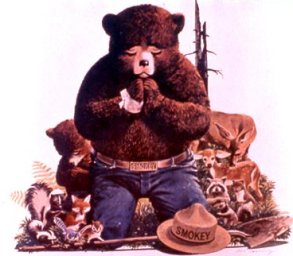
Many Happy Returns to Smokey the Bear!

Today is Smokey the Bear's 75th birthday. One of our favorite poets, 50 long years ago, said what is even more important today and tomorrow and thereafter:

Gary Snyder: Smokey the Bear Sutra


.
Once in the Jurassic about 150 million years ago, the Great Sun Buddha in this corner of the Infinite Void gave a discourse to all the assembled elements and energies: to the standing beings, the walking beings, the flying beings, and the sitting beings–even the grasses, to the number of thirteen billion, each one born from a seed, assembled there: a Discourse concerning Enlightenment on the planet Earth.

“In some future time, there will be a continent called America. It will have great centers of power called such as Pyramid Lake, Walden Pond, Mt. Rainier, Big Sur, Everglades, and so forth; and powerful nerves and channels such as Columbia River, Mississippi River, and Grand Canyon. The human race in that era will get into troubles all over its head, and practically wreck everything in spite of its own strong intelligent Buddha-nature.”

“The twisting strata of the great mountains and the pulsings of volcanoes are my love burning deep in the earth. My obstinate compassion is schist and basalt and granite, to be mountains, to bring down the rain. In that future American Era I shall enter a new form; to cure the world of loveless knowledge that seeks with blind hunger: and mindless rage eating food that will not fill it.” 
And he showed himself in his true form of

SMOKEY THE BEAR


A handsome smokey-colored brown bear standing on his hind legs, showing that he is aroused and watchful.

Bearing in his right paw the Shovel that digs to the truth beneath appearances; cuts the roots of useless attachments, and flings damp sand on the fires of greed and war;

His left paw in the mudra of Comradely Display–indicating that all creatures have the full right to live to their limits and that of deer, rabbits, chipmunks, snakes, dandelions, and lizards all grow in the realm of the Dharma;

Wearing the blue work overalls symbolic of slaves and laborers, the countless men oppressed by a civilization that claims to save but often destroys;

Wearing the broad-brimmed hat of the west, symbolic of the forces that guard the wilderness, which is the Natural State of the Dharma and the true path of man on Earth:

all true paths lead through mountains

With a halo of smoke and flame behind, the forest fires of the kali-yuga, fires caused by the stupidity of those who think things can be gained and lost whereas in truth all is contained vast and free in the Blue Sky and Green Earth of One Mind;

Round-bellied to show his kind nature and that the great earth has food enough for everyone who loves her and trusts her;

Trampling underfoot wasteful freeways and needless suburbs, smashing the worms of capitalism and totalitarianism;

Indicating the task: his followers, becoming free of cars, houses, canned foods, universities, and shoes, master the Three Mysteries of their own Body, Speech, and Mind; and fearlessly chop down the rotten trees and prune out the sick limbs of this country America and then burn the leftover trash.
Wrathful but calm. Austere but Comic. Smokey the Bear will Illuminate those who would help him; but for those who would hinder or slander him… 

HE WILL PUT THEM OUT.

Thus his great Mantra:

Namah samanta vajranam chanda maharoshana Sphataya hum traka ham mam

“I DEDICATE MYSELF TO THE UNIVERSAL DIAMOND BE THIS RAGING FURY BE DESTROYED”

And he will protect those who love the woods and rivers, Gods and animals, hobos and madmen, prisoners and sick people, musicians, playful women, and hopeful children:

And if anyone is threatened by advertising, air pollution, television, or the police, they should chant SMOKEY THE BEAR’S WAR SPELL:


DROWN THEIR BUTTS

CRUSH THEIR BUTTS

DROWN THEIR BUTTS

CRUSH THEIR BUTTS 

And SMOKEY THE BEAR will surely appear to put the enemy out with his vajra-shovel.

Now those who recite this Sutra and then try to put it in practice will accumulate merit as countless as the sands of Arizona and Nevada.

Will help save the planet Earth from total oil slick.

Will enter the age of harmony of man and nature.

Will win the tender love and caresses of men, women, and beasts.

Will always have ripened blackberries to eat and a sunny spot under a pine tree to sit at.

AND IN THE END WILL WIN HIGHEST PERFECT ENLIGHTENMENT

…thus we have heard…

(may be reproduced free forever)
.

NoteSmokey the Bear Sutra is a 1969 poem by Gary Snyder which presents environmental concerns in the form of a Buddhist sutra, and depicts Smokey as the reincarnation of Vairocana Buddha. Snyder composed the poem in one night for a February 1969 Sierra Club Wilderness Conference, at which he distributed the first copies. The poem “may be reproduced free forever,” and has since been widely disseminated in print and electronic forms. [Wikipedia]

Wednesday, April 17, 2019

Leave it on the ground?

As bud burst and the first hint of leaf out appears in our local trees, their stark, harsh Winter outlines begin to soften. We've noticed that particularly in some of the neighborhood aspens. The rain that's falling today, and forecast for tomorrow, combined with the prospect of sunnier, warmer weather later this week means we should be able to sit quietly outside and hear the woods explode with new growth, all except maybe the mosses growing on fallen tree trunks. Unlike trees, which we can watch grow taller year by year, moss growth appears much more subdued, almost nonexistent.

moss growing on a fallen tree
Photo by J. Harrington

We've learned all we know about mosses (precious little though it is) from reading Robin Wall Kimmerer's Gathering Moss: A Natural and Cultural History of Mosses. The existence of mosses on fallen tree trunks and the uses that woodpeckers and those that depend on their cavities make of dead standing trees tempers our desire for a neat, clean, uncluttered wood lot. We're still trying to sort out the ecological role played by fallen trees and how much we can "tidy up" our woodlot without doing serious damage to those that share the neighborhood with us. If we had more ruffed grouse around, and one or more of them used any of our fallen trees as a drumming log, the question would be settled. We've had a soft sport for grouse for all our adult life. Still, there's our intermittent atavistic desire to enjoy a blaze in our fire pit from time to time. We think we've once again reached the point at which "a little knowledge is a dangerous thing." The fact that we've cleared the driveway and thus gathered a bunch of fallen, dead branches from last week's storm(s) will hold us for now. Trying to find a responsible balance point in moderation is an ongoing challenge but at least we don't have to travel hours every day to gather firewood needed for family cooking and to keep a hearth fire going.

The Forest


Susan Stewart1952


You should lie down now and remember the forest, 
for it is disappearing--
no, the truth is it is gone now 
and so what details you can bring back 
might have a kind of life.

Not the one you had hoped for, but a life
--you should lie down now and remember the forest--
nonetheless, you might call it “in the forest,"
no the truth is, it is gone now,
starting somewhere near the beginning, that edge,

Or instead the first layer, the place you remember 
(not the one you had hoped for, but a life)
as if it were firm, underfoot, for that place is a sea, 
nonetheless, you might call it “in the forest,"
which we can never drift above, we were there or we were not,

No surface, skimming. And blank in life, too, 
or instead the first layer, the place you remember, 
as layers fold in time, black humus there, 
as if it were firm, underfoot, for that place is a sea, 
like a light left hand descending, always on the same keys.

The flecked birds of the forest sing behind and before 
no surface, skimming. And blank in life, too, 
sing without a music where there cannot be an order, 
as layers fold in time, black humus there, 
where wide swatches of light slice between gray trunks,

Where the air has a texture of drying moss, 
the flecked birds of the forest sing behind and before:
a musk from the mushrooms and scalloped molds. 
They sing without a music where there cannot be an order, 
though high in the dry leaves something does fall,

Nothing comes down to us here. 
Where the air has a texture of drying moss, 
(in that place where I was raised) the forest was tangled, 
a musk from the mushrooms and scalloped molds, 
tangled with brambles, soft-starred and moving, ferns

And the marred twines of cinquefoil, false strawberry, sumac--
nothing comes down to us here, 
stained. A low branch swinging above a brook 
in that place where I was raised, the forest was tangled, 
and a cave just the width of shoulder blades.

You can understand what I am doing when I think of the entry--
and the marred twines of cinquefoil, false strawberry, sumac--
as a kind of limit. Sometimes I imagine us walking there 
(. . .pokeberry, stained. A low branch swinging above a brook) 
in a place that is something like a forest.

But perhaps the other kind, where the ground is covered 
(you can understand what I am doing when I think of the entry) 
by pliant green needles, there below the piney fronds, 
a kind of limit. Sometimes I imagine us walking there. 
And quickening below lie the sharp brown blades,

The disfiguring blackness, then the bulbed phosphorescence of the roots. 
But perhaps the other kind, where the ground is covered, 
so strangely alike and yet singular, too, below
the pliant green needles, the piney fronds.
Once we were lost in the forest, so strangely alike and yet singular, too, 
but the truth is, it is, lost to us now.


********************************************
Thanks for visiting. Come again when you can.
Please be kind to each other while you can.

Saturday, April 13, 2019

Will the real Green New Deal please stand up?

One of the first, and best, authors writing about climate disruption and its consequences is Bill McKibben. He started with The End of Nature and now, about 30 years later, has a recently published new book titled Falter. It's going on our "to be read" list. Each of these, and several other of his works, point out that "it doesn't have to be this way."

a disrupted climate means perpetual storm clouds
Photo by J. Harrington

Many of the issues and potential responses McKibben identifies are encapsulated in recent legislative documents at the national level and, even more recently, in a Minnesota-specific version. We spent much of today watching snow melt (even for the North Country, this April is anomalous) while wandering the back roads of the internet trying to find resources and sort out our thoughts on whether any of that recent activity represents real accomplishment. In the hopes that you're interested in the question, and to help save some of your time, here's a set of links to major pieces of the puzzle, as we see it [ymmv].
So, we believe that the Green New Deal offers a solid basis for building the kind of cooperation and consensus needed to avoid, or at least moderate, the catestrophic effects of the forces we've unleashed. We further believe that using a candidate's support for (or lack thereof) the New Green Deal (in whatever the current consensus version is) might be a worthwhile litmus test for deciding which Democratic candidates to support in the upcoming national and Minnesota primaries. The folks that produced the "IPCC special report on the impacts of global warming of 1.5 °C above pre-industrial levels and related global greenhouse gas emission pathways" would no doubt appreciate it if we act on the fact that 2030 is no longer 12 years away, we are now down to 11 years and counting. And, taking a wild guess, we bet Bill McKibben wouldn't get too upset if his gloom and doom analyses were proven incorrect, or at least very premature, because the rest of us finally managed to figure out how to pull in the same direction.

Ovid on Climate Change


Bastard, the other boys teased him,
till Phaethon unleashed the steeds 
of Armageddon. He couldn’t hold 
their reins. Driving the sun too close 
to earth, the boy withered rivers, 
torched Eucalyptus groves, until the hills 
burst into flame, and the people’s blood 
boiled through the skin. Ethiopia,
land of   burnt faces. In a boy’s rage 
for a name, the myth of race begins.


********************************************
Thanks for visiting. Come again when you can.
Please be kind to each other while you can.

Thursday, December 13, 2018

a-dee-dee-dee

Last night we read the last "Fall" story in Emily Stone's natural connections book. It was about chickadees and the author's efforts to handfeed chickadees sunflower seeds. We learned a couple of things we think are worth sharing, especially since a brief session with an internet search engine did not enable us to confirm any of the shared tidbits. We'll continue to work on it since what we read fascinated us.
  • In order to maintain their normal 108 degree body temperature, chickadees must eat the caloric equivalent of 250 sunflower seeds each day. They gain up to 10 percent of their body weight in fat each day and burn it off each night to stay warm.
  • Norwegian researchers found that the tit (a chickadee relative) caches up to 80,000 seeds in a single autumn.
black-capped chickadee in Winter
Photo by J. Harrington

Cornell's All About Birds web site provides no information on the quantity of food chickadees consume. Audubon's Field Guide web site also lacks caloric and related details. The BirdNote site informs us that "That perky little chickadee flitting back and forth for sunflower seeds from your feeder eats the equivalent of 35% of its weight."

We wonder where and how naturalists learn the multitude of intriguing details they share with us. No close observation would tell us a chickadees normal body temperature, yet the Sheldrake Environmental Center, in Larchmont, NY, notes that "Half the calories that a bird needs to survive a wintry day could be depleted in the act of shivering. A chickadee, for example, requires the equivalent of 65 sunflower seeds to survive a cold winter day." It would seem widely different sources are needed to account for the difference between caloric equivalent of 250 sunflower seeds and 65 seeds. Maybe, with the warmer weather in the forecast, we'll see if we can get a chickadee to feed out of our hand. Years ago we did that with a white-breasted nuthatch.

The Chickadee


Piped a tiny voice hard by,
Gay and polite, a cheerful cry,
" Chic-chicadee-dee! " Saucy note
Out of a sound heart and a merry throat,
As if it said, " Good day, good sir.
Fine afternoon, old passenger!
Happy to meet you in these places
When January brings new faces! " 


********************************************
Thanks for visiting. Come again when you can.
Please be kind to each other while you can.

Sunday, September 9, 2018

Of hawks and meadowhawks and...

The past few days we've seen a couple of large, beautiful hawks soaring over the fields behind the house. We haven't yet got a close enough look to identify any of the raptors that are visiting. The first sighting was when a very large hawk made a couple of threatening passes at a smaller one perched in an oak tree at the far property line, more than 100 yards away. It is the time of year for hawk migration to be underway. We've not been back to hawk ridge in Duluth for several years, so we can't speak to whether their chart has changed, although we suspect not much, if at all.

Hawk Ridge Migration Timing
Photo by J. Harrington

Another kind of "hawk," the ruby meadowhawk dragonfly, has also been showing up more frequently over the past few days than we saw them over the peak of Summer. That name seems like it should belong to a character in a Louise Erdrich novel, doesn't it? With the end of Summer reduction in mosquitos and deer flies, we're not sure what's left for any remaining dragonflies to feast on.

ruby meadowhawk dragonfly
Photo by J. Harrington

Last, but far from least, our own "hawk eyes" managed to find a couple of resources on the internet that, if read, you might find encouraging and, possibly, even a source of hope. We'll be reading them more than once over the next several months, because they help to nicely frame many of the concerns that are troubling us these days. Each of these contains fundamental concepts that more of us should be intimately familiar with, we believe, and hope you'll agree.

Evening Hawk


From plane of light to plane, wings dipping through 
Geometries and orchids that the sunset builds, 
Out of the peak's black angularity of shadow, riding 
The last tumultuous avalanche of 
Light above pines and the guttural gorge, 
The hawk comes. 

His wing 
Scythes down another day, his motion  
Is that of the honed steel-edge, we hear 
The crashless fall of stalks of Time. 

The head of each stalk is heavy with the gold of our error. 

Look! Look! he is climbing the last light 
Who knows neither Time nor error, and under 
Whose eye, unforgiving, the world, unforgiven, swings 
Into shadow. 

Long now, 
The last thrush is still, the last bat 
Now cruises in his sharp hieroglyphics. His wisdom 
Is ancient, too, and immense. The star 
Is steady, like Plato, over the mountain. 

If there were no wind we might, we think, hear 
The earth grind on its axis, or history 
Drip in darkness like a leaking pipe in the cellar.


********************************************
Thanks for visiting. Come again when you can.
Please be kind to each other while you can.

Wednesday, August 22, 2018

writing nature

One outcome of our recent participation in a workshop about "nature writing" was a reminder that we had started to compile a list of sources of awards on that theme. Even with one or two more incarnations, we doubt if we'd have time to read all the books we already know we'd like to read, let alone those we haven't yet discovered, to say nothing of those yet to be written. Limiting the list to writing about nature and the outdoors probably wouldn't help much, but we need to start somewhere. Perhaps sometime soon we'll get "caught up" enough to add Dwellings, a Linda Hogan book, to our Christmas list, along with some others. We've been trying to get to reading some of her writing for a couple of years now. The writing class included a page-long excerpt from Dwellings.

our Blue Marble, "Nature" from a distance
Photo by J. Harrington


  • Sigurd Olson Nature Writing Award [SONWA] (Northland College)
    Established in 1991, SONWA honors the literary legacy of Sigurd F. Olson by recognizing and encouraging contemporary writers who seek to carry on his tradition of nature writing. In 2004, organizers expanded the award to include children’s literature and in 2015 added the young adult genre. For a full list of winners 1991-present.
  • Henry David Thoreau Prize (PEN America)
    Established in 2010 by Dale Peterson, the Henry David Thoreau Prize is awarded annually to a writer demonstrating literary excellence in nature writing. Previous winners: Gretel Ehrlich, E. O. Wilson, Gary Snyder, Peter Matthiessen, T. C. Boyle, Diane Ackerman, and Linda Hogan.
  • John Burroughs Medal, John Burroughs Nature Essay Award and Riverby Awards
    (John Burroughs Association)
    The John Burroughs Association seeks to enrich lives through nature by encouraging and promoting nature writing. Not only do these literary awards promote nature books and essays and exploration of the natural world, they serve to advance their authors and stand as inspiration to other nature writers.
  • The National Outdoor Book Awards
    National Outdoor Book Awards Foundation, Association of Outdoor Recreation and Education, and Idaho State University
    The purpose of the awards is to recognize and encourage outstanding writing and publishing. Each fall in early November, the NOBA Foundation announces the winners of the ten categories making up the program, including History, Literature, Children, Nature, Natural History, Instructional, Adventure Guidebook, Nature Guidebook, Design, and Outdoor Classic.

Nature, at a more intimate scale
Photo by J. Harrington

Minnesota has its own annual book awards, but there isn't a separate category for nature writing, which is too bad we think since our adopted home state has provided many wonderful and great writers, a fair number of whom have done a superior job of writing about nature in Minnesota as we'll as writing about Minnesota's nature.

OH NATURE


     Today some things worked as they were meant to.
A big spring wind came up and blew down
     from the verdant neighborhood trees,
millions of those little spinning things,
     with seeds inside, and my heart woke up alive again too,
as if the brain could be erased of its angry hurt;
     fat chance of that, yet
things sometimes work as they were meant,
     like the torturer who finally can’t sleep,
or the god damn moon
     who sees everything we do
and who still comes up behind clouds
     spread out like hands to keep the light away.


********************************************
Thanks for visiting. Come again when you can.
Please be kind to each other while you can.

Saturday, August 18, 2018

A natural wonder

This morning, on our way to the Leopold Center, we found several fields full ion flocks of cranes and Canada geese. Several years ago we found some cranes flocking up at the end of August, in fields much closer to home. Oon arrival at the center, we met a room full of a dozen or so writers seeking the wisdom that sits in places in the natural world. (If you get an opportunity too attend something like this, we strongly recommend doing so.) Today's poem bu Joy Harjo is one of the readings we used as a model.

sandhill cranes in St. Croix river valley fields
Photo by J. Harrington

We also got another chance to visit "The Shack." This time in full Summer. Leopold and family did lots of work turning a vacant sand farm into fields and wood lots full of life. We found ourselves wondering if it took more work to create the original sand county farm or to restore life to burned out land. Since we recognized a handful of plants at the Center, and some at The Shack, that also grow in our fields at home, we didn't feel as much as if we were in strange country. That's a good reason to learn your local wildflowers.

Aldo Leopold Center
Aldo Leopold Center
Photo by J. Harrington

Tomorrow's a mostly travel day so we'll probably do a short posting again but we'll add some pictures of the non-writing high points. 'Til then.


She Had Some Horses


By Joy Harjo


I. She Had Some Horses

She had some horses.
She had horses who were bodies of sand.
She had horses who were maps drawn of blood.
She had horses who were skins of ocean water.
She had horses who were the blue air of sky.
She had horses who were fur and teeth.
She had horses who were clay and would break.
She had horses who were splintered red cliff.

She had some horses.

She had horses with eyes of trains.
She had horses with full, brown thighs.
She had horses who laughed too much.
She had horses who threw rocks at glass houses.
She had horses who licked razor blades.

She had some horses.

She had horses who danced in their mothers' arms.
She had horses who thought they were the sun and their
bodies shone and burned like stars.
She had horses who waltzed nightly on the moon.
She had horses who were much too shy, and kept quiet
in stalls of their own making.

She had some horses.

She had horses who liked Creek Stomp Dance songs.
She had horses who cried in their beer.
She had horses who spit at male queens who made
them afraid of themselves.
She had horses who said they weren't afraid.
She had horses who lied.
She had horses who told the truth, who were stripped
bare of their tongues.

She had some horses.

She had horses who called themselves, "horse."
She had horses who called themselves, "spirit," and kept
their voices secret and to themselves.
She had horses who had no names.
She had horses who had books of names.

She had some horses.

She had horses who whispered in the dark, who were afraid to speak.
She had horses who screamed out of fear of the silence, who
carried knives to protect themselves from ghosts.
She had horses who waited for destruction.
She had horses who waited for resurrection.

She had some horses.

She had horses who got down on their knees for any saviour.
She had horses who thought their high price had saved them.
She had horses who tried to save her, who climbed in her
bed at night and prayed.

She had some horses.

She had some horses she loved.
She had some horses she hated.

These were the same horses.


********************************************
Thanks for visiting. Come again when you can.
Please be kind to each other while you can.