Showing posts with label cities. Show all posts

Sunday, May 8, 2022

Happy Mother’s Day to those deserving it

Happy Mother’s Day to those celebrating, unless they’re members of the Grand Oligarchy Party or of similar ilk that has no respect for women. The Democrats' failure to pass legislation embodying Roe v. Wade despite having several opportunities during the past 50 years makes them a little suspect too. Becoming a mother should be a matter of choice more than chance.

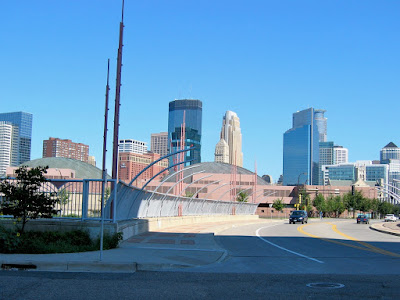
Mother Nature has arranged for drier weather than anticipated today. That’s to the good since we had to do some traveling into The Cities today. What with COVID and other factors, we’ve not been into Minneapolis much over the past two years or so. From lots of what we saw today, despite some changes, we’re not feeling deprived.

a Mother’s Day bouquet

Thunderstorms are forecast a couple of times later in the week. Maybe one or more of them will provide enough rain to make the newly seeded front yard happy. If not, we’ll water in a few days. Meanwhile, there seems to be enough moisture to support bud burst and the beginnings of leafout throughout the area. Spring has finally settled in. 🤞 This year looks like a banner year for forsythia blossoms, but why isn’t clear. Late, wet spring?

We’re about to head off to the Daughter Person’s and Son-In-Law’s for a Mother’s Day celebration. The daisy bouquet our son gave his mother was a big hit. So far, things are going pretty well. May the rest of the day (week, month, year) go as well.


The Raincoat

 - 1976-


When the doctor suggested surgery
and a brace for all my youngest years,
my parents scrambled to take me
to massage therapy, deep tissue work,
osteopathy, and soon my crooked spine
unspooled a bit, I could breathe again,
and move more in a body unclouded
by pain. My mom would tell me to sing
songs to her the whole forty-five minute
drive to Middle Two Rock Road and forty-
five minutes back from physical therapy.
She’d say, even my voice sounded unfettered
by my spine afterward. So I sang and sang,
because I thought she liked it. I never
asked her what she gave up to drive me,
or how her day was before this chore. Today,
at her age, I was driving myself home from yet
another spine appointment, singing along
to some maudlin but solid song on the radio,
and I saw a mom take her raincoat off
and give it to her young daughter when
a storm took over the afternoon. My god,
I thought, my whole life I’ve been under her
raincoat thinking it was somehow a marvel
that I never got wet.


********************************************
Thanks for visiting. Come again when you can.
Please be kind to each other while you can.

Thursday, September 2, 2021

Blue vs. Red; urban vs rural

 In Minnesota, the Democratic Party is called the Democratic-Farmer-Labor (DFL) Party, but you probably knew that. What’s interesting is that farmers tend to vote Republican, while Labor leans Democratic, but not as much as  farmers lean Republican. [source] In the 2020 election, most of Minnesota’s counties voted Republican while Democrats are concentrated in urban areas. [source] Representative government, as I understand it, is supposed to represent people, not acreage, The principle is one person, one vote, right? Yes, there is an exception in the US Senate, but other than that, not so much.

Republicans claim to be opposed to socialism, but farmers are heavily dependent on government for subsidies that enable them to farm at a profit. Labor hasn’t seen an increase in the Federal minimum wage of $7.25/hour since 2009. President Obama and the Democrats "had “total control” of the Senate from September 24, 2009 until February 4, 2010. A grand total of 4 months.” [source] President Biden is faced with a couple of senators who are often Democrats In Name Only, and has to rely on the Vice President’s vote to have a majority vote in a Senate that, by its own rules, requires 60 votes to close debate on a piece of legislation.

I voted button
I voted
Photo by J. Harrington

Meanwhile, at the national level, the Democratic National Committee and similar organizations seem more concerned about keeping the progressives in their place than in building grassroots support among labor or farmers. That’s one of the major reasons I can’t find it in my heart to support mainstream Democratic Party funding requests. I lean heavily toward the progressive end of the political spectrum, but I also live in an exurban/rural location in a metropolitan area and can confirm the DFL is in a minority, but, with “Farmer” as a constituency, don’t believe it has to stay a minority.

Democrats in Minnesota often win statewide races, but the legislature tends to be divided as often as not. Republican state senators are more representative of acres than people, similar to the pattern  at the national level. My  experience has been that the DFL focuses on sure things and hasn’t seemed willing to fight for every possible vote in close districts. That may well prove to be a losing strategy if the signs of disenchantment I’ve been seeing among progressive voters is an indication of how the midterms may play out.

But, you may well ask, aren’t we all better off if we vote Blue instead of Red? That question reminds me of the story about the local gambler who, when  asked why he  played every Friday night in a game known to be crooked, replied that it’s the only game in town. Would he and his family be better off if he found another hobby and a different way to spend Friday nights? Maybe it’s time to find out.


Politics


Tonight Hazard’s father and stepmother are having
jazz for McGovern. In the old game-room
the old liberals listen as the quintet builds
crazy houses out of skin and brass, crumbling
the house of decorum, everybody likes that.

For decades they have paid for the refurbishing
of America and they have not got their money’s worth.
Now they listen, hopeful,
to the hard rock for McGovern.

The ceiling in this palace needs fixing,
the chalky blue paint is like an old heaven
but there are holes and flaking.
They had movies here when grandpa was solvent.

Hazard desires his wife, the way people
on the trains to the death camps were seized
by irrational lust. She is the youngest woman
in the room, he would like to be in bed
with her now, he would like to be president.

He has not been to his studio
in four days, he asks the bartender,
a college boy with a ponytail, for more gin.
He stands in the doorway. Forsythia and lilac
have overgrown the porch, there is the rich
smell of wood-rot. What twenty years will do
to untended shrubbery and America and Hazard.


********************************************
Thanks for visiting. Come again when you can.
Please be kind to each other while you can.
Thursday, February 11, 2021

A trip to "The City"

We had an adventure this morning, a small one. At the invitation of the State of Minnesota, we hied ourselves into the big city of Minneapolis, to the Convention Center, wherein our aged body received its first COVID-19 vaccine shot. All went well except for the ten minutes or so during which we had misplaced where we parked the Jeep and the brief consternation when we read the sign that said parking validation for the 2nd Street Parking Garage wasn't needed and we read our parking ticket which said we had parked in the Plaza garage. Slight case of mixed nomenclature. Our left arm is a little sore but other than that, we think we're doing ok although we are feeling slightly stressed out.


Minneapolis, "The City," near the Convention Center
Photo by J. Harrington

The other thing we learned this morning is that our ears won't support three masks. Having recently read that double masking has been found to be more effective than a single mask, we had two masks on as we traipsed through the skyway  and Convention Center hallways. Upon arrival at the checkin for the vaccination activities, we were handed another mask and politely instructed to put it on also. The first one we tried promptly broke one of the elastic connections to the mask, thereby freeing our right ear from a third binding. The second try at a third mask lasted until we completed checkin and bent forward to get out temperature taken. At that point the second third mask had an elastic to mask connection failure. We replaced that one and the third third mask did hold together until we were back in the Jeep.

It's possible, maybe even probable, that the mask failures were due, in part, to the amount of space behind our ears occupied by our hearing aids. To the best of our knowledge, no one took our picture while our left ear was bent directly out from our head by three ear straps, making us look like one side of the old Mad Magazine mascot and cover boy, Alfred E. Neuman. All in all, as with many things these days, it could have been worse. Then again, some years it could have been warmer than -17℉ on February 11 and other years vaccines against COVID-19 and its mutations didn't require a trip to the big city. It has changed since we last worked or played there.

We have been neglectful of the fact that Black History Month is continuing. Fortunately, the academy of american poets, of which we've been a long-time member, suggests in "poems to read and share"
 

"to celebrate the rich tradition of Black poetry this month and year-round, browse the following classic and contemporary poems:


Still I Rise” by Maya Angelou

Forever” by Paul Laurence Dunbar

Frederick Douglass” by Robert Hayden

Let America Be America Again” by Langston Hughes

Making History” by Marilyn Nelson

little prayer” by Danez Smith

This Body II” by Renée Watson

Declaration” by Tracy K. Smith

This Is Not a Small Voice” by Sonia Sanchez 


********************************************
Thanks for visiting. Come again when you can.
Please be kind to each other while you can.

Sunday, October 6, 2019

On rural poets

This morning I belatedly began listing the poets I've read and enjoyed who lived in rural areas or are largely known for poems about rural areas. The more I pondered, the more I surprised myself. I suspect there's a certain amount of self-selection involved here. There's also a strong counter to those who would consider rural communities full of nothing but parochial bumpkins. None of these poets limited their writings to rural subjects although perhaps considering the universality of rurality is probably a better way to think about that. Here's some of those I've thus far though of:
  • Robert Bly - western Minnesota farm

  • Wendell Berry - Kentucky farm

  • Donald Hall - Eagle Pond Farm in Wilmot, New Hampshire

  • Jane Kenyon - Eagle Pond Farm in Wilmot, New Hampshire

  • Ted Kooser - rural Nebraska

  • Jim Harrison - Patagonia, Arizona; Livingston, Montana; farm in Michigan

  • Robert Frost - Vermont and Massachusetts

  • Joyce Sutphen - southern Minnesota

  • Bill Holm - Minneota, Minnesota
I have no doubt that additional time and effort and thinking would lengthen the list above, probably considerably. What might also be an interesting exercise would be to review the biographies or autobiographies or memoirs of these and similar poets to see what common themes might emerge about why these well educated, literate, intelligent folks chose to live in rural America. Could it be that a society wishing to be truly cultured needs a transect of urban, rural, wild and other places? Do we have more in common than we focus on while we debate which of our differences should prevail?

stone wall fence: urban or rural? fencing in or fencing out?
Photo by J. Harrington

Was Robert Frost anticipating our current "urban / rural divide" when he wrote:


Mending Wall


By Robert Frost


Something there is that doesn't love a wall,
That sends the frozen-ground-swell under it,
And spills the upper boulders in the sun;
And makes gaps even two can pass abreast.
The work of hunters is another thing:
I have come after them and made repair
Where they have left not one stone on a stone,
But they would have the rabbit out of hiding,
To please the yelping dogs. The gaps I mean,
No one has seen them made or heard them made,
But at spring mending-time we find them there.
I let my neighbor know beyond the hill;
And on a day we meet to walk the line
And set the wall between us once again.
We keep the wall between us as we go.
To each the boulders that have fallen to each.
And some are loaves and some so nearly balls
We have to use a spell to make them balance:
‘Stay where you are until our backs are turned!’
We wear our fingers rough with handling them.
Oh, just another kind of out-door game,
One on a side. It comes to little more:
There where it is we do not need the wall:
He is all pine and I am apple orchard.
My apple trees will never get across
And eat the cones under his pines, I tell him.
He only says, ‘Good fences make good neighbors.’
Spring is the mischief in me, and I wonder
If I could put a notion in his head:
‘Why do they make good neighbors? Isn't it
Where there are cows? But here there are no cows.
Before I built a wall I'd ask to know
What I was walling in or walling out,
And to whom I was like to give offense.
Something there is that doesn't love a wall,
That wants it down.’ I could say ‘Elves’ to him,
But it's not elves exactly, and I'd rather
He said it for himself. I see him there
Bringing a stone grasped firmly by the top
In each hand, like an old-stone savage armed.
He moves in darkness as it seems to me,
Not of woods only and the shade of trees.
He will not go behind his father's saying,
And he likes having thought of it so well
He says again, ‘Good fences make good neighbors.’


********************************************
Thanks for visiting. Come again when you can.
Please be kind to each other while you can.

Thursday, March 7, 2019

#OneMinnesota needs board citizen advocates

The campaign theme of Governor Walz and Lt. Governor Flanagan was #OneMinnesota. It is now the guiding vision of their administration. We wish them great success and were pleased to see reports that the Minnesota legislature is moving toward helping our state's future success by reinstalling some of the fundamental building blocks Minnesota needs to bridge its growing divisions.

Once upon a time, no so very long ago, in a nearby state building, there was a Citizens' Board that governed the Minnesota Pollution Control Agency. It last met in 2015, because the legislative session that year, in a fit of pique, eliminated the board. This session, the legislature has begun to rectify its misjudgment. If you're interested in more background about how and why the agency and its board were established, read Grant Merritt's Iron and Water. To gain insight into why the board was eliminated, and should be reestablished, read this article from MinnPost.

The Laurentian may no longer be Minnesota's most significant divide
Photo by J. Harrington

The point we want to focus on today is our hope that we are learning that how we make decisions can be, and often is, as important as the decisions themselves. Legislators are, in our opinion, too susceptible to lobbying by special interests that can also make noteworthy campaign contributions. Appointed citizen board members, not so much. Citizen boards offer another benefit that can be of immense benefit: they don't caucus by political party, so they can work hard to look at facts instead of ideology as they make their decisions.

With some members from rural Minnesota, and others from the major urban centers in the state, we would once again have dialogue that crosses an urban / rural divide. Then, professional staff can focus on fact-gathering and analyses, and board members can concentrate on the balancing act. We need much more of that kind of activity to restore a semblance of civility to our democracy. As we understand it, today a legislative committee in the Minnesota House approved a bill bringing back the MPCA Citizens' Board. We hope the entire legislature enacts the bill and Governor Walz signs it as furtherance of the #OneMinnesota vision. We need legitimate forums, other than predominantly political ones, in which we can discuss and try to resolve increasingly thorny issues with which our society and state will be faced. In fact, we'd really like to see the Minnesota Department of Natural Resources restructured and placed under the guidance of a citizens board. Democracy, to be healthy, depends on decentralized decision-making. Else we move toward a monarchy or a dictatorship. If you don't believe us, just ask Ed Abbey and the members of the Monkey Wrench Gang.

To the Oracle at Delphi


Great Oracle, why are you staring at me,
do I baffle you, do I make you despair?
I, Americus, the American,
wrought from the dark in my mother long ago,
from the dark of ancient Europa--
Why are you staring at me now
in the dusk of our civilization--
Why are you staring at me
as if I were America itself
the new Empire
vaster than any in ancient days
with its electronic highways
carrying its corporate monoculture
around the world
And English the Latin of our days--

Great Oracle, sleeping through the centuries, 
Awaken now at last
And tell us how to save us from ourselves
and how to survive our own rulers 
who would make a plutocracy of our democracy 
in the Great Divide
between the rich and the poor
in whom Walt Whitman heard America singing

O long-silent Sybil, 
you of the winged dreams, 
Speak out from your temple of light 
as the serious constellations 
with Greek names
still stare down on us 
as a lighthouse moves its megaphone 
over the sea
Speak out and shine upon us 
the sea-light of Greece 
the diamond light of Greece

Far-seeing Sybil, forever hidden, 
Come out of your cave at last 
And speak to us in the poet’s voice 
the voice of the fourth person singular 
the voice of the inscrutable future 
the voice of the people mixed
with a wild soft laughter--
And give us new dreams to dream, 
Give us new myths to live by!
Read at Delphi, Greece, on March 21, 2001 at the UNESCO World Poetry Day


********************************************
Thanks for visiting. Come again when you can.
Please be kind to each other while you can.

Sunday, December 17, 2017

Plenty of room at this Inn

The original story of Christmas has Joseph and a very pregnant Mary being turned away from an "inn" in Bethlehem, followed by Mary giving birth in a stable. It was almost a year ago, we think, when we (yr obt svt and his Better Half) received a gift card for accommodations at a more local inn, the Nicollet Island Inn. This morning we used it at brunch. The food and the ambiance were superior. Brunch was leisurely. We're not sure why we don't do this more often. Perhaps we will.

Nicollet Island Inn, view to exterior
Photo by J. Harrington

Nicollet Island Inn, interior view
Photo by J. Harrington

On the other hand, the Inn must somehow have received an exemption from whatever sidewalk shoveling requirements the City of Minneapolis imposes on other folks. Else, we're sure, the sidewalks in front of and along the side of the Inn's building would have been clear(er). Perhaps the risk of slipping and falling is intended as an inducement to use the Inn's valet parking. We wonder if their insurance company knows about this.

Nicollet Island Inn, unshoveled sidewalk
Photo by J. Harrington


             “Your Luck Is About To Change”


(A fortune cookie)


Ominous inscrutable Chinese news
to get just before Christmas,
considering my reasonable health,
marriage spicy as moo-goo-gai-pan,
career running like a not-too-old Chevrolet.
Not bad, considering what can go wrong:
the bony finger of Uncle Sam
might point out my husband,
my own national guard,
and set him in Afghanistan;
my boss could take a personal interest;
the pain in my left knee could spread to my right.
Still, as the old year tips into the new,
I insist on the infant hope, gooing and kicking
his legs in the air. I won't give in
to the dark, the sub-zero weather, the fog,
or even the neighbors' Nativity.
Their four-year-old has arranged
his whole legion of dinosaurs
so they, too, worship the child,
joining the cow and sheep. Or else,
ultimate mortals, they've come to eat
ox and camel, Mary and Joseph,
then savor the newborn babe.

********************************************
Thanks for visiting. Come again when you can.
Please be kind to each other while you can.

Wednesday, December 13, 2017

MAGA -- improve railroad travel!

We've spent four of the past six days on Amtrak's Empire Builder and Lake Shore Limited, traveling from St. Paul to Boston and back after a couple of days and a surprise birthday party in Boston for a younger sister. If we were the type to believe in such things, and we're working on that, we could readily believe that the picture below, taken at St. Croix Chocolate almost exactly one year ago, foretold our recent train travel.

did this foretell, by a year, an upcoming trip?
Photo by J. Harrington

We have vague recollections of other train trips, way back in the late 1940s or early 1950s, We think, but can't confirm, that train is how we traveled from Boston to Atlanta for a couple of years when our father was teaching at Georgia Tech. After our recent trip, and comparing it with plane travel, we'd really like to see Amtrak add some amenities and better market them. More comfortable seats and sleepers, more room in the compartments, some improvements in the menus, although the food was good, and some approached better, the offerings were uneven.

Polar Express at Union Station, Chicago
Photo by J. Harrington

Another noteworthy deficiency we found was the overall lack of decent wifi-internet access. It was entirely missing from St. Paul to Chicago on the Empire Builder and available from Chicago to to around Erie PA and then disappeared again. Also, lake effect snow managed to freeze closed the doors and stairs of several "first class" cars, so we had to detour through a couple of cars to de-train. That's not a fatal flaw, but lake effect snow can't be a surprise and obviously hasn't yet been included as a design basis for passenger rail cars.

Christmas Tree in Union Station
Photo by J. Harrington

Enough of the kvetching. Union Station's Christmas decorations were superb. South Station, in Boston, triggered an ear worm of Jimmy Buffet's old song, as delivered by Willie Nelson. (see below)

We enjoyed the trip, especially the company we traveled with, returned slightly worn but not much tattered and are now trying to finish Christmas preparations and a few projects we left behind while we were gone. It was fun to go traveling and nice to get back home again.

Railroad Lady


by Jimmy Buffett and Jerry Jeff Walker 


She’s a railroad lady
Just a little bit shady
Spending her days on the train
She’s a semi-good-looker
The fast rails they took ‘er
Now she’s tryin’, just tryin’ to get home again

South Station in Boston to the freight yards of Austin
From the Florida sunshine to the New Orleans rain
Now that the rail packs
Has taken the best tracks
She’s tryin’, just tryin’ to get home again

She’s a railroad lady
Just a little bit shady
Spending her life on the trains
Once a Pullman car traveler
Now the brakeman won’t have ‘er
She’s tryin’, just tryin’ to get home again

Once a high balling loner he thought he could own ‘er
He bought her a fur and a big diamond ring
She hopped on for cold cash
Left town on the Wabash
Never thinking, Never thinking of home way back then

But the rails are now rusty
The dining car’s dusty
The gold plated watches have taken their toll
The railroads are dying
And the lady she’s crying
Now she’ tryin’, just tryin’ to get home again

She’s a railroad lady
Just a little bit shady
Spending her life on the train
She’s a semi-good looker
But the fast rails the took ‘er
Now she’ tryin’, just tryin’ to get home again

On a bus to Kentucky and home once again 


********************************************
Thanks for visiting. Come again when you can.
Please be kind to each other while you can.

Sunday, December 10, 2017

Surprise! Birthday

Just a quick note to let you know that we can now reveal the traveling.  We're back in Boston and just left an extended Surprise Birthday Party for our younger sister. We couldn't reveal what we've been doing or where for fear of blowing our cover. More details soon. In some ways, Thomas Wolfe was right, "you can't go home again." Just as Heraclitus was right to tell us that we can't step into the same river twice. (Both we and the river are constantly changing.)

Boston Garden, Frog Pond from Four Seasons Hotel
Photo by J. Harrington

Crossroads

The second half of my life will be black 
to the white rind of the old and fading moon. 
The second half of my life will be water 
over the cracked floor of these desert years. 
I will land on my feet this time, 
knowing at least two languages and who 
my friends are. I will dress for the 
occasion, and my hair shall be 
whatever color I please.
Everyone will go on celebrating the old 
birthday, counting the years as usual, 
but I will count myself new from this 
inception, this imprint of my own desire.

The second half of my life will be swift, 
past leaning fenceposts, a gravel shoulder, 
asphalt tickets, the beckon of open road. 
The second half of my life will be wide-eyed, 
fingers shifting through fine sands, 
arms loose at my sides, wandering feet. 
There will be new dreams every night, 
and the drapes will never be closed. 
I will toss my string of keys into a deep 
well and old letters into the grate.

The second half of my life will be ice
breaking up on the river, rain
soaking the fields, a hand
held out, a fire,
and smoke going
upward, always up.


********************************************
Thanks for visiting. Come again when you can.
Please be kind to each other while you can.

Saturday, October 28, 2017

Greetings from the Iron Range

This is coming to you from snow-covered Embarrass, MN, on the Iron Range. We've already had lunch in Ely, shopped at Wintergreen and Steger Mukluks, and then headed for the B&B we're staying at for the weekend. The Better Half intends to enjoy a sauna this evening and many of the local road names have a Finnish tone to them.

Speaking candidly, we've noticed that snowed-on pines, spruce, tamarack, aspen and birch look a pretty much the same no matter where in Minnesota they're growing. There's just lots more acres of them growing up here than down near The Cities. The snow cover isn't likely to start melting until tomorrow. Weather for the next week or so up here is going to be cloudy, slightly snowy with temperatures in the mid-30's.

Iron Range in October or Chisago County in December?
Photo by J. Harrington

Looking at the empty storefronts as we drove through Biwabik and Gilbert, it's clear that those local economies are hurting. "Downtown" Ely looks healthier and some building renovation was evident. We're wondering how Paul Wellstone's concept, that "We all do better when we all do better" can be made to work effectively throughout Minnesota. As farms have gotten fewer and bigger, rural agricultural centers have faded, some completely away. Mining has been boom and bust for a long, long time. Cities like Minneapolis and St. Paul are prospering in part because they've created their own critical mass. Better high speed internet could help substitute for the physical proximity cities offer, but that's only part of the answer.

South St. Paul used to have an economy dependent on stock yards. They're gone. Wales, in England, once had an economy based on coal, as had Appalachia in the U.S. The world and its economies keep changing. Is Amazon the new Dayton's? What will replace Amazon in a generation? Can a multitude of smaller businesses like Steger Mukluks and Wintergreen clothing begin to replace mining jobs? Our county has solar farms sprouting like weeds. Wind farms and solar farms need to be built, maintained and operated. How much metal recycling is being done in northern Minnesota? How much could be done? How many conferences have been organized at Giants Ridge to explore these and related questions?


North Star


by Sheila Packa


In Hanko, Finland
a young woman boards
the vessel in the Baltic
for a ship across the Atlantic.
The North Star shines in the sky.
She’s carrying in her valise
a change of clothes
a packet of seeds
and the sauna dipper.
Distance pours between constellations
between English words on her tongue
through storms and sun.
In New York City, she buys
a one way ticket
boards the train going
across the continent
arrives on an inland sea.
The winter ground underfoot
is familiar with frost
as she transfers to a northbound
along the Vermilion Trail
in Minnesota.
Ahead of her waits a man
a house to be built
and a fire that burns it down.
Ahead, eleven children
to bear, a few she must bury,
the cows in the barn
needing to be milked.
Unbroken ground only hers to till.
Above her, the North Star
inside the aurora borealis, northern
banners waving welcome —


********************************************
Thanks for visiting. Come again when you can.
Please be kind to each other while you can.

Wednesday, August 5, 2015

How you live -- miles to go before you sleep

My slightly obsessive record keeping makes it easy for me to answer today's bioregional quiz question, a two-parter.

What is the mpg of your vehicle?
How many miles per year does it travel?

Southwestern Minnesota fields
Photo by J. Harrington

Cumulatively, since the day I bought it, my Outback has averaged 28 mpg, 2 to 3 less during Winter and as many more in Summer. Yearly mileage has dropped significantly since I'm no longer working at a job that requires travel to all four corners of Minnesota. The first year I owned this Outback, I drove about 35,000 miles. Now it's closer to 15,000 (with a corresponding drop in my carbon footprint). Curious about how that compares to others in My Minnesota, I searched and found this report by the good folks at the Center for Rural Policy and Development. They raise some points that, at first thought, don't seem to neatly fit withe the old "drive 'til you qualify" approach to housing, nor do they seem to align automatically with the Center for Neighborhood Technology's Housing + Transportation Affordability Index. I agree that housing affordability needs to take into account trade-offs with transportation costs, but I wonder if we also need to take a further hard look at central place theory and some other systemic factors. If we are going to be successful at disbursing concentrated affordable housing, we have to look at transportation costs. If we are going to be successful at making workforce housing affordable and available, we have to look at regional economic patterns and activity. We also need better metrics so we can tell if we're being successful.

Northeastern Minnesota woods
Photo by J. Harrington

Back to the questions and answers. Clearly, I drove more than the average miles per year in a vehicle that got better than average mpg. Do you think if we all converted to electric vehicles, powered by renewable energy, anyone would care about any of these factors except $ per mile driven. That then gets us to the relative effects of fixed (vehicle and insurance) versus variable (maintenance and electricity) costs. It might also get us a lot closer to a zero carbon economy. The technology seems to be there, but the public policy and subsidies we need to change are probably going to require huge battles against entrenched interests. We need to win those battles and learn better how to align our home planet's interests and our own so we can avoid voting against either. Have you read This Changes Everything? It's out in paperback. Try it, you'll like it.

Twin Cities new St. Croix Bridge
Photo by J. Harrington

"Green building" can get us part way to where we need to be, but too many green buildings are in locations where it takes an inordinate amount of energy to get occupants to the building. Not exactly light Summer reading, but definitely worth at least a look if you're interested in improving the alignment of your interests with Gaia's are:
  • A Pattern Language, Christopher Alexander -- look especially at his thoughts on Towns.
  • Design with Nature, Ian McHarg -- will we ever learn not to pave over aquifer recharge areas? And, not to be missed,
  • Planet Drum, Peter Berg -- Bioregionalism

Driving Through

By Mark Vinz 
This could be the town you’re from,
marked only by what it’s near.
The gas station man speaks of weather
and the high school football team
just as you knew he would—
kind to strangers, happy to live here.

Tell yourself it doesn’t matter now,
you’re only driving through.
Past the sagging, empty porches
locked up tight to travelers’ stares,
toward the great dark of the fields,
your headlights startle a flock of
old love letters—still undelivered,
enroute for years.


********************************************
Thanks for visiting. Come again when you can.
Please be kind to each other while you can.

Sunday, July 5, 2015

RE: wilding

One of the basic premises of ecology is that everything's connected to everything else. One of the fundamental concepts Peter Berg, Gary Snyder and others have espoused is that cities need to be "rewilded" or else we humans will lose a critical connection to nature. In principle, I completely agree with all the above. In practice, I started to think about what rewilding actually might mean. Would it mean more mosquitoes and the diseases they carry? I can't see too many people favoring that idea. Does it involve more wood and deer ticks and increased exposure to Lyme disease? The answers to these and similar questions I think has to be "that depends."

Mississippi River, Minneapolis
Photo by J. Harrington

I grew up in a city, then spent several years in what was, at the time, a far-flung suburb, then back to the city. I remember when I was in the first and second grade swiping not yet ripened peaches from the neighbor's back-yard garden. That helped make the city not quite Eden, but reasonably close for a boy with a sense of adventure. City mosquitoes were never a problem, as I recall. They were more so in the exurb where one of the attractions was a local beach only a few mile from where we lived. The Summer before I started high school, I could have grown gills. Mosquitoes and ticks were acknowledged hazards and were swatted and pulled with some regularity. If I wasn't a "free-range" kid, I don't know who qualifies.

flock of turkeys behind the house
Photo by J. Harrington

I think what I'm trying to get at is it may be time to acknowledge we can't always cherry-pick our way through life and there are limitations to our ability to "manage" nature. Mosquitoes feed birds, mosquito larvae feed fish, I liked to go fishing, ticks are why we get married. The key, as with so many things, is to try to attain a balance. I was thinking about that this morning as a flock of turkeys picked their way through the yard. I hoped they were eating whatever ticks were around. Ticks, or their reduction, might be another reason to consider raising chickens, which is sort of like actual family farming, but not being an industrial "chicken grower." I'm not sure I can comfortably fuss about "farmers" (food manufacturers?) ploughing fence row to fence row and using herbicides and pesticides to excess while I simultaneously wish away mosquitoes, ticks and other creepy crawly things that feed the critters I like to watch. You know, it's all trying to hard to cherry pick the good from the not so good.  Speaking of which, I do believe that polluting your community's (or your neighbor's) groundwater is more attributable to industrial growers' (not farmers) greed and self-centeredness than to "that's just the way it is." We'll talk more about that some day soon.

Enemies

By Wendell Berry 
If you are not to become a monster,
you must care what they think.
If you care what they think,

how will you not hate them,
and so become a monster
of the opposite kind? From where then

is love to come—love for your enemy
that is the way of liberty?
From forgiveness. Forgiven, they go

free of you, and you of them;
they are to you as sunlight
on a green branch. You must not

think of them again, except
as monsters like yourself,
pitiable because unforgiving.


********************************************
Thanks for visiting. Come again when you can.
Please be kind to each other while you can.

Sunday, February 15, 2015

Another gray day

Rest in Peace, Philip. Your work here is done, well done.

Philip Levine was a Pulitzer prize winning former U.S. poet laureate, whose poetry has been linked to and cited several times on My Minnesota. He wrote about Americans when we were world leaders in manufacturing real, durable goods and not just vaporous virtual reality. His poem, What Work Is, captures the intensity and ambiguity of work, family, and the passions to which we humans are prone. I have read that he did not suffer fools and have been told I share a similar character trait. Sometimes, I'm outrageously pleased with the company I get to keep, no matter how tenuous the association. As Detroit slowly returns to life, I hope someone there channels Philip's spirit and talent to capture it.

a gray mid-Winter day
Photo by J. Harrington

In the midst of another cold, cloudy, depressing (see above) mid-Winter Minnesota day, the dogs look bored, frustrated and cabin fevered as much as their owners, possibly more. I still haven't figured out how best to balance not wishing my life away and wishing it were Spring or early Summer. Several of the folks I follow on Twitter have been sharing photos of crocuses starting to bloom and other signs of a world that is greening up. The extended local weather forecast is dominated by below average temperatures. Below average in February, in Minnesota, is cold, not Polar Vortex cold, but cold enough to take much of the fun out of being outside. The good new is we aren't getting buried in a never-ending blizzard like the East Coast. The bad news is the snow cover isn't really enough to support snow shoeing, cross-country skiing or sledding. As of today, I think I'm dropping "global warming" from my vocabulary. As far as I can see, we're clearly experiencing climate change brought on by Anthropogenic Climate Disruption. Winters in Minnesota show little sign of warming.

Burial Rites

By Philip Levine 
Everyone comes back here to die
as I will soon. The place feels right
since it’s half dead to begin with.
Even on a rare morning of rain,
like this morning, with the low sky
hoarding its riches except for
a few mock tears, the hard ground
accepts nothing. Six years ago
I buried my mother’s ashes
beside a young lilac that’s now
taller than I, and stuck the stub
of a rosebush into her dirt,
where like everything else not
human it thrives. The small blossoms
never unfurl; whatever they know
they keep to themselves until
a morning rain or a night wind
pares the petals down to nothing.
Even the neighbor cat who shits
daily on the paths and then hides
deep in the jungle of the weeds
refuses to purr. Whatever’s here
is just here, and nowhere else,
so it’s right to end up beside
the woman who bore me, to shovel
into the dirt whatever’s left
and leave only a name for some-
one who wants it. Think of it,
my name, no longer a portion
of me, no longer inflated
or bruised, no longer stewing
in a rich compost of memory
or the simpler one of bone shards,
dirt, kitty litter, wood ashes,
the roots of the eucalyptus
I planted in ’73,
a tiny me taking nothing,
giving nothing, and free at last.


********************************************
Thanks for visiting. Come again when you can.
Please be kind to each other while you can.

Wednesday, February 11, 2015

Of streetcars and rural development

More than once we've promoted the idea that greater Minnesota needs a more diversified economy, particularly on the Iron Range. Apparently, we're not the only ones with similar thoughts. These days more and more resources are being developed to help local communities empower local businesses and develop the local economy. Here are some that have recently caught our eye.

Minnesota, in particular the Twin Cities and our agricultural areas, has long benefited from the development of co-ops. According to the Citizens' Institute on Rural Design [CIRD], "The USDA Rural Development's Rural Business-Cooperative Service helps residents form new cooperatives and improves the operations of existing ones through education, research, technical assistance, publications and funding, and provides much-needed capital in rural areas."

Spring Valley, Minnesota
Photo by J. Harrington

CIRD also highlights an upcoming "Community Builders Webinar: Creative Approaches to Economic Development: What it Takes to Attract and Retain Businesses in Today's Economy on February 25."

The University of Minnesota's own Center for Small Towns will be hosting a Rural Arts and Culture Summit on June 2-4 in Morris. The theme this year is "From the Ground Up: Cultivating Creative People and Places."

rural Chisago County Minnesota
Photo by J. Harrington

I've recently been amused by the Republicans emphasis on greater Minnesota. Once upon a time, so long ago the the Department of Employment and Economic Development was called the Department of Trade and Economic Development, Minnesota had a Rural Development Board. That disappeared in the mid-1990s, during the Republican Administration of Arne Carlson. The DFL controlled the House for many of those years so they may bear some responsibility for abolishing that board. Along about those times or a little earlier, Minnesota produced and regularly updated a Rural Investment Guide. My point is that Minnesota used to have institutions focused on greater Minnesota.

Maybe the trouble started when Earl Butz, a Republican Agriculture Secretary, told farmers to "get big or get out." That philosophy essentially signed a death knell for many rural communities. In 1862, when the USDA was established, about 90% of Americans were farmers. Today its about 2%. Think about how many farmers it takes to support a cafe or a Target store. The growth of bigger farms hasn't much helped rural school districts or businesses. Of course, once we had streetcars in Minnesota too. Now we're faced with the need to rebuild a rural economy and an urban streetcar system because we weren't wise enough to protect what we had. Have we learned any lessons from our history, or will our lack of institutional memory support further destruction of our environment? One of my long-time rural development heroes, Aldo Leopold, once wrote "To keep every cog and wheel is the first precaution of intelligent tinkering." Are we keeping track of all Minnesota's social, economic and environmental cogs in both "The Cities" and greater Minnesota? It would seem not.

Repetition

By Kay Ryan 

Trying to walk
the same way
to the same store
takes high-wire
balance:
each step
not exactly
as before
risks chasms
of flatness.
One stumble
alone and   
nothing
happens.
Few are
the willing
and fewer
the champions.


********************************************
Thanks for visiting. Come again when you can.
Please be kind to each other while you can.

Sunday, December 21, 2014

It's beginning to smell a lot like Christmas

There's lots of activity around the homestead: baking, both cookies and bread, shopping trips, present wrapping, and walking dogs through the "snain" (that's a snow rain mix). In the city this morning, it was coming down in big, wet globs of flakes (unfortunately barely visible in the photo. Funny, you looked much bigger in person Mr. Snowflake.) As we left Nina's, I caught a strong wiff of wood smoke that went amazingly well with the snow flakes tumbling down.

Christmas in the City
Photo by J. Harrington

In the country, our mostly snow "snain" added wonderful highlights and outlines to the reeds and rushes and heightened the sense of being alive with a fresh, damp smell.

snow-covered marsh
snow-covered marsh
Photo by J. Harrington

But the highlight of the day, so far, was the trip into Penzey's, with all the wonderful spice smells inside. We make a trip each year about this time as part of our Christmas tradition. Now, what I want for Christmas next year is a new and improved smart phone that can capture the aromas of places like Penzey's, or the balsam and fraser fir scents at the tree farm or the alive dampness of the marsh. I don't know if anyone's working on that technology yet, but they should be. Many of our memories are entangled with aromas. It would be great to capture what our memories smell like as well as being able to photograph them.


Photo by J. Harrington

Smoke in Our Hair

By Ofelia Zepeda 
The scent of burning wood holds
the strongest memory.
Mesquite, cedar, piñon, juniper,
all are distinct.
Mesquite is dry desert air and mild winter.
Cedar and piñon are colder places.
Winter air in our hair is pulled away,
and scent of smoke settles in its place.
We walk around the rest of the day
with the aroma resting on our shoulders.
The sweet smell holds the strongest memory.
We stand around the fire.
The sound of the crackle of wood and spark
is ephemeral.
Smoke, like memories, permeates our hair,
our clothing, our layers of skin.
The smoke travels deep
to the seat of memory.
We walk away from the fire;
no matter how far we walk,
we carry this scent with us.
New York City, France, Germany—
we catch the scent of burning wood;
we are brought home.


********************************************
Thanks for visiting. Come again when you can.
Please be kind to each other while you can.

Sunday, December 7, 2014

The story of "North?"

The house Home is redolent with the aroma of Christmas cookies, evoking the spirits of Christmas past and those to be. It's possible I've put on a couple of pounds just by inhaling while my Better Half and the Daughter Person take turns at the oven. The stockings are hung on the stairway with care, and I'm debating with myself whether to laugh or cry about the recent effort to rebrand and/or reposition MSP's, and /or Minnesota's "national identity". The first time we noted some of these efforts, we shared some preliminary thoughts here and then here. MinnPost has recently (re)published Camille LeFevre's article from The Line. The gist of the reasoning seems to be that either the state, or the Twin Cities, or the Cities plus Duluth and Rochester (our major urban areas) needs differentiation from the rest of the Midwest in order to be competitive in the new world order. I suspect that, if we were writing a letter to Santa asking for a new identity other than flyover land, Santa might be mightily confused about our lack of clear geographic identification.

stockings hung with care
Photo by J. Harrington

As most of us (all of us?) know, The Twin Cities are very different than Duluth which is also quite distinctive from Rochester (medical destination center anyone?). And yet, as Ms. LeFevre writes:
"Minnesota, as all East and West Coasters know, is famous for its emotionally minimalist, anti-drama approach to life’s challenges, along with a refusal to boast about our accomplishments. And for being a blank screen in the national consciousness, fly-over country in other words. Haven’t we had enough already? Of being misunderstood, overlooked, flown over and disparaged? And of being lumped in with all of the rest of the amorphous Midwest?"
As I can speak to only too well, knowing what you don't want is often a far cry from knowing what you do want. It isn't enough to want to be distinguished from the rest of the Midwest. What do we (all of us, urban us, if the latter, then what about the Iron Rangers and or the farmers?) want to be know as, what do we want to be known for?

Minneapolis -- Mill City
Photo by J. Harrington

I don't believe I'll ever be able to think of Chicago without also remembering Carl Sandburg's wonderful line: "City of the Big Shoulders:" Read the rest of the poem. Then think of a comparable literary description of all or much of Minnesota. Minnesota has been blessed with being home to a fantastically talented assembly of writers and poets. Do any of their lines capture the state of The Cities or the state as Sandburg does Chicago? If not, why?

Some time ago, My Minnesota wrote about 25 books every Minnesotan should read. We never quite got to 25, but the list is notable. One of the wisest marketing folks I know of, Seth Godin, consistently points out the necessity of story in marketing / branding / change. See if what he writes makes sense and how it might apply to Minnesota's brand. I'm still really partial to "the state that works." That way we can include Mill City (Minneapolis), the Saintly City (St. Paul), Medical Center (Rochester), and the air-conditioned city (Duluth) and all of greater Minnesota. When I think of North, I look for Alaska, Inuit, and igloos. (Do you remember the song North to Alaska?) In Minnesota, I think of up to the lake (north being up on most maps). I believe our identity for the 21st century, to be authentic, will also need to include our past.

Earth Day Story

By Stephen Sandy 

I remember the dusty floorboards of wood in the streetcar
Of the Minneapolis Street Railway Company
And the varnished yellow banquettes of tight-knit rattan
Worn smooth by decades of passengers
The worn gleaming brass grips at the corners of the seats
And the motorman’s little bell
Windows trembling in their casings as we crossed the avenue
Liberty dimes falling softly into the steel-rimmed hour glass
The gnarled hand of the motorman near.
My grandmother arranged herself against the seat
Her back as straight as a soldier’s beside me
Her navy hat with velvet band
And net veil down making her head seem distant,
Her dreaming smile and the patient Roman nose,
A repose so deep; from my place
I watched her when we rode like princes
Rattling past traffic stopped on the granite cobbles
Riding downtown together, my hands in hers;
All that so much
That I love yet but feel no sadness for, that
Time crossed out like the trolley tracks taken up
Or entombed under the pliant blacktop of the modernized. 


********************************************
Thanks for visiting. Come again when you can.
Please be kind to each other while you can.