Showing posts with label recycling. Show all posts

Sunday, July 30, 2023

Just some stuff

Today’s posting is brought to you by SiSi and Harry, our two rescue dogs. SiSi’s continuing existence is somewhat miraculous, in light of how much she sheds I wonder there’s anything left of her. Harry, on the other hand, does a better job hanging onto his hair but does his best to destroy his crate every time we have to go out. SiSi necessitates ownership of a heavy duty vacuum; Harry a handful of cleanup tools to deal with the residue on and around the carpet outside his crate. Having dogs means having dog stuff like leashes and toys and food and dishes and collars and combs and crates. You get the picture. If SiSi could learn to run the vacuum and Harry the rug cleaner, today’s posting would be very different. But needing that extra stuff, in large part on their behalf, brought me again to wondering about how much stuff we have. (At the rate I’m exhibiting male pattern baldness, I soon won’t need a hair brush but I’m not shedding on the carpet.)

SiSi and Harry overseeing stuff
Photo by J. Harrington

So, it’s been quite a while since I watched The Story of Stuff. I’m overdue for a re-view. The Better Half and I have reached a point at which we need to start downsizing, No, not beginning with the dogs. At one point, we operated a home based business. We now have an accumulation of file cabinets and desks that don’t get nearly the use they once did. How long should we keep old files and insurance policies? Has a “Downsizing for Dummies” been published?

A decade or so ago I was much more active in fishing and hunting than I am now. I have duck decoys and a duck boat that haven’t been used in years. If I get rid of them will that trigger a sudden desire to take up duck hunting again? (I’m well qualified to write “Duck Hunting for Dummies,” I’ve lived it.)

At the time I acquired everything I now own, it seemed like a good idea but I hadn’t considered ultimate disposal. The Daughter Person and Son-In-Law have expressed no interest in ownership of any part of the three belly boat / float tubes the Better Half and I have acquired over the years. And let’s not even touch on the library of books about fishing, hunting, nature, etc. and -- poetry, that are overflowing shelves and stacks. I have a partial excuse in that libraries frequently fail to carry much of what I’ve wanted to read. So, I’m hoping for some inspiration when I rewatch The Story.... I’m beginning to feel more and more like an old Scandahoovian uncle with newspapers and magazine stacks filling the house with narrow passageways between.


The Green Stamp Book

Child in the thick of yearning. Doll carted and pushed 
like child. The aisles purport opportunities — 

looking up, the women's chins, the straight rows 
of peas and pretzels, Fizzies' foils, hermetic 

boxes no one knows. I'll get it! What thing therein 
— bendy straws, powder blue pack Blackjack gum — 

will this child fix upon? On TV, women with grocery carts 
careen down aisles to find expensive stuff. Mostly, 

this means meat. This, then, is a life. This, a life 
that's woven wrong and, woven once, disbraided, sits 

like Halloween before a child, disguised in its red 
Santa suit, making its lap loom the poppy field 

Dorothy wants to bed. Can I have and the song's begun. 
O world spotted through more frugal legs. O world. 


********************************************
Thanks for visiting. Come again when you can.
Please be kind to each other while you can.

Friday, July 28, 2023

Some errors of our era

We finally got lots of rain last night. The telltale puddle in the driveway was close to full this morning. Yesterday brought several severe storms to our north with winds and hail bringing down lots of leaves and some trees. Meanwhile, the UN secretary general has announced that “the era of global boiling has arrived.” Nevertheless the Biden administration has chosen to not (yet?) declare a climate emergency. Neither have I read that there are any pre-established triggers or criteria for such a declaration.

Meanwhile, closer to home, yet another aquifer puncture has been discovered along Enbridge's Line 3. I’ve not yet learned how all the fines in the world will actually restore the environment, sort of similar to how long it’s estimated to take for earth’s climate to begin to return to “normal” if we ever minimize greenhouse gas discharges. The Wisconsin Department of Natural Resources is being sued to keep it from requiring approved manure management plans for Concentrated Animal Feeding Operations [CAFOs]. In Minnesota, I wonder if there’s any state agency that does as much to support metals recycling as the Minnesota Department of Natural Resources does to support metals mining.

recycling before extraction
Photo by J. Harrington

Back when Manifest Destiny was aspirational, the colonizing powers gave away land to get the country “developed.” In 1972, the Clean Water Act Amendments updated and expanded the “Rivers and Harbors Act (1899), the Federal Water Pollution Control Act (1948), the Water Quality Act (1965), and the Refuse Act (1970)” Folks are still debating the interpretation and coverage of that legislation. There has been no comparable update to the Mining Act of 1872. We have long “settled” and colonized the country from coast to coast. We no longer need to promote extractive industries as an economic development strategy. Protecting and restoring clean air, water, food sovereignty and, probably, manufacturing are more critical priorities if we wish to have a survivable future, let alone a sustainable one.

There’s an old saying in the planning profession: “More of the same never solved a problem.” The same is true of law and politics. We can and must do better and stop the “same old, same old” solutions.


Value Added


No one knew what the stones like squatting frogs
signified. There they were, fuming in rows, out
of the ground; every critic had his explanation
or hers. But—we had to remember—they
 
came to nothing, every one; those large stones
out of the earth served the systems
of those who considered them, as explaining
something about the past it was important
 
for the explainer to explain. And yet
no one had any idea truly; there was no
basis in fact for any view of them, and
they remained like their origins—or like
 
smiling Olmec babies, sweet but ominous figures
come from the earth to reproach us, almost
cheerfully, for our ignorance—a mystery, just
as the probe of our feelings came up with nothing.


********************************************
Thanks for visiting. Come again when you can.
Please be kind to each other while you can.

Tuesday, November 15, 2022

Cycles of transition

Today is National Recycling Day. Although we sometimes think we’re wasting time, we cycled through similar seasons time and again, until we weirded the climate. The big picture pattern is based on the relationship between the sun and the earth, so the solstices and equinoxes should stay pretty much the same, but what happens between those key events may well change a lot unless we do.

We’re halfway through November. It’s just slightly more than five weeks until Winter Solstice, which occurs locally at 3:48 pm on December 21. From then until March 20 at 4:24 pm it will be astronomical winter, which will last for 88 days, 23 hrs, 36 minutes. Spring will then last 92 days, 17 hrs, 33 mins, followed by summer at 93 days, 15 hrs, 52 mins. I suppose we can claim this is proof that Mother Nature is merciful since summer is five days longer than winter, but that would probably get a number of Minnesota’s winter lovers on our case. On the other hand, we’re only 60% of the way through autumn and it’s been snowing for the past three days in a row, so winter lovers get no sympathy here.

sandhill cranes at Crex Meadows
Photo by J. Harrington

Small or shallow ponds are once again getting iced-in. Canada geese are feeding in harvested corn fields. Minnesotans are again proving that, over last summer, they forgot how to drive in the snow, and I’m embarrassed I never realized how many sandhill cranes flock into (onto?) Sherburne National Wildlife Refuge in November. This year set a record we've read. We missed an autumn trip to Crex Meadows in Wisconsin this year, but that makes the prospect of a trip next April even more appealing, although we may have to defer until May if we want to diminish the chances of getting caught  in a spring snowstorm.

The pumpkins we dumped under the pear tree a couple of days ago have disappeared. I’ve not been up there to check for tracks, and the persistent snowfall has probably filled in whatever tracks might have been left, but I’m betting some local deer enjoyed a nice snack. We’ve seen none to speak of on the property for weeks now.


How Soon


The story goes from in a rainfall
to sister walking a field
browned autumn. And when she arrives
winter has come, so the old man
rises from his chair, picks up
matches, pipes and tools, and
walks out to begin again.
 
The sculptures grow by the day,
birds in ice, recognizable
eagles, a bear who began
as a man in a moment of dance.
He does this in ice, all
winter carving at dawn,
carving at dusk.
 
And sister after walking a field
browned autumn, arrives, watches
from the east window, waits,
goes out to him in spring,
taps him on the shoulder
and points to the pools
of water he's standing over.


********************************************
Thanks for visiting. Come again when you can.
Please be kind to each other while you can.
Friday, November 12, 2021

Becoming naturalized

Harry the beagle, the Better Half’s new rescue dog, is settling in nicely. There’s still a few adjustments that are needed but the situation looks promising. Yesterday the Better Half got a COVID vaccine booster. Today it was my turn. Our diligence is due in part to self-preservation tendencies and also because we have a one year old granddaughter who’s not eligible yet for any COVID vaccine. Except for the last item, we can add each of these things to our list of what we have to be grateful for this Thanksgiving.

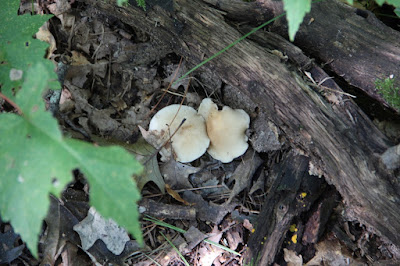
some mushrooms thrive on or near dead wood
Photo by J. Harrington

As of this morning, I’m adding to that list Aldo Leopold’s essay, A Mighty Fortress from A Sand County Almanac. I’ve read and reread his description of the benefits of tree diseases to many forms of wildlife, but it keeps slipping my mind every time there’s a new batch of broken branches covering the driveway and yard. Such was the case this morning after yesterday’s and last night’s storms. That’s when I get tempted to just "get rid of all these dead branches and diseased trees," forgetting once again that nature’s way is not the way of middle-class America’s tendency to excessive neatness.

brush pile and lightning-struck oak
Photo by J. Harrington

Most years by this time the brush pile in the backyard would have been reduced to ashes at least once and maybe twice. The folks at the Xerces Society have educated me to the benefits of brush piles for pollinators and other creatures. We’ll let the brush pile stand throughout winter and, barring the unexpected, let the dead oaks stay as they are. The pileated woodpeckers seem to appreciated that and, no doubt, so do a number of other critters we haven’t noticed.


The Nurse Tree


Why waste away in a box
when you could be a nurse tree?
That’s what they call dead logs:
mushroomeries of the woods.

Your living room’s a wood
of couches, books, and chairs.
You’re dead not at all, but
could you be preparing

for things to grow inside
the chest of the log
you plan to become:
cherished compost heap

where heat turns the brown
mess of feelings, sorry,
that’s peelings, into comp-o-
sition? For we who love

our hands in dirt, a leaf skirt
decomposing seems an ideal
station between this life and
next: I visit your room

as on a forest walk. Passing
a fallen log — is that you? — 
I see a scarlet fungus cap
pop up from friable bark.


********************************************
Thanks for visiting. Come again when you can.
Please be kind to each other while you can.
Wednesday, June 26, 2019

Can mining be sustainable in Minnesota?

Back around the turn of the millennium, I read a book by John Elkington titled Cannibals With Forks. The title derives from a question the Polish poet Stanislaw Lec asked, “Is it progress if a cannibal uses a fork?” Reading recent articles about mining in Minnesota and the degree to which environmental regulators might be aiding and abetting mining companies who cannibalize Minnesota's social and natural environment, leads me to believe that, if we want to progress, it's past time for a new and more rigorous framework for permitting mines and mining in this state. We offer the following outline not because we expect it to be fully adopted, but because we've seen so little recognition that others have already mined the vein of making mining sustainable. (Sorry, couldn't resist.)

Let's start with four principles identified as a basis for The Natural Step approach to sustainability:
In a sustainable society, nature is not subject to systematically increasing …
  1. … concentrations of substances from the earth’s crust (such as fossil CO2 and heavy metals),
  2. … concentrations of substances produced by society (such as antibiotics and endocrine disruptors),
  3. … degradation by physical means (such as deforestation and draining of groundwater tables),
…and in that society …
  1. … there are no structural obstacles to people’s health, influence, competence, impartiality and meaning.
These factors are explored in some detail at Is there Mining in a Sustainable Society.

Another basic approach is described by Donella Meadows in Indicators and Information Systems for Sustainable Development, in which she wrote:
The three most basic aggregate measures of sustainable development are the sufficiency with which ultimate ends are realized for all people, the efficiency with which ultimate means are translated into ultimate ends, and the sustainability of use of ultimate means.
Those aggregate measures translate into the following basic hierarchy (see page 42 in the linked report for a more complete description):
  • Well-being (ultimate ends)
  • Social capital (intermediate ends)
  • Human capital (intermediate means/ends)
  • Built capital (intermediate means)
  • Natural capital (ultimate means) 
To put it in simple terms related to mining, the natural capital of ore is extracted and processed using built and human capital that creates jobs in healthy communities (social capital) inhabited by fulfilled, healthy families living in a healthy environment (well-being).

iron mine "spoils" Minnesota's Iron Range
Photo by J. Harrington

Not many / any mining operations function sustainably today and, in historical terms, the situation has been even worse. That's why there are so many abandoned mines continuing to pollute the environment with toxic substances. We'll touch on some of those details in coming days. For now, be aware that there's a significant gap between any mining operation and a sustainable community, but, it may not have to be that way. To get near sustainable mining in Minnesota will require more than more stringent regulations. Would that it were that simple.

We're going to share the usual poem we put here a stanza at a time. It's a long poem but, we believe, fits really well with the theme.

Conflict Resolution for Holy Beings

By Joy Harjo


I am the holy being of my mother's prayer and my father's song
                                                      —Norman Patrick Brown, Dineh Poet and Speaker

1. SET CONFLICT RESOLUTION GROUND RULES:

Recognize whose lands these are on which we stand.
Ask the deer, turtle, and the crane.
Make sure the spirits of these lands are respected and treated with goodwill.
The land is a being who remembers everything.
You will have to answer to your children, and their children, and theirs—
The red shimmer of remembering will compel you up the night to walk the perimeter of truth for understanding.
As I brushed my hair over the hotel sink to get ready I heard:
By listening we will understand who we are in this holy realm of words.
Do not parade, pleased with yourself.
You must speak in the language of justice.


********************************************
Thanks for visiting. Come again when you can.
Please be kind to each other while you can.

Saturday, September 16, 2017

Autumn leaves #phenology

It is a pensive, cloudy morning. Summer's leaves leap from the only home they've ever known onto the backs of passing winds. Their rides will be brief but, oh, so exhilarating! Freedom comes rarely for them. It will be eons before they get this thrill again. First, they must spend Winters and many seasons following as they reshape and return to their source. Only then can their journey again become a climb to reach for the heavens.

leaving home
leaving home
Photo by J. Harrington

destination unknown
destination unknown
Photo by J. Harrington

journey interrupted
journey interrupted
Photo by J. Harrington

Wish them timely, uninterrupted journeys and godspeed on their return.

                     Immortal Autumn


I speak this poem now with grave and level voice   
In praise of autumn, of the far-horn-winding fall.

I praise the flower-barren fields, the clouds, the tall   
Unanswering branches where the wind makes sullen noise.

I praise the fall: it is the human season.
                                                                  Now
No more the foreign sun does meddle at our earth,   
Enforce the green and bring the fallow land to birth,   
Nor winter yet weigh all with silence the pine bough,

But now in autumn with the black and outcast crows   
Share we the spacious world: the whispering year is gone:   
There is more room to live now: the once secret dawn   
Comes late by daylight and the dark unguarded goes.

Between the mutinous brave burning of the leaves   
And winter’s covering of our hearts with his deep snow   
We are alone: there are no evening birds: we know   
The naked moon: the tame stars circle at our eaves.

It is the human season. On this sterile air
Do words outcarry breath: the sound goes on and on.   
I hear a dead man’s cry from autumn long since gone.

I cry to you beyond upon this bitter air.


********************************************
Thanks for visiting. Come again when you can.
Please be kind to each other while you can.

Thursday, November 19, 2015

Will the Iron Range be going in circles?

The Timberjay has a very worthwhile read on competing visions for the future of northern Minnesota. It prompted me to do a little checking on the context for those future visions, particularly regarding what to expect for future demand of metals mining. Fortunately, McKinsey & Co., "the trusted advisor and counselor to many of the world's most influential businesses and institutions," has a relatively recent (2013) report on Resource Revolution: Tracking global commodity markets, in which they write about:
"transport sector" headed for Duluth
Photo by J. Harrington

Disruptive demand-side technologies and recycling. There is a large opportunity to curtail future demand for metals through technology that increases the efficiency with which we use metals, and through increased recycling. Past McKinsey research has found potential to address up to 13 percent of 2030 steel demand through, for example, higher use of high- strength steel.51 Even more impact on demand could be achieved through the adoption of the “circular economy” concept that aims to reduce, re-use, and recycle resources. A circular economy is an industrial system that is restorative or regenerative by intention and design. It replaces the “end-of-life” concept with restoration; shifts toward the use of renewable energy; eliminates the use of toxic chemicals, which impair re-use; and aims for the elimination of waste through the superior design of materials, products, systems, and within this, business models.52 Take the example of washing machines. Over a 20-year period, replacing the purchase of five 2,000-cycle machines with the lease of one 10,000-cycle machine would also yield almost 180 kilograms of steel savings. In total, the Ellen MacArthur Foundation estimates that more than 100 million tons of iron ore use could be avoided by 2025 if the circular economy were to be broadly applied in the steel-intensive automotive, machining, and other transport sectors that account for about 40 percent of demand. The opportunity to boost recycling is significant. Strong demand for metals over the past decade that has led to high resource prices means that a significant amount of scrap metal is available. Recycling of precious metals has more than doubled since 2005.53 [emphasis added]
When I think about the number of times I've encountered a reference to a "new normal," and I anticipate the rock (business as usual) and the hard place (transition to a low carbon economy) and see more and more reports on what it will cost if we don't monumentally reduce iur greenhouse gas emisions and fossil fuel consumption, I see increasingly greater likelihood we'll have a circular economy to go with our renewable energy future. I don't think that combination bodes particularly well for the recovery of iron mining or the economic future of copper mining in Minnesota. McKinsey offers these insights on the environmental implications of future mining:
Incorporating environmental externalities. The mining industry could face increasing pressure from regulators to pay for inputs such as carbon and water that are currently largely un-priced. A carbon price would have the most direct impact on coal producers (discussed in the energy section of this survey) but would also have an indirect impact on other operators through increases in the cost of energy inputs. Pricing water could have a dramatic impact on costs—and constrain output—given that 32 percent of copper mines and 39 percent of iron ore mines are in areas of moderate to high water scarcity, according to Trucost. Analysis by McKinsey and Trucost shows that pricing water to reflect its “shadow cost” (i.e., the economic value of the water if put to its best alternative use) could increase iron ore costs by 3.3 percent across the industry. A price of $30 per tonne of carbon emissions could increase the cost of iron ore by 2.5 percent. Goldman Sachs has estimated that a hypothetical $10 per tonne carbon tax would have reduced profits of mining companies by around 2 percent in 2011.50 In water-scarce regions, some operators could face increased costs of up to 16 percent from the combined costs of water and carbon emissions.
Grand Marais harbor
Grand Marais harbor
Photo by J. Harrington

It seems to me that too many who support hard rock mining and anticipate the "return" of taconite mining are missing the point that the Iron Range may well have lost much of its competitive advantage of selling to nearby markets. From what I read, there are much larger, less expensive mines being developed and the prospect that mining at Minnesota's scale can be successful in a global market looks questionable to me. Minnesota's Eighth District congressman recognizes the added dangers that a TransPacific Partnership trade agreement would impose on northern Minnesota's mining sector, but a Democratic president and a Republican congress may not care. How many times do we need to hear the lyrics to North Country Blues before the message starts to sink in? Increased costs, increased regulation and increased reuse don't offer much in the way of a bright, shiny future for ore-based metal commodity market growth, do they?

Urban Affection

By Emanuel Xavier
for Walt Whitman 
Besides the obvious technological and architectural advances, only one thing has really changed between our generations:
We now live in an America where blacks are not only allowed the right to vote but can become the Redeemer President of the United States
Otherwise, we still live in an America where the audacity to openly enjoy the pleasures of sex and being respected for wisdom are contradictions without reconciliation
We still live in an America where the economy collapses while the masses are consumed with preventing the rights of anyone with a fancy for anything out of the ordinary
We still live in an America where rotting leaves, tufts of straw, and debris are found in more homes than poetry books
We still live in an America where Christ and Dracula provide both excitement and fear for restless lives longing for a simple touch
We still live in an America where the impact of urbanization reaches out to the common person more than the obscene nature of poetry
We still live in an America where writing about prostitution is considered trashy and profane
We still live in an America where poets have to work while publishing to survive financial difficulty unless they are fashioned like Shakespeare
We still live in an America where, unless you belong to a church, you are a religious skeptic believing in nothing
We still live in an America where overt sexuality, siding with the barnburners, and authoring disreputable books limit poets to a vagabond lifestyle
We still live in an America where breaking tradition and the boundaries of poetic form are considered the trademarks of a pretentious ass
We still live in an America where everything from thieves to dwarfs to fog to beetles deserve validity
We still live in an America where books cannot prevent war and the sick and wounded need healing
We still live in an America where not everyone can appreciate the beauty of immigration, crowded streets, brutal differences, urban affection
We still live in an America where the same sun that once invigorated your passion continues to provide us with the beauty of life worth fighting for
We still live in an America where America still lives in us
  

********************************************
Thanks for visiting. Come again when you can.
Please be kind to each other while you can.

Thursday, July 30, 2015

How you live -- recycling plastics

I didn't know it at the time, but I first encountered the idea of recycling when I was much younger and learning to fly fish. That's when I read Lee Wulff's famous statement “Game fish are too valuable to be caught only once.” Catch and release fishing is one form of recycling a resource.

old barns with little or no plastic can be deconstructed and recycled
Photo by J. Harrington

Bioregional living includes the recognition that nature doesn't produce waste, resources are recycled and natural economies are circular. One way to avoid waste is not to produce it in the first place. Another is to find alternate uses for products when their primary purpose has been served. A third is to recycle products that aren't suitable for reuse. I don't know about you, but I keep forgetting that the concept to "reduce, reuse, recycle" what would otherwise become "waste" is actually a hierarchy. Sliding down that hierarchy to recycling brings us to today's bioregional question.

bookshelves made from recycled barn roofing boards
Photo by J. Harrington

What types of plastic are accepted by your regional recycling center?

Minnesota counties have long played lead roles in Minnesota's solid waste management system. Recycling legislation was enacted in 1973. [Full disclosure: I have from time to time over the years worked in and on the periphery of the Twin Cities Metropolitan Area solid waste planning sector.]

Chisago County requires household waste collectors to provide recycling collection including: Chisago County Curbside Recycling "Plastics: milk jugs, water, soda, and juice bottles, condiment, dish, and detergent bottles, shampoo, soap, and lotion bottles. No plastics without a recycling number stamped on it"

Our household waste collection service accepts: "Plastic containers marked with a number 1-7 recycle logo. No plastic bags." So the answer seems to be "all plastics identified as recyclable."

[UPDATE: Meanwhile, the search for sustainable plastics continues.]

The Bear at the Dump

By William Matthews 

Amidst the too much that we buy and throw   
away and the far too much we wrap it in,   
the bear found a few items of special
interest—a honeydew rind, a used tampon,   
the bone from a leg of lamb. He’d rock back   
lightly onto his rear paws and slash
open a plastic bag, and then his nose—
jammed almost with a surfeit of rank
and likely information, for he would pause—
and then his whole dowsing snout would   
insinuate itself a little way
inside. By now he’d have hunched his weight   
forward slightly, and then he’d snatch it back,   
trailed by some tidbit in his teeth. He’d look   
around. What a good boy am he.
The guardian of the dump was used
to this and not amused. “He’ll drag that shit   
every which damn way,” he grumbled
who’d dozed and scraped a pit to keep that shit   
where the town paid to contain it.
The others of us looked and looked. “City   
folks like you don’t get to see this often,”   
one year-round resident accused me.
Some winter I’ll bring him down to learn   
to love a rat working a length of subway   
track. “Nope,” I replied. Just then the bear   
decamped for the woods with a marl of grease   
and slather in his mouth and on his snout,   
picking up speed, not cute (nor had he been   
cute before, slavering with greed, his weight   
all sunk to his seated rump and his nose stuck   
up to sift the rich and fetid air, shaped   
like a huge, furry pear), but richly
fed on the slow-simmering dump, and gone   
into the bug-thick woods and anecdote.


********************************************
Thanks for visiting. Come again when you can.
Please be kind to each other while you can.

Saturday, March 7, 2015

Spring: it's started

The midday temperature is about 40F. The road is about half mud. Wild River State Park is demonstrating how to tap a maple tree. The snow on the roof is melting and the drips are forming icicles and then mud. Eventually, the groundwater will get recharged. Runoff will reach the Sunrise River and then the St. Croix. Spring's high water will, in several months, become Summer's lower flows. By then, sap will have been turned to syrup. Eggs will have turned to hatchlingsand then nestlings and then a new generation of birds will be on the wing. If we're lucky and pay attention, we'll notice and enjoy at least some of these changes. Seeds will sprout, flowers blossom, butterflies and bees pollinate and fruits and seeds develop. Life's annual cycle continues. As far as we know, it couldn't happen without water.

the start of Spring's flows
Photo by J. Harrington

Here are today's Shades of Green with links to color definition and images.
Doesn't Spring, with it's rebirth and regrowth and returning of migrants seem like the beginning of the year? When you think of the seasons, do you think of life, including your own, more as a circle, or as a straight line? Scientists claim we are comprised of atoms that started, billions of years ago, in the stars. Joni Mitchell, years and years ago, wrote in her haunting hit  Woodstock: "we are star dust, we are golden." Could this mean we are the ultimate recyclables. That would fit with Einstein's concept that matter can neither be created nor destroyed, wouldn't it?. Do you suppose we'll ever manage to redefine capitalism from creative destruction to creative reuse and recycling? I hope so, because it's looking more and more to me as if that's likely to be the way we'll be around long enough to "get ourselves back to the garden."

Recycling Center

By Brenda Hillman 

The labeled bins on the California hillside
catch the glint and quarter-glint of passing cars.
Families pull up with their interesting trash
and start unloading: Here, sweetheart,
this goes over in Newspaper. The bundle
hits with a thud. Diet soda cans
spin almost noiselessly down, and the sun-
permitting bottles from a day’s pleasure
are tossed into Mixed Glass by the children
who like to hear the smash, unknowable, chaotic,
as matter greets itself and starts to change.

What mystery is inside a thing! If we peered
into the bin, we could see it waiting there,
could believe everything is alive and specific
and personal, could tell by the tilt of one
bottle against the next that it’s difficult
to be singular, to have identity, to keep
an outline safe in the terrors of space.
Even the child knows this. Bye, bottle! she shouts,
tossing it in; and the bottle lies there
in the two o’clock position, temporarily itself,
before being swept into the destiny of mixture. . .

And what if some don’t want to. What if some items
in the piles of paper, the orange and blue
envelopes from a magazine sweepstakes, numbers
pressing through the cloudy windows
with our names, some among those pale sheets curled
with moisture, would rather stay as they are.
It’s spring; we’ve thrown away mistakes—
tax forms, recipes, tennis-ball-sized
drafts of poems—that which was blank
shall be made blank again—but what if
that failed letter wants to be a failure,
not go back to pulp, and thought .. .
Or across the parking lot, where light insists
on changing the dull cans, a few cans don’t want
to be changed, though they should want to,
shouldn’t they, should want to be changed
by light, light which is called sweet reason,
honeyed, spectra, magnitude, light that goes
from the parking lot looking helpless
though it is matter that has been betrayed. . .

All afternoon the bins are carried off
by those who know about where things should go,
who are used to the clatter the cans make,
pouring out; and the families, who believed change
would heal them are pulling away in their vans,
slightly embarrassed by that which refused . . .
The bins fill again with hard substances,
the hills bear down with their fugitive gold,
the pampas grass bending low to protect
what was briefly certain and alive with hope. 


********************************************
Thanks for visiting. Come again when you can.
Please be kind to each other while you can.

Monday, August 26, 2013

Trash talking

photo of black chokeberry awaiting compost mulch
© harrington
Hi. Let's get straight to today's question, shall we? That is: "9.    Where does your garbage go?" The straightforward answer is: The garbage (food waste) goes to the compost heap along with the yard waste and eventually becomes soil enrichment helping us to grow more food. Our post-consumer recycling is picked up and presumably (I've never followed the truck) goes to an aggregation/bundling center and then to processing facilities. Our trash goes to the local sanitary landfill, located one municipality south of us. We also participate in a rural equivalent of a "freecycle" by taping "FREE" signs to still usable but no longer wanted items and leaving them by the road. See why it's essential to clarify what's meant by "garbage" to answer this question? Ted Kooser nicely mixes these meanings and more in this poem:

In the Basement of the Goodwill Store

By Ted Kooser
In musty light, in the thin brown air   
of damp carpet, doll heads and rust,   
beneath long rows of sharp footfalls   
like nails in a lid, an old man stands   
trying on glasses, lifting each pair
from the box like a glittering fish   
and holding it up to the light
of a dirty bulb. Near him, a heap   
of enameled pans as white as skulls   
looms in the catacomb shadows,   
and old toilets with dry red throats   
cough up bouquets of curtain rods.

You’ve seen him somewhere before.   
He’s wearing the green leisure suit   
you threw out with the garbage,   
and the Christmas tie you hated,   
and the ventilated wingtip shoes   
you found in your father’s closet   
and wore as a joke. And the glasses   
which finally fit him, through which   
he looks to see you looking back—
two mirrors which flash and glance—
are those through which one day
you too will look down over the years,   
when you have grown old and thin   
and no longer particular,
and the things you once thought   
you were rid of forever
have taken you back in their arms.
Tomorrow we'll be halfway through the quiz when we answer question "10.    How long is the growing season where you live?" Come again when you can. Rants, raves and reflections served here daily, often with a rasher of poetry.