Showing posts with label non-point sources. Show all posts

Friday, March 8, 2024

A step in a hopeful direction

There are sayings that “There is no waste in nature” and “Nature wastes nothing.” You may have seen writings about a “circular economy.” Based on a recent article in MinnPost, and related materials, the sayings are true, the writings are coming true, and the Green New Deal is turning blue. Here’s a reprint of the MinnPost piece to save you the trouble of following a link. Combining pollution control with economic development is what nonpoint source pollution has been waiting for. I’m on my way to sign up for more information. Enjoy!!

How innovation in technology used to manage and treat water could spur economic development

The University of Minnesota is partnering with a consortium of science and engineering researchers across the Great Lakes region to develop technological innovations around water management and resource conservation. 

The consortium, Great Lakes ReNEW, will receive up to $160 million over the next decade from the U.S. National Science Foundation to focus on how it could create new technologies and use them to boost the economies of Illinois, Indiana, Michigan, Minnesota, Ohio and Wisconsin. 

“The basic concept is to make research investments at a regional scale that involves university researchers, but also partners in the corporate sector and in the community, and invest in a way that creates innovation that would lead to economic development in the region,” said Jeffrey Peterson, director of the university’s Water Resources Center and one of the school’s co-leads on the project.  

The university put together a proposal to join the consortium last year. It was linked with a proposal from another group, Current, a Chicago-based organization that focuses on water innovation across the Great Lakes region. 

Developing technologies

The work of the consortium includes technologies to manage and treat water that seek to minimize negative impacts on the climate. They can sometimes have added benefits like recovering waste from water and turning it into something economically valuable. 

“There's many things that are connected to (water management) that might not be so obvious,” Peterson said. 

Those include sensors or advancements in data science and analytics that can monitor large data streams that come from those sensors, he said. 

The ultimate goal of the project is to get the ideas out of a lab and into the field. The researchers will look at how to improve productivity for Minnesota’s farmers by recovering nitrates from water and re-using them to fertilize land. 

The University of Minnesota is working on a project to recover nutrients from water. It also has a project that focuses on sensors that can detect nutrients like nitrates, phosphates and heavy metals in water, which Tianhong Cui, the co-lead of the University of Minnesota project and professor of mechanical engineering, will be working on. 

Jeffrey Strock, a professor and soil scientist at the University of Minnesota’s Southwest Research & Outreach Center in Lamberton, is involved with this effort. He works on different innovations to help crop and livestock farmers have good productivity, profitability and environmental quality. 

He’s excited about the project because there’s so much collaboration from people in different disciplines. 

Recycling water and nutrients

Some of the solutions Strock is looking at involve storing water on landscapes in ditches or farm ponds. By doing that, water could be “recycled” and irrigated back onto the landscape, allowing the resources like nitrogen and phosphorus — which were either applied as fertilizer or were already in the water — to not go to waste. 

“If you think about the last three years … we've had moderate to severe droughts in different parts of the state. Some places like Southern Minnesota, we don't have wells for irrigating like you do in sandier soils in central Minnesota,” Strock said. “But what we do have are these farm ponds and these drainage ditches where we can take drainage water that's been temporarily stored, pump it back out of those reservoirs back onto the landscape and irrigate some of the land that might be under drought conditions. It ends up bringing that water full circle.” 

He said most agricultural areas don’t have bodies of water that can be used for storage, so some innovations have involved adjustments to drainage ditches to slow the flow of water, similar to how urban drainage systems manage stormwater runoff.
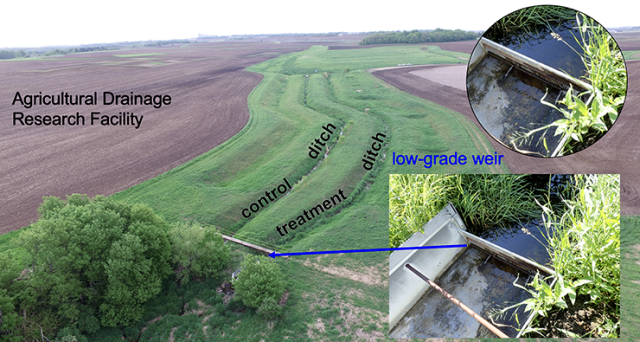
Some of the solutions Strock is looking at involve storing water on landscapes in ditches or farm ponds.
Some of the solutions Jeffrey Strock, a professor and soil scientist, is looking at involve storing water on landscapes in ditches or farm ponds.

“(That) can potentially help with, you know, downstream flooding. It can potentially help with things like reducing nutrients, like nitrogen and phosphorus, that might be in the water,” Strock said. 

Cui is developing sensors that can monitor nitrogen, phosphorus and heavy metals in drainage water in real time. Strock said having that data from the sensors will allow certain water management processes to happen in preparation for weather events, creating more productivity for farmers and keeping the water quality up to standards. 

“Say they know there’s a storm coming — those sensors will allow water in water bodies to drain and create storage capacity. Before that storm event we can drain more rapidly some of the water … that's currently there,” Strock said. “Then that storm event happens, conceptually what our idea here is, you can actually then slow that water back down and create some storage capacity in that system, to then hold back the new flush of water and nutrients that might be coming out of our (agricultural) lands.” 

Strock is working with the Cottonwood Soil and Water Conservation District, which has an 11,0000-acre watershed. He applied for a grant through the state’s Environment and Natural Resources Trust Fund, which he thinks could complement the larger U.S. National Science Foundation grant and help to manage and clean the water in the drainage ditches that lead to Cottonwood Lake. 

The technology developed through the NSF research, he said, could really help the Cottonwood district. “There's an absolute application of the technology that we're developing in a watershed like that,” he said. 

A ‘decarbonized’ economy

The “Great Lakes Water Innovation Engine,” which the University of Minnesota is part of, is one of ten such engines that seek to improve innovation across the nation and foster regional economic competitiveness through a near $1.6 billion investment from the NSF. 

A central focus of the grant is creating a “decarbonized circular blue economy,” which Peterson described as a system of water management that can also generate economic value for the region. 

Cui, for example, is in communication with companies in the water management sector who would be interested in implementing these technologies. Those private companies are who municipalities would then work with in implementing the technologies in water treatment plants.

“You're taking resources out and reusing them for other things and creating value along the way. That circular blue economy that's being referenced, there's the circularity of resources associated with water and, hopefully, finding technologies that generate new kinds of economic value,” Peterson said.

This article first appeared on MinnPost and is republished here under a Creative Commons license.


********************************************
Thanks for visiting. Come again when you can.
Please be kind to each other while you can.

Tuesday, June 7, 2022

It’s about dancing with systems

 One of the nice things about below average temperatures in June is that the bread baking season continues to warm the house and make it smell good. Come late July and August, the heat and humidity diminish the need for taking a chill off and offer a chance the baker may get even more light-headed than usual if he overdoes the amount of baking. Then again, June’s below average temperatures mean the furnace is off and it takes much longer for the dough to rise. During the actual heating season I use the upstairs bathroom, with the door closed, as a proofing room. That doesn’t work worth a damn when there’s no heat or the AC is on.

beardtongue (Penstemon grandiflorus)
Photo by J. Harrington

The beardtongue will be in bloom later today or tomorrow. Then we’ll be “in the pink.” [Couldn’t resist.] Using the dates on photos from other years, those blooms are just about on schedule. Climate scientists have alerted us to the likelihood of greater variability and intensity of storm events. I don’t recall seeing anything about greater variability in seasonal events due to climate weirding. I suspect I may have a better feel for that in a few weeks because I’m now in the midst of doing some stormwater research to see what, if anything, is projected as future “design storms.” In that process, I may well stumble into some descriptions of seasonal variability effects.

I’m not an engineer, but I’ve worked with several. As I understand it, the current “period of record” for stormwater management is 1971 - 2000 for most of Minnesota. I’ll look for updates because I believe that the variability of storms and precipitation patterns have increased over the past few decades. Is it possible to assess if the climate has become a nonlinear, complex, adaptive system displaying emergent properties? Has the climate always been such a system but in a more stable pattern? A University of California, Berkeley, seminar notes:

The environment is a classic complex system, composed of multiple interacting “agents,” or variables, that cause emergent behavior. Applying a complex-systems approach to environmental problems such as climate change, landscape evolution, or societal-ecological sustainability can yield valuable insight into risk, potential drivers of change, likely outcomes of perturbation, and whether it is even possible to forecast or manage the system.

I wish I’d had this kind of insight when I first began working on environmental planning and management. At least I think I do. At the moment I’m trying to sort out, to paraphrase an old saying, if we’re hunting gnats with an elephant gun, or elephants with a gnat gun. The whole question of restoration of an urban trout stream is looking more interesting by the week, day, hour. Stay tuned.


My Debt

 - 1953-


Like all
who believe in the senses,
I was an accountant,
copyist,
statistician.

Not registrar,
witness.

Permitted to touch
the leaf of a thistle,
the trembling
work of a spider.

To ponder the Hubble’s recordings.

It did not matter
if I believed in
the party of particle or of wave,
as I carried no weapon.

It did not matter if I believed.

I weighed ashes,
actions, 
cities that glittered like rubies,
on the scales I was given,
calibrated
in units of fear and amazement.

I wrote the word it, the word is.

I entered the debt that is owed to the real.

Forgive,
spine-covered leaf, soft-bodied spider,
octopus lifting
one curious tentacle back toward the hand of the diver
that in such black ink
I set down your flammable colors.

—2018


********************************************
Thanks for visiting. Come again when you can.
Please be kind to each other while you can.

Thursday, October 19, 2017

Tired of seeing red?

The areas in red indicated rivers and lakes that have been classified as "impaired." These waters don't meet the standards necessary to support the uses, such as swimming, designated for them. About 40% of Minnesota's waters fail to meet required standards, and the amount of red (not counting Lake Superior) generally increases from north to south and east to west.

impaired waters, 2018 draft

Western and southern Minnesota are where agricultural land use predominates. Public waters in Minnesota are required, as of the beginning of next month, to have a 50 foot buffer (or alternative conservation measures) to reduce the amount of pollutants getting into our public waters from farm fields. The map below shows, in shades of blue, the estimated percent of parcels in each county meeting buffer requirements. Lighter shades denote lower/lesser levels of compliance. The degree of blue is sort of the inverse of the amount of red. The press release noted that the total compliance is estimated at 94%. Unfortunately, many of those counties where agriculture predominates are also those with the lowest percentage compliance.

estimated compliance with buffer requirements

The Minnesota Pollution Control Agency has proposed a revised water quality standard for wild rice waters. Public comments can be submitted until November 22 and public hearings start next week. (If you're an activist advocate for water quality and/or wild rice, you're entitled to wonder if there's a conspiracy, since hearings for Enbridge's proposed "Line 3" pipeline are going on now.) The proposed standard, if adopted, will be more complex and labor intensive to establish for each wild rice water.

Since the Agency is already under review by the US Environmental Protection Agency because
"The Minnesota Pollution Control Agency (MPCA) and the EPA agreed in 2013 that Minnesota had a significant problem with expired and out - of - date NPDES permits that failed to control pertinent parameters. Despite a formal Metallic Mining Joint Priority Agreement with EPA, MPCA has made virtually no progress in addressing the backlog of out - of - date mining permits that provide inadequate control of pollutants."
we're hesitant to assume the Agency would have the staff and other resources needed to implement an more complex version of a standard that's been on the books for years, but wasn't enforced until recently. The intent of federal legislation enacted in 1972, with a Minnesota Congressman as a chief author, was that the discharge of toxic pollutants in toxic amounts would cease by 1985. Forty-five years after enactment, more than three decades after the 1985 deadline, are we still moving backwards? Some of us, but, we hope, far from the majority, wonder if this philosophy means we should post speed limits, but eliminate all traffic cops, and then see what happens. Maybe we can turn more of northeast Minnesota's waters red on the maps. Is that what we really want?

Let Muddy Water Sit and It Grows Clear


It’s clear when, in membranous
              predawn blue
I enter pines, mind on
              embryo in amnion,
my tracks preceded
              by those of the dog,
his by a doe’s, hers by six
              hours of snow, it’s clear then
the distance between
              my affections and ability
to touch their sinuosity
              is itself a felt silence
called sun. Sun rises
              without provocation
over a frozen stream that frustrates
              reflection, but will
by the time a pulse is palpable,
              have thawed and grown
clear again, permitting me to see
              a tree surface, distort, flow.


********************************************
Thanks for visiting. Come again when you can.
Please be kind to each other while you can.

Wednesday, June 7, 2017

Don't go in the waters?

Governor Dayton has recently announced a new water quality goal to "Improve Water Quality in Minnesota 25 Percent by 2025." As the press release notes "A 25 percent reduction in bacteria will increase the number of days that the Cannon River in Goodhue and the Whitewater River in Olmsted and Winona County are safe for swimming, canoeing, and tubing."

how would you know if it's safe to wade the St. Croix River?
Photo by J. Harrington

Without getting into technical details, at least for now, those improvements may not be noticeable by river users since I doubt that those waters are currently posted. Minnesota's Health Department informs us that "Although not required by Minnesota state law, some local public health departments or cities regularly monitor beach water quality." Goodhue, Olmstead and Winona Counties are not among those listed as doing beach monitoring, although the Minnesota Pollution Control Agency lists the Cannon River, from Belle Cr to split near mouth, in Goodhue County, as failing to meet aquatic recreation standards; as it does, in Olmstead County, the:
  • Whitewater River, Middle Fork from Headwaters to T107 R11W S34, east line; 
  • Whitewater River, North Fork from Unnamed cr to M Fk Whitewater R; 
  • Whitewater River, South Fork from Headwaters to St Charles Twp Rd 7; and, in Winona County, 
  • Whitewater River, South Fork St Charles Twp Rd 7 to T106 R10W S2, east line; and 
  • Whitewater River, South Fork T106 R10W S1, west line to N Fk Whitewater R.

Unfortunately, these river segments aren't readily identifiable in the online maps at MPCA's web site because aquatic recreation nonattainment segments are combined with those segments that don't meet standards for aquatic life. In the Duluth area, they've taken it upon themselves to compensate for such information gaps for Lake Superior beaches.

how would you know if Lake Superior is clean enough to swim in?
Photo by J. Harrington

One way to engage Minnesotans in improving water quality is to make it more obvious to us where our waters are unhealthy for us to wade or swim. If we wanted to get really sophisticated, we could even start working toward a clear distinction between primary and secondary water contact.

I applaud Governor Dayton for his initiative, although I believe it should be even more aggressive. The 1972 Clean Water Act Amendments set an interim goal of "swimmable water" for 1983, almost 35 years ago. The fact that we haven't come close to meeting that goal yet, and won't for the foreseeable future should be a source of shame. One reason we haven't given restoration of our water quality a higher priority is because our regulatory agencies haven't made it as clear as it needs to be that we're at risk each time we go in or near many or our ol' fishin' and swimmin' holes. As Joni Mitchell sings in Big Yellow Taxi, "you don't know what you've got 'til it's gone," and sometimes, not even then.

Miracles


Walt Whitman, 1819 - 1892


Why, who makes much of a miracle?
As to me I know of nothing else but miracles,
Whether I walk the streets of Manhattan,
Or dart my sight over the roofs of houses toward the sky,
Or wade with naked feet along the beach just in the edge of the
        water,
Or stand under trees in the woods,
Or talk by day with any one I love, or sleep in the bed at night
        with any one I love,
Or sit at table at dinner with the rest,
Or look at strangers opposite me riding in the car,
Or watch honey-bees busy around the hive of a summer
        forenoon,
Or animals feeding in the fields,
Or birds, or the wonderfulness of insects in the air,
Or the wonderfulness of the sundown, or of stars shining so
        quiet and bright,
Or the exquisite delicate thin curve of the new moon in spring;
These with the rest, one and all, are to me miracles,
The whole referring, yet each distinct and in its place.

To me every hour of the light and dark is a miracle,
Every cubic inch of space is a miracle,
Every square yard of the surface of the earth is spread with the
        same,
Every foot of the interior swarms with the same.

To me the sea is a continual miracle,
The fishes that swim—the rocks—the motion of the waves—the
        ships with men in them,
What stranger miracles are there?


********************************************
Thanks for visiting. Come again when you can.
Please be kind to each other while you can.

Friday, July 1, 2016

July's arrived #phenology

This morning's sky was dominated by the waning crescent moon. A supporting cast of paling stars and rippling clouds took their bows as the sun rose. We have the gift of a new day and a new month to share. Since I had pretty much written off the swamp milkweed we've planted over the past few years around the "wet spot" in our yard, today I was delighted with a gift: evidence that I'd been prematurely pessimistic. At least one plant has survived and is in bloom. Now, if the blazing stars that we planted in the same area would make like Lazarus, both the monarchs and yours truly would be very pleased.

a lonely swamp milkweed
Photo by J. Harrington

As, late yesterday afternoon -- early evening, June slowly closed out, the sky was full of a mix of clouds the likes of which I haven't seen for some time, probably not since last Summer. I don't know if Cumulous clouds are part of phenology, but, like thunderstorms, they seem to occur almost exclusively in the Summer and the ones earlier in the day brought brief but significant downpours, perhaps triggering the swamp milkweed blossom to bloom? On the same trip on which I saw the Cumulous clouds, I also saw the first snake of the Summer, a hit-and-run visit on our gravel township road. I'd prefer to not see wildlife at all than to see it as road kill.

Summer's Cumulous clouds
Photo by J. Harrington

Have you noticed that more and more of us have become involved in local food, organic food, Community Supported Agriculture, Slow Food, Slow Money, local economies and the like? I'm coming to sense, perhaps belatedly, a related growing interest in phenology, or at least in seasonal observations and eating "seasonally appropriate" foods. Cherries, peaches and blueberries, plus local sweet corn are as much signs of Summer to me as are fireworks. I just learned that July is ice cream month. Much as I enjoy ice cream cones, I don't eat them after Halloween. I suppose growing numbers of organic, locavore, butterfly and other pollinator lovers are what's created the market demand in the "green" food sector. Now, can we, and do we want to, also create similar consumer demand for commodity foods produced and certified "Water Safe" [similar to the Salmon-Safe program in the northwest US create by Trout Unlimited and other partners] so that feeding our kids their favorite cereal doesn't destroy their Summer recreations of swimming and fishing in local waters? Something to think about. I remember being able to bike to the beach and to the local river when I was young (you know, last millenium). I'd like other kids to have the same opportunities.

A Boat Beneath a Sunny Sky


By Lewis Carroll


A BOAT beneath a sunny sky,
Lingering onward dreamily
In an evening of July —

Children three that nestle near,
Eager eye and willing ear,
Pleased a simple tale to hear —

Long has paled that sunny sky:
Echoes fade and memories die:
Autumn frosts have slain July.

Still she haunts me, phantomwise,
Alice moving under skies
Never seen by waking eyes.

Children yet, the tale to hear,
Eager eye and willing ear,
Lovingly shall nestle near.

In a Wonderland they lie,
Dreaming as the days go by,
Dreaming as the summers die:

Ever drifting down the stream —
Lingering in the golden gleam —
Life, what is it but a dream? 


********************************************
Thanks for visiting. Come again when you can.
Please be kind to each other while you can.

Tuesday, June 30, 2015

Water management is all wet. Who's in charge?

Today we received a notice from our township supervisor alerting us to a proposal to expand the current Chisago Lakes Improvement (taxing) District [LID] to align with a new and improved watershed boundary. If the expansion is approved, properties newly added to the district will probably see an increase in taxes. Today's posting isn't about a tax increase however. That may or may not be the issue. I don't understand why the County Commissioners and the LID board can't provide a detailed set of maps that clearly delineates which properties are in and out of the current and proposed district and why. Here's some background:

St. Croix River Basin
The Sunrise River watershed isn't identified on this map

Further troubling my impression of a lack of rigorous accountability and focus on mission are these statements on the LID's web site:

"The Chisago Lakes Lake Improvement District partners with other organizations such as Chisago Soil & Water Conservation District, local communities, lake associations, state and federal agencies.... The following fact sheets highlight 2014 Chisago Lakes Lake Improvement District activities that benefit lakeshore, non-lakeshore, city, and rural residents.


Sunrise River Watershed
The yellow area is the Chisago Lakes District

Perhaps I wouldn't be as disturbed as I am if I hadn't recently been reading the Watershed Restoration and Protection Strategy Report for the Sunrise River Watershed, prepared by the Minnesota Pollution Control Agency. The Chisago Lakes watershed is part of the Sunrise River watershed, which is part of the Lower St. Croix River Watershed that is part of the Mississippi River Watershed. The WRAPS report notes
"Many key partners have been brought together to make this WRAPS Report a useable document that will ultimately help us to meet the goals of the Sunrise River Watershed and the Direct Drainage to the St. Croix River. These groups include: Anoka CD, Chisago SWCD, Isanti SWCD, Washington CD, Chisago County, MN DNR (Fisheries and Eco/Waters), MPCA, City of North Branch, City of Stacy, City of Wyoming, City of Shafer, City of Taylors Falls, USDA NRCS, Sunrise River Water Management Organization, Comfort Lake-Forest Lake Watershed District, Chisago Lakes Lake Improvement District, Linwood Lake Association, and Friends of the Sunrise River. These groups have collaborated with the Chisago SWCD to provide comments and additions specific to their subwatersheds. This collaboration will prove to be pivotal in applying for funding in the future to complete projects in each constituent’s jurisdiction."

Here's my basic complaint: Nowhere can I find a clearly laid out matrix of which agency or agency is responsible for which issue in which jurisdiction. Nowhere can I find a coordinated work program and budget that aligns resources with priorities. I'm not suggesting that all these folks aren't doing good and necessary work. I am stating unequivocally that we, the taxpayers and resource users, don't know. We'll report back here from time to time as we, hopefully, make some progress on this.

Issa’s Cricket

On a branch
floating downriver
a cricket, singing.

Issa (Japan, 1763-1827)

[translated by Jane Hirshfield]


********************************************
Thanks for visiting. Come again when you can.
Please be kind to each other while you can.

Tuesday, May 26, 2015

At home afloat in the bioregion

Near the base of the nested places that we call home is the Sunrise River watershed, which is tributary to the St. Croix River. According to the Minnesota Pollution Control Agency, much of the water in the Sunrise River and the lakes in the watershed fails to meet appropriate water quality standards. This, in turn, means that "The Sunrise River was identified as one of the greatest contributors of phosphorus and sediment to the St. Croix River (U.S. Geological Survey, 1999)." That surprised me, as did the number of registered feed lots in the watershed.

manure management needed?
Photo by J. Harrington

I've lived in this area for a long while. Before moving to Minnesota, I became involved in environmental planning and management back when the 1972 Clean Water Act Amendments were being considered by Congress. Because of work I've been involved with over the years, I was not surprised to see that "BMP effectiveness monitoring is currently not being done widespread due to funding. There are not many funding opportunities to encourage this type of practice on the local level." (BMPs are Best Management Practices for non-point sources of pollution such as agricultural and urban runoff.) The largest reduction in a critical pollutant, phosphorus, is expected to be attained with the implementation of agricultural conservation tillage practices. The watershed has some folks who follow conservation practices, but, judging by the amount of snirt we saw in ditches last Winter, there's lots of room for improvement. I wonder if "snirt counts" could be a way to track improvements.

crop residue in the field
Photo by J. Harrington

We've been fussing and fuming for some time now about the fact that agriculture is largely exempt from water quality pollution reduction requirements. We've also expressed a lot of scepticism about whether a voluntary approach is likely to be successful. After all, if we Minnesotans were sufficiently inclined to follow "best practices" like obeying the speed limit, we wouldn't need as many traffic cops as we have. So, since many of the issues, concerns and opportunities we've written about (e.g., Minnesota River sediment reductions) are going on right in our back yard, so to speak, we're now commited to focusing on learning more about the local actors, actions and results, and writing about what we learn, during the next year or so, God willing and the river don't rise, to borrow a phrase that would be most helpful in Texas these days.

Spring high water, St. Croix River
Photo by J. Harrington

A River

By John Poch 
God knows the law of life is death,
and you can feel it in your warbler neck,
your river-quick high stick wrist
at the end of day. But the trophies:
a goldfinch tearing up a pink thistle,
a magpie dipping her wing tips
in a white cloud, an ouzel barreling
hip-high upstream with a warning.
You wish you had a river. To make
a river, it takes some mountains.
Some rain to watershed. You wish
you had a steady meadow and pink thistles
bobbing at the border for your horizons,
pale robins bouncing their good postures
in the spruce shadows. Instead, the law
of life comes for you like three men
and a car. In your dreams, you win them over
with your dreams: a goldfinch tearing up
a pink thistle. A magpie so slow
she knows how to keep death at bay,
she takes her time with argument
and hides her royal blue in black.
Shy as a blue grouse, nevertheless God
doesn’t forget his green mountains.
You wish you had a river.


********************************************
Thanks for visiting. Come again when you can.
Please be kind to each other while you can.