Showing posts with label ethic. Show all posts

Friday, March 3, 2023

interested in a land ethic?

We spent part of the morning watching and listening to the introduction to this year’s Leopold Week. My favorite part was Kim  Blaeser reading several of her poems, including new works. In the process, I learned that she was the Founding Director of Indigenous Nations Poets [IN-NA-PO].

the Aldo Leopold “shack"
Photo by J. Harrington

There are a couple of other Leopold Week presentations I really don’t want to miss and, although I don’t really need more books to read, I bet I’ll find some I can’t live without on the IN-NA-PO site. Plus, Scott Russell Sanders is one of the presenters I’m looking forward to seeing and I’ve put off for a few years reading his A Conservationist Manifesto and now seems to be the time to correct that deficiency.

That’s mostly all for today. We’re busy with some family celebratory stuff so it’s a briefer than usual posting. We’ll explore some of the underlying themes of a land, or water, ethic in future postings.


The Way We Love Something Small


The translucent claws of newborn mice

this pearl cast of color,

the barely perceptible

like a ghosted threshold of being:

here     not here.

The single breath we hold

on the thinnest verge of sight:

not there   there.

A curve nearly naked 

an arc of almost, 

a wisp of becoming

a wand—

tiny enough to change me.


********************************************
Thanks for visiting. Come again when you can.
Please be kind to each other while you can.

Thursday, June 16, 2022

What’s your bottom line?

The market is once again going to hell. Monkeypox (or whatever less discriminatory name is bestowed upon it) continues to spread. Congress is holding hearings on a recent attempt to overthrow our government and install an autocrat(?), oligarch(?), dictator(?), what? The wind is strong enough to inhibit fly-fishing, or spraying the poison ivy. Although we were scheduled to have a tech work on our water softener today, it got rescheduled to late this month. This weekend and next week are forecast to be unseasonably hot. There are also lots of less important annoyances occurring. A multitude of explanations exist for why I join many others in a less than joyful mood these days.

Then again, the bright side is: we aren’t in a war zone like Ukraine or Palestine or...; we don’t own property along the Yellowstone River (a one-time fantasy). The township is very unlikely to harass us about a failure to mow. Father’s Day is coming up. I have a stack of new (to me) books to read. We have food, water and shelter for the foreseeable future. The family seems to be moderately to reasonably healthy at the moment. On a scale of zero to ten, ten being best, we’d rate our life a ... what? Compared to what or whom?

If you’ve been to a doctor in the past few years, it’s possible you were asked about how painful your “owie” was. Is it possible that more than one scale is needed? One mosquito bite is rarely painful, but the itch can be annoying. Are ten bites painful, or just ten times as annoying as one? At some point does annoyance cross over into pain?

an example of "stability, and beauty of the biotic community"
Photo by J. Harrington

Philosophers have been know to debate how many angels will fit on the head of a pin, thereby explaining the origin of the phrase “pin-headed philosopher.” The Catholic church has twisted a straightforward declarative sentence “Thou shalt not kill.” to accommodate “unless in a just war.” 

Are Liz Cheney and Mike Pence real heroes? Quite likely. Would I have predicted it? No, not in this lifetime. Today is Bloomsday. James Joyce’ masterpiece was not very popular when first published. What literature or scientific theories are unpopular today that may come to be considered classics in twenty five or fifty years?

I’m not making a case for alternate facts here. I’m pondering the multitude of belief systems against which facts can be judged. I’m taking a long-winded way to get back to part of Aldo Leopold’s Land Ethic. Leopold wrote: “Examine each question in terms of what is ethically and esthetically right, as well as what is economically expedient. A thing is right when it tends to preserve the integrity, stability, and beauty of the biotic community. It is wrong when it tends otherwise.” Does even this wisdom help us determine if we are, or should be, satisfied or dissatisfied with where we are and the direction in which we’re traveling?


The Journey

One day you finally knew
what you had to do, and began,
though the voices around you
kept shouting
their bad advice–
though the whole house
began to tremble
and you felt the old tug
at your ankles.
“Mend my life!”
each voice cried.
But you didn’t stop.
You knew what you had to do,
though the wind pried
with its stiff fingers
at the very foundations,
though their melancholy
was terrible.
It was already late
enough, and a wild night,
and the road full of fallen
branches and stones.
But little by little,
as you left their voices behind,
the stars began to burn
through the sheets of clouds,
and there was a new voice
which you slowly
recognized as your own,
that kept you company
as you strode deeper and deeper
into the world,
determined to do
the only thing you could do–
determined to save
the only life you could save.

Mary Oliver


********************************************
Thanks for visiting. Come again when you can.
Please be kind to each other while you can.

Tuesday, June 14, 2022

It’s litter-ally the law!

In his incomparable A Sand County Almanac, Aldo Leopold introduces us to the concept of a land ethic. He writes:

“I have purposely presented the land ethic as a product of social evolution because nothing so important as an ethic is ever ‘written.’ Only the most superficial student of history will suppose that Moses ‘wrote’ the Decalogue; it evolved in the minds of a thinking community, and Moses wrote a tentative summary of it for a ‘seminar.” I say tentative because evolution never stops. The evolution of a land ethic is an intellectual as well as an emotional process.” 

Yesterday, we alluded to the idea that laws alone are insufficient to get US where we want and need to go. Here’s an example. Minnesota has a law against littering.

169.42 LITTERING; DROPPING OBJECT ON VEHICLE; MISDEMEANOR.

Subdivision 1. Objects on highway.

No person shall throw, deposit, place, or dump, or cause to be thrown, deposited, placed, or dumped upon any street or highway or upon any public or privately owned land adjacent thereto without the owner's consent any snow, ice, glass bottle, glass, nails, tacks, wire, cans, garbage, swill, papers, ashes, cigarette filters, debris from fireworks, refuse, carcass of any dead animal, offal, trash or rubbish or any other form of offensive matter, or any other substance likely to injure any person, animal, or vehicle upon any such street or highway. 

recycling and trash cans awaiting pickup
Photo by J. Harrington

On our township road, littering occurs regularly. From a few observations, it appears to me one of the most frequent offenders are the open top trash trucks that use hydraulic(?) arms to lift the trash can and dump it into the collection box. Since we don’t have organized collection, there are several trash days each week and on any given collection day the amount of roadside litter is noticeably increased because the trucks drive along with the open top open and litter blows out. I doubt the drivers ever even look in their mirrors and have yet to see one stop and collect their litter.

So, we have one example of a poorly enforced law that accomplishes little more than to convince folks to be scofflaws. Identifying additional examples isn’t all that hard. Alternatively, as we mentioned yesterday, there’s Elinor Ostrum’s principles for managing commons and the Leopold Foundation’s explanation:

Ethics direct all members of a community to treat one another with respect for the mutual benefit of all. A land ethic expands the definition of “community” to include not only humans, but all of the other parts of the Earth, as well: soils, waters, plants, and animals, or what Leopold called “the land.”

Thoughtlessness is but one form of disrespect for an area and those who live in it. Trash truck drivers may not be evil, but they certainly appear thoughtless. Littering may not be among the more critical problems we’re facing, but it does offer an example of how laws can be of little use in framing behavior, particularly the actions of those who remain unknown and unseen. Have any of you seen reference to ethics in our Common Core Curricula? All I see are standards for English and Math. No standards for how to be a good person or proper citizen? Think about that. In fact, as far as I can see, we have more requirements for getting a driver’s license or buying a firearm than for running for school board or local government.


the trash men


here they come
these guys
grey truck
radio playing

they are in a hurry

it’s quite exciting:
shirt open
bellies hanging out

they run out the trash bins
roll them out to the fork lift
and then the truck grinds it upward
with far too much sound . . .


they had to fill out application forms
to get these jobs
they are paying for homes and
drive late model cars

they get drunk on Saturday night

now in the Los Angeles sunshine
they run back and forth with their trash bins

all that trash goes somewhere

and they shout to each other

then they are all up in the truck
driving west toward the sea

none of them know
that I am alive

REX DISPOSAL CO.


********************************************
Thanks for visiting. Come again when you can.
Please be kind to each other while you can.

Wednesday, April 20, 2022

What is a “thinking community?"

 It was late April several years ago that the Better Half and I made a pilgrimage to Wisconsin’s Sand County and visited Aldo Leopold’s “shack.” If you’ve not read A Sand County Almanac, you’ve been deprived of enjoying one of the better pieces of “nature writing” that’s been written.

Aldo Leopold’s “shack"
Photo by J. Harrington

Later today I’ll be Zooming into the first session of an online nature writing course I’ve registered for, but first I want to pose a challenge, based on Leopold’s land ethic.

Leopold also recognized that the relationship between people and each other and people and land was a complex one, and an evolutionary process. Near the end of the essay, he explains:

“I have purposely presented the land ethic as a product of social evolution because nothing so important as an ethic is ever ‘written.’ Only the most superficial student of history will suppose that Moses ‘wrote’ the Decalogue; it evolved in the minds of a thinking community, and Moses wrote a tentative summary of it for a ‘seminar.” I say tentative because evolution never stops. The evolution of a land ethic is an intellectual as well as an emotional process.” 

Spend a little time scanning headlines or doom scrolling on social media, and I believe it will become apparent that today’s “thinking community” is not as large as it should be to support the wide-spread adoption of the land ethic we so desperately need. The challenge is: How do we first enlarge a thinking community to encompass those for whom thinking is a new and unusual experience? Or, do we expect to see evolution, over its own time scale, diminish the number of unthinking members through pandemics and similar catastrophes?


I Don’t Know What Will Kill Us First: The Race War or What We’ve Done to the Earth


so I count my hopes: the bumblebees
are making a comeback, one snug tight
in a purple flower I passed to get to you;

your favorite color is purple but Prince’s
was orange & we both find this hard to believe;
today the park is green, we take grass for granted

the leaves chuckle around us; behind
your head a butterfly rests on a tree; it’s been
there our whole conversation; by my old apartment

was a butterfly sanctuary where I would read
& two little girls would sit next to me; you caught
a butterfly once but didn’t know what to feed it

so you trapped it in a jar & gave it to a girl
you liked. I asked if it died. you say you like
to think it lived a long life. yes, it lived a long life.


********************************************
Thanks for visiting. Come again when you can.
Please be kind to each other while you can.
Tuesday, January 11, 2022

Best wishes on Aldo Leopold’s birthday

It isn't really a January thaw if the temperature doesn't reach at least 32℉, right? I’m feeling as though  we’re coming close to, but being robbed of, a January thaw. Rather than rely on thermometers, we’re going to see if we can observe signs of melting on the deck, patio or front stoop.

January sunrise
January sunrise
Photo by J. Harrington

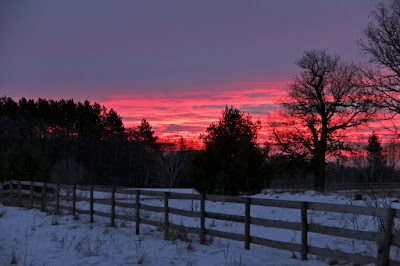
This morning’s sunrise was, again, spectacular. The picture above, from several years ago, doesn’t even capture the strength of all the magentas and hot pinks in the dawn sky prior to sunrise. It’s one of my favorite aspects of winter in the North Country. I’ve been looking around for better guidance on how to better capture the red end of the spectrum, but to no avail so far.

Today is the 135th anniversary of the birth of Aldo Leopold. We’re once again rereading his masterpiece, A Sand County Almanac, with emphasis on the land ethic. As the urban / rural; Red /Blue; vaxx / antivaxx divide continues to have US at each other’s throats, we continue to hope and believe that the benefits of adopting such an ethic have increased geometrically since
Ethics direct all members of a community to treat one another with respect for the mutual benefit of all. A land ethic expands the definition of “community” to include not only humans, but all of the other parts of the Earth, as well: soils, waters, plants, and animals, or what Leopold called “the land.”

If  you have concerns about the importance of belonging to a “community,” perhaps you could spend some time thinking about where the air we breathe, the food we eat, the water we drink are produced if not from Leopold’s “the land.”


Our Land


 - 1902-1967


We should have a land of sun, 
Of gorgeous sun, 
And a land of fragrant water
Where the twilight is a soft bandanna handkerchief 
Of rose and gold, 
And not this land
Where life is cold. 

We should have a land of trees, 
Of tall thick trees, 
Bowed down with chattering parrots
Brilliant as the day, 
And not this land where birds are gray. 

Ah, we should have a land of joy, 
Of love and joy and wine and song, 
And not this land where joy is wrong. 


********************************************
Thanks for visiting. Come again when you can.
Please be kind to each other while you can.

Tuesday, December 28, 2021

A thinking community? Yes!!!

 Cloudy, dreary, snowing. Bitter cold through New Years weekend. These are indeed the darkest days of the year, both literally and psychologically. And the pundits tell us the new year will bring lots of uncertainty. All of which, plus spending too much time on social media, has me wondering about taking  the shifting baseline syndrome from ecology, applying it to the natural, cultural, social and political worlds (economic fits in there somewhere) and working on restoration sociology or anthropology.

Aldo Leopold refers to a “thinking community” as he writes about a land ethic.

Leopold recognized that his dream of a widely accepted and implemented set of values based on caring – for people, for land, and for all the connections between them – would have to “evolve… in the minds of a thinking community.”

“It evolves in the minds of a thinking community."
Photo by J. Harrington

I believe we need to focus on creating a thinking community as well as "simply caring: about people, about land, and about strengthening the relationships between them.” Much of the behavior we see, read about, and too often exhibit is based very little on either thinking or caring. We have become reactors (other-directed) rather than actors (inner-directed, check The Lonely Crowd).

Slowly, we are learning how to do restoration ecology more effectively. Perhaps that means we can actually (re)create a thinking community that honors a land ethic and will be better prepared to respond to whatever the James Webb Space Telescope will soon begin transmitting.

I think I’ve just added to my New Year’s wish list.


Remember


 - 1951-


Remember the sky that you were born under,
know each of the star's stories.
Remember the moon, know who she is.
Remember the sun's birth at dawn, that is the
strongest point of time. Remember sundown
and the giving away to night.
Remember your birth, how your mother struggled
to give you form and breath. You are evidence of
her life, and her mother's, and hers.
Remember your father. He is your life, also.
Remember the earth whose skin you are:
red earth, black earth, yellow earth, white earth
brown earth, we are earth.
Remember the plants, trees, animal life who all have their
tribes, their families, their histories, too. Talk to them,
listen to them. They are alive poems.
Remember the wind. Remember her voice. She knows the
origin of this universe.
Remember you are all people and all people
are you.
Remember you are this universe and this
universe is you.
Remember all is in motion, is growing, is you.
Remember language comes from this.
Remember the dance language is, that life is.
Remember.


********************************************
Thanks for visiting. Come again when you can.
Please be kind to each other while you can.

Tuesday, December 21, 2021

Happy Solstice!

We hope that today, and all the days that follow, will find you healthy, happy and hopeful. Although Solstice brings the longest night of the year, it also brings the assurance of days that grow longer and a new season that will arrive in 89 days, on March  20, 2022. For now we must keep hope warm on our hearths and in our hearts. I know, easier said than done, but this morning I found a quotation that helped ease my doom and gloom.

“Watching the morning break, I realize again that darkness doesn't kill the light—it defines it.” 
― Richard Wagamese, Embers: One Ojibway's Meditations

Winter Solstice 9:59 am 12/21/21
Winter Solstice: 9:59 am 12/21/21
Photo by J. Harrington

It’s been too long since I last read Embers. It’s now in the stack of books to begin reading next year, along with whatever may end up under the tree or in my stocking, plus Aldo Leopold’s A Sand County Almanac. That’s where Leopold writes about his concept of a Land Ethic.

Ethics direct all members of a community to treat one another with respect for the mutual benefit of all. A land ethic expands the definition of “community” to include not only humans, but all of the other parts of the Earth, as well: soils, waters, plants, and animals, or what Leopold called “the land.”

It’s the emphasis on community that I believe all of US need to be more attentive too. We have forgotten just how interdependent we are. Perhaps this winter, compounded by COVID-19 and its never-ending variants, plus the consequences of climate breakdown and loss of biodiversity, and supply chain disruptions, and related matters, will help US remember how much we need each other. If we do so, and act accordingly, perhaps spring will bring about a renewal of life that exceeds our current expectations. Wouldn’t that be a wonderful, if belated, Christmas present?


    The Shortest Day


    by Susan Cooper


    And so the Shortest Day came and the year died

    And everywhere down the centuries of the snow-white world

    Came people singing, dancing,

    To drive the dark away.

    They lighted candles in the winter trees;

    They hung their homes with evergreen;

    They burned beseeching fires all night long

    To keep the year alive.

    And when the new year’s sunshine blazed awake

    They shouted, reveling.

    Through all the frosty ages you can hear them

    Echoing behind us—listen!

    All the long echoes, sing the same delight,

    This Shortest Day,

    As promise wakens in the sleeping land:

    They carol, feast, give thanks,

    And dearly love their friends,

    And hope for peace.

    And now so do we, here, now,

    This year and every year.

    Welcome, Yule!


********************************************
Thanks for visiting. Come again when you can.
Please be kind to each other while you can.

Friday, June 18, 2021

Failed leadership? Tried prayer?

Sunday, June 20, the summer solstice occurs. Tuesday, June 22, days grow shorter, only by seconds to begin with, but shorter, nevertheless. Within days thereafter, half of the year 2021 will be gone. Meanwhile, Republicans in the state legislature are reported to be opposing and/or disrupting progress on budget bills that need to be enacted by July 1. I suppose it would be hypocritical of me to cheer the Texas Democrats who broke quorum to oppose voting suppression while jeering  Minnesota Republicans for filibustering bills. So be it!

Despite Texas Republican Representative Gohmert's fantasy about changing the earth's orbit to solve climate change, there's grossly insufficient activity at the state, federal or international level to adequately  respond to climate breakdown's need for mitigation and adaptation. I don't know about you, but I get angry watching the tax dollars of the 99% (1%'ers don't pay taxes) being spent to pay for clowns in a circus instead of solving public policy problems they were allegedly elected to address.

As far as I can tell, the Democrats are the only ones who continue to fantasize about comity and bipartisanship. That's true in both D.C. and St. Paul. Isn't it time we cease to elect children and/or members of the flat earth society to supposedly responsible positions?

planetary boundaries credit: J. Lokrantz/Azote based on Steffen et al. 2015.

Meanwhile, the US Catholic Bishops are ignoring "guidance" from Pope Francis and are moving toward denying communion to President Biden for his support of women's reproductive health rights. Don't those in political and spiritual positions of responsibility recognize that the earth and its inhabitants are facing several existential crises? Climate breakdown, biodiversity, and exceeding the capacity of several of the world's planetary boundaries require real leadership and consensus building and systems thinking. All of those seem to be sadly lacking wherever one might expect to find them in the world's political and spiritual "leadership." And not enough regular folks are pushing back hard enough or often enough to really change things before we run out of time.


Saint’s Day Triolet: Saint Anthony


When no one else would listen, Saint Anthony
preached seaward, his words fishnet for the lost
souls of the heretics. Caught up in despair, we plea
to the one who will listen: Saint Anthony,
please return Tía’s teeth or the misplaced key 
to our bolted hopes. Patron retriever of all we’ve tossed 
when no one else would. Listen, Saint Anthony,
teach us to steward this world, all our netted loss.


********************************************
Thanks for visiting. Come again when you can.
Please be kind to each other while you can.

Saturday, March 27, 2021

Do we need an Agricultural Code of Ethics?

This morning I received a very pleasant surprise, the work of one of my long time environmental heroes was cited in a very recent editorial in the Times of Storm Lake Iowa [Editorial: Reaching our limits]. After spending a number of paragraphs describing Iowa's agricultural pollution and its consequences, Art Cullen, the Storm Lake Times editor, notes:

This was all foreseen more than 70 years ago by native Iowan Aldo Leopold, who predicted that all our chemicals and engineering would destroy us as we destroyed the land. He suggested in a key 1949 essay, The Land Ethic, while at the University of Wisconsin that we develop conservation agriculture as our ethos. Everything he suggested came true: the rivers have lost their former lives, the soil is washing down them, and in dominating the landscape we diminish ourselves. He suggested that we live as citizens of the land rather than over it. 

In the decades since we moved to Minnesota, we've observed a growing number of instances in which our adopted home has chosen to participate in races to the bottom with contenders such as Iowa. That's part of the problem resulting from the consolidation of economic, and consequently political, power.

agriculture in the Driftless Area
Photo by J. Harrington

A truism that's been with us since New Testament times is that “A prophet is not without honor except in his own country, among his own relatives, and in his own house.” Perhaps that helps explain why Leopold's Land Ethic [Aldo Leopold Foundation The Land Ethic] is not acknowledged and followed more in the restorative agriculture sector.

Unless we are missing a significant distinction between "ethic" and "ethics," which is all too possible, we would quibble with Leopold's thinking and writing when he asserts that “I have purposely presented the land ethic as a product of social evolution because nothing so important as an ethic is ever ‘written.’ Our experience with ethics has been in the context of the codes of conduct they articulate. For example, there's the Boone and Crockett Club's statement on hunter ethics and fair chase and Trout Unlimited's Code of Ethics. Maybe what we need is the broad, overarching Land Ethic from which we could derive an Agricultural Code of Ethics. What should that look like and encompass?


Ethics


In ethics class so many years ago 
our teacher asked this question every fall: 
if there were a fire in a museum 
which would you save, a Rembrandt painting 
or an old woman who hadn't many 
years left anyhow? Restless on hard chairs 
caring little for pictures or old age 
we'd opt one year for life, the next for art 
and always half-heartedly. Sometimes 
the woman borrowed my grandmother's face 
leaving her usual kitchen to wander 
some drafty, half imagined museum. 
One year, feeling clever, I replied 
why not let the woman decide herself? 
Linda, the teacher would report, eschews 
the burdens of responsibility. 
This fall in a real museum I stand 
before a real Rembrandt, old woman, 
or nearly so, myself. The colors 
within this frame are darker than autumn, 
darker even than winter — the browns of earth, 
though earth's most radiant elements burn 
through the canvas. I know now that woman 
and painting and season are almost one 
and all beyond saving by children.


********************************************
Thanks for visiting. Come again when you can.
Please be kind to each other while you can.

Wednesday, November 11, 2020

Whitewash, or not?

The Better Half [BH] and the Daughter Person have spent a large part of the past week or so making fruit cakes. Today BH has concocted some sort of fruit and nut paste which failed my personal taste test. I've never been a fan of fruit cakes. Wasn't a fruit cake the origin of re-gifting, the same cake getting passed around year after year after...?

Meanwhile, the fields behind the house are again covered with several inches of wind-scoured snow. Let's see, fruit cakes, snowy fields, esoteric food treats, we're approaching the Holiday Season! Time to get in a "holiday mood." Thank heaven for places like REI [BH is a member.] We're all aboard with their Black Friday #optoutside initiative. We're sure we'd be in a better mood if we spent more time outside playing, as well as doing chores which, when we were younger, we sometimes found ways to turn into play. Remember Tom Sawyer and the fence painting?

So, now a question becomes, could some Tom Sawyer philosophizing be applied to bridging our urban--rural divide? As the inimitable Art Cullen, editor of the The Storm Lake Times put it today (An electoral map awash in red)

The urban-rural divide is vivid as ever. If it can’t be closed, the very idea of American democratic liberty remains challenged. There is a palpable resentment among those left behind from the economic coastal juggernauts that finds its expression in terrorist rubes from the sticks dressed in Hawaiian shirts planning to kidnap the governor of Michigan and execute her to start a civil war. Believe it. Most of us are not ready to pick up a gun. But it keeps racism bubbling. It erodes trust in institutions, like our courts or elections. It prevents us from solving existential crises like the pandemic or, even more threatening, global heating.

Tom's strategy keyed off of the idea that to make something worth coveting, it needs to be seen as difficult to attain. Now we all have taken democracy for granted for so long that it seems easy and therefore not worth working at (see also Sawyer about what's "work"). As things stand today, we are all going to have to work like hell to get back to a fully functioning democracy that's a world leader. 


definition of Rural
how would a definition of "urban" differ?
Photo by J. Harrington

Perhaps that's the message we should be finding in the number of articles by political pundits who are busy point out the flaws in both Democratic and Republican strategies. In fact, since today is Veteran's Day, formerly Armistice Day, it's probably a good day to remember the words of one Winston Churchill:

‘Many forms of Government have been tried, and will be tried in this world of sin and woe. No one pretends that democracy is perfect or all-wise. Indeed it has been said that democracy is the worst form of Government except for all those other forms that have been tried from time to time.…’

Winston S Churchill, 11 November 1947


Liberty


When liberty is headlong girl
And runs her roads and wends her ways
Liberty will shriek and whirl
Her showery torch to see it blaze.

When liberty is wedded wife
And keeps the barn and counts the byre
Liberty amends her life.
She drowns her torch for fear of fire.


********************************************
Thanks for visiting. Come again when you can.
Please be kind to each other while you can.

Thursday, November 5, 2020

Time to trade in the outdated solutions.

How are you holding up under the uncertainty? Would it be nicer and better if we lived in a world where politics and government were less relevant? That's not a rhetorical question but neither is it one to which we can pretend we have an answer. We've read enough fantasy and science fiction to be able to envision both a utopian and a dystopian option. For the past four years, and, actually, lots longer than that, we've seen a drift towards more dystopian society for US.

We remember the hope we felt when Jack Kennedy was elected, and the despair at his assassination. Lyndon Johnson's Great Society didn't work out as well as many of us hoped it would. "The main goal was the total elimination of poverty and racial injustice." Despite progress under Johnson, many of us felt doubly and triply robbed by the assassinations of Martin Luther King Jr. in April 1968 and Robert F. Kennedy shortly thereafter in June. 


time to shore up our foundations
Photo by J. Harrington

Skipping ahead, President William Jefferson Clinton brought US the North American Free Trade Agreement. Its ratification was hindered because it omitted serious consideration of labor and environmental issues until they were addressed in side agreements. President Barack Obama tried to bring us the Trans-Pacific Partnership despite the criticism and opposition of many liberals and progressives.


time to mend our fences
Photo by J. Harrington

A cursory review of the past couple of decades indicates that the two major political parties representing US have become, for the most part, more considerate of their corporate sponsors than of the constituents who vote for them. How else to account for the missing "public sector" option in the passage of the Affordable Care Act. Does it now seem more understandable how many could vote for Trump, even after the past four years and why there has been a decided lack of enthusiasm for the candidacy of Joe Biden?

There is much needed and necessary work ahead for the rest of US to return what has become a corporatocracy into some semblance of a democracy. Some concepts and guidance can be found in these resources:

These aren't all that's available, but they, and Elinor Ostrom, and Wendell Berry and the Schumacher Lectures and Doughnut Economics are places to start. Just remember, it's up to US to create the future we want and need and we can't do it alone, plus, the problems will change as we work on them.

For You O Democracy


Come, I will make the continent indissoluble,
I will make the most splendid race the sun ever shone upon, 
I will make divine magnetic lands, 
                   With the love of comrades, 
                      With the life-long love of comrades. 

I will plant companionship thick as trees along all the rivers of America, and along the shores of the great lakes, and all over the prairies, 
I will make inseparable cities with their arms about each other’s necks, 
                   By the love of comrades, 
                      By the manly love of comrades. 

For you these from me, O Democracy, to serve you ma femme! 
For you, for you I am trilling these songs.


********************************************
Thanks for visiting. Come again when you can.
Please be kind to each other while you can.

Thursday, August 20, 2020

It's Earth Overshoot Day, 2020!!!

“All ethics so far evolved rest upon a single premise: that the individual is a member of a community of interdependent parts.The land ethic simply enlarges the boundaries of the community to include soils, waters, plants and animals, or collectively the land.” The Land Ethic, A Sand County Almanac.
1972 was the year the Clean Water Act amendments became law. In anticipation of their enactment, Massachusetts had been engaged in a pilot study with the USACE looking at how areawide water quality management plans, as called for by Section 208 of that act, could appropriately be implemented. The United States has yet to meet the water quality goals called for in the act, despite massive expenditures of public dollars to collect and treat urban and industrial wastewater. Little has been done to address agricultural water pollution. Neither has much been done to respond to the issues and challenges identified in the 1972 report: Limits To Growth.

Blue Marble
Blue Marble,
Image Credit: NASA/NOAA/GSFC/Suomi NPP/VIIRS/Norman Kuring

Although I once debated, on MIT radio, Dennis Meadows, one of authors of that report, it would be presumptuous of me to attempt to summarize the report here, Instead, I offer the following excerpts from: The History of The Limits to Growth
A pioneering report, The Limits to Growth, published in 1972, marked a turning point in thinking about the environment, selling some 30 million copies in 30 languages.1 The two-year study behind the report took place at the Massachusetts Institute of Technology at the request of the Club of Rome, an international group of distinguished business people, state officials, and scientists founded by Aurelio Peccei, a former Fiat executive and president of Olivetti.
What have Western societies been doing in the thirty-five years since the appearance of LtG and similar warnings from the same period?17,18 When it comes to taking serious action, little has been done to reach a sustainable form of development, with the exception of some modest technical adjustments. On the other factors, such as population, consumption, and production, the political steps taken have generally been in the opposite direction from sustainability, and they have more than offset any benefits of technical progress. The result is that global environmental pressure, as for example indicated by humanity’s ecological footprint,19 is today much worse. And there are few signs of significant action toward changing this trend.
A sustainable future is not a matter of technology alone, partly because of the rebound effect.33 It must build on new ways to live and organize societies, for instance recognizing that today “corporations have even less incentive than individuals to keep the Commons in order; in fact they have a (legal) clear line of responsibility to their shareholders alone and have continuously resisted government and international efforts to regulate the Commons.”34 This is referring to G. Hardin’s classical paper on the problems of sharing the limited capacity of the Commons.35 Elinor Ostrom won the 2009 Nobel Prize in Economics for her analysis of economic governance, and especially of the commons, that understands this conundrum. She shared the prize with Oliver A. Williamson, who was lauded for his analysis of economic governance, especially in regard to the boundaries of the modern corporation.36 Both study how individuals can work together and share scarce resources, an ethos shared by the authors of LtG.37

So, here we are on Earth Overshoot Day, 2020. We are living in a world faced with

  • climate breakdown, and all that brings with it
  • a sixth extinction, and breakdown of the ecosystems on which we depend for clean air and water
  • a pandemic disrupting global economies, with the prospect of more pandemics on the horizon
  • no quick solutions in sight to any of the above
  • several long-standing democracies faced with economic and/or civic collapse
It looks more and more as if Western knowledge and economics alone isn't sufficient to motivate us to change our ways enough to save ourselves from each other. It's encouraging that some communities are adapting Doughnut Economics to a local scale. Personally, I believe we'd all be better off, as, certainly, would any descendants we have, if we also adopted and adapted to Traditional Ecological Knowledge.

A Map to the Next World


           for Desiray Kierra Chee

In the last days of the fourth world I wished to make a map for
those who would climb through the hole in the sky.

My only tools were the desires of humans as they emerged
from the killing fields, from the bedrooms and the kitchens.

For the soul is a wanderer with many hands and feet.

The map must be of sand and can’t be read by ordinary light. It
must carry fire to the next tribal town, for renewal of spirit.

In the legend are instructions on the language of the land, how it
was we forgot to acknowledge the gift, as if we were not in it or of it.

Take note of the proliferation of supermarkets and malls, the
altars of money. They best describe the detour from grace.

Keep track of the errors of our forgetfulness; the fog steals our
children while we sleep.

Flowers of rage spring up in the depression. Monsters are born
there of nuclear anger.

Trees of ashes wave good-bye to good-bye and the map appears to
disappear.

We no longer know the names of the birds here, how to speak to
them by their personal names.

Once we knew everything in this lush promise.

What I am telling you is real and is printed in a warning on the
map. Our forgetfulness stalks us, walks the earth behind us, leav-
ing a trail of paper diapers, needles, and wasted blood.

An imperfect map will have to do, little one.

The place of entry is the sea of your mother’s blood, your father’s
small death as he longs to know himself in another.

There is no exit.

The map can be interpreted through the wall of the intestine—a
spiral on the road of knowledge.

You will travel through the membrane of death, smell cooking
from the encampment where our relatives make a feast of fresh
deer meat and corn soup, in the Milky Way.

They have never left us; we abandoned them for science.

And when you take your next breath as we enter the fifth world
there will be no X, no guidebook with words you can carry.

You will have to navigate by your mother’s voice, renew the song
she is singing.

Fresh courage glimmers from planets.

And lights the map printed with the blood of history, a map you
will have to know by your intention, by the language of suns.

When you emerge note the tracks of the monster slayers where they
entered the cities of artificial light and killed what was killing us.

You will see red cliffs. They are the heart, contain the ladder.

A white deer will greet you when the last human climbs from the
destruction.

Remember the hole of shame marking the act of abandoning our
tribal grounds.

We were never perfect.

Yet, the journey we make together is perfect on this earth who was
once a star and made the same mistakes as humans.

We might make them again, she said.

Crucial to finding the way is this: there is no beginning or end.

You must make your own map.


********************************************
Thanks for visiting. Come again when you can.
Please be kind to each other while you can.

Thursday, July 16, 2020

Where's your Planet B?

Do you remember, during the last campaign for POTUS, Donald Trump asked "What do you have to lose?" in an appeal for the votes of black voters? I hope by now it's clear what black voters, and the rest of US, have to lose. For one example, in the midst of a pandemic, with more than 130,000 dead in the United States alone, CDC no longer in charge of the nation's COVID-19 data. Health experts are concerned. If anyone doubts this is the beginning of magically making the pandemic end before November of this year, by manipulating or hiding the actual numbers, I have some fracking company stock to sell them.

Trump has already begun attempted intimidation of more liberal, urban locales such as Portland, Oregon: Federal officers severely wounded a Portland protester. Local leaders blame Trump.

Closer to home, in Minnesota, recent reports note that:
It’s well known that the Trump administration has done enormous favors for Antofagasta, the Chilean-owned mining company behind Twin Metals, the proposed copper-sulfide mine at the edge of the Boundary Waters. Not only did the administration resurrect expired mineral leases, effectively breathing new life into this controversial project, but it’s becoming more apparent that federal agencies have allowed Twin Metals to set the terms.
The Trump regime is now in the process of trying to loosen National Environmental Protection Act rules to make it even easier to preclude local interests from participating in setting terms for potentially polluting projects that often offer few, if any, local benefits. (Trump Revised Rules Are Set to Cut Project NEPA Review Time)

who protects this northern Minnesota trout stream
Photo by J. Harrington

If you read this blog even occasionally, you may have noticed that all too often we find cause to criticize decisions made by our public agencies. That's frequently due to their failure to follow established rules and procedures. Minnesota may not (doesn't in my opinion) have the most stringent environmental rules governing mining. It does have one of the best, if not the best, Environmental Rights Acts.
The legislature finds and declares that each person is entitled by right to the protection, preservation, and enhancement of air, water, land, and other natural resources located within the state and that each person has the responsibility to contribute to the protection, preservation, and enhancement thereof. The legislature further declares its policy to create and maintain within the state conditions under which human beings and nature can exist in productive harmony in order that present and future generations may enjoy clean air and water, productive land, and other natural resources with which this state has been endowed. Accordingly, it is in the public interest to provide an adequate civil remedy to protect air, water, land and other natural resources located within the state from pollution, impairment, or destruction. [emphasis added]
The preceding language is much stronger than the comparable "Purpose" section of the National Environmental Policy Act.

If enough of us don't become too complacent, or just plain lazy, to vote come November, and actually create not only a blue wave but a blue tsunami, I'd strongly recommend a follow through by pushing for a National Environmental Rights Act, comparable to Minnesota's, separately or as part of any Green New Deal. It's time to get our priorities straight. Jobs on a dead planet aren't worth much unless there's a different home planet where the workers live. Where's your Planet B?


Work Song, part 2: A Vision


by Wendell Berry


If we will have the wisdom to survive,
to stand like slow growing trees
on a ruined place, renewing, enriching it,
if we will make our seasons welcome here,
asking not too much of earth or heaven,
then a long time after we are dead
the lives our lives prepare will live
here, their houses strongly placed
upon the valley sides, fields and gardens
rich in the windows. The river will run
clear, as we will never know it
and over it birdsong like a canopy.
On the levels of the hills will be
green meadows, stock bells in noon shade.
On the steeps where greed and ignorance cut down
the old forest, an old forest will stand,
its rich leaf-fall drifting on its roots.
The veins of forgotten springs will have opened.
Families will be singing in the fields.
In their voices they will hear a music
risen out of the ground. They will take
nothing from the ground they will not return,
Whatever the grief at parting. Memory,
native to this valley, will spread over it
like a grove, and memory will grow
into legend, legend into song, song
into sacrament. The abundance of this place,
the songs of its people and its birds,
will be health and wisdom and indwelling
light. This is no paradisal dream.
Its hardship is its reality.


********************************************
Thanks for visiting. Come again when you can.
Please be kind to each other while you can.

Thursday, June 11, 2020

Repairing the window of my world view

If I had started practicing my fly casting back in April, today would have been a great day for practicing casting into the wind. I hadn't, so it isn't. Fortunately, I learned long ago not to spit into the wind so that's not an issue. Prepare for some sort of untoward weather events tomorrow since that's when I plan to check out some trout fishing spots. I'm more interested in getting a look at a handful of places I want to reconnoiter for river access and casting obstructions than in actually wetting a line, but, to be on the safe side, I'll bring a rod or two. Otherwise, I'm sure I'd get to see the hatch and rise of my lifetime and there I'd be, standing empty-handed looking like a witless damn fool.

even sunny days often have storm clouds
Photo by J. Harrington

Yes, the continuing diminished and undistinguished state of the world has once again gotten under my skin. The tiller I want to use to make mounds for planting a three sisters garden may be ready this weekend. When I dropped it off at the beginning of last week, they said it should be done some time this week. It's been my experience that similar issues occur with about every small engine repair shop I've used in the past twenty or so years. "Oh, you thought we'd have it done when we said we would?" If the planting doesn't get done by the first part of next week, I'm not going to try it during our 100+℉ spell forecast for several days midweek. (Time to remember the wabi sabi "accept imperfections" approach.) Late next week, after the hot spell, should still allow a viable time to maturity so....

As I promised a day or so ago, I've been looking through the "Progressive's Style Guide." Today I learned a definition of intersectionality:
Intersectionality is a concept often used in critical theories to describe the ways in which oppressive institutions (racism, sexism, homophobia, transphobia, ableism, xenophobia, classism, etc.) are interconnected and cannot be examined separately from one another. The concept first came from legal scholar Kimberlé Crenshaw in 1989 and is largely used in critical theories, especially Feminist theory, when discussing systematic oppression. When possible, credit Kimberlé Crenshaw for coining the term "intersectionality" and bringing the concept to wider attention.
Although I know the meaning of each of the words in the definition, when they are all strung together, I'm still not sure holistic might not be a better term, unless the inclusion of oppression affects the denotation and connotation of the term. Plus, I have reservations about the validity and utility of critical theory, but then I had been more inclined toward a Hegelian than a Marxian world view. These days I find myself leaning much more toward Margaret Wheatley's emergent systems perspectives, combined with the Ojibwe world views described by Richard Wagamese, with a moderate sprinkling of zen and wabi sabi thrown in.

Fortunately, when I become as disgruntled as I too often am these days, I can almost always rely on the oeuvre of one of Minnesota's own Nobel laureates to help me out. Dylan has, decades ago, described today's challenges to a "T."

It’s Alright, Ma (I’m Only Bleeding)


Written by: Bob Dylan 


Darkness at the break of noon
Shadows even the silver spoon
The handmade blade, the child’s balloon
Eclipses both the sun and moon
To understand you know too soon
There is no sense in trying

Pointed threats, they bluff with scorn
Suicide remarks are torn
From the fool’s gold mouthpiece the hollow horn
Plays wasted words, proves to warn
That he not busy being born is busy dying

Temptation’s page flies out the door
You follow, find yourself at war
Watch waterfalls of pity roar
You feel to moan but unlike before
You discover that you’d just be one more
Person crying

So don’t fear if you hear
A foreign sound to your ear
It’s alright, Ma, I’m only sighing

As some warn victory, some downfall
Private reasons great or small
Can be seen in the eyes of those that call
To make all that should be killed to crawl
While others say don’t hate nothing at all
Except hatred

Disillusioned words like bullets bark
As human gods aim for their mark
Make everything from toy guns that spark
To flesh-colored Christs that glow in the dark
It’s easy to see without looking too far
That not much is really sacred

While preachers preach of evil fates
Teachers teach that knowledge waits
Can lead to hundred-dollar plates
Goodness hides behind its gates
But even the president of the United States
Sometimes must have to stand naked

An’ though the rules of the road have been lodged
It’s only people’s games that you got to dodge
And it’s alright, Ma, I can make it

Advertising signs they con
You into thinking you’re the one
That can do what’s never been done
That can win what’s never been won
Meantime life outside goes on
All around you

You lose yourself, you reappear
You suddenly find you got nothing to fear
Alone you stand with nobody near
When a trembling distant voice, unclear
Startles your sleeping ears to hear
That somebody thinks they really found you

A question in your nerves is lit
Yet you know there is no answer fit
To satisfy, insure you not to quit
To keep it in your mind and not forget
That it is not he or she or them or it
That you belong to

Although the masters make the rules
For the wise men and the fools
I got nothing, Ma, to live up to

For them that must obey authority
That they do not respect in any degree
Who despise their jobs, their destinies
Speak jealously of them that are free
Cultivate their flowers to be
Nothing more than something they invest in

While some on principles baptized
To strict party platform ties
Social clubs in drag disguise
Outsiders they can freely criticize
Tell nothing except who to idolize
And then say God bless him

While one who sings with his tongue on fire
Gargles in the rat race choir
Bent out of shape from society’s pliers
Cares not to come up any higher
But rather get you down in the hole
That he’s in

But I mean no harm nor put fault
On anyone that lives in a vault
But it’s alright, Ma, if I can’t please him

Old lady judges watch people in pairs
Limited in sex, they dare
To push fake morals, insult and stare
While money doesn’t talk, it swears
Obscenity, who really cares
Propaganda, all is phony

While them that defend what they cannot see
With a killer’s pride, security
It blows the minds most bitterly
For them that think death’s honesty
Won’t fall upon them naturally
Life sometimes must get lonely

My eyes collide head-on with stuffed
Graveyards, false gods, I scuff
At pettiness which plays so rough
Walk upside-down inside handcuffs
Kick my legs to crash it off
Say okay, I have had enough
what else can you show me?

And if my thought-dreams could be seen
They’d probably put my head in a guillotine
But it’s alright, Ma, it’s life, and life only


********************************************
Thanks for visiting. Come again when you can.
Please be kind to each other while you can.

Monday, June 8, 2020

What do we value in our communities?

It is too hot (~92℉ right now) for yard chores and too windy (S ~20 mph) to be standing in a cool trout stream casting a fly. So, since lots of folks are talking about disbanding police forces, and what  that means, I'd like to focus on some fundamentals I believe should be considered and, ideally, incorporated into any formulation of public safety departments.


In her outstanding  book Who Do We Choose To Be, Margaret J. Wheatley writes that
Ethics are rules for how to live together. Moral principles mediate our interactions by establishing expectations of how to behave. All spiritual traditions have a clear code of ethics so that people can grow and prosper as a community, restrain individual impulses, and together withstand challenges great and small. This is always the role of ethics, to bind together individuals in trustworthy relationships so we can stay together through the vicissitudes of life.

Ethics are designed to serve us in community; they have no relevance to individuals who live in isolation or self-absorption, where there is no concern for others. Without ethics, there is no social coherence, no community resilience. Without ethics, it becomes a dog-eat-dog world. Such as many of us are now experiencing in this popularity culture.
In a fortuitous bit of serendipity, this morning I had reasons to research the Ojibwe Seven Grandfather Teachings. "Many Anishinaabeg view the Seven Grandfather Teachings as traditional knowledge that collectively represents what is needed for community survival." I respectfully propose that the Grandfather Teachings contain the kernel of much of what is needed to be included in ethics for any public safety department to serve its community. The teachings, according to several Ojibwe / Anishinaabe web sites are:
  • Nibwaakaawin—Wisdom
  • Zaagi’idiwin—Love
  • Minaadendamowin—Respect
  • Aakode’ewin—Bravery
  • Gwayakwaadiziwin—Honesty
  • Dabaadendiziwin—Humility
  • Debwewin—Truth
Can you think of a set of values that offers a better basis for community protection? In a similar vein, I was delighted to read today this article in the Strong Towns Journal: "Is It Time to Hit the Reset Button on Policing?" which concludes:
There is no credible argument against dismantling the Minneapolis police department. Nor the police department in Ferguson. Nor the dozens, potentially hundreds, of police departments across the country that—due to whatever cause —do not represent the values of the communities they serve.

the bullet was a girl


Danez Smith


the bullet is his whole life.
his mother named him & the bullet

was on its way. in another life
the bullet was a girl & his skin

was a boy with a sad laugh.
they say he asked for it— 

must I define they? they are not
monsters, or hooded or hands black

with cross smoke.
they teachers, they pay tithes

they like rap, they police—good folks
gather around a boy’s body

to take a picture, share a prayer.
oh da horror, oh what a shame

why’d he do that to himself?
they really should stop
getting themselves killed


********************************************
Thanks for visiting. Come again when you can.
Please be kind to each other while you can.