Showing posts with label watershed. Show all posts

Wednesday, February 14, 2024

A Valentine’s gift

A Valentine’s Day indulgence
Photo by J. Harrington

Happy Valentine’s Day (and Ash Wednesday) for those who observe. Recently, we tumbled onto something that has us in thralls of exploration. We share it here in honor of Valentine’s Day and the need for many more of US to love the Earth. We hope you enjoy it a much as we are.

Writing the Land is a collaborative outreach and fundraising project for land protection organizations. Through our anthologies, poets help raise awareness of the importance for land conservation.

I only wish it also referenced the importance of water protection. What happens on the land doesn’t stay on the land. 


A Line-storm Song


The line-storm clouds fly tattered and swift,  
  The road is forlorn all day,  
Where a myriad snowy quartz stones lift,  
  And the hoof-prints vanish away.  
The roadside flowers, too wet for the bee,
  Expend their bloom in vain.  
Come over the hills and far with me,  
  And be my love in the rain.  

The birds have less to say for themselves  
  In the wood-world’s torn despair
Than now these numberless years the elves,  
  Although they are no less there:  
All song of the woods is crushed like some  
  Wild, easily shattered rose.  
Come, be my love in the wet woods; come,
  Where the boughs rain when it blows.  

There is the gale to urge behind  
  And bruit our singing down,  
And the shallow waters aflutter with wind  
  From which to gather your gown.     
What matter if we go clear to the west,  
  And come not through dry-shod?  
For wilding brooch shall wet your breast  
  The rain-fresh goldenrod.  

Oh, never this whelming east wind swells    
  But it seems like the sea’s return  
To the ancient lands where it left the shells  
  Before the age of the fern;  
And it seems like the time when after doubt  
  Our love came back amain.       
Oh, come forth into the storm and rout  
  And be my love in the rain.


********************************************
Thanks for visiting. Come again when you can.
Please be kind to each other while you can.

Wednesday, July 12, 2023

Going with the flow

I’ve been playing in and around, and working on and for, rivers, streams and oceans for more than half a century. I keep finding that my knowledge of water quality, hydrology, land use and pollution abatement could always stand more breadth and depth. I probably would benefit from a better understanding of human psychology, too.

Somehow, I’ve not yet read any of Luna Leopold’s books, nor have I read any of the tomes on riparian zones. One of my earliest reads was The Ecology of Running Water plus several photo essays on rivers. Then there’s the classic A River Runs Through It and multitudes of volumes on trout, trout streams, aquatic invertebrates, hatch matching, fly casting, and the ever critical “reading the water.”

heron in a riparian zone
Photo by J. Harrington

All the preceding is a lead in to a recent discovery of the only book like it I’ve come across: Field Guide to Wisconsin Streams:  Plants, Fishes, Invertebrates, Amphibians, and Reptiles. The book originally sold for $30.00. Most copies I can find these days are being offered for anywhere from $1,000 to $3,000. (Most stocks wish they appreciated like that.) The original publisher notes they don’t know when it will be available again.

This leads me to (leaves me and you with) several questions:

  • What would it take for the University of Wisconsin to republish / reprint the volume at a reasonablle price? There seems to be a market.
  • Why aren’t comparable volumes available for the other states?
  • Should Trout Unlimited and its chapters be encouraged to create comparable volumes to accompany the Trout in the Classroom program and stream restoration projects such as DARE? 


Damselfly, Trout, Heron


The damselfly folds its wings
over its body when at rest. Captured,
it should not be killed
in cyanide, but allowed to die
slowly: then the colors,
especially the reds and blues,
will last. In the hand
it crushes easily into a rosy
slime. Its powers of flight
are weak. The trout

feeds on the living damselfly.
The trout leaps up from the water,
and if there is sun you see
the briefest shiver of gold,
and then the river again.         
When the trout dies
it turns its white belly
to the mirror of the sky.
The heron fishes for the trout

in the gravelly shallows on the far
side of the stream. The heron
is the exact blue of the shadows
the sun makes of trees on water.
When you hold the heron most clearly
in your eye, you are least certain
it is there. When the blue heron dies,
it lies beyond reach
on the far side of the river.


********************************************
Thanks for visiting. Come again when you can.
Please be kind to each other while you can.

Saturday, June 24, 2023

In praise of poets laureate

The elderberry bush growing in the “wet spot”in the back yard is coming into flower. More orange day lilies, plus one scarlet one, have started to bloom along the road ditch. One of the azaleas hydrangeas [the Better Half informed me my  plant i.d. was incorrect] and peonies we planted behind the house is each developing a flower. Yesterday we got enough rain to settle the dust, but not much more. Today offers additional possibilities. We’ll see if the clouds actually deliver or again pass us by. The local paper is now reporting that we’re experiencing the “Driest spring in 5 decades ...” 

June dawn, Sunrise River pools
Photo by J. Harrington

Among other volumes recently, I’ve been reading Michael Garrigan’s poetry. One of his redeeming perspectives is that he “believes that every watershed should have a Poet Laureate.” I think that’s one of the better ideas I’ve run across in a while and think the St. Croix, between Minnesota and Wisconsin, would be a wonderful place to begin. We already have a number of Poets of Place from last year’s Big Read. The selection process raises the question of what level of watershed are we talking about. I’d like to see a laureate for each 10 digit or 12 digit watershed like our own Sunrise River, but we should have one for no less than watersheds as large as the St. Croix. Poetry can grow community in a place like a watershed. It can also capture the horror of a watershed misused and abused.


Watershed


200 cows         more than 600 hilly acres

            property would have been even larger
had  J not sold 66 acres to DuPont for
                      waste from its Washington Works factory
where J was employed        
                                                did not want to sell
            but needed money   poor health         
mysterious ailments

Not long after the sale cattle began to act
deranged     
                          footage shot on a camcorder
grainy               intercut with static         
Images jump repeat      sound accelerates        
      slows down          
                    quality of a horror movie

the rippling shallow water       the white ash
      trees shedding their leaves 
                                                      a large pipe
discharging green water      
                                                  a skinny red cow
hair missing      back humped  
                                               
a dead black calf in snow         its eye
      a brilliant chemical blue    

                                            a calf’s bisected head       
      liver     heart    stomachs    kidneys           
              gall bladder      some dark      some green                  

cows with stringy tails         malformed hooves           
      lesions      red receded eyes        suffering   slobbering       
                  staggering like drunks

It don’t look like
                               anything I’ve been into before


I began rising through the ceiling of each floor in the hospital as though I were being pulled by some force outside my own volition. I continued rising until I passed through the roof itself and found myself in the sky. I began to move much more quickly past the mountain range near the hospital and over the city. I was swept away by some unknown force, and started to move at an enormous speed. Just moving like a thunderbolt through a darkness. 


R’s taking on the case I found to be inconceivable

It just felt like the right thing to do
                                                                   a great
opportunity to use my background for people who
                                really needed it          

                                R: filed a federal suit 
                                         pulled permits  
                                             land deeds    
                                                     a letter that mentioned
a substance at the landfill     
                                                 PFOA          
                               perfluorooctanoic acid

a soap-like agent used in
                                              ScotchgardTM
                                                                         TeflonTM

PFOA:                 was to be incinerated or
                              sent to chemical waste facilities     
                                    not to be flushed into water or sewers

DuPont:
                 pumped hundreds of thousands of pounds
                          into the Ohio River    
                 dumped tons of PFOA sludge
                          into open unlined pits 

PFOA:
               increased the size of the liver in rats and rabbits         
                                  (results replicated in dogs)
               caused birth defects in rats      
               caused cancerous testicular pancreatic and
                             liver tumors in lab animals      
               possible DNA damage from exposure 
               bound to plasma proteins in blood     
               was found circulating through each organ       
               high concentrations in the blood of factory workers   
               children of pregnant employees had eye defects          
               dust vented from factory chimneys settled well-beyond
                            the property line
               entered the water table
               concentration in drinking water 3x international safety limit
               study of workers linked exposure with prostate cancer
               worth $1 billion in annual profit
 

(It don’t look like anything I’ve been into before)      


Every individual thing glowed with life. Bands of energy were being dispersed from a huge universal heartbeat, faster than a raging river. I found I could move as fast as I could think. 


DuPont:
               did not make this information public
               declined to disclose this finding       
               considered switching to new compound that appeared less toxic
                        and stayed in the body for a much shorter duration of time
               decided against it
               decided it needed to find a landfill for toxic sludge
               bought 66 acres from a low-level employee
                        at the Washington Works facility
 

(J needed money         
                                         had been in poor health     
a dead black calf              
                                         its eye chemical blue          
cows slobbering               
                                         staggering like drunks)


could perceive the Earth, outer space, and humanity from a spacious and indescribable ‘God’s eye view.’ I saw a planet to my left covered with vegetation of many colors no signs of mankind or any familiar shorelines. The waters were living waters, the grass was living, the trees and the animals were more alive than on earth.

                                   
D’s first husband had been a chemist
                                                                          When you
worked at DuPont in this town you could have
everything you wanted
                                       DuPont paid for his education          
secured him a mortgage           paid a generous salary 
even gave him a free supply of PFOA


He explained that the planet we call Earth really has a proper name, has its own energy, is a true living being, was very strong but has been weakened considerably.
 

                                                              which she used
as soap in the family’s dishwasher       


I could feel Earth’s desperate situation. Her aura appeared to be very strange, made me wonder if it was radioactivity. It was bleak, faded in color, and its sound was heart wrenching.


                                                Sometimes
her husband came home sick—fever, nausea, diarrhea,
vomiting—‘Teflon flu’

             an emergency hysterectomy
                                                                   a second surgery          


I could tell the Doctor everything he did upon my arrival down to the minute details of accompanying the nurse to the basement of the hospital to get the plasma for me; everything he did while also being instructed and shown around in Heaven.
 

Clients called R to say they had received diagnoses of cancer
         or that a family member had died

                  W who had cancer had died of a heart attack

            Two years later W’s wife died of cancer

They knew this stuff was harmful
            and they put it in the water anyway
 

I suspect that Earth may be a place of education.
 

PFOA detected in:
                                American blood banks    
                                blood or vital organs of:
                                                                            Atlantic salmon
                                                                            swordfish
                                                                            striped mullet
                                                                            gray seals
                                                                            common cormorants
                                                                            Alaskan polar bears
                                                                            brown pelicans
                                                                            sea turtles
                                                                            sea eagles
                                                                            California sea lions      
                                                                            Laysan albatrosses on a wildlife refuge
                                                                                          in the middle of the North Pacific       Ocean;>


Viewing the myriad human faces with an indescribable, intimate, and profound love. This love was all around me, it was everywhere, but at the same time it was also me.


                                      We see a situation

        that has gone

                                from Washington Works
 

All that was important in life was the love we felt.
 

                                                                                          to statewide
 

All that was made, said, done, or even thought without love was undone. 


                                     to everywhere
 

                  it’s global


In my particular case, God took the form of a luminous warm water. It does not mean that a luminous warm water is God. It is just that, for me, it was experiencing the luminous warm water that I felt the most connection with the eternal.


********************************************
Thanks for visiting. Come again when you can.
Please be kind to each other while you can.

Thursday, May 11, 2023

In honor of wetlands month

 Until recently, I was unaware that May is American Wetlands Month. As a waterfowler, wetlands are one of my favorite places. Ducks, geese, swans, shorebirds, and others depend on wetlands. So do the rest of us who live on planet Earth. Someone whom I have been helping restore a nearby river shared an email a few days ago on videos of Wisconsin Tribes: Leading the way in protecting and restoring wetlands and watersheds. Today, as part of wetlands month, I want to pay forward that sharing. I hope you enjoy these videos as much as I have, even more, maybe. The summaries below the photo come from an Outreach Toolkit for the videos.

a neighborhood wetland->Sunrise River->St. Croix River
Photo by J. Harrington

Protecting our Waters: Wetland Conservation and the Red Cliff Band of Lake Superior Chippewa

The Red Cliff Band of Lake Superior Chippewa, located on the southern shore of Lake Superior in the northernmost tip of Wisconsin, retains a strong cultural connection to the waters and lands of the region. Tribal members use a wealth of natural products from wetlands including fish (gigoonh), blueberries (miinan), cranberries (aniibinimmashkiigimin), wild rice (manoomin), and many traditional medicines and plants used in ceremonies. Protection of tribal wetlands and the associated cultural resources and natural benefits like clean water and flood protection is critical for the health and welfare of tribal members. Learn how the Tribe recently increased its investment in these critical resources by establishing a wetland program to protect, monitor, and manage wetlands for future generations.

Keywords: wetlands, water, Bayfield, Superior, Red Cliff, tribes, watershed, Bayfield County, culture, tradition, Chippewa, Anishinaabe, flooding, water quality, protection


Water is life: Wetland conservation and the Bad River Band of Lake Superior Chippewa

For the Bad River Band of Lake Superior Tribe of Chippewa Indians in Northern Wisconsin, water is life. Protecting water means protecting the watersheds that provide water for their Reservation and people from top to bottom, including uplands, floodplains, and globally important coastal wetlands along Lake Superior. It also means carefully monitoring their land and water resources and developing programs and policies to protect these resources for future generations. As a result of these efforts, the Tribe is protecting water quality, alleviating flooding, protecting habitat for fish and wildlife, and providing natural resources for their people’s sustenance and cultural practices.

Keywords: wetlands, protection, restoration, Bad River, tribes, manoomin, wild rice, flooding, water quality, habitat, Superior, Ashland, Chequamegon, Ashland County, Mashkiiziibii, Chippewa, Anishinaabe


Preserving a way of life: Wetland conservation and the Bad River Band of Lake Superior Chippewa

The ancestors of today’s Bad River Band of Lake Superior Tribe of Chippewa Indians in Northern Wisconsin followed a prophecy telling their people to travel westward to seek a new home “where the food grows on water.” The vast beds of manoomin (wild rice) growing in what we now call the Kakagon-Bad River Sloughs on Lake Superior signaled to the travelers that they’d found this new home. Today, the Sloughs, which have received global recognition for their ecological and cultural importance, continue to provide the natural resources to meet the tribe’s physical and cultural needs.

Keywords: wetlands, protection, restoration, Bad River, tribes, manoomin, wild rice, migration, Superior, Ashland, Chequamegon, Ashland County, Mashkiiziibii, Chippewa, Anishinaabe


Managing watersheds in an age of climate change: Wetland conservation and the Bad River Band of Lake Superior Chippewa

Our climate is changing. Along the shores of Lake Superior in Northern Wisconsin, one signal of these changes is the intense storm events that in recent years have dropped many inches of water in just a few hours. The Bad River Band of Lake Superior Tribe of Chippewa Indians is working with nature to help manage these changes. By protecting wetlands within the watersheds on their Reservation, Bad River is helping manage water from these big storms. Wetlands help slow the flow of water, disperse its energy, and allow the water to soak into the ground, which replenishes groundwater. These areas also provide habitat for wildlife and a more resilient tomorrow for future generations.

Keywords: wetlands, restoration, climate change, Bad River, tribes, watershed, flooding, erosion, water quality, Superior, Ashland, Chequamegon, Ashland County, Mashkiiziibii, Chippewa, Anishinaabe

It’s truly unfortunate that in Minnesota, one of our congressional representatives [“mine" he typed in disgust] is putting at risk the wetlands and watersheds of the Boundary Waters and other watersheds in northern Minnesota in his efforts to toady to the mining interests up north. I wonder if there’s a way to make him watch the videos and follow the examples of Minnesota’s Ojibwe.


Praise the Rain

by Joy Harjo


Praise the rain; the seagull dive
The curl of plant, the raven talk—
Praise the hurt, the house slack
The stand of trees, the dignity—
Praise the dark, the moon cradle
The sky fall, the bear sleep—
Praise the mist, the warrior name
The earth eclipse, the fired leap—
Praise the backwards, upward sky
The baby cry, the spirit food—
Praise canoe, the fish rush
The hole for frog, the upside-down—
Praise the day, the cloud cup
The mind flat, forget it all—

Praise crazy. Praise sad.
Praise the path on which we're led.
Praise the roads on earth and water.
Praise the eater and the eaten.
Praise beginnings; praise the end.
Praise the song and praise the singer.

Praise the rain; it brings more rain.


********************************************
Thanks for visiting. Come again when you can.
Please be kind to each other while you can.

Sunday, September 25, 2022

Celebrate Rivers! Water Is Life!

Today is World Rivers Day. Here in the US, we have an abundance of rivers but less and less an abundance of clean water, and, with climate change, many of our rivers are running dry.

US Rivers
US Rivers

Yesterday I promised some resources on Minnesota’s rivers. Here they are:

Watersheds often form the core of a bioregion.

Rivers and watersheds are the responsibility of an extremely fragmented array of governmental entities, making holistic management almost impossible. As our environmental crises continue to become more serious, fragmented approaches will become more problematic in adapting to and minimizing those crises.

In the US, the American Rivers organization and Trout Unlimited are doing an abundance of good work to protect, restore, reconnect, and sustain our rivers and streams.

In Minnesota, the Minnesota Pollution Control Agency is responsible for the water quality in our rivers and streams. There’s lots of room for improvement. The screen shot below identifies in red the rivers and streams that fail to meet water quality standards.

Minnesota’s Impaired Waters


The River Now


Hardly a ghost left to talk with. The slavs moved on
or changed their names to something green. Greeks gave up   
old dishes and slid into repose. Runs of salmon thin   
and thin until a ripple in October might mean carp.
Huge mills bang and smoke. Day hangs thick with commerce
and my favorite home, always overgrown with roses,   
collapsed like moral advice. Tugs still pound against   
the outtide pour but real, running on some definite fuel.   
I can’t dream anything, not some lovely woman   
murdered in a shack, not saw mills going broke,
not even wild wine and a landslide though I knew both well.   
The blood still begs direction home. This river points   
the way north to the blood, the blue stars certain   
in their swing, their fix. I pass the backwash where   
the cattails still lean north, familiar grebes pop up,   
the windchill is the same. And it comes back with the odor   
of the river, some way I know the lonely sources   
of despair break down from too much love. No matter   
how this water fragments in the reeds, it rejoins   
the river and the bright bay north receives it all,   
new salmon on their way to open ocean,   
the easy tub returned.


********************************************
Thanks for visiting. Come again when you can.
Please be kind to each other while you can.

Saturday, July 9, 2022

Feeding body and soul

I have a loaf of sourdough in the oven. The dough was much tackier (sticky) than I anticipated. Once I had shaped the boule and put it in the ‘fridge to proof, I went online to see what I might learn about why my dough was sticky and what I might do about it. I ended up at a web site I haven’t visited for months. If you’re interested in baking artisan bread, I suggest you spend some time visiting The Fresh Loaf, A Community of Amateur Bakers and Artisan Bread Enthusiasts. Another site I find helpful and interesting is Emilie Raffa’s The Clever Carrot, Sourdough tips, videos & recipes. Now that we’ve taken care of feeding the body....

early Spring, wood ducks
Photo by J. Harrington

We are lucky to live someplace that varies from pretty to beautiful to stunning. We’re in the Minnesota watershed of the wild and scenic St. Croix River. Several years ago, Craig Blacklock published a book of his photographs of the St. Croix and Namekagon. The photo gallery from the book is now online for all to see. Although not every part of our neighborhood is as gorgeous as the pictures, it’s helpful to be reminded from time to time that we should be more attentive to our surroundings. We might be missing much of the beauty that surrounds us.


The peace of wild things

by Wendell Berry

When despair grows in me
and I wake in the middle of the Night at the least sound
in fear of what my life and my children's lives may be,
I go and lie down where the wood drake
rests in his beauty on the water, and the great heron feeds.
I come into the Peace of wild things
who do not tax their lives with forethought
of grief. I come into the presence of still water.
And I feel above me the day-blind stars
waiting for their light. For a time
I rest in the grace of the world, and am free.


********************************************
Thanks for visiting. Come again when you can.
Please be kind to each other while you can.

Thursday, June 9, 2022

Sometimes being all wet is all right!

There are two books that I’ll be acquiring sometime this month. I discovered them after I had put together my list of requests for an upcoming birthday and for Father’s Day. Each has to do with water. Water has been a central element of my personal and professional adult life. Both books have interesting web sites. I suggest you check them out.

The River Always Wins by David Marquis       and

Water Always Wins by Erica Gies

I’m seeing more and more warnings that we are not doing nearly enough to respect and protect the environmental systems on which we depend for clean air to breathe and clean, potable water to drink and water to grow food for ourselves and raise our livestock. Other writers have noted how important (essential?) nature and outdoor recreation is for our physical and, especially, mental health.

a trout stream to wade
Photo by J. Harrington

I recall being happier the years I managed to go clamming, fishing, boating, wading, swimming (sometimes intentionally), and duck hunting. Too many of those activities have fallen by my wayside. As far as I know, Minnesota is woefully short of clam flats. I confess I’ve just kind of drifted away from many of the other activities and intend to rectify that by returning to at least a couple of them. Boating has become a hassle with all the aquatic invasive species requirements, but wading for trout fishing is manageable. Anyhow, later this summer look for book reports on each of the titles above and think about how water problems like urban runoff’s pollution and flooding can be turned into assets with techniques such as rain gardens. It’s a variation on the saying “When life gives you lemons, make lemonade.” 


Water


The water understands 
Civilization well; 
It wets my foot, but prettily, 
It chills my life, but wittily, 
It is not disconcerted, 
It is not broken-hearted: 
Well used, it decketh joy, 
Adorneth, doubleth joy: 
Ill used, it will destroy, 
In perfect time and measure 
With a face of golden pleasure 
Elegantly destroy.


********************************************
Thanks for visiting. Come again when you can.
Please be kind to each other while you can.

Saturday, March 5, 2022

Going with the flow

The trees are coated with barely melting ice, The air is full of fog, some of which is trying to accumulate on the trees as ice. Temperatures are drifting around 32 to 33℉. Welcome to “spring” in the North Country. The woods surrounding the house look like they’re full of ghost trees, all whiteish and shrouded. Tonight, after an afternoon’s worth of rain, the forecast includes slushy snow. Welcome to “spring?” in the North Country. Hard to believe three or four months from now we may be complaining about heat.

Over the next several weeks, the snow and ice on the ground will melt and become groundwater or flow overland into brooks, creeks, streams and rivers. As I continue to try to get a handle of the place in which I live, I’m gaining some insight into how much political boundaries can distort the bioregional reality in which we live. Here’s an example.

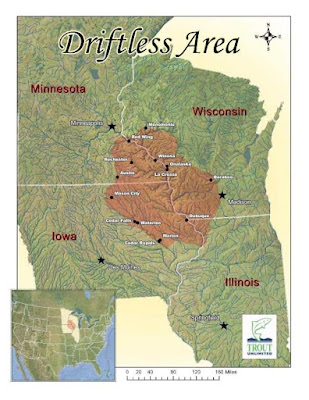
Driftless Area map
Driftless Area map

Our property is part of the Sunrise River watershed, which is part of the Lower St. Croix River watershed, which  is part of the Upper Mississippi River watershed. Across the St. Croix is the state of Wisconsin. On that side of the river, also part of the lower St. Croix River watershed, is the Kinnickinnic River watershed which, as near as I can tell, is one of the most northern watersheds of the Driftless Area, which encompasses parts of Minnesota (southeastern), Wisconsin (southwestern), Iowa (northeastern) and Illinois (northwestern).

Almost all of the time I’ve lived in Minnesota, I’ve leaned toward the wilderness of the northern part of the state and the City of Duluth, which I find a little reminiscent of my native Boston. It was only a few years ago that I learned an area such as the Driftless existed, although I have from time to time fished some of the trout streams in southeast Minnesota. Now I find myself drawn toward the Driftless, mostly due to trout fishing, food, music, and roots. Brook trout char are native to the Driftless and to New England. I’ve been a fan of Greg Brown’s for some years now. He lives in the Iowa section of the Driftless and his music is captured in Going Driftless. Spring, when it finally gets here, and summer, are looking more promising by the day.

In lieu of a standard poem today, let’s enjoy a “prose poem” by the author of Anatomy of a Fisherman.


“I fish because I love to; because I love the environs where trout are found, which are invariably beautiful, and hate the environs where crowds of people are found, which are invariably ugly; because of all the television commercials, cocktail parties, and assorted social posturing I thus escape; because, in a world where most men seem to spend their lives doing things they hate, my fishing is at once an endless source of delight and an act of small rebellion; because trout do not lie or cheat and cannot be bought or bribed or impressed by power, but respond only to quietude and humility and endless patience; because I suspect that men are going along this way for the last time, and I for one don't want to waste the trip; because mercifully there are no telephones on trout waters; because only in the woods can I find solitude without loneliness; because bourbon out of an old tin cup always tastes better out there; because maybe one day I will catch a mermaid; and, finally, not because I regard fishing as being so terribly important but because I suspect that so many of the other concerns of men are equally unimportant - and not nearly so much fun.” - Robert Traver
(John Voelker)


********************************************
Thanks for visiting. Come again when you can.
Please be kind to each other while you can.

Saturday, December 11, 2021

going with the flow

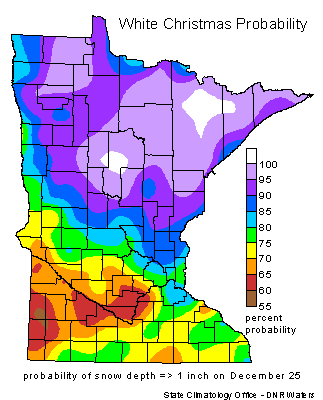
Sunshine, 32℉, 3.5 inches of snow already cleared from the drive and living about 40 miles north of where  the snowfall was 20 inches. For some of us, Christmas came early, leaving the question of whether or not we’ll have a white Christmas. Odds are in favor of it according to the MNDNR.

probability of a white Christmas

Harry the beagle has very short legs and even just several inches of snow comes uncomfortably close to his tummy. He’s having trouble adjusting to snow covering the ground where he’s expected to “do his business.” He’ll be pleased, at least for awhile, about next week’s December thaw.

The snow cover in the back yard holds deer tracks going up and  down the hill near the pear tree under which we left this year’s spent pumpkins. If we do get the melt forecast for the coming week, we’ll go take a peek and see if there are any remnants of pumpkins remaining. We expect none but have to admit that it is nice to see tracks in the snow confirming night time visitors.

As you know, melted snow becomes water. That’s a segue to something we recently read, that the federal government, particularly the Environmental Protection Agency and  the Army  Corps of Engineers, is once again revising its definition of Waters of the United States (WOTUS). Fifty years after enactment of the Clean Water Act Amendments of 1972 the legal-political-regulatory systems are still wrangling about what they cover. Don’t be surprised if you see more and more opinions expressed here about WOTUS since we sort of have a dog in this fight. We were involved in pilot programs to help clarify land use -- water quality relationships back before the 1972 amendments were passed. Maybe this circle has gone around only  to come around again.


River

by Joni Mitchell

It's coming on Christmas 
They're cutting down trees 
They're putting up reindeer 
And singing songs of joy and peace 
Oh I wish I had a river I could skate away on 

But it don't snow here 
It stays pretty green 
I'm going to make a lot of money 
Then I'm going to quit this crazy scene 
Oh I wish I had a river I could skate away on 

I wish I had a river so long 
I would teach my feet to fly 
I wish I had a river I could skate away on 
I made my baby cry

He tried hard to help me 
You know, he put me at ease 
And he loved me so naughty 
Made me weak in the knees 
Oh, I wish I had a river I could skate away on

I'm so hard to handle 
I'm selfish and I'm sad 
Now I've gone and lost the best baby 
That I ever had 
I wish I had a river I could skate away on 

Oh, I wish I had a river so long 
I would teach my feet to fly 
I wish I had a river 
I could skate away on 
I made my baby say goodbye 

It's coming on Christmas 
They're cutting down trees 
They're putting up reindeer 
And singing songs of joy and peace 
I wish I had a river I could skate away on


********************************************
Thanks for visiting. Come again when you can.
Please be kind to each other while you can.

Thursday, July 1, 2021

Home waters

Are you aware that the work "brook" has two very different meanings? They are

  1. a natural stream of water normally smaller than and often tributary to a river, and,
  2. to stand for

Synonyms for the first meaning include:

beck [British], bourn (or bourne), brooklet, burn [British], creek, gill [British], rill, rivulet, run [chiefly Midland], runlet, runnel, streamlet

And why, you are by now thinking, do we care about this? To which I answer: because I've recently rediscovered that there are reports that brook trout exist in some "streams" relatively nearby and, apropos of yesterday's "I believe I'll go fishing" assessment posted here, this drib of information is just the motivation I need to spend less time in a chair in the living room and more time in the seat of the Jeep looking for those streams, their access points and assessing their potential fishability.

is this a brook, creek, stream, rill or run?
Photo by J. Harrington

In a directly related vein, I've noticed that the British and some other cultures have many more terms for small streams than we Americans use. In fact, we have a difficult to impossible time agreeing on the relationship among brook, creek, etc. Follow this link for one example and this link for another. If, as several folks and indigenous peoples assert, language is a critical connection to our places, the lack of clear, consistent language for our  flowing waters would seem to be reflected in our treatment of them more as waste disposal systems than as sources of life and our drinking water.

In any case, I'm hoping through a search for local brook trout populations to find a version of my own home waters, a stretch of brook, creek, or river I can visit regularly and get to know intimately.


Hamlen Brook


By Richard Wilbur


At the alder-darkened brink 
Where the stream slows to a lucid jet 
I lean to the water, dinting its top with sweat, 
And see, before I can drink, 

A startled inchling trout 
Of spotted near-transparency, 
Trawling a shadow solider than he. 
He swerves now, darting out 

To where, in a flicked slew 
Of sparks and glittering silt, he weaves 
Through stream-bed rocks, disturbing foundered leaves, 
And butts then out of view 

Beneath a sliding glass 
Crazed by the skimming of a brace 
Of burnished dragon-flies across its face, 
In which deep cloudlets pass 

And a white precipice 
Of mirrored birch-trees plunges down 
Toward where the azures of the zenith drown. 
How shall I drink all this? 

Joy’s trick is to supply 
Dry lips with what can cool and slake, 
Leaving them dumbstruck also with an ache 
Nothing can satisfy.


********************************************
Thanks for visiting. Come again when you can.
Please be kind to each other while you can.

Thursday, June 17, 2021

Minnesota H2O: who's in charge?

It's been quite awhile since we've had any rain around here. From what I can read, it's much worse west and south of here. Meanwhile, many states, including Minnesota, continue to let agriculture pollute the crap (sorry, couldn't resist) into their surface and groundwaters. In Minnesota, and a number of other  states, we compound the problem by failing to adopt and apply rigorous discharge and design standards for mining activities. The last time I took a look, the Great Lakes Compact states were interpreting and applying policy kind of loosely deciding who's eligible to tap into that fresh  water resource.

who's responsible for protecting Minnesota waters
Photo by J. Harrington

Once upon a time, both Will Rogers and Mark Twain shared a sentiment about the value of buying land. Fresh water in potable, swimmable, or fishable condition is an even rarer resource. So, back in 2011, the Water Resources Center responded to a 2009 directive from the Minnesota Legislature by developing and publishing The MINNESOTA WATER SUSTAINABILITY FRAMEWORK.

The Framework identifies ten major issues that present the challenges, and solutions to those challenges, that must be addressed if water sustainability is to be achieved in Minnesota. These issues (labeled A – J) fall within the three areas that define sustainability: environmental, economic, and social. 

One of those major issues proposes a desired future described as "Governments, institutions, and communities working together to implement an overarching water sustainability policy that is aligned with all other systems policies (land use, energy, economic development, transportation, food and fiber production) through laws, ordinances, and actions that promote resilience and sustainability." The problem is that:

Minnesota’s waters are governed by hundreds of laws, regulations, rules, and ordinances involving more than 20 federal agencies, seven state agencies, and hundreds of local units of government. 

I doubt very seriously that we're much, if any, closer to the desired future proposed than at the time the Framework was drafted. In fact, what we're seeing more and more of is the Minnesota Legislature attempting to act as both the legislative and the executive branch of government. Check it's actions in regard to mining and environmental regulations; the governor's emergency powers; mutual aid support among local units of government; and, no doubt, other issues legislators find critical to their reelection (Clean Cars, anyone?).

Meanwhile, if anyone can point me toward specific legislative action taken in support of implementing the Water Sustainability Framework that body directed be prepared, I'll be pleasantly surprised. Do you remember the old advice about the time to lock the barn door? Perhaps we should require candidates for elective office to sign a pledge at least acknowledging their familiarity with that advice before they can be considered a legitimate candidate for any office.


Water


The water understands 
Civilization well; 
It wets my foot, but prettily, 
It chills my life, but wittily, 
It is not disconcerted, 
It is not broken-hearted: 
Well used, it decketh joy, 
Adorneth, doubleth joy: 
Ill used, it will destroy, 
In perfect time and measure 
With a face of golden pleasure 
Elegantly destroy.


********************************************
Thanks for visiting. Come again when you can.
Please be kind to each other while you can.

Monday, March 22, 2021

What's our clean water worth? #WorldWaterDay


Today is:    World Water Day and, at the Minnesota Legislature, it's Protect Pollinators Day. Without clean water and healthy food, we humans wouldn't be around for long. Will common sense ever become common? The graphic below is a screen capture from the Minnesota Pollution Control Ageny's Impaired Waters List map viewer. Water that  fails quality standards is red. What does it say about how much Minnesotans value clean water?

Minnesota's Impaired Waters

Meanwhile, Minnesota's regulatory agencies have had several permits, needed for unproven copper sulfate mine projects, suspended or overturned by the courts. [Full Disclosure: we'd rather support nonprofit environmental agencies than pay taxes to fund dysfunctional (regulatory capture) state "environmental protection" agencies.]

There's a current proposal to reduce existing water quality standards, which would make it easier to get a permit to discharge pollutants. Loosening standards might even make some of those red waters go away. They wouldn't be less polluted, you understand. The amount of pollution allowed before they're coded red would simply have been increased. Is that really what Minnesotans want as a "strategy  to protect the environment?" You can follow the MPCA rule-making process at this page. You can also learn what the Minnesota Center for Environmental Advocacy thinks about the proposed revisions at this page. Next election, you might want to ask if the candidate you're thinking of supporting really supports clean air and clean water and healthy Minnesotans.


Water


The water understands 
Civilization well; 
It wets my foot, but prettily, 
It chills my life, but wittily, 
It is not disconcerted, 
It is not broken-hearted: 
Well used, it decketh joy, 
Adorneth, doubleth joy: 
Ill used, it will destroy, 
In perfect time and measure 
With a face of golden pleasure 
Elegantly destroy.


********************************************
Thanks for visiting. Come again when you can.
Please be kind to each other while you can.

Wednesday, February 24, 2021

Way too little, way too late! Why?

Slightly more than a year from now, on October 18, 2022, we will observe the 50th anniversary of the Federal Water Pollution Control Act of 1972, Public Law 92-500, which became effective after the Senate, and then the House, overrode then President Nixon's veto.

National goals were stated in Title I, Section 101, including these:

 " (1) it is the national Goal that the discharge of pollutants into
 the navigable waters be eliminated by 1985;
 " (2) it is the national goal that wherever attainable, an interim
 goal of water quality which provides for the protection and
 propagation of fish, shellfish, and wildlife and provides for recrea-
 tion in and on the water be achieved by July 1,1983;
 " (3) it is the national policy that the discharge of toxic pollut-
 ants in toxic amounts be prohibited;

Follow this link to view Minnesota's draft 2020 Impaired Waters List map. According to the Star Tribune, 56% of Minnesota's waters fail to attain water quality standards. It's unnecessary to emphasize that, decades later, Minnesota, and probably all states, are far from attaining any of the goals adopted in 1972.


Sunrise River flowing towards the St. Croix
Photo by J. Harrington

If you wonder why this country, one of the richest in today's world, is failing miserably to meet its commitments on greenhouse gas reduction, adaptation measures to respond to the effects of climate breakdown, or other environmental responsibilities, you need look no further than our abysmal track record at protecting and restoring that with which we cannot live without, water
.

California is considering adopting its own version of the Clean Water Act, since an estimated 95% of that state's waters are in impaired status. Meanwhile, members of the Minnesota legislature continue to insist that our environmental requirements are "most stringent." If that's so, why haven't we attained the 1983 goal and how much longer do we expect it to take? How about a major effort to document, fifty years later, where, precisely we stand and what it will take to belatedly meet those goals. Or, Minnesota could continue to follow the lead of those bastions of progressiveness like Iowa or the Dakotas.


The River Now


Hardly a ghost left to talk with. The slavs moved on
or changed their names to something green. Greeks gave up   
old dishes and slid into repose. Runs of salmon thin   
and thin until a ripple in October might mean carp.
Huge mills bang and smoke. Day hangs thick with commerce
and my favorite home, always overgrown with roses,   
collapsed like moral advice. Tugs still pound against   
the outtide pour but real, running on some definite fuel.   
I can’t dream anything, not some lovely woman   
murdered in a shack, not saw mills going broke,
not even wild wine and a landslide though I knew both well.   
The blood still begs direction home. This river points   
the way north to the blood, the blue stars certain   
in their swing, their fix. I pass the backwash where   
the cattails still lean north, familiar grebes pop up,   
the windchill is the same. And it comes back with the odor   
of the river, some way I know the lonely sources   
of despair break down from too much love. No matter   
how this water fragments in the reeds, it rejoins   
the river and the bright bay north receives it all,   
new salmon on their way to open ocean,   
the easy tub returned.


********************************************
Thanks for visiting. Come again when you can.
Please be kind to each other while you can.